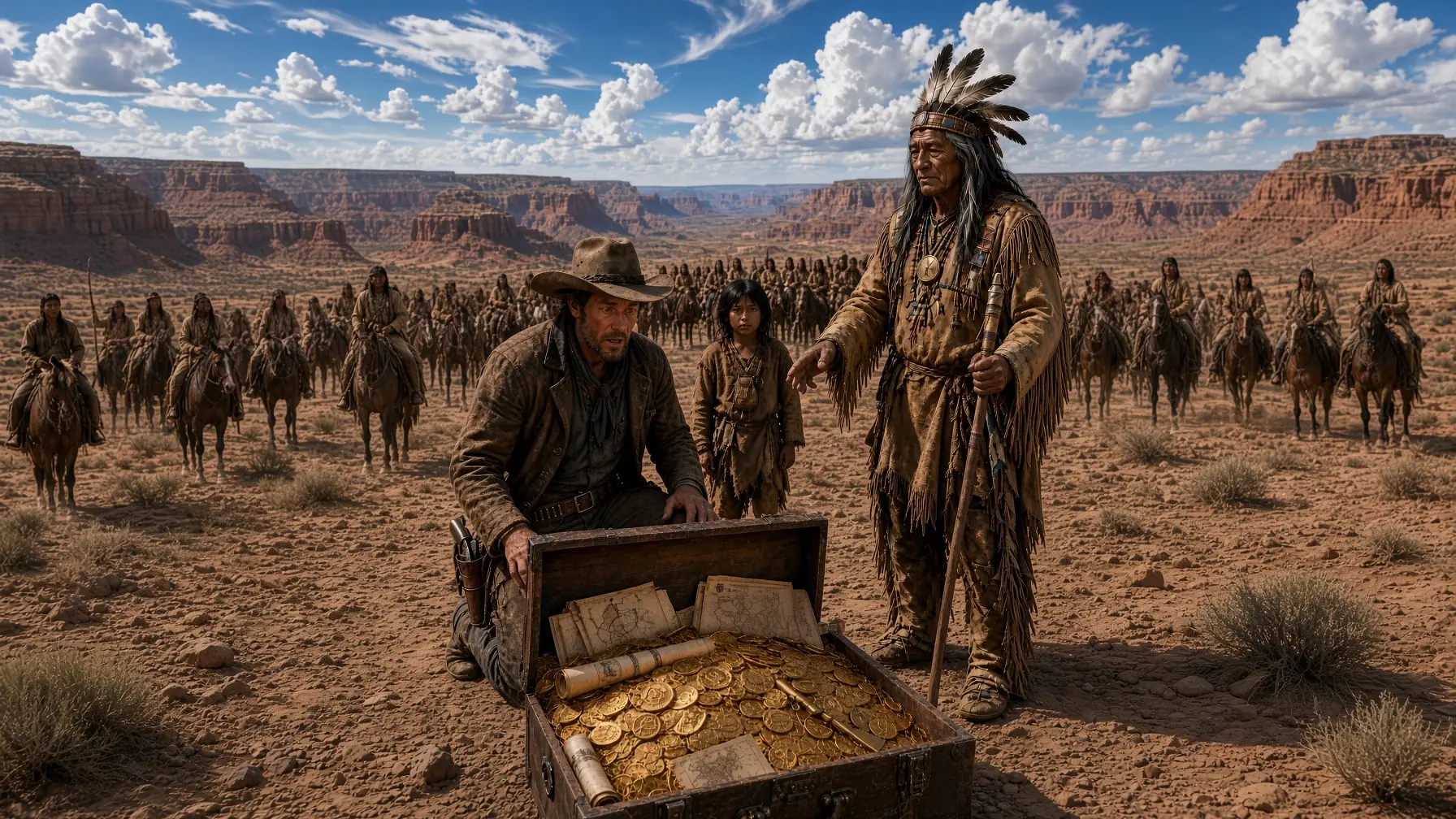
There is a kind of moment that comes only once in a man's life. A moment that lasts no more than a few seconds, but somehow contains everything he has ever believed about himself. Whether he is the person he always told himself he was, or just another man who looked away when it mattered most. Reed Calloway had that moment on a Thursday afternoon in the canyon country of New Mexico when he came around a bend in the trail and saw something that stopped the air in his lungs cold. Four armed men.
One child. And the kind of silence that means something terrible is about to happen. Reed was not a man who went looking for trouble. He had done enough of that in his younger years scouting for the army through territories that left marks on him he never quite talked about. By the time he had his own land, his own cattle, and his own four walls to sleep inside, he had made a quiet agreement with himself.
Keep your head down. Tend your herd. Let the world run its course. He was 43 years old. His wife had been gone for 6 years, and the only thing he still cared about defending was a small piece of rocky ground near the Rio Puerco that the bank had tried to take from him twice and failed.
He was a simple man living a deliberate life. And then the trail bent, and the world asked him a question he could not pretend not to hear. The boy could not have been more than 12. He was pressed back against the red canyon wall, one arm raised slightly in front of him in that instinctive human gesture that means stay back. His clothing was Apache.
His feet were bare against the stone. His dark eyes were moving fast between the four men who had fanned out in a loose half circle around him, not because he was afraid. Reed could see that clearly, but because he was counting, calculating, looking for the gap. He had the composure of someone raised to face danger without flinching, but he was still a child, and the men surrounding him were not. The one doing the talking was a wide-shouldered man named Greer.
Reed did not know his name yet, but he would learn it before the day was over. Greer worked for a land acquisition company out of Santa Fe, an outfit that dressed up its business in legal language, but operated like something considerably less polished when no lawyers were watching. The railroad wanted a survey corridor through that canyon country, and certain Apache hunting grounds sat directly in the way of where certain powerful men wanted to put tracks. The method for clearing those grounds was not always paperwork. Sometimes it was intimidation.
Sometimes it was worse. And sometimes it started with whatever member of a tribe happened to be walking alone. Reed pulled his horse to a stop at the top of the trail. From where he sat, he could see everything clearly. He could also turn around.
The men had not seen him yet. The boy had not seen him yet. There was still a version of this afternoon where Reed Calloway rode back the way he came, unseen, uninvolved, and went home to tend his cattle and eat whatever was left in his pantry, and sleep the sleep of a man who had not done anything wrong that day, because technically he had not. That version existed. It was real.
He could feel it pulling at him the way a current pulls at a man standing knee-deep in a river. He put his heels to his horse and rode down into the canyon. He came in at a walk, not a charge, which was deliberate. A man riding in hard and fast reads as panic. A man riding in at a steady walk reads as something else entirely.
It reads as a man who is not afraid. Greer turned first, hand dropping to his hip, and Reed kept his own hands visible, reins in one, the other open and resting on his thigh. "Afternoon," Reed said. His voice came out level and unhurried, which surprised even him. Greer squinted up at him.
"This doesn't concern you, friend. " "Maybe not," Reed said. He looked past Greer at the boy, then back. "But I'm going to need you to step back from that child. " The silence that followed was the kind that has weight to it. One of the other men, younger, with a restless energy and a rifle already half-raised, let out a short laugh. Greer did not laugh.
He studied Reed the way a man studies something he is trying to place, trying to figure out whether this was a real problem or a manageable one. "He's Apache," Greer said finally, as though that was a complete explanation. "I can see that," Reed said. "Step back. " What happened next was not a gunfight. There were no bodies in the dust.
No dramatic last-second draw, and the smell of powder smoke and someone falling from their saddle. What happened was considerably less cinematic, and in some ways considerably more frightening. Greer looked at Reed for a long time. He looked at the rifle across Reed's saddle. He looked at the boy, who had not moved, still pressed against the canyon wall with that steady measuring gaze.
And then Greer looked at something behind Reed, which made Reed go very still. Because when a man looks behind you that carefully, you either turn and look yourself and lose the advantage, or you trust that whatever he sees back there is not going to kill you before he does. Reed did not turn. He held Greer's eyes. Greer stepped back, one step, then two.
The other men followed with the uncertain shuffling of people who have not quite decided what they are doing. You're making a mistake. Greer said quietly. Not loud, not theatrical. Just a simple statement.
The way a man tells you the weather is going to change. I've made them before, Reed said. Greer looked at him one more time, and then the four of them walked back to their horses and rode south along the canyon floor without another word. Reed watched them until they rounded the bend and disappeared, and then he let out a breath that felt like it had been sitting in his chest for the last several minutes. He looked at the boy.
The boy looked back at him with those dark assessing eyes and said nothing at all. You hurt? Reed asked. The boy shook his head slowly. You know where your people are?
A pause. Then a careful nod in the direction of the northern ridgeline. Reed stepped down from his horse. His knees felt older than usual. He walked over to his saddle bag, pulled out a cloth-wrapped piece of dried venison and a half-full canteen, and held them both out without making a production of it.