“You don’t live around here. ID. Now.”
The words came sharp and flat, like they had been waiting for me before I even turned the corner.
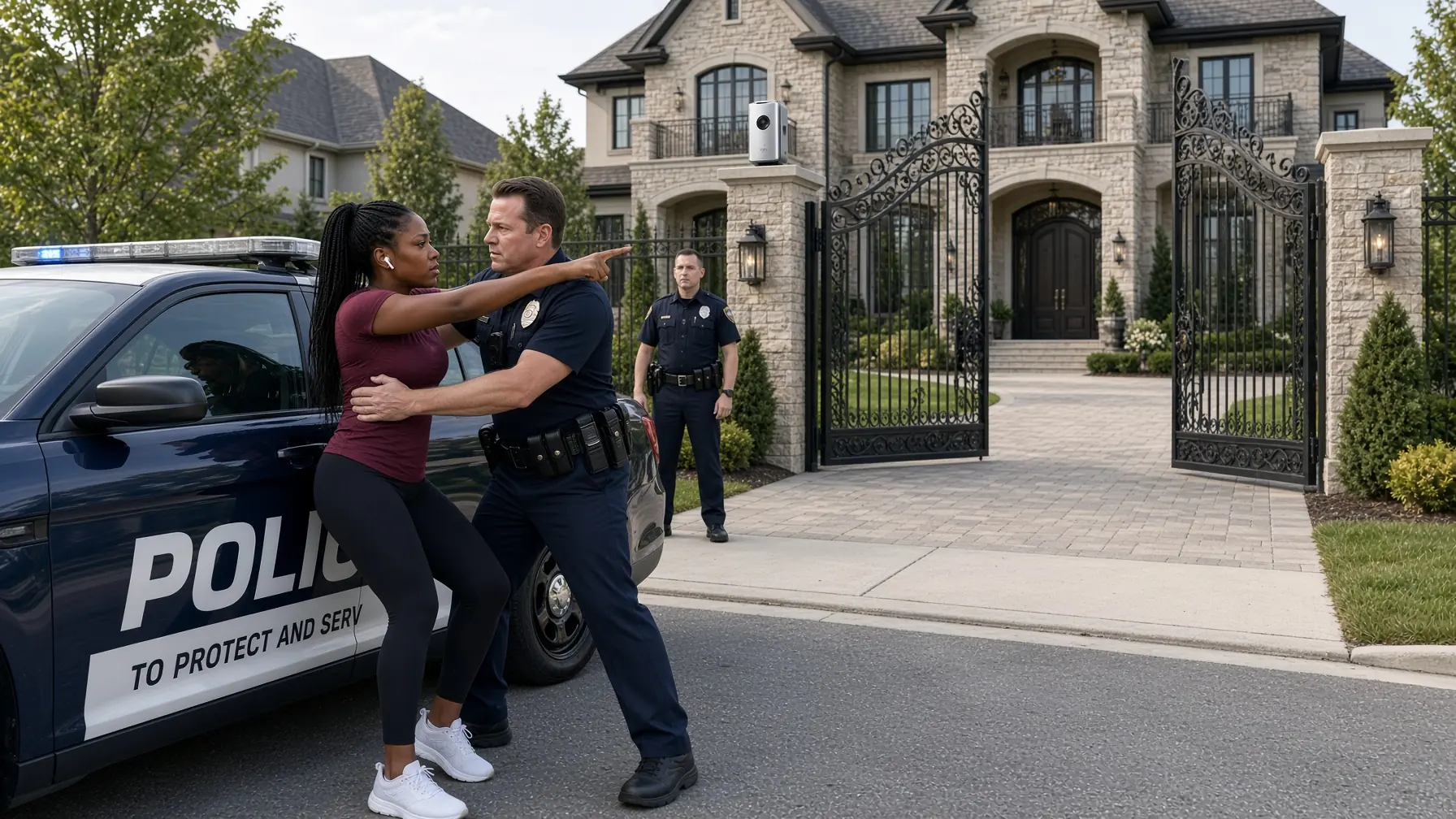
I stopped mid-stride on the quiet suburban sidewalk, one earbud still in, the other hanging loose against my shoulder after I pulled it out too fast. My breathing was steady from the run, but the irritation hit immediately—clean, familiar, and hot. It was barely past seven in the morning, and the neighborhood was still waking up under a pale gold wash of sunlight. Sprinklers clicked across manicured lawns. A dog barked once from behind a white privacy fence. Somewhere farther down the block, a garage door groaned open.
And right in front of me stood Officer Blake Turner.
White. Early forties. Thick through the chest and arms. Navy patrol uniform pressed flat and perfect. Body camera mounted center chest. One hand resting near his duty belt. The other slightly raised, already positioned like he might touch me if I gave him the wrong answer.
Behind him, angled at the curb, sat a marked police cruiser with its engine still running. Another officer stood near the passenger side, watching. Not helping. Not speaking. Just watching the way people do when they know something is going wrong but haven’t yet decided whether it is their job to stop it.
I looked at Blake once from head to toe.
Then I looked past him at the rows of expensive homes lining both sides of the street. Stone facades. iron gates. trimmed hedges so precise they looked measured by laser. The kind of neighborhood where people paid more for privacy than most families spent on their first house.
Then I looked back at him.
“I’m on a public sidewalk,” I said. “What exactly do you need my ID for?”
His jaw shifted.
That question annoyed him.
Good.
He took a step closer, eyes narrowing as he looked me over—my fitted burgundy running top, black leggings, white shoes, smartwatch, high ponytail of braids, and dark skin apparently being the part he found least compatible with the zip code.
“Because you don’t look like you belong in this neighborhood,” he said.
There it was.
Not subtle. Not clever. Not even dressed up as procedure.
Just plain.
A few houses down, a woman collecting her newspaper froze at the end of her driveway. Across the street, a landscaper paused with a leaf blower hanging limp at his side. Morning has a strange way of making public humiliation feel even brighter.
I kept my voice level.
“And what exactly does belonging look like to you, Officer?”
The second officer shifted beside the cruiser.
Turner’s face hardened. Men like him hate being asked to explain what they know sounds ugly out loud.
“Don’t play games,” he said. “We had a suspicious person call. Female matching your description, moving through the area, looking at houses. So I’m asking again. Identification.”
I almost laughed.
Looking at houses.
I had spent the last eleven months looking at those houses. Studying contracts for them. Sitting in escrow meetings because of them. Reviewing architectural plans, utility permits, and security integrations because one of them—just one—had nearly cost me everything before it became mine.
But that morning, to Blake Turner, I was not a homeowner or a resident or even a runner getting in five miles before breakfast.
I was a suspicious person in good shoes.
“I’m not showing you ID because some caller saw a Black woman jogging and got nervous,” I said.
That was when I tried to step around him.
It should have ended there.
A verbal exchange. A wrong assumption. An irritated officer watching me continue down the block while reconsidering his morning.
Instead, Blake Turner reached out and grabbed my arm.
Hard.
His fingers clamped just above my elbow with the automatic force of a man too used to getting compliance from people he had no right to control. The movement was fast enough to snap my body sideways before I could fully plant my foot.
“Hey,” I said sharply. “Take your hand off me.”
But he was already moving.
“Quit resisting!”
The words came out loud—far louder than necessary—the kind of phrase officers sometimes use not because it is true, but because saying it early helps frame everything after it.
He shoved me toward the patrol car.
My hip struck the front fender first, then my palm flattened against the warm metal to keep from going down. I heard the woman with the newspaper gasp. The landscaper took two uncertain steps closer, then stopped. The second officer pushed off the cruiser at last, finally moving, though I couldn’t yet tell whether it was to help or simply to stand nearer to the problem.
My heart slammed once against my ribs.
Not from fear.
From fury.
Because this was exactly how bad stories begin. Not with some dramatic crime. Not with obvious chaos. But with one person in authority deciding that your refusal to agree with humiliation is the same thing as resistance.
“Let go of my arm,” I said.
Blake’s grip tightened for half a second before loosening just enough to avoid looking obvious.
“Then stop fighting me.”
I turned my head and looked directly at him.
“I am not fighting you.”
That part mattered.
So I said it again, slowly.
“I. Am. Not. Fighting. You.”
The second officer had reached us now. He was younger, maybe early thirties, square-jawed, quieter in the eyes. His name tag read MASON. He looked from Blake’s hand on my arm to my face, then toward the nearby houses and the growing number of witnesses who had begun pretending not to watch.
“Blake,” he said quietly, “maybe we should just—”
But Blake cut him off without looking away from me.
“She’s refusing to identify herself.”
“I’m refusing to cooperate with nonsense,” I said.
Then I did the one thing he did not expect.
I pointed across the street.
Directly at the massive limestone house with black-framed windows, a steel-and-wood gate, and a curved drive lined with clipped boxwoods.
“Then explain why that house just unlocked for me.”
For the first time, confusion interrupted his aggression.
“What?”
I said nothing else.
I just looked at the gate.
A beat passed.