The advertisement was only twenty-six words long.
Rancher, age thirty-seven, seeks capable wife. Must cook, preserve meat, manage household, tolerate remote country and honest work. No fortune offered. Good land. Serious replies only.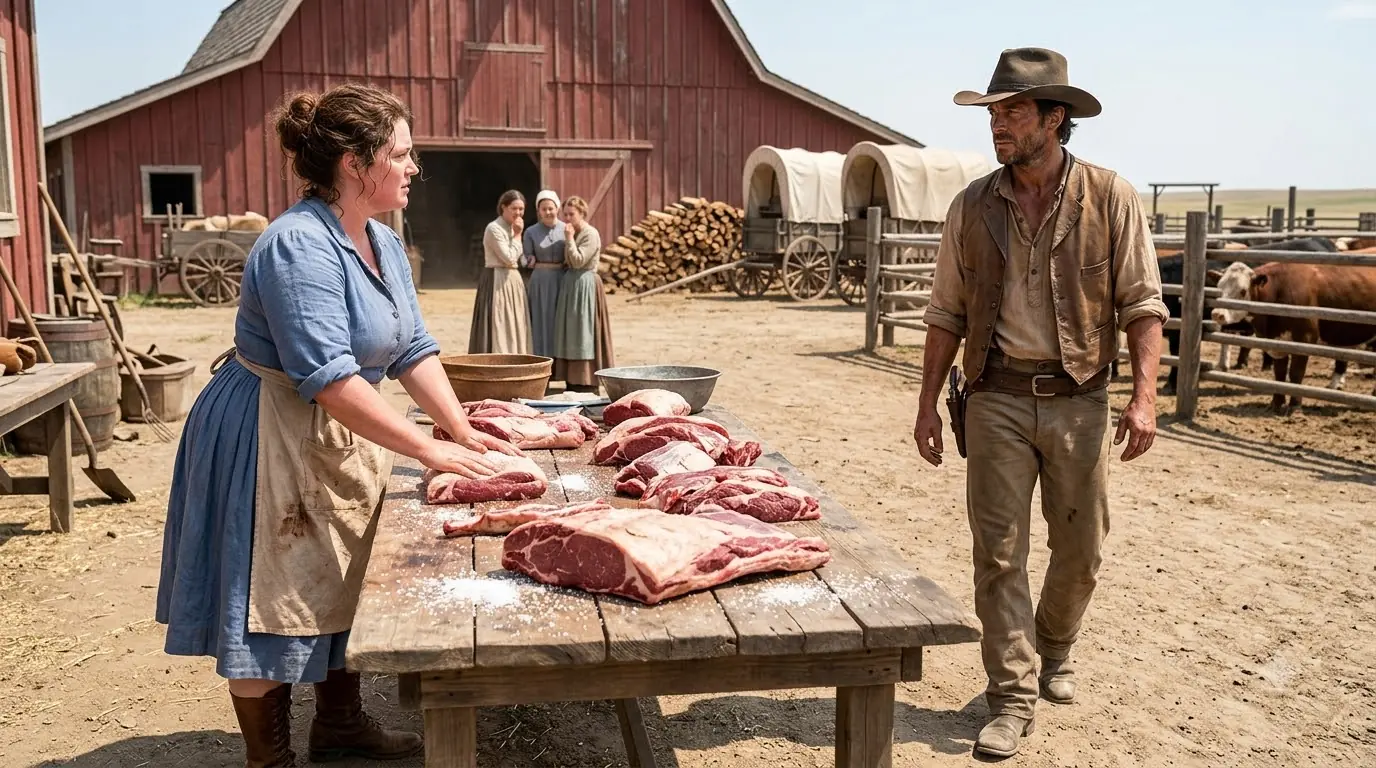
Jacob Turner read it three times before allowing the printer in Helena to set the type.
Then he nearly took it back.
“Something wrong?” the printer asked.
Jacob stared at the small slip of paper.
The whole thing felt humiliating.
He owned nearly eight hundred acres outside Millhaven, Montana Territory. He had two barns, a solid house, seventy-eight breeding cows, four good horses, one temperamental mule, and enough scars to prove he had managed all of it without asking anybody’s permission.
Yet there he stood placing an advertisement for a wife because he could raise cattle but apparently could not keep himself alive through another winter without ruining half the food in his own pantry.
“No,” Jacob finally said.
The printer smiled.
“Lonely?”
Jacob’s eyes hardened.
“Practical.”
“Of course.”
Jacob left before the man could laugh.
He told himself that was the truth.
Practical.
Nothing more.
His first wife, Mary Turner, had died six years earlier from fever. They had been married only three years. There had been no children, and after burying her beside the cottonwoods above the north pasture, Jacob had decided that whatever part of a man was supposed to look toward another marriage had died too.
For several years, ranch work made that decision easy.
Then reality became less romantic.
Jacob could cook exactly four things.
Beans.
Coffee.
Fried beef.
And biscuits hard enough to repair wagon wheels.
He could butcher cattle but wasted too much meat because his curing methods were inconsistent. He had lost nearly two hundred pounds of beef the previous winter when moisture spoiled a storage shed. He forgot laundry until every clean shirt disappeared. Accounts piled up because he preferred working cattle to examining numbers.
He could hire temporary help.
He did.
Housekeepers rarely stayed.
Turner Ranch stood fifteen miles from town and farther from gossip, comfort, and nearly every convenience respectable women were supposed to appreciate.
By thirty-seven, Jacob had accepted that he was good at ranching and poor at almost everything surrounding it.
So he placed the advertisement.
Then went home determined never to think about it again.
Three weeks later, a letter arrived.
Mr. Turner,
Your advertisement is either the most honest marriage proposal I have ever read or the least romantic. I have not yet decided which.
Jacob stopped reading.
Then started again.
My name is Abigail Mercer. I am thirty-two years old, widowed, healthy, capable of cooking considerably more than beans, and experienced in salting, smoking, drying, and preserving meat. My father operated a small butcher business in Missouri, and I worked beside him for twelve years. I can keep household accounts, sew adequately, milk badly, and ride well enough not to embarrass a horse.
Jacob’s mouth twitched.
I should also make something clear before either of us wastes postage. I am not a small woman. I never have been. If you are seeking a delicate wife who survives on tea, admires everything you say, and looks ornamental beside a piano, I recommend continuing your search.
Jacob laughed.
Actually laughed.
Alone at his kitchen table.
He read the final lines.
If, however, you genuinely require a partner willing to work and you understand that partnership means I will occasionally disagree with you, write back.
Abigail Mercer
Jacob stared at the letter for a long time.
Then looked around the kitchen.
Dirty plate.
Unwashed pan.
Ledger unopened for two weeks.
A strip of bacon hanging too close to the stove.
He picked up his pencil.
They exchanged eleven letters.
The first five were practical.
How many cattle?
What crops?
Nearest doctor?
Church?
Water?
Debt?
Children wanted?
Jacob was surprised when Abigail asked that directly.
He answered directly.
Yes, if God allows. No, if He does not. I will not marry a woman solely to produce heirs.
Her next letter came quickly.
Good answer.
By letter six, something changed.
Abigail described growing up above her father’s butcher shop.
Jacob told her how Mary died.
Abigail wrote about her own husband, Samuel Mercer, who had been kind but reckless with money and died when a wagon overturned during a storm.
She had loved him.
She also admitted marriage to him had exhausted her.
That honesty surprised Jacob.
Most widows he knew polished dead husbands into saints.
Abigail did not insult Samuel.
She simply remembered him as a human being.
Jacob respected that.
By letter eight, he began waiting for the mail.
By letter ten, he hated himself for waiting.
By letter eleven, Abigail wrote:
If we continue writing indefinitely, one of us will eventually invent virtues the other does not possess. I suggest we meet before imagination ruins us both.
Jacob agreed.
She arrived in April of 1884.
The stage stopped beside Turner Ranch shortly after noon.
Jacob stood near the gate wearing a clean shirt he had changed twice because neither looked clean enough once he put it on.
The driver climbed down.
Then Abigail appeared.
Jacob forgot every sentence he had prepared.
She was taller than he expected.
Not tall exactly, but substantial.
Full-bodied.
Broad-hipped.
Strong.
A deep blue traveling dress fitted her waist before falling heavily around her boots. Thick chestnut hair was pinned beneath a modest hat, and her fair face carried the kind of nervous determination people wore when they intended to survive embarrassment by refusing to admit they felt it.
She looked toward Jacob.
He stared one second too long.
Abigail noticed.
Of course she did.
“You must be Jacob.”
“Yes.”
“I was afraid you might be the mule.”
Jacob blinked.
She nodded toward the animal behind him.
“He looks judgmental.”
Jacob looked back.
“His name’s Bishop.”
“Why?”
“Because he objects to everything.”
Abigail smiled.
The tension broke.
Jacob stepped toward her suitcase.
“I can carry that.”
“So can I.”
“I didn’t say you couldn’t.”
She studied him.
Then released the handle.
“Good answer.”
He carried it toward the house.
Halfway there, Abigail stopped.
Jacob turned.
She was looking across the ranch.
Barn.
Pens.
Cattle.
Mountains beyond.
The land was still brown from winter, but patches of green were beginning along the creek.
“What?” he asked.
“It’s bigger than I imagined.”
“Disappointed?”
“No.”
“Afraid?”
Abigail looked toward him.
“Yes.”
Jacob appreciated that more than false courage.
“So am I.”
She smiled faintly.
“Another good answer.”
They married eight days later.
Not because they fell instantly in love.
They did not.
Because they had agreed to try.
The ceremony happened in Millhaven’s small church with twelve witnesses, three of whom attended primarily because the town had spent weeks speculating about what kind of woman would answer Jacob Turner’s advertisement.
Several women whispered when Abigail entered.
Jacob heard.
He turned.
Looked directly at them.
The whispering stopped.
Abigail noticed.
Said nothing.
After the ceremony, Jacob helped her into the wagon.
She looked at him.
“You didn’t need to glare at those women.”
“Yes, I did.”
“I’ve heard comments about my size since I was twelve.”
“That doesn’t make them acceptable.”
Abigail stared at him.
Then looked forward.
“Thank you.”
Jacob nodded.
Nothing more.
But that evening, lying separately because neither wanted to rush intimacy simply because a preacher had spoken words over them, Abigail thought about that moment longer than she expected.
Marriage began awkwardly.
Jacob woke before dawn.
Abigail did not.
He considered sunrise late.
She considered anyone speaking before coffee hostile.
They argued about storage.
Jacob kept tools indoors.
Abigail moved them.
He moved them back.
She moved them again.
Eventually he built a tool shelf outside because he realized she would win through endurance alone.
Abigail reorganized the pantry.
Jacob could no longer find anything.
“Where’s salt?”
“Left shelf.”
“Used to be right.”
“Right side gets damp.”
“I knew where it was.”
“You know where it is now.”
“This house made sense before you arrived.”
Abigail looked around.
“No.”
“It merely reflected your confusion.”
Jacob stared.
Then laughed.
That became easier with her.
Laughing.
The first real crisis came after spring butchering.
Jacob prepared several cuts for storage using his usual method.
Abigail watched.
“You’re wasting salt.”
He kept rubbing.
“No.”
“Yes.”
“I’ve done this twelve years.”
“Poorly.”
Jacob stopped.
She stood across the table, sleeves rolled, apron tied firmly around her waist.
“What exactly am I doing wrong?”
“Salt distribution.”
“It’s covered.”
“Surface isn’t enough.”
Jacob looked irritated.
Abigail picked up one thick cut.
“You’re curing meat like every piece is identical.”
“It’s beef.”
“Thickness varies.”
“Fat varies.”
“Temperature matters.”
“Humidity matters.”
Jacob folded his arms.
“You sound like your father.”
“He stayed in business thirty years.”
“My method works.”
Abigail pointed toward the storage shed.
“You lost nearly two hundred pounds last winter.”
Jacob’s mouth closed.
He hated when she used facts.
Abigail continued.
“Let me do half.”
“And if yours spoils?”
“My fault.”
“If mine spoils?”
“You admit I’m right.”
Jacob stared.
“That arrangement seems unfair.”