Diane Kesler locked me out of my own field and then billed me for standing at the gate.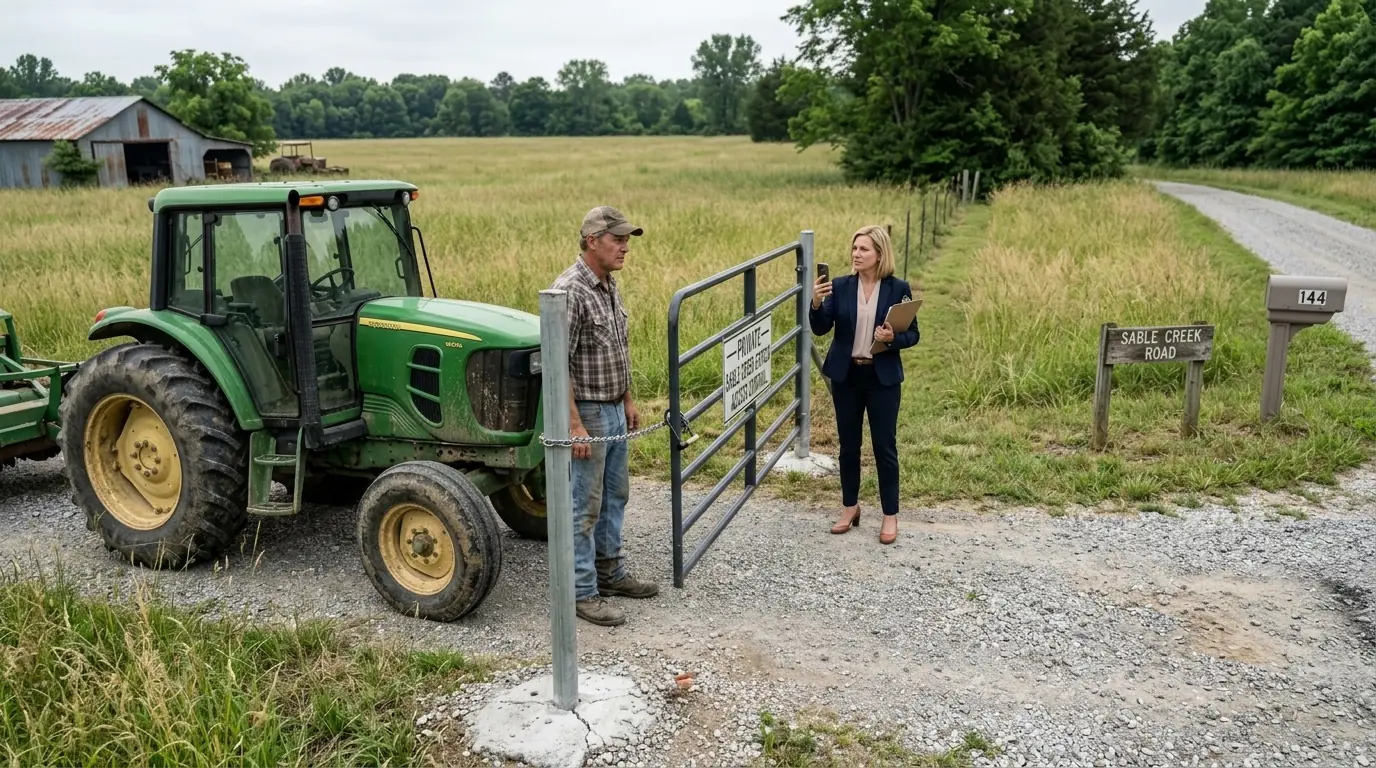
Steel posts, concrete footings, a U-lock, and a sign bolted across it that said "Private: Sable Creek Estates Access Control." That gate sat on Ashford Lane on ground deeded to my family since 1961. And behind it were 6.2 acres of hay that hadn't been cut in a year.
60 years my family cut that field. Then a woman with a clipboard decided we didn't.
I had the chain around the post when her car pulled up. She got out with her phone already recording—no hurry, no nerves.
"Get off the equipment, Brad. You don't own access; you own dirt. Touch that gate and I'll have you arrested before lunch."
"It's my land."
"It's my community. Every second of this is costing you money."
"Then start counting."
The chain went tight. The steel screamed and the front post leaned over hard. Then the sound changed. Concrete and packed ground breaks dry; this came up wet. The footing rolled out of the hole and something came up with it: black plastic, dirt the color of rust, and a smell rising off the open ground, sweet and sharp like a battery run hot.
Diane stopped recording.
14 months before that morning, I still thought Diane Kesler was just a nuisance. Here's the part she never understood and the part that ended up mattering more than anything else: I own two things in Sable Creek.
Lot 22 is the house—brick ranch, quarter acre, inside the association. And yes, I paid my dues and cut my grass at the height they wanted.
Parcel 1104-B is different. That's 6.2 acres of hay ground and the gravel lane that runs to it. Separate deed, separate history.
When the developer platted Sable Creek, my father refused to sell the field, and the county marked it right there on the recorded plat: "Excepted parcel. Not in the association. Never was."
Diane knew that. Everyone on that board knew that. It just stopped being convenient.
My father died 3 years ago. He was on that tractor at 79, which is a stupid thing to be doing at 79, and I told him so, and he did it anyway. The last thing he asked me for wasn't money or a promise about the house; it was the field: "Don't let it go to brush."
So, I cut it. Two cuttings a year sold to a couple of horse barns off County Road 9. It never made me real money; it made me a June and an August. It made me somebody's son still doing a thing his father did.
Ashford Lane runs 380 yards of gravel from the county road back to that field. There's exactly one spot wide enough to unload a tractor off a trailer, and that's the apron at the head of the lane, right where it meets the pavement. One spot. Remember that.
Now, the part I didn't see coming because I wasn't looking for it.
That April, the association tore out the old clubhouse and the maintenance shed behind it. Both were full of the kind of things nobody thinks about until somebody has to haul them away: cracked pool chemical drums, floor tile that predated anybody's caution about floor tile, drained motor oil in five-gallon buckets.
Diane ran that project herself. She stood up at the spring meeting and said she'd found a way to bring it in under budget, and 30 people applauded her. I applauded, too. I was standing in the back with a paper cup of coffee, thinking about hay.
In May, I left the state for 3 weeks to help my sister empty our aunt's house. I mention it because the dates ended up mattering. I was gone from the 6th of May. When I got back on the 2nd of June, the apron at the head of my lane had new gravel on it. Not patched—new, graded flat and smooth edge to edge, better than that apron had looked in 20 years.
I stood there with my truck door open trying to work out who'd done me a favor. Diane told me at the mailboxes. She was pleasant about it; that's the part I keep coming back to.
"The board resurfaced it," she said. "Consider it a gift."
I said, "Thank you." I actually said, "Thank you."
August was wet—3 days of rain—and afterward there was standing water in the low ditch beside the apron. And the water had a color to it: orange, thin, sitting on top like film on cold soup. There was a smell, too, faint, that I couldn't place and didn't like. I've moved enough dirt in my life to know that iron in the soil can do that. So I told myself "iron in the soil," and I went back to my hay. And I'd give a lot now to have that week back.
But I did one thing right. On the 2nd of September, I sent the association a certified letter: "Orange discharge in the ditch at the head of Ashford Lane. Unidentified odor. Please advise."
Diane signed for it on the 5th. Nobody advised. Nobody called. Nobody came out and looked.