You know that moment when someone's audacity is so staggering you almost have to admire it? Almost.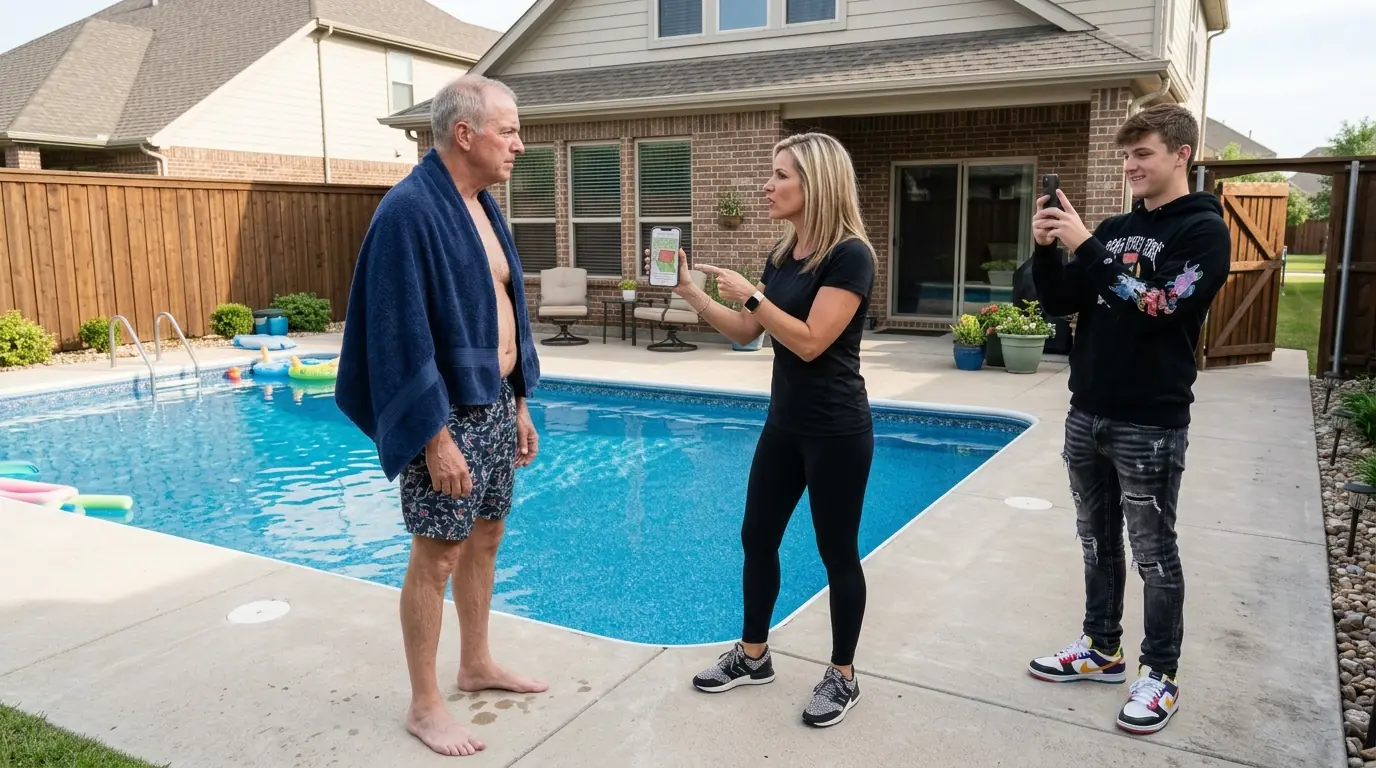
I was floating in my pool on a Saturday afternoon, cold beer in hand, enjoying the kind of peace you only get after a brutal week at work. The sun was beating down, the water was perfect, and life was good.
That's when I heard it: the screech of expensive sneakers on concrete and a voice dripping with entitlement.
"Hey, old man. You need to get out now."
I opened one eye to see a teenager standing at the edge of my pool, arms crossed, looking at me like I was the hired help who'd forgotten his place. This kid, maybe seventeen, designer everything, had the kind of smirk that said he'd never heard the word "no" in his entire life.
"This is HOA property," he announced. "My mom runs this neighborhood, so unless you want problems, I suggest you leave."
I almost laughed. If only this entitled brat knew who he was talking to.
Let me back up and tell you how I ended up in this absurd situation.
Six months ago, I moved into Willowbrook Estates, one of those picture-perfect suburban neighborhoods where every lawn is manicured within an inch of its life and the HOA rules are thicker than a phone book. I'd just been elected to a position that required me to relocate to this county, and this place seemed ideal: quiet, safe, good property value. What I didn't know was that I was moving into a dictatorship disguised as a homeowners association.
My first week there, I met Karen Mitchell. She showed up at my door on day three with a basket of muffins and a smile that didn't quite reach her eyes. Karen was the kind of woman who wore her authority like designer jewelry: expensive, obvious, and meant to intimidate. Blonde highlights that cost more than most people's car payments, yoga pants that probably had a three-figure price tag, and an expression that said she was always looking for someone to correct.
"Welcome to the neighborhood," she'd said, her voice sugary sweet. "I'm Karen, the HOA president. Just wanted to make sure you received your welcome packet with all our community guidelines."
I had received it—all forty-seven pages of it.
"I noticed your moving truck blocked the Hendersons' driveway for about twenty minutes yesterday," she continued, that smile never wavering. "Just a friendly reminder that we have very strict parking regulations. I'd hate for you to receive a citation on your first week."
A citation for a moving truck that was temporarily parked while unloading my entire life.
"I'll keep that in mind," I'd said, keeping my tone neutral.
Years in my profession had taught me to read people, and I was reading Karen loud and clear: control freak, power-hungry, the type who needed to establish dominance immediately.
What I didn't mention to her, what I didn't mention to anyone, was my actual job. I'd learned early in my career that telling people what I did for a living changed how they acted around me. I wanted to be just another neighbor, not someone people felt they had to perform for, so I kept it vague.
"Public service," I'd say if anyone asked. "County work."
Technically true. That decision would turn out to be both my biggest mistake and my greatest advantage.
Karen's son, Brandon, I met about a week later. He was seventeen, drove a BMW his parents had gifted him for getting a C-plus average, and had apparently been raised to believe that rules were suggestions for other people.
I first encountered him when his music was rattling my windows at two in the morning on a Tuesday. I'd gone over, knocked politely, and asked if he could turn it down.
Brandon had looked me up and down like I was something he'd scraped off his shoe. "Dude, it's not even that late," he'd said, not moving to lower the volume. "Besides, my mom's the HOA president. We can do whatever we want."
That phrase: We can do whatever we want. I'd hear it a lot over the next few months.
The thing about the Mitchell family was that they'd weaponized the HOA into their personal enforcement agency. Karen had been president for three years, and in that time, she'd stacked the board with people who either owed her favors or were too intimidated to challenge her. Every meeting was a performance where Karen decided who was in compliance and who wasn't, based entirely on whether she liked you.
Mrs. Patterson, the elderly woman three doors down, had been fined $200 because her garden gnomes violated the aesthetic standards outlined in Section 14.3 of the HOA bylaws. Never mind that those gnomes had been there for fifteen years before Karen took power. When Mrs. Patterson tried to protest, Karen threatened daily inspections of her property until she found more violations.
The Johnsons, a young couple with a newborn, got cited because their car, a 10-year-old Honda, was deemed "unsightly and lowering property values." Karen had actually measured the car's parking position and found it was three inches over the designated spot line. Three inches. The fine was $500.
And Brandon? Brandon was learning from the master. He parked his BMW across two spaces regularly. He threw parties that went until dawn. He'd borrowed Mr. Chen's lawn mower without asking and returned it broken, then denied ever touching it. When confronted, Karen would appear like a designer-clad dragon, breathing fire about harassment of her family and threatening legal action.
The neighborhood lived in fear. I watched it happen. People would see Karen coming and suddenly remember urgent errands. They'd agree to her absurd demands: repainting houses in approved colors, removing basketball hoops, taking down Christmas decorations exactly on January 2nd—just to avoid becoming her next target.
I tried to stay neutral, keep my head down. My job was demanding enough without neighborhood drama. But I noticed things: the way conversation stopped when Karen walked by, the exhaustion in people's faces when they talked about the latest HOA decree, the quiet resignation of a community that had surrendered to tyranny.
I had a few more run-ins with Brandon over those months. He'd rev his engine at 6:00 in the morning—deliberately, it seemed. He'd let his friends park in front of my driveway. Once, I came home to find beer cans in my yard from a party that had spilled over from his place. Each time, I stayed calm, documented it, made polite requests.
But Brandon's attitude got worse. He could sense I wasn't afraid of his mother, and that seemed to enrage him. Most people in this neighborhood trembled at the Mitchell name. I didn't. That made me a problem.
Karen tried different tactics with me: surprise inspections where she'd show up with a clipboard searching for violations, letters about my grass being a quarter-inch too long, complaints about my truck—the vehicle I used for work—being "commercial in nature" and therefore banned under HOA rules. I complied when the rules were legitimate, ignored her when they weren't, and I never, not once, told her what I actually did for a living. That restraint would prove very valuable.
By month six, I'd seen enough. The Mitchells weren't just annoying; they were operating what amounted to a protection racket: comply with Karen's whims or face endless harassment and fines; let Brandon do whatever he wanted or Karen would find a way to make your life miserable.
What they didn't know was that I'd been collecting evidence the whole time: photos, videos, documented incidents, witness statements that people gave me privately, too afraid to speak publicly. I wasn't just a neighbor anymore. I was building a case.
And then came that Saturday. That beautiful, peaceful Saturday when Brandon decided to escalate from nuisance to direct confrontation. When he stood at my pool—my pool on my property—and ordered me to leave. That's when I knew it was time to stop being quiet.