The first thing Rachel Keene noticed was that the cable was ugly.
Not dangerous.
Not blocking a sidewalk.
Not hanging low enough for a child to reach.
Ugly.
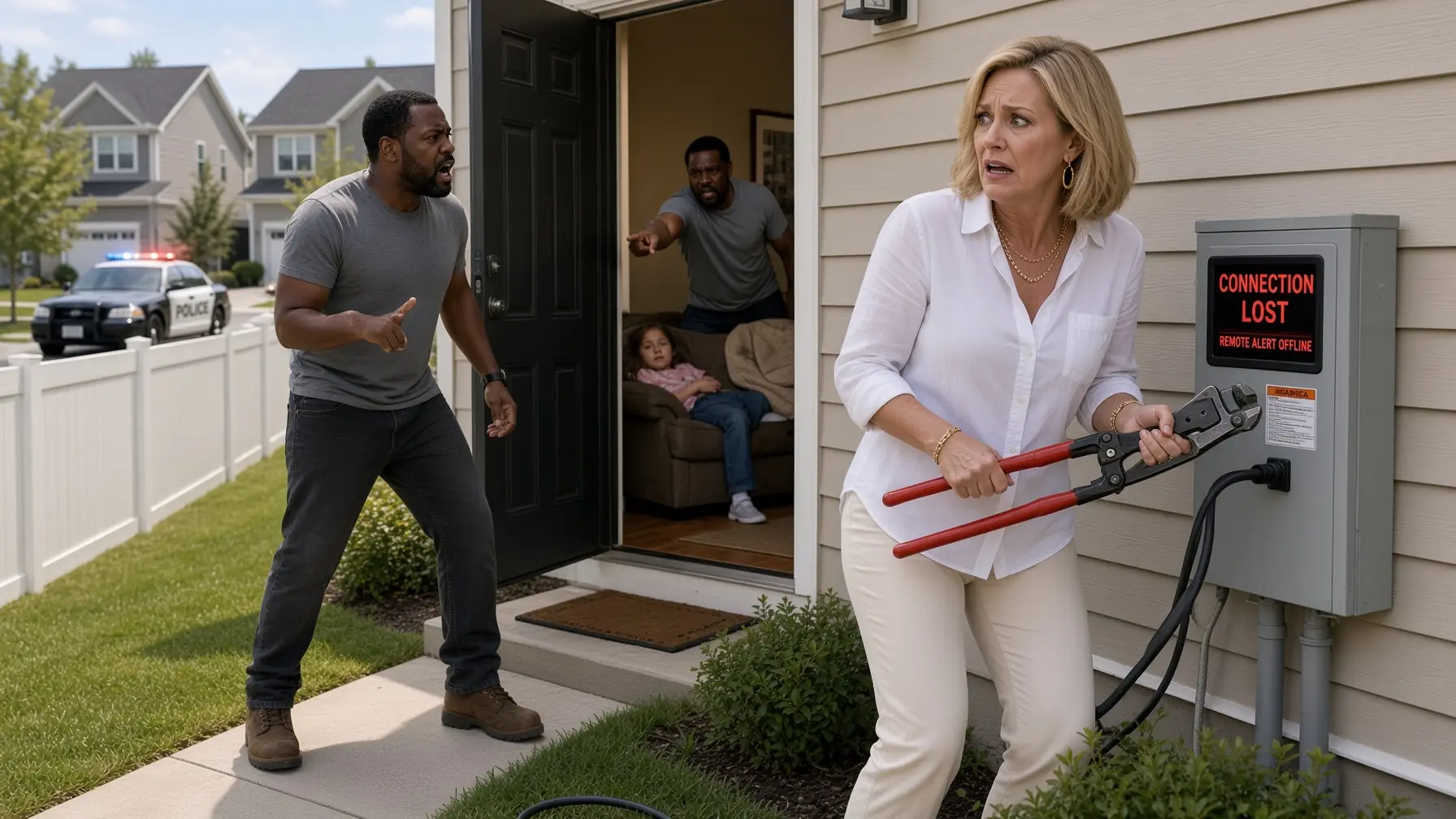
A narrow white communications line ran from the utility box beside Daniel Foster’s garage, climbed six feet along the brick, then disappeared through a weatherproof conduit into the house.
Against the dark red siding of 118 Hawthorne Ridge, it was visible from the street.
And Rachel Keene hated visible things she had not approved.
She stood on the sidewalk that Tuesday morning wearing white tennis shoes, pressed khaki pants, and the navy polo shirt she wore whenever she wanted neighbors to remember she was president of the Hawthorne Ridge Homeowners Association.
Her clipboard was tucked beneath one arm.
Beside her stood Carl Benton, the HOA’s part-time maintenance contractor.
Rachel pointed.
“There.”
Carl looked at the cable.
“What about it?”
“It wasn’t there last month.”
“Okay.”
“It violates exterior appearance standards.”
Carl scratched his beard.
“Looks like internet.”
“It looks like a wire attached to the front-facing elevation without architectural approval.”
Carl stared at her.
The cable was on the side of the garage.
Barely visible unless somebody was searching for it.
“Rachel.”
“What?”
“You called me out here for that?”
She looked offended.
“That is exactly the attitude that destroys property values.”
Carl glanced around the subdivision.
Forty-seven homes.
Trimmed lawns.
Matching mailboxes.
Maple trees planted at identical intervals.
A fountain at the entrance that had not worked correctly in six years.
“Property values seem alive.”
“That isn’t the point.”
Rachel walked toward Daniel’s driveway.
A small laminated tag was attached beside the conduit.
AUTHORIZED MEDICAL COMMUNICATION LINE — DO NOT DISCONNECT
Rachel stopped.
Carl read it too.
“That seems important.”
Rachel leaned closer.
“It looks homemade.”
“It says medical.”
“People put labels on everything.”
Carl stepped back.
“I’m not touching it.”
Rachel turned.
“You’re the maintenance contractor.”
“I maintain common property.”
“You enforce association standards.”
“No. You write letters. I replace broken gate hinges.”
Her jaw tightened.
“I instructed Mr. Foster twice to correct this.”
“Then send him another letter.”
“He ignored the first two.”
Carl looked at the house.
Daniel’s pickup was gone.
“No one home?”
“His vehicle isn’t here.”
“Then definitely no.”
Rachel folded her arms.
“He has been given adequate notice.”
Carl shook his head.
“I’m leaving.”
He turned toward his truck.
Rachel called after him.
“If you refuse to enforce the board’s directives, I’ll find someone who will.”
Carl opened his door.
“That’s fine.”
He looked back toward the cable.
“But if you cut something labeled medical, you might want to make sure your attorney is available.”
Rachel watched him drive away.
Then looked at the white cable again.
For six years, nobody in Hawthorne Ridge had challenged Rachel Keene successfully.
People argued.
Complained.
Called her controlling.
One man once printed T-shirts that said I SURVIVED THE HAWTHORNE RIDGE MULCH GUIDELINES.
But eventually they complied.
Because Rachel had learned that persistence usually defeated resistance.
Another letter.
Another fine.
Another violation notice.
Another photograph.
Eventually, people became too tired to fight over trash cans, basketball hoops, decorative flags, or whether a garden shed was technically four inches too tall.
Daniel Foster had not become tired.
That was what bothered her.
Three weeks earlier, Rachel sent him the first violation notice.
UNAPPROVED EXTERIOR TELECOMMUNICATIONS EQUIPMENT.
Daniel replied that afternoon.
His response was short.
Professional.
The line had been installed by a licensed telecommunications contractor as part of a home medical monitoring system for his daughter.
It needed to remain exactly where the installer placed it until the provider could reroute it.
He attached documentation from the medical-equipment company and asked that the HOA treat the installation as an accommodation.
Rachel replied:
The Association cannot permit every homeowner to bypass standards based on individual convenience.
Daniel answered:
This is not convenience. Please do not touch the line.
Rachel sent a fine.
Daniel disputed it.
She doubled it.
He requested a hearing.
The board’s next meeting was nineteen days away.
Rachel decided nineteen days was too long.
At 10:16 that Tuesday morning, she returned to her SUV.
Opened the rear compartment.
Removed a pair of heavy garden shears.
And walked back toward Daniel Foster’s garage.
She did not cut the cable immediately.
She took three photographs first.
One wide.
One close.
One showing the line against the brick.
Evidence.
Then she placed the shears around the cable.
The blades closed.
There was a soft plastic snap.
Nothing sparked.
Nothing exploded.
The cable simply fell against the wall.
Rachel stepped back.
“Fixed.”
She photographed the result.
Then drove away.
Inside the house, a small blue light on a medical communications hub turned amber.
Then red.
Upstairs, beside the bed of nine-year-old Lily Foster, a cardiac and oxygen monitor continued operating on wall power and battery backup.
The monitor itself did not stop.
Its local alarms still worked.
But the home hub lost its primary broadband connection.
Normally, that hub transmitted Lily’s overnight oxygen saturation, heart rate, and rhythm events to a pediatric monitoring service.
If certain thresholds were crossed, the system alerted Daniel’s phone and the hospital’s remote monitoring team.
There was supposed to be a cellular backup.
That backup modem had failed six days earlier.
A replacement had already been ordered.
Until it arrived, the broadband line was the only path carrying Lily’s remote alerts outside the house.
Daniel knew that.
The medical provider knew that.
Rachel Keene had been told in writing not to touch the line.
At 10:18, the monitoring center recorded:
HOME HUB OFFLINE.
At 10:21, an automated message was sent to Daniel.
He did not see it.
He was inside a hardware store across town buying replacement fittings for a leaking kitchen faucet.
At 10:26, the monitoring center called.
Daniel’s phone was on silent because he had been speaking with the store manager.
At 10:32, they called again.
This time he answered.
“Daniel Foster?”
“Yes.”
“This is Pediatric Remote Monitoring. Lily’s home hub has lost connectivity.”
Daniel stopped walking.
“What?”
“Her local device may still be operating, but we’re no longer receiving telemetry.”
“When?”
“About fourteen minutes ago.”
Daniel abandoned his cart.
“I’m heading home.”
“Can someone check the equipment sooner?”
“My neighbor has a key.”
Daniel called Martha Bell across the street.
Sixty-eight.
Retired schoolteacher.
The person Lily trusted almost as much as her father.
Martha answered on the second ring.
“Daniel?”
“Can you check Lily’s monitor hub?”
“What’s wrong?”
“Internet connection dropped. She’s at school, but I need to know what happened.”
“I’m going.”
Five minutes later, Martha stood beside Daniel’s garage.
She saw the cable hanging loose.
Then she saw something else.