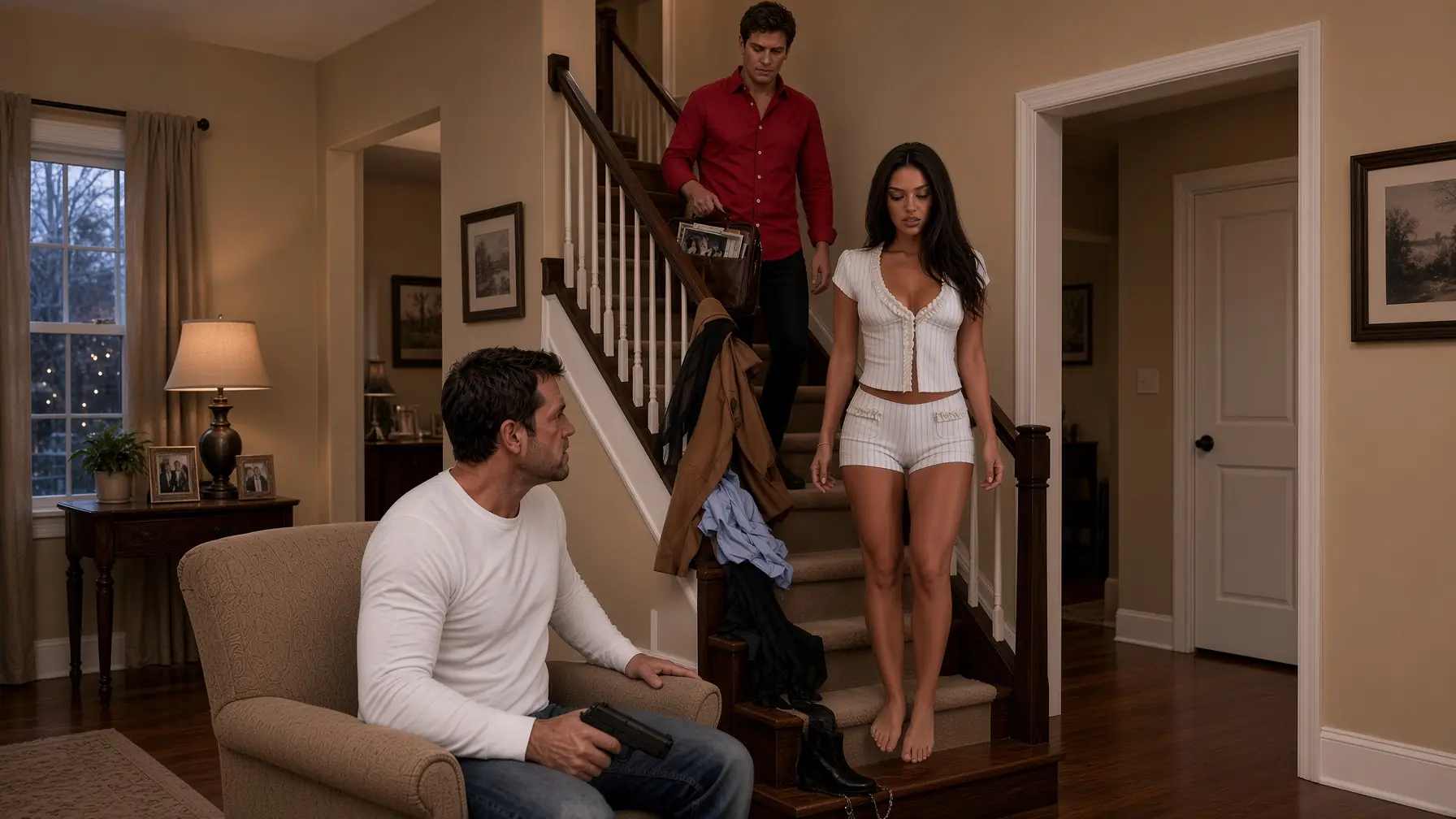
I came home early because I wanted to surprise my wife. That was all it was, nothing dramatic, nothing worth remembering under normal circumstances. A client meeting in Boulder ended almost two hours ahead of schedule, the afternoon rain had thinned to a mist, and I found myself driving past the bakery where Hannah always bought almond-pear pastries whenever she had a terrible week. I bought three, tied inside one of those ridiculous cream-colored boxes with twine she loved.
The drive back to our neighborhood outside Loveland took less than forty minutes. By then the clouds had begun separating, leaving strips of pale gold over the foothills, and I remember thinking it might actually be a nice evening. Hannah and I had barely sat down together all week between her appointments, my travel schedule, and the strange tiredness she kept blaming on work. I planned to make coffee, put the pastries on plates, and ask her to forget everything else for an hour.
Our porch light was on when I pulled into the driveway. It was barely four-thirty, and Hannah never turned that light on before sunset because she complained the bulb attracted moths. I noticed it, but not enough to feel afraid. The thing that truly stopped me was the front door sitting half an inch from the frame.
It was not open exactly. The lock had not been broken, and there was no damage around the knob, but the latch had not caught. I stood on the porch holding the bakery box and stared at that thin dark line between the door and the frame. Then I called, “Hannah?”
No answer came. I nudged the door inward with my shoe and stepped into the foyer. The house smelled like wet air, cedar from the candle Hannah had burned that morning, and something sharp underneath it that I could not identify. A second later, I saw her coat on the floor.
It was the camel-colored wool coat she wore to medical appointments. One sleeve had folded beneath it, and a button lay several inches away beside the entry rug. A black ankle boot rested near the bottom of the staircase, turned onto its side as if it had been kicked or pulled off. Then I saw the clothes going up the stairs.
A pale-blue blouse lay on the fourth step. Hannah’s dark skirt had caught against one spindle farther up, and one stocking hung across the banister. Near the landing was the silver necklace I had given her on our tenth anniversary, its chain stretched open like it had been ripped loose.
I stopped breathing for a second. The pastry box suddenly felt absurd in my hands. Somewhere outside, a lawn service truck backed up with a distant electronic beep, and our refrigerator hummed from the kitchen as though nothing inside the house had changed. All of those ordinary sounds made the staircase look worse.
“Hannah?” I called again. This time my voice was louder. Still nothing.
Then a man answered from upstairs.
“Don’t come up yet, Caleb.”
I froze.
He knew my name.
That detail struck before anything else did. Not the fact that another man was on the second floor of my house, not my wife’s clothes on the stairs, not the bedroom door I could barely see from below. A stranger knew exactly who I was.
“Who the hell are you?” I shouted. The man did not answer immediately.
Then Hannah spoke from the hallway.
“Caleb, please just listen before you come up.”
There are moments when the human mind becomes cruelly efficient. It takes ten pieces of incomplete information and builds the ugliest possible answer because ugliness feels safer than uncertainty. I saw her clothes, heard a man, heard my wife asking me not to come upstairs, and suddenly twelve years of marriage rearranged themselves into a story I had never imagined needing.
I set the pastry box on the entry table. Slowly. Carefully.
If I threw it, I thought, then something inside me would become real before I knew whether it deserved to be.
“Hannah,” I said. “Come downstairs.”
“I can’t right now.” Her voice shook.
The man answered next. “She can, but you need to understand something first.”
I laughed once. It did not sound like me.
“You’re standing upstairs with my wife and telling me what I need to understand?”
I stepped onto the first stair.
The bedroom door opened.
Hannah appeared in the hallway wearing my old gray robe. Her hair was loose, one side of her face marked with a faint red scrape near the cheekbone, and her eyes were swollen from crying. She looked terrified, but not in the way I expected a guilty person to look.
Behind her stood a tall man around fifty with gray beginning at his temples and a scar running down one side of his chin. He wore a dark raincoat and held a weathered leather case in his right hand. His expression was cautious, almost tired, and there was no embarrassment anywhere in it.
That made me angrier.
“Caleb,” Hannah said, “this is Adrian Vale.”
The name meant nothing to me.
Adrian shifted one step forward. “I’m not here because of Hannah.”
I stared at my wife’s robe, the half-open bedroom door, and the stranger behind her. “You might want to rethink that sentence.”
Hannah began crying. Not loudly, not theatrically, just tears slipping down her face while she gripped the robe closed at the neck. “I was changing when he arrived,” she said.
“You let him upstairs while you were changing?” I asked.
“No.” Hannah shook her head. “He came to the back door and said he knew my father.”
“Your father has been dead eleven years.”
“I know.” She looked toward Adrian. “That’s why I opened it.”
Adrian put the leather case on the small table at the top of the stairs. “My father has been dead thirty-one years.”
Something about the way he said it slowed me down. Not because I trusted him. I simply heard the weight in his voice, the kind of weight people usually cannot manufacture quickly enough when confronted.
He opened the case.
Inside were old photographs wrapped in wax paper, several legal documents, a tarnished brass locket, a mini cassette, a child’s hospital wristband, and a folded newspaper clipping yellowed almost brown around the edges. My anger did not disappear, but it lost its footing. None of those objects belonged in the story I had built.
Adrian picked up one photograph.
A little girl sat on a wooden porch beside a boy maybe five years old. The girl had dark curly hair, and the boy held a carved wooden fox. Behind them stood mountains and a white farmhouse I had never seen.
I almost looked away.
Then I noticed the boy’s left hand.
His ring finger bent slightly inward at the middle joint.
Mine did too.
My parents had always said I damaged it in a door accident before kindergarten, something I could not remember. The finger had never straightened completely.
Adrian watched my face.
“That boy is you.”
I stared at him.
“No.”
Hannah took one step toward me. “Caleb—”
“No.” I looked at Adrian. “You don’t know me.”
He turned the photograph over.
Three names had been written in faded pencil.
Mara. Jonah. Eli.
I read the last name twice.
Eli.
Adrian pointed to the girl.
“That’s my sister Mara.” Then toward the boy.
“And that was my little brother.”
My mouth went dry.
“My name is Caleb Morgan.”
“It is now.” Adrian’s voice remained quiet.
Hannah covered her mouth.
Adrian continued. “You were born Elijah Vale.”
The hallway seemed to tilt slightly.
“No.”
“You were five when the house burned.”
The word burned hit somewhere behind my ribs.
A flash entered my head so quickly I almost did not recognize it as memory.
Orange light.
Wet wool.
A woman yelling from far away.
Smoke moving low across a floor.
Then nothing.
I grabbed the banister.
Hannah moved instinctively toward me.
I lifted one hand. “Not yet.”
She stopped.
Adrian reached into the case and removed the newspaper clipping. He unfolded it carefully.
FIVE-YEAR-OLD ELIJAH VALE PRESUMED DEAD AFTER MOUNTAIN FARMHOUSE FIRE
The date printed beneath the headline was October 19, 1993.
I looked toward our kitchen calendar visible through the hallway.
Today was October 19.
Hannah had circled the date in red.
Beneath it, she had written:
Tell Caleb tonight.
I stared at her.
“You knew?”
Her shoulders collapsed.
“For twenty-six days.”
Twenty-six days.
We had slept in the same bed for twenty-six days. She had cooked dinner, kissed me goodbye, complained about nausea, laughed at bad television, and let me ask why she seemed distracted. All that time she had known someone might have buried my entire identity under another name.
“That’s why you’ve been acting strange?”
“Yes.”
“You knew my life might be a lie and said nothing?”
“I needed proof.”
Her answer hurt because it made sense.
Adrian pulled out the hospital wristband.
The plastic had yellowed and cracked. Black letters still showed beneath the scratches.
ELIJAH J. VALE — DOB 05/12/1988
My birthday was May 12.
Every birthday story my mother ever told moved through my head at once. She always said I was born during a late spring thunderstorm. My father supposedly drove the wrong way into the hospital parking lot.
My mother laughed every time she told it.
Had they invented all of it?
I turned toward the staircase.
The clothes remained scattered exactly where I had first seen them. They still looked like betrayal if I let my eyes answer before my mind did. I forced myself to ask the obvious question.
“Why are your clothes everywhere?”
Hannah looked embarrassed and afraid at the same time.
“When Adrian showed me the locket, I panicked.” She swallowed. “I had just gotten out of the shower and was trying to dress.”
“That doesn’t explain the stairs.”
She looked toward Adrian.
He answered. “Someone came to the front door.”
“Who?”
Neither spoke for a second.
Then Adrian said, “Martin Cross.”
My stomach tightened.
Martin was my godfather.
Not officially related to us, but closer than most family. He had been my father’s business partner for years and the person who stayed beside my mother after Dad died from pancreatic cancer.
Martin came to birthdays. Graduations.
He helped me buy my first truck.
He gave a speech at our wedding.
When Hannah’s father died before the ceremony, Martin walked her halfway down the aisle before handing her to her mother.
“What about Martin?” I asked.
Adrian’s expression hardened.
“That’s not the name he was born with.”
He removed another photograph.
Three young men stood outside a hardware store in the early nineties. One of them was Martin, thinner but unmistakable, with the same narrow eyes and careful smile.
On the back was written:
Raymond Pike
I looked again.
“That’s impossible.”
“Martin Cross did not exist until 1995.” Adrian’s voice remained steady. “Raymond Pike did.”
Hannah spoke softly. “He came ten minutes after Adrian.”
I looked at her.
“Here?”
“Yes.”
“What did he want?”
“He kept knocking.” Hannah swallowed. “I saw him through the front window.”
Adrian continued. “I told her not to answer.”
“Why?”
“Because Raymond Pike was questioned after the fire that killed our parents.”
The words emptied the air from the hallway.
“My parents are alive,” I said automatically.
Then reality caught up.
My father was dead.
My mother, Diane Morgan, lived thirty-five minutes away in a small ranch house full of quilts, houseplants, and framed photographs of a child who might never have belonged to her.
Adrian looked toward me.
“The people who raised you may have loved you.” He paused. “I’m not here to take that away.”
I almost hated him for saying it.
“But loving you after a lie doesn’t erase what happened before it.”
Hannah descended one step.
“Caleb, I found this because of the doctor.”
“What doctor?”
Her eyes moved downward.
One hand touched her stomach.
She did not seem to realize she had done it.
The world stopped again.
“Hannah?”
She looked up.
“I’m pregnant.”
I stared.
“How pregnant?”
“Nine weeks.”
I gripped the railing harder.
Nine weeks.
That was why she was tired.
Why she stopped drinking wine.
Why she suddenly hated coffee.
Why she had been quietly crying two nights ago and blamed a television commercial.
“You were going to tell me tonight.”
Hannah nodded.
“I had a little gift upstairs.” Her voice cracked. “The ultrasound picture is in it.”
I looked toward the bakery box below.
That was what the evening was supposed to be.
Pastries.
A pregnancy.
Shock of the good kind.
Instead, I had walked into a house full of clothes, strangers, dead names, and proof that childhood might have been constructed around me.
“How did the pregnancy lead to this?” I asked.
Hannah wiped her face.
“My doctor wanted complete family medical history because of one of my blood tests. I called your mother.”
“And?”
“She panicked.”
“My mother panics about everything.”
“No.” Hannah shook her head. “This was different.”
“What did she say?”
Hannah hesitated.
“She said, ‘That family line was supposed to disappear.’”
I stared at her.
“What?”
“I asked what she meant.” Hannah’s voice lowered. “She hung up.”
I looked toward Adrian.
“Then Martin called me eight minutes later.”
“Why?”
“He asked why I was asking Diane questions that had nothing to do with me.”
My skin went cold.
“Did Mom tell him about the baby?”
“No.”
That was the part that made all of us quiet.
If Diane had not mentioned the pregnancy, Martin’s call was not concerned family gossip.
It was damage control.
My phone vibrated in my pocket.
Before I could reach it, another phone buzzed downstairs.
Hannah looked toward the foyer.