Sweden’s Circular Economy: The Advanced System Turning Trash into Energy
Facts 08/12/2025 11:46
The image in question presents what is commonly described as side-by-side full-body MRI scans of two adult women—one weighing approximately 250 pounds and the other 125 pounds. Although simplified for illustrative purposes, the contrast between the two bodies highlights meaningful differences in anatomy, fat distribution, and overall body composition. These visual differences help explain why health professionals increasingly emphasize body composition rather than weight alone when evaluating metabolic and cardiovascular health.
A key distinction noticeable in the comparison is the way fat tissue is stored and distributed throughout the body. In the scan representing a 250-pound woman, there is a significantly higher amount of both subcutaneous fat (fat stored beneath the skin) and visceral fat (fat stored deep inside the abdomen around internal organs). These tissues typically appear as lighter or yellowish areas in imaging reconstructions. Visceral fat, in particular, tends to wrap around the liver, intestines, stomach, and pancreas, sometimes compressing or obscuring them in the scan. In contrast, the 125-pound body displays much thinner layers of subcutaneous fat and notably lower levels of visceral fat, allowing muscles, bones, and organ structures to appear with much greater clarity and definition.
From a medical standpoint, these differences matter because visceral fat is metabolically active, meaning it releases inflammatory hormones and chemicals that can disrupt normal bodily functions. Extensive research—including studies from the Harvard T.H. Chan School of Public Health, the National Institutes of Health (NIH), and the Mayo Clinic—links excess visceral fat to a higher risk of many chronic illnesses. These include heart disease, insulin resistance, Type 2 diabetes, high blood pressure, fatty liver disease, stroke, and certain cancers. Unlike subcutaneous fat, which primarily serves as energy storage and insulation, visceral fat acts almost like an internal endocrine organ, influencing inflammation and metabolic health.
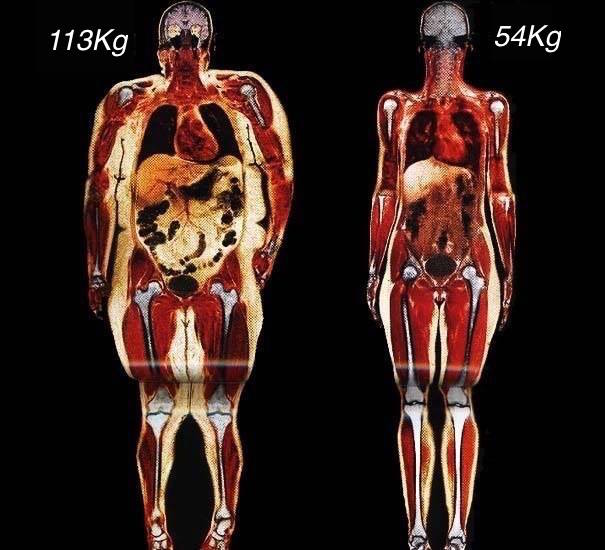
MRI (Magnetic Resonance Imaging) plays a valuable role in studying these differences. It is a non-invasive, radiation-free imaging technique that excels at visualizing soft tissues, making it extremely effective for examining patterns of fat accumulation. Radiologists and researchers routinely use MRI to evaluate metabolic disorders, monitor treatment progress, and study how lifestyle or medical interventions influence body composition over time.
However, while the image clearly demonstrates the physical differences between two body types, it is essential to recognize that body weight alone does not determine health. Individuals with higher weights can still maintain good metabolic fitness if they have strong muscle mass, good cardiovascular health, balanced nutrition, and low visceral fat. Similarly, someone with lower body weight may still face metabolic risks—especially if they have low muscle mass, poor diet, chronic stress, or genetic susceptibility to visceral fat accumulation.
The broader message conveyed by this comparison is educational rather than judgmental. It visually illustrates how fat storage varies dramatically among individuals and why health professionals focus on body composition, metabolic markers, lifestyle habits, and genetics when assessing overall health. Ultimately, understanding what happens inside the body—not just what is visible on the outside—provides a more accurate and nuanced perspective on human health.
Sources:
• Harvard T.H. Chan School of Public Health – Research on Visceral Fat & Metabolic Disease
• National Institutes of Health (NIH) – Body Composition & Chronic Disease Studies
• Mayo Clinic – Visceral Fat, Imaging, and Health Risks
• Journal of Clinical Endocrinology & Metabolism – Research on Fat Distribution and Metabolic Health