The girl was already crying when she pulled into the lot.
Ray Decker saw her from 30 feet away. He was wiping his hands on a shop rag, getting ready to lock the front gate when the silver Mercedes limped in on a rear flat.
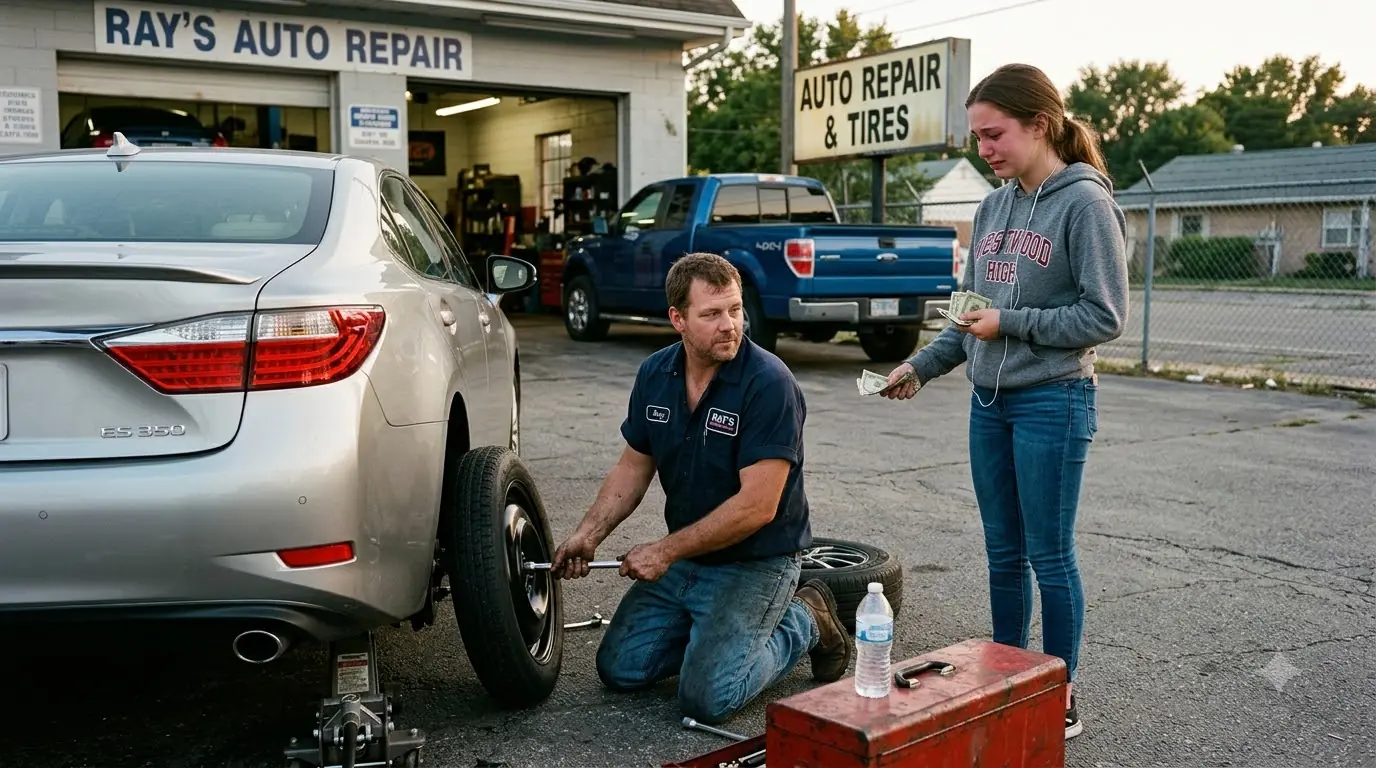
It scraped in slowly, like the car itself was embarrassed to be there. The girl behind the wheel had both hands gripping the steering wheel so tight her knuckles had gone pale. Her face was red. Her eyes were swollen. She had been crying for a while before the tire went. Ray stood still for a second. He had been closing up for 20 minutes. The invoice on the counter was already filed. The coffee maker was off. His truck keys were in his hand. He walked toward her anyway. From the other side of the chain-link fence, the two guys from Dale's Auto next door were leaning against their truck, Dale Pruitt and his cousin Owen. They had been wrapping up their own day, loud about it the way those two always were. Radios going, laughing at something. When the Mercedes pulled in, Owen said something Ray couldn't fully hear, but the tone of it was clear enough. The kind of tone that meant they were watching, waiting to see what he would do, waiting to turn it into something to laugh about later. Ray didn't look their way. He walked to the driver's side window and waited. The girl didn't roll it down right away. She was staring straight ahead, jaw tight, trying to get herself together. He could see it, the exact moment she decided she didn't have a choice. She pressed the button and the window came down. She looked maybe 17. Her mascara had tracked down both cheeks. She had earbuds around her neck and a backpack on the seat beside her, and the look of someone who had been holding it together all day until she couldn't anymore. "The back tire," she said. Her voice was steady, but only barely. "I can see that," Ray said. "You want me to take a look?" She nodded. He walked around to the rear of the car. The left tire was flat as paper. She had driven on it a little too long. The sidewall had a small tear, not a blowout but close. He crouched down, ran two fingers along the rim to check for damage, and straightened up. Owen called out from across the fence. "Hey, Decker. Thought you were closed." Ray didn't answer. "Man's got a soft spot for nice cars," Dale said. They both laughed. Ray walked to his shop bay, pulled the jack from the corner, grabbed the impact wrench, and came back out. He didn't explain himself to anyone. He positioned the jack under the lift point, got down on one knee, and started working. The girl had gotten out of the car. She was standing a few feet away, arms wrapped around herself watching him, not saying anything. He didn't push her to talk. Some people needed to talk. Some people needed someone to just do the thing and not make it bigger than it already was. He had been doing this long enough to know which one she was. He had the lug nuts off in under 2 minutes. The spare was in the trunk, clean, barely used. Good family. Someone in that house took care of things. He pulled it out, set it in place, and started running the nuts back down by hand before hitting them with the wrench. "You didn't have to stop," the girl said. "I know," Ray said. She was quiet for a moment. "I called my mom. She didn't pick up." He tightened the last lug nut and stood up, brushing the grit off his knee. "She'll call back." "She always does eventually," the girl said. The way she said it was not a complaint. It was just a fact she had made peace with a long time ago. Something in that sentence was heavy in a way that had nothing to do with tires. Ray lowered the jack. He bounced the rear corner of the car once to settle it. He walked around, checked the pressure on the other three tires with the gauge he kept in his shirt pocket. The front right was a little low. He went back inside and brought out the portable compressor, topped it off, didn't say anything about it. From across the fence, Owen called out again. "What do you charge for roadside therapy, Decker?" Dale laughed harder this time. Ray stood up and looked at the girl. "You're good to go. Don't push it above 60 on the spare, and get a new tire within the week. That spare isn't built for long-distance." She opened her purse. "How much do I owe you?" "Nothing." She looked up. "What?" "Nothing," he said again, simple and final. "I can pay. I have..." "I know you can pay." He walked to the shop door and came back with a bottle of water, still cold from the cooler inside. He held it out to her. She took it. "You've been crying for a while. Drink that before you drive." She looked at the bottle, then at him. Something moved across her face that he recognized. It was the specific expression of someone who was not used to being looked after, suddenly being looked after, and not knowing what to do with it. She didn't say anything. He took a shop card from his breast pocket and wrote his cell number on the back. If you get another flat or something else goes wrong, call that before you pull over anywhere, okay? She took the card, looked at it, turned it over in her hand. "Why are you doing all this?" Ray looked at her straight, not in a strange way, in the way of a man who had a reason he wasn't going to say out loud. "Just drink the water," he said. "Drive safe." She nodded. She got back in the car. He stepped back and watched her back out slowly, carefully, the way kids drive when they're still a little scared of the road. The Mercedes rolled out onto the street and the taillights went red at the corner. Then she was gone. The lot was quiet. From next door, Owen made one more comment, something about Ray doing charity work now, something about how the sign above his shop was barely readable, and maybe he should fix that instead of doing free tire changes, both of them laughing. Ray looked up at his shop sign. It had been flickering for about 3 weeks, one letter dark. He had kept meaning to fix it. He looked at it a moment longer, then he went inside, turned off the last light, locked the door, and drove home. He lived 12 minutes from the shop. The drive was the same every night. Two lights, a railroad crossing, the long curve past the old lumber yard that had been empty for 5 years. He knew every crack in that road. He could drive it without thinking, which was the problem, because driving without thinking meant thinking about other things. He thought about the girl's hands on the steering wheel. He thought about how she had said her mom always called back eventually. He thought about his own daughter Lily, about the way she used to come to the shop after school on Thursdays and sit on the stool in the corner and do her homework while he worked. How she'd complain about the smell and then come back the next Thursday anyway. She would have been 19 now. He pulled into his driveway, sat in the truck for a minute with the engine off, then went inside. He made dinner, ate it standing at the counter, washed the dish, went to bed. He did not sleep right away. He thought about the girl's face when he handed her the water, the thing that moved across it, the specific thing. He had seen that expression once before, in the mirror, right after a stranger, a man he never got the name of, changed a flat for him on the side of a highway during the worst night of his life, 3 years ago, and wouldn't take a single dollar for it. He had never found that man to thank him. He stared at the ceiling until around 2:00 in the morning, then he slept. His phone rang at 7:46 the next day. He was already at the shop. He had been there since 6:30. The coffee was half gone and he was under the hood of a 2019 pickup that needed a new alternator, the kind of job that required him to be entirely inside the engine bay, which meant he almost missed the call. He wiped his hands, looked at the screen. Unknown number, out-of-state area code. He almost put it back in his pocket. He answered it. "Is this Ray Decker?" The voice was a woman's voice, calm, clear, the kind of calm that wasn't relaxed. It was the kind of calm that came from spending a long time deciding exactly how much to reveal in exactly which words. "It is," he said. "My name is Nadia Voss." He knew the name. Anyone in the city knew the name. Voss Capital had a building downtown with her photograph in the lobby. She had been on the cover of two business magazines in the past year. She was the kind of name that showed up in conversations Ray was never part of. "My daughter came home last night," Nadia Voss said. "She told me what you did." Ray leaned against the truck fender. "She get home okay?" "She did." A short pause. "What did you charge her?" "Nothing." Another pause, longer this time. "I'd like to know why." Ray thought about it. Not long. "Because she needed help and I could give it. That's all." The line was quiet for a moment. Not an empty quiet, a thinking quiet, the kind that meant the person on the other end was deciding something. "She said you gave her your number in case she had more car trouble." "That's right." "She also said..." Nadia Voss stopped, then started again. "She said you didn't ask her any questions. You just fixed the tire and got her on her way." "Yes. Most people would have asked what was wrong." "Most people would have," Ray agreed. She was quiet again. He waited. He was good at waiting. 12 years of working alone in a shop had made him comfortable with silence in a way that made some people nervous. "Mr. Decker," she said finally, "I'd like to bring my car in. I think there's something wrong with the engine." "What's it doing?" "A small vibration at idle. It started about 2 weeks ago." "What are you driving?" "A Range Rover, 2 years old." "I can take a look at it. When works for you?" "This morning, if you have space." Ray looked around the shop. The pickup would take most of the morning. He had one other job after lunch. The bay at the end was open. "I've got a bay free," he said. "Good." She said the word the way people say it when they are relieved, but will not show it. "I'll be there in 2 hours." She hung up. Ray stood holding the phone for a moment. He thought about the girl's face again. The thing that moved across it. He put the phone back in his pocket and went back under the hood. She arrived in exactly 2 hours. He heard the Range Rover before he saw it. It pulled into the lot with a low, even hum that told him immediately the idle vibration was minor. Whatever it was, it wasn't serious, but he didn't say that yet. He came out of the bay and watched her get out of the car. She was not what he had expected. He was not sure what he had expected exactly. Someone more formal maybe, someone who traveled with people, someone whose clothing made a point. She was in dark trousers and a gray shirt, sleeves pushed up to the elbow. No entourage. She walked like someone who was used to moving fast and had decided today to move at a normal speed, which took more effort than the fast pace did. Her hair was pulled back loosely. She carried her phone in her hand, not in a bag. She was somewhere in her early 40s. She had the face of someone who had made a lot of decisions under pressure for a long time. Not hard, just precise. She walked toward him and put out her hand. He shook it. "Mr. Decker." "Ray," he said. She nodded, accepting that. Nadia. He walked around to the driver's side, got in, started the engine, and sat with it for a moment. He could feel the vibration right away. It was small, coming from somewhere in the front. He revved it slightly, let it settle back to idle, revved it again. He had a feeling about what it was. He got out and popped the hood. She stood back and watched him work. She didn't hover. She didn't ask every 30 seconds what he was seeing. She just watched, and the watching was the kind that missed nothing. He found it within 4 minutes. One of the engine mounts was beginning to wear. Not failed, not even close to failing, but enough to send a small vibration up through the chassis at idle. Easy fix. Inexpensive part. She could have driven it another 3 months without incident. He straightened up and told her this. She looked at him. "How long would it take to fix?" "I'd need to order the mount. Could have it in tomorrow, done by early afternoon." "Good," she said. "I'll leave the car." He nodded. He wrote up a quick estimate on the clipboard he kept at the bay entrance. She looked at it for barely a second and nodded. She didn't negotiate. She didn't look for a reason to doubt the number. She just accepted it the way someone accepts something when they have already decided to trust you. And that decision had been made before she walked in. He noticed that. He handed her the clipboard to sign. She signed it and handed it back. "Can I ask you something?" she said. "Go ahead." "How long have you run this shop alone?" "12 years. I've got a part-time kid who comes in 3 days a week, but mostly, yeah, just me." She looked around the shop slowly, at the organized tool wall, at the way the invoices were filed, at the floor, which was stained and old, but clean, at the sign above the door that had one letter still dark. "You ever think about expanding?" He thought about it the way he thought about most things, without rushing. "No." "Why not?" He leaned against the truck he'd been working on all morning. "There are two kinds of people in a business: people who are building something and people who are fixing something. I've always been the second kind. You try to be both things at once, you usually end up doing neither one right." She looked at him for a moment. Not the way people look at you when they're waiting for you to stop talking, the way they look when something you said landed somewhere in them and they're deciding what to do with it. "That's a very specific way to see it," she said. "It's the only way I know how to see it." She was quiet for a moment, then she looked back at the car. "She's been having a difficult year," she said. "My daughter. Cora," she said her daughter's name the way parents say their children's names when they're talking to someone outside the family for the first time, careful, like the name itself was something fragile. "She gets her license in 3 months, and she's been driving with me on the weekends to practice. Last night was the first time she took the car out on her own." "She drove well," Ray said. "She was careful pulling out of here." Nadia looked at him. "You noticed that?" "I notice how people drive. It's a habit." "She called me from the lot," Nadia said. "Before she left." "She was..." She stopped. "She seemed calmer than she was when she left the house." Ray didn't say anything to that. He didn't push the conversation toward what the girl had been upset about. It wasn't his to ask. Nadia seemed to notice that. The not asking. Something in her expression shifted. Just slightly. The same way a door opens a half inch before you decide whether to push it the rest of the way. "She said you gave her water," Nadia said. "She'd been crying for a while." "She had." A pause. "She doesn't like for people to notice when she's struggling." "She gets that from me, I think." She said it without apology, just plainly. "I didn't make a thing of it," Ray said. "She didn't need me to make a thing of it." Nadia was quiet again. Then: "Do you have children?" He met her eyes. "I had a daughter." She heard the had. She did not flinch from it, and she did not rush past it. She held it the way you hold something someone hands you that you understand is heavy. "I'm sorry," she said. "Thank you," he said. Neither of them spoke for a moment. The shop was quiet except for the sound of the radio in the back bay, low. Outside, a truck passed on the street. "I'll have someone pick me up," she said finally, taking her phone out. "What time tomorrow should I come for the car?" "Call ahead in the morning. I'll know by then when the part will arrive." She nodded. She looked at him one more time, not in a searching way, in the way of someone who has already found what they were looking for and is deciding whether to say so. She did not say so. "Thank you, Ray," she said. She walked out of the shop and across the lot and through the front gate, and he watched her go the way he had watched her daughter go the night before. The same careful attention, different reason. He went back to the pickup. He had the alternator in and the truck running by 2:00 in the afternoon. He ordered the engine mount for the Range Rover online, chose the faster delivery, paid for it out of pocket, and noted it in the invoice to be settled later. He didn't know why he paid for faster delivery. He didn't examine the reason too closely. At 4:00, his part-time helper, a 22-year-old named Cal, came in to help him with an oil change that had been sitting since morning. Cal was a good kid, quiet worker. He asked few questions, which Ray appreciated, but as they were finishing up, Cal looked over at the Range Rover sitting in the far bay. "That a customer car?" he asked. "Yeah," Ray said. "Engine mount?" "Yeah." Cal wiped his hands. "That the Voss woman's car? The one from downtown?" Ray looked at him. "You know her?" "I know the name. My aunt works in her building. She was on the news last year. Something about a big project." Cal shrugged. "She come in herself?" "She did." Cal looked at the car again, then at Ray. He had the good sense not to say whatever it was he was thinking. He went back to work. Outside through the chain link, Owen from Dale's Auto was watching the lot again. Ray could see him in his peripheral vision. Not staring, exactly, but watching. The way he always watched whenever something happened at Ray's shop that he couldn't quite figure out or fit into the version of Ray he had decided to believe in. Ray didn't look over. He finished the oil change, signed off on the ticket, and sent the car on its way. At 5:30, he was alone again. He stood in the middle of the empty shop and looked at it. 12 years of work in these walls. Every crack in the floor. Every grease mark on the ceiling that he'd never quite gotten off. His daughter's old stool still in the corner. He hadn't moved it. He wasn't sure he ever would. He thought about what Nadia had said. She gets that from me, I think. The way someone says something about themselves without excusing it, without explaining it, just acknowledging it like weather. He thought about what he had said back. He had not told a stranger that in a long time. He had not told most people at all. He went to the corner and picked up the stepladder. He climbed up to the sign above the door and looked at the broken letter, the E in Decker. It had been dark for 3 weeks. The bulb was just loose. That was all. A loose bulb. He tightened it. It came on. He climbed down and looked at the sign from the outside. Decker Auto. Both words lit. Clean. He stood there a minute in the cooling evening air. From next door, the other lot was empty. Dale and Owen were gone for the day. Good. He locked up and drove home. He was halfway through dinner when Nadia called again. He answered before the second ring. "I wanted to tell you the part arrived at the supplier," she said. "I called ahead. I hope that's not strange." "It's not," he said. "I also..." She stopped. A very slight pause. The kind that meant the next sentence had been thought about. "I referred a colleague. He has a fleet of vehicles that need regular service. I gave him your number. I hope that's all right." Ray set down his fork. "You didn't have to do that." "I know." She said it the same way he had said it to Cora the night before. Simple. Final. He was quiet for a moment. "Nadia." "Yes." "Why did you really come in today? The vibration wasn't serious enough to need same-day attention. You knew that." The line was quiet for a moment. Then she said, "I wanted to see what kind of man my daughter was talking about." He let that sit. "And?" he said. "And I found out," she said. She said good night. He said good night. She hung up. He sat at the table for a while, not thinking about anything specific, just sitting in the quiet of the house, which was usually a hard kind of quiet, and noticing that tonight it was a slightly different kind. Not easier. Not harder. Just different. He picked up his fork and finished his dinner. Two days later, the fleet manager Nadia had referred walked into the shop with a card in his hand and six vehicles that needed various things done. His name was Gordon Fitch, a practical man in his 50s who shook hands firmly and got to the point quickly. He looked around the shop, asked a few smart questions, and told Ray he wanted to put the shop on his company's service contract. Ray told him he'd think about it. Gordon Fitch blinked. He was clearly not a man who was told that very often. "I'll call you by end of the week," Ray said. Gordon Fitch nodded slowly, like he was recalibrating. He shook Ray's hand again and left. Cal had watched the whole thing from the back bay. When Gordon's car pulled out, Cal looked at Ray. "You're going to say yes," Cal said. It wasn't a question. "Probably," Ray said. "So, why didn't you just say yes?" Ray thought about it. "Because when you say yes too fast, people think the need was theirs to fill. I don't want anyone thinking they're doing me a favor. I want them thinking they found a good mechanic." Cal stared at him. "Write that down somewhere," Cal said. Ray almost smiled. He went back to work. The word got around the strip the way it always did, crooked and loud. By the second week, Owen from next door had pieced together that the black car parked outside Ray's shop every couple of days belonged to someone important. He got creative with it in the way that people do when they don't have real information but don't want to say so. The story shifted every time it passed through another mouth. Ray let it go. What was actually happening was simple. Nadia brought the Range Rover back after the engine mount was replaced, stayed for 40 minutes while Ray showed her what had been worn and what the new part looked like. She asked good questions, mechanical questions, the kind that meant she actually wanted to understand, not just be reassured. After the car was done, she sat in the small waiting area he had near the front, two chairs and a table with old magazines he never updated, and answered emails on her phone while Ray finished a brake job on another customer's car. She didn't try to talk to him while he worked. She just sat easy in the space like she'd been there before. Before she left, she asked if he'd eaten lunch. He said he usually didn't, not until late. She said that was a bad habit. He said he had a few of those. She looked at him with something close to amusement, which on her face was a quiet thing, barely there but real. She left. He ate a sandwich he found in the back of the shop fridge that was aggressively past its best day and thought about the way she had looked at him. The following Tuesday, Nadia's colleague Gordon Fitch got the yes he had been waiting for. Ray called him. They agreed on terms and just like that, the shop had more steady work than it had seen in 2 years. Cal came in an extra day. Ray stayed later some nights. The shop started feeling like a different version of itself, busier, fuller, without having changed what it fundamentally was. Owen from Dale's Auto watched a third fleet vehicle pull out of Ray's lot one afternoon and said something loud and mean-spirited to Dale about it. Dale didn't laugh this time. He just looked at Ray's shop for a moment and then went inside. Some things you can't make a joke of forever. Ray noticed, said nothing. He was under the hood of one of Gordon's fleet vehicles on a Friday afternoon when Cal called from the front. "Ray, someone on the phone." He came out, wiped his hands, picked up the receiver. It was Cora. "Hi," she said. "It's Cora. Voss, from the parking lot 2 weeks ago." "I remember," he said. "I just wanted to..." She stopped. He could hear her organizing her words. "I told my mom about you. I guess you know that." "I do." "She came in?" "She did." "Okay." A pause. "I wanted to say thank you. I know my mom probably already said that, but I wanted to say it myself." "I appreciate that," Ray said. Another pause, longer. "Was it weird that she came in?" "No," he said. "She's easy to talk to." Cora was quiet for a moment, then she said, "She doesn't talk to a lot of people, like actually talk. You should know that." He didn't say anything. He just listened. "Okay," Cora said. "That's all. I just wanted to say thank you." "You're welcome, Cora." "Drive safe." "I will." A short laugh, small and real. "I always check the tires now." She hung up. He stood with the receiver in his hand for a moment. Cal appeared in the doorway. "Fleet car or personal call?" "Personal," Ray said. Cal nodded and disappeared back into the bay. Ray set the receiver down, stood there a moment in the quiet of the front office. The afternoon light was coming in at a low angle through the front window, and the sign above the door cast a clean shadow across the floor. He thought about what Cora had said. "She doesn't talk to a lot of people, like actually talk." He picked up his rag and went back to work. That evening Nadia called. Not to talk about the car, not about Gordon or the fleet contract or anything related to the shop. She asked if he had ever been to the diner two blocks down, the one on the corner with the red awning. He said he drove past it every day. She said she had been going there since she moved offices four years ago. That the coffee was not good, but the quiet booth in the back was reliable. And that reliable quiet was something she actively looked for. He said he understood that. She said she would be there Friday evening around 7:00 if he wanted to stop in. Not an invitation, exactly. More like a door left open. The kind where you decide for yourself whether to walk through. He said he would be there. She said she would see him then. He hung up and sat very still for a moment in the empty shop. Outside, the sign above the door was lit. All the letters of his name clean and steady in the early dark. He got up, locked the bay doors, and drove home. He slept well that night. Better than he had in a long time. Not because anything had been solved or fixed or figured out. Nothing had. The grief was still exactly where it lived. The house was still as quiet as it always was. The stool in the corner of the shop was still his daughter's stool and would never be anything else. But something had shifted. Not in the facts of his life. In the way the facts sat in him. He woke up at 5:30, made coffee, and was at the shop before the sun was fully up. Cal came in at 8:00, looked at Ray, and said, "You seem different." "I'm not," Ray said. "Okay," Cal said in the tone of someone who knows better, but will let it go. They worked through the morning in easy silence. A brake job, a timing belt, an oil change for a woman who came in every 6 weeks and always brought donuts, which she left on the counter without saying anything about them. Ray ate two donuts standing at the workbench. At noon, he called Gordon Fitch and confirmed the schedule for the following week. At 2:00, Owen came through the chain-link gate. Ray looked up. Owen was not the kind of man who came through other people's gates easily. He stood just inside the entrance, hands in his pockets, looking around the shop like he was trying to find a way to start a sentence. Ray waited. "Busy lately," Owen said finally. "Getting there," Ray said. Owen nodded. "I heard you picked up a fleet contract." "That's right." Owen looked at the floor, pushed a piece of grit around with his boot. "We've been trying to get one of those for about a year. Gordon Fitch's lot. He came to us first, actually." Ray said nothing. "I just..." Owen stopped. Started again. "I'm not here to give you a hard time." He said it like it cost him something. "Dale said I should come over. I didn't want to." He looked up. "But I'm over here." Ray looked at him for a long moment. "Okay," he said. Owen nodded. He stood there another beat, like he might say something else. Then he turned and walked back through the gate. Ray watched him go. Cal appeared from the back bay. "Was that Owen?" "Yeah." "What did he want?" "To show up," Ray said. Cal thought about that. "That it?" "That's a lot sometimes," Ray said. Cal considered this seriously, in the way that young men do when someone older says something they're not sure they understand, but want to. Then he went back to work. At 6:30, Ray finished the last invoice of the day, turned off the radio, and locked the bay. He went into the small bathroom at the back of the shop and washed his face and hands properly, changed out of his work shirt into the clean one he kept in his truck, combed his hair. He drove the two blocks to the diner with the red awning. Nadia was already there. Back booth, like she'd said. She had a cup of coffee she wasn't drinking yet, and her phone was turned face down on the table. He noticed that. In his experience, a phone placed face down on a table in a restaurant meant the person had decided to be present. It was a small decision. It was a real one. He slid into the seat across from her. "The coffee is bad," she said. "You warned me," he said. She almost smiled. "I did." The waiter came. Ray ordered coffee. Nadia turned hers face up and ordered another. They talked for 3 hours about Cora: what she was like as a small girl, how she had her father's stubbornness and her mother's memory for detail, and how the year had been hard in ways that teenagers don't have words for yet but feel with everything they have. They talked briefly and plainly about the divorce, about the building downtown and what it had cost to build it, and what it had cost that had nothing to do with money. And they talked about Lily. Ray didn't talk about her much. But he talked about her tonight. The Thursdays, the stool, the way she used to tell him the shop smelled like something real, and how he had laughed at that, and how he would give everything he owned to hear her say it one more time. Nadia listened the way very few people had ever listened to him, not waiting for her turn, not looking for the place to insert comfort, just listening, the way you hold a door open for someone, fully, without rushing them. She told him about a morning last year when she had sat in her office on the 14th floor before anyone else arrived, watching the city come awake, and realized she had not had a conversation in 6 months that wasn't about money, or strategy, or solving something, that she had become very good at solving things and had quietly forgotten how to just be in a room with another person without an agenda. She said she wasn't sure when that had happened. He said he wasn't sure when it had happened for him, either. They looked at each other across the table. "This isn't going to be simple," she said. She was not talking about the engine mount or the fleet contract. "No," he agreed. "I'm complicated," she said. "So am I. I have a daughter who is 17 and pays attention to everything." "I know," he said. "She called me." Nadia blinked. "She called you?" "To say thank you." Nadia was quiet. She looked down at her coffee cup for a moment, and when she looked back up, there was something in her face that wasn't there before, something unguarded, something she didn't try to put away. "She doesn't do that," Nadia said. "Call strangers." "Maybe she didn't think I was a stranger," Ray said. Nadia held his gaze. "She has good instincts," she said. "She does," Ray agreed. They ordered food eventually, ate it slowly. The diner filled up and quieted down around them, and they stayed in the back booth past nine, past the point where either of them had anything left to explain or justify. At one point, Nadia said, "She told me the shop smelled like something real." Ray went very still. Nadia said it carefully, looking at him. "She came home and said that night of the flat. She said she couldn't explain it. Just that it smelled like a place where real things happened." He looked at the table, pressed his thumb against the edge of it. He didn't say anything for a moment. Then he said, "Yeah." Just that. Nadia nodded. She didn't push it. She didn't try to make the moment more than it was. She just let it be what it was. They left around 9:30. He walked her to her car, parked around the corner. She clicked it unlocked, and then stopped and turned. "Ray." "Yeah." "Thank you for the tire," she said. He understood she wasn't talking about the tire. "Thank you for calling," he said. He walked back to his truck, drove home on the same road he always drove, two lights, the railroad crossing, the curve past the old lumberyard. He went inside, sat in the chair he always sat in, looked at the room. Then he got up, went to the shelf by the window where his daughter's photograph had been for 3 years, and picked it up. Looked at it for a long moment, set it down gently, not away, just down. He sat back. The house was quiet, but tonight the quiet was full of things, not empty of them. He thought about what Cora had said. She described the shop as a place where real things happened. He thought about what Nadia had said at the table, that she had forgotten how to be in a room with someone without an agenda. He thought about Owen coming through the chain-link gate with his hands in his pockets and nothing more to say than that he was there. He thought about the loose bulb in the sign. How it had taken him 3 weeks to climb a ladder and tighten it. How it took 30 seconds. How the light came right back on. He wasn't a man who drew lessons from things. He didn't believe life organized itself into neat meanings. Things happened. You worked through them. You showed up the next day. But he sat there for a while in the quiet house and thought about a flat tire and a crying girl and a phone call the next morning and everything that had come from it. All of it from one simple thing. Not a grand gesture. Not a decision he had agonized over. Just a man who saw someone who needed help and walked over. That was all. That was everything. He went to bed. He slept. In the morning, he was at the shop by 6:30. Coffee made. Radio low. The sign outside lit up in the early gray light. All the letters of his name steady and clear. Cal came in at 8:00 and found Ray under the hood of a car, already deep into it. The kind of focus that meant he had been there a while. "Good morning," Cal said. "Morning," Ray said without looking up. Cal poured himself coffee, looked around the shop, looked at the sign outside through the window. "Sign looks good," he said. "Yeah," Ray said. "Always did, really. Just needed a little attention." Ray paused. He didn't say anything for a moment. Then he went back to work.The girl was already crying when she pulled into the lot. Ray Decker saw her from 30 feet away. He was wiping his hands on a shop rag, getting ready to lock the front gate when the silver Mercedes limped in on a rear flat. It scraped in slowly, like the car itself was embarrassed to be there.
The girl behind the wheel had both hands gripping the steering wheel so tight her knuckles had gone pale. Her face was red. Her eyes were swollen. She had been crying for a while before the tire went.
Ray stood still for a second. He had been closing up for 20 minutes. The invoice on the counter was already filed. The coffee maker was off.
His truck keys were in his hand. He walked toward her anyway. From the other side of the chain-link fence, the two guys from Dale's Auto next door were leaning against their truck, Dale Pruitt and his cousin Owen. They had been wrapping up their own day, loud about it the way those two always were.
Radios going, laughing at something. When the Mercedes pulled in, Owen said something Ray couldn't fully hear, but the tone of it was clear enough. The kind of tone that meant they were watching, waiting to see what he would do, waiting to turn it into something to laugh about later. Ray didn't look their way.
He walked to the driver's side window and waited. The girl didn't roll it down right away. She was staring straight ahead, jaw tight, trying to get herself together. He could see it, the exact moment she decided she didn't have a choice.
She pressed the button and the window came down. She looked maybe 17. Her mascara had tracked down both cheeks. She had earbuds around her neck and a backpack on the seat beside her, and the look of someone who had been holding it together all day until she couldn't anymore.
"The back tire," she said. Her voice was steady, but only barely. "I can see that," Ray said. "You want me to take a look?"
She nodded. He walked around to the rear of the car. The left tire was flat as paper. She had driven on it a little too long.
The sidewall had a small tear, not a blowout but close. He crouched down, ran two fingers along the rim to check for damage, and straightened up. Owen called out from across the fence. "Hey, Decker. Thought you were closed."
Ray didn't answer. "Man's got a soft spot for nice cars," Dale said. They both laughed. Ray walked to his shop bay, pulled the jack from the corner, grabbed the impact wrench, and came back out.
He didn't explain himself to anyone. He positioned the jack under the lift point, got down on one knee, and started working. The girl had gotten out of the car. She was standing a few feet away, arms wrapped around herself watching him, not saying anything.
He didn't push her to talk. Some people needed to talk. Some people needed someone to just do the thing and not make it bigger than it already was. He had been doing this long enough to know which one she was.
He had the lug nuts off in under 2 minutes. The spare was in the trunk, clean, barely used. Good family. Someone in that house took care of things.
He pulled it out, set it in place, and started running the nuts back down by hand before hitting them with the wrench. "You didn't have to stop," the girl said. "I know," Ray said. She was quiet for a moment.
"I called my mom. She didn't pick up." He tightened the last lug nut and stood up, brushing the grit off his knee. "She'll call back."