"No man wants a wife with opinions," said the Duke of Arlington, and reached for the salt.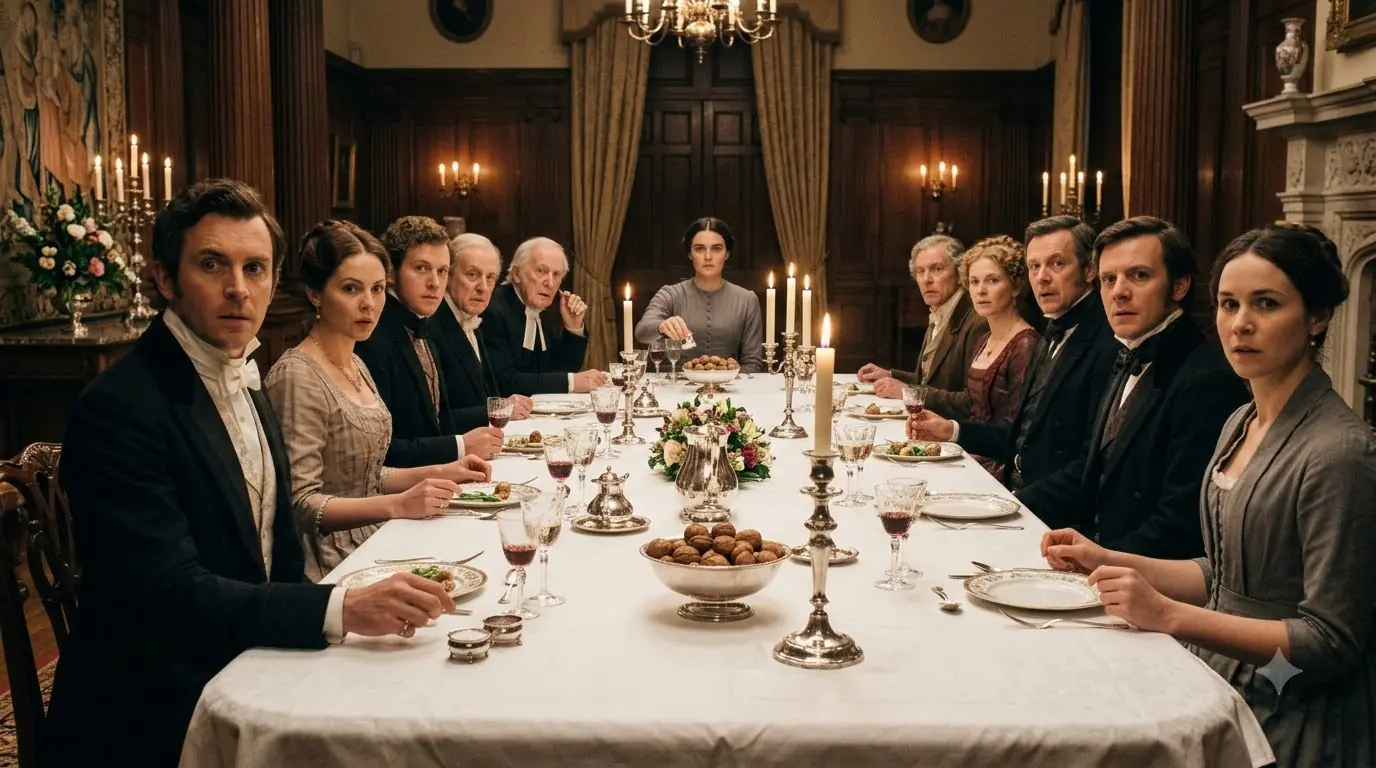
"Then it is a mercy," said the young woman at the far end of the table, "that no man is obliged to have one. You are quite safe, Your Grace. My opinions are entirely spoken for."
Eleven people stopped eating.
The Duke of Arlington put down the salt and looked, for the first time that evening, at the person who had been placed at the very end of his own board, between a deaf canon and a bowl of walnuts. He had been told her name at the door and had not attended: Miss Standen, a bookseller's niece from Arlington village, who read three evenings a week to old Lady Calvert and had come with her as a sort of appendage. She had a plain gray gown, no jewelry, and a look on her face that he could only describe as braced.
"You have taken me up," he said.
"You spoke loudly. I supposed it was for taking up."
"Miss Standen," Lady Calvert's voice from the middle of the table, dry as sand, "you are not at the vestry."
"No, ma'am. I beg your pardon." Not in the least apologetic. "It is only that His Grace has just now said, in the hearing of two magistrates and a canon, that a woman with an opinion is undesirable. And half this table will repeat it at market on Tuesday. And by Michaelmas, there will be four girls in this parish taught to keep quiet who might otherwise have been useful."
"And the other half," said the Duke, "the other half already believed it, so no harm is done there."
He heard himself laugh. It surprised him more than it surprised the table. He was, as a rule, a poor guest at his own dinners. He had come into the title at 31 and had spent seven years being deferred to by everybody within 11 miles until he had almost forgotten that conversation was a thing done between two people rather than at one. And now, a bookseller's niece had thrown a sentence the length of the table and hit him with it.
"Then I withdraw the remark," he said, "on the ground that it was lazy. Not on the ground that it was wrong."
"Miss Standen, do not be greedy."
He thought about it for a good part of the night, which annoyed him.
On the Tuesday, he went to the Turnpike Trust meeting in the vestry at Arlingham, which he did four times a year out of duty and had never once found interesting. And Miss Philippa Standen was sitting in the third row with a folded paper and a pencil.
His surveyor read the scheme for the new bridge at Standen Mill, a stone bridge of three arches on the old footings, to replace the timber one carried away in February. £490. The trustees murmured approval. It was a handsome scheme.
"Mr. Chairman," said Miss Standen, standing up, "may I be permitted a question?"
The chairman, a farmer of 80, said she might, chiefly because he had known her since she was two.
"The old footings are set 9 ft apart at the second pier," she said. "In February, the water at that point stood 4 ft above the sill for 11 days. I have the figures. My uncle has kept the flood marks on the shop wall since 1804 because the shop is the third building up from the ford, and we should like to know when to move the books upstairs."
A ripple of laughter; she let it pass.
"Three arches on those footings will pass less water than the timber bridge did, and the timber bridge went. If the gentlemen build there, they will build twice."
There was a silence of the specific kind produced when a room full of men realizes that a person they had not been listening to has done more arithmetic than they have.
The surveyor said something about the expense of new footings.
"Two arches, wider set on the hard ground 11 yd upstream," said Miss Standen. "It is a longer approach, and it will cost you perhaps 60 lb more, and it will stand. My father was a millwright at Standen, and I have been watching that water since I was six years old, and it is not a river that forgives a narrow arch."
The Duke of Arlington had come to that meeting intending to say nothing at all, as usual.
"Mr. Chairman," he said, "I move that the scheme be referred back, and that the surveyor be instructed to take Miss Standen's flood marks and report on two arches at the upstream site."
There was a certain amount of noise. It was carried.
Afterwards in the churchyard, she caught him by the lychgate, pink and furious.
"You should not have done that. I was under the impression I had agreed with you. You have made it your doing. In a fortnight, the whole county will say the Duke of Arlington was very clever about the bridge, and my uncle's shop will be the place where the difficult niece lives, and Mr. Nash, the surveyor, will be my enemy for the rest of his life, and none of that would have happened if you had let it be voted down and brought up again in April by somebody with a name."
"You wish me to be a coward with better manners."
"I wished you," said Miss Standen, "to say nothing and vote."
The Duke of Arlington took off his hat and turned it in his hands and looked at this maddening young woman standing among the gravestones with her flood marks in her fist.
"I have been a duke for seven years," he said, "and you are the first person in that time who has told me that I did a thing badly by doing what she wanted. I find I have no reply. Good afternoon, Miss Standen."
On the Wednesday, he found out who she was.