The handcuffs clicked shut before seventeen-year-old Jordan Bennett could finish saying his name. Officer Travis Cole shoved him forward against the wet hood of the patrol car while cold November rain ran down the back of his school warm-up jacket, and Officer Mason Briggs laughed when the teenager flinched. “You kids always start crying when you realize nobody’s coming to save you,” Cole said. Jordan swallowed hard and kept his hands exactly where they had been ordered, even though one cuff was already biting into his right wrist. He had stopped at the Route 42 convenience store for one gallon of milk after basketball practice, nothing more, but somehow a five-minute errand had become two officers surrounding his aging Honda as if they had caught him breaking into the closed electronics store next door. Neither officer noticed the black sedan turning slowly into the rain-soaked parking lot behind them.
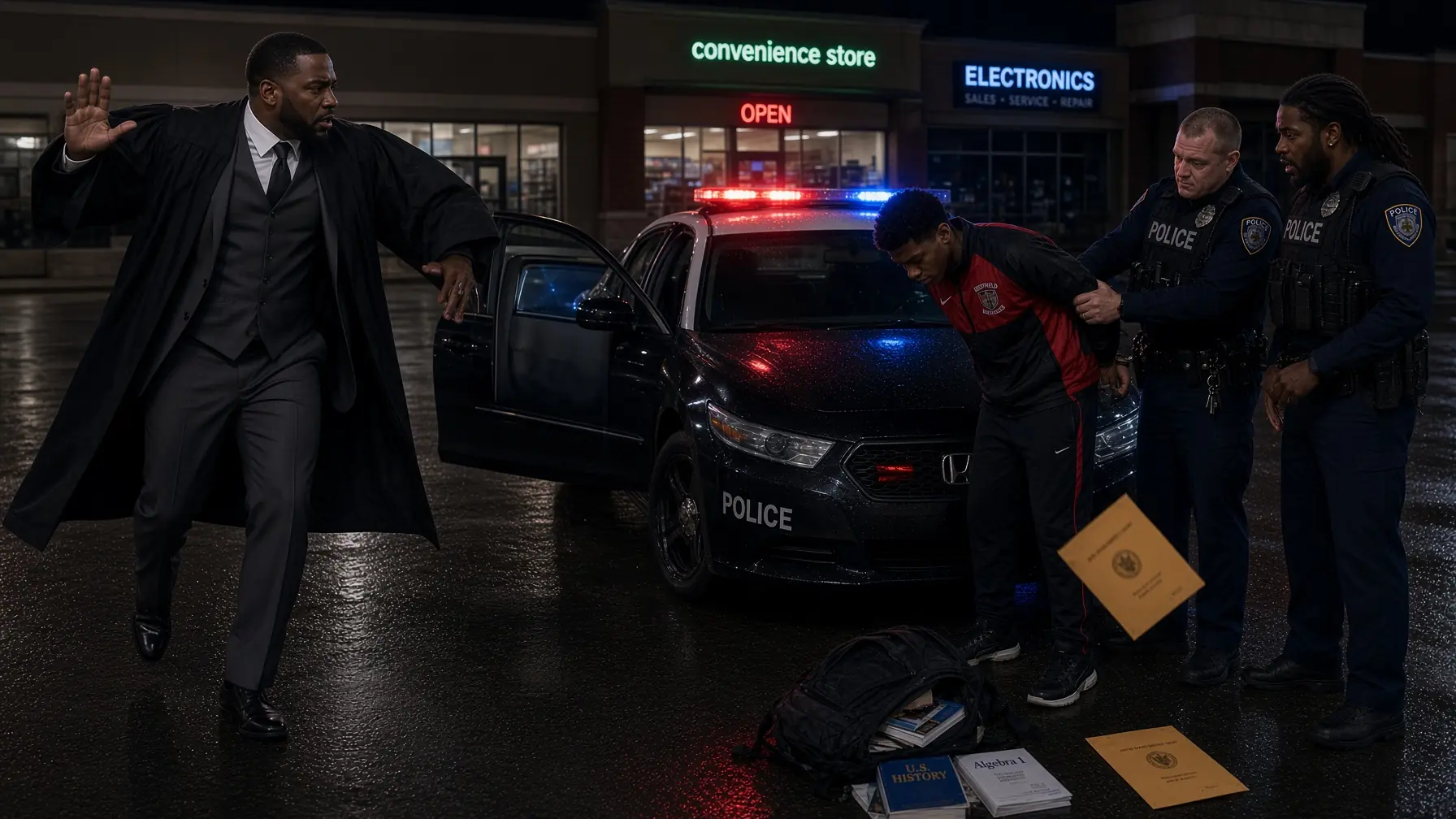
Jordan had been taught not to make sudden movements around police. His parents had repeated the rules so often that he could hear his mother’s voice even now: keep your hands visible, speak clearly, do not reach for anything without saying what you are doing first. When Cole demanded his license, Jordan told him it was in his wallet and waited until Cole allowed him to reach. When Briggs ordered him out of the car, Jordan complied. When the officers asked why he was there, he pointed toward the convenience store and said, “My mom texted me to get milk on the way home.” None of those answers seemed to reduce their suspicion. Every calm response appeared to irritate Cole more, as though cooperation was only useful if it sounded frightened enough to satisfy him.
The original call had been vague. A delivery driver passing through the strip mall reported seeing “a young guy in dark clothes walking near the electronics store and looking into the windows.” The caller did not report a break-in, did not see anyone forcing a door, and could not describe a vehicle beyond “maybe a dark sedan.” Jordan’s Honda was silver. He had walked past the electronics store because the convenience store entrance was on the far end of the same building, and the rain had driven him close to the awning. That should have been easy to verify. Instead Cole looked at Jordan’s school jacket, his age, his skin, and the empty commercial lot, then decided the unanswered parts of the call mattered more than the parts already becoming clear.
“Where’s your proof you were buying something?” Cole asked. Jordan nodded toward the convenience store. Through the glass, the clerk could be seen stocking cigarettes behind the counter. “I hadn’t bought it yet. You pulled in while I was getting out.” Cole smiled. “Convenient.” Jordan looked confused. “You can ask him.” “You telling me how to investigate?” “No, sir.” “Sounds like it.” Jordan lowered his eyes. He knew enough to recognize the trap. If he explained himself, Cole called it argument. If he stopped speaking, silence would become suspicious. He chose the only safe option he knew and said, “I’ll answer whatever you ask.”
Briggs opened Jordan’s passenger door without asking. His backpack was resting on the seat beside a basketball duffel and a folded practice jersey. “What’s in here?” Briggs asked. Jordan turned his head slightly. “School stuff.” Cole tightened his grip on Jordan’s arm. “Face forward.” Jordan obeyed. Behind him, he heard a zipper open. Textbooks hit the seat. A charger clattered onto the floorboard. Briggs pulled out basketball shoes, a calculator, a geometry notebook, and finally a thick white envelope bearing the seal of the United States District Court. “Well, look at this,” he said, almost amused. “You pretending to be some lawyer now?”
Jordan’s stomach tightened. “That belongs to my father.” Briggs looked at the return address. “Federal courthouse?” Jordan nodded. “He left it in my backpack yesterday.” The envelope contained nothing dramatic—just materials Jordan’s father had asked him to carry from the car when they arrived home late. Briggs held it up toward Cole. “Kid’s got federal court papers.” Cole laughed. “Sure he does.” Then Briggs tossed the envelope onto the wet pavement. The corner landed in a shallow puddle. Jordan instinctively shifted his weight toward it, and Cole immediately jerked his arms higher. “Don’t move.” Jordan winced. “I wasn’t reaching for you.” “Then stop moving like you’re reaching for something.”
Jordan’s phone began ringing inside the Honda. The screen lit up through the rain-streaked window. DAD. Jordan looked toward it. “Can I answer that, please? My father’s expecting me home.” Cole reached through the open driver’s window, picked up the phone, and silenced the call. “Daddy can wait.” Jordan looked at him. “He’s going to worry.” Cole smiled. “Maybe he should’ve taught you not to hang around closed stores at midnight.” Jordan’s jaw tightened, but he said nothing. His father had taught him plenty. One lesson was echoing louder than all the others: when authority starts abusing itself, remember details. Do not embellish. Names. Badge numbers. Time. Exact words. Who searched what. Who said what first.
The convenience store had three cameras visible from the parking lot. Jordan had noticed them when Briggs searched his backpack because one pointed almost directly toward his car. Briggs eventually noticed where Jordan was looking. His expression changed. He stepped sideways until his body blocked part of the camera’s view and said quietly, “You think that camera is going to save you?” Jordan looked at him. “I didn’t say anything.” Briggs leaned closer. “Out here, our report becomes the truth.” Cole laughed behind him. “Especially when a kid decides to make things difficult.” Jordan’s breathing changed, but he lowered his eyes. The fear was real now. Not because he believed both officers could make him disappear. Because he understood that adults with uniforms could create hours, days, or months of trouble before anyone else checked what actually happened.
Across the lot, the black sedan stopped beneath a flickering pharmacy sign. The rear door opened and a tall Black man stepped into the rain carrying a leather briefcase. He wore a charcoal suit beneath a dark overcoat, the kind of suit that had been pressed early that morning and then survived far too many hours of work. Folded over one arm was a black judicial robe. Jordan saw him before the officers did. His face changed instantly. “Dad.” Cole turned halfway. “Who?” The man crossed the wet asphalt without hurrying, his eyes fixed on Jordan’s wrists. Briggs stepped toward him and raised one hand. “Sir, stay back. Active police investigation.”
Marcus Bennett stopped six feet away. He was fifty-two, broad-shouldered, silver beginning to show at his temples, and so controlled that his calmness felt more dangerous than shouting. “My son is seventeen,” he said. “Tell me why he’s in handcuffs.” Cole looked him up and down. “Sir, unless you’re his attorney, you need to move along.” Marcus did not mention the robe. He did not mention the federal courthouse. He did not mention the sentencing hearing he had finished two hours earlier. He looked at Jordan’s cuffed hands and asked, “Is he under arrest?” Cole’s face tightened. “He’s detained during an investigation.” Marcus nodded once. “For what specific offense?”
Cole gave the same answer he had been giving Jordan. “Possible burglary activity.” Marcus glanced toward the dark electronics storefront. “Was there a burglary?” Briggs answered, “We had a suspicious-person report.” Marcus looked back at him. “That’s not the same question.” Cole stepped forward. “Sir, I’m not going to debate procedure with you in a parking lot.” Marcus’s gaze shifted toward Jordan’s open backpack and the soaked envelope on the ground. “Did my son consent to a search of his bag?” Jordan immediately said, “No.” Cole snapped, “Jordan, don’t answer unless asked.” Marcus’s expression changed just slightly. “You just used his name. So his identity is confirmed?”
Cole stared at him. Briggs looked away. Marcus continued, “You have his license?” “Yes.” “Does it come back valid?” “Yes.” “Any warrants?” “No.” “Any property from that store in his vehicle?” Cole’s jaw tightened. “We’re still investigating.” Marcus nodded toward the convenience store window. “Have you asked the clerk whether Jordan just arrived to shop?” Neither officer answered. Marcus looked toward the cameras. “Have you checked whether the electronics store alarm activated?” Silence again.
Only then did Marcus lower his briefcase onto the hood of his sedan. His judicial robe remained folded over one arm. He did not put it on. He did not need theater. As he shifted the fabric, however, the gold embroidery on the garment bag beneath it became visible: UNITED STATES DISTRICT COURT. Briggs stared. His face changed first. He looked from the robe to Marcus’s face, recognition slowly taking hold. Two hours earlier, the local evening news had carried footage from a federal corruption sentencing. Marcus Bennett had been on every television in the precinct lobby while officers changed shifts.
Briggs whispered, “Judge Bennett?”
Cole looked at him.
Then at Marcus.
Then back at Jordan.
The entire emotional temperature of the encounter changed in less than three seconds.
Cole’s voice softened. “Your Honor, if we had known—”
Marcus raised one hand. “Don’t finish that sentence.”
Cole stopped.
Marcus looked at his son.
Then at the cuffs.
“What fact about Jordan changes because you know what I do?”
Cole swallowed.
Marcus continued, “His license was valid before you recognized me. The store camera existed before you recognized me. His school jacket existed. The convenience store clerk existed. The fact that no burglary alarm has sounded existed.” He looked at Briggs. “My occupation adds nothing to whether your detention is lawful.”
Briggs glanced at Jordan’s wrists. Cole shifted his stance. “We received a legitimate report.” Marcus nodded. “Then investigate it. I have no objection to that.” The answer surprised both officers. Marcus continued, “But investigation means checking facts. It does not mean every fact that clears him becomes another reason to keep him cuffed.” Cole’s face reddened. “You weren’t here when we made contact.” “Correct.” “Then you don’t know how he was acting.” Marcus looked at Jordan. “Was he threatening you?” Neither officer answered immediately. “Did he run?” “No.” “Did he refuse to identify himself?” “No.” “Did you see a weapon?” “No.”
Marcus’s phone was already connected to a call. He turned the screen slightly, not toward the officers but toward himself so he could hear better. A woman’s voice came through the speaker. “Judge Bennett, are the officers still there?” Cole went pale because he recognized the name Marcus had given when requesting a supervisor through the department’s published non-emergency line. It was Lieutenant Carla Nguyen, the overnight watch commander. Marcus answered, “Yes. I am at the scene now. My son remains handcuffed.” Nguyen said, “I’m two minutes away. Please don’t interfere with the stop.” Marcus replied, “I have no intention of doing so.”
Headlights flooded the parking lot behind them. A marked supervisor SUV entered first, followed by another patrol unit. Cole’s shoulders stiffened. Briggs stepped away from Jordan. Nguyen parked near the curb and walked toward the group beneath the rain, her expression unreadable. She did not look at Marcus first. She looked at Jordan. Then at the cuffs. Then at the open backpack and wet court envelope. “Who requested a supervisor?” Marcus raised one hand slightly. Cole said, “Lieutenant, this is Judge Bennett.” Nguyen looked at him. “I heard.” Then she turned back to Cole. “Start with the call.”
Cole described a suspicious male near a closed electronics business. He said Jordan matched the general description, was evasive, became argumentative, and “kept looking toward the store as if checking surveillance.” Marcus said nothing. Jordan said nothing. Nguyen listened until Cole finished, then looked at Briggs. “Anything to add?” Briggs hesitated. “Caller reported young Black male, dark clothing, possibly checking windows. No forced entry seen. No alarm. We located Jordan near his car.” Nguyen asked, “What was he doing?” Briggs looked toward the convenience store. “Standing by the driver’s door.”
“Burglary tools?”
“No.”
“Stolen property?”
“No.”
“Alarm activation?”
“Not that we know.”
“Vehicle match?”
Briggs glanced toward Jordan’s silver Honda. “Caller said maybe dark sedan.”
Nguyen looked at Cole. “Why cuffs?”
Cole said, “Officer safety and investigative detention.”
“What safety concern?”
“He kept turning around.”
Jordan immediately said, “Because Officer Briggs was searching my backpack.”
Cole snapped, “You need to stop interrupting.”
Nguyen held up one hand. “He’s a juvenile and directly involved. He can answer.” Then she asked Jordan, “Did anyone ask for consent to search your backpack?” Jordan shook his head. “No, ma’am.” Nguyen looked at Briggs. His eyes dropped. “I opened it during the detention.” “Why?” “To make sure there weren’t burglary tools or weapons.” Nguyen stared at him. “Did you have any specific reason to believe the backpack contained a weapon?” Briggs hesitated. “The suspected offense.” “Which suspected offense?” “Possible burglary.” Nguyen asked, “Was the bag within his reach when you searched it?” Briggs looked toward Jordan, who had already been cuffed against the patrol car. “No.”
Marcus looked at the pavement.
He did not smile.
This was not vindication.
It was chronology.
Nguyen turned to Cole. “Why is he still cuffed?” Cole answered, “We hadn’t completed the investigation.” Nguyen asked, “What remains incomplete?” Cole pointed toward the electronics store. “Whether he was casing it.” Nguyen looked at the convenience store. “Has anyone spoken to the clerk?” Silence. “Pulled exterior video?” Silence. “Checked store alarm?” Silence. “Called the original witness back?” Silence. “Then what exactly have you been investigating besides Jordan?”
The rain intensified.
Jordan’s cuffs suddenly looked louder than the weather.
Nguyen stepped toward him. “I’m taking these off while we verify the call.” Cole objected. “Lieutenant—” She looked at him. “Is there a current safety basis?” He said Jordan had been argumentative. Nguyen’s face hardened. “Argument is not a weapon.” She unlocked the cuffs herself. Jordan brought his hands forward and winced. The right wrist had a red mark where Briggs tightened the metal after Jordan looked toward the camera.
Marcus saw it.
He took one step forward and stopped himself.
“Jordan,” he said, “do you need medical attention?”
Jordan shook his head automatically.
Marcus knew his son.
“Look at me.”
Jordan did.
“Do you need medical attention?”
Jordan swallowed. “My wrist hurts.”
Nguyen called EMS.
Cole looked annoyed.
Marcus noticed.
So did Nguyen.
“Officer Cole,” she said, “go sit in your vehicle until I speak with you.”
His face changed. “Lieutenant, I—”
“That wasn’t a debate.”
For the first time all night, Cole complied without commentary.
Briggs remained but looked as though he wanted the asphalt to open beneath him. Nguyen asked him to retrieve the envelope from the puddle using gloves. The heavy paper was wet along one corner, and the seal had smeared slightly. Jordan watched him place it on the hood instead of tossing it again. Marcus said, “Leave it there.” Briggs looked at him. “Sir?” “I want the scene photographed before anything is cleaned or moved further.” Nguyen nodded. “Reasonable.”
The convenience store clerk answered Nguyen’s questions in under a minute. Jordan had pulled in less than five minutes before police arrived. The clerk saw him park, get out, and walk toward the store. He had not entered yet because the first cruiser came into the lot almost immediately. The electronics store’s monitoring company confirmed no alarm had activated all evening. Its glass doors were intact. A patrol officer walked the storefront and found no pry marks, broken windows, or disturbed locks. The original caller, when reached again, admitted he had seen Jordan beneath the awning but had not seen him touch the electronics store door.
Nguyen asked the caller why he thought Jordan was suspicious.
“He kept looking through the glass.”
“How long?”
“I don’t know. Maybe a few seconds.”
“Did he try the handle?”
“No.”
“Did he carry tools?”
“Not that I saw.”
“Did you see him break anything?”
“No.”
“Why did you call?”
The answer came after a pause.
“It was late.”
Nguyen looked toward Jordan.
Then toward the rain.
Then at the closed store beside a lit convenience store.
That call could justify police driving through and asking questions. It might even justify a brief investigative stop depending on the totality of circumstances. It did not explain everything that followed.
EMS checked Jordan’s wrist and found no fracture, only compression soreness and superficial bruising. The medic asked whether his hands had gone numb. Jordan said only briefly. Marcus stood nearby without speaking. He wanted to ask ten questions, but he also understood how much of the evening had already consisted of adults talking over his son. When the medic finished, Marcus said, “Tell me what happened from the beginning. Slowly.”
Jordan did.
He described the stop, the ID request, the order to exit, Cole’s comments, the handcuffs, Briggs searching the backpack, the court envelope, the phone call, the camera, and the words he had memorized. When he reached Briggs saying our report becomes the truth, Nguyen’s pen stopped.
“Exact words?”
Jordan nodded.
“You’re certain?”
“Yes.”
Briggs looked toward him.
Jordan met his eyes.
“You said it after you stepped between me and the camera.”
Briggs opened his mouth.
Nguyen said, “Don’t respond yet.”
Jordan continued. “Officer Cole said they could add resisting if I made things difficult.” Nguyen looked toward Cole’s cruiser. “Were you resisting?” Jordan shook his head. “No. I was scared.”
Marcus closed his eyes for a second.
That was the first word that hurt him.
Not angry.
Not humiliated.
Scared.
Marcus had spent years listening to frightened defendants, victims, witnesses, jurors, parents, and attorneys. He had learned that fear often sounded ordinary when someone had spent enough effort controlling it. Jordan had been doing exactly that.
Nguyen asked whether the parking-lot cameras were recording. The clerk said yes and agreed to preserve them for police investigators. Marcus immediately asked that the department preserve both officers’ body-camera files, vehicle video, dispatch audio, the original call, GPS logs, mobile-terminal queries, and every version of written reports. Nguyen looked toward him. “We will.” Marcus added, “And I am not asking you to make any employment decision tonight.”
Cole, still within earshot from his cruiser, looked surprised.
Marcus continued, “I’m asking for the evidence to be preserved before narratives settle.”
Nguyen nodded slowly. “Understood.”
Marcus then looked toward Jordan. “We’re going home after they finish what they need.” Jordan stared at him. “You’re not going to arrest them?” For the first time that night, Briggs looked almost ashamed.
Marcus crouched slightly so he was closer to his son’s eye level.
“I can’t arrest them.”
“But you’re a federal judge.”
“That does not make me their police chief.”
“They did that to me.”
“I know.”