Every weekday at 3:15, the bell above the door of Miller’s Corner Diner rang like a tired little song.
It was not a fancy bell. It had no bright shine left, and one side of it hung a little crooked from years of being pushed open by delivery men, tired mothers, teenagers with backpacks, retired men looking for coffee, and workers coming off the early shift. But to Eleanor Mae Carter, that bell was one of the most honest sounds in all of Cedar Falls, Ohio.
It meant someone had come in from the cold, or the heat, or the rain.
It meant someone needed coffee, soup, pie, a booth near the window, or just five minutes where nobody asked too much of them.
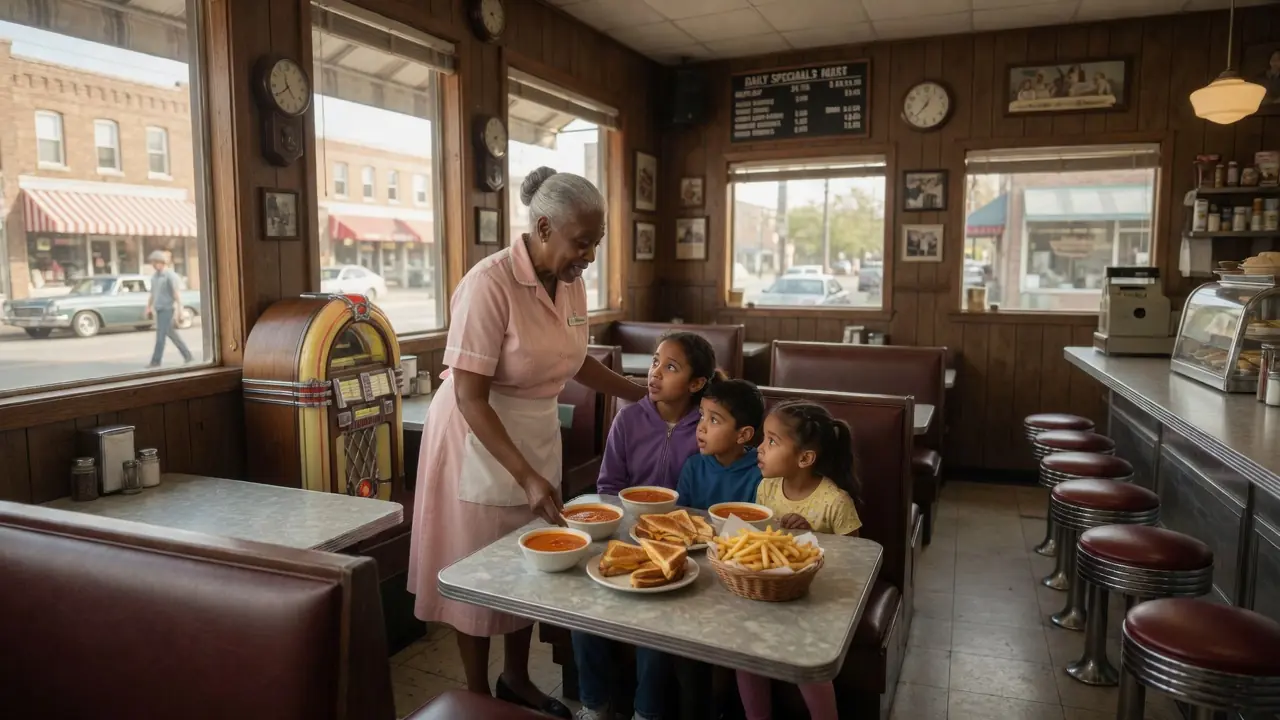
Eleanor was seventy-two years old, with silver hair pinned into a neat bun, brown skin, kind eyes, and hands that had carried plates for so many years they seemed to know the weight of hunger before a person spoke. She had worked at Miller’s Corner Diner for almost thirty years, long enough to remember when the jukebox still worked, when the red vinyl booths were new, and when the cracked black-and-white floor tiles still shone after mopping.
The diner sat on the corner of Bell Street and Monroe Avenue, across from a small public library and two blocks from Cedar Falls Elementary School. It was the kind of place people passed every day without really seeing until they needed it. The windows were wide, the coffee was strong, the pancakes were large, and the regulars believed every problem in town could be discussed over hash browns if you sat long enough.
Eleanor liked the afternoon best.
The breakfast rush was noisy. Lunch was crowded. Dinner could be lonely. But the hour after school let out had its own rhythm. Children walked past with backpacks bouncing. Parents stopped in for takeout. Teachers bought coffee strong enough to survive grading papers. Sometimes a child pressed both hands against the glass to look at the pies in the display case, and Eleanor would smile as if the world had not changed too much after all.
On a chilly Wednesday in November, the bell rang at 3:17.
Eleanor looked up from wiping the counter.
Three children stood just inside the door.
The oldest was a girl of about eleven, thin and serious, with dark blond hair pulled into a ponytail and a green backpack that looked too heavy for her shoulders. Beside her stood a boy around eight, with round glasses slipping down his nose and a jacket missing one button. Behind them, half-hidden by the older girl’s arm, was a little girl maybe six years old, clutching a stuffed rabbit with one flattened ear.
They were not regulars.
Eleanor knew most of the children who came in after school. Some came with parents, some with grandparents, some with older siblings who ordered fries and tried to act grown. These three did not move like children entering a place they knew. They stepped in carefully, as if the floor might object to them being there.
The older girl looked at the menu board above the counter.
Then she looked at the coins in her palm.
Eleanor noticed that.
She had spent enough years in diners, kitchens, church basements, school fundraisers, and grocery lines to recognize the quiet math of not having enough.
The boy whispered something to the older girl.
She shook her head.
The little girl with the rabbit stared at the rotating pie case as if it contained treasure behind glass.
Eleanor folded her towel and placed it under the counter.
“Afternoon,” she said gently. “Y’all coming in out of the cold?”
The oldest girl straightened.
“Yes, ma’am.”
Her voice was polite but guarded.
“You want a booth or the counter?”
The girl looked at the other two children, then back at the menu.
“Just one small fries, please.”
The boy looked down.
The little girl kept staring at the pie.
Eleanor did not move toward the register yet.
“One small fries,” she repeated. “Anything to drink?”
“Water is fine.”
“For all three of you?”
The older girl nodded quickly. “Yes, ma’am.”
Eleanor could see the coins in her hand more clearly now. Quarters, nickels, pennies, maybe a dime. Not much. The girl held them tight, as though someone might count them before she was ready.
“What are your names?” Eleanor asked.
The girl hesitated.
“I’m Sophie.”
The boy lifted a hand shyly. “Noah.”
The little girl whispered, “Lily.”
Eleanor smiled. “Well, Sophie, Noah, and Lily, I’m Eleanor. Most folks around here call me Miss Ellie.”
Lily peered around Sophie’s sleeve. “Are you the cook?”
“No, baby. I’m the one who tells the cook what people need.”
Lily seemed to consider that an important job.
Sophie placed the coins on the counter. “We only need one small fries.”
Eleanor looked at the money without touching it.
Then she looked at the children’s shoes, their thin jackets, Noah’s red fingers, Lily’s tired eyes, and Sophie’s careful expression. The oldest child had already learned how to stand between the world and the younger ones. Eleanor had seen that before, and it always made her chest ache.
“Tell you what,” Eleanor said. “Why don’t you three sit in that booth by the window? It’s warmer there.”
Sophie did not move.
“How much is the small fries?”
“Today?” Eleanor said. “Today the small fries are on special.”
Sophie frowned.
“They are?”
“They are when I say they are.”
The girl’s face tightened, not with anger, but with embarrassment. “We can pay.”
“I know you can,” Eleanor said softly. “And you will. But first sit down so I can bring water. Your hands look frozen.”
Noah glanced at Sophie. Lily tugged the older girl’s sleeve.
Finally, Sophie gathered the coins again and led her brother and sister to the window booth.
Eleanor walked into the kitchen and found Ray, the cook, flipping burgers on the flat-top grill.
“Ray,” she said quietly, “I need a basket of fries, three grilled cheese sandwiches, and three cups of tomato soup.”
“Kids got money?”
“They got enough.”
“For all that?”
Eleanor gave him a look.
Ray raised both hands. “All right, Miss Ellie. I know that look.”
“And cut the sandwiches diagonal.”
“You think I was born yesterday?”
“And don’t make a fuss when I ring it up as staff meal.”
Ray turned back to the grill, shaking his head.
“You been feeding half this town since before I had gray hair.”
“And look how good you turned out.”
“I turned out tired.”
“That’s because you complain too much.”
Ray laughed, but he started the sandwiches.
Eleanor returned with three glasses of water and set them on the table.
Sophie sat upright, backpack still on her shoulders. Noah held his hands around the glass but did not drink yet. Lily had placed the stuffed rabbit carefully beside her.
“You can take your backpack off, sweetheart,” Eleanor said.
Sophie shook her head. “We won’t stay long.”
“No rush. It’s cold outside.”
“We’re waiting for our mom to finish work.”
“At the school?”
“No. At the grocery store on Wilson.”
“That’s a long walk from here.”
Sophie looked down.
Eleanor did not push.
Children who protected family information did not need to be forced open. Trust was not a can. It could not be pried loose. It had to be warmed.
A few minutes later, Eleanor brought the food.
Three bowls of tomato soup.
Three grilled cheese sandwiches.
A large basket of fries in the middle.
Lily’s eyes grew wide.
Noah sat back as if the plates had startled him.
Sophie looked at Eleanor, then at the food, then at the coins still in her hand.
“We didn’t order this.”
“I know,” Eleanor said. “Kitchen made extra.”
Sophie’s cheeks flushed. “We can’t pay for extra.”
Eleanor leaned slightly closer, keeping her voice low so no one else would hear.
“Then don’t call it extra. Call it lucky timing.”
Sophie stared at her.
“My mama says we don’t take things from people.”
“Your mama sounds like a woman with pride.”
“She is.”
“I respect that,” Eleanor said. “So here’s what we’ll do. You pay for the fries. The soup and sandwiches are from the kitchen because Ray made more than we needed.”
Sophie glanced toward the kitchen.
Ray, who had clearly been listening, called out, “Burned the first batch of sandwiches in my mind. Had to remake them.”
Lily giggled.
Sophie did not smile yet, but her shoulders lowered a little.
Eleanor placed a small plate in front of Lily. “Eat while it’s hot.”
Lily looked at Sophie for permission.
Sophie nodded.
Only then did the little girl pick up half a grilled cheese sandwich with both hands and take a bite.
Eleanor turned away before the children could see her face.
There were many kinds of hunger. Some were loud and impatient. Some were hidden behind manners, backpacks, and older sisters who ordered one small fries for three children.
That afternoon, the three children ate almost silently at first. Not greedily. Carefully. As if saving room was a habit. Noah dipped his sandwich into the soup and closed his eyes for half a second. Lily fed a pretend crumb to her rabbit before eating another bite. Sophie ate last, watching the younger two until she was sure they had enough.
Eleanor refilled their water.
When she cleared the empty bowls, Sophie placed the coins on the table.
“We owe for the fries,” she said.
Eleanor counted the coins slowly, though she already knew it was not enough.
“Looks right to me.”
Sophie watched her face, searching for a lie.
Eleanor put the coins in her apron pocket. “Thank you.”
Noah looked up. “Do you have pie every day?”
“Most days.”
“What kind is that one?”
“Apple.”
Lily whispered, “It looks like Thanksgiving.”
Eleanor glanced at the pie case.
Then she looked at Sophie, who was already preparing to say no.
“Not today,” Eleanor said before the older girl could speak. “But sometimes pie has a way of finding people.”
Sophie did not know what to do with that, so she stood.
“We should go.”
“Where are you meeting your mama?”
“At home.”
Eleanor kept her face calm. “You three walk home by yourselves?”
Sophie lifted her chin. “We know the way.”
“I believe you.”
“Our mom doesn’t like it, but she has work.”
“I understand.”
And Eleanor did. More than the child knew.
She watched them leave, Lily holding Sophie’s hand, Noah walking close on the other side. The bell gave its tired little song as the door closed behind them.
Ray came out of the kitchen holding a towel.
“You going to tell somebody?” he asked.
“Tell who?”
“The school? Their mama?”
Eleanor looked through the window as the children turned the corner.
“Not yet.”
“They’re little.”
“Yes.”
“And hungry.”
“Yes.”
Ray sighed. “You always got to carry everything quiet.”
“Not everything needs a trumpet.”
The next day, they came back.
This time at 3:21.
Sophie opened the door first and looked inside as if expecting yesterday’s kindness to have expired.
Eleanor was ready with coffee for a customer at the counter and three waters waiting near the service station.
“Well, look who found us again,” she said.
Noah smiled shyly.
Lily waved the rabbit’s paw.
Sophie came to the counter and placed a folded dollar bill down with great seriousness.
“One small fries, please.”
Eleanor nodded as if this were a business negotiation. “Coming up.”
That day, the kitchen again had extra soup.
The day after that, there were pancakes that had been “made by mistake.”
On Friday, Ray claimed he had accidentally cooked too much macaroni and cheese, which was unlikely because Ray measured everything. Lily believed him completely.
Within two weeks, the children became part of the diner’s afternoon.
They always ordered something small. They always paid what they had. Eleanor always found a way to make the meal larger without making the children feel smaller.
She learned their story slowly.
Their last name was Walker.
Sophie was eleven, Noah was eight, Lily was six.
Their mother, Marissa Walker, worked at Greenway Market on Wilson Avenue. She had recently picked up extra shifts after her hours at a cleaning company were cut. Their apartment was four blocks from the diner, above a closed hardware store with a blue door that stuck in cold weather.
Their father was not in the home. Sophie said that only once and did not explain further. Eleanor did not ask.
On school days, the children were supposed to go home together, lock the door, and wait for Marissa. But when the weather turned cold, and the walk felt longer, and the apartment felt too quiet, they had started stopping in front of the diner window.
At first, just to look.
Then to buy fries.
Then Eleanor had seen them.
By December, Sophie began taking off her backpack in the booth.
That was when Eleanor knew trust had started.
Noah brought homework and spread worksheets across the table. Lily colored on napkins with crayons Eleanor kept in a coffee mug behind the counter. Sophie helped them both before doing her own assignments.
Eleanor watched the girl one afternoon as she explained subtraction to Lily with patient seriousness.
“You’d make a good teacher,” Eleanor said.
Sophie looked startled. “Me?”
“Yes, you.”
“I don’t know.”
“Teachers have to explain things five different ways and not throw the pencil. You’re already ahead.”
Sophie smiled at the table.
Noah looked up from his spelling words. “I want to be a builder.”
“What kind?” Eleanor asked.
“Houses. But not the kind that cost too much.”
Ray, listening from the kitchen, called, “That’s the only kind they build now.”
Eleanor said, “Ray.”
“What? I’m educating the youth.”
Lily raised her hand. “I want to be a pie maker.”
Eleanor smiled. “A fine profession.”
Sophie nudged Lily gently. “You said yesterday you wanted to be a veterinarian.”
“I can be both.”
“Pie for pets?” Noah asked.
Lily frowned. “No. People pie.”
Eleanor laughed so hard she had to sit down.
Those afternoons became the warmest part of her days.
Not because they were easy. Eleanor still worked long hours. Her knees ached when the weather changed. Her apartment was quiet since her husband, Samuel, had passed nine years earlier. Her own daughter lived in North Carolina and called twice a week, but the distance remained. Some evenings, Eleanor went home so tired she ate toast for dinner and fell asleep with the television on.
But the Walker children made the world feel less empty.
They did not know they were doing that.
Children rarely knew when they saved adults.
They only knew Miss Ellie had napkins, crayons, warm food, and a booth where nobody rushed them.
One Friday before Christmas break, Cedar Falls Elementary dismissed early.
The diner was busy with parents, teachers, and holiday shoppers. Eleanor moved from table to table carrying plates, refilling coffee, wrapping leftovers, and calling everyone “baby” when she was too tired to remember names.
At 1:40, the Walker children came in.
Lily’s eyes were red.
Sophie’s face was tight.
Noah looked angry in the helpless way children look angry when they are trying not to cry.
Eleanor saw them immediately.
She pointed to the window booth. “Sit.”
Sophie did not argue.
Eleanor finished delivering two plates, then came over.
“What happened?”
Sophie shook her head.
Noah blurted, “They said Lily couldn’t be in the winter show because she didn’t have the right shirt.”
Sophie whispered, “Noah.”
Eleanor sat down beside them.
“What shirt?”
“A white button-up,” Sophie said. “The kindergarten class is singing. They sent a paper home, but Mama didn’t see it until last night. Lily has a white sweater, but Mrs. Bell said everybody has to match.”
Lily held her rabbit against her chest.
“I practiced the snow song,” she whispered.
Eleanor felt a flare of anger rise inside her, but she kept her voice gentle.
“When is the show?”
“Tonight,” Sophie said.
Eleanor stood.
“Eat first.”
“We’re not hungry,” Sophie said automatically.
Ray leaned through the service window. “That is the saddest lie I heard all week.”
Eleanor gave him a look, but Sophie almost smiled.
The children ate grilled cheese and vegetable soup. After they finished, Eleanor took off her apron.
Ray noticed immediately.
“Where are you going?”
“Back in twenty minutes.”
“We got customers.”
“You got hands.”
“Miss Ellie.”
She pointed at him. “You know how to pour coffee.”
Ray muttered, but he took the coffee pot.
Eleanor walked two blocks to the thrift store near the church. She knew the owner, Mrs. Patterson, and she knew the back rack where children’s clothes hung by size.
By luck, or grace, or the mysterious way the right thing sometimes waits in an ordinary place, there was one white button-up shirt in Lily’s size.
It cost three dollars.
Eleanor bought it, along with a small red ribbon from a basket near the register.
When she returned to the diner, the children were still in the booth. Sophie stood as soon as she saw the bag.
“What is that?”
“A solution.”
Sophie’s face closed. “Miss Ellie.”
Eleanor lowered her voice. “This is not charity. This is wardrobe management.”
Noah frowned. “That sounds like school words.”
“It is.”
Sophie looked at the bag. “My mom didn’t say we could.”
“Then we will call her.”
That was the first time Eleanor spoke to Marissa Walker.
The grocery store was loud in the background when Marissa answered. Her voice sounded strained, cautious, and tired.
Eleanor introduced herself carefully.
“I work at Miller’s Corner Diner. Your children stop in after school sometimes.”
There was a pause.
“My children what?”
Eleanor closed her eyes for half a second. She had not wanted to make trouble.
“They are safe,” she said quickly. “They buy fries. They do homework. I should have called sooner, and I apologize for that.”
Another pause.
Then Marissa’s voice lowered. “Are they bothering you?”
“No, ma’am. Not at all.”
“I told them to go straight home.”
“They do go home. They stop here first because it is cold and close, and I should have asked your permission. That is on me.”
Marissa said nothing.
Eleanor continued, “Your youngest has her winter show tonight. There was a shirt issue. I found a white button-up at the thrift store. I am asking if you will allow Lily to wear it.”
In the silence that followed, Eleanor heard a register beeping on the other end.
Then Marissa said softly, “How much?”
“Three dollars.”
“I can bring it when I get paid.”
“No rush.”
“I will bring it.”
“Yes, ma’am.”
“My children ate there?”
“They did.”
“How much do they owe?”
Eleanor looked at Sophie, who was watching with fear in her eyes.
“They pay for what they order,” Eleanor said. “Sometimes the kitchen has extra.”
Marissa understood. Eleanor could hear it in her breathing.
“I don’t want them begging.”
“They are not begging.”
“I work.”
“I know.”
“I am trying.”
“I know that too.”
Marissa was quiet for a long moment.
Then she whispered, “Let her wear the shirt.”
Eleanor’s eyes stung.
“Yes, ma’am.”
“And tell Sophie I’m not mad.”
Eleanor looked at Sophie and smiled gently.
“She needs to hear that.”
“I’ll come to the diner tomorrow,” Marissa said. “We’ll talk.”
“I’ll be here.”
The winter show that night took place in the elementary school cafeteria, with folding chairs, paper snowflakes, and parents holding up phones.
Eleanor came after her shift, wearing her good coat and black shoes. She stood in the back beside Marissa Walker, who had arrived just before the kindergarten class walked in.
Marissa was younger than Eleanor had imagined, maybe early thirties, with tired eyes, light brown hair pulled into a bun, and a grocery store uniform under her coat. She looked like someone who had run from work without stopping to breathe.
When Lily walked onto the stage in the white button-up shirt with the red ribbon in her hair, she searched the room nervously.
She found her mother first.
Then Sophie and Noah.
Then Miss Ellie.
Lily smiled so wide the whole cafeteria seemed brighter.
She sang every word of the snow song.
Marissa cried quietly through the entire performance.
Afterward, she turned to Eleanor.
“I don’t know what to say.”
Eleanor watched Lily run toward them.
“Say she looked beautiful.”
Marissa nodded, wiping her face. “She did.”
From that night on, there were no more secrets between Marissa and Eleanor.
There was pride, yes. There were boundaries. There were conversations at the counter about what the children could accept and what Marissa insisted on paying back. But there was also relief.
Marissa began leaving a few dollars in a jar Eleanor kept under the register marked “Walker Account,” though Eleanor never counted it in front of her. Sometimes Marissa paid. Sometimes she could not. Eleanor never mentioned the difference.
The children kept coming after school.
On rainy days, they came in damp and laughing.
On hot days, Eleanor gave them ice water before they asked.
On days when homework was hard, Ray pretended he knew math until Noah corrected him.
On days when Sophie looked worn down from being responsible, Eleanor gave her small jobs that made her feel older in a good way instead of a heavy one.
“Can you help me check these sugar packets?”
“Can you tell Lily that pie crust needs patience?”
“Can you read this sign and make sure my spelling looks right?”
Sophie liked being trusted.
Noah liked fixing things. If a chair leg wobbled, he noticed. If a napkin holder stuck, he studied it. Ray gave him a screwdriver once, then regretted it when Noah tried to improve every loose hinge in the diner.
Lily liked drawing pies, dogs, flowers, and once, a picture of Eleanor with wings.
“I am not an angel,” Eleanor told her.
Lily shrugged. “You have restaurant wings.”
Eleanor pinned the drawing behind the counter.
Years passed in the way years do when people are busy surviving them.
The Walker children grew.
Sophie became taller, her serious face softening into quiet confidence. She volunteered in the school library and helped younger children read. Teachers said she had a gift for patience.
Noah became a boy who carried tools in his backpack and could not pass a crooked shelf without wanting to repair it. Ray taught him how to patch a cracked diner stool, tighten cabinet handles, and respect every tool enough to put it back where it belonged.
Lily became cheerful, imaginative, and stubborn. She baked her first apple pie at thirteen with Eleanor standing beside her in the diner kitchen on a Sunday afternoon when the restaurant was closed.
The pie was uneven.
The filling bubbled over.
The crust browned too much on one side.
Lily looked devastated.
Eleanor cut a slice, tasted it, and nodded seriously.
“This pie has a future.”
Lily laughed until she cried.
Marissa worked her way up at Greenway Market. First shift leader, then assistant manager. The children still struggled sometimes, but the desperation of those first months eased. Their apartment above the hardware store became a place with secondhand curtains, a kitchen table, and a shelf where Lily kept recipe cards.
Every Thanksgiving, Eleanor brought them pie.
Every Christmas, the Walkers brought Eleanor a tin of cookies, even when the cookies were slightly burned.
Eleanor loved them more than perfect cookies.
When Sophie graduated high school, she wore a blue dress and came straight to Miller’s Corner Diner afterward.
Eleanor was seventy-nine then.
Her hair was fully silver, her knees slower, but she still worked the afternoon shift. Sophie walked in wearing her graduation gown, and the bell above the door rang like it had been waiting for that moment.
“Miss Ellie,” Sophie said, holding an envelope.
Eleanor wiped her hands on her apron. “Don’t you start crying before I do.”
“I got the scholarship.”
Ray leaned out of the kitchen. “The teaching one?”
Sophie nodded.
Ray shouted so loudly a man at the counter spilled coffee onto his saucer.
Eleanor hugged Sophie carefully, then held her at arm’s length.
“I told you.”
“You told me what?”
“That you’d make a good teacher.”
Sophie smiled through tears. “I remember.”
Noah graduated three years later and went to a community college construction management program. He told Eleanor he wanted to build affordable homes and community spaces.
“Not ugly ones,” he said.
“Good,” Eleanor replied. “Poor folks deserve windows too.”
Lily, the youngest, stayed closest to the diner. She worked there part-time in high school, learned the breakfast shift, mastered pie crust after many failures, and eventually went to culinary school in Columbus.
When each child left Cedar Falls, Eleanor felt proud.
She also felt the booth by the window grow larger and emptier.
Children were supposed to grow. She knew that. She had told herself that when her own daughter moved away, when the Walker children went to college, when the school kids she once served became adults who came in with babies of their own.
Still, some afternoons, at 3:17, Eleanor looked at the door.
The bell rang for other people.
But not for three hungry children with coins in one careful hand.
By the time Eleanor turned eighty-two, Miller’s Corner Diner was in trouble.
The owner, Mr. Miller’s grandson, had inherited the building but not the love for the place. He lived in Cincinnati, visited twice a year, and spoke about “market value” as if the diner were an old chair to be sold. The roof needed work. The booths needed repair. The kitchen equipment was old. New restaurants had opened near the highway with shiny signs and online ordering.
Miller’s Corner Diner still had loyal customers, but loyalty did not always pay invoices.
Eleanor noticed the signs before anyone told her.
Shorter supply orders.
Repairs delayed.
The pie case light left unfixed.
Ray’s hours cut.
Then one Monday morning in March, a notice appeared near the register.
Miller’s Corner Diner will be closing at the end of April.
Thank you for serving Cedar Falls for over fifty years.
Eleanor read it three times.
Ray stood beside her, arms crossed.
“Well,” he said, too quietly, “that’s that.”
Eleanor touched the edge of the counter.
She thought of all the people who had sat there. All the coffee poured. All the schoolchildren warmed. All the worries softened over soup and toast. She thought of Samuel sitting in the corner booth years ago, waiting for her shift to end. She thought of Sophie, Noah, and Lily sharing one small fries.
The diner was not just a business.
It was a memory with tables.
For the next several weeks, people came in to say goodbye.
Retired teachers. Former students. Truck drivers. Church ladies. Old couples who had eaten there every Friday for thirty years. Young parents who remembered coming after school. Everyone had a story, and every story seemed to pass through Eleanor.
“You remember when you gave my son pancakes after he missed the bus?”
“You remember when my mother sat here after Dad passed?”
“You remember when you let us use the back table for tutoring?”
Eleanor remembered more than she admitted.
But each night, she went home exhausted and sat alone at her kitchen table, too tired to cook.
Her daughter begged her to move to North Carolina.
“Mom, you can finally rest.”
Eleanor looked around her small apartment, at the photographs on the wall, the church calendar, the potted plant Lily had given her, the old recipe box on the counter.
“I don’t know how to be useful there,” she said.
“You don’t have to be useful all the time.”
Eleanor smiled sadly. “That sounds nice when young people say it.”
The final week arrived.
The pie case was half-empty. The menu was shorter. The regulars tried to act cheerful and failed.
On the last Friday, Eleanor came in before sunrise.
She wore her best uniform dress, the one she usually saved for holidays at the diner. She pinned her hair carefully and put on the small pearl earrings Samuel had given her on their twentieth anniversary.
Ray was already in the kitchen.
“You’re early,” he said.
“So are you.”
“Couldn’t sleep.”
“Me neither.”
They worked mostly in silence.
At 3:15, Eleanor stood behind the counter and looked at the door.
The bell rang.
For one impossible second, she expected to see them as children.
Sophie with the green backpack.
Noah with round glasses.
Lily with the stuffed rabbit.
Instead, three adults walked in.
Sophie came first, now twenty-seven, with her hair pulled back and a teacher’s badge clipped to her coat. Noah followed, tall and broad-shouldered, carrying rolled blueprints under one arm. Lily stepped in last, wearing a cream-colored baker’s jacket beneath a long coat, her eyes already shining.
Eleanor placed one hand on the counter.
“Oh,” she whispered.
Lily crossed the diner first and wrapped her arms around Eleanor.
Sophie joined them.
Then Noah.
For a moment, Eleanor disappeared inside the embrace of the children she had fed when the world had been cold.
Ray leaned through the kitchen window, wiping his eyes with a towel and pretending not to.
“You all got grown without permission,” he said.
Noah laughed. “You got older with permission?”
“Watch it, tool boy.”
Eleanor pulled back and touched each of their faces as if making sure they were real.
“What are you doing here?”
Sophie smiled. “We heard the diner was closing.”
Eleanor looked down. “Everybody heard.”
“We came to talk,” Noah said.
“That sounds serious.”
“It is,” Lily said.
They sat in the old window booth.
The same booth.
For a moment, no one spoke.
Then Sophie placed an envelope on the table.
“Do you remember the first day we came in?” she asked.
Eleanor laughed softly. “You ordered one small fries.”
“We had eighty-seven cents,” Noah said.
“I knew it wasn’t enough,” Sophie admitted.
“I did too.”
Lily smiled. “I thought tomato soup came with fries everywhere.”
They laughed, then grew quiet.
Sophie opened the envelope and took out an old napkin, carefully preserved in a plastic sleeve. On it was a faded crayon drawing of Eleanor with wings.
Eleanor covered her mouth.
“You kept that?”
Lily nodded. “You kept the original behind the counter. I drew another one at home because I wanted one too.”
Eleanor’s eyes filled.
Noah unrolled the blueprints.
“These are plans.”
“For what?” Eleanor asked.
“For this place,” he said. “If the owner will sell.”
Eleanor stared at him.
Sophie leaned forward. “We formed a nonprofit last year. It’s called The Corner Table Project.”
“The what?”
“The Corner Table Project,” Lily said. “It combines after-school meals, tutoring, family dinners, and job training in familiar neighborhood restaurants.”
Eleanor looked from one to the other.
Noah continued, “A lot of towns have old diners, churches, cafés, and community kitchens that people trust but can’t keep open. We want to preserve them and use them to feed kids after school with dignity.”
“With dignity,” Sophie repeated softly. “Not lines. Not labels. Just a place to sit, eat, study, and be known.”
Eleanor could not speak.
Lily reached across the table and took her hand.
“It started here.”
Ray came out of the kitchen slowly.
“What exactly are you saying?” he asked.
Noah tapped the blueprints. “I’m saying we have investors, grants, and a purchase offer ready. The building needs work, but it’s solid. We want to buy it, renovate it, keep the diner open, and add an after-school meal program in the back room.”
Ray blinked. “You want to buy Miller’s?”
Sophie smiled. “We already made the offer this morning.”
Eleanor’s heart seemed to stop for a second.
“You what?”
“The owner is interested,” Noah said. “Very interested.”
Ray muttered, “Of course he is. He’d sell his own shoes if somebody praised the leather.”
Eleanor shot him a look, but she almost laughed through her tears.
Lily squeezed Eleanor’s hand.
“We want you to stay,” she said.
“Baby, I’m eighty-two.”
“We know.”
“My knees are older.”
“We know that too,” Sophie said.
“I can’t run some big program.”
“You don’t have to,” Noah said. “We’ll hire staff. Lily will oversee the kitchen launch. Sophie is building the tutoring partnerships. I’ll manage renovations. Ray, if he wants, stays head cook.”
Ray folded his arms. “If he wants?”
Lily grinned. “We were trying to be respectful.”
“I want.”
Everyone laughed.
Eleanor wiped her eyes with a napkin.
“And me?”
Sophie’s voice softened.
“You would be what you’ve always been.”
“What’s that?”
“The heart of the room.”
Eleanor looked toward the counter, the pie case, the cracked floor tiles, the booth where three children had once learned they could be hungry without being ashamed.
“I only gave you food,” she whispered.
Noah shook his head.
“No, Miss Ellie. You gave us a place where needing help didn’t feel like failing.”
Sophie added, “You gave me time to be a child, even when I was trying to be the adult.”
“You taught me that food can feel safe,” Lily said.
Ray cleared his throat. “And you taught me to make extra without asking questions.”
Eleanor laughed and cried at the same time.
The deal took two months.
The town talked about nothing else.
Miller’s Corner Diner closed for renovations in June and reopened in September under a new sign that kept the old name but added smaller letters beneath it:
Miller’s Corner Diner
Home of The Corner Table Project
The outside was repainted but still familiar. The red booths were repaired, not replaced. The black-and-white floor was cleaned and restored. The bell above the door was polished but left crooked because Eleanor insisted it had character.
The back room, once used for storage, became a bright after-school space with bookshelves, homework tables, a small reading corner, and a serving window from the kitchen.
But the most important rule came from Eleanor.
“No child stands in a separate line,” she said.
So they did not.
Children came in, sat at tables, and ordered from a simple afternoon menu. Grilled cheese. Soup. Fruit. Oatmeal. Turkey sandwiches. Pancakes on Fridays. Everything looked like regular diner food because it was regular diner food.
Families could pay what they could, volunteer, donate, or simply say thank you. No child was asked to explain hunger.
On opening day, the first group came from Cedar Falls Elementary at 3:15.
Eleanor stood by the counter in a fresh apron.
Sophie guided children to tables. Noah adjusted a wobbly chair he had already fixed twice. Lily brought out a tray of apple hand pies, each one wrapped in paper printed with the words: Made with patience.
Ray called from the kitchen, “Soup’s ready!”
The bell rang.
Children poured in.
Some were loud. Some were shy. Some tried to act like they did not need the meal. Eleanor recognized them all.
A little boy with a backpack almost as big as his body approached the counter.
“How much is grilled cheese?” he asked.
Eleanor leaned down slightly.
“Today it’s on special.”
He narrowed his eyes. “Every day?”
She smiled.
“Most important things are.”
He considered this, then nodded. “Okay.”
A girl nearby said, “Do we have to eat fast?”
Sophie heard her and answered, “No. You have time.”
That sentence settled over Eleanor like a blessing.
You have time.
How many children needed to hear that?
Time to eat.
Time to warm up.
Time to grow.
Time to stop carrying adult worry for twenty minutes.
Later that afternoon, the town gathered for a small ceremony. Eleanor did not want speeches. The Walker siblings insisted on one.
Sophie stood first.
“When we were children,” she said, “my brother, sister, and I came into this diner with less than a dollar. We were cold, hungry, and embarrassed. Miss Ellie saw us. But she did more than see us. She helped us in a way that protected our pride.”
Noah stood beside her.
“She never made us feel like a project. She made us feel like customers, neighbors, children worth feeding.”
Lily wiped her eyes before speaking.
“I became a baker because Miss Ellie taught me that food is not only what fills a stomach. It can tell someone they are welcome to stay.”
Eleanor sat in the front booth, crying openly now.
Sophie looked at the crowd.
“The Corner Table Project exists because one elderly waitress decided three hungry kids deserved more than one small fries.”
Everyone turned toward Eleanor.
She shook her head, overwhelmed.
Ray called out, “Speech!”
Eleanor pointed at him. “You hush.”
But the crowd clapped until she stood.
She walked slowly to the front, one hand resting on Lily’s arm.
For a moment, she looked around the diner.
The repaired booths.
The clean floor.
The children eating soup.
The old bell over the door.
The Walker siblings standing tall.
“I don’t have a big speech,” Eleanor began.
Ray muttered, “That’ll be the day.”
People laughed.
Eleanor smiled, then grew serious.
“I worked in this diner a long time. I thought I was carrying plates. Coffee. Pie. Soup. But sometimes, without knowing it, you carry a little bit of somebody’s tomorrow.”
The room quieted.
“When children come through a door hungry, cold, or worried, they are not asking us to solve the whole world. Most times, they just need one adult to make the next hour gentler.”
She looked at Sophie, Noah, and Lily.
“These three came in years ago and ordered one small fries. I saw children trying very hard not to need anything. And I remembered something my mother told me when I was young. She said, ‘Eleanor, if you can feed a child without making them bow their head, do it.’”
Sophie lowered her eyes, crying.
“So I did,” Eleanor said. “And now look what happened. They came back and built a bigger table.”
The applause rose warm and full.
Not fancy.
Not polished.
Just real.
That evening, after the celebration ended and the last child went home with a full stomach, Eleanor sat in the window booth with Sophie, Noah, Lily, Marissa, and Ray.
For the first time in years, the diner was quiet without feeling empty.
Lily brought out a pie.
It was apple, golden and uneven in the best way.
Eleanor took one bite and closed her eyes.
“This pie has a future,” she said.
Lily laughed through tears. “Still?”
“Always.”
Noah raised his coffee cup. “To Miss Ellie.”
Sophie lifted hers. “To the woman who made extra.”
Ray lifted his. “To staff meals that fooled nobody.”
Marissa, older now but stronger, touched Eleanor’s hand.
“To the first person who helped my children without making me feel like I had failed them.”
Eleanor could not answer right away.
She looked at Marissa, then at the three grown children, then at the back room where tomorrow more children would sit after school, pretending not to be hungry until someone placed food in front of them with kindness.
Finally, Eleanor lifted her cup.
“To the corner table,” she said.
The next afternoon, at 3:15, the bell rang again.
A new group of children came in from the cold. They carried backpacks, worries, homework, and the quiet hunger that adults often miss when children are too polite to name it.
Eleanor stood by the counter.
Her knees hurt.
Her hands were slower.
Her heart was full.
A little girl approached, holding coins in her palm.
“One small fries, please,” the girl said.
Eleanor smiled gently.
Behind her, Sophie looked up from the homework table. Noah tightened a screw on a chair leg. Lily slid grilled cheese sandwiches onto plates. Ray stirred tomato soup in the kitchen.
Eleanor leaned on the counter and said what she had said years before.
“Why don’t you sit in that booth by the window, sweetheart? It’s warmer there.”
The girl hesitated.
Then she nodded.
The bell above the door settled into silence.
Outside, Cedar Falls moved through another ordinary afternoon.
Inside Miller’s Corner Diner, one small kindness kept becoming something larger.
A meal.
A safe seat.
A repaired place.
A bigger table.
And because an old waitress had once noticed three hungry children counting coins in the cold, no child who came through that door would ever have to feel ashamed for needing to be fed.