Marcus Webb woke before sunrise in a penthouse overlooking San Francisco Bay, but the view meant nothing to him.
The room was quiet, cold, and perfect in a way that made it feel less like a home and more like a place someone had staged for photographs. Glass walls stretched from floor to ceiling. The city below was wrapped in pale morning fog. A coffee machine worth more than most people’s monthly rent began humming in the kitchen, but Marcus barely looked at it.
He was 31 years old, the founder of a successful technology company, and worth more money than he had ever known how to spend.
People called him brilliant.
Investors called him disciplined.
Magazines called him a self-made success story.
But every morning, before the emails, before the meetings, before anyone had a chance to praise him for another business win, Marcus opened the bottom drawer of his desk and took out the only object in his apartment that truly mattered.
It was a yellowed church offering envelope sealed inside a clear plastic bag.
The edges were soft with age. The ink had faded but had not disappeared.
Written across the front in careful handwriting was a name and address.
Claudette M. Pearson.
4817 Crane Street.
Detroit, Michigan.
Marcus touched the plastic gently, the way a person touches something sacred.
He had carried that envelope for 23 years.
He had been eight years old when it was given to him, sitting outside a gas station in the freezing Detroit cold, sick, hungry, and nearly forgotten by the world.
The woman who gave it to him had saved his life with $1.17.
And now, after building companies, raising millions, and becoming a man people listened to, Marcus still had not found her.
He had spent four years searching.
He had hired private investigators. He had checked old church records. He had searched city databases. He had driven through Detroit neighborhoods himself, stopping at old houses, closed churches, and community centers.
Nothing.
Every trail ended.
The house on Crane Street had been sold years ago.
The church she once attended had closed.
No fixed address had been found after 2015.
Most people told him gently that perhaps Claudette Pearson was gone.
Marcus refused to believe it.
That morning, his phone buzzed with another message from his co-founder, Deja.
Series closed. $18 million.
Marcus typed back one word.
Good.
Then he put the phone down.
Eighteen million dollars should have made him feel something.
It did not.
He looked again at the offering envelope and whispered, “Where are you?”
When the call ended, Deja asked him to stay behind.
“You’re somewhere else again,” she said.
“I’m fine.”
“You’re always fine. That’s the problem.”
Marcus looked away.
Deja softened. “Is this about Detroit?”
He said nothing.
“You’ve flown there four times this year,” she said. “You keep funding programs in the same few neighborhoods. You keep showing up there like you’re waiting for a ghost.”
“She’s not a ghost.”
“You don’t know that.”
Marcus’s jaw tightened.
“I know she’s out there.”
Deja sighed. She cared about him, and that made the conversation harder.
“Marcus, I’m not telling you to stop caring. I’m telling you not to let this consume everything you’ve built.”
He almost laughed.
Everything he had built had begun with her.
After the call, Marcus opened a folder on his computer. Inside were years of notes, reports, addresses, leads, photographs, and dead ends.
Claudette M. Pearson.
Believed to be in her early to mid-seventies.
Last known church connection inactive.
No confirmed current residence.
Trail ends.
Marcus leaned back in his chair and stared at the screen.
Then a calendar reminder appeared.
Community Dinner.
Second Hope Church of God.
Detroit.
6:30 p.m.
Volunteer orientation.
Normally, Marcus would have sent a check. His team handled his charitable partnerships. He was expected to be generous from a distance, the kind of donor whose name appeared on plaques but whose face rarely appeared at folding tables.
But something about that reminder held him.
Second Hope was only a few miles from the address on the envelope.
He opened his email and wrote directly to the program director.
I’ll attend in person tonight.
He did not know why he was going.
Not exactly.
But Marcus had learned to respect certain feelings.
Some memories did not fade.
They waited.
They followed.
They returned at strange hours with perfect clarity.
Twenty-three years earlier, Marcus had been eight years old in Detroit during a January cold wave that made the streets feel dangerous even in daylight.
His mother had been in the hospital for six days. No one had told him clearly when she would come home. His aunt had promised to check on him, but promises were easy to make and easier to abandon.
By the third night, Marcus understood something adults had tried not to say.
No one was coming.
He had 43 cents in his pocket and a coat with a broken zipper.
By the fourth night, he found himself sitting outside a gas station on Mac Avenue, pressed against the brick wall near an exhaust vent because it gave off a little warmth. He was feverish. His stomach had moved past hunger into something hollow and painful. His fingers were stiff. His lips were cracked.
People walked past him.
Some glanced at him.
Most looked away.
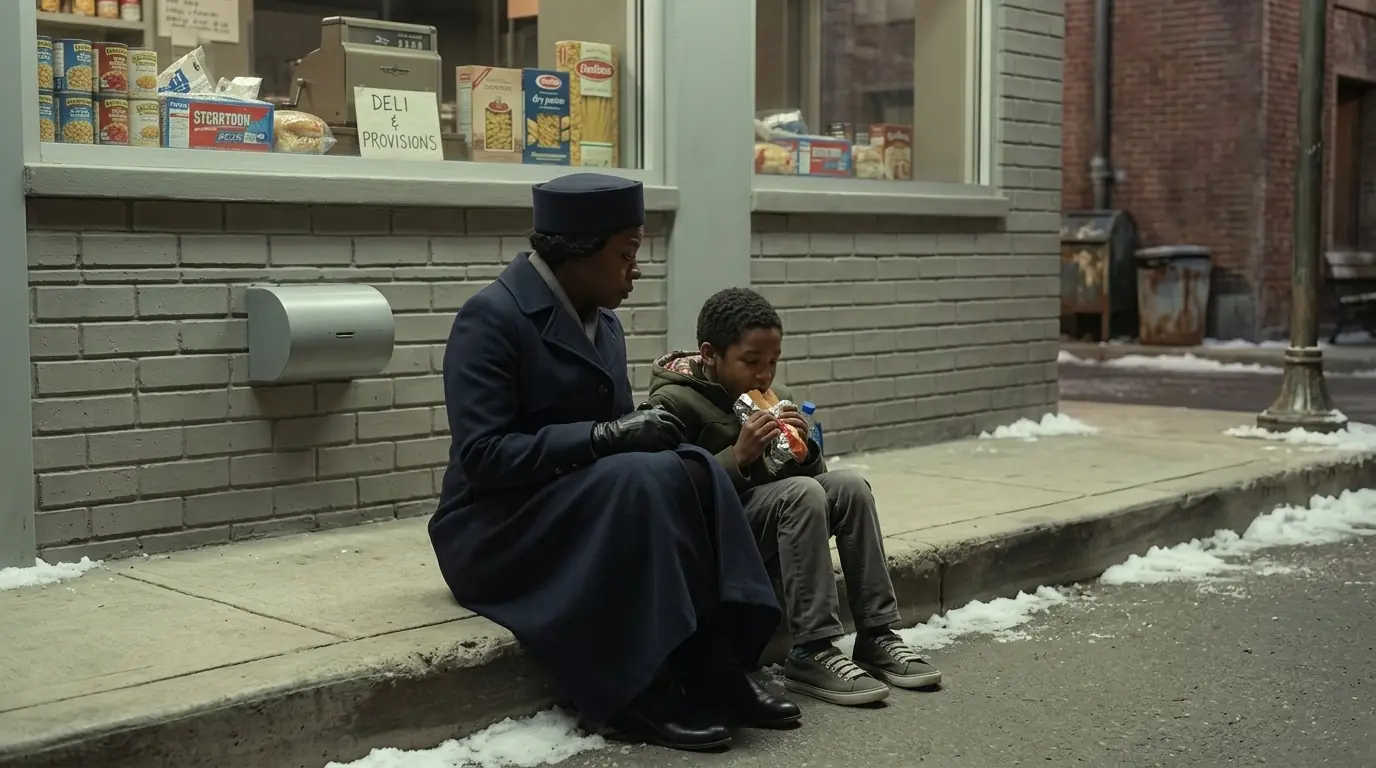
Then an elderly Black woman in an old church coat came out of the gas station carrying a small bottle of aspirin.
She saw him.
Not in the quick, uncomfortable way adults sometimes noticed suffering and moved faster to escape it.
She truly saw him.
She stopped.
“Baby,” she said gently, “how long you been sitting here?”
Marcus tried to answer, but his throat was too dry.
The woman looked at him for a long moment. Then she turned around and went back inside the gas station.
Through the glass, Marcus watched her speak to the cashier. She opened her purse. She counted coins carefully. She pushed something back across the counter. She pointed toward the food warmer.
A few minutes later, she came back outside with a hot dog wrapped in foil, a bottle of water, and a small bag of chips.
She sat down beside him on the cold concrete in her good church coat.
“What’s your name?” she asked.
“Marcus,” he whispered.
“Well, Marcus,” she said, handing him the food, “you eat slow.”
He did.
He ate like the food might disappear if he moved too quickly.
The woman did not rush him. She did not lecture him. She did not ask accusing questions. She simply sat beside him as if being there were the most natural thing in the world.
Only later would Marcus learn that she had spent her last $1.17 on him.
She had put back crackers and soup meant for herself so she could buy him a hot dog, water, and chips.
That night, she called her pastor. By the next morning, Marcus was placed with a temporary family who gave him a clean bed, a warm meal, and a chance to survive until his mother recovered.
Before they parted, Marcus had made a promise only a child would dare make.
“I’m going to pay you back a thousand times when I grow up.”
The woman had laughed softly.
Then she pressed the yellow church offering envelope into his hand.
“My name is Claudette,” she said. “You grow up first.”
Marcus did.
But he never forgot.
That evening, Marcus arrived at Second Hope Church of God at 6:22 p.m.
The building was old brick with a hand-painted sign and a cracked parking lot where weeds grew through the pavement. Inside, the fellowship hall was warm and bright. Folding tables stretched across the room. Volunteers moved quickly, carrying trays, setting chairs, filling water pitchers, and arranging plastic utensils.
The smell of greens, cornbread, baked chicken, and coffee hit Marcus as soon as he walked in.
A woman near the door checked a clipboard.
“Marcus Webb?”
“Yes.”
She looked up, surprised. “You’re actually here.”
“I said I’d come.”
“Most donors don’t come themselves.”
Marcus gave a faint smile. “I’m not most donors.”
“We’ll see,” she said, handing him a plastic apron. “I’m Pastor Ivonne. We serve at seven. Right now, we need help setting up.”
Marcus tied on the apron and got to work.
He unfolded chairs, carried trays, bundled napkins with plastic forks, and kept his head down. Around him, volunteers laughed, teased one another, and greeted guests by name as people began arriving from the cold.
Marcus noticed that more than the food.
They knew people here.
They remembered who liked extra cornbread, who needed a softer chair, whose child had been sick, who had found work, who had lost it, who needed to be spoken to gently.
The knowing mattered.
At 6:58, Marcus came out of the kitchen carrying a tray of cornbread.
Then he stopped.
At the far end of the serving line stood a woman in her mid-seventies, spooning collard greens from a large pot.
Her silver hair was pinned back neatly. Reading glasses hung from a chain around her neck. She wore an old church coat, good quality but faded with time.
Around her neck was a small gold cross.
Marcus felt the tray grow heavy in his hands.
It could not be.
He had thought this before.
Seven times in four years, he had seen an older woman from a distance and felt his heart seize.
Seven times, he had been wrong.
He set the tray down carefully.
The woman was speaking to an elderly man in line, teasing him about whether he had been eating enough vegetables. The man laughed. She laughed too, easy and warm.
Marcus walked closer.
Three feet away, he stopped.
She still had not looked up.
Then she raised her eyes.
The room seemed to fall silent around him.
Marcus knew those eyes.
Twenty-three years vanished.
He was eight again, sick and freezing on concrete, looking up at the first person who had stopped.
“Miss Claudette,” he said.
The spoon in her hand went still.
Her lips parted.
“Lord,” she whispered.
Marcus’s voice broke.
“It’s me. Marcus Webb. The boy from the gas station on Mac Avenue. January. You bought me a hot dog.”
For a moment, Claudette Pearson did not move.
Then both her hands rose to her mouth.
Tears filled her eyes so quickly they spilled before she could stop them.
“Marcus,” she said.
The name came out like a prayer she had repeated for years.
“I told you I’d pay you back,” he said, crying now despite every effort not to. “A thousand times. I kept my promise.”
Claudette came around the serving table.
She was smaller than he remembered, or maybe he had grown into a man and never adjusted the memory. She took his face in both hands, looking at him as if trying to prove he was real.
“I prayed for you,” she said. “Every morning. I never knew your last name, so I prayed for the boy from Mac Avenue. I asked God to let you be alive.”
Marcus closed his eyes.
“I’ve been looking for you for four years.”
“You were looking for me?”
“Everywhere.”
Pastor Ivonne quietly moved someone else into Claudette’s place at the serving line. She guided them to two folding chairs in the corner of the fellowship hall, where the noise of dinner continued around them like a river.
Marcus and Claudette sat close.
For a while, neither spoke.
Then Marcus said, “Tell me what you remember.”
Claudette folded her hands.
“My husband, Earl, had passed that October,” she said. “I was still learning how to be alone. I stopped at that gas station for aspirin because my head was hurting. I saw you through the window before I went in.”
“You came back out.”
“I couldn’t walk past you.”
She looked at him steadily.
“You looked like my son did at that age.”
Marcus grew still.
“I didn’t know you had a son.”
“Jerome,” she said softly. “He passed when he was twelve. Car accident. Ordinary Tuesday afternoon. The kind of day that should not ruin a life, but did.”
Marcus swallowed hard.
“When I saw you,” Claudette continued, “I saw his face. And I thought, no child should be sitting outside alone in that cold.”
“You spent your grocery money on me.”
Claudette looked away.
“Who told you that?”
“The cashier. I found him three years ago. He remembered you. He said you put back crackers and a can of soup so you could buy food for me.”
Claudette sighed.
“Marcus, I had a refrigerator at home. You had a sidewalk. It was not a hard choice.”
To her, it had been simple.
To Marcus, it had been everything.
He reached into his jacket and took out an envelope.
Claudette looked at it suspiciously.
“What is that?”
“Open it.”
She did.
Her eyes moved across the paper once.
Then again.
Then she looked up sharply.
“Marcus.”
“It’s a house,” he said. “Three bedrooms. One story. Easy on the joints. Fifteen minutes from here. Fully paid. Yours.”
“No.”
“I bought it two years ago.”
“You bought a house two years ago on the chance you might find me?”
“Yes.”
“Marcus, I cannot accept this.”
He leaned forward.
“You gave me your last dollar.”
“That was different.”
“No,” Marcus said. “It wasn’t. You gave what you had. Now I’m giving what I have.”
Claudette shook her head, tears gathering again.
“I only prayed you were alive,” she whispered. “That was all. I didn’t pray for this.”
Marcus smiled through his tears.
“But here we are.”
For a long moment, Claudette rested her hand on the envelope.
Then she closed her eyes.
When she opened them, she nodded once.
“All right,” she said softly. “But you come Sunday.”
Marcus blinked.
“What?”
“Sunday dinner. I make sweet potato pie. You are not going to buy me a house and then disappear like some fancy stranger.”
Marcus laughed for the first time in what felt like years.
“Yes, ma’am.”
“And don’t be late.”
“I won’t.”
That night, Marcus stayed until the fellowship hall was clean.
He washed pans beside a retired teacher named Gerald, carried trash bags outside, wiped tables, and stacked chairs. No one treated him like a wealthy man. No one cared what his company was worth.
They handed him a mop.
He used it.
When he finally sat in his rental car after nine o’clock, he took the yellow offering envelope from his pocket and looked at it one more time.
For years, he had carried it like an open wound.
Now, for the first time, it felt like a bridge.
He placed it carefully in the glove compartment.
He had found her.
He had somewhere to be Sunday at 12:30.
That Sunday, Marcus arrived twelve minutes early.
Claudette served baked chicken, collard greens, cornbread, and sweet potato pie so good that Marcus ate three pieces before he realized what he was doing.
They sat across from each other in the church kitchen and talked for four hours.
She told him about Earl, who had delivered mail for thirty-one years and made her laugh every day. She told him about Jerome, the son she had lost and never stopped loving.
Marcus told her about his mother, who had recovered and stayed sober for ten good years before dying peacefully in a real bed, in a real home.
He told her about school, scholarships, computer science, and the first company he built in a garage. He told her about money so large it felt unreal, and the loneliness that came with being admired by everyone and known by almost no one.
Claudette listened the same way she had listened on that sidewalk 23 years ago.
Fully.
Without hurry.
When he finished, she asked, “What do you need?”
Marcus had no prepared answer.
“I don’t know.”
“Yes, you do.”
He looked down at the table.
“I need it to mean something. The money. The work. All of it. I need it to connect back to something real.”
Claudette pointed around the fellowship hall.
“Then stay connected to something real.”
So he did.
Over the next six months, Marcus began changing the way he gave.
He stopped donating from a distance and started showing up.
He flew to Detroit twice a month. He helped at Second Hope. He listened to Pastor Ivonne, Gerald, and the volunteers who understood the neighborhood better than any report could.
He met a seventeen-year-old named Devonte who was couch surfing and brilliant at math. Marcus helped him find stable housing, hired a tutor, and guided him through engineering school applications.
Then Marcus helped one more young person.
Then another.
Then ten.
He realized the problem was not a lack of talent or ambition. It was that too many children were falling through gaps no child should ever have to face alone.
Eight months after finding Claudette, he launched the Marcus Webb Foundation.
Its purpose was direct and urgent: emergency support for unhoused and at-risk youth between eight and seventeen, including housing, food, medical care, education support, legal help, and long-term mentorship.
At the launch event, a reporter asked him why he chose Detroit.
Marcus told the truth.
“Twenty-three years ago, a woman spent her last dollar on me when I was an eight-year-old child sitting outside in January. She did not know my future. She did not know my name would ever matter. She only knew I was cold and hungry, and she stopped. I’ve been trying to be worth that stop ever since.”
Claudette sat in the front row with a handkerchief pressed to her eyes.
After the event, she pointed at him.
“You did not have to say all that.”
Marcus smiled.
“Yes, ma’am. I did.”
One year after their reunion, Marcus drove Claudette to see her new house.
It was a small brick home on the east side of Detroit with a front porch, wide doorways, a bright kitchen, and a garden in back.
Claudette stood in the yard for a long time.
“Earl would have liked this,” she said.
“What would he have planted?”
“Tomatoes,” she said immediately. “Beans. Zucchini, though it always took over. And sunflowers along the back fence, just because they make a place look happy.”
Marcus listened.
The next spring, they planted every one of them.
Claudette moved in before winter.
She did not have many boxes. Her life had never given her much room for things. But she placed Earl’s photograph on the kitchen table, set her Bible beside it, and stood in the middle of the room quietly.
Then she turned to Marcus.
“Sunday dinner starts here now.”
“I’ll bring pie.”
She narrowed her eyes.
“Don’t you dare.”
Two years after Marcus found her, the foundation had helped 847 young people across eleven cities.
Devonte entered the University of Michigan to study civil engineering and began mentoring two younger boys in the program. Second Hope expanded its kitchen. Pastor Ivonne hired more staff. Gerald still washed pans every Friday, and Marcus joined him whenever he was in Detroit.
Every young person who entered the foundation’s program received a card.
On the front was the foundation’s name.
On the back was one sentence.
Someone stopped for you. Now stop for someone else.
The story spread across the country.
Not because of the money.
Because of the $1.17.
People understood that number.
They understood what it meant to give when giving cost something.
They understood that kindness was not measured by the size of the gift, but by the heart willing to give it.
At the foundation’s second-year gala, Marcus stood before 400 people and spoke about housing numbers, program growth, and expansion plans.
Then he stopped.
He looked at Claudette in the front row.
“None of this started in a boardroom,” he said. “It started on a sidewalk in January. It started when Claudette Pearson decided that a child she had never met was worth stopping for.”
The room fell silent.
“She did not know what I would become. She did not ask whether I deserved help. She did not calculate whether the kindness would return to her. She only saw a child who was cold and hungry, and she stopped.”
His voice softened.
“So tonight, I want to ask one question. Who stopped for you when you needed it? And who have you stopped for lately?”
No one spoke.
Many cried.
Claudette shook her head, giving Marcus the same look she always gave him when he praised her too much.
But he only smiled back.
She had given him food.
She had given him warmth.
She had given him proof that he mattered before the world had any reason to believe he would become someone important.
And that had saved more than his body.
It had saved the part of him that still knew how to hope.
Later that night, after the speeches ended and the guests went home, Marcus drove Claudette back to her house.
The porch light glowed softly. The sunflowers in the back garden had grown taller than the fence. Tomatoes ripened on their vines. The kitchen smelled faintly of cinnamon from the pie she had baked that morning.
Before she went inside, Claudette looked at Marcus.
“You know,” she said, “I only wanted you to live.”
Marcus nodded.
“I did.”
“No,” she said gently. “I mean really live.”
He looked toward the warm windows of her house, then back at the woman who had once sat beside him on cold concrete and changed his entire future with a hot dog, a bottle of water, and a bag of chips.
“I’m learning,” he said.
Claudette smiled.
“That’s all any of us can do.”
Marcus helped her up the steps.
Inside, the kitchen table was already set for two.
Because some debts are not repaid with money.
Some are repaid by becoming the kind of person who stops for someone else.
Claudette spent $1.17 on a hungry child.
Twenty-three years later, that child found her, gave her a home, and built a foundation that helped hundreds more.
But the greatest result was not the house.
It was not the money.
It was not the headlines.
It was the circle of kindness that began on a freezing sidewalk and kept widening, life after life, until strangers became family and forgotten children learned they were worth saving.
Marcus had once promised to pay Claudette back a thousand times.
In the end, he did something better.
He carried her kindness forward.
And somewhere, because of one elderly woman who stopped when no one else did, another child found food, warmth, shelter, and a reason to keep living.