Blackthorn Manor stood as it always had. Proud, immovable, and utterly indifferent to the suffering of the man who lived inside it. From the lane below, travelers often stopped their carriages simply to stare at the twin towers of dark granite that rose against the Yorkshire sky, at the ivy that crept along the eastern wing like a slow green tide, at the formal gardens stretching southward in geometric precision toward the distant shimmer of the lake. It was, by every measure of English aristocracy, magnificent. It was also, by every measure that mattered, a cage.
Adrian Blackthorn, the seventh Duke of Ashfield, stood at the window of his study on the morning of the 10th of September and watched the first carriage roll through the iron gates with something close to dread settling in his chest. He was 32 years old and had been Duke for six years. Six years of managing tenants, attending Parliament, receiving correspondence, and enduring the steady, relentless pressure of a world that reduced him to a title and a fortune. He had grown accustomed to feeling invisible inside his own name. He was not, by any surface measure, a man who invited sympathy.
He was tall, broad-shouldered, with dark hair that curled slightly at the temples when the Yorkshire damp rolled in off the moors. His jaw was angular, his eyes a deep, storm-colored gray that seemed, to those who met him at dinner parties and parliamentary sessions, to be constantly assessing. People described him as composed, formidable, impeccably correct. What they did not see, what no one had seen in years, was the exhaustion beneath the composure, the profound, aching exhaustion of a man who had not in six years been spoken to as simply a person. He let the velvet curtain fall and turned back to his desk.
His secretary, Mr. Pemberton, had left the morning's correspondence in a neat stack. And atop the stack, as if deliberately placed to torment him, was a letter from his aunt, Lady Octavia Thornfield, written in her characteristic violet ink and her characteristic lack of subtlety. He did not need to open it. He had already read it three times.
She was arriving today, along with two guests she had personally selected, Lady Helena Ashbourne, daughter of the Earl of Whitwick, and Lady Clara Whitmore, niece to the Marchioness of Stowe, both unmarried. Both, his aunt had noted with pointed emphasis, extremely well suited to the responsibilities of a Duchess. Adrian pressed two fingers to the bridge of his nose and breathed slowly. "Will that be all, Your Grace?" Pemberton asked from the doorway.
"Yes," Adrian said. "And Pemberton, tell Mrs. Hartley to ensure the East Wing is prepared and that the formal dining room is ready for dinner." He paused. "And send word to the stables that I'll be riding out this afternoon.
Late afternoon. I don't care about the weather." Pemberton withdrew without comment. He had been in the Duke's service long enough to recognize when a man needed to breathe. Adrian did not ride immediately.
Instead, without quite making a conscious decision to do so, he found himself walking through the manor's long corridors, past the portrait gallery with its parade of Blackthorn ancestors, past the music room that had not seen candlelight in 3 years. And down the servants' stair that led through the kitchen garden and out through a low wooden door half hidden behind a curtain of wisteria. It was the same door he had used as a boy when escaping lessons, when chasing his mother through the grounds on summer evenings. He had not used it in years. But his feet remembered the way.
Beyond the wisteria, a narrow path wound through a stand of silver birch, descended a gentle slope, and ended at a stone archway so old its keystone had sunk 2 in lower than it once had. A rusted iron gate stood half open beneath it. And beyond the gate lay what the household staff, those who spoke of it at all, called the south garden. Or more precisely, what had once been the south garden. Adrian stopped beneath the archway and looked in.
It was not what he had expected. He had expected neglect. The tangled cheerless ruin of a garden abandoned for grief. His mother, the late Duchess of Ashfield, had planted this garden herself over the course of 20 years. When she died 4 years ago, Adrian had told the head gardener, old Mr.
Everly, that it was to be left alone. That had been, he understood now, less an instruction than a wound expressed as language. He had not been back. But the garden was not ruined. It was alive.
Abundantly, almost startlingly alive. Roses in late summer crimson and blush and white climbing the old brick walls, lavender in great purple waves along the inner path, a climbing hydrangea draping the south wall in lace. Someone had been tending it. Someone had been here. And then he saw her.
She was kneeling beside a low stone planter near the far wall, her back to him, a pair of worn leather gloves on her hands and a small pruning knife in one. Her dress was plain, the dark gray of the household staff, but she had pushed her sleeves to the elbow and tied her apron loosely. And her dark hair was half escaped from its pins, trailing in a loose wave down the back of her neck. She was working with precise, unhurried care, cutting stems at an angle, setting the cuttings into a basket beside her. Speaking, he realized, she was speaking softly to the roses as she worked.
Adrian stood perfectly still and listened, unashamed, because she had not heard him and because something about her voice, low, warm, unhurried, held him in place the way a hand might close gently around his arm. "There you are," she was saying to a particular bloom, a deep, wine-colored rose with petals that curled at the edges. "You've been sulking since last week. Come now. You don't need that old cane anymore, do you?
You can stand on your own." She finished her cut. She sat back on her heels and looked at the rose with an expression of quiet, genuine satisfaction. It was the expression of someone who was entirely unselfconsciously content in the present moment, a quality Adrian had not encountered in so long that he found himself without words for it. He must have made some sound, a shift of gravel beneath his boot, because she turned.
Her eyes were brown, warm as autumn light, and in the first second after she turned, they were simply surprised. Then she took in his coat, his bearing, the particular stillness of a man accustomed to being obeyed, and her expression shifted into something more careful. Not afraid, exactly, but measured. “Your Grace.” She rose quickly, pushed a strand of hair from her face with the back of her wrist, leaving a faint streak of garden soil across her cheekbone.
She dipped into a curtsy that was respectful, but not flustered. “I apologize. I didn't hear you approach. I'll be out of your way directly.” “Who are you?” he asked.
A flicker of something tender and grieved and resolved, all at once. “I hope I haven't overstepped.” If you'd prefer it left as it was, I can... “No,” he said. It came out more quickly than he intended, more certain.
He looked at the roses, at the wine-colored bloom she just freed from its tangle. It had been his mother's favorite. He had not told anyone that. “No. Please don't stop.”
He looked at her once more, at the streak of soil on her cheek, at the pruning knife still loose in her gloved hand, at the absolute composure of a woman who had expected to be dismissed and was quietly, carefully adjusting to something else. And then he turned and walked back up the path toward the manor, where his aunt's carriage was just then crunching to a stop on the gravel. He did not know, walking away, that the hidden garden had just become the most important place in his world. Lady Helena Ashbourne arrived first, which Adrian suspected was not an accident. She descended from the carriage in a dress the color of the winter sky, a gray-blue silk that caught the September light with a shimmer that suggested both restraint and considerable expense.
And she moved across the gravel with the practiced grace of a woman who had spent 24 years perfecting an entrance. She was, by any honest assessment, breathtakingly beautiful. Her hair was the color of winter wheat, her eyes a brilliant green that somehow managed to be warm and calculating at precisely the same time. And she smiled at Adrian with the confidence of a woman who had never met a room she could not command. “Your Grace.”
Her voice was low, musical, precisely calibrated. Blackthorn Manor is even more magnificent than its reputation suggests. Though I confess, I expected nothing less from its master. It was, as compliments went, exquisitely done. It praised the estate, praised him, and positioned her as a perceptive judge of both.
All in two sentences. Adrian offered her his arm and led her inside. And he watched her eyes move across the entrance hall with the swift expert appraisal of a woman cataloging value. She admired the correct things in the correct order. The Flemish tapestry, the marble staircase, the Constable landscape above the fireplace.
She made no errors. Lady Clara Whitmore arrived 20 minutes later, wind-swept from the moors and laughing about it. A bright, irresistible peal of laughter that filled the entrance hall and made the housemaids smile despite themselves. She was smaller than Helena, rounder of face, with copper hair and a scattering of freckles she made no attempt to conceal. And she moved through a room the way warm light moves through glass.
Everything she touched seemed to brighten briefly. "Your Grace," she said, shaking his hand before he could properly bow over hers, which made his aunt visibly wince. "Forgive me. I've been in carriages for 6 hours and my manners have entirely abandoned me. Your Yorkshire roads are magnificent and absolutely unforgiving."
She tilted her head at him with frank cheerful attention. "You're taller than I expected. Lady Thornfield described you as imposing. I thought that meant short." Adrian, to his own surprise, almost smiled.
Dinner that evening was an exercise in civilized performance. The dining room blazed with 30 candles, his aunt's instruction, Adrian knew, intended to create atmosphere that would flatter faces and warm moods. And the conversation moved through the expected channels. London season gossip, the state of the roads, the prince's latest architectural enthusiasms. Helena spoke brilliantly on every subject with the ease of someone who had prepared.
Clara spoke warmly and spontaneously, interrupting herself twice to contradict points she'd made three sentences earlier, which somehow only increased the table's affection for. Adrian participated correctly. He laughed at the appropriate moments. He directed questions with the courtesy of a man who has mastered hospitality as a form of self-concealment. And the entire time a part of his mind was in the south garden in the late afternoon shadow of the stone archway watching a woman in a gray dress speak tenderly to a wine-colored rose.
He told himself it was simply a morning walk. He told himself this on the second morning when he found himself on the narrow path through the silver birch before the household was properly awake. Dew still heavy on the grass, and the air carrying that particular September sharpness that felt to him like the world drawing a clean breath. Rose was already there. She had arrived even earlier.
Her basket was half full of deadheads already, and she had her sleeves rolled and her hair pinned more securely than yesterday, as though she'd known she would not be alone and had made a concession to formality. She looked up when she heard his footsteps and did not curtsy this time, only nodded, a small, dignified acknowledgement that he thought was more honest than any curtsy. "You're here early," she said. "So are you," he said. She almost smiled.
"The roses prefer the morning. The light is gentler, and there's nobody about yet to ask me whether I've finished the east hallway or polished the silver properly." A pause. "Forgive me. That was impertinent."
"It was honest," he said. "I find I prefer that." She looked at him for a moment, a direct, unhurried look that did not perform itself, did not add layers of deference or calculation, and then she turned back to her roses. "There's a cane needs strapping here if you'd like something to do," she said. "If you're staying."
It was not a question. It was not precisely an invitation. It was the honest offer of a task to someone who appeared to need one, and it was, Adrian thought, the kindest thing anyone had said to him in weeks. He stayed. She showed him what to do with patient, practical competence.
How to hold the new cane gently against the old support. How to tie the jute so it's secured without cutting into the bark. How much tension to give the knot. Her hands moved over his briefly as she adjusted his grip, warm and calloused and completely unselfconscious. And when she pulled away, she was already looking at the next section of wall, thinking ahead.
The touch already gone from her mind. It was not gone from his. "These are Duchess roses," she said, nodding at the deep crimson climbers that covered the north wall. "Your mother planted the first one, the original rootstock, in 1861. Everything you see now grew from that single plant over 30 years."
She reached out and touched the bloom with the lightest possible contact of two fingers, the way you might touch something you loved and feared to damage. "She used to say they were the most honest thing about Blackthorn. They didn't perform. They just grew." Adrian was quiet for a moment.
The grief was still present, the way grief always was. Not sharp anymore, but resident, woven into ordinary moments with unpredictable intimacy. "You knew her?" he asked. "My father worked for her for 32 years. I grew up here, in the cottage at the edge of the south grounds.
She was" Rose paused, seeming to search for the right word. And unlike most people who paused like that in his company and then produced the most impressively polished phrase available, Rose simply said quietly, "She was kind, not performatively kind, actually kind, the sort of kind that cost something. She glanced at him. You have her eyes, the same color, like weather. He did not know what to say to that.
He had not been seen, actually seen, feature to feature, person to person, in so long that the experience produced something that was almost physical. A warmth behind his sternum, immediately followed by a profound and aching vulnerability that he didn't know what to do with. He tied three more canes. He left before the household stirred. He returned the following morning.
Inside the manor, the courtship proceeded according to its own relentless logic. Helena had begun to manage the situation with the efficiency of a general conducting a campaign. She appeared at breakfast in gowns of flawless restraint. She engaged Adrian in conversation about estate management at luncheon, about literature in the evenings, about architecture during their afternoon walks. Always walks carefully orchestrated so that she appeared beside him before Clara could arrange the same proximity.
She was, Adrian observed with a kind of weary admiration, extraordinarily skilled at all of this. She was also, he was beginning to notice, never quite present. Her eyes, even in their most intimate moments of conversation, were performing a calculation, reading his responses, adjusting her positions, optimizing. She was never wrong. She never misstepped.
She was brilliant and beautiful and impeccably prepared for every occasion. And when she looked at him, what she saw was the Duke of Ashfield, and she could not quite hide it. Clara was different, and the difference made her in some ways more dangerous. She was genuinely warm, genuinely funny, and what she felt when she looked at him was, he believed, genuinely real. She liked him, but she liked Blackthorn Manor more.
He could see it in the way her gaze moved across a room when she thought he wasn't watching, measuring, calculating, imagining herself as its mistress. Her warmth was not performance, but it was also not quite love. It was affection married to ambition, and the marriage was comfortable enough that she probably never examined it closely. One evening after dinner, Clara sat down at the piano in the music room, the first time it had been played in 3 years, and played with surprising skill. A Schubert nocturne that filled the candlelit room and crept down the corridor and wound through the old manor like a living thing.
Adrian sat in the chair nearest the window and let the music reach him, and for a moment it was beautiful, genuinely beautiful, the kind of beauty that costs nothing to admit. Then his aunt leaned to his ear and murmured, "She has an excellent sense of what a room requires." And something in him flinched at it, at the reduction of beauty to strategy. And he found himself thinking of rose gardens and morning light, and how a woman had pressed two gentle fingers to a crimson bloom and not said anything at all. Helena, watching him from across the room, noticed the flinch.
Her green eyes sharpened briefly. She began the next morning to pay more careful attention to where the Duke disappeared to before breakfast. By the end of the first week, the morning visits had extended. Adrian began arriving later, not before the household woke, but in the late afternoon, when the light turned gold and long, and the roses held it in their petals, like something precious. He told Pemberton he was walking.
Pemberton, who had been in his service for 8 years, did not ask where. Rose was not always there in the afternoons, but she was there often enough. And on the evenings when she was, they fell into a rhythm that had no self-consciousness in it. She working, he watching, and then inevitably talking. The conversation moving between them in the unhurried way of two people who have both grown accustomed to silence and find with some surprise that they do not need it with each other.
She told him about the garden's history, about the original layout his mother had altered, the hybrid roses she'd developed through cross-pollination over 15 years, the fact that the climbing hydrangea on the south wall was 20 years old, and its root system probably extended beneath the entire south foundation. He told her in return, with more openness than he'd intended, about the 6 years since his father's death, about the weight of parliamentary sessions, about the peculiar isolation of being a man whom everyone approached with a purpose already formed. "You're lonely," she said one evening, without particular emphasis. Not as a diagnosis, not as pity, simply as an observation offered honestly, the way she might note that a rose needed water. "Yes," he said with equal simplicity, and the words surprised him.
How clean it felt, said plainly, with no performance around it. "So am I sometimes," she said. "Though differently. I'm lonely because the people who might have been my friends are now my employers. And because my father can't work anymore, and we don't speak about that."
She was quiet for a moment. "Grief makes a particular kind of loneliness, not like ordinary loneliness. More like" She paused, searching. "Like being in a room where the furniture has been rearranged. Everything is there, but you keep reaching for things that are no longer where you left them."
He looked at her across the darkening garden. This woman in her plain gray dress with rose soil still dark under her fingernails. This woman who had never once said anything to impress him, and had therefore impressed him more thoroughly than anyone else he had known. And something moved in his chest. Not simply longing, though longing was certainly present, but recognition.
The particular rare ache of being recognized. "You should go in," she said softly. "They'll be wondering." "Let them," he said. It came out more bitterly than he intended.
She looked at him steadily. "Don't say that. You have responsibilities that matter, even if they're also a weight." A pause. "Your mother understood that.
She used to come here when the weight got too much. Not to escape it, just to remember that she was a person first and a duchess second. The garden was the place where that was true." She touched the stone wall beside her. "I've tried to keep it that way."
Adrian looked at the roses around them, blood red and cream, and the deep wine color his mother had loved best and felt for the first time in years something he could only describe as peace. Not happiness, not the loud brightness of pleasure, but the quieter, deeper thing beneath it. The sense of being in the right place with the right person in a moment that needed nothing added to it. "Will you show me something tomorrow?" he asked. "What?"
"Anything," he said. "Anything about this garden that you'd want someone to know." She considered him for a moment in the last light. Then, quiet as a secret, she smiled. The next afternoon he came with his coat off and his shirt sleeves rolled, which made Rose go still for a fraction of a second before she recovered her composure and handed him a pair of gloves without comment.
He noticed the pause and said nothing about it. They were past the point of pretending the air between them was entirely ordinary. "Pruning is not about cutting," she said, leading him to a section of the east wall where a sprawling old climber was beginning to crowd its neighbors. That's what most people think. They see the cutting and assume the point is removal, but the point is direction.
You cut here she indicated a node on the stem with her fingertip to tell the plant where you want its energy to go. You're not taking away. You're redirecting." "And if you cut in the wrong place?" he asked. "It recovers," she said simply.
"Roses are more resilient than people think. They forgive poor pruning. The only thing they don't recover from is being ignored entirely." She passed him the pruning knife, handle first, carefully, and positioned herself beside him, close enough that he could feel the warmth of her arm without touching it. She guided his hand with both of hers, not grasping, not assertive, just present.
Her fingers light over his, correcting the angle with the same unhurried competence with which she did everything. "There," she said low. "That angle. Clean through quick. Don't hesitate."
He made the cut. The stem fell cleanly. She made a small sound of approval, barely more than an exhale, and stepped back. And he was aware all at once of several things simultaneously. The sharp green scent of cut stem, the warmth that remained on his hand where hers had rested, the fact that his heart was behaving in a manner entirely inconsistent with the demands of the situation.
"Good," she said, inspecting the cut with a critical eye of someone who genuinely cared about the standard. "You have steady hands." "A necessity for a duke," he said, "who is expected to sign documents of great consequence with appropriate gravity." She laughed at that, an unguarded laugh, nothing performed about it. And the sound of it moved through him like light through water.
They worked for 2 hours. The conversation moved and paused and moved again. And at one point, she leaned across him to redirect a stem, and a strand of her hair came loose from its pin and brushed his jaw. And neither of them said anything about it because there was nothing to say that wouldn't require admitting something they were not yet ready to admit. He removed a smear of soil from her cheek with his thumb, carefully, without asking, without thinking, and she went very still and then quietly resumed what she was doing.
And he looked at his thumb for a moment with an expression he was glad she could not see. When he finally pulled on his coat to go, the light had gone bronze, and the garden was filling with shadow and the first faint chill of a September evening. He paused at the gate. Rose. She looked up from the basket she was gathering.
Thank you, he said. For the roses. For the lesson. For not looking at him as though he were a title in a coat. He did not say any of that.
He said only the two words. But she heard the weight in them. He could see it in her face. And she nodded once with that particular gravity she carried. “Same time tomorrow?” she asked.
“Yes,” he said. “Same time tomorrow.” And then he walked back up the path through the birch trees. And the evening closed behind him like a door. Helena Ashbourne was not a woman who left things to chance.
She had arrived at Blackthorn Manor with a plan that was, in its broad strokes, simple. She was to be so thoroughly ideal that the choice would cease to feel like a choice and begin to feel like inevitability. She had performed this operation twice before. In Sussex, at the Earl of Hartfield's estate. And in Bath.
At a younger baron's family home. And on both occasions had been edged out by variables she had failed to anticipate. She did not intend to be surprised a third time. She had noted by the third day that the Duke disappeared every afternoon. She had noted, by the fifth day.
That he returned to dinner subtly different. Quieter. Less armored. With something behind his eyes that she could not name. but that irritated her because it was clearly something she was not providing. On the seventh day, she followed him.
She did not follow closely enough to hear anything. She stood at the edge of the birch stand, half hidden behind a birch trunk, and watched through the gap in the stone archway. She watched the Duke of Ashfield, one of the most powerful men in the north of England, stand in a garden with a housemaid and help her tie rose canes with a piece of jute. She watched him lean close to look at a rose she was indicating. She watched him laugh at something the girl said.
It was the laugh that stopped Helena's breath. Uncontrolled, unperformed, genuine in a way she had not seen from him at any dinner, during any walk, in any of their carefully conducted conversations. She walked back to the manor with her jaw set and her hands perfectly still at her sides. That evening at dinner, she was more brilliant than she had ever been. She was witty, warm, intellectually dazzling.
She directed a conversation about the nature of love and duty with such elegant philosophy that even Adrian's aunt was openly admiring. She smiled at the Duke across the candlelight with eyes that held precisely the right amount of warmth and precisely the right amount of restrained feeling, and he smiled back with genuine courtesy. And behind the courtesy was nothing that she could reach. Clara, watching Helena across the table, saw something shift in the green eyes and felt the first faint chill of a competition she hadn't realized was already over. It was the first evening he found her there by accident, not during a planned visit, but after a formal dinner that had exhausted him so completely, he had simply walked without direction until his feet brought him to the stone archway and through it into the night garden.
She did not know she was being watched. She was standing at the center of the garden in the silver moonlight with her boots set neatly beside the path and her feet bare on the grass. Her head tilted back slightly to look at the sky. Her hair was down, completely down. Not the half-escaped situation of working hours, but properly down.
Falling past her shoulders in a dark wave. And she was turning slowly in place, very slowly, arms loose at her sides, as though she were listening to music too quiet for anyone else to hear. Adrian stopped at the gate and stayed still because moving felt like an interruption of something too private and too beautiful for interruption. She completed her slow turning and stopped, looking up. And then something made her laugh, a soft, delighted laugh aimed at the moon or the roses or the night itself.
And it was the most purely joyful sound he had heard in years. And it went into him like a key into a lock. She heard him then, some shift in the shadows at the gate, and turned, and she went still for a beat. And then very quietly she said, "How long have you been standing there?" "Long enough," he said.
"Forgive me. I don't want to interrupt." She glanced down at her bare feet in the moonlit grass with an expression that was not quite embarrassment, but something adjacent to it. The slight flushing warmth of being seen in a moment of privacy. "I do this sometimes," she said.
"When it's late enough that nobody's about. The grass is cold and that's rather the point. A pause. It sounds ridiculous, I know. It doesn't, he said.
He came slowly through the gate. What were you looking at before you noticed me? The moon, she said. And the roses. At night the colors all go silver and the scent gets heavier.
It's a different garden in the dark. More honest somehow. Like everything that pretends in the daylight has given up pretending. He stood beside her in the moonlight and looked and she was right. The garden was different.
The reds were black and the whites were luminous and the air was dense with perfume and cricket song and the distant sound of the moor wind. And for a long wordless moment they simply stood there side by side and were two people in a world that had briefly stopped requiring anything from them. I don't have evenings like this, he said at last. I'm not sure I've ever had evenings like this. You can, she said simply.
It's your garden. It's your garden, he said. I'm only a visitor. She looked at him with an expression he had never seen directed at him before. Something half startled half tender.
As though he had said something that found a bruise she hadn't known she was carrying. Your mother used to say that, too, she said very softly. She said the garden belonged to whoever loved it most. The wind moved through the roses. A petal fell.
Then we share it, he said. She was quiet for a moment then, like morning. Yes, all right. It was the rain that kept him inside. The storm had moved in from the north on a Sunday afternoon.
A proper Yorkshire storm, black-bellied and serious, turning the moors to pewter and driving rain in horizontal sheets against the manor's old windows. The riding was canceled. The garden was impossible. Adrian sat in his study and tried to read and managed three pages in two hours. He was going to the library for a new book when he heard the voices.
The yellow sitting room was adjacent to the library, separated by a door that was slightly ajar. He had not known anyone was using it. He slowed without thinking because Helena's voice, usually so perfectly modulated, had an unguarded quality he'd never heard from her, and something in the unguardedness made him stop entirely. "He is duller than I expected," Helena was saying. "Agreeable enough, but he has no warmth, not really.
He goes through the motions of civility without any actual engagement. It's like dining with a very handsome armoire." "But the estate," Clara said. A sound, perhaps tea being poured. "Helena, the estate alone."
"Yes, yes, the estate is magnificent. And the income is better than I anticipated." A pause. "That's the point of the thing, isn't it? You don't marry Blackthorn, you marry Blackthorn Manor.
The man is simply the arrangement by which the property is transferred." Another pause. "Though if he continues to disappear to play in the garden with the housemaid, I'll have to be more aggressive about securing things quickly. I haven't come this far to be beaten out by a girl who smells of compost." Clara laughed, a soft, slightly guilty laugh.
"Helena, be kind. She seems nice enough." "Nice is for people who can't afford to be anything else," Helena said. "She's beneath him socially, historically, financially, in every way that the world actually runs on. He knows that.
Whatever this garden business is, it's an eccentricity he'll grow out of once the novelty wears off. Men like him always Adrian had already turned away. He walked back to his study. He sat at his desk and looked at his hands for a long time. He was not naive.
He had known, in the abstract, that both women were here for pragmatic reasons. That the warmth they showed him was real only insofar as it was useful. He had told himself he was doing the same thing. Appraising the situation, managing the situation, proceeding with the situation. He had told himself the garden was a separate thing entirely.
But sitting in his study with rain crashing against the windows and Helena's voice still in the air around him, the man is simply the arrangement by which the property is transferred. He understood, with a clarity that was almost physical, that he was not the same man he'd been 2 weeks ago. Something had shifted. Something important. Something that had grown in the south garden with as much quiet inevitability as a rose climbing a wall had made him different, and he had no interest in going back.
He had not heard an armoire mentioned. He had heard his grief recognized and reflected honestly back at him. He had heard someone speak to him as though he were worth the truth, which was the rarest and most generous thing one person could offer another. The storm darkened. He sat very still and thought about roses and moonlight and what it meant to choose something the world said you couldn't have.
He found Rose in the corridor outside the linen room at dusk, arms full of folded sheets, moving with the quiet efficiency of someone who had learned to be useful in small, invisible ways. She saw him and stopped, and something in his face made her stop more completely. Made her look at him with the particular careful attention of someone reading weather. Your Grace? Her voice was careful.
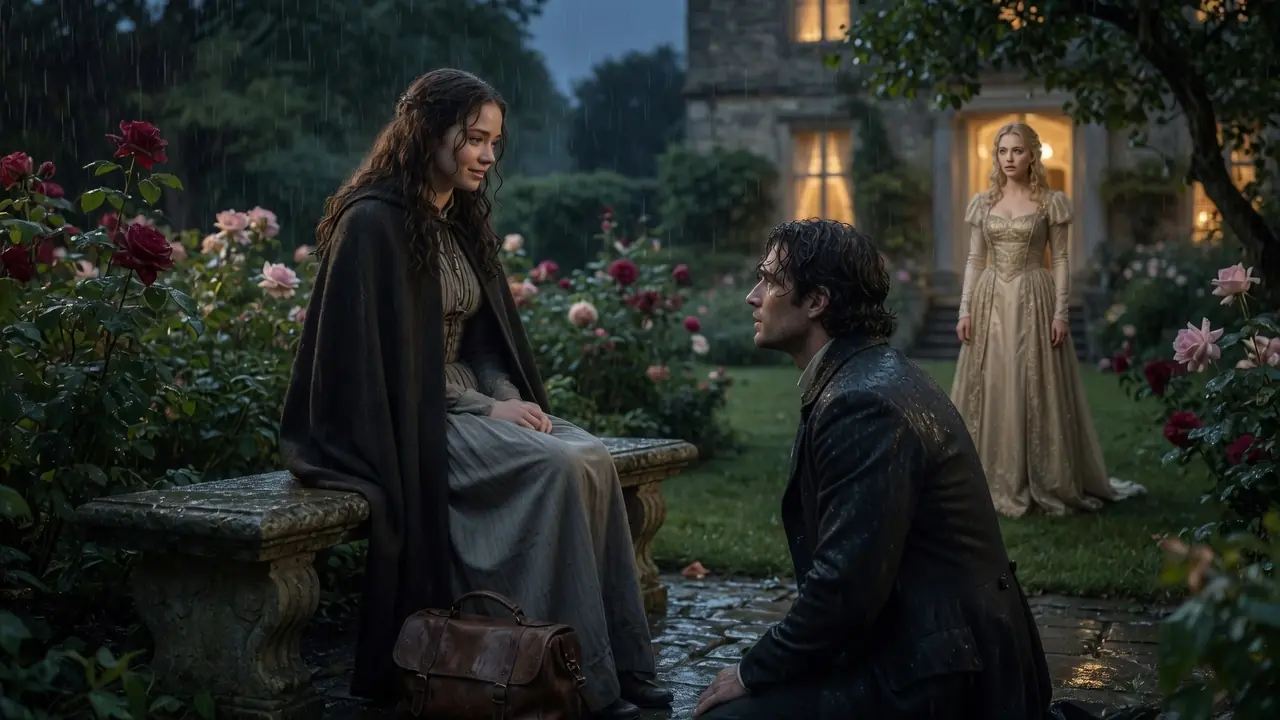
Is something wrong? Walk with me, he said. She set the sheets down on the hall table and followed him without question. Out through the back corridor, down the servants' stair, through the kitchen garden, out through the wisteria door into the storm. They made it to the shelter of the arch gateway before the full force of the rain found them and stood together beneath the dripping stone, the garden beyond them half invisible in the downpour, roses bowing and straightening under the weight of water like living things breathing.
You're going to tell me something, she said quietly. Something I won't like. I heard Lady Ashbourne speaking this afternoon, he said. About the estate, about me. He paused.
About you. Her expression did not change exactly, but it settled into something resigned, something that told him she was not surprised. And the absence of surprise hurt him somehow. That she had expected this particular species of contempt as a matter of course. I'm sorry, he said.
You shouldn't have to. Don't apologize, she said. It's the truth of what I am in their world. It's the truth of what you are and theirs. The arrangement is clear.
She looked out at the rain. The garden is separate from all of that. It always has been. That's why your mother loved it. I don't want it to be separate anymore, he said.
She went very still. Rose. He stopped. Started again. He was not a man accustomed to vulnerability, had spent six years constructing himself against it.
And finding the right words now was like reaching through armor. Everything I have said in this garden, I have meant. Everything I have felt, I have felt. I have not performed any of it. You are the first person in years who has allowed me to simply be.
And I don't, she said. Her voice was barely above the sound of the rain. Please don't say it. Not like this. Not when you've just been hurt and you're looking for something honest because what you found today was cruel.
She turned to face him and her eyes were wet. From the rain or something else. And she looked at him with the absolute directness that was her most natural expression. I can't be a choice you make because better options failed you. I won't be that.
That's not what this is, he said. You have a duty, she said. An estate, a line. People who depend on the decision you make. I am not she faltered slightly.
I am not what the world will allow you to choose. Then perhaps, he said very quietly, it is time to let the world rearrange itself around what I choose. She looked at him for a long moment in the rain. Then she stepped back. I need to think," she said.
"And you need to go inside." She pressed her hands together, a gesture that looked almost like prayer. "Please, Your Grace, go inside." He looked at her, this woman standing in the doorway of a storm-soaked garden with roses behind her shaking in the wind. And he went.
But his chest was a locked room for which he held the only key. And he knew now with the certainty of a man who has stopped lying to himself that nothing in the life awaiting him upstairs would ever feel like enough. She was not there at breakfast. She was not in the corridor at noon. By evening, one of the other housemaids told him, when he asked with forced casualness, that Rose had spoken to Mrs.
Hartley about returning to the cottage to care for her father, whose health was declining. That she'd asked to be released from the household for an indefinite period. That she'd packed a small bag. Adrian set down his wine glass at dinner with more force than was appropriate, and did not speak again for 20 minutes. Helena, watching him with her green eyes bright with sudden calculation, began a story about a ball she'd attended in London.
Clara watched Adrian watch the door and felt something sad move through her, a genuine, unperformed sadness for a man who was clearly in the wrong place at entirely the wrong time of his life. And she set down her own glass quietly and thought about home. Adrian excused himself from the table before the last course. He took a lamp. He walked through the manor and out through the wisteria door and down the path through the birch trees.
And the storm was still grumbling somewhere to the north. And the garden was very wet and very dark and very fragrant with the smell of rain on roses. She was there. She was sitting on the low stone bench by the south wall. Her cloak pulled around her.
Her small bag set at her feet as though she had meant to leave and had come to say goodbye to the garden first and had not yet managed to go. She looked up when she heard him and the lamp light found her face. The streak of emotion across it like weather. "You said you needed to think." He said.
"I have been thinking." She said. "And?" She was quiet for a long moment. Around them the roses dripped in the darkness leaning into the lamp light like an audience.
The whole garden seemed to lean in. "I think." She said finally. "That I have loved this garden because it never asked me to be less than what I am. Because your mother made a place that was honest.
Where things grew because they wanted to grow. Not because they were trained into a shape that would please someone." She looked up at him. "And I think that is what you are looking for. And I think I know where to find it.
And I am terrified." She said. And her voice shook slightly on the word. "Because I have never wanted anything the way I want to stay." He crossed the wet grass in four strides.
He crouched before the bench so that they were at eye level and took her face in both hands. The way he'd touched the roses he realized with that particular care you give to things you cannot afford to break. "Then stay." He said. "Adrian."
She had used his name. For the first time, she had simply used his name. And the sound of it in her voice, this voice that had spoken honestly to him in rain and lamplight and morning air, undid something in his chest that he had been holding closed for 6 years. "You are the only flower," he said, his voice breaking slightly at the last word and holding, "that I cannot live without." She looked at him in the lamplight of the midnight garden with rain still dripping from the roses and the whole great weight of his world hanging somewhere above them in the dark.
The manor, the title, the expectation, the carriage waiting on the lane with two women who wanted what he was instead of who. And she made her choice. She kissed him. Or he kissed her. It was, later, impossible to determine where one ended and the other began.
Lips finding each other in the rain-dark garden among the roses his mother had loved. A kiss that was equal parts surrender and arrival. That tasted of rain and night air and the specific relief of a grief finally set down. The roses surrounded them like silent witnesses. A petal fell against her shoulder.
He held her like something found after long searching, which was precisely what she was. And she held him back, fully, without qualification, without the half-presence of someone maintaining an exit. And it was real in the way that only entirely honest things are real. When they pulled back, she was laughing softly, slightly trembling. And he was looking at her with an expression she had never seen on him before.
Open, entirely open, as every careful wall had simply dissolved in the rain. "What happens now?" she asked. "Now," he said, "I go inside and have a very honest conversation with two women and my aunt." Her eyes were very bright. "And then?"
"And then," he said, "I build a life I can actually live in." He called for Lady Helena first in the morning in the formal drawing room with the light still pale and clean. She came in with her head high and her green eyes perfectly composed. And he thought, with the clear-eyed certainty of a man who has recently kissed a rose gardener in the rain, that she was extraordinarily beautiful and almost entirely a stranger. "I want to be honest with you," he said.
"I should have been honest sooner and I apologize for that. But I believe you are owed a direct conversation rather than a prolonged performance." Helena's composure wavered very slightly, a hairline fracture, and then composed itself. She sat very straight. "You've made a decision."
"I have." A pause. Her jaw tightened fractionally. "The girl from the garden." "Her name is Rose Everly," he said with a quietness that held iron in it.
"And yes." Helena rose. She looked at him for a moment with an expression that passed through several chambers. Anger, calculation, genuine bewilderment, and stopped finally at something that was, he thought, as close to honest as she had come in their entire acquaintance. "You are making a catastrophic social error," she said.
"Very possibly," he said. "Your family." "My family is my concern." He stood. "I wish you every happiness, Lady Ashbourne.
Genuinely. I think you deserve a man who can appreciate what you are offering. I am not that man. He paused. I believe there is a carriage available at 11.
She left the room beautifully, as she did everything. With her back very straight and her chin level. And if she wept on the journey south, she did it inside the curtained carriage where no one could see. Which was perhaps the most human thing she had done in weeks. Clara's conversation was shorter and in its way more honest.
She came in and looked at him and said, before he could speak, "The garden." "Yes," he said. She sighed, a real sigh, not a performed one, and sat for a moment with her hands folded and an expression of genuine, uncomplicated wistfulness. "She's lovely," she said. "I noticed that, too, actually.
She has a quality." Clara looked at the window. "I would have liked the manor, but I think I would have been miserable inside it if you were pining for someone else." A pause. "I have a tendency to want things that look beautiful from outside them.
I should probably work on that." She rose and offered him her hand, a frank, friendly handshake, none of the courtship precision. "I hope she makes you very happy, Your Grace. Truly." "Thank you, Clara," he said, and meant it.
His aunt, Lady Octavia Thornfield, lasted 3 days. There were several conversations that Adrian would not later describe in detail even to people he trusted. What emerged from them was this. She wept. She raged.
She listed 17 hereditary objections. She made reference to his father's reputation and his mother's legacy and the social fabric of the entire English aristocracy. He listened to all of it with the respect she deserved, which was considerable, and remained entirely unmoved, which was probably more patience than she had expected. And on the fourth morning, she departed for London having made, in a private moment of something that might have been grace, her peace with it. "Your mother," she said, in the entrance hall drawing on her gloves, "would not have been surprised."
She paused. "She was always more interested in what people were than in what they were called." A further pause. "The girl had better be equal to it." "She is equal to anything," Adrian said.
His aunt made a sound that could have been a laugh or a dismissal and got into her carriage and Blackthorn Manor exhaled. They were married on the 23rd of October at dawn. It was Rose who had suggested the garden. Not immediately. There had been several weeks first of ordinary extraordinary days of conversation and proximity and the careful honest work of two people learning each other without the scaffold of performance or expectation.
He had introduced her to the household as his intended with the particular simplicity of a man who has decided to stop managing other people's expectations. And the household had received this information with varying mixtures of delight, disbelief, and the resigned pragmatism of people who work for powerful men and have learned that powerful men occasionally do unexpected things. He had written to his aunt. He had written to his solicitors. He had written to the bishop.
He had not written to society because society would learn soon enough. And because one thing Rose had given him quietly, without making a speech about it, was the understanding that the world's opinion was not a fixed constraint, but a chorus, and that choruses could be changed by people who were willing to stand in the middle of them and sing something different. Her father, Mr. Everly, had wept when Adrian asked formally for his blessing. Wept.
And then laughed, and then gripped Adrian's hand in both of his and said, "She's going to argue with you constantly, Your Grace. She always knows best about growing things." Adrian had said that he was counting on it. The morning of the 23rd arrived with a frost that sugared the grass silver and a sky in the east that was the particular pale rose gold of a dawn that intends to keep its promises. Rose woke early.
She was always early. And came down to the garden alone first while the light was still finding its courage and stood at the center of it among the roses. The autumn roses were different from the summer ones, less lush, more spare, but with a depth of color that summer never achieved. The Duchess roses on the north wall had gone the color of old garnets. The climbers above the arch were copper and cream.
The air held the cold and the last of the perfume and the wood smoke from the cottage beyond the grounds. And Rose stood in the middle of it all with her breath coming in small clouds and felt, in the way that you sometimes feel the truth of something before you have words for it, that she was exactly where she was supposed to be. Adrian found her there at half past five while the frost was still on everything. he was not in his usual coat. He had dressed for the occasion in deep charcoal, his cravat more simply tied than any valet would have approved. And he looked, crossing the grass toward her in the first light, like a man who has arrived at something he has been walking toward for a long time without knowing it.
He stopped in front of her and looked at her face in the dawn light. The warmth of her eyes, the strand of dark hair already escaping its arrangement, the particular composure that was never armor, but always simply herself. And he thought that he would spend the rest of his life learning this face, and it would not be enough time. "The vicar is shivering on the path," she said softly. "He'll survive," Adrian said.
He took her hands, her bare hands, warm despite the cold, already a little rough from yesterday's gardening, which she had done with a stubborn cheerfulness that had made him love her so completely it alarmed him. He looked at her hands for a moment. "Are you certain?" he asked. "I've never been more certain of anything," she said. "Are you?"
"I was certain the morning I found you talking to that rose," he said. "I just hadn't caught up with myself yet." She laughed, that real unguarded laugh, and the sound of it moved through the garden, and the roses leaned in the first light breeze like they were listening. The vicar was indeed shivering, and the witnesses were, too. Mrs.
Hartley, the housekeeper, who cried from the moment she arrived and did not stop until well after the ceremony concluded, and Mr. Pemberton, who did not cry, but who shook both their hands afterward with a grip of such warmth that he did not need to. The ceremony was short and true. The words were old words, the same words said in English churches for centuries over couples who ranged from the entirely mismatched to the profoundly blessed. But in the hidden garden in the frost light among the autumn roses, they felt not old but immediate, as though they were being said for the first time and had been waiting for precisely this occasion.
When it was over, Adrian drew Rose to him slowly with a deliberate unhurried care of a man who does not intend to rush a single moment of whatever comes next. And kissed her in the center of the garden his mother had built. Surrounded by the roses she had planted in the light of a morning that had no interest in yesterday's rules. She kissed him back with equal unhurriedness. Her hands in his.
Her eyes closed. Her whole self present and unguarded in the cold October dawn. And the garden was very quiet around them. The particular quiet of a living thing at rest. Of a space that has done what it was made to do.
Winter came to Blackthorn Manor and covered everything in white. And for the first time in six years, the manor did not feel like a cage. It felt like a house. Large and cold and full of history, yes. But also full of the sound of two people moving through it in the particular rhythm of a shared life finding its shape.
Rose planted winter jasmine along the study window. So that in the darkest weeks of January, there would be something yellow and alive in the view. She won an argument with the head gardener about the drainage in the kitchen garden with such quiet certainty that the man spent three days pretending not to be impressed and then told Mrs. Hartley she was the most sensible person in the county. She sat with her father at the cottage on Tuesday afternoons and came home with soil on her hands and her eyes soft with love and loss in equal measure.
And Adrian never said anything about the soil and always had the fire built up before she arrived. He sat in his study on Tuesday evenings and worked. And she sat across from him and read. And the silence between them was not the silence of emptiness, but the silence of two people who have found in each other the thing that makes silence feel like rest rather than absence. Sometimes he looked up from his papers and found her watching him over the top of her book with an expression of such unadorned affection that he had to look back at the papers before he could make himself stop smiling, which he found every time entirely unreasonable and secretly adored.
In February, she found a cutting of a rose she did not recognize, small, deep red with a scent that was more complex than anything else in the garden, tucked in among the stored rootstock in the potting shed. There was a label in faded ink in his mother's handwriting for the one who comes after me. Rose stood in the cold potting shed for a long time holding the label. And then she went inside and found Adrian in the entrance hall and put her arms around him without explanation. And he held her without requiring one.
They planted the cutting in the center of the south garden in March when the ground softened enough to receive it. Rose chose the spot, a circle of earth at the garden's heart where the light fell longest and the frost cleared first. And she and Adrian planted it together kneeling in the cold mud with their hands in the earth, pressing the roots gently down. "It'll take 3 years to bloom properly," she said. "I'm not in a hurry," he said.
She looked at him across the low planter, her face flushed with cold and the particular satisfaction of doing something that will outlast the doing of it. And he looked back at her with the steady, serious warmth of a man who has learned, late but in time, that the most important things in a life cannot be inherited or managed or performed. They can only be grown, slowly, with patience, in a garden made from love. The rose bloomed 3 years later in June, when the light was longest and the air was full of bees and the south garden blazed with everything that had been tended and allowed and trusted to grow in its own time. It was a deep, extraordinary crimson with petals that opened slowly over 3 days and held for a week.
And the scent of it filled the entire garden and drifted up toward the manor on the morning breeze. And Rose stood before it in the morning it opened fully and felt something in her chest that had no name in any language she had been taught. Adrian came to find her there. He always came to find her there and stood beside her and looked at the rose and then at his wife. And the garden was full of light and the sound of summer.
And the old manor rose at their backs against a Yorkshire sky that had decided, for today at least, to be kind. "She would have loved you," he said. Rose took his hand. Her fingers laced through his, warm and unhurried and entirely sure.
"She did," Rose said. She planted this for me. He thought about that, about his mother and her garden 30 years ago, planting a rose for someone she had not yet met, leaving a gift for a future she could not see, trusting that love, properly planted, would find its way to light. He held his wife's hand in the summer garden and felt the grief in him, still present, always present, settle into something that was no longer only loss.
His mother had left him the garden, and the garden had given him Rose, and Rose had given him back himself, the self that lay beneath the title and the duty and the years of careful lonely management, the self that could prune roses and laugh without preparing to, and stand barefoot in wet grass under the moon, and feel, finally, that the world was large enough and generous enough to hold all the things he actually was. The roses swayed. A bee moved from bloom to bloom in the ancient, unhurried arithmetic of summer. Rose leaned her head against Adrian's shoulder, and he pressed his lips to her hair, and they stayed that way for a long time in the secret garden, in the light, while the crimson rose opened its last petal and offered it quietly and without condition to the morning.