I am going to begin this one on a high northern road in the early autumn of 1819 with a proud man on a tired horse cresting the last hill before the place he had sent his wife to be forgotten because what he saw from the top of that hill knocked the breath clean out of him and it is the whole hinge of this story and I want you up on that hilltop beside him when the world he expected turns out to be a world he never imagined. His name was Edmund, Duke of Calverton, and he was riding north to look upon the ruin of his own cruelty. He had not put it to himself in those words, you understand. Proud men rarely do, but that was the truth of the errand underneath the careful excuses he had given himself for making it.
Two years before, the Duke of Calverton had banished his wife, sent her away in disgrace to Coldfell, the bleakest, poorest, most neglected and forgotten of all his many holdings, a half-ruined estate on the wild edge of the far north, chosen precisely, because it was the most dismal place in his possession, and the furthest from anyone who mattered. He had sent her there to bury her, to put her and her scandal out of sight of the world, to let her molder quietly in the wet and the cold and the dark until London forgot she had ever existed, and the great name of Calverton was clean again. He had not seen her in two years. He had not written.
He had meant, as far as he had let himself mean anything, never to see her again at all. And now he was riding north to find her. and I will tell you presently exactly what had changed in him to bring him on that road. For something had, and it had shaken him to the roots. But as he climbed that last long hill toward Coldfell, the Duke of Calverton was braced in his heart, for one thing above all others. He was braced for ruin.
He was braced for a bleak dead estate gone bleaker and dead in two years of neglect and for a broken woman at the heart of it, a recluse, faded and bitter and half mad with loneliness. The wreck that two years of exile makes of a person who has been thrown away. That is what he expected. That is what a man who banishes his wife to a wasteland expects to find when at last he goes to look at what he has done. He had prepared himself, as well as a proud man can, to look upon a broken thing and know that he had broken it.
He reached the top of the hill, and he looked down, and there was no ruin anywhere to be seen. I want you to see what he saw spread out below him in the clear northern light. He remembered Coldfell. He had seen it once, years before, and chosen it for its very desolation. A sodden, exhausted, half-drowned valley of poor wet fields and failing farms and tumbledown cottages.
The land sour, the people sunk in the gray, hopeless poverty, of a place that has been neglected for generations by a master who never came. That was the coldfell he had banished her to. That was the dismal hole he expected to find gone worse. What lay below him now was a different country. The wet, sour fields had been drained.
He could see the new dikes and ditches running clean and straight across the valley, throwing off the standing water that had drowned the land for a century. And the fields they had reclaimed were not sour now, but rich, dark, well-tilled. Some gold with a harvest such as that valley, had surely never grown in living memory. some green with fat, contented livestock, of a quality that made the Duke, who knew good stock when he saw it, sit up sharply in his saddle. The tumbledown cottages had been mended, new roofed, made snug.
There was fresh whitewash. There were gardens. There was smoke rising cheerful and prosperous from a score of chimneys that had stood cold and broken two years before. There was a new mill turning by the beck. There was, he could scarcely credit it, a new schoolhouse, plainly, sturdily built, at the heart of a village that hummed with the quiet, busy prosperity of a place that has, against all the odds of its bleak position, begun decisively to thrive.
The Duke of Calverton sat his tired horse on the hilltop, and stared down at the thriving valley, where he had buried his wife to be forgotten, and could make no sense of it at all, until his eye was drawn to the heart of it, to a fold in the land below, where a knot of people stood gathered about some piece of work, and to the figure at the center of them, whom every face was turned toward, who was plainly, unmistakably, directing the whole of it. A woman on horseback in a plain serviceable habit, sitting her horse like a general surveying a field she had won, pointing, deciding, commanding with the easy, unquestioned authority of a sovereign among devoted subjects, the men touching their caps, and hurrying to do her bidding, not with the cringing of the cowed, but with the glad, eager loyalty of people who would follow her anywhere. And even at that distance, after two years, the Duke of Calverton knew her. It was his wife.
Her name was Harriet, Harriet Bramwell before she was anything grander. And she was the daughter of a man named Josiah Bramwell, who was in his day one of the most remarkable men in England, though you will not find him in the histories. For the histories have no room for men who merely fed the country. Josiah Bramwell had been born a yeoman farmer's son with dirt under his nails and a genius in his head. and he had risen by that genius and by forty years of relentless work to become one of the great agricultural improvers of the age.
He was a man who understood land the way a great physician understands a body. Who could look at a sour drowned wasteland that had defeated farmers for centuries and see beneath it the rich country it could become. Who drained the undrainable and bred the unbreedable and turned poor acres into gold by methods so far ahead of his neighbors that they called him a wizard before they grudgingly called him a master. He made a vast fortune doing it, for land transformed his wealth made.
And he made it honestly with his own hands and his own mind out of the earth itself. And Josiah Bramwell had one child, a daughter, and he loved her, and he did with her the thing that shaped her whole life. He taught her everything. He had no son to pass his genius to, and he was far too sensible a man to let a gift go to waste merely because it had been born in a girl, and so he raised Harriet at his side, in the fields, and the byres, and the drainage works, and over the account books, and he poured into her the whole of his forty years knowledge of the land, and found to his deep delight that she had inherited his genius entire.
By the time she was twenty, Harriet Bramwell could do anything her father could do, and a few things he could not. She could walk a sour field and tell you what it wanted. She could breed a flock, drain a fen, manage a hundred laborers, balance the books of a great agricultural enterprise, and turn a dying farm thriving inside of three seasons. It was the joy of her life. It was the thing she was for.
She was, in the truest sense, a queen of the land, raised to a kingdom of earth and growing things. And she asked nothing more of the world than to be let go on ruling it. And then her father died and left her his entire vast fortune, and the world she had never wanted came and got her. For a great fortune in the hands of an unmarried young woman is a thing the world cannot leave alone. And the world that came for Harriet Bramwell's money was the impoverished aristocracy who had been marrying rich men's daughters to mend their broken fortunes since fortunes were first invented.
And the man who got her was the Duke of Calverton. I must be fair to him even here, for fairness is the whole of good storytelling. The Duke of Calverton did not marry Harriet Bramwell out of greed exactly, nor out of cruelty. He married her out of need and out of pride, which is a more interesting and more dangerous mixture. His ancient dukedom was, beneath its splendor, deeply encumbered.
Generations of grand careless Calvertons had spent more than the estates brought in, and Edmund had inherited a great name wrapped around a hollow center, and he needed money badly to save it. And Harriet Bramwell had money, mountains of it. So the bargain was struck as such bargains always are. The merchant's fortune for the ducal name. The dirt farmer's daughter made a duchess in exchange for the gold that would save 400 years of Calverton from the auctioneer.
Her father's lawyers arranged it. The Duke condescended to it. And Harriet, who had no say in the matter that anyone troubled to ask for, and who was, in the cold months after her father's death, too grieved and too alone to fight it, found herself married to a proud, cold stranger, and carried off to be the Duchess of Calverton. And here is the cruelty at the heart of the bargain, the cruelty that no one signed, but everyone inflicted.
The Duke of Calverton wanted Harriet Bramwell's money, and he wanted the heir she might give him, but he did not want her. He was shamed of her. A dirt farmer's daughter, however rich, was beneath the dignity of Calverton, and Edmund never once let her forget it. Not cruel, not with blows or curses, but with the colder weapons of the proud, the lifted eyebrow, the faint distaste, the careful distance, the unspoken but constant reminder that she had been purchased, that her money was welcome, but her person was an embarrassment to be managed.
He spent her fortune to save his estates and looked down on her for having had it to spend. He installed her in his great houses, as a man installs a necessary but regrettable piece of machinery, and he never in all the months of their marriage troubled to discover that the woman he had bought and was shamed of was one of the most gifted human beings in England. For that is the part that breaks my heart, and you must feel it to understand everything that comes after. Harriet Bramwell, Queen of the Land, born and bred to rule a kingdom of earth and growing things, was shut up as Duchess of Calverton in a gilded cage where every single thing she was good at was forbidden her.
A duchess does not drain fields. A duchess does not breed livestock or walk the boundaries or balance the estate accounts or stride about the byres with mud on her boots directing the laborers. A duchess sits in drawing rooms. A duchess presides over dinners and makes correct conversation and wears the correct gowns and is admired or scorned by the correct people. A duchess is an ornament.
And Harriet, who had never in her life been an ornament, who had been raised to be the most useful woman in any room she entered, found herself with idle hands and an idle mind, in a world that prized her for nothing but her husband's name and her father's money, surrounded by people who looked down on her birth and laughed behind their fans at the dirt farmer's daughter, who did not know how to be a great lady, and who, worst of all, had a husband who agreed with them. She tried. I want that known. In the early months, she tried.
Tried to learn the ornamental arts. Tried to win the cold, proud man she had married, tried to make something of the marriage, even on its loveless terms. And there was a moment early before everything went wrong, when she thought she glimpsed in Edmund, something she might have loved, had he let her, a flash of real intelligence beneath the pride, a loneliness behind the coldness, a man who might, just possibly be more than his terrible upbringing had made him. She reached toward it once or twice, and each time he drew back behind his pride and his distaste, and reminded her, without a word, of exactly what she was and was not, and at last she stopped reaching, and folded that small, foolish hope away, and resigned herself to a long, cold, ornamental life in a cage, with her great gift rusting unused inside her, and her great heart going slowly to sleep for want of anyone who wanted it.
That was the marriage, a purchased duchess, shamed of by her lord, dying by inches of uselessness in a gilded room. And it might have gone on like that for 40 gray years, a great many such marriages did, had it not been for Lady Cresa Ashley and the scandal she built. Lady Cresa Ashley was beautiful and wellborn and poisonous, and she had wanted to be the Duchess of Calverton herself. That was the root of it, the old simple root of so much cruelty, which is thwarted want.
Lady Cresa had expected for years to marry Edmund. She was exactly the sort of woman a Duke of Calverton was supposed to marry. Highborn, fashionable, correct, and she had considered the match as good as made in her own mind, and had let the world consider it so too. And then the Calverton fortunes had failed, and Edmund had needed money more than he needed breeding, and he had thrown Lady Cresa over to marry the dirt farmer's rich daughter instead.
And Lady Cresa Ashley had smiled and curtsied, and congratulated the happy couple, and underneath the smile, she had sworn that the merchant's chit, who had stolen her dukedom, would be made to pay for it. She was patient, and she was clever, and she was waiting. and Harriet, isolated, friendless, ignorant of the vicious undercurrents of the ton, made an easy mark. Lady Cresa built her scandal carefully, the way such things are built, out of nothing, out of appearances, out of whispers placed in the right ears, and meetings arranged to look like what they were not. There was a young man, an innocent enough young man, a music master or some such, engaged about the house, and Lady Cresa arranged matters with forged notes and bribed servants and careful staging, so that the Duchess of Calverton appeared to those primed to see it, to be carrying on an intrigue with him.
A private meeting that was no meeting. A letter in a hand got up to look like Harriet's. A whisper and then another, and then the slow, poisonous spreading of a thing that once spreading cannot be caught and killed until all of fashionable London, was murmuring that the dirt farmer's daughter, the Duke, had so unwisely married, had shown her low breeding at last, and disgraced the great name of Calverton with a vulgar affair. It was a lie.
Every word of it was a lie, manufactured out of malice by a woman who hated her. And Harriet, when she understood what was being said of her, was at first too stunned to defend herself, and then when she tried, found, as the falsely accused always find, that there is no defense against a lie that everyone has already decided to believe. She went to her husband. Of course, she went to her husband. He was the one person in the world with the power and the standing to clear her, to stand beside her, to face down the slander and protect his own wife.
And the Duke of Calverton did not believe her. That is the wound at the center of this whole story, and I will not let you look away from it, for it is the thing he must spend the rest of the tale atoning for. He did not believe her, or rather, and this is worse, he did not trouble to find out whether to believe her. He heard the scandal, and he saw the appearances Lady Cresa had so carefully staged. And his proud heart, which had never valued his wife, which was half shamed of her low birth, which was quick to think the worst of a woman raised in the dirt, leapt to the convenient and dishonorable conclusion.
He did not investigate. He did not weigh her word against her accusers. He did not give the woman who had brought him a fortune and three years of faithful patient endurance so much as a fair hearing. He looked at his wife, white and desperate and telling the truth. And he chose because it was easier because it salved his wounded pride because he had never thought her worth the trouble of justice to believe she had betrayed him.
And he banished her coldly, finally without appeal. He would not divorce her. A divorce was a scandal in itself, and besides, he had spent her money and could not return it. But he would not keep her where the world could see her either. He would bury her.
He sent her away to Coldfell, the bleakest hole in his possession, with a cold curt order, that she was to remain there out of sight for the rest of her life, that she had disgraced his name, and would now be hidden away, where she could disgrace it no further, that he never wished to see her face again. He did not shout it. He said it quietly, with distaste, the way one gives instructions for the disposal of something spoiled. and then he turned his back on her and had her carried off to the north and considered the matter closed. She did not weep when he banished her.
I am told she stood very straight and very white and heard him out and said only one thing at the end very quietly and remember it for it is the seed of everything. You have never once known what I am. You are about to find out and you will be sorry. And then she went north to Coldfell to be forgotten. She arrived at Coldfell in the dead of winter, to a place that would have broken a lesser soul, and very nearly broke her.
For Coldfell was every bit as dismal as the Duke had intended. A cold, half-ruined manor house with the wind howling through it, a sodden, exhausted valley of drowned fields and failing farms. A village of tumbledown cottages and people sunk in the dull gray hopelessness of generations of neglect, who looked at the disgraced duchess sent to live among them with the flat in curious stare of folk too beaten down to wonder much about anything. There was no one to help her, no one to comfort her, nothing to do but sit in the cold, ruined house and be exactly the broken recluse her husband had sent her there to become.
And for a few weeks I will tell you honestly that is very nearly what she was. She sat in the cold, and she grieved for her ruined name, for her loveless marriage, for the husband who had thrown her away unheard, for the whole shape of a life that had been taken from her by people who had never once troubled to see who she was. And then, somewhere in the dark heart of that first winter, something in Harriet Bramwell that the cold and the grief had nearly put out caught fire instead. for she went walking one gray day out of the cold house, out across the drowned and sour and neglected fields of Coldfell. And as she walked, the daughter of Josiah Bramwell looked at that wasted, defeated, miserable land with her father's eyes.
And she saw beneath the ruin exactly what her father had taught her to see. Not a wasteland, but a kingdom waiting to be made. She saw where the water wanted draining. She saw what the soured fields wanted to make them sweet. She saw the fat, contented country, this drowned valley could become under the right hand, and she understood, standing there in the cold wind, with her heart beginning to pound for the first time in three years, that her husband, in his cruelty, had made a mistake so enormous and so perfect that she could have laughed out loud.
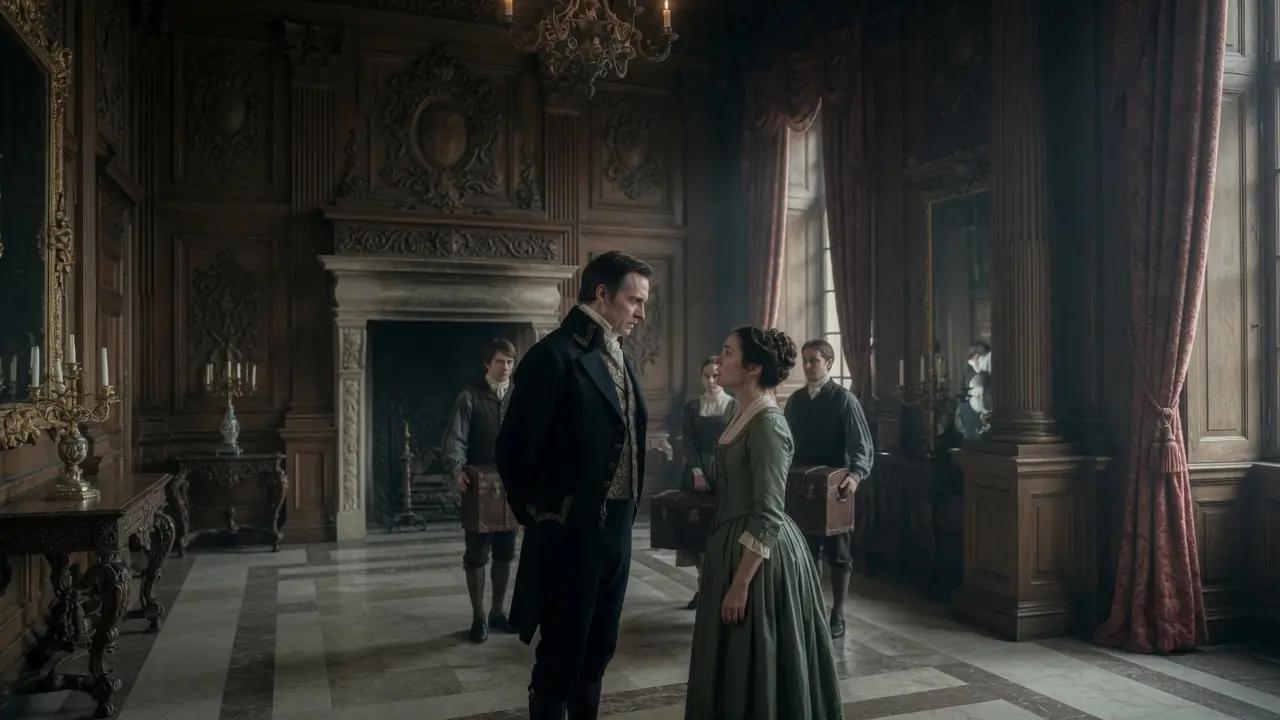
He had meant to bury her, and instead he had handed her a kingdom. For Coldfell was land neglected, ruined, crying out for exactly the gift that Harriet Bramwell had been born and bred, and was dying to use, the gift that her gilded ducal cage had forbidden her for three long years. He had taken her out of the drawing rooms where she was useless and an ornament and an embarrassment, and he had set her down in the middle of 9,000 acres of the one thing on earth she was a genius at. And he had given her in his contempt complete and total command of it, with no one to stop her, no duke to be shamed of her, no fashionable world to laugh, nothing but the land and the people, and her own two clever hands.
He thought he had thrown her into a grave. He had thrown her into her element like a fish flung back into the sea. And Harriet Bramwell rolled up her sleeves and went to work. I wish I had a whole evening only for this part, for it is my favorite, and I will have to gallop through what deserves a slow, proud walk, but you saw the end of it already from the hilltop. So, let me at least tell you how it was done.
She did everything her father had taught her, and she did it like a force of nature. She drained the valley first, surveyed it herself, walked every sodden acre, laid out the dikes and ditches with her own hand, and hired the men of the village to dig them, paying them honest wages out of her own great fortune, which was the one thing the Duke had not been able to take from her, for it was tied up in her own name by her shrewd dead father's lawyers, and was hers to spend as she pleased, and spend it she did, pouring her father's fortune back into the land the way her father had taught her, knowing as he had known that land transformed pays back tenfold what is sown in it. She drained the fields and sweetened the soured soil and brought in better seed and better methods and better stock. She rebuilt the failing farms and mended the tumbledown cottages and put new roofs over the heads of people who had shivered under broken ones for generations.
She built the mill and the school and a dozen things besides. But it was not only the doing of it that made her what she became. It was the way of it, for Harriet did not lord it over the people of Coldfell, as the Calverton always had, from a cold distance, taking and never giving. She worked among them. She was out in the fields with them in all weathers, mud on her boots and her sleeves pushed up, knowing every man by name, and every man's family, and every man's troubles, teaching them the new methods with her own hands.
And the people of Coldfell, who had been neglected and despised and beaten down for as long as anyone could remember, who had never in living memory had a master who so much as came to look at them, gave her in return something the Duke of Calverton had never earned from anyone in his life. They gave her their whole devoted, loyal hearts. She had lifted them out of hopeless, grinding poverty into prosperity and dignity. She had seen them and known them and worked beside them and made their bleak forgotten corner of the world into a thriving place a person could be proud to live in.
And they loved her for it with a fierce loyal love and called her among themselves not the duchess but simply our lady and would have walked through fire for her. Within a year the change was astonishing. Within two, it was complete enough to take a proud man's breath away on a hilltop. Coldfell, bleak, drowned, dying Coldfell, the dismal hole chosen to bury a disgraced wife, had become one of the most thriving, prosperous, talked of agricultural estates in the whole of the north of England, a model that improving farmers came from three counties to study. a little kingdom of rich fields and fat stock and snug cottages and devoted prosperous people.
And at the heart of it, commanding the whole of it, beloved and magnificent, and entirely unbroken, was the woman the Duke of Calverton had thrown away. She had not become a broken recluse. She had become a queen, and the word of it had begun, despite everything, to spread. For word does spread, my dears, however far north you bury a thing, and two separate words came south to the Duke of Calverton in the second year, and between them they put him on that high northern road.
The first word was the accounts. for Coldfell, which had drained money out of the Calverton coffers for generations, which the Duke had never expected to hear of again, except as a dismal expense, had begun astonishingly to show a profit, and then a remarkable profit, and then a profit so large that the Duke's own men of business came to him baffled, and asked what in heaven's name was happening at the northern estate, for it had become, of a sudden the most productive holding in the entire dukedom. And the Duke baffled himself, made inquiries, and the inquiries came back with tales he could not credit, of drained valleys and model farms, and a thriving village and improving men coming from three counties to study the methods of the remarkable Duchess of Calverton, who had taken a ruin, and made it a wonder. That alone might not have moved him. Pride is a heavy thing to shift.
But the second word came at nearly the same time, and the second word shook the Duke of Calverton to his foundations, for the truth of the scandal had begun at last to surface. It surfaced, as such truths do, a guilty conscience, a falling out, a loose thread pulled. One of the servants Lady Cresa had bribed two years before, dismissed since, and bitter, and frightened by some trouble of her own, unburdened herself at last. And what she confessed and could prove was the whole of it.
The forged notes, the bribed witnesses, the staged meetings, the careful manufacture of a scandal out of nothing by Lady Cresa Ashley to ruin the wife who had taken the dukedom she wanted. It reached the Duke, and the Duke of Calverton sat with the proof of it in his hands, and understood slowly, with a horror that grew and grew the magnitude of what he had done. His wife had been innocent. innocent, entirely provably innocent, falsely accused by a jealous enemy. And he, her husband, the one man on earth bound to protect and believe her, had not troubled to discover the truth, had condemned her unheard on the word of her enemies, because his pride preferred the convenient lie, and had banished her, an innocent woman, his own faithful wife, to rot in a wasteland for a crime she had never committed.
He did not sleep after that. A proud man's pride once it cracks lets in a flood. And the flood that came in upon the Duke of Calverton was shame, the deep scouring shame of a man forced to see himself clearly at last, and it would not let him rest. He had to go to her. He hardly knew what he would say or do.
He had no right to anything. He knew that he had forfeited every right. But he could not stay south knowing what he knew, knowing she was buried in the north for his crime, and not go to her. So he rode north in dawning shame, braced for the broken ruin of a woman he had wronged past forgiveness. And he reached the top of the hill and looked down, and found not a victim, but a queen.
Now I may let him ride down the hill at last, and I promise you the riding down was the longest mile of the Duke of Calverton's life. He came down into the thriving valley, past the new dikes and the rich fields and the snug cottages, past the curious, and then the cold, and then the openly hostile stares of the people of Coldfell. for they knew him. This proud southern lord who had banished their lady and never once come to see them in all the years of their suffering and they did not love him and they did not trouble to hide it. And he came at last to the fold of land where she sat her horse among her devoted people directing the work. and she saw him coming and she did not start and she did not pale and she did not do any of the things a broken banished wife does at the sudden sight of the Lord who broke her.
She simply finished giving her instructions calmly to the man beside her. And then she turned her horse and walked it the few steps to where the duke had reigned in. And she looked at her husband across the small cold distance, level and unafraid, with two years of a kingdom behind her, and she said, "Your grace, you are a long way from London. Have you lost your way?" It was beautifully done.
There was no anger in it, no tears, no reproach, only a cool, sovereign, faintly amused composure, the composure of a woman who held every card in the deck and knew it. And the Duke of Calverton, who had ridden north full of shame he had rehearsed a hundred ways, found every rehearsed word desert him and could only look at her at the woman he had bought and been shamed of and condemned unheard and buried in a wasteland, sitting her horse like a queen in the kingdom she had built out of the grave he dug for her, magnificent and unbroken, and entirely utterly beyond him. Harriet," he said. "I..." He stopped, then began again. "I have seen what you have done here from the hill. I could not, Harriet, this valley was a ruin. It was a wasteland. I chose it because it was the most wretched place I owned. And you have made it, he gestured helplessly, at the thriving country all around.
You have made it this in two years alone with everyone against you. I cannot. I do not have the words for what you have done. "It is called work, Your Grace," she said pleasantly. And knowledge, both of which I have had in great abundance my whole life, and neither of which you ever once troubled to discover I possessed.
You spent three years shamed of a dirt farmer's daughter. This is what dirt farmers daughters can do when someone is foolish enough to give them a free hand and 9,000 acres. She let that sit just a moment. You gave me both when you banished me. I have been meaning to thank you.
It is the only kindness you ever did me, and you did it by accident, meaning the opposite. The Duke flinched and took it, for he knew he had earned it. "I came north," he said low, "because I learned the truth about the scandal, about Cresa Ashley. He saw her go very still. I have the proof of it, Harriet. the whole of it.
The forged notes, the bribed witnesses, the confession of the servant she paid. I know what was done to you. I know you were innocent. I know that you were innocent the whole time. And that I, his voice cracked, "that I did not believe you.
That I did not even trouble to find out whether to believe you. that I condemned you and banished you and buried you here, an innocent woman, my own wife, because it was easier than justice, and because my pride preferred the lie. I have come to tell you that I know it, and to tell you that there are no words on this earth for how grievously, how unforgivably I wronged you. And here, for the first time, something moved behind Harriet's cool composure. Not softness, not yet, but a flash of the old deep wound, the wound of two years and a lifetime.
You did not believe me, she said. And now there was iron in it. I came to you, Edmund. I stood in front of you, your own wife, and told you the truth and begged you to stand beside me. And you looked at me, and you chose to believe a woman who hated me, because I was born in the dirt, and you had always thought the worst of me, and it was easier.
She drew a breath. Do you understand that the scandal is not what you must atone for? Lady Cresa built the lie, but lies are cheap, and the world is full of them. What you must atone for is that when it came you had so little regard for your own wife, so little after three years, that you did not think me worth the trouble of the truth. That is the wound, Edmund, not that I was lied about, that you, who were bound before God to know me and protect me, had never once cared to know me at all.
I know, said the Duke. I know it, and I have no defense, and I offer none. He dismounted, then got down off his horse there in the field, so that he stood below her, where she sat hers, which I do not think was an accident. I was raised to value one thing above all others, Harriet, and that thing was the name of Calverton, to value it above kindness, above justice, above people, above everything. My father beat that into me before I was 10 years old.
It is not an excuse. There is no excuse. It is only the shape of the ruin I was when you married me. I valued my name more than my wife. I valued my pride more than the truth.
And it took me two years and the proof of my own monstrous error and the sight of what you built out of the grave I dug for you to understand that the name of Calverton is worthless. That it is a hollow gilded nothing next to the worth of the woman I was too proud and too blind to see. He looked up at her. You told me when I banished you that I had never once known what you were and that I was about to find out and that I would be sorry.
You were right on every count. I have found out what you are and I am sorry past all telling and I know it is too late. She did not forgive him quickly. I want you to know that and to be glad of it for a forgiveness given quickly would have cheapened everything she had become. And Harriet Bramwell had not built a kingdom out of a wasteland, only to hand herself meekly back to the man who had buried her the moment he came crawling north with his shame.
"Why are you here, Edmund," she asked him, and it was the real question, the one beneath all the others. "Truly, you have learned I was innocent." "Very well, you might have cleared my name by letter, and spared us both this. You have learned this estate turns a great profit. Perhaps you have come to claim it, for it is yours in law, as I am yours in law, the land and the wife, both your property to dispose of. So which is it?
Have you come for the profit? Or have you come having found I am not the broken thing you expected to collect the wife who has turned out to be an asset after all? Be honest with me, for once in your life, I will have honesty or I will have nothing. And the Duke of Calverton, who had spent his whole life behind the armor of his pride, took the armor off there in the field in front of her devoted, hostile people, and gave her the naked truth.
I have not come for the profit, he said. Keep it. It is yours. You made it. I would not touch a penny of it.
And I have not come to collect you like a parcel, like a thing that has appreciated in value. I have come because, and his voice was not steady at all now, because I rode over that hill, braced to find a woman I had broken, and I found instead the most magnificent human being I have ever seen in my life, ruling a kingdom she built with her own hands, out of the ruin I left her in, beloved by every soul for miles, needing nothing and no one, least of all me." And I understood, looking down at you from that hill, the full measure of what I threw away. I did not marry a fortune Harriet. I did not marry an embarrassment.
I married the finest woman in England, and I was too blind to see it, and I buried her in the north, and she turned the grave into a throne. I have come because I have fallen in love with my own wife two years too late. Having forfeited every right to her and because even knowing I have no right, I could not stay away. That is the whole truth. I want nothing from you that you do not freely give.
I expect nothing. I deserve nothing. I have only come to say it and to do if you will permit me. The one thing I can still do to begin to set right what I broke. And what is that?
She asked. Clear your name, he said completely, publicly before the whole of the world that condemned you. I will take the proof of Cresa Ashley's lie to London and I will destroy her with it. Ruin her standing as she tried to ruin yours and stand up before all of society and declare my wife innocent, wronged, and the most admirable woman in England. I will undo the burying Harriet.
I will spend the name of Calverton, the precious name I valued above you, to restore yours, not so that you will come back to me. I have no illusion that you owe me that or anything, but because it is owed to you, whatever becomes of us, and I should have paid it two years ago, and I will pay it now, whether you take me back or send me away forever." And that, my dears, was the right answer or the beginning of it. For he had offered to spend the one thing he had always held most precious, his name and his pride, not to reclaim her, but simply because justice owed it to her, and he had offered it with no condition attached, expecting nothing in return. He had finally, at long last, valued her above his name.
And Harriet Bramwell, Queen of Coldfell, looked down at the humbled man standing below her horse, and saw beneath two years of shame and a lifetime of ruinous pride, the flicker of the thing she had glimpsed once early on, and reached for and been refused. A man who might, after all, be worth something, now that the pride had been burned out of him, and the truth had got in. She did not fall into his arms. She was far too much herself for that.
You will clear my name, she said, because it is owed, and you will expect nothing for it. Agreed. You will do it whether I take you back or not. Agreed. She swung down off her horse, then came down to stand level with him on the rich, dark earth she had reclaimed, which I do not think was an accident either.
And then you will come back here, and you will stay, not as the Duke of Calverton inspecting his property, as a man learning to be worthy of his wife. And you will learn it the way my people learned to trust me, which is slowly, and by your deeds, and on this land, with your sleeves pushed up. You valued your name above me once. You will spend a good long while, Edmund, proving you have truly learned to value me above it.
And I warn you, I am a hard mistress and Coldfell is hard country, and I will not make it easy. And I will not be wooed with words, for I have had a belly full of fine words from people who never meant them. Win me the way I won this valley with work and time and truth. And then, and here, at last, the smallest warmth came into her sovereign composure, the first thaw of a long northern winter. And then we shall see.
I will promise you nothing more than the chance. But the chance, Edmund, the chance you may have. It is more than you came expecting, I think. It is certainly more than you deserve. But I find I am queen enough now to be generous.
And there was a man I glimpsed once, behind your pride, that I should not mind to meet again, if he has truly come north at last. And the Duke of Calverton, who had come to the north expecting to look upon a ruin, bowed his head before the queen his cruelty had made, and accepted the chance she gave him as the greatest gift of his life, which it was. And that, my dear listeners, is where I leave them, not in an embrace, for they had not earned one yet, but standing level on the rich dark earth of a reclaimed valley, a humbled lord and the magnificent woman he had thrown away, with a long, slow proving stretched out ahead of them, and at the end of it, if he was man enough to earn it, the one thing neither of them had ever had, a true marriage, freely chosen between equals. and he earned it. I am glad to tell you that he earned it, though it took him a deal longer than he might have wished.
He went south and he cleared her name as he had sworn. Took Lady Cresa Ashley's whole poisonous scheme before the world and shattered it and stood up in the teeth of all society and declared his duchess innocent and wronged and the finest woman in England and ruined Cresa's standing so thoroughly that she retired from the world she had schemed in and was not much missed. And then he came back north to Coldfell, and he stayed. And he learned slowly, with his sleeves pushed up on Harriet's hard land, and on Harriet's hard terms, how to be a man worthy of his wife.
He learned the land from her, who knew it better than any man alive. He learned the people from her, who loved her. He learned humility, which his whole life had never taught him. from two years of patient proving on a northern estate where his ducal name meant precisely nothing and only his deeds counted for anything at all. And Harriet watched him learn it, wearily at first, and then less wearily, and found, as she had hoped, that the man behind the burned away pride was indeed the man she had glimpsed once and reached for, clever and capable, and once humbled, surprisingly kind, and worth, after all, the loving.
They came to love each other in the end. Truly the real way, the way that has to be built and cannot be bought between two people who married as strangers and a transaction and became by the long hard road husband and wife in earnest. And they ruled coldfell together side by side the dirt farmer's daughter and the once proud duke and made it the wonder of the north. And the Duke of Calverton, who had spent his life shamed of his common wife, lived to be prouder of her than of every Calverton who had ever held the name, and to know himself the most fortunate fool in England, that his own cruelty had buried his happiness in a wasteland, and his wife had dug it back up and made it bloom.
If you ask me what this story is truly about, I will tell you it is about the difference between the two kinds of sovereignty there are in this world. There is the kind you are born to, the title, the name, the land you inherit, and did nothing to earn. And the Duke of Calverton had all of that, and squandered it, and valued it above every human thing, and it made him small. And then there is the other kind, the sovereignty you make out of nothing by your own gift and your own work, and the love you earn from the people whose lives you better.
And Harriet Bramwell had that. And the proud world that scorned her birth could not take it from her because she had built it herself out of a wasteland with her own two hands. He was a king by accident. She was a queen by merit. And when at last he understood the difference.
When he stood on that hilltop and saw what the woman he despised had built out of the grave he dug for her, it broke his pride and remade his soul. And that breaking was the best thing that ever happened to him. For there is no banishing a person who carries their kingdom inside them. You may send them to the ends of the earth, and they will simply build the kingdom there and reign.