"Forgive me," she whispered to the gardener. "They have made you part of my humiliation." Evermere Hall looked gentle from a distance. Pale stone walls rose above a slope of old lawns.
Ivy softened the edges, and narrow windows caught the morning sun with a glow that made travelers slow their horses and say, "What a fortunate family must live there." Rosalyn knew better. She knew the long breakfast room where her chair had been moved farther from her father's place each year after her mother died. She knew the blue drawing room where Lady Marberry, her stepmother, inspected her as if she were an inherited ornament with a crack down one side.
She knew the music room where Celestine sang for applause and made every note sound like a victory over someone else. Lady Helena Evermere, Rosalyn's mother, had been dead 10 years, but the parts of the house that had loved her seemed to have been punished for it. Her books were locked away. Her garden beds were allowed to fade.
Her name was spoken only when someone needed to remind Rosalyn that she had inherited too much quietness and not enough charm. Rosalyn did not have Celestine's brilliance. She was not a woman who entered a room and made men forget the last sentence they had spoken. She had dark hair, thoughtful eyes, and a habit of watching before speaking. Lady Marberry called it dullness.
Her father called it shyness. Rosalyn herself had no name for it except survival. The one fixed fact in her life had been her betrothal to Lord Alistair Vain. The contract had been arranged when she was 12, too young to understand that noble marriages were not promises of love, but carefully sealed exchanges of land, debts, and bloodlines. Alistair had been polite to her always, though never warm.
He had pale hair, pale eyes, and the kind of smile that weighed a person's usefulness before deciding how much sunlight to provide. Rosalyn did not love him, but the contract meant escape, and escape mattered to a daughter who was slowly being erased from her own home. Then, Evermere money began to fail. Rosalyn learned it not from confession, but from silence. Closed doors, late, her father's gray face after meetings with lawyers, Lady Marberry's sudden interest in keys and ledgers.
Soon after, she was summoned to the blue drawing room. Lord Evermere stood by the mantle, turning his signet ring around and around. Lady Marberry sat with perfect posture beside the tea table. Celestine waited near the window in a rosecolored gown, her eyes bright. Lord Alistair Vain stood beside her.
Rosalyn understood before anyone spoke. Lady Marberry delivered the blow with the softness she reserved for cruelty. My dear Rosalyn, certain adjustments have become necessary. Lord Vain's position requires a wife with a particular brightness, a public grace, a capacity for society. Celestine is more suited to such a life.
Celestine lowered her lashes in a graceful performance of humility. Rosalyn looked at her father. The contract was made with me. Lord Evermere winced. Contracts can be amended when all parties agree.
All parties? She asked. He did not meet her eyes. Alistair bowed smooth and untroubled. I hope you will not view this as a slight.
Your sister and I have found an unexpected compatibility. These things happen. These things happen. A childhood promise, a woman's future, a dead mother's last protection, a life moved from one hand to another because the prettier hand had reached first. Lady Marberry poured tea that no one drank.
You are fortunate, really. Marriage to Lord Vain would have required much of you. You have always been happiest with your books and your flowers. Celestine smiled. Do not look so wounded.
You never like society anyway. Rosalyn felt every eye waiting for tears, anger, pleading, anything they could use to prove she was unsuitable. Instead, she folded her hands. When will the change be announced? Her father exhaled as if she had given him a gift.
At the spring gathering at Hawthorne Estate, Lady Marberry said, everyone of consequence will be there. Hawthorne. Even Alistair's expression sharpened at the name. Hawthorne estate was the grandest property in the county, richer than most noble lines and older than some royal favors. Its current master, the Duke of Hawthorne, was rarely seen.
Some said he was ill. Others said he had returned from the continent changed. A few whispered that he had refused three advantageous marriages, closed half his house, and vanished into his gardens like a ghost with a title. Rosalyn had never met him. She only knew the estate by reputation.
Miles of parkland, glass houses warmed through winter, walled gardens, marble terraces, and a spring festival where flowers bloomed earlier than reason allowed. You will behave graciously, Lady Marberry said. No one must suspect resentment. A family united in affection is still a family worth trusting. There it was, the true command.
Be wounded, but do not bleed where anyone can see. That night, Rosalyn went to the neglected South Garden alone. Rain had softened the paths. Beneath weeds and dead stems, stubborn green shoots had begun to push upward. She knelt in the mud, placed her palm over the earth, and whispered what she could not say in the house.
I'm tired of being moved. No one answered, but beneath her hand, unseen roots held fast. Hawthorne estate did not rise from the countryside so much as commanded. The evermeir carriage passed through iron gates shaped like Hawthorne branches, and followed a curving road under ancient trees. Lanterns burned along the drive.
Beyond the lawns, the house appeared in pieces, chimneys first, then towers, then tall windows bright with candlelight, until the whole great structure opened before them, like a palace built to keep secrets beautifully. Celestine leaned toward the window. Imagine being mistress of a place like this. Lady Marberry smiled. Mistresses are made by good marriages, my dear.
Remember that. Rosalyn looked past them to the gardens. Terraces descended into shadow. A fountain lifted silver water beneath the moon. Farther away, a glass house shone faintly, and along the entrance steps, white flowers overflowed from stone urns without looking arranged.
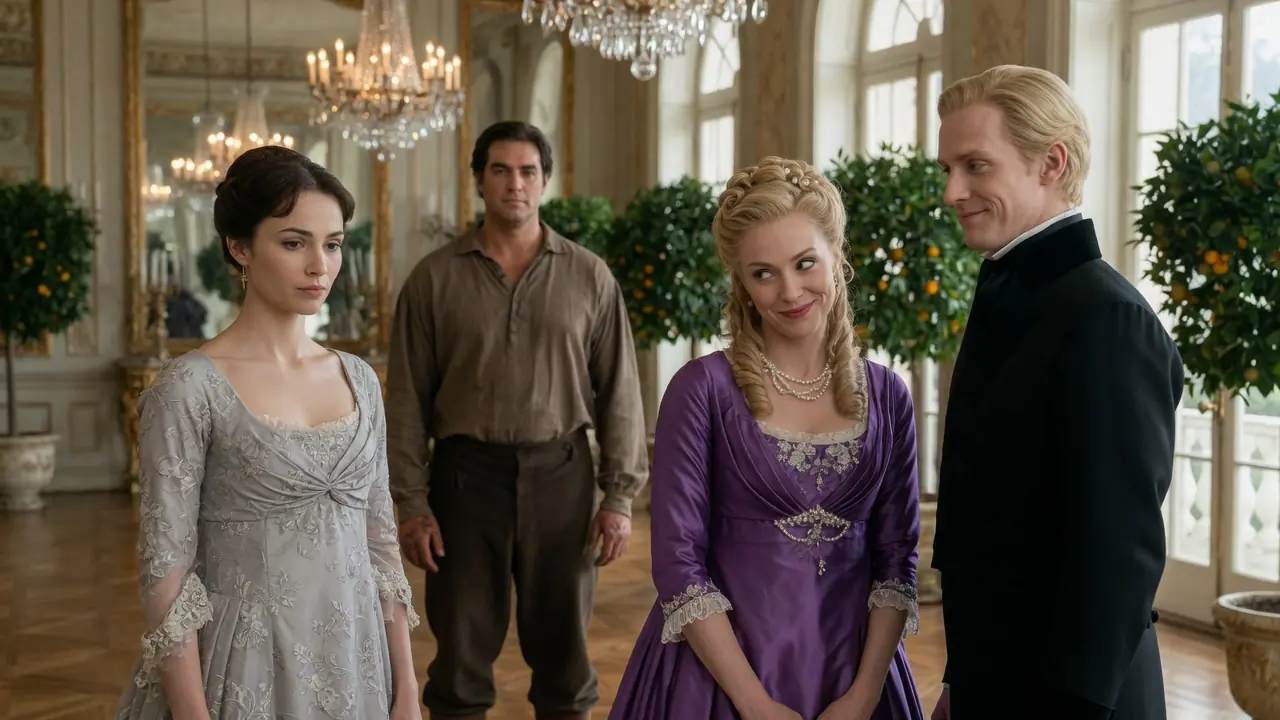
Men gathered in dark coats, their faces composed into the alert boredom of rank. Servants carried champagne and sugared fruits. Music floated from a raised al cove as if scandal, debt, and hunger had never entered any room so bright. Rosalyn wore pale gray, a gown chosen by Lady Marberry because it made her look modest without making her memorable. Celestine wore violet silk trimmed with pearls.
Alistair stayed near her, accepting congratulations before the announcement had been made. For nearly an hour, Rosalyn behaved as ordered. Then Lord Alistair requested silence. Standing beside Celestine beneath an ancestral portrait, he raised her hand and announced their engagement. Applause filled the ballroom at once.
Lady Marberry's eyes shown with triumph. Lord Evermere looked relieved as if betrayal had been a difficult errand now completed. Rosalyn smiled. She had practiced the expression in her mirror until it no longer looked like pain. But Celestine was not satisfied with victory.
Victory for her became real only when Rosalyn had been made to kneel beneath it. "You must congratulate my sister too," she said, her voice sweet enough to draw nearby attention. "She's been so generous in surrendering what never quite suited her." "A few ladies turned." Lady Marberry murmured, "Celestine."
But Celestine had an audience now. It is true. Rosalyn never cared for balls. She has always preferred gardens. I sometimes think she would be happier with a spade than with a title.
Someone chuckled. Rosalyn felt heat rise to her face. Alistair did not stop Celestine. Why would he? Rosalyn's humiliation made his choice appear wiser.
Celestine looked toward the open terrace doors where evening air carried the scent of damp leaves. There, she said suddenly, even Hawthorne's gardener looks more suited to her than any gentleman here. The gardener stood just beyond the threshold, half in candlelight, half in dusk. He had been arranging potted orange trees along the terrace. Perhaps the work was finished.
Perhaps he had been listening. He was tall and broad-shouldered with dark hair pushed back from his forehead and a face too controlled to be called merely handsome. His hands were marked with earth. The guests saw a servant. Rosalyn saw a man being forced into another person's joke.
He did not lower his eyes. He looked first at Celestine, then at Rosalyn. There was no pity in his gaze. That saved her. Pity would have undone her.
His steadiness asked only one question. What will you allow them to make of this moment? Celestine laughed. Do not be shy, Rosalyn. If you cannot be Lady Vain, "Perhaps you may be queen of the cabbages."
Rosalyn moved before fear could stop her. She crossed the polished floor. Whispers broke behind her like small glass. Her father said her name. Lady Marberry rose half from her chair.
Alistair's eyes narrowed. Rosalyn reached the terrace doors. "Forgive me," she whispered to the gardener. "They have made you part of my humiliation." "They have tried," he said.
The answer was quiet, but it held so much dignity that Rosalyn felt her spine straighten. She turned and took his hand. The room fell silent. Celestine's smile stiffened. My dear sister, have you truly chosen him?
Rosalyn looked at the jewels on Alistair's fingers, then at the earth on the gardener's hand. At least he knows how to nurture what he touches. No one laughed. The gardener's hand closed gently around hers. Not possessive, not theatrical, simply steady.
"Lady Rosalyn," he said, his voice carrying now. "The night air is kinder than this room. May I escort you?" It was absurd. A gardener offering escort in a Duke's ballroom.
A lady accepting while half the county watched. Rosalyn said, "Please." Together, they left the ballroom. Outside, the terrace smelled of wet stone and orange blossom. Behind them, music restarted too quickly.
Rosalyn knew her family would be furious. She knew every drawing room in the county would repeat the story by breakfast, but for a few minutes, she did not care. The gardener led her down the terrace steps and into the moonlit paths. When they reached the shadow of the glass house, he released her hand at once. "You need not continue the performance," he said.
Rosalyn looked at him. It was not a performance. Something moved across his face and disappeared. Then it was a risk. "Yes, for a stranger."
"For a person," she corrected. They walked in silence along a gravel path bordered by white tulips. At last, the path curved beyond the glasshouse toward a small cottage hidden behind fruit trees. It had a green door, a slate roof, and lamp light glowing in one window. "This is yours?"
Rosalyn asked. "For now." He opened the gate and gestured toward a bench beneath an apple tree. "Sit a moment. The house will swallow you again soon enough."
Rosalyn sat because her knees had begun to tremble. He went inside and returned with a cup of water. "Not wine, not tea, not a servant's remedy. Water." The simplicity nearly made her weep.
"Thank you. I am Julian," he said. "Only that. No surname, Rosalyn. I know your sister speaks loudly.
Despite everything, she laughed. The sound seemed to surprise him. For one second, his guarded face warmed, and Rosalyn saw the outline of a different man beneath the stillness. "Will they dismiss you?" she asked suddenly. "No."
The certainty startled her. "The Duke values his gardens that much?" "More than most things." "Have you met him?" A pause.
"Often." "What is he like?" Julian looked toward the dark glass house. Difficult. This time her laugh came easier.
Voices sounded from the path above. Rosalyn. Her father's voice strained and angry with humiliation. Lady Marberry followed cold and sharp. Do not make this worse than it already is.
Rosalyn stood. Julian's attention sharpened. You need not return alone. Yes, she said after a moment. I do, but thank you for asking.
At the gate, she paused. May I come back to see the gardens? Another day, if the Duke permits visitors? Julian rested one hand on the gate post. The Duke permits those who come to look not to possess.
Then I may be safe, she said. I own very little. His eyes held hers. That is not the same as having little value. Rosalyn had no answer.
No one had ever said such a thing to her without wanting obedience in return. She walked back toward the house with her head high enough to anger everyone waiting for her. From that night onward, the county had a story. Lady Rosalyn Evermere, discarded by Lord Vain, had taken the hand of Hawthorne's gardener in a fit of wounded pride. Only Julian knew the truth.
She had not chosen him because she was wounded. She had chosen him because, for one breathless moment, she had seen clearly. Lady Marberry forbade Rosalyn to return to Hawthorne. "You will not attend calls this week," she said at breakfast the next morning. "You will not answer letters without my inspection.
You will not mention that man again. Your father has written an apology to Lord Vain. For what? Rosalyn asked. The room chilled.
Lord Evermere lowered his newspaper by an inch. Lady Marberry set down her cup. For your behavior. My behavior was a response to Celestines. His father written an apology for her.
Celestine's eyes flashed. Lord Evermere sighed. Rosalyn, do not be childish. There it was again, the word used whenever she noticed injustice aloud. For 3 days, Rosalyn remained at Evermere Hall.
On the fourth, she walked to the south garden with pruning shears and did not stop at the gate. An old footpath through the woods led eventually to the outer lands of Hawthorne. It was not a road ladies used, but Rosalyn had stopped measuring her life entirely by what ladies were expected to do. Julian was repairing a fence when she arrived at the cottage. He wore no coat and a smear of earth marked his cheek.
He did not look surprised. Lady Rosalyn, you expected me? I hoped you would stay away, he said. That is not the same thing. Do you always greet visitors by telling them they are unwelcome?
Only when their presence may cost them something. Everything costs something. I'm trying to learn which prices are worth paying. After a moment, he handed her a pair of gloves. "Then start with splinters."
That became the first afternoon. She held boards while he hammered them into place. Her work was clumsy. He corrected her without mockery. When she struck her thumb and gasped, he inspected her hand with grave attention and said, "You will live," which made her laugh despite the pain.
The second afternoon, he showed her the old rosewalk. It had once been beautiful. She could tell by its bones, arching iron supports, careful spacing, good morning light, but Bramble had swallowed part of it, and many roses were weak. "This belonged to my mother," Julian said. Rosalyn noticed the phrase only after he spoke.
My mother, not the Duke's mother. She loved white roses. She loved stubborn things. White roses were merely the prettiest example. Can they be saved?
Rosalyn knelt beside a struggling plant with patience, cutting away what steals from it, supporting what remains, waiting longer than seems reasonable. You speak of plants as if they were people. Perhaps people are more like plants than we admit. From then on, she returned whenever she could, not openly, not every day, but enough for the garden to begin measuring time by her arrival. Julian never flirted as drawing room men did.
He didn't scatter compliments like coins. He did not call her beautiful when she bent over soil with loose hair escaping her pins. Instead, he noticed practical things. You forgot your gloves. You have not eaten.
That path floods after rain. Take the higher one. Do not trust that ladder. It lies. Strangely, each warning felt more intimate than praise.
Rosalyn began to notice things, too. The estate steward, Mr. Vale, came to Julian's cottage with ledgers tucked under his arm. He addressed Julian as sir, but not in the way one addressed a gardener. A London solicitor arrived one morning and removed his hat before entering the cottage. Two visiting gentlemen once began to greet Julian near the glass house, then stopped abruptly when he looked at them.
Rosalyn waited until they were gone. "You are an unusual gardener." Julian tied a vine to its support. "Most people are unusual when observed closely. Most gardeners do not receive solicitors.
Some estates are poorly managed. And the gardener corrects that. He looked at her. This one does. It was not an answer.
It was a wall with a hidden door. Rosalyn should have pressed, but she feared knowing. Not because she feared he was wicked. She feared that if Julian belonged to a world larger than the cottage, then the peace she found with him might be temporary. Another borrowed thing waiting to be taken.
Meanwhile, Celestine's triumph began to fray. Lord Alistair visited Evermere often and performed devotion with discipline. He admired Celestine's gowns, praised her singing, spoke of London seasons and future houses. But Rosalyn saw what Celestine did not. His attention sharpened whenever Lady Marberry mentioned settlement figures.
His warmth increased in proportion to talk of dowry when Celestine spoke of romance. His gaze moved toward the window. One afternoon, Rosalyn passed the library door and heard Alistair speaking to Lady Marberry. The funds must be guaranteed before the wedding. I have been patient, Lady Marberry answered.
Lord Evermere needs time to shift certain assets. Time, Alistair said, is exactly what my creditors do not possess. Rosalyn moved away before the door opened. That evening, Celestine found her in the garden. Still playing in dirt?
Celestine asked. Rosalyn trimmed a dead stem, still confusing attention with affection. Celestine's smile vanished. Everyone knows why you go to Hawthorne. Do you imagine the gardener will make you respectable?
No, I imagine respectability has made a great many people cruel without consequence. You truly would choose him over Lord Vain? Rosalyn looked up. I would choose a kind man with empty pockets over a titled one with empty hands. Celestine laughed, but uncertainty flickered in her face.
She carried the conversation to Alistair, intending to mock Rosalyn. Instead, she awakened something uglier in him. Alistair did not love Celestine, but he understood ownership. He had discarded Rosalyn because Celestine's dowry was more useful. Yet Rosalyn's refusal to appear ruined offended him.
A possession he had set aside was not supposed to find value elsewhere. He began making inquiries about Hawthorne's gardener. At first he found nothing. No proper wage record for a gardener named Julian. No parish entry.
No reference from another estate. Only household notes in the steward's hand. JH approved. JH instructed. JH requires the East Glass House opened.
J. In old county records, in sealed notices, and on an invitation Alistair had once ignored, the current Duke of Hawthorne appeared under his full name, Julian Hawthorne. The truth reached Rosalyn on a morning full of rain. She had gone to Hawthorne because the rosewalk would need checking after the storm. Her cloak was damp when she reached the cottage.
The door stood slightly open. She raised her hand to knock, then heard voices inside. Mr. Vale sounded anxious. Your grace, Lord Vain has been asking questions in London. Careless questions.
He will not be long in piecing it together. Rosalyn's hand froze. Your grace. Julian's voice answered, low and controlled. Then let him.
With respect, the masquerade has gone too far. The county believes you are a gardener. Lady Rosalyn believes it. Silence. I know what she believes, Julian said.
And when she learns otherwise. Rosalyn stepped back. The gravel shifted beneath her shoe. The voices stopped. Julian opened the door.
For one second, neither of them moved. Then his face changed with the pain of a man arriving too late to prevent a wound he always knew was possible. Rosalyn. She hated how safe her name still sounded in his voice. Your grace, she said.
He flinched. Mr. Vale vanished wisely into the shadows. Rain fell between them. I can explain, Julian said. Were you ever going to tell me?
Yes. When after I finished defending you, after the whole county laughed at me for caring about a servant who is never in danger of being dismissed, I was in danger, he said, not of dismissal, of being seen only as a title again. So you let me see a lie. I let the world believe what it wanted. Do not make this the world's fault.
I asked you what the Duke was like. You said he was difficult. A faint, miserable honesty crossed his face. He is. You let me worry for you.
You let me bring you a ledger because I thought you had nowhere proper to write your planting notes. I use that book every day. That is not the point. No, he said quietly. It is not.
She wrapped her cloak tighter, though cold was not the problem. Was any of it true? Julian stepped forward once, then stopped when she moved back. All of it that mattered. That is a very nobleman's answer.
His eyes darkened. I was born into rooms where every smile looked first at my inheritance. My mother died after years of being treated as a signature beside my father's name. When my father died, three families sent daughters in mourning gowns before the earth settled on his grave. They spoke of comfort.
Their father spoke of alliances. I began to understand that the Duke of Hawthorne was a house people wished to enter. Julian was merely the door. Rosalyn listened despite herself. So I closed it, he continued.
I came here to the part of the estate my mother loved. I worked where hands mattered more than names. I told myself I would remain hidden until the pressure to marry passed. Then you took my hand in a ballroom because you thought I had nothing. His voice roughened.
Do you understand what that did to me? Rosalyn did understand. That was the crulest part. You thought I was different, she said. And instead of trusting that difference, you tested it without telling me there was an examination.
Julian closed his eyes briefly. Yes. The admission hurt more than any defense. I have been tested all my life, she said, for grace, silence, usefulness, and whether I could be hurt without becoming inconvenient. I did not expect to be tested by you.
Rain slid from the cottage roof. I hid the title, he said. I did not pretend to care for you. No, but you allowed me to care for a man who did not fully exist. He exists, Julian said, sharper now.
The man in the garden is the only part of me that ever felt real. Then why did you not trust me with the rest? He had no answer. That answer was enough. Rosalyn turned.
Lady Rosalyn. She stopped but didn't look back. Vain is dangerous, Julian said. Not with violence perhaps, but with debt and pride. If he knows, he will use whatever he can against you, against your family, against me if it serves him.
Thank you for the warning, your grace. I've lived among dangerous people long enough to recognize polished teeth. Let me help you. This time she looked back. That is the tragedy.
You could have helped me as Julian. Now everything you offer sounds like the Duke. She left him standing in the rain for 2 weeks. She did not return to Hawthorne. Evermere Hall tightened around her.
Lady Marberry was anxious. Alistair visited more often, spending long hours with Lord Evermere in the library. Celestine grew restless, changing wedding plans as if Lace could quiet doubt. Then Lord Evermere summoned Rosalyn to the library. Lady Marberry stood beside him.
Alistair was there. So was Mr. Phelps, the family solicitor. On the desk lay a document. Lord Evermere cleared his throat. "Your mother's small settlement has become legally inconvenient."
The softness of the sentence made it more monstrous. Lady Marberry continued, "Certain funds are tied in ways that restrict your father's ability to provide properly for Celestine's marriage. As you are unmarried, we need you to sign a temporary release of claim." "Temporary?" Mr. Phelps coughed.
In effect, Lady Rosalyn, it would allow Lord Evermere to consolidate assets under his management. My mother's assets. Her father looked miserable. Rosalyn, please. It is for the good of the family.
The family, the altar upon which only Rosalyn was ever asked to be sacrificed. Alistair smiled faintly. You would not wish your sister's future to suffer because of sentiment. Rosalyn looked at him. No, I would wish it to suffer only because of your creditors.
The room went still. Celestine, listening unseen from the doorway, stepped into the room. Creditors. Alistair turned sharply. My dear, what does she mean?
Lady Marberry moved quickly. Nothing. Your sister is resentful. But Celestine was looking at Alistair now, and vanity did not entirely blind her. Alistair's smile hardened.
Lady Rosalyn, sign the paper. I will not have my marriage arrangements disrupted by a woman nursing disappointment. You no longer have any claim over what I do. Do not be certain. Women without husbands depend on families.
Families depend on reputation. There are houses where difficult women are sent to rest until they remember gratitude. Lord Evermere said nothing. That silence frightened Rosalyn more than Alistair's threat. Lady Marberry placed the document before her.
You will sign before the Flower Festival at Hawthorne next week or you will discover how little the world cares for a young woman who embarrasses every protection she has left. Rosalyn looked at each of them. Her father, ashamed but passive, her stepmother determined. Alistair cornered enough to be cruel. Celestine suddenly unsure whether the prize she had stolen had teeth.
"No," Rosalyn said. Then she walked out. That night she unlocked the small box of things that had belonged to her mother. Letters, pressed flowers, a miniature portrait, a ribbon. At the bottom lay a folded garden plan she had not examined in years.
It did not show Evermere Hall. It showed a section of Hawthorne's east gardens. In her mother's handwriting, beside the outline of a glass house, were four words. For Rosalyn, when ready. The old plan brought Rosalyn back to Hawthorne before dawn.
Mist lay low over the fields. She did not go to Julian's cottage. She went directly to the East Glass House, the oldest and most neglected of Hawthorne's glass structures. Its panes were clouded. Ivy crept along one wall.
The lock was rusted, the frame warped. Once Rosalyn would have hesitated. That morning she found a stone, struck the weakest hinge, and forced the door open. Inside, the air smelled of dust, damp soil, and old secrets. Broken pots lined empty benches.
Vines had entered through cracks. At the far end, beneath a sheet of canvas stiff with age, stood something large and round. Rosalyn unfolded her mother's plan. The drawing matched the glass house exactly. Along the margins, Lady Helena had written notes in the hand Rosalyn remembered from childhood birthday cards and garden labels.
White camellias here. Winter jasmine on the north wall. Do not let them move the stone. Rosalyn crossed the brick path and pulled the canvas away. Dust rose.
Beneath it stood a carved planter, round and deep, its rim engraved with intertwined Hawthorne and Evermere leaves. At the base were two names, Helena Evermere, Margaret Hawthorne. Rosalyn touched the carving. My mother knew his mother. Yes.
She turned. Julian stood in the broken doorway. He looked tired. He wore dark clothes. Neither gardener's linen nor ducal finery, as if neither life fit him now.
Rosalyn straightened. Did you know about this? Not all of it. I knew our mothers were friends before marriage pulled them into different houses. I knew they worked together here.
I did not know your mother left you the plan. My family hid it. I suspected they hid more than one thing. Rosalyn looked back at the planter. What is this place?
My mother called it the women's glass house. Publicly, it was ornamental. Privately, she and Lady Helena experimented with plants, kept accounts, stored correspondence, and according to old staff gossip, spoke freely enough to alarm every man who preferred women were decorative. Despite herself, Rosalyn almost smiled. That sounds like my mother and mine.
The shared grief softened the air, but only for a moment. Rosalyn pointed to the plan. It says not to let them move the stone. What stone? Julian came closer, careful not to crowd her.
There was a foundation stone under the planter. My father wanted this glass house cleared after my mother died. She left instructions that it remain. I thought it was sentiment. Together they cleared dead soil from the planter.
Julian fetched tools. Rosalyn worked beside him without speaking. Whatever lay beneath belonged to both their mothers, and for one hour that mattered more than anger. At last the stone disc shifted. Under it was a metal box wrapped in oil cloth.
Julian lifted it out. The lock had corroded. He broke it carefully. Inside were letters, a small ledger, and a legal document tied with faded blue ribbon. Rosalyn recognized Helena's seal.
Julian recognized Margaret's. They read side by side in the gray morning light. Years earlier, when Julian's father had considered selling part of the East Gardens to cover private debts, Margaret Hawthorne and Helena Evermere had created a trust. Helena had contributed funds from her own marriage portion to preserve the land and glass house. In return, rights of use, income, and management over part of the East Garden would remain tied to Helena's female line.
To Rosalyn, not enough to make her the richest woman in England, enough to give her legal standing, enough to provide income independent of her father, enough to explain why Lady Marberry had hidden the papers and why Lord Evermere had chosen not to look for them. At the bottom of one letter, Helena had written, "If my daughter grows in a house that mistakes obedience for goodness, let this garden remind her that roots may travel underground long before they break the surface." Rosalyn pressed the page to her chest. For a moment, she was not angry. She was simply a daughter, hearing her mother arrive too late, and yet not too late at all.
Julian turned away to give her privacy. That almost broke her more than if he had touched her. "Why did no one tell me?" she asked. "Because knowledge gives a woman choices," he said. Rosalyn closed her eyes.
When she opened them, Julian was watching her with restraint that looked painful. "I'm sorry," he said. "For the title, for deciding my fear was more important than your trust." The apology did not ask for reward. That made it harder to dismiss.
I do not know how to forgive you yet. Then do not begin with forgiveness. Begin with the papers. Let my solicitor review them. Not as rescue, not as a bargain, as correction.
And what will you gain? A sad almost smile touched his mouth. A functioning conscience perhaps. I have neglected it. Rosalyn looked down at the documents.
If she returned to Evermere with these, they would try to bury them. If she refused all help, because pride demanded purity, she might hand victory to those who had stolen from her mother. Independence did not mean never accepting a hand. It meant deciding whose hand did not close around the throat. Very well, she said.
Your solicitor may review them, but I will be present for every conversation. No sealed rooms, no decisions without me. No explanations after the fact. Julian inclined his head. Agreed.
And you will not speak for me at the festival. He paused. If Vain attacks you publicly, you will not speak for me unless I ask. The Duke in him wanted to resist. She saw it.
Power, even kind instincts. Then he bowed his head again, agreed. Outside, sunlight broke through mist and struck the dirty panes above them. For one brief moment, the neglected glass house filled with gold. It was not restored.
Not yet, but light had entered. By the day of the Hawthorne Flower Festival, the whole county had prepared itself for spectacle without knowing what kind it would receive. Carriages rolled through the gates from noon onward. The lawns were arranged with white tents, tables of fruit and cakes, displays of rare tulips, and arches of roses coaxed early under glass. Musicians played beneath a striped canopy.
Guests drifted through the gardens in silks and dark coats, admiring flowers with the seriousness of people who believed taste proved virtue. The east lawn had been reserved for announcements. Lady Marberry arrived in deep green. Celestine wore pale blue, her engagement ring bright on her hand. Lord Alistair looked immaculate and dangerously calm.
Lord Evermere seemed older than he had the week before. Rosalyn wore white, not bridal white, not innocent white, a simple gown with clean lines and little ornament except a narrow ribbon at her waist. Lady Marberry had objected. You look as if you are making a statement. Rosalyn had fastened her gloves.
I am now whispers followed her across the lawn. The story of the gardener had improved with repetition. Some said she had proposed to him. Some said he had been dismissed. One version had her vowing to live in a potting shed and raise turnips in revenge.
Celestine leaned close. You should have stayed home. "And miss your triumph?" "Do not pretend courage." Everyone knows you were humiliated.
Rosalyn looked toward the old glass house where its broken panes had been cleaned but not yet repaired. "Humiliation is not fatal," she said. "Sometimes it is clarifying." At 2:00, guests gathered near the dais. Lord Alistair stood beside Celestine, smiling with the confidence of a man who believed control could be restored if performed publicly enough.
Friends, he began. It is a pleasure to stand at Hawthorne during a season devoted to cultivation, beauty, and the promise of well-ordered futures. Rosalyn almost admired the audacity. The man could speak of cultivation while salting every field around him. He praised the estate, the county, the families gathered.
Then his gaze moved to her. There has, I understand, been unfortunate gossip concerning my future sister, Lady Rosalyn. Society can be unkind when a young woman, overcome by disappointment, mistakes impulse for dignity. A murmur moved through the guests. Lady Marberry's hand closed around Rosalyn's wrist.
Alistair continued. Lord Evermere's household is generous. Lady Rosalyn will soon retire from public strain for a period of rest with relatives in the north. We wish her peace, reflection, and a quieter understanding of her duties. Rest, reflection, duties, the three words used to bury women alive without digging a grave.
Rosalyn removed Lady Marberry's hand from her wrist and stepped forward. The guests turned. Alistair's smile flickered. Lady Rosalyn, this is not your announcement to make, she asked. No, it is not.
Her heart pounded, but each step steadied her. Lord Vain speaks of well-ordered futures, Rosalyn said to the guests. He is fond of order. A woman moved from one contract to another. A dowry secured before affection is required.
A family reputation used to silence inconvenient questions. Alistair descended one step. Careful. Rosalyn looked at him. "I have been careful all my life.
It has profited everyone but me." Lady Marberry spoke loudly. "Lady Rosalyn is overwrought. The heat." "The heat has nothing to do with Lord Vain's creditors."
The words struck like a dropped glass. Celestine turned toward Alistair. "Creditors?" Alistair's expression hardened. "You ridiculous girl."
"Not girl," Rosalyn said. Not yours, not theirs, not anyone's to send away because I refused to sign away my mother's protection. The guests were no longer merely entertained. They were alert. Debt was gossip.
Hidden settlement papers were blood in the water. Alistair moved closer, voice low. You have no idea what you're doing. I do, Rosalyn said, for the first time. Then a different silence fell.
It began near the house and traveled outward, person by person. Rosalyn followed the turning heads. Julian Hawthorne was walking across the lawn. He no longer wore gardener's linen. He wore a black formal coat, a silver gray waist coat, and the signet ring of Hawthorne on his hand.
Mr. Vale walked behind him. Beside him came a London solicitor carrying a leather case. Older guests bowed before thinking. Younger guests stared until their parents dragged them into respect. Lady Marberry made a small sound.
Celestine whispered, "No." Alistair's face lost color. Julian did not look triumphant. He looked calm, stern, and deeply unhappy that truth had required theater. When he reached the dais, he bowed first to the assembly, then to Rosalyn, not as a duke indulging a woman, as a man honoring her ground.
"Lady Rosalyn," he said, voice carrying clearly, "you asked me not to speak for you. I will not, but with your permission, I will speak for my estate." Rosalyn understood what he asked. Not forgiveness, permission. After a moment, she nodded.
Julian turned to the guests. I am Julian Hawthorne, Duke of Hawthorne. For reasons of my own, I have spent the season working in the East Gardens under no title. During that time, many people showed me who they were when they believed I had no power to answer them. Shame moved through the crowd like wind through grass.
His gaze passed over Celestine, Lady Marberry, and finally Alistair. Lady Rosalyn Evermere was mocked in my house for showing respect to a man presumed beneath her. She alone, among many present, behaved as rank is meant to teach us to behave and so rarely does." The solicitor stepped forward. Julian continued, "Documents verified this morning confirmed that Lady Helena Evermere, mother of Lady Rosalyn, entered a lawful trust with my mother, Margaret Hawthorne.
Under its terms, Lady Rosalyn holds rights of use, income, and management over the East Glass House in Gardens of Hawthorne, independent of Lord Evermere's household. Whispers exploded. Lady Marberry looked as if the earth had opened beneath her silk shoes. Lord Evermere sat heavily in a nearby chair. Celestine stared at Rosalyn with something Rosalyn had never seen in her face before.
Not envy, not mockery, but dawning recognition. Alistair recovered first. This is absurd, he snapped. A convenient document produced by a duke besotted with a woman who threw herself at his gardener disguise. Julian's eyes cooled.
Careful, Lord Vain. You're standing on my lawn insulting a lady whose legal rights my house is prepared to defend while your own financial position is of interest to several men in London. The solicitor opened his leather case and with devastating politeness read a list of debts, liens, and obligations tied to Celestine's expected dowry. He did not embellish. He did not need to.
Each number landed cleanly. Celestine removed her hand from Alistair's arm. You told me the settlement was a formality. Alistair turned to her. My dear, do not allow hysteria.
Do not call me dear. Her voice shook, but she did not retreat. For a moment, Rosalyn saw the child Celestine might have been before Lady Marberry taught her that survival required standing on someone else. Alistair turned on Rosalyn. You vindictive little.
Julian moved one step. He did not raise his voice. Leave. One word, absolute. Alistair looked around and discovered no one of consequence wished to stand beside a man publicly exposed and privately indebted.
That was society's morality. Late, self-interested, but occasionally useful. He left the dais, then the lawn, then Hawthorne estate. Lady Marberry tried to reach Rosalyn, but Mr. Vale gently intercepted her with the efficiency of a man who had long wanted permission. Lord Evermere approached with wet eyes.
Rosalyn, I did not know the full extent. She looked at him. You knew enough to choose not knowing the rest. He flinched as if struck. She had no more to say to him then.
When the guests drifted away, they carried a new story. Lady Rosalyn had not ruined herself with a gardener. She had recognized a duke before anyone else did, not by his title, but by his character. Rosalyn knew the truth was harder. She had recognized kindness, then discovered fear behind it.
She had been hurt by the same man who helped free her, and now she had to decide who she was when no one had the right to arrange her. Near the old glass house, Julian found her. "You kept your promise," she said. "I tried to." "Thank you."
His eyes softened, but he did not step closer. "What will you do now?" Rosalyn looked at the dirty panes, the rosewalk beyond, the land hidden from her in plain sight. "I do not know, but I will not be sent away to learn gratitude." A faint smile touched his mouth.
No, I imagine gratitude is quite frightened of you by now. She almost smiled too. Then the ache returned. Julian, I'm grateful for what you did today, but I cannot step from one form of dependence into another and call it love. The words cost him.
She saw it. Still, he bowed his head. I know. I need to know who I am when no one is arranging me. Then Hawthorne will not arrange you.
He reached into his coat and withdrew an old iron key. This belongs to the East Glass House. It should have been yours long ago. Rosalyn took it, their fingers brushed. It was the first time they had touched since she learned the truth.
And both of them felt it. Julian released the key at once. Whether you stay, leave, forgive me, or never do, that place is yours. For a long time after he walked away, Rosalyn stood with the key in her palm. It was not a ring, not a contract, not a chain, a key.
Rosalyn did not return to Evermere Hall as a defeated daughter, nor did she enter Hawthorne House as a rescued bride. 3 days after the festival, she packed her mother's letters, the trust papers, two plain gowns, her gardening gloves, and the old iron key. Lady Marberry spoke of reputation until the word lost all power. Lord Evermere stood in the corridor and said he had never wanted her hurt, but Rosalyn no longer mistook regret for protection. "Wanting is not the same as defending," she told him.
She rented a small cottage near Hawthorne's east gate, close enough to see the glass house roof through the trees, and far enough from the great house to know each morning belonged to her. The cottage had a crooked wall, two leaking windows, and a garden full of nettles. To Lady Marberry, it would have looked like disgrace. To Rosalyn, it looked like freedom with weeds in it. She began with the soil.
The work was hard and honest. Nettles came up by the roots, stones were moved, beds were dug, her hands blistered, healed, and toughened. Village women who expected a noble woman playing at rustic sorrow found instead a quiet lady who rose early, bargained fairly, and knew how to bring neglected things back to life. Julian did not come the first week. Rosalyn noticed and resented noticing.
On the ninth day, he appeared at her back gate with a repaired hinge in a toolbox. "Mrs. Bell says this gate is planning to murder someone," he said. From inside the cottage, Mrs. Bell shouted, "It is. Let the man fix it." Rosalyn folded her arms.
Do all dukes obey village widows? The intelligent ones. She should have sent him away. Instead, she handed him the broken latch. That was how Julian courted her the second time.
Not with jewels, not with speeches, not with the arrogance of a man who had defended her publicly and expected gratitude to become love. He repaired a gate. He brought rose cutings. He carried compost. He asked permission before entering the glass house.
He listened when she spoke. He left before his presence became a claim. The east garden changed with them. Broken panes were replaced. The stone planter bearing the names Helena Evermere and Margaret Hawthorne was restored and placed at the center.
Rosalyn opened the glass house to village women who wished to learn flowers, herbs, accounts, and trade. Some came for money, some came from curiosity, some came because they had never stood in a room where a woman taught other women that beauty could become independence. One winter afternoon, a letter arrived from Celestine. I'm sorry for the ballroom. I'm sorry for Lord Vain.
I'm sorry for becoming Mama's mirror and calling the reflection my own face. Rosalyn folded the letter and placed it with her mother's papers. Some wounds did not close because a letter arrived, but a letter could be a seed. When Hawthorne held the next spring festival, Julian did not put Rosalyn on a dais as a romantic trophy. He stood beside her at the entrance to the restored glass house and introduced her again and again as Lady Rosalyn Ever, director of the East Gardens.
Late in the day, Rosalyn escaped to the old rose walk. White roses were opening along the iron arches, stubborn and luminous after months of pruning. At the end of the path, Julian waited with soil on one cuff and nervousness in his eyes. "Escaping your own festival?" she asked, following its director with permission. "Granted," he took a small box from his coat.
"No audience," he said quickly. No dais, no solicitor hiding in a shrub. Rosalyn smiled. "A relief. I've grown suspicious of legal men near plants."
Julian laughed once, then grew still. The first time you chose me, you thought I had nothing. After the truth, you chose distance until I learned not to use everything I had to keep you. I love you when you stand beside me and I love you when you stand apart because your own ground matters. He opened the box.
Inside was a slender gold ring set with a small white stone. On one side of the band was a Hawthorne leaf. On the other an evermere leaf, not ownership entwining. Rosalyn, he said, will you marry me? Not to decorate my name, not to repay protection I offered too late.
Marry me only if a life beside me would leave you more yourself, not less. She saw all of him at once. The gardener who had given her water, the Duke who had failed to trust her, the man who had learned to ask, the partner who carried compost and listened when corrected. She held out her hand. "Yes," she said, "but I reserve the right to correct your pruning."
His breath broke into laughter. I would expect nothing less. Their wedding took place in the East Garden under a sky washed clean by morning rain. It was not a triumphal parade. White roses climbed the arch.
Herbs scented the aisle. The restored planters stood nearby, filled with camellias and winter jasmine in honor of Helena and Margaret. Celestine came in pale gold, no longer a rival, not yet an intimate sister, but someone trying to belong without taking. Lord Evermere came too, humbled and quiet. Rosalyn walked not from Hawthorne House, but from the glass house.
No one gave her away. She had already given herself back to herself. Julian waited beneath the roses. He wore formal black, but one cuff bore a faint mark of soil. When Rosalyn noticed it, she smiled.
"You were gardening this morning," she whispered. "The roses were nervous." Naturally, they spoke their vows plainly. No scandal interrupted. No hidden document appeared.
The great drama of the day was simply the two people who had survived concealment chose truth in front of everyone. Near sunset, they slipped away to the rosewalk. "Duchess of Hawthorne," Julian said softly. Rosalyn considered the title. "Once, such a name might have seemed like the end of the story.
A discarded woman elevated, a cruel room corrected, a gardener revealed as a duke. But standing there, she understood that the title was only one word among many. Wife, gardener, daughter, teacher, friend, woman, herself. Do not sound too pleased, she said. I chose the gardener first.
Julian kissed the place where earth had calloused her palm. I know. That's why the Duke had any chance at all. Years later, visitors heard a polished version of the story. They said the duchess had once defended the Duke when she believed him a mere gardener.
They said he loved her for her kindness. They said the garden bloomed because of devotion. All of that was true. But those who knew Rosalyn best understood the deeper truth. She had not been rewarded for choosing a hidden duke.
She had been freed because in a room full of people worshiping rank, she had chosen the human being everyone else thought safe to mock. That choice did not make her lucky. It revealed her. And in the end, that was why Hawthorne bloomed.