Part 1 — The Outlaw Who Would Not Stay Buried
Prologue
On December 8, 1976, a television crew was filming an episode of the popular American series The Six Million Dollar Man inside the Laff in the Dark funhouse at The Pike amusement zone in Long Beach, California.
The production needed to move what appeared to be an old hanging mannequin—a weathered figure suspended by a rope as part of the attraction's spooky décor. It looked convincing, but no one believed it was anything more than a decades-old prop.
As one crew member reached for the figure and tugged on its arm, something unexpected happened.
The arm detached.
Inside the torn material, instead of wood, plaster, or fiberglass, the crew saw human bone and dried muscle tissue.
The production stopped immediately.
Police and medical investigators soon confirmed an astonishing truth.
The "dummy" hanging in the funhouse was not a prop at all.
It was the remarkably well-preserved, mummified body of Elmer J. McCurdy, an Oklahoma outlaw who had been killed by law enforcement sixty-five years earlier, in 1911.
How could the body of a man killed during the Wild West era end up hanging in a California amusement park as a carnival attraction?
The answer begins long before Hollywood ever discovered him.
It begins with a troubled young man whose ambition far exceeded his talent.
Historical Background
The closing years of the nineteenth century marked the end of the American frontier.
Railroads stretched across the continent.
New towns replaced isolated settlements.
Law enforcement agencies became better organized, making life increasingly difficult for train robbers, bank robbers, and horse thieves who had once exploited the vast open territories of the West.
The romantic image of the "Wild West outlaw" had already begun to fade.
Yet newspapers still devoted enormous attention to every attempted train robbery or bank heist.
Stories about notorious criminals sold papers, and the exploits of men like Jesse James and the Dalton Gang remained fresh in the public imagination.
It was into this changing America that Elmer J. McCurdy was born.
Unlike many famous outlaws, however, McCurdy would never become a legendary criminal because of remarkable success.
Instead, history would remember him for something entirely different.
A Difficult Beginning
Elmer John McCurdy was born on January 1, 1880, near Washington, Maine.
His early life was marked by instability and painful family circumstances.
For much of his childhood, McCurdy believed that the couple raising him were his parents. In reality, they were his grandparents. His biological mother had been only a teenager when he was born, and his father was her cousin—an arrangement that carried enormous social stigma at the time.
To avoid public scandal, the infant Elmer was raised within the family under a different understanding of his parentage.
When he was a teenager, he finally learned the truth.
According to contemporary accounts, the revelation deeply affected him and contributed to growing emotional instability during his later years.
Whether this discovery alone shaped the course of his life is impossible to determine, but it marked one of several hardships that defined his early years.
Seeking a trade, McCurdy apprenticed as a plumber. By all accounts, he proved capable with his hands and found steady employment.
But another habit was taking hold.
He drank heavily.
Alcohol would become one of the defining features of his adult life, influencing many of the poor decisions that followed.
Soldier and Demolition Trainee
In 1907, at the age of twenty-seven, McCurdy enlisted in the United States Army.
His military service would later play an unexpected role in his criminal career.
During his enlistment, he received training in handling explosives, including nitroglycerin and other demolition techniques used by military engineers.
Although he was never considered an expert, the knowledge he acquired gave him confidence that he possessed a valuable skill.
Unfortunately, confidence and competence were not always the same thing.
Military records indicate that McCurdy's service was generally unremarkable. He was honorably discharged in 1910, leaving the Army with practical experience but little direction for his future.
Instead of returning to a stable profession, he drifted.
Heavy drinking continued.
Steady employment became increasingly difficult to maintain.
Before long, he encountered men whose ambitions lay outside the law.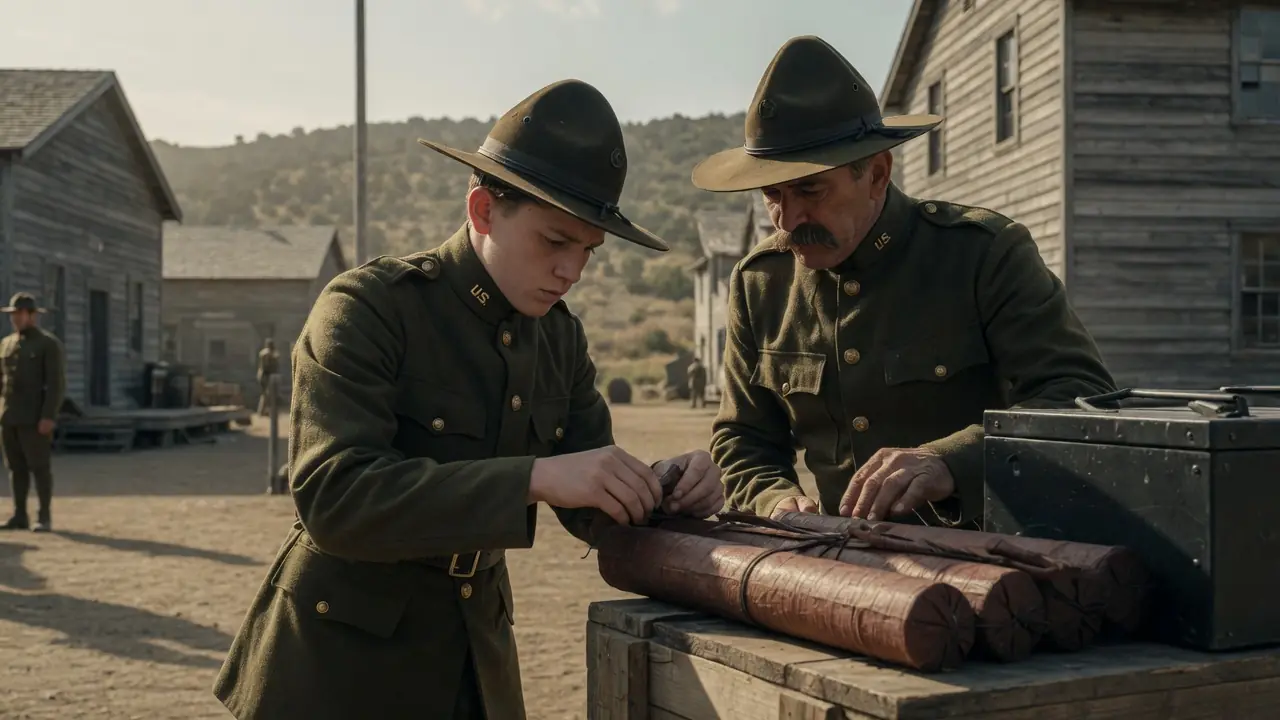
Turning to Crime
By 1911, McCurdy had fallen in with a small group of criminals operating in Oklahoma, then a relatively new state admitted to the Union only four years earlier.
The region's expanding railroad network offered tempting targets.
Payroll shipments, bank transfers, and passenger trains often carried large sums of cash.
Train robbery had become one of the most sensational crimes of the era.
McCurdy believed his Army training made him particularly valuable.
He would serve as the gang's explosives expert.
Reality proved rather different.
One of the gang's earliest schemes involved robbing a bank.
McCurdy attempted to use nitroglycerin to force open the safe.
The explosion was far more powerful than intended.
Rather than opening the safe cleanly, it damaged both the safe and much of the money stored inside.
The gang escaped with only a relatively small amount of cash.
It was hardly the spectacular success they had envisioned.
The failure did little to discourage McCurdy.
Instead, he became convinced that greater rewards awaited if the gang targeted railroad shipments.
That decision would seal his fate.
The "Iron Mountain" Mistake
In October 1911, McCurdy joined another robbery aimed at a train operated by the Missouri, Kansas and Texas Railway, commonly known as the M.K.&T. Railroad.
The gang believed they were intercepting a train carrying a payroll worth approximately $400,000—an enormous fortune at the time.
Their intelligence was wrong.
The train they stopped carried far less money than expected.
Once again, McCurdy relied on explosives to open the safe.
Once again, the blast proved excessive.
The explosion damaged much of the contents.
Instead of escaping with hundreds of thousands of dollars, the robbers reportedly obtained only about $46 in cash, a revolver, and several containers of whiskey.
It was an astonishing failure.
The newspapers mocked the robbery almost as much as they condemned it.
Law enforcement agencies quickly launched a search for those responsible.
Unlike legendary outlaws who successfully vanished into the frontier, McCurdy had neither the resources nor the organization to remain hidden for long.
The Last Hideout
Following the failed robbery, McCurdy separated from his companions.
He made his way to the countryside near Bartlesville, Oklahoma, where he sought refuge on the property of a friend.
For several days, he remained hidden.
Meanwhile, local authorities, railroad detectives, and posses gathered information about the robbery.
Their investigation steadily narrowed the search.
On October 7, 1911, a sheriff's posse surrounded the barn where McCurdy had taken shelter.
They called for him to surrender.
What happened over the next several minutes would end his brief criminal career forever.
The exchange of gunfire that followed would also begin one of the strangest posthumous journeys in American history—a journey that no outlaw, no matter how infamous, could ever have imagined.
Part 2 — The Outlaw Becomes a Sideshow Attraction
The Final Gunfight
In the early hours of October 7, 1911, law enforcement officers surrounded a hay barn on the outskirts of Bartlesville, Oklahoma, where Elmer McCurdy had taken refuge following the failed train robbery.
The posse consisted of local sheriff's deputies, railroad detectives, and officers determined to capture the fugitive before he could disappear again.
Accounts from the time agree that officers repeatedly called on McCurdy to surrender.
He did not.
Instead, a gunfight broke out between the men outside and the lone outlaw inside the barn.
The exchange lasted for roughly an hour.
Exactly who fired each shot has never been documented in complete detail, but the outcome is well established.
When the shooting stopped, officers entered the barn.
They found Elmer McCurdy dead, having been struck by a gunshot wound to the chest.
He was 31 years old.
His criminal career had lasted only a short time.
Unlike Jesse James, Butch Cassidy, or the Dalton Gang, McCurdy never became famous for successful robberies or daring escapes.
In fact, most of his crimes had been remarkable failures.
Yet history was about to remember him for something far stranger than anything he had done while alive.
An Unclaimed Body
McCurdy's body was transported to Pawhuska, Oklahoma, where it was placed in the funeral home of undertaker Joseph L. Johnson.
At the time, embalming was becoming increasingly common in the United States, particularly when families needed time to travel before burial.
Johnson embalmed McCurdy's body using an arsenic-based embalming solution, one of several preservation methods employed during the early twentieth century.
Then he waited.
Days passed.
No family members came forward.
No friends claimed the body.
No one appeared willing to pay for a funeral.
Whether because relatives could not be located, lacked the means to travel, or chose not to come remains uncertain.
Eventually, Johnson faced a practical problem.
He had a remarkably well-preserved body occupying space in his funeral home with no one to bury it.
Rather than arranging an immediate pauper's burial, he made an unusual decision.
He placed the embalmed outlaw on public display.
Visitors who were curious about the recently killed train robber could pay five cents to view "The Bandit Who Wouldn't Give Up."
For Johnson, it helped recover the cost of embalming.
For the public, it became an unusual local attraction.
Newspapers of the era often sensationalized stories involving outlaws, and curious visitors came to see the man whose failed robbery had already become regional news.
At first, everyone understood exactly what they were looking at.
It was not a wax figure.
It was Elmer McCurdy himself.
The "Brothers" Who Never Were
Years passed.
By 1916, McCurdy's body remained in Johnson's possession.
It had become something of a curiosity, but Johnson still refused to release it without proper authorization.
Then two men arrived at the funeral home.
They identified themselves as McCurdy's long-lost brothers from California.
According to later investigations, the men claimed they wished to give their relative a proper burial.
Johnson, relieved that family had finally appeared, allowed them to take custody of the body.
The story, however, was a fraud.
The two men were not McCurdy's brothers.
Instead, they were carnival promoters.
They had recognized that an authentic outlaw's corpse could become a profitable attraction.
By deceiving Johnson, they acquired something far more valuable than an ordinary exhibit.
They now possessed a genuine human body linked to the fading legend of the Wild West.
It marked the beginning of one of the most extraordinary journeys any human remains have ever taken in American history.
Traveling America's Carnival Circuit
The carnival business was thriving during the early twentieth century.
Traveling shows crossed the country by rail, bringing entertainment to towns that had few permanent attractions.
Visitors could watch acrobats, magicians, musicians, animal acts, illusionists, and so-called "sideshows" displaying unusual curiosities.
Among the most popular attractions were exhibitions claiming to feature famous criminals or notorious historical figures.
Some displays used wax models.
Others relied on elaborate storytelling.
McCurdy's body offered something that few competitors possessed:
Authenticity.
Promoters advertised him under various names, including "The Outlaw Who Would Never Be Captured Alive."
Paying customers viewed the preserved corpse much as earlier generations had visited exhibitions featuring notorious criminals.
Over time, McCurdy passed from one owner to another.
Exactly who possessed the body during every year of the following decades is not completely documented.
Historians have reconstructed much of its path through newspaper advertisements, business records, eyewitness accounts, and later investigations, but some gaps remain.
What is clear is that the body traveled extensively through carnivals, traveling museums, roadside attractions, and amusement venues across the United States.
With every new owner, the original story became a little more distorted.
Some operators knew the body's identity.
Others inherited it with only vague tales attached.
As memories faded and documentation disappeared, the remarkable fact that it was once a real person became increasingly obscured.
From Human Remains to "Movie Prop"
Decades of exposure transformed McCurdy's appearance.
The arsenic embalming solution had slowed decomposition, while the dry environments of many exhibitions encouraged natural mummification.
His skin darkened and hardened.
Soft tissue gradually shrank.
Hair disappeared in places.
The preserved body became increasingly rigid.
To make the exhibit easier to transport, some owners reinforced fragile areas with wire and other materials.
At various times, clothing, wax coatings, and layers of paint were reportedly applied to improve its appearance or conceal deterioration.
By the middle of the twentieth century, McCurdy no longer resembled a recently deceased man.
He looked more like a weathered mannequin.
As ownership changed again and again, many people handling the exhibit no longer realized it was genuine human remains.
Instead, they assumed it was an exceptionally realistic carnival dummy.
By the 1960s and early 1970s, the mummified body eventually found its way to The Pike, a famous seaside amusement zone in Long Beach, California.
Inside one of its attractions—Laff in the Dark, a haunted funhouse—the figure was incorporated into the spooky scenery.
Visitors walked past it every day.
Children pointed at it.
Employees moved it when necessary.
Few, if any, suspected they were looking at the preserved remains of an outlaw killed more than half a century earlier.
The remarkable truth had been hidden not because of a deliberate conspiracy, but because decades of changing ownership, fading records, and assumptions had erased the body's history.
Its extraordinary journey was nearing its end.
Hollywood was about to arrive.
Part 3 — The Mystery Finally Solved
Hollywood's Shocking Discovery
On December 8, 1976, a production crew from the television series The Six Million Dollar Man arrived at Laff in the Dark, a haunted funhouse located in The Pike amusement zone in Long Beach, California.
The series, starring Lee Majors, frequently filmed on location, and the carnival's eerie atmosphere provided a fitting backdrop for one of its episodes.
Inside the attraction hung what everyone believed was an old carnival prop—a weathered, mummified figure suspended from a rope as part of the haunted display.
Years of dust, paint, wax, and neglect had transformed the body into something that looked artificial. Employees who worked at the funhouse treated it like any other decoration.
As the crew prepared the set, one member attempted to reposition the hanging figure.
When he grasped one of its arms, it unexpectedly detached.
What should have revealed wood or plaster instead exposed real human bone and dried tissue.
Filming stopped immediately.
Authorities were called to the scene, and investigators quickly realized they were no longer dealing with a movie prop.
They had discovered genuine human remains.
A Forensic Investigation
The Los Angeles County Coroner's Office began a detailed examination of the body.
Despite decades of exposure, enough physical evidence remained to establish that the remains belonged to a real person rather than an anatomical specimen or museum display.
Medical examiners found preserved skin, muscle tissue, and internal structures that had survived because of the body's unusual history of embalming and natural mummification.
More importantly, investigators discovered evidence of an old gunshot wound, consistent with historical accounts of an outlaw killed in the early twentieth century.
Modern forensic techniques available in the 1970s were limited compared with today's DNA analysis, so investigators relied heavily on physical examination, historical records, photographs, fingerprints, and documentation.
One of the most significant breakthroughs came from a small metal penny found inside the body's mouth.
The coin had been dated 1924, indicating that someone had placed it there years after the man's death—likely while the body was already part of a traveling exhibition. While it did not identify the deceased, it helped investigators reconstruct the timeline of the body's movement through various attractions.
Another crucial clue came from preserved tissue that still allowed examiners to compare scars and physical characteristics with historical descriptions.
Researchers then turned to newspaper archives, funeral records, and law enforcement documents.
Piece by piece, the bizarre history began to emerge.
The remains belonged to Elmer J. McCurdy, the unsuccessful Oklahoma outlaw killed during a shootout on October 7, 1911.
More than sixty-five years after his death, his identity had finally been confirmed.
Reconstructing an Extraordinary Journey
Once investigators knew whose body they had found, historians and journalists began tracing how McCurdy had traveled across the country for more than six decades.
Their research revealed a story unlike anything they had expected.
After being embalmed by undertaker Joseph L. Johnson, McCurdy's body had remained unclaimed.
Johnson had displayed the body to curious visitors before eventually being deceived by two carnival promoters posing as McCurdy's relatives.
From there, the body passed through a succession of traveling carnivals, museums, sideshows, and amusement attractions.
Not every step of that journey could be documented with certainty.
Some ownership records had disappeared.
Some stories passed from one carnival operator to another without written evidence.
As a result, historians acknowledge that portions of the body's path remain incomplete.
What is well supported, however, is that McCurdy's remains circulated through multiple entertainment venues over several decades before ultimately arriving at The Pike in Long Beach.
By then, almost everyone who encountered the body believed it was merely an unusually realistic prop.
Its true identity had simply been forgotten.
The discovery attracted enormous media attention.
Newspapers across the United States covered the story, fascinated by the idea that a real outlaw had unknowingly become part of a carnival haunted house for generations.
Television news programs interviewed investigators, historians, and former carnival workers, while magazines published detailed accounts of the strange case.
The story quickly entered American popular culture as one of the most unusual forensic investigations ever conducted.
A Proper Burial at Last
After investigators completed their examination, officials decided that McCurdy's long and unusual journey should finally come to an end.
On April 22, 1977, more than sixty-five years after his death, Elmer McCurdy was buried in Summit View Cemetery in Guthrie, Oklahoma, not far from the state where his brief criminal career had ended.
Representatives from the funeral industry, historians, local officials, and members of the public attended the ceremony.
For the first time since 1911, McCurdy received a formal burial under his own name.
To ensure that his remains would never again become a public attraction, workers reportedly placed a substantial layer of concrete over the casket after burial before the grave was filled.
Although this detail has often been repeated in reliable historical accounts, it was not intended as punishment. Rather, it reflected a practical decision to prevent future grave robbing or unauthorized removal, given the extraordinary history of the body.
At last, the man whose corpse had traveled farther in death than he ever had in life was allowed to rest.