His name was Caleb “Stone” Mercer.
I never asked why people called him Stone. In my life, nicknames came from family jokes, office mistakes, or something embarrassing that happened at a barbecue. In his world, I had the feeling nicknames came from nights nobody wanted to explain.
He lived in the other side of our duplex on the east edge of Tulsa, the half with the oil stain in the driveway and the porch light that flickered when it rained. He did not own much. A motorcycle. A tool chest. Two army-green duffel bags. A battered coffee pot that started growling before sunrise.
And the vest.
That black leather cut with patches on the back and road dust in every seam. He never wore it like decoration. He wore it the way other people wore grief, heavy and close to the body.
Every morning, before the sun had fully climbed over the grocery store roof, I heard him moving in the garage.
Metal clicked. A wrench dropped. The Harley coughed once, then settled back into silence. Sometimes I smelled coffee through the thin wall between our kitchens. Sometimes motor oil. Sometimes cigarette smoke, though I never once saw him smoke near a child.
He did not throw parties.
He did not bring women home.
He did not blast music or start fights in the parking lot.
Still, the neighbors watched him like danger had rented the duplex next door and learned how to pay rent on time.
My daughter Sophie watched him too.
But children watch differently than adults.
Adults look for records, rumors, warning signs, and excuses to be afraid. Children look for patterns. They notice who steps over a stray dog and who kneels down with half a sandwich.
Sophie noticed that Caleb left water for the skinny black cat behind the laundromat. She noticed that he shoveled Mrs. Barlow’s steps during the February freeze without telling her. She noticed that when a little boy on our block fell off his scooter and split his knee, Caleb came out with a first-aid kit before the boy’s own father noticed the crying.
He cleaned the scrape, taped it neatly, and said, “Helmet.”
That was it.
No lecture.
No softness anyone could make fun of.
Just one word and a bandage placed like it mattered.
The first strange thing I noticed about Caleb was his hands. They looked like they had belonged to several different lives. Scarred knuckles, tattooed fingers, thick wrists, old burns near the thumb.
But his nails were always trimmed clean.
The second strange thing was something Sophie found one afternoon after school.
She came into the kitchen holding a small green plastic button between two fingers.
“Mom,” she said, “Mr. Caleb dropped this by the mailbox.”
I wiped my hands on a dish towel and looked down.
The button was shaped like a little frog. The print had faded, but I could still read the words around the edge.
RIVERDALE ELEMENTARY READING BUDDIES.
I almost smiled.
Nothing in the world seemed less connected to Caleb Mercer than an elementary school reading button shaped like a frog.
That evening, I knocked on his door.
He opened it with a socket wrench in one hand and grease up his forearm. He wore a white undershirt, jeans, and boots that looked older than some cars. Behind him, the garage smelled like gasoline, leather, and dust.
“Think this is yours,” I said.
I held out the button.
He looked at it.
For half a second, the hard lines of his face changed.
Not softened exactly.
Cracked.
“Yeah,” he said.
“You volunteer with kids?”
“No.”
He took the button carefully, as if the cheap plastic might fall apart if handled wrong.
Then he closed it in his fist and added, “Used to read with one.”
That was all he said.
I knew better than to ask more.
Back then, I thought Caleb was just the quiet biker next door. A little scary, maybe, but polite. The kind of man you kept distance from, not because he had done anything to you, but because the world had trained you to be careful around men with skull rings and club patches.
Then the school trouble started.
Sophie was seven years old, small for her age, with brown hair that never stayed in a ponytail and a habit of apologizing when other people bumped into her. Her father had left when she was three. Not dramatically. Not with a big fight or a door slammed hard enough to remember.
He just got tired of being needed.
Then every other Sunday.
Then on birthdays.
Then not at all.
Sophie stopped asking about him before I stopped feeling angry.
By second grade, she had learned how to carry missing things quietly.
The kids at McKinley Elementary found that softness in her.
Children can be cruel in the way weather is cruel. Not always evil. Not always planned. But still capable of leaving damage behind.
It began with whispers.
Then jokes about her thrift-store shoes.
Then one boy asked whether her dad had “returned her” because she was boring.
Sophie told me nothing at first.
I found out because she started asking to stay home with stomachaches every Monday. Then she stopped wearing the pink backpack she had loved because someone wrote “NO DAD GIRL” in marker along the bottom.
I washed it twice.
The words faded.
She saw them anyway.
I worked at Clara’s Diner off Route 66, the morning shift when I could get it, doubles when rent got ugly. School pickup was a daily panic. If the lunch rush ran late, I arrived breathless, guilty, and ten minutes after the bell.
Those ten minutes were where the world got mean.
The first time Caleb helped, I was late because a tour bus had dumped thirty people into the diner at 2:20. I called the school twice. No answer. By the time I turned onto the school street, my hands were shaking on the wheel.
Sophie was not by the gate.
My heart dropped.
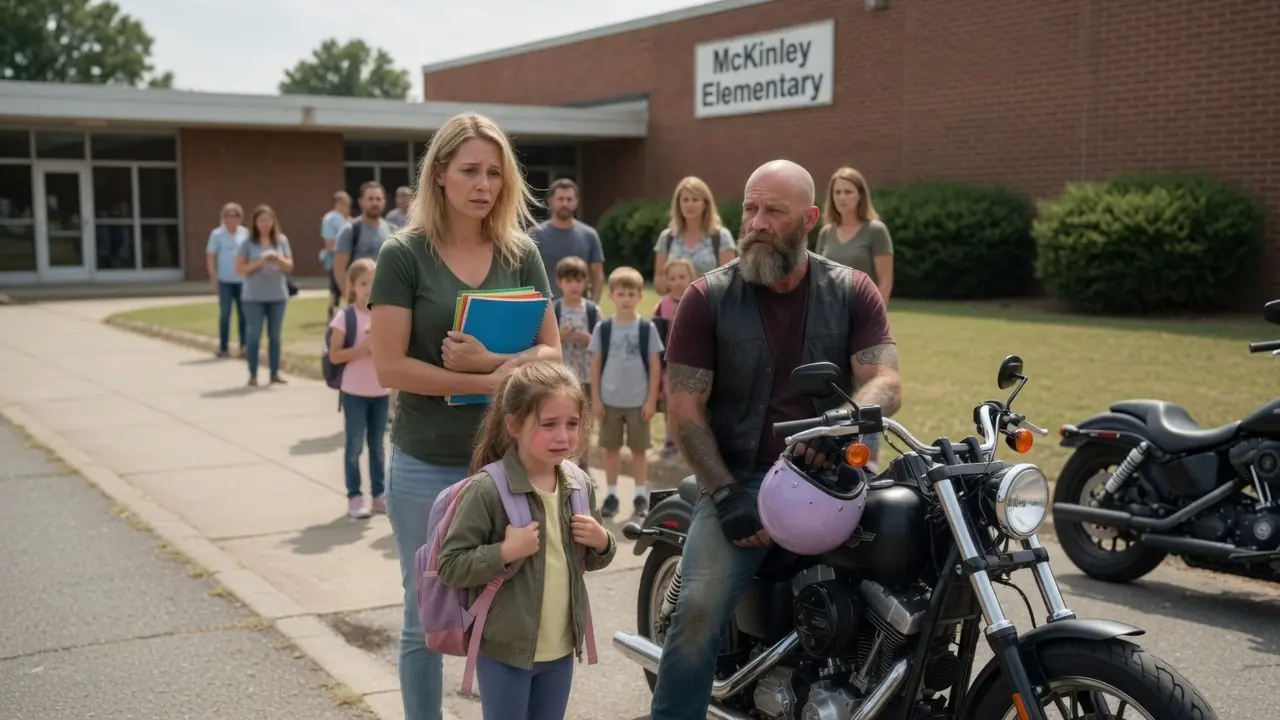
Then I saw her across the street, sitting on the curb beside Caleb Mercer’s Harley.
Caleb stood between her and three boys near the chain-link fence.
He was not yelling.
He was not threatening anyone.
He was just standing there, hands loose at his sides, eyes fixed on the boys with the quiet patience of a locked door.
The boys backed away before I got the car parked.
I jumped out.
“Sophie!”
She ran to me, crying now that I was there to catch it.
Caleb looked at me once.
“She was behind the cafeteria,” he said. “Crying.”
My face burned with shame.
“I’m sorry. I got stuck at work.”
He did not say what other people said.
He did not say, “You should have been here.”
He did not say, “Kids are cruel.”
He did not say, “Maybe talk to the school.”
He only looked toward the gate and said, “Somebody should be standing here.”
Then he got on his bike and left.
I thought it was one day.
One favor.
One rough-looking man doing the right thing because he happened to pass by at the right time.
But Monday came.
At 3:05, the Harley rolled up.
Tuesday, the same.
Wednesday, I watched from my old Honda down the block as Caleb parked near the curb, killed the engine, and waited with both boots planted on the pavement.
He did not talk to parents.
Did not perform kindness.
Did not smile for approval.
He just waited.
When Sophie came out, she walked faster than she had in weeks.
The boys at the gate moved aside.
One of them muttered something.
Caleb turned his head.
That was all it took.
No violence.
No scene.
No threat the school could put in an email.
Just presence.
A wall in leather.
By the end of the second week, Sophie stopped calling me in tears from the office. By the end of the first month, Caleb had a small lavender helmet hanging from the left handlebar. Not for highways. Not for showing off.
Just two slow blocks home.
So slow that Mrs. Barlow once passed them with her walker and shouted, “Pick up the pace, Stone!”
Caleb actually smiled.
I saw it from the porch.
It lasted half a second.
His brothers noticed the helmet before I did.
They came by one Saturday around noon, six Harleys lining the curb like a storm cloud made of chrome. Big men. Weathered men. Bearded men. Men with patches, scars, rings, and the kind of posture that made strangers lower their voices.
One of them, tall and thin with silver hair and preacher eyes, pointed at the lavender helmet.
“Stone,” he said, “you running a school bus now?”
The others laughed.
Caleb did not.
He was bent over an engine part on a workbench.
“She needed a ride,” he said.
The silver-haired man’s smile faded.
Another brother, heavyset with a gray beard and a limp, looked toward my kitchen window.
“That all?”
Caleb kept his eyes on the engine part.
“No,” he said.
The garage went quiet.
That was the first time I understood his brothers knew something about him I did not.
Something old.
Something they did not joke about after the first warning.
Winter came hard that year.
Oklahoma wind has a way of finding every crack in a window frame, every weak place in a coat, every sadness you thought you had hidden well enough.
The worst day came in January.
I was carrying plates at the diner when the school called.
Not the nurse.
The principal.
Any mother knows the difference before the first sentence is finished.
“Ms. Lawson,” Principal Greer said, “we need you to come in.”
My hand tightened around the phone.
“What happened?”
There was a pause.
I hated that pause.
“Sophie was involved in an incident after recess.”
Involved.
That word people use when a child has been hurt and adults do not want to say who did it.
Three kids had cornered her near the storage shed behind the gym. Two boys and one girl. The girl had taken Sophie’s lunchbox and thrown it onto the roof of the shed. One boy had pulled the lavender helmet from her hands and called it “biker trash.”
The other told her maybe if her real dad wanted her, she would not have to borrow a criminal.
A teacher found Sophie crying behind the dumpsters.
I left work without clocking out.
My manager called my name twice.
I kept walking.
When I reached the school, Caleb’s Harley was already by the curb, engine ticking hot in the cold air.
I never asked how he knew.
Maybe the school called him.
Maybe Sophie asked.
Maybe men like Caleb hear certain kinds of trouble from far away because they have spent their whole lives listening for it.
He was in the office when I rushed through the glass doors.
The room felt too small for him.
His boots were planted on the tile. His leather cut creaked when he turned. The secretary kept her eyes on her computer screen like if she did not look directly at him, she could pretend he was not there.
Sophie sat in a chair near the wall, holding the lavender helmet in her lap.
One side was scratched.
Caleb stood three feet away from a man in a red company polo.
The man had a thick neck, a red face, and the kind of confidence that comes from never being held responsible in front of the right people.
He turned on me before I spoke.
“You’re the mother?” he snapped. “Maybe if you didn’t have gang members picking up your daughter, my son wouldn’t feel threatened.”
Caleb’s jaw shifted.
That was it.
Just one small movement.
Every adult in that room felt it.
The man pointed at him.
“You got something to say, biker?”
Caleb looked down at Sophie.
Her eyes were wide and wet. Her shoulders were tucked inward, like she was trying to take up less room in the world.
Then Caleb looked at his own hands.
I saw them tremble.
Not from fear.
From restraint.
He closed his fingers slowly into fists, then opened them again.
“No,” he said.
The man laughed.
“That’s what I thought.”
For one ugly second, I wanted Caleb to hit him.
I am not proud of that.
But when your child is hurt, the civilized parts of you get very thin. You start wanting consequences with teeth.
Caleb did not move toward the man.
Instead, he lowered himself in front of Sophie.
His voice changed.
Not softer exactly.
Lower.
“You hurt?”
She shook her head.
“Try again,” he said.
Her mouth trembled.
“My stomach.”
He nodded once, like that answer mattered.
Then he picked up the scratched helmet and turned it over in his hands.
“Names,” he said.
Principal Greer blinked.
“I’m sorry?”
Caleb stood.
“I want the names written down. I want the dates. I want every report her mama made. Every call. Every teacher who saw it. Every teacher who missed it. All of it.”
His voice stayed calm.
That made the room colder.
The boy’s father scoffed.
“You threatening the school now?”
Caleb turned his head.
“No,” he said. “I’m creating a record.”
Record.
Not revenge.
Not rage.
A record.
The word surprised the room more than a shout would have.
Then the office door opened behind me.
The silver-haired brother from Caleb’s garage walked in wearing a dark suit jacket over his club shirt, rain on his shoulders, a leather briefcase in one hand.
I had seen him laughing on Caleb’s porch.
I had seen him drink gas station coffee out of a paper cup.
I had not known he was a lawyer.
He smiled at Principal Greer without warmth.
“Afternoon,” he said. “Name’s Jonah Pierce. Folks call me Deacon, but the state bar still uses Jonah.”
The principal’s face changed.
The boy’s father stopped smirking.
Jonah set the briefcase on the desk.
“Let’s talk about the district’s anti-bullying policy and how many chances McKinley Elementary had to follow it.”
That should have been the big moment.
A biker bringing an attorney into a school office.
The bullies named.
The principal suddenly remembering procedures.
The angry father realizing his son’s version of the story was no longer enough.
For another story, maybe that would have been the ending.
But while the adults started speaking in tense, careful sentences, Sophie reached out and caught the bottom edge of Caleb’s leather vest.
Just two fingers.
Barely enough to pull.
He looked down.
She whispered, “Please don’t go.”
Caleb’s face changed in a way I did not understand then.
It was not pity.
It was not pride.
It looked like a door inside him had opened, and something buried behind it had stepped into the light.
After that day, the school changed quickly.
Not because they suddenly became brave.
Because Jonah Pierce knew how to use words like liability, documentation, negligence, and district review.
The boys were separated from Sophie’s recess group. The girl was moved to another classroom. A counselor appeared. Principal Greer began greeting Sophie every morning like kindness had been added to the employee handbook.
Parents who once pulled their children closer when Caleb parked at the curb started giving him small nods.
No one apologized properly.
People rarely do.
They change behavior and hope you are generous enough to call that regret.
Every afternoon, Caleb still came.
Rain.
Cold.
Wind sharp enough to cut tears out of your eyes.
He parked the Harley, removed his gloves, and waited.
Sometimes Sophie ran to him with spelling tests. Sometimes she walked slowly because the day had been heavy. Sometimes she simply leaned against his leg and said nothing.
He never rushed her.
I thought he was saving my daughter.
That was the easy version.
The version a mother wants to believe because gratitude is simpler than grief.
Then one night in March, I heard his voice through the wall.
Not tools.
Not television.
Not the low rumble of men talking in the garage.
Just Caleb.
Broken.
Repeating the same sentence.
“I should’ve been there.”
I stood in my kitchen with a towel in my hands, listening through cheap drywall like I had no right to do and no strength to stop.
“I should’ve been there,” he said again.
The next morning, I found him sitting on the back steps before sunrise. His Harley was wet with dew. He held the little green frog button in his palm.
I could have gone back inside.
Maybe I should have.
Instead, I poured two cups of coffee and stepped out.
He took one without looking surprised.
For a while, we sat in the blue-gray morning and watched the alley wake up.
Finally, I asked, “Who should you have been there for?”
He did not answer right away.
Men like Caleb do not confess like actors in movies.
They circle the wound first.
They stare past it.
They make sure the words will not kill them coming out.
“My sister,” he said at last.
I sat very still.
“Her name was Maisie. She was seven. Same as Sophie.”
He turned the button over with his thumb.
“We didn’t have much. Mom cleaned rooms at a motel off the interstate. I was thirteen and thought that made me grown. Maisie got picked on because her clothes were old and because she talked funny when she got nervous.”
His mouth tightened.
“I used to walk her home.”
The alley was quiet except for the distant hiss of traffic.
“Then I got tired of it,” he said. “Tired of being laughed at. Tired of carrying her books. Tired of feeling like I was her parent when I was still a kid myself.”
He swallowed.
“One Friday, I didn’t go.”
I felt the coffee cooling between my hands.
Caleb stared at the dead weeds near the fence.
“She waited for me by the gate. When I didn’t come, she started walking. Some kids followed her, shouting. She ran across Sheridan Road without looking.”
He stopped.
I already knew the rest.
A truck.
A scream.
A child who should not have been alone.
“She had that reading button on her shirt,” he said. “Teacher gave it to her that morning. Said she’d read the most books in class.”
His hand closed around the button.
“I was behind the gas station with boys who thought I was funny. She was on the road.”
That was the truth under everything.
Not that Caleb had a soft heart beneath the leather.
Not that people had misjudged him.
It was heavier than that.
He was not picking up Sophie only because she needed someone.
He was picking up Sophie because once, a little girl had waited at a school gate and her brother had not come.
The clean bandages.
The lavender helmet.
The way he arrived at 3:05, never 3:06.
The way he watched the school doors like a man guarding a border.
It all came from one missed afternoon.
One empty sidewalk.
One road crossed alone.
After that morning, I understood why his brothers did not tease him too hard. Jonah knew. The gray-bearded one, called Bear, knew. Even the youngest rider who swept the garage and pretended not to care knew enough to lower his voice when Sophie came outside.
Caleb had not joined the Bandidos right away.
First, he had done what grief often teaches young men to do badly.
He drank.
He fought.
He disappeared for days.
He slept in county lockup twice before he turned twenty-two. He lost jobs, wrecked a car, broke his mother’s heart, and carried his sister’s ghost everywhere without admitting he was carrying anything at all.
He said the club found him outside Amarillo one summer when his bike died behind a truck stop.
He was drunk, mean, and ready to swing at the first person who offered help.
Bear offered him a wrench.
Jonah offered him coffee.
Another man told him, “Quit trying to look dangerous. You just look tired.”
For some reason, that sentence got through where sermons, court dates, and family tears had failed.
The club did not fix him.
People do not get fixed like broken chains.
But they gave him men who noticed when he went quiet too long. Men who rode to his place when Maisie’s birthday came around. Men who stood in his garage pretending to check tires because one brother should not be left alone with the wrong memories.
Brotherhood, I learned, was not just patches and road names.
Sometimes it was four men drinking bad coffee before dawn because one of them might not survive the morning by himself.
The frog button stayed sewn inside Caleb’s vest after that.
He had stitched it under the left panel, close to his ribs, with black thread so uneven it looked like a child’s work. That was the place Sophie had touched the day she grabbed his vest in the school office.
I thought she had grabbed leather.
She had found Maisie.
A week after he told me about his sister, Caleb knocked on my front door.
It was 7:18 in the evening. Sophie was at the kitchen table doing subtraction, kicking her feet against the chair. I opened the door and found Caleb standing on the porch with his helmet under one arm.
He looked uncomfortable.
That worried me more than anger would have.
“I need to say something straight,” he said.
“All right.”
“I’m not her father.”
“I know.”
“I ain’t trying to take the place of one.”
“I know that too.”
His eyes moved past me toward the kitchen window.
Sophie was humming over her worksheet.
Caleb looked back at me.
“But if you’re all right with it, I’ll keep showing up.”
There were many things I could have said.
Thank you.
Please do.
You already have.
Instead, the words came out simpler.
“Then don’t be late.”
He nodded once.
Something in his face settled.
“Never again.”
That became the rule.
Never again.
Not just for Sophie.
For him.
At the end of May, McKinley Elementary held family art night in the cafeteria. Paper stars hung from the ceiling. Long tables were covered with drawings, clay bowls, painted handprints, and construction-paper projects that only parents could identify with confidence.
Sophie wore a yellow dress from the thrift store and silver shoes that were half a size too big.
In the parking lot, she reached for Caleb’s hand.
He looked down at her fingers wrapped around his.
Then he looked at me.
I shrugged.
He let her hold on.
Inside the cafeteria, people stared.
Not the way they used to.
There was still curiosity.
Still unease.
Still the little pause people made when they saw patches and tattoos in a school building.
But there was less fear now.
Her class wall was covered with pictures titled MY FAMILY.
There were stick-figure parents. Dogs. Baby brothers. A grandmother with hair so large it filled half the page. One child had drawn a house, a cat, and what appeared to be a tornado.
Then I saw Sophie’s drawing.
A little brown-haired girl in a yellow dress.
A woman in a red diner apron.
A huge man in a black leather vest.
A motorcycle drawn bigger than the house.
And above all of them, a green frog sitting inside a yellow sun.
Mrs. Alvarez, Sophie’s teacher, crouched beside the picture.
“Sophie,” she asked gently, “who is this?”
Sophie looked at Caleb.
I saw him stop breathing.
His shoulders locked. His scarred hands opened and closed once. His face went still in the way a man goes still when he is standing on the edge of something too deep to name.
Sophie smiled.
“That’s my dad.”
The cafeteria noise seemed to fall away.
Mrs. Alvarez’s eyes softened.
“Your dad?”
Sophie nodded, completely certain.
“He picks me up.”
That was the whole explanation.
That was all the proof she needed.
Caleb turned his head away.
He did not cry.
Not there.
Not in front of the art wall and the cafeteria tables and the people who had once crossed the street to avoid him.
But Bear, standing near the lemonade cooler with the other brothers, suddenly coughed hard and looked at the ceiling like the fluorescent lights had personally offended him.
Jonah removed his glasses and wiped them.
I looked at Caleb’s vest.
Just inside the leather, near his ribs, I saw the edge of the little green frog.
Maisie had come to art night too.
In the only way she could.
Summer arrived hot and loud.
The school gates were locked. The playground sat empty beneath a sun that made the blacktop shimmer. Children rode bikes in the street and shouted through sprinklers. The air smelled like cut grass, gasoline, and melted asphalt.
Caleb still rode every afternoon.
At 3:05.
Not to pick Sophie up anymore.
Just past McKinley Elementary, around the block, down Sheridan Road, and back home.
At first, I thought it was habit.
Then one day Sophie asked him.
We were sitting on the porch eating popsicles that melted down our wrists. Caleb’s Harley clicked in the driveway as it cooled. The cat he fed slept under the dead bush by the fence.
“Mr. Caleb,” Sophie said, “why do you still ride by school when school’s closed?”
He looked toward the road.
The answer took time.
“To remind it,” he said.
Sophie frowned.
“Remind what?”
“The road.”
“Of what?”
Caleb looked at her then.
“That it doesn’t get every kid.”
Sophie accepted this the way children accept adult sadness when it is offered simply enough. She nodded and handed him her orange popsicle because she had decided he liked orange best.
He took it.
There he sat, a broad-shouldered biker with skull rings, a dead sister stitched inside his vest, and a melting popsicle in his hand, beside a seven-year-old girl who no longer looked at the sidewalk when she walked.
That was the real story, to me.
Not the school office.
Not the lawyer.
Not the bullies getting quiet because an attorney knew the right words.
This.
A man who looked like every warning people whisper about learning how to stay gentle without becoming weak.
After that, his brothers came around more often.
They still filled the curb with chrome and noise. They still smelled like leather, sweat, fuel, and gas station coffee. They still looked like men you would not want following you into a dark parking lot.
But now they brought sidewalk chalk.
A used bicycle Bear claimed he “found,” though I saw the Walmart receipt fall from his pocket. A box of books Jonah said had been “cluttering his office,” even though half of them were brand new. A kite shaped like a dragon that took three grown bikers and one seven-year-old girl forty-five minutes to get into the air.
They never called Sophie a mascot.
Never made her a joke.
They called her Little Frog because of the drawing.
Caleb pretended he hated it.
But one evening, I saw him sitting in the garage under a yellow work light, sewing a small patch inside his vest. Hidden. Green thread this time.
Not on the outside for the world.
Inside.
Where a man keeps the dead who shaped him and the living who brought him back.
On the last day of second grade, I got off work early.
I wanted to pick Sophie up myself for once. I wanted to stand at the gate and watch her come out smiling, just to prove to both of us that we had survived the year.
But when I turned onto the school street, the Harley was already there.
Of course it was.
Caleb stood beside it with his arms crossed, the lavender helmet hanging from the handlebar. Parents moved around him easily now, like he had become part of the landscape. Some nodded. One father asked him about tire pressure. Mrs. Alvarez waved from the sidewalk.
Sophie came out carrying a folder, a backpack, and a construction-paper crown that said PROMOTED TO THIRD GRADE.
She saw me first.
Then she saw him.
And she ran straight to Caleb.
He bent down, ready for the impact, and she crashed into his chest with both arms. He caught her carefully, as if she were made of glass and sunlight.
Then she placed the paper crown on his shaved head.
The entire pickup line went quiet for half a breath.
Caleb froze.
A large biker in a black leather vest, tattoos up his neck, wearing a crooked yellow paper crown with purple crayon stars on it.
Bear started laughing first.
Then Jonah.
Then Sophie.
Then me.
Caleb stood there looking ridiculous, dangerous, embarrassed, and somehow more human than anyone I had ever known.
He looked saved.
A few minutes later, he started the Harley. The engine rolled low and steady, not loud enough to scare the smaller kids. Sophie climbed on behind him, lavender helmet buckled, backpack tight against her shoulders.
He looked at me.
I nodded.
They pulled away slowly, past the school gate where she used to cry, past the curb where he used to wait, past the road that had taken a little girl named Maisie long before Sophie was born.
The sun hit the inside of Caleb’s vest as he turned.
For one second, I saw the green thread flash near his heart.
Then the bike rolled around the corner toward home.
And this time, nobody was left waiting.