Part 1 — The Birth of "Old Ironsides"
Prologue
On the afternoon of August 19, 1812, somewhere in the rolling waters of the North Atlantic southeast of Nova Scotia, two warships closed the distance between them. One flew the Stars and Stripes of the young United States. The other carried the White Ensign of the Royal Navy, the most powerful naval force the world had ever known.
The British expected another swift victory. After all, Britain's navy had spent decades defeating the fleets of Europe during the Napoleonic Wars. American frigates, though well designed, were few in number and largely untested against Britain's veteran crews.
But within a matter of hours, everything would change.
As heavy iron cannonballs slammed into the side of the American frigate USS Constitution, witnesses reportedly watched in disbelief as many shots appeared to ricochet or fall away without causing the catastrophic damage the British expected. Amid the chaos, one American sailor is traditionally said to have shouted:
"Huzzah! Her sides are made of iron!"
Whether every word of that famous exclamation was recorded exactly as spoken has been debated by historians, but the nickname it inspired endured forever.
From that day onward, USS Constitution became known as "Old Ironsides."
Yet the remarkable battle was only the climax of a much larger story—one that began years before a single cannon was fired.
Historical Background
The story of USS Constitution cannot be understood without first understanding the precarious position of the United States in the years following the American Revolution.
When Britain formally recognized American independence in 1783, peace did not erase the nation's vulnerabilities. The United States possessed little naval power, no substantial standing army, and a fragile economy dependent on overseas trade.
American merchant ships crossed the Atlantic carrying flour, tobacco, cotton, timber, and other goods. These commercial routes became the lifeblood of the young republic.
But the oceans were anything but peaceful.
Throughout the late eighteenth century, American vessels faced threats from North African corsairs operating in the Mediterranean, European privateers, and eventually the competing naval powers locked in the struggle between Napoleonic France and Great Britain.
Recognizing that commerce could not survive without protection, Congress passed the Naval Act of 1794, authorizing the construction of six powerful frigates. These ships were intended not to rival Britain's enormous fleet but to serve as exceptionally strong, fast warships capable of defeating enemy frigates while avoiding larger ships of the line.
Among these six vessels was USS Constitution.
Building an Extraordinary Warship
Responsibility for designing America's new frigates fell largely to the gifted naval architect Joshua Humphreys.
Humphreys rejected conventional European designs.
Instead of building ships comparable to existing frigates, he envisioned vessels that were both larger and stronger than nearly every frigate afloat.
His philosophy was simple:
If the ship encountered another frigate, it should be powerful enough to defeat it.
If it encountered a ship of the line, it should be fast enough to escape.
To achieve this, Constitution featured several innovative characteristics.
Its hull was built from southern live oak, an exceptionally dense hardwood native to the southeastern United States. Live oak grew slowly, producing tightly packed wood fibers that made it far stronger than the white oak commonly used in many European ships.
In critical sections of the hull, the timbers measured approximately 21 inches (53 centimeters) thick, providing remarkable structural strength.
The ship also incorporated diagonal riders—massive internal braces that helped prevent the hull from twisting under stress.
At approximately 204 feet (62 meters) in length, Constitution ranked among the largest frigates in the world when launched.
Although officially rated as a 44-gun frigate, she frequently carried more than fifty guns during wartime, including powerful 24-pounder long guns capable of firing significantly heavier shot than the 18-pounders commonly mounted on many British frigates.
Construction began at Edmund Hartt's shipyard in Boston.
On October 21, 1797, thousands gathered along the waterfront to watch the great vessel slide into Boston Harbor.
Few among the spectators could have imagined that the ship before them would one day become the oldest commissioned naval warship still afloat.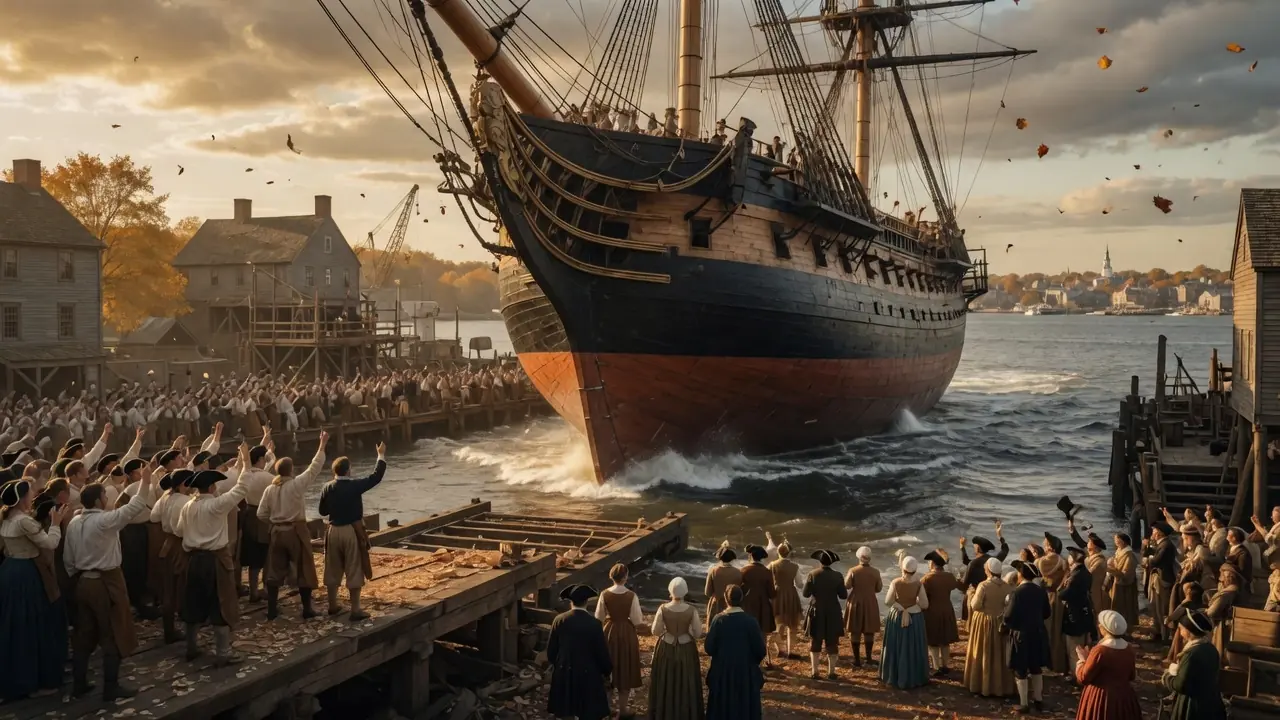
The Gathering Storm
During Constitution's early years, Europe descended once again into nearly continuous warfare.
Beginning in 1803, Britain and Napoleonic France fought for dominance across the continent and the seas.
Neither side respected American neutrality when it interfered with military objectives.
The British Royal Navy desperately needed sailors to crew hundreds of warships enforcing blockades across Europe.
As casualties mounted and voluntary enlistment declined, Britain increasingly relied upon impressment—the practice of forcing men into naval service.
Royal Navy boarding parties frequently stopped merchant ships on the high seas.
If they believed sailors aboard were British subjects—or sometimes merely claimed they were—they removed them by force.
Thousands of seamen serving on American merchant vessels were impressed during these years.
The British government maintained that British subjects could not legally renounce their allegiance, even if they had become American citizens.
Americans saw the practice as a direct violation of their sovereignty.
The tensions reached a dangerous turning point on June 22, 1807.
The British warship HMS Leopard intercepted the American frigate USS Chesapeake off the coast of Virginia.
Demanding permission to search for alleged deserters, Leopard was refused.
The British opened fire.
Caught almost completely unprepared for combat, Chesapeake suffered multiple casualties before surrendering.
British sailors boarded the American ship and removed four crewmen.
News of the Chesapeake–Leopard Affair spread rapidly across the United States.
Public outrage exploded.
Although President Thomas Jefferson initially responded through economic sanctions rather than war, many Americans viewed the incident as proof that Britain had little respect for American independence.
Over the next several years, tensions only worsened.
British blockades disrupted American trade.
American politicians known as the War Hawks, including Henry Clay and John C. Calhoun, argued that national honor demanded a stronger response.
On June 18, 1812, President James Madison signed the declaration of war against Great Britain.
The United States had entered what history would remember as the War of 1812.
A Dangerous Mission
At first glance, America's naval prospects appeared bleak.
The Royal Navy possessed hundreds of commissioned warships.
The United States Navy had only a handful of ocean-going frigates.
Direct fleet engagements were impossible.
Instead, American naval strategy focused on deploying its heavy frigates independently to attack isolated British ships and disrupt commerce whenever opportunities arose.
Among the most formidable of these vessels stood USS Constitution, commanded by Captain Isaac Hull.
Hull was no reckless adventurer.
An experienced officer who had fought against the Barbary corsairs, he understood both the strengths and limitations of his ship.
His crew numbered roughly 460 officers, sailors, and Marines, many experienced seamen but all fully aware of the odds they faced.
Across the Atlantic, the Royal Navy remained confident.
British commanders generally regarded American frigates as capable but inferior opponents whose defeats were only a matter of time.
Neither side yet realized that they were about to test those assumptions in one of the most famous single-ship actions in naval history.
Far out on the Atlantic, the paths of USS Constitution and HMS Guerriere, commanded by Captain James Richard Dacres, were steadily converging.
Within days, the two frigates would sight one another across the waves—and the battle that gave birth to the legend of Old Ironsides would begin.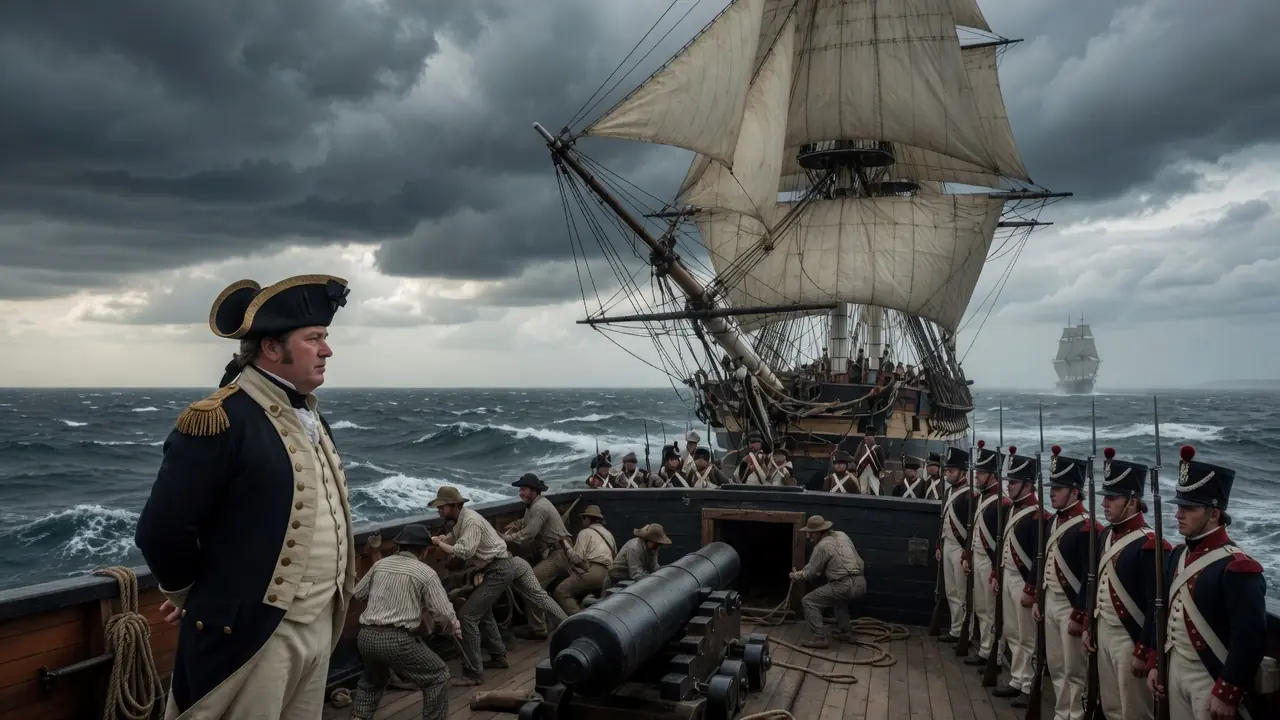
Part 2 — The Battle That Forged "Old Ironsides"
Rising Tension
The morning of August 19, 1812, broke beneath a sky of scattered clouds over the North Atlantic, roughly 400 miles southeast of Halifax, Nova Scotia. The sea rolled gently, and a steady breeze filled the sails of ships scattered across the vast expanse.
Among them was HMS Guerriere, a 38-gun British frigate under the command of Captain James Richard Dacres. Built in France before being captured by the Royal Navy in 1806, Guerriere had already seen years of active service during the Napoleonic Wars. Her crew consisted of approximately 270 officers, sailors, and Royal Marines—experienced men serving in what was widely regarded as the world's most formidable navy.
Earlier that day, Guerriere had become separated from a small British squadron. Alone, she continued her patrol, searching for American merchantmen and warships.
Not long afterward, a sail appeared on the horizon.
As the distance closed, both captains worked to identify the approaching vessel.
Captain Isaac Hull soon recognized that the stranger was a British frigate.
Captain Dacres, meanwhile, realized he had encountered one of the American Navy's heavy frigates. Rather than avoid combat, he chose to engage.
At the time, many British officers remained confident that Royal Navy training, discipline, and combat experience would outweigh any advantage the larger American frigates possessed.
The challenge was accepted.
For nearly two hours, the two ships maneuvered carefully, each captain attempting to gain the weather gauge and place his vessel in the most advantageous position before opening fire.
Every adjustment of the helm mattered.
Every change in wind direction could determine which broadside struck first.
The silence before battle was broken only by creaking timbers, snapping canvas, and the sound of waves striking wooden hulls.
Soon, that silence would disappear beneath thunder.
Two Very Different Frigates
Although often described simply as two frigates meeting in single combat, Constitution and Guerriere were not evenly matched in every respect.
USS Constitution displaced significantly more water and carried heavier armament.
Her main battery consisted primarily of 24-pounder long guns, capable of firing iron shot weighing twenty-four pounds with tremendous force.
Guerriere's principal battery, by comparison, consisted mainly of 18-pounder long guns, the standard armament for many British frigates of her class.
Constitution also carried numerous carronades—short-barreled guns devastating at close range.
Her crew was larger as well, numbering roughly 460 men, compared with Guerriere's approximately 270.
Yet numbers alone did not guarantee victory.
British crews had earned a reputation for remarkable speed in loading and firing their guns. Years of continuous warfare against France had forged highly disciplined gun crews capable of delivering devastating broadsides.
Captain Hull understood that allowing the British to exploit their rapid rate of fire at long range could unnecessarily expose Constitution to damage.
He therefore intended to fight on his own terms.
Rather than exchanging ineffective distant broadsides, Hull planned to close the range until every American shot would count.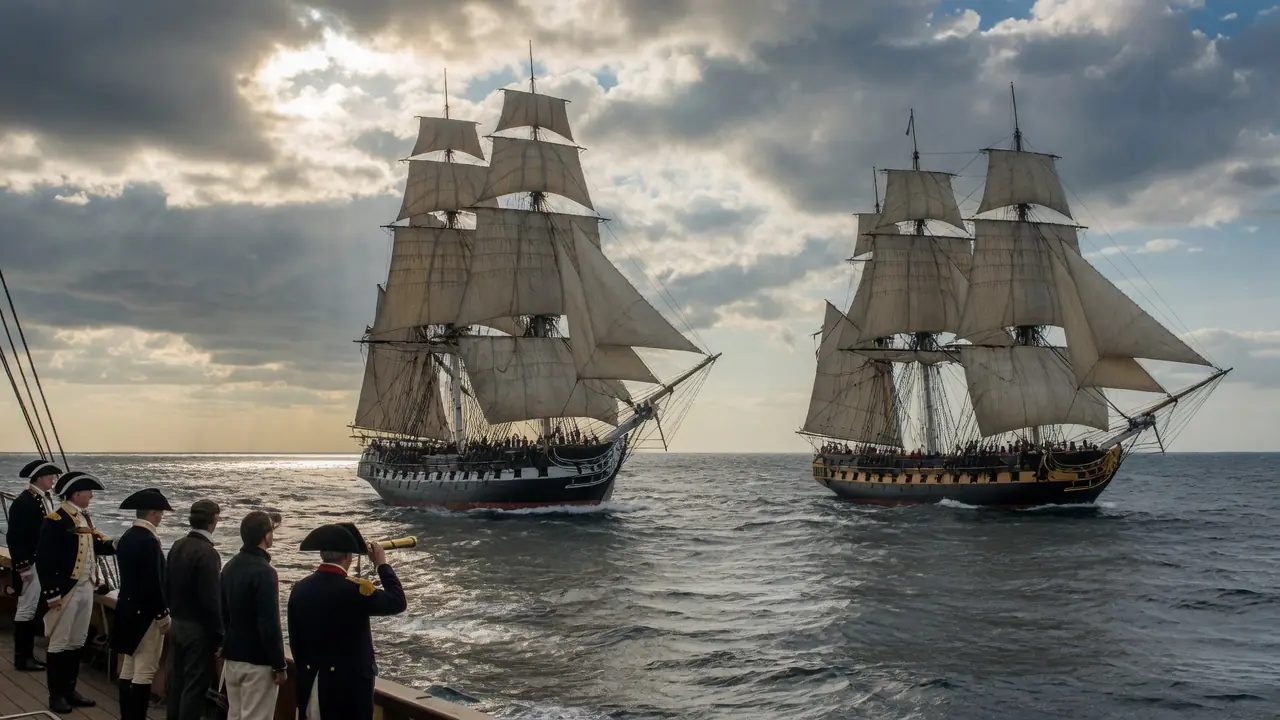
The First Shots
At approximately 6:00 p.m., Guerriere fired the opening broadside.
The distance between the ships was still considerable.
Most of the British shot either struck harmlessly or caused only limited damage.
Hull refused to answer immediately.
Instead, he calmly urged Constitution closer.
Witnesses later recalled the remarkable composure displayed by the American captain. Rather than allowing excitement to dictate his decisions, Hull repeatedly instructed his crew to wait.
The order was simple:
Hold your fire.
As the ships continued to converge, British cannon continued to roar.
Iron shot smashed through spars, rigging, and sails.
Wood splinters—often among the deadliest hazards aboard wooden warships—flew across crowded gun decks.
Still, Constitution advanced.
Only when the range had narrowed dramatically did Hull finally issue the long-awaited command.
The American broadside erupted almost simultaneously.
The effect was immediate.
Heavy 24-pound cannonballs crashed into Guerriere's hull, tearing through planking, smashing gun carriages, and scattering splinters throughout the British gun deck.
The battle had become a brutal contest fought at close quarters.
"Her Sides Are Made of Iron"
As the engagement intensified, British gunners concentrated their fire upon Constitution's hull.
Observers aboard the American ship witnessed something extraordinary.
Many incoming cannonballs appeared to strike the thick live oak sides before bouncing away or falling into the sea after causing far less damage than expected.
Modern historians caution that not every cannonball literally rebounded untouched. Constitution certainly suffered damage throughout the battle, particularly to her rigging and sails. However, her unusually thick live oak construction absorbed punishment remarkably well, preventing the catastrophic structural damage British crews expected.
Among the American sailors, amazement quickly spread.
According to long-standing naval tradition, one crewman reportedly shouted:
"Huzzah! Her sides are made of iron!"
Although historians cannot state with absolute certainty exactly who first uttered the phrase—or whether those were the precise words spoken—the story appeared soon after the battle and became firmly associated with Constitution's victory.
The nickname that emerged would outlive every sailor who fought aboard her.
From that day forward, she was remembered as Old Ironsides.
Closing the Distance
As both ships continued firing, Captain Hull recognized that Constitution's superior size and heavier guns were beginning to dominate the engagement.
He maneuvered aggressively.
The frigates closed until they were exchanging broadsides at extremely short range.
Each discharge blasted enormous gaps through wooden hulls.
Smoke became so dense that crews sometimes fired into little more than shadows drifting through gray clouds of gunpowder.
Communication depended almost entirely upon shouted orders and prearranged signals.
Then came one of the battle's decisive moments.
Constitution's accurate fire shattered Guerriere's mizzenmast, the rearmost of her three principal masts.
The enormous structure crashed overboard, dragging rigging into the sea.
Losing a mast dramatically reduced a sailing warship's maneuverability.
Guerriere could no longer handle as effectively as before.
Hull immediately sought to exploit the advantage.
Moments later, Constitution collided with Guerriere.
The ships became briefly entangled.
Rigging intertwined overhead while sailors on both vessels prepared for the possibility of boarding.
American Marines stationed high in Constitution's fighting tops fired downward at exposed British personnel using muskets.
British Marines returned fire.
Captain Dacres himself was reportedly wounded during the action.
Despite the close proximity, no large-scale boarding assault developed.
The ships drifted apart once more.
But Guerriere had suffered catastrophic damage.
Her ability to continue the fight was rapidly disappearing.
The worst was yet to come.
Part 3 — The Victory That Changed a Nation
Climax
As USS Constitution and HMS Guerriere separated after their brief collision, the outcome of the battle had not yet been formally decided. Thick clouds of gunpowder smoke still drifted across the Atlantic, obscuring portions of both ships. The roar of cannon echoed across the water, but one vessel was now in far greater distress than the other.
Captain Isaac Hull quickly brought Constitution back under control and prepared to renew the attack.
Aboard Guerriere, Captain James Richard Dacres faced a rapidly deteriorating situation. His frigate had already lost the mizzenmast, severely limiting her maneuverability. Before long, Constitution's heavy broadsides inflicted even greater damage.
The foremast gave way.
Soon afterward, the mainmast—the tallest and most important mast on the ship—collapsed as well.
The enormous spars crashed into the sea, dragging a tangled web of rigging, torn sails, and heavy timbers alongside the hull.
Within minutes, Guerriere had been transformed from a maneuverable warship into a nearly helpless wreck.
Age had also worked against the British frigate. Guerriere had seen years of hard service, and some historians note that her structural condition was no longer ideal by 1812. Nevertheless, there is broad agreement that Constitution's heavier guns and remarkably accurate fire were the decisive factors in reducing the British ship to such a state.
Unable to sail effectively, Guerriere drifted in the swells.
Her guns could no longer be brought to bear efficiently.
The initiative had passed completely to the Americans.
Captain Hull prepared for another devastating broadside if necessary.
It never came.
Recognizing that further resistance would only cost more lives without changing the outcome, Captain Dacres made the difficult decision expected of a professional naval officer.
He struck his colors.
In the traditions of naval warfare, lowering a ship's ensign signaled surrender.
After roughly 35 minutes of effective close-range combat, one of the Royal Navy's frigates had been defeated in a single-ship action by the young United States Navy.
It was an outcome that few observers on either side of the Atlantic had predicted.
Humanity After the Battle
Victory did not end Captain Hull's responsibilities.
As was customary among many professional naval officers of the era, attention quickly turned to the wounded and surviving crew.
American sailors boarded the damaged British frigate.
Approximately 79 members of Guerriere's crew had been killed or wounded, while Constitution suffered 14 killed and wounded combined. Although the Americans had clearly won, both crews had paid a price.
British officers and sailors were taken aboard Constitution as prisoners.
Captain Dacres himself was treated with professional respect. During the Age of Sail, it was not uncommon for victorious captains to extend courtesy toward defeated officers who had fought honorably.
Hull and Dacres reportedly interacted cordially after the battle, reflecting the customs of many naval professionals despite serving opposing nations.
The Americans then carefully examined their prize.
What they discovered presented an unexpected problem.
Guerriere was beyond saving.
Her hull had suffered severe structural damage.
Her masts were gone.
The pounding Atlantic swell caused the weakened vessel to leak badly.
After inspecting the ship, Hull concluded that towing her back to an American port was impractical.
The prize that had been so hard won could not be preserved.
On August 20, 1812, the Americans removed prisoners, useful equipment, and supplies from Guerriere.
They then set the abandoned frigate ablaze.
As fire spread through the shattered hull, flames climbed the remaining timbers before eventually reaching the ship's magazine.
A tremendous explosion followed.
The once-proud British frigate disappeared beneath the Atlantic.
News Crosses the Atlantic
Long before radio or telegraph, victories traveled by ship.
When Constitution finally returned to Boston on August 30, 1812, news spread rapidly through the city.
Crowds gathered along the waterfront.
Church bells rang.
Newspapers rushed to print accounts of the remarkable victory.
For the United States, the triumph arrived at a critical moment.
The War of 1812 had begun poorly on land. American attempts to invade Canada had met with setbacks, and public confidence in the war effort was uncertain.
Constitution's victory provided something the young nation desperately needed:
Proof that American forces could defeat Britain in open combat.
The psychological effect far exceeded the destruction of a single enemy frigate.
Across the United States, newspapers celebrated Captain Hull and his crew as national heroes.
Citizens who had questioned the value of maintaining a navy now viewed the service with renewed pride.
Recruitment improved.
Public morale soared.
Across the Atlantic, however, the reaction was very different.
The Royal Navy had not expected one of its frigates to suffer such a decisive defeat.
Some British observers initially attributed the loss primarily to Constitution's unusual size and heavier armament, arguing that the American vessel resembled a small ship of the line more than a traditional frigate.
While Constitution was indeed larger and more heavily armed than Guerriere, modern historians generally note that the victory reflected several factors working together: superior firepower, excellent American gunnery, effective leadership by Captain Hull, and the exceptional strength of the ship herself.
The battle also prompted the Royal Navy to reassess how it engaged America's heavy frigates during the remainder of the war.
The Legacy of "Old Ironsides"
The victory over Guerriere became only the beginning of Constitution's legendary career.
During the War of 1812, she would go on to defeat additional British warships, including HMS Java in December 1812 and later HMS Cyane and HMS Levant in February 1815.
Remarkably, Constitution was never defeated in battle.
By the early nineteenth century, "Old Ironsides" had become one of the most recognizable symbols of the United States Navy.
Yet her greatest challenge came not during wartime, but in peace.
By the 1830s, the aging wooden frigate was considered obsolete. Plans were proposed to scrap her.
Public reaction was swift.
In 1830, the poet Oliver Wendell Holmes Sr. published his famous poem "Old Ironsides," passionately urging Americans to preserve the historic vessel rather than dismantle it.
The poem resonated across the country and helped generate overwhelming public support for saving the ship.
Instead of being broken up, Constitution underwent restoration.
Over the following two centuries, she would continue to receive periodic repairs while preserving as much of her historic character as possible.
Today, USS Constitution remains the world's oldest commissioned naval warship still afloat. She is permanently berthed at the Charlestown Navy Yard in Boston, Massachusetts, where she is operated by the United States Navy and maintained in partnership with the USS Constitution Museum.
Although much of her timber has been replaced during successive restorations—a necessity for any wooden vessel exposed to the elements—she remains an active commissioned naval vessel, crewed by U.S. Navy sailors who continue traditions dating back more than two centuries.
Every year, visitors from around the world walk her decks, stand beside her massive live oak hull, and imagine the moment when British cannonballs failed to break through.
Whether every iron shot truly bounced dramatically into the sea or whether time enhanced some details of the story, one fact is beyond dispute.
On August 19, 1812, USS Constitution defeated HMS Guerriere in one of the most famous single-ship naval engagements in history.
The battle demonstrated the effectiveness of Joshua Humphreys' innovative design, showcased the leadership of Captain Isaac Hull and his crew, and provided a young nation with a desperately needed symbol of confidence during wartime.
More than two hundred years later, the nickname born from that victory still endures.
Not because the ship was made of iron—
but because, on one unforgettable afternoon in 1812, she proved as resilient as if she had been.