Part 1 — The Birth of the Ironclads
Prologue
On the morning of March 9, 1862, two strange-looking warships slowly approached each other in the waters of Hampton Roads, Virginia.
Neither resembled the proud wooden sailing warships that had dominated the world's oceans for centuries.
One was low to the water, carrying a revolving iron gun turret unlike anything ever seen before.
The other looked like a floating fortress, its sloping iron armor covering what had once been the hull of a burned-out wooden frigate.
For the next four hours, the two ships exchanged heavy cannon fire at close range.
Again and again, massive iron shot slammed into thick armor—only to ricochet harmlessly away.
Neither vessel could destroy the other.
Yet by the time the battle ended, naval warfare had entered a new age.
Although wooden warships did not disappear overnight, the world's great navies suddenly understood that the future belonged to armored steam-powered warships.
The road to that historic duel had begun months earlier, with the destruction of a single American frigate.
A Navy in Transition
When the American Civil War began in 1861, the world's most powerful warships were still built primarily of wood.
Steam engines had become increasingly common, but most major navies continued to rely on large wooden frigates and ships-of-the-line armed with rows of heavy cannons.
For centuries, naval battles had changed surprisingly little.
Victory depended on heavier guns, stronger crews, and better seamanship.
But new technology was beginning to challenge those traditions.
European powers such as France and Great Britain had already started experimenting with ironclads—warships protected by iron armor plating—but only a handful existed.
No one yet knew whether armored ships would truly replace the great wooden fleets that ruled the seas.
Then the American Civil War accelerated that technological revolution.
Both the Union and the Confederacy desperately searched for any innovation that might give them an advantage.
Nowhere was that more important than along the Atlantic coast, where the Union Navy maintained a growing blockade intended to cut the Confederacy off from international trade.
The South needed a way to break that blockade.
The answer would come from the remains of a ship the Union had abandoned.
From USS Merrimack to CSS Virginia
In April 1861, as Confederate forces captured the Norfolk Navy Yard in Virginia, Union sailors attempted to prevent valuable ships from falling into enemy hands.
Among them was the steam frigate USS Merrimack.
Before withdrawing, Union forces set the ship on fire and scuttled her at the dockyard.
The attempt was only partially successful.
Much of the upper structure burned away, but the hull and powerful steam engines remained largely intact beneath the water.
Confederate engineers quickly recognized an opportunity.
Lacking the industrial capacity to build a modern navy from scratch, they decided to salvage the damaged vessel instead.
The burned hull of Merrimack was raised from the harbor and completely transformed.
Workers cut away the remains of the old wooden upper deck and constructed a massive armored casemate over the center of the ship.
The new structure was covered with thick layers of iron plating mounted over heavy timber.
Behind that armor sat a battery of powerful guns capable of firing in multiple directions.
At the bow, the Confederates added another weapon rarely seen in modern naval warfare:
A heavy iron ram, designed to sink enemy ships by punching holes below the waterline.
When completed, the ship was commissioned as CSS Virginia.
Although many people continued referring to her as the "Merrimack," her official Confederate name was Virginia.
She had become one of the world's newest ironclad warships.
The Union Navy suddenly faced a dangerous threat.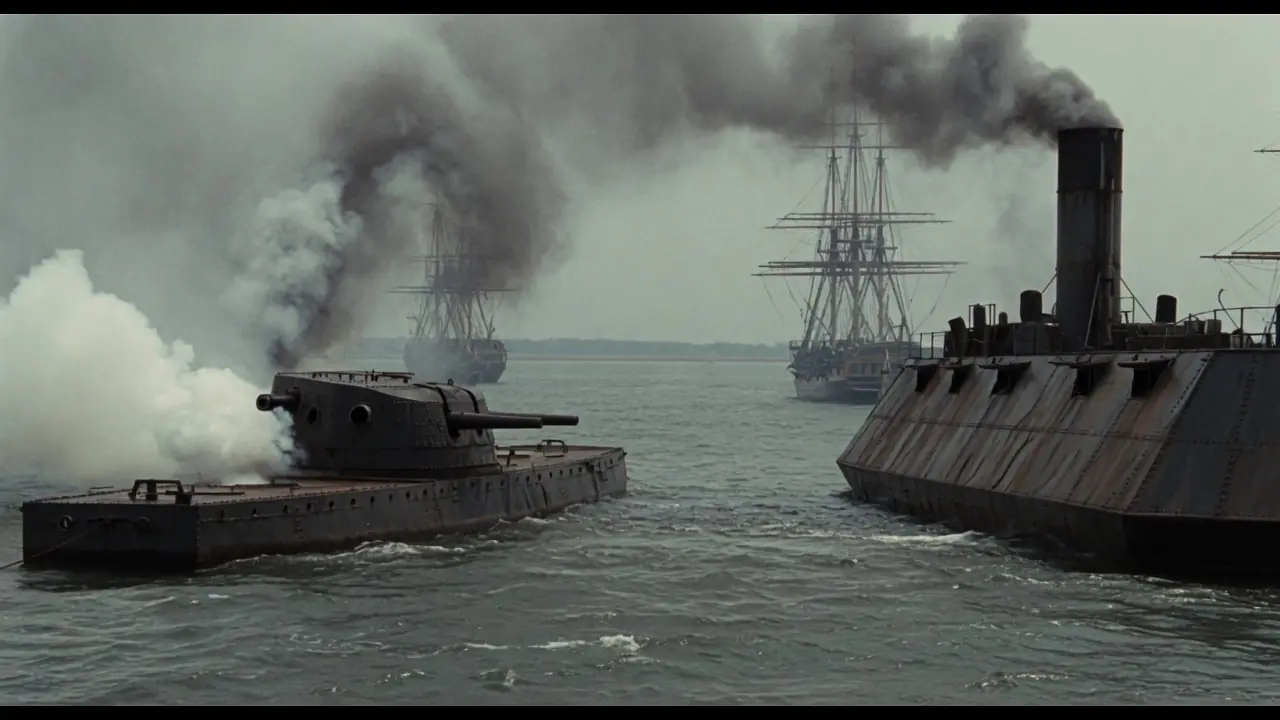
The Union Responds
News that the Confederacy was constructing an armored warship soon reached Washington.
Union leaders understood the danger.
If the new Confederate ironclad broke through the blockade, it could threaten Union control of the Chesapeake Bay and even endanger the nation's capital.
The Navy responded with remarkable speed.
Several experimental ironclad designs were proposed, but one stood out from the rest.
It came from the Swedish-born inventor John Ericsson.
His design looked unlike any warship ever built.
Instead of tall masts and broad gun decks, Ericsson's vessel rode extremely low in the water.
Most of the hull sat just above the surface, presenting a very small target.
Its most revolutionary feature was a rotating armored turret carrying two large 11-inch Dahlgren smoothbore guns.
Rather than turning the entire ship to aim its cannons, the crew could rotate the turret itself.
It was a concept that would influence warship design for generations.
Construction proceeded at extraordinary speed.
The vessel was named USS Monitor.
As workers rushed to finish the experimental ship, few realized that history was racing toward a confrontation unlike anything the world had ever witnessed.
Within days, the Confederacy's new ironclad would steam into Hampton Roads.
Waiting there would be dozens of wooden Union warships completely unprepared for what was about to happen.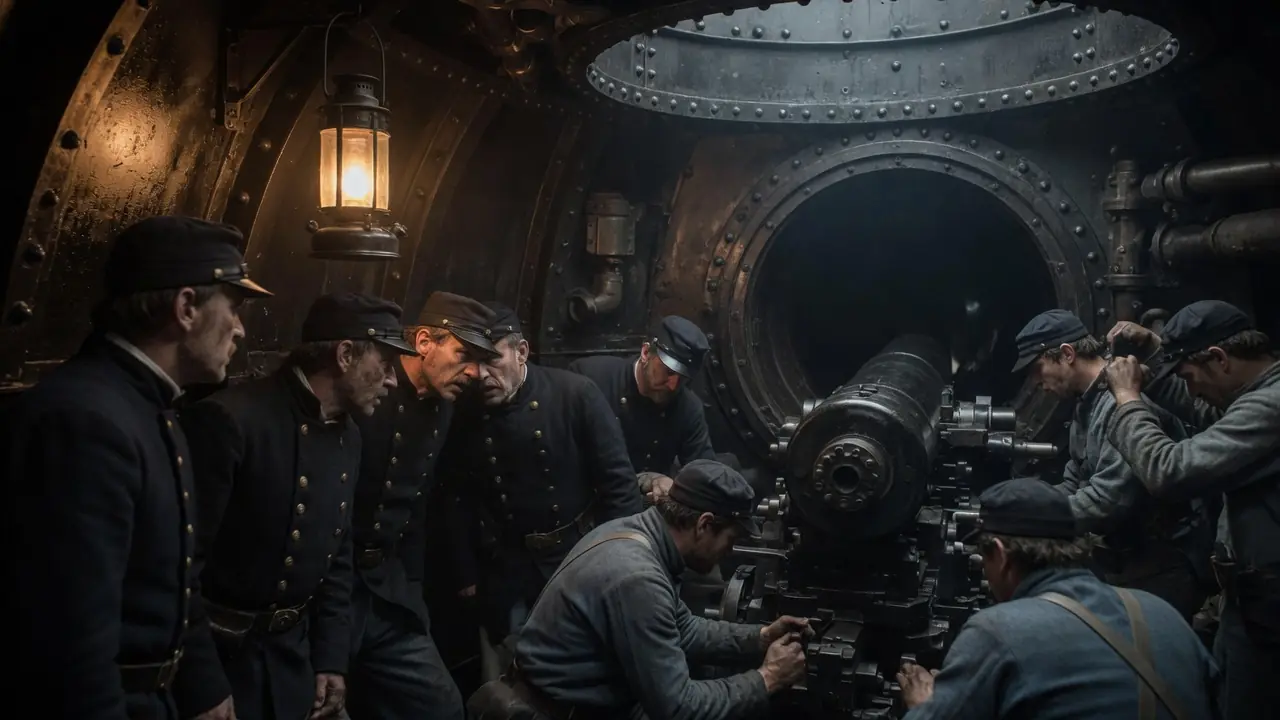
Part 2 — The Duel at Hampton Roads
March 8, 1862 — The Monster Appears
On the morning of March 8, 1862, the Confederacy unveiled its newest and most powerful weapon.
Slowly emerging from the Elizabeth River, the ironclad CSS Virginia steamed toward the Union fleet anchored at Hampton Roads.
The sight astonished those watching from nearby ships and shore.
Instead of the graceful profile of a traditional warship, Virginia appeared as a low, sloping mass of iron moving steadily through the water.
Its armored casemate reflected sunlight while smoke poured from its funnels.
Many Union sailors had never seen an ironclad before.
Few realized they were witnessing the beginning of a revolution.
The Union fleet waiting at Hampton Roads consisted almost entirely of wooden warships.
Against conventional opponents, they were formidable.
Against an armored steam-powered vessel, they were dangerously vulnerable.
Virginia's commander, Flag Officer Franklin Buchanan, intended to prove exactly that.
As the Confederate ironclad closed the distance, Union ships opened fire.
Round after round struck Virginia's sloping iron armor.
Instead of smashing through the hull, most cannonballs bounced away or shattered harmlessly against the metal plating.
For the first time in history, many naval officers witnessed the terrifying limitations of traditional naval artillery against armored warships.
The Destruction of USS Cumberland
Virginia's first major target was the USS Cumberland, a powerful wooden sailing frigate.
The Union crew fought with determination.
Despite realizing that many of their cannonballs had little effect against the Confederate ironclad, they continued firing until the last possible moment.
Rather than relying solely on its guns, Virginia employed one of its most unusual weapons.
Its massive iron ram.
The Confederate vessel struck Cumberland below the waterline with tremendous force.
The impact tore a huge hole into the wooden hull.
Water poured into the ship almost immediately.
Even as Cumberland began sinking, her crew continued loading and firing their guns.
Witnesses later recalled that the frigate's colors remained flying until the ship finally disappeared beneath the water.
It was one of the most dramatic moments of the Civil War at sea.
For generations, wooden warships had dominated naval combat.
In a matter of minutes, one had been destroyed by an armored opponent that seemed almost invulnerable.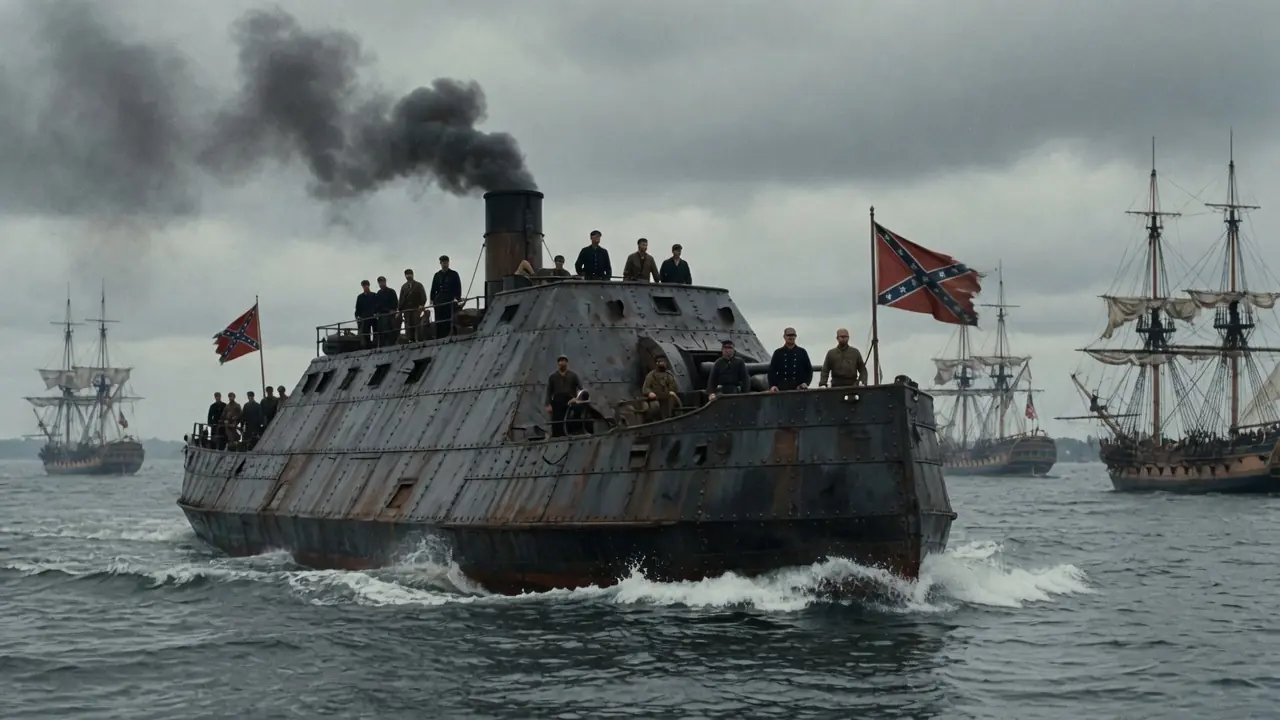
Congress Falls
After sinking Cumberland, Virginia turned toward another Union warship, the USS Congress.
Unable to maneuver effectively in shallow water, Congress soon found herself trapped.
The Confederate ironclad and accompanying Southern gunboats subjected the ship to heavy fire.
Eventually, Congress struck her colors to indicate surrender.
During the confusion that followed, firing continued from various directions along the shoreline.
Believing his crews were still under attack, Flag Officer Franklin Buchanan ordered additional fire against Congress.
The vessel eventually caught fire.
Later that afternoon, flames reached her ammunition magazines.
A tremendous explosion destroyed what remained of the ship.
By sunset, two major Union warships had been lost.
The Union Navy had suffered one of the worst single-day defeats in its history.
Panic spread throughout Hampton Roads.
Only one significant wooden warship, the USS Minnesota, remained stranded after running aground while attempting to join the fight.
Virginia planned to finish her off the following morning.
It appeared that nothing could stop the Confederate ironclad.
The Arrival of Monitor
As darkness fell on March 8, an extraordinary new vessel quietly entered Hampton Roads.
It was the USS Monitor.
Having completed a difficult voyage from New York only days earlier, the experimental ironclad arrived just in time.
Its appearance surprised many Union sailors.
The ship looked unlike anything afloat.
Most of its hull rode only inches above the water.
Dominating the deck was a single revolving iron turret containing two powerful 11-inch Dahlgren guns.
Throughout the night, Monitor positioned herself beside the stranded Minnesota.
Her commander, Lieutenant John Lorimer Worden, prepared for battle.
At dawn on March 9, 1862, Virginia steamed back toward Hampton Roads expecting to destroy the helpless Minnesota.
Instead, another ironclad moved forward to meet her.
For the first time in history, two armored warships prepared to fight one another.
The outcome would determine far more than the fate of a single harbor.
Navies around the world were watching.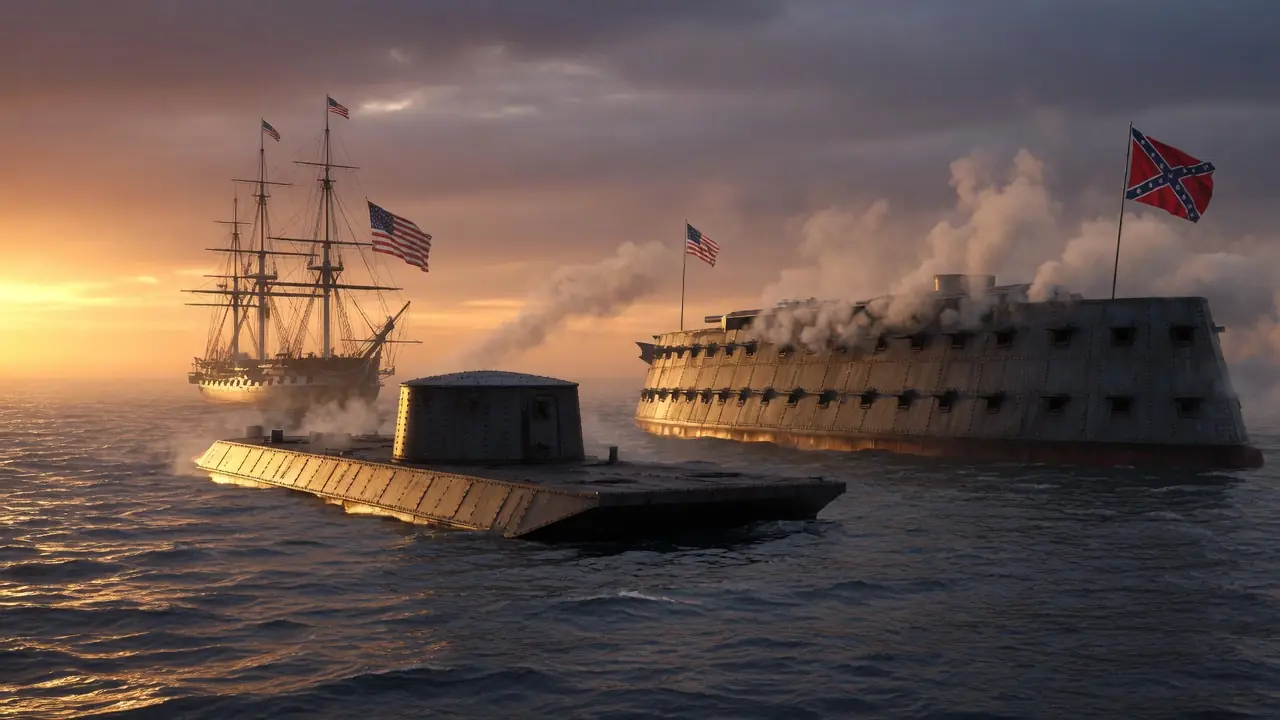
Part 3 — The Battle That Changed the World's Navies
Four Hours of Iron Against Iron
At dawn on March 9, 1862, the two ironclads finally met.
For approximately four hours, USS Monitor and CSS Virginia circled one another across the waters of Hampton Roads, exchanging heavy cannon fire at remarkably close range.
Unlike earlier naval battles, there were no towering wooden masts splintering under broadsides.
Instead, iron shells slammed into iron armor.
Again and again, the crews fired their heaviest guns.
Monitor's two 11-inch Dahlgren smoothbore cannons launched massive solid shot toward Virginia's sloped casemate.
Virginia answered with its own battery of heavy guns.
The impacts shook both ships violently.
Crewmen inside the armored vessels described deafening explosions, clouds of gunpowder smoke, and the terrifying sound of iron striking iron.
Yet the armor generally held.
Many projectiles simply bounced away.
Others dented armor plates or damaged fittings without penetrating the hull.
The battle demonstrated something no major naval engagement had ever proven so clearly.
Traditional naval cannon fire was no longer sufficient against armored warships.
Neither vessel could gain a decisive advantage.
Virginia attempted to ram Monitor, but the smaller Union ship's greater maneuverability allowed her to avoid a direct collision.
Monitor, meanwhile, repeatedly maneuvered around Virginia, using her revolutionary rotating turret to fire regardless of the ship's direction.
It was a completely new way of fighting at sea.
A Tactical Draw
Late in the morning, one dramatic moment nearly changed the outcome.
While observing the battle from the pilot house, Lieutenant John Lorimer Worden, commander of Monitor, looked through one of the narrow viewing slits.
At that instant, a Confederate shell struck directly against the pilot house.
The explosion sent fragments of iron and paint into the opening, temporarily blinding Worden and seriously injuring his eyes.
With its commander incapacitated, Monitor briefly withdrew while Lieutenant Samuel Dana Greene, the ship's executive officer, assumed command.
Virginia's crew believed the Union vessel might be retreating.
However, the Confederate ironclad also faced growing problems.
Its armor had endured repeated punishment.
Several guns had been damaged.
Coal supplies were running low, and the falling tide made maneuvering increasingly difficult for the much larger vessel.
Neither ship was in a position to continue the duel indefinitely.
Eventually, Virginia withdrew toward Norfolk, while Monitor remained near the grounded USS Minnesota, successfully preventing the Confederate ironclad from destroying the vulnerable Union frigate.
From a tactical perspective, the battle ended without a clear victor.
Neither ship had sunk the other.
Neither side had completely achieved its objectives.
Yet strategically, the Union blockade at Hampton Roads remained intact.
Virginia had failed to break it.
The Fate of the Two Ironclads
Although the famous duel ended in a draw, neither ship enjoyed a long career.
In May 1862, Confederate forces abandoned Norfolk, Virginia, as Union troops advanced.
Without control of the naval yard, Virginia could no longer operate effectively.
Because her deep draft prevented escape into shallower inland waters, Confederate authorities decided to destroy the ship rather than allow her capture.
On May 11, 1862, her crew evacuated the vessel and set her on fire.
The flames eventually reached the ship's ammunition magazine, destroying the ironclad in a massive explosion.
USS Monitor survived longer but met a different fate.
On the night of December 30–31, 1862, while being towed along the coast near Cape Hatteras, North Carolina, the low-freeboard ironclad encountered a severe Atlantic storm.
Heavy seas swept across her deck.
Water entered the ship faster than the pumps could remove it.
Despite desperate efforts to save her, Monitor sank during the early hours of December 31, 1862.
Sixteen crew members lost their lives.
More than a century later, in 1973, the wreck of Monitor was located on the seabed.
Many important artifacts—including the famous revolving turret—have since been recovered and preserved.
A Revolution in Naval Warfare
Although the Battle of Hampton Roads produced no decisive battlefield winner, its impact reached far beyond the American Civil War.
Naval observers from Europe carefully studied reports of the engagement.
The conclusions were impossible to ignore.
Wooden warships had not become instantly obsolete overnight, but the battle clearly demonstrated that armored steam-powered warships represented the future of naval combat.
Within a few years, the world's major naval powers—including Great Britain, France, Russia, and others—accelerated the construction of ironclads while gradually retiring or converting traditional wooden warships.
The revolving gun turret introduced by Monitor also transformed warship design.
Future battleships increasingly abandoned long rows of broadside guns in favor of rotating armored turrets capable of firing in multiple directions.
The duel at Hampton Roads marked the beginning of that transition.