The first thing Lily noticed was that the boy did not eat like other hungry children.
He did not tear into the sandwich.
He did not bite too fast or chew with his mouth open or reach for more before swallowing what he already had. He held it carefully in both hands, as if it might disappear if he trusted it too much.
Rain had stopped an hour earlier, but the sidewalk still shone under the late afternoon light.
Water dripped from the green awning of Fairlane Bakery and ran in crooked lines toward the gutter. People stepped around the puddles without looking down. Cars hissed along Seventh Avenue, their tires cutting through gray water left behind by the storm.
Lily stood beside her mother’s shopping bags with a small paper sack pressed to her chest.
She was seven years old, old enough to know she should not talk to strangers and young enough to believe that a person sitting alone in wet clothes was not a stranger.
He was just a boy.
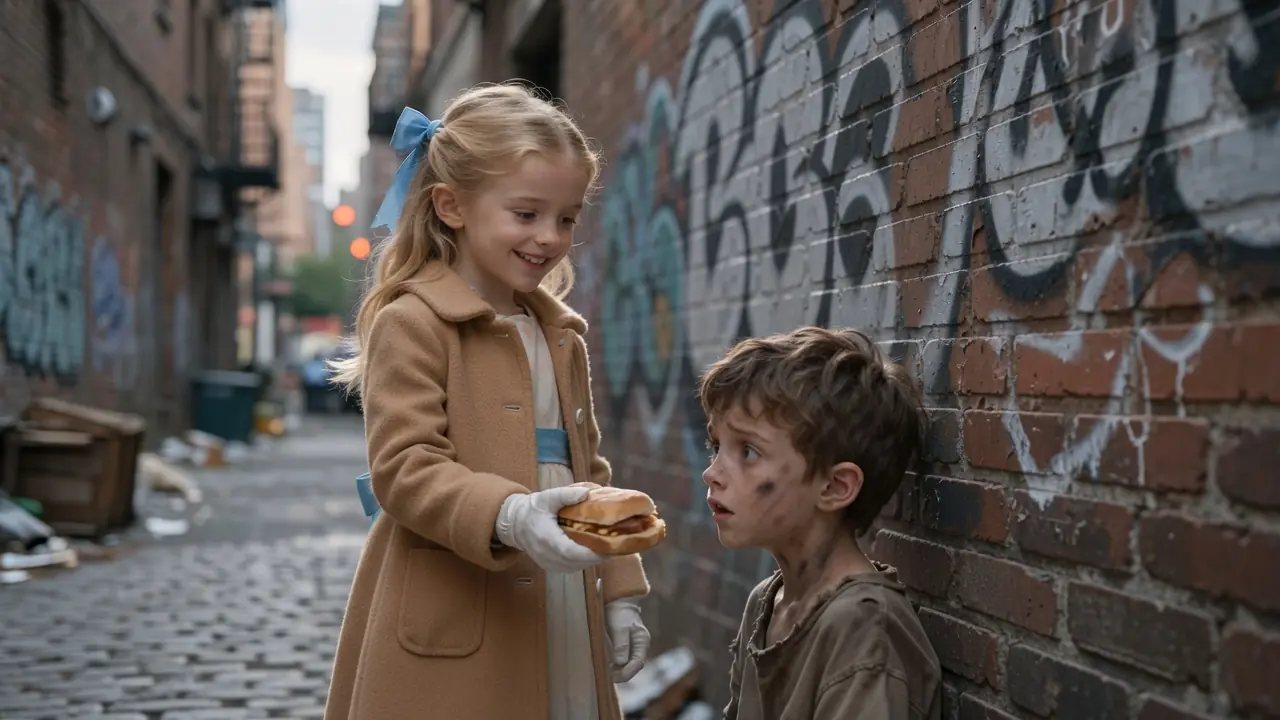
He sat beside the brick wall near the alley, knees pulled close, back hunched against the cold. His hair was dark and tangled. His cheeks were dirty. One sleeve of his shirt had ripped near the elbow, and his sneakers looked like they had spent too many nights outside.
He could not have been much older than ten.
Maybe eleven.
His eyes were what made Lily stop.
They did not look mean.
They looked tired.
She had seen tired eyes before in adults. In her mother after long phone calls. In the cashier at the pharmacy. In the old man downstairs who carried groceries up three flights of stairs one bag at a time.
But she had never seen eyes like that on a child.
Lily looked inside the paper sack.
Her mother had bought her a turkey sandwich from the bakery because Lily had complained of being hungry after piano class. She had eaten half in the car and said she would save the rest for later.
Now later was standing in front of her.
Not for her.
For him.
She walked toward the boy before she had time to be afraid.
“Do you want this?” she asked.
The boy looked up sharply.
Not greedy.
Startled.
Like kindness was something that usually came with a trick hidden inside it.
Lily held out the sandwich.
“It’s turkey. I don’t like the mustard part, but you can take it off.”
The boy stared at the sack.
Then at her.
“You sure?”
She nodded.
“My mom says wasting food is bad.”
The corner of his mouth moved, almost like a smile that had forgotten how.
“I won’t waste it.”
He took the sandwich with both hands.
His fingers were thin and dirty, the nails broken short. Lily noticed a bruise on his wrist, yellow at the edges like it had been there for days. She wanted to ask about it, but something told her not to.
Behind them, her mother’s voice cut through the sidewalk.
“Lily?”
Lily turned.
Her mother, Caroline Hayes, stood outside the bakery doors with two shopping bags hanging from one arm and her phone in the other hand. She wore a camel-colored coat belted at the waist, her auburn hair pulled into a smooth twist, her face still shaped by whatever stressful call she had just ended.
At first, Caroline only looked annoyed.
Then she saw the boy.
Her whole expression changed into alarm.
“Lily, step away from him.”
The boy lowered his eyes at once.
Lily frowned.
“Mom, he’s hungry.”
“Come here now.”
“But I gave him my sandwich.”
Caroline moved quickly across the wet sidewalk, heels clicking hard. She grabbed Lily’s hand and pulled her back with more force than she meant to.
The boy flinched.
Caroline saw that.
For one strange second, guilt passed over her face.
Then fear covered it.
“You cannot just walk up to people like that,” she said.
“He’s a kid.”
“You don’t know him.”
“He didn’t do anything.”
The boy started to stand, still holding the sandwich.
“I’m sorry,” he said quickly. “I didn’t ask her. She just—”
His voice stopped.
Caroline had turned toward him.
Really turned.
The noise of the city seemed to thin around her.
A bus hissed at the corner. Someone laughed under the bakery awning. A man bumped past with a coffee and muttered about people blocking the sidewalk.
Caroline did not move.
The boy stared back at her.
The sandwich trembled in his hands.
At first, Lily thought her mother was angry.
Then she saw Caroline’s face drain of color.
The shopping bags slipped from her arm and hit the pavement. A small box of pastries rolled out, its white ribbon dragging through dirty water.
Caroline took one step forward.
Then another.
“No,” she whispered.
The boy stepped back against the brick wall.
Caroline lifted both hands as if reaching for something fragile and impossible.
“What is your name?” she asked.
The boy’s eyes narrowed.
“Why?”
Her voice broke.
“Please.”
He looked toward the alley, then down at the sandwich.
“Eli.”
Caroline made a sound that did not belong on a busy sidewalk.
It was not quite a sob.
Not quite a breath.
Just pain leaving the body before words could catch it.
Lily looked from her mother to the boy.
“Mom?”
Caroline barely heard her.
At first, Eli flinched.
Not because he did not know her.
Because some part of him did.
Her fingers touched his dirty cheek.
A tear fell from her chin onto the front of his torn shirt.
“My baby,” she whispered.
The boy’s eyes widened.
He looked at her face like he was trying to match it to a dream he had been told was not real.
“You came back?” he whispered.
Caroline covered her mouth.
“I never left you.”
His hands tightened around the sandwich until the bread bent.
“They said you didn’t want me.”
Caroline shook her head hard.
“No. No, I was told you were gone.”
Eli’s face crumpled.
“For real?”
Caroline pulled him into her arms before he could say anything else.
For one second, he stayed stiff.
His whole body held the shape of a child who had learned not to lean into anything, because everything he leaned on eventually moved away.
Then he broke.
The sandwich fell beside them.
Eli clung to Caroline’s coat with both hands and cried into her shoulder like a child who had been holding his breath for seven years.
Lily stood frozen behind them.
Her mother was hugging a boy who looked like he had slept outside.
Her mother was crying like the world had ended and come back wrong.
Her mother had called him my baby.
Lily stepped closer, trembling.
“Mom,” she whispered, “is he my brother?”
Caroline looked up through tears.
For a moment, she seemed to remember Lily was there.
Then she reached out and pulled her daughter in too.
“Yes,” she whispered. “He’s your brother.”
Eli looked at the little girl who had given him food before she knew his name.
His cheeks were wet.
His eyes were red.
But for the first time, he smiled.
Not because he was safe yet.
Because someone had finally found him.
Seven years earlier, Caroline Hayes had left a hospital in Philadelphia without her son.
She did not remember leaving.
Not clearly.
There were flashes.
White ceiling lights. A nurse saying her blood pressure was dropping. Her husband’s voice somewhere far away. A baby crying, then not crying, then someone pressing a mask over her face and telling her to breathe.
When she woke, the room was too quiet.
Her mother-in-law, Vivian, sat beside the bed wearing pearls and a black dress as if she had come from a funeral instead of a maternity ward. Caroline’s husband, Peter, stood near the window with his back turned.
Caroline asked where the baby was.
No one answered at first.
That silence told her everything before the words did.
Vivian took Caroline’s hand and said there had been complications. The baby had been too weak. The doctors had tried. They were sorry.
Caroline screamed until a nurse came in.
Then she screamed at the nurse.
Then at Peter.
Then at God.
They told her she had been sedated. They told her seeing the baby would only make it worse. They told her arrangements had been made because she was not strong enough.
She had begged.
Peter cried and said he could not bear it.
Vivian held her shoulders and said, “You must survive this, Caroline.”
So Caroline survived.
If the thing she did afterward could be called surviving.
For months, she did not get out of bed unless someone made her. She stopped going into the nursery. She stopped answering messages. She stopped touching the tiny blue blanket folded in the closet because the softness of it made something tear open inside her.
Peter grieved differently.
Or so she thought.
He returned to work within two weeks. He said routine helped. His mother moved into their home “temporarily” and handled everything Caroline could not.
Bills.
Calls.
Medication.
Visitors.
The small white urn Vivian placed on the mantel before Caroline was ready to see it.
There was no funeral.
Vivian said Caroline had been too ill.
Peter said he had not known what else to do.
Years passed.
Caroline learned how to stand upright again.
Then she learned how to smile in public.
Then she became pregnant with Lily.
Everyone told her Lily would heal what had been broken.
That was not true.
Children are not bandages.
But Lily gave Caroline a reason to keep breathing with purpose.
Caroline loved her daughter fiercely, almost fearfully. She checked Lily’s temperature too often. Watched cars too closely. Panicked when Lily slept too long. Refused to leave her with anyone except the nanny she had personally interviewed six times.
People called her protective.
They did not know she lived with a locked room inside her chest where another child still cried.
Peter left when Lily was two.
Officially, it was a separation caused by grief, distance, incompatible healing, all the polished phrases people use when a marriage has rotted from the inside. Unofficially, Caroline had begun to see his cowardice clearly.
He avoided certain questions.
He hated hospitals.
He became angry whenever she asked why she had never seen a death certificate.
Then Vivian died of a stroke.
Peter drank too much at the funeral.
Three months later, he moved to Denver with a woman from his firm.
Caroline raised Lily alone.
She built a quiet life.
Work.
School.
Piano lessons.
Bakery on Fridays.
The pain did not vanish. It became part of the furniture of her life, something she learned not to bump into too often.
Then, on a wet sidewalk outside Fairlane Bakery, a hungry boy looked up with Peter’s eyes and Caroline’s mouth.
And the locked room inside her chest burst open.
Eli stopped crying first.
Not because he was finished.
Because crying in public had become dangerous in his life.
He pulled away from Caroline’s arms, wiping his face hard with the back of one wrist.
Caroline did not let go completely.
She held his shoulders, as if afraid he would disappear if she lost contact.
“Where have you been?” she asked.
Eli looked down.
“Around.”
“Who are you with?”
He shrugged.
“Different people.”
Caroline’s hands tightened.
“Who told you I didn’t want you?”
His face changed.
He looked toward the alley again.
Caroline followed his glance.
“Eli?”
“There’s a man,” he said.
“What man?”
“He said he was helping.”
Lily moved closer to her mother’s side.
The city had started to notice them again. A few people lingered under the awning, pretending not to stare. One woman held a phone low at her side, recording.
Caroline stood at once.
Her lawyer’s voice came back before the rest of her did.
“Put the phone away.”
The woman blinked.
“I’m just—”
“You are filming a child in distress. Put it away.”
The phone lowered.
Caroline turned back to Eli.
“We need to go somewhere warm.”
He stepped back.
“No.”
The word came too fast.
Caroline froze.
“All right. We don’t have to go far. The bakery is right there.”
“No.”
“Eli, you’re freezing.”
“I can’t.”
“Why?”
His eyes filled again, but this time the tears did not fall.
“I have to check on Noah.”
Caroline’s breath caught.
“Who is Noah?”
“My brother.”
Lily whispered, “Another brother?”
Eli shook his head quickly.
“Not like that. He’s little. He’s with Mrs. June. She watches him when she can. I said I’d bring food.”
Caroline tried to understand through the pounding in her ears.
He had another child he was taking care of.
At ten years old.
The sandwich lay ruined on the sidewalk.
Lily noticed at the same time.
She picked it up carefully, though the paper was wet now and the bread had touched the ground.
“We can get more,” she said.
Eli looked at her as if more was a word from another language.
Caroline reached for her fallen shopping bags.
Her hands shook too badly to gather everything.
A bakery worker came outside with a clean paper bag.
“Ma’am,” he said softly, “come inside. Please. We can help.”
Caroline nodded.
Then looked at Eli.
“I won’t force you. But if there is another child waiting for food, we can bring food to him. Together.”
Eli stared at her.
He wanted to run.
She could see it.
His feet shifted. His eyes checked the alley, the street, the door, every possible escape. He had learned survival by never standing too long in any place where adults suddenly wanted something from him.
Caroline lowered herself to his eye level.
“I am not going to let anyone take you from me again,” she said. “But I know you don’t know whether to believe me yet. So for now, you lead. I will follow.”
Something in his face changed.
Not trust.
Not yet.
But maybe the smallest crack where trust could someday enter.
“Food first,” he said.
“Food first,” Caroline agreed.
Inside the bakery, warmth wrapped around them.
The smell of bread, sugar, butter, and coffee filled the room. Lily had always loved that smell. Eli looked overwhelmed by it, like a person standing too close to a dream.
The owner, Mr. Alvarez, recognized Caroline. She had bought birthday cakes there for years. He took one look at her wet coat, her ruined face, and the boy beside her, then stopped asking questions before they formed.
“What do you need?” he asked.
Caroline looked at Eli.
“What does Noah eat?”
Eli swallowed.
“Anything soft. He lost a tooth. But not soup if it’s too hot. He burns his mouth.”
Mr. Alvarez began packing food immediately.
Turkey sandwiches.
Chicken soup in sealed containers.
Bananas.
Milk.
Soft rolls.
Cookies because Lily insisted.
Eli watched every item go into the bags.
“That’s too much,” he said.
“No,” Caroline replied. “It is not.”
He looked at the floor.
“Mrs. June says taking too much makes people change their mind.”
Caroline closed her eyes for half a second.
“They will not change their mind.”
Mr. Alvarez set the bags on the counter and waved away Caroline’s card.
“Later,” he said.
“Please let me pay.”
“Later,” he repeated, softer.
Caroline nodded, too close to crying again.
Lily stood beside Eli with two cups of hot chocolate. She offered one to him.
He did not take it.
“It’s yours,” she said.
“Why?”
“Because your hands look cold.”
He took the cup slowly.
The heat surprised him.
He held it with both hands and did not drink, just let the warmth touch his fingers.
Caroline watched him and felt seven years of absence pressing against her ribs.
She wanted to ask a hundred questions.
Who cut your hair?
Who held you when you had nightmares?
Who taught you to tie your shoes?
Who left you hungry?
Who told you I was not coming?
But every question was a weight, and Eli already looked like he had been carrying too much.
So she waited.
Eli led them through side streets behind the bakery, away from the clean storefronts and into the service alleys where delivery doors opened to dumpsters and steam pipes. Caroline carried three food bags. Lily carried the cookies. Eli walked ahead with the hot chocolate untouched in one hand.
He kept looking back.
At first Caroline thought he was making sure they followed.
Then she realized he was making sure they did not leave.
They passed a laundromat with fogged windows, a closed pawnshop, and a building with plywood over its lower windows. At the corner, a man in a gray hoodie watched them from beneath a fire escape.
Eli saw him and stiffened.
Caroline noticed.
“Is that him?”
Eli shook his head too quickly.
The man smiled without warmth.
“Well, look at that,” he called. “Little prince found himself a rich lady.”
Eli’s face went pale.
Caroline stepped between them.
“Keep walking,” she said quietly.
The man laughed.
“Careful with that one, ma’am. Kid lies.”
Caroline turned toward him fully.
“Then you should have no reason to worry when I ask the police to speak with you.”
His smile vanished.
Eli grabbed Caroline’s sleeve.
“No police.”
The fear in his voice stopped her.
The man slipped back into the alley.
Caroline watched him go, every instinct screaming.
But Eli was trembling.
“All right,” she said. “Not now. But he does not get to scare you forever.”
Eli did not answer.
They reached a narrow courtyard behind an old church recreation building. The church had closed years ago, but the basement entrance was still used by outreach volunteers during winter. Near the back steps, under a blue tarp tied to a railing, an elderly woman sat on a milk crate with a blanket around her shoulders.
Beside her, a little boy slept curled on a pile of coats.
He was maybe five.
His hair was sandy and uneven, his cheeks flushed with fever. One hand clutched the sleeve of an old stuffed dinosaur.
“Mrs. June,” Eli called.
The woman looked up.
Her eyes sharpened when she saw Caroline.
“Eli?”
“It’s okay,” he said quickly. “She brought food.”
Mrs. June did not relax.
Women who had lived long enough on the street did not trust cream coats and tearful faces just because they arrived carrying bakery bags.
“Who is she?” she asked.
Eli hesitated.
Caroline answered carefully.
“My name is Caroline Hayes.”
Mrs. June’s eyes moved over her.
“And?”
Caroline looked at Eli.
He gave the smallest nod.
“I am his mother.”
The courtyard went very still.
Mrs. June stared at Eli.
The little boy, Noah, stirred under the coats.
Eli crouched beside him and touched his forehead.
“I brought soup,” he whispered. “And soft bread.”
Noah blinked awake.
“Eli?”
“Yeah.”
“You were long.”
“I know. Sorry.”
Lily stepped closer and held out the bag of cookies.
“I brought these.”
Noah looked at her suspiciously.
“Who are you?”
Lily glanced at Eli.
“I think I’m his sister.”
Noah considered that.
Then he said, “You got cookies?”
Lily nodded.
“Then okay.”
Mrs. June watched Caroline kneel in the damp courtyard and set out food with careful hands.
“So,” the old woman said, “seven years and now you appear?”
Caroline looked up.
The words struck hard because they deserved to.
“I was told he died.”
Mrs. June’s face changed.
Eli looked at the ground.
Noah sat up slowly, rubbing one eye.
Mrs. June’s voice lowered.
“Who told you that?”
“My husband. His mother. Everyone around me who should have told me the truth.”
Mrs. June turned toward Eli.
“Baby, you hear that?”
Eli’s jaw tightened.
“They said she didn’t want me.”
“Who said?”
He did not answer.
Mrs. June did.
“Ray Carver,” she said.
Eli flinched at the name.
Caroline remembered the man in the gray hoodie.
“Who is he?”
Mrs. June gave a bitter laugh.
“A collector of lost things. Lost wallets. Lost phones. Lost kids if he can use them. He found Eli three years ago after the foster placement broke. Let him sleep behind his building, then made him run errands, carry packages, beg for cash. Told him his mama was alive but had signed him away.”
Caroline felt the world tilt.
“Foster placement?”
Mrs. June sighed.
“You really don’t know.”
“No.”
Eli’s shoulders were up around his ears now.
Caroline wanted to reach for him.
She did not.
Mrs. June took the soup container Lily handed her and continued.
“He was not on the street the whole seven years. First, there was some private family. Then state care. Then a foster couple out near Camden. Some decent. Some not. Files get lost. Names get changed. Adults tell children stories because stories are cheaper than truth.”
Caroline’s hands had gone numb.
Private family.
State care.
Foster placement.
Her son had been alive in systems and rooms and houses while she lit candles beside a white urn.
“Who took him from the hospital?” she whispered.
Mrs. June looked at Eli.
The boy’s face had closed completely.
Caroline understood then that he knew pieces.
Pieces no child should have had to carry.
Mrs. June said, “That is a question for police and lawyers.”
Caroline’s voice went cold.
“I am a lawyer.”
Mrs. June studied her.
“Then be his mother first.”
The words stopped Caroline better than any accusation could have.
She looked at Eli.
He was feeding Noah small pieces of bread, careful to blow on the soup before offering each spoonful. He moved with practiced tenderness, too old in the hands, too young in the face.
Lily sat beside them, quiet now.
She had stopped looking confused and started looking heartbroken.
Noah ate slowly.
After half a bowl of soup, color came back into his face.
Caroline touched the side of her phone.
“He has a fever. He needs a doctor.”
Eli tensed.
“He gets better.”
“Maybe. But we should make sure.”
“No hospitals.”
“Why?”
“They ask names.”
Caroline looked at Mrs. June.
Mrs. June’s face told her enough.
Children without secure adults learned to fear names. Names opened files. Files opened doors. Doors separated people.
Caroline took a breath.
“Then we go together. You, Noah, Mrs. June if she wants, Lily, me. Nobody disappears. Nobody gets left behind in a waiting room. And if anyone asks questions, they ask me first.”
Eli looked at her.
“You can do that?”
“Yes.”
“Because you’re rich?”
Caroline flinched.
“Because I’m your mother.”
He held her gaze.
“That didn’t help before.”
The courtyard went quiet.
Caroline nodded slowly.
“You’re right.”
Tears burned her eyes, but she did not let them become the center of the moment.
“It did not help before. I did not help before because I did not know. But you do not have to believe seven years of missing can be fixed in one afternoon. Just let me take the next step.”
Eli looked at Noah.
Then at Mrs. June.
Then at Lily.
Finally, he nodded once.
“Next step.”
Caroline called her driver, then a pediatric urgent care where she knew the medical director from a charity board. She hated that knowing someone mattered. She used it anyway.
Within thirty minutes, a black SUV pulled up near the church courtyard.
Eli stared at it like it might bite.
Noah asked if it had snacks.
Lily said probably, because grown-up cars sometimes did.
Mrs. June refused to come at first.
“I don’t need your rescue.”
Caroline respected the pride in that.
“No,” she said. “But I may need your help. Eli trusts you more than he trusts me.”
Mrs. June looked at the boy.
Eli did not look up, but his hand touched the edge of her blanket.
The old woman sighed.
“Well, I’m not riding anywhere with wet socks.”
Caroline removed her own dry socks from a shopping bag she had bought that morning and handed them over without a word.
Mrs. June took them.
“That coat cost more than my first car,” she muttered.
“Probably.”
“At least you know.”
They went to the clinic.
Noah had an infection and a fever but nothing that could not be treated. He was also underweight, dehydrated, and overdue for every kind of regular care. The nurse cleaned Eli’s scraped knuckles, checked the bruise on his wrist, and asked too many questions with too much concern.
Caroline stayed beside him.
When Eli stopped answering, she said, “We will provide information when he is ready.”
The nurse looked like she wanted to argue.
Caroline looked like a woman who had cross-examined men twice her size and made them sweat.
The nurse backed down.
Lily sat with Noah and taught him how to play tic-tac-toe on the paper covering the exam table. Mrs. June drank three cups of clinic coffee and declared all of them terrible. Noah took his medicine with dramatic gagging that made Lily laugh.
For a few minutes, they almost looked like a strange, messy family.
Then Caroline’s phone rang.
Peter Hayes.
Her ex-husband’s name lit the screen like a bad omen.
Caroline stepped into the hallway and answered.
“Did you know?” she asked before he could speak.
There was silence.
Then Peter said, “Caroline, where are you?”
“Did you know our son was alive?”
Another silence.
This one answered her.
Caroline leaned against the wall because her knees nearly gave out.
Peter’s voice lowered.
“My mother handled it.”
“Handled what?”
“You were unstable. The baby was premature. There were complications.”
“Our son was alive.”
“Not well. My mother said he would never be normal, that the adoption was arranged with people who could care for him.”
Caroline could not breathe.
“Adoption?”
“It was private. Quiet. You were in no condition—”
“You told me he died.”
“I was trying to protect you.”
Caroline looked through the small window in the exam room door.
Eli sat on the edge of the table, holding Noah’s dinosaur while the little boy drank apple juice. Lily sat beside him, talking softly. His hair fell into his eyes the same way Peter’s had when they were young.
“You protected yourself,” Caroline said.
Peter exhaled sharply.
“You do not understand what my mother was like.”
“I understand that my son spent seven years believing I abandoned him.”
“Caroline—”
“Do not say my name like you are the injured party.”
“I didn’t know he ended up on the street.”
“But you knew he was alive.”
Peter did not answer.
That silence became evidence.
Caroline’s voice settled into something calm and terrible.
“You will send me every document you have. Every name. Every signature. Every lawyer involved.”
“You cannot undo this.”
“No,” she said. “But I can expose it.”
Peter’s tone changed.
“You should think carefully. There are legal implications for everyone.”
“For you,” Caroline said. “There are legal implications for you.”
She ended the call.
Then she stood in the hallway for a moment, shaking so hard she had to press both hands against the wall.
Mrs. June came out of the room.
“Bad?”
Caroline laughed once without humor.
“Worse.”
“Your man?”
“My ex-husband.”
“Figured.”
Caroline looked at the old woman.
“How do I walk back in there?”
Mrs. June sipped her terrible coffee.
“Not with the whole truth at once. Children can choke on adult sins if you shove them down too fast.”
Caroline closed her eyes.
“He knew.”
Mrs. June was quiet.
Then she said, “Then you stay steady enough that the boy learns one parent’s lie is not the whole world.”
Caroline nodded.
She wiped her face, breathed once, and returned to the exam room.
Eli looked at her immediately.
He knew something had happened.
Children like him always knew.
“Was it about me?” he asked.
Caroline sat beside him.
“Yes.”
“Bad?”
“Yes.”
He looked down.
“Did I do something?”
The question nearly destroyed her.
“No.” Caroline reached for his hand, then stopped and waited.
After a moment, Eli let her take it.
“You did nothing wrong. Adults made choices they had no right to make. I am going to find out every part of it. But you are not the mistake. You are not the problem. You are my son.”
His mouth trembled.
He looked away quickly.
Noah whispered, “Does that mean we still get soup?”
Lily burst into a watery laugh.
Even Eli smiled a little.
The next step became many steps.
That evening, Caroline did not take Eli straight to her apartment, though every part of her wanted to. She knew wanting was not the same as being ready. Instead, she arranged adjoining rooms at a small family hotel near the clinic.
Mrs. June took one bed and complained about the pillows.
Noah fell asleep with the stuffed dinosaur under his chin.
Lily called her nanny to bring pajamas, extra clothes, and her favorite blanket, then insisted Eli should have the blanket because he looked like he had forgotten what blankets were for.
Eli refused.
Lily left it on the chair beside him anyway.
Caroline sat by the window long after the children slept.
Eli did not sleep for a long time.
He lay on the far side of the second bed, shoes still on, one arm hanging over the edge as if ready to run.
“I used to dream you came,” he said into the darkness.
Caroline turned.
She could barely see his face.
“What happened in the dream?”
“You’d be wearing a yellow coat.”
Caroline looked down at her camel coat hanging over the chair.
“I’m sorry. I got the color wrong.”
He did not laugh.
“For a while, I thought if I stood near places with lots of moms, maybe you’d see me.”
Caroline pressed her fist against her mouth.
“Then Ray said you had a new kid and didn’t want the old one.”
“No.”
“I saw girls with moms and wondered if one was her.”
Caroline understood.
Lily.
He had imagined his sister before knowing her name.
“She did not replace you,” Caroline said. “No one could.”
He was quiet.
Then, almost too softly to hear, he asked, “Did you name me?”
“Yes.”
“What was it?”
She swallowed.
“Elias James Hayes.”
He turned toward her slightly.
“Elias.”
“Your grandfather was James. I wanted Eli. Your father wanted something more formal. I said we could do both.”
“Do I have to be Hayes?”
“No.”
That answer surprised him.
Caroline continued.
“You do not have to decide anything tonight. Your name belongs to you before it belongs to me.”
He stared at her.
“Ray called me Mouse.”
Caroline felt rage move through her so quickly it frightened her.
She kept her voice gentle.
“Do you like Eli?”
He thought about it.
“Better than Mouse.”
“Then Eli.”
He turned back toward the wall.
After a long time, he said, “Lily gave me food.”
“She did.”
“She didn’t know.”
“No.”
“She was nice first.”
Caroline closed her eyes.
“Yes. She was.”
The next morning, Caroline began the work of rebuilding a life that should never have been stolen.
Lawyers.
Hospitals.
Old records.
Private adoption papers with signatures she did not recognize and one signature that looked too much like Peter’s to be coincidence. A doctor who had retired early. A nurse who remembered Vivian Hayes very well and cried when Caroline called.
The story was uglier than Caroline expected.
Vivian had believed Caroline was too fragile, too middle-class, too emotionally unstable to carry the Hayes family forward. Peter, weak and frightened of his mother, had gone along when she arranged for the premature baby to be placed with a private couple through a lawyer who specialized in quiet solutions for wealthy families.
The couple had wanted a newborn.
Then medical costs and Eli’s early developmental delays scared them.
They surrendered him to state care before his second birthday under a slightly altered name.
After that, the trail became a map of institutional failure.
Moves.
Placements.
Missed reviews.
Overworked caseworkers.
A foster home closed after complaints.
One runaway report.
Then nothing.
Eli had slipped through cracks adults later called unfortunate.
Caroline called them crimes.
But while the legal machine began turning, life had to happen inside each day.
Eli moved into Caroline’s apartment two weeks later after emergency custody was granted and after he insisted Noah and Mrs. June had to be safe too. Noah, whose mother had died the year before and whose legal situation was a tangle of absent relatives and ignored paperwork, was placed temporarily with Mrs. June through an emergency kinship-style arrangement supported by Caroline’s attorneys.
Mrs. June refused to live with Caroline.
“I’m too old to be polished,” she said.
So Caroline found her a small ground-floor apartment in the same building, with heat that worked and a window where she could grow basil in coffee cans. Noah stayed with her, visited upstairs constantly, and called Caroline “Miss Lawyer Mom” until she begged him to choose fewer words.
Lily adjusted faster than anyone expected and slower than she pretended.
She loved Eli immediately.
She also cried one night because she thought loving him meant her mother might have less love left.
Caroline held her and told her love was not soup in a small bowl.
Lily said that made no sense.
Caroline said she was trying.
Eli struggled with the apartment.
The first week, he hid bread in pillowcases, under the bathroom sink, behind books. Caroline found it slowly, never confronting him all at once. She placed a basket in the kitchen labeled Eli’s Food — No Asking Needed.
He stared at the label for a long time.
Then he put the hidden bread back.
Mostly.
He woke from nightmares.
He hated closed doors unless he was the one closing them.
He could not bear the sound of Caroline’s phone ringing with Peter’s name, so she changed Peter’s contact to Legal Evidence and then stopped answering unless her attorney was present.
He did not call her Mom.
Not for weeks.
He called her Caroline.
Sometimes ma’am when frightened.
Once, after a nightmare, he whispered Mama before he was fully awake and then refused to speak at breakfast.
Caroline did not push.
She had lost seven years.
She could not demand repayment in affection.
One afternoon, Lily came home from school upset.
A classmate had said her brother looked like a street kid.
Eli heard.
He disappeared into the bathroom and locked the door.
Lily pounded on it.
“I kicked him.”
Caroline closed her eyes.
“Lily.”
“Not hard.”
“Still.”
“He was mean.”
From inside the bathroom, Eli said, “Don’t get in trouble for me.”
Lily pressed her forehead to the door.
“You’re my brother. That’s what trouble is for.”
Silence.
Then, from inside, the smallest laugh.
Caroline stood in the hallway with laundry in her arms and cried quietly where neither child could see.
The hug did not fix everything.
That was what people wanted to believe when they heard the story later.
They wanted the sidewalk scene to be the ending.
The lost boy recognized.
The mother weeping.
The sister asking, “Is he my brother?”
The embrace.
The reunion.
But reunion is not the same as repair.
Repair was court hearings.
Therapy appointments.
School enrollment.
Dental work.
New clothes he did not trust at first.
Teaching Eli that he could leave half a sandwich in the fridge and find it still there later.
Teaching Caroline that love sometimes had to sit outside a locked bathroom and say, “I am here,” without demanding the door open.
Repair was Lily learning not to ask too many questions at once.
It was Eli learning that Lily’s questions came from love, not inspection.
It was Caroline learning to apologize without explaining herself.
It was Mrs. June telling all of them when they were being fools.
In June, seven years and three months after Caroline had been told her son died, Peter appeared at the first major custody hearing.
He looked older.
Not enough.
He wore a navy suit, brought an expensive attorney, and avoided looking at Eli until the judge asked whether the child was present.
Eli sat beside Caroline.
His hair had been trimmed, but not too much because he did not want to look like someone else. He wore a blue sweater Lily had chosen and sneakers he had picked himself. His hands were tucked under his legs to stop them from shaking.
Peter looked at him then.
Something like grief crossed his face.
Eli looked back without expression.
Later, in the hallway, Peter approached.
Caroline stepped in front of Eli.
Peter stopped.
“I just want to speak to him.”
“No,” Caroline said.
Peter’s jaw tightened.
“I am his father.”
Eli moved slightly behind Caroline.
Caroline’s voice turned cold.
“You lost the right to use that word casually.”
Peter looked past her.
“Eli, I was told things. I made mistakes.”
Eli’s hand gripped the back of Caroline’s coat.
Peter’s eyes filled.
“I thought I was doing what was best.”
Eli spoke before Caroline could.
“You thought wrong.”
Peter flinched.
The boy’s voice did not rise.
That made it stronger.
“You let them say she didn’t want me.”
Peter looked down.
“I was weak.”
Eli nodded.
“Yeah.”
Then he turned and walked back into the courtroom.
Caroline watched him go.
She had never been prouder or more heartbroken in her life.
By the end of summer, the court granted Caroline permanent custody and opened separate proceedings into the fraudulent adoption and related misconduct. Vivian was dead. Peter was not. Other people were not.
Justice moved slowly.
Eli hated that.
Mrs. June said justice was an old mule but still worth hitching.
In September, Eli started fifth grade.
The night before school, he packed and repacked his backpack six times. Lily sat on his bed and gave advice she was too young to give.
“Don’t sit by boys named Mason,” she said. “I know three and all are loud.”
“Okay.”
“If someone asks where you were before, say it’s classified.”
“That sounds weird.”
“It sounds mysterious.”
Caroline leaned in the doorway.
“Or you can say, ‘I don’t want to talk about it.’”
Lily considered this.
“Less mysterious, but fine.”
Eli zipped the backpack.
“What if they ask why I’m new?”
“Because you are,” Caroline said.
“What if they ask about my family?”
Caroline stepped into the room.
“Then you decide what you want to say.”
He looked at her.
“What do I say?”
She smiled gently.
“You have a mother, a sister, Mrs. June downstairs, Noah who steals cereal, and several adults who will come running if you need us.”
Lily raised her hand.
“I run fastest.”
Eli rolled his eyes.
But he smiled.
That night, Caroline passed his room and saw him asleep with Lily’s old blanket over his feet. Not clutched. Not hidden. Just there, accepted.
She stood in the hallway for a long time.
Seven years had not returned.
They never would.
But something new was growing in the space grief had occupied.
Not replacement.
Never that.
A second life.
On the anniversary of the day Caroline found him, Lily insisted they go back to Fairlane Bakery.
Eli said that was dramatic.
Lily said true stories deserved snacks.
Mrs. June said she would come if someone else paid for coffee.
Noah said he wanted cookies shaped like dinosaurs, which the bakery did not sell, so he settled for a chocolate croissant after making his disappointment known to management.
It was raining again.
Not as hard as that first day, but enough to darken the sidewalk and bead on the bakery windows. Caroline stood under the green awning with Lily on one side and Eli on the other.
For a moment, none of them spoke.
Eli looked toward the brick wall where he had once sat with hunger folded into his bones.
The spot was empty now.
A planter of yellow flowers stood nearby.
Mr. Alvarez had put it there in spring.
Lily nudged Eli.
“That’s where I gave you the sandwich.”
“It had too much mustard.”
“You were starving and still complained?”
“I didn’t complain then.”
“You thought it.”
He looked at her.
“Maybe.”
Caroline laughed softly.
Then she cried.
She tried to hide it, but Eli saw.
He always saw.
“You okay?” he asked.
She wiped her face.
“Yes.”
“That means no.”
“It means both.”
He nodded as if that made sense.
Caroline looked at him.
He was taller now. Not much, but enough that she noticed. His cheeks had filled out. His eyes still carried shadows, but they were not the only thing a person saw anymore.
“I thought I lost you forever,” she said.
Eli looked at the wet sidewalk.
“I thought you didn’t want me forever.”
The sentence stood between them.
Not as accusation.
As truth.
Caroline held out her arms.
She did not reach for him first.
She had learned.
Eli stared at her for a second.
Then he stepped forward.
The hug was different from the first one.
That first hug had been a collapse. A storm breaking through a dam. A child falling into the arms of a mother he did not know whether to trust.
This one was chosen.
He wrapped his arms around her and held on.
Lily joined without asking, squeezing between them with her face pressed against Caroline’s coat.
Noah hugged Eli from the side because he wanted to be included.
Mrs. June stood under the awning, holding her coffee.
“Y’all are blocking the door,” she said.
Her eyes were wet.
Mr. Alvarez opened the bakery door and looked out.
“Let them block it,” he said.
People stepped around them.
The city kept moving.
Cars hissed through rain.
Umbrellas passed.
Somewhere, a bus sighed at the curb.
But under the green awning, seven years of lies did not disappear.
They loosened.
They made room for something else.
Later, when people asked Caroline how she found her son, she never started with the court case, the hospital records, or the private adoption scheme.
She started with Lily.
“My daughter gave away half a sandwich,” she would say.
That was the part that mattered most to her.
Before blood recognized blood, kindness had recognized hunger.
Before Caroline knew the boy’s name, Lily had seen him.
Before anyone said brother, sister, son, mother, family, Lily had held out food and said, Do you want this?
And because of that small mercy on a wet sidewalk, a lost child looked up at exactly the right moment.
Eli kept the memory differently.
He did not talk about the first hug often.
He did not like people looking at him with sad eyes.
But sometimes, when Lily annoyed him, he would say, “You gave me the mustard half.”
And Lily would say, “You’re welcome for saving your life.”
He would say, “That’s not what happened.”
She would say, “Emotionally, it is.”
Then he would pretend not to smile.
Caroline kept the ruined paper sandwich bag in a box with court documents, hospital records, and Lily’s drawing of their family made two months after Eli came home.
In the drawing, everyone stood under a green awning.
Caroline was too tall.
Lily had purple hair.
Noah had dinosaur teeth.
Mrs. June held coffee.
Eli stood in the middle, holding a sandwich in one hand and Caroline’s hand in the other.
Above them, Lily had written in crooked letters:
The day we found him.
Eli saw it once and corrected her.
“You didn’t find me,” he said. “I was sitting right there.”
Lily shrugged.
“Same thing.”
He looked at the drawing for a long time.
Then he said, very quietly, “Maybe.”
Years would pass before Eli fully believed he was not temporary.
There would be bad nights.
Angry days.
Questions Caroline could not answer without crying.
There would be birthdays that hurt because they reminded everyone how many had been missed. There would be school projects about baby pictures that made Eli go silent. There would be moments when he pulled away from love because love still felt like something that could be revoked.
But there would also be mornings when he made pancakes with Lily and burned the first three.
Afternoons when Noah fell asleep on his shoulder during movies.
Evenings when Caroline found him at the kitchen table doing homework, one socked foot hooked around the chair leg, as ordinary as any child who had always belonged there.
There would be family.
Not the clean kind people put in holiday cards.
The repaired kind.
The kind with visible seams.
The kind that knows exactly where it broke and still holds.
And every year, on the day of the rain, they returned to Fairlane Bakery.
They bought turkey sandwiches.
No mustard on Eli’s.
Extra mustard on Lily’s, because she claimed it made her mature.
They sat by the window and watched the sidewalk fill with people who did not know they were walking past the place where a family had been reborn.
Sometimes Caroline would reach across the table and touch Eli’s cheek.
The first time, he had flinched.
Years later, he leaned into her hand without thinking.
That was the miracle nobody filmed.
Not the dramatic reunion.
Not the tears on the sidewalk.
Not the mother dropping to her knees in the rain.
The miracle was a boy learning, slowly and stubbornly, that when his mother reached for him, she was not going to disappear.
The hug had taken seven years to arrive.
It would take longer to heal everything.
But it had arrived.
And for Eli, for Caroline, for Lily, that was where the rest of their lives began.