The grease-stained fingers tugged at the leather vest with surprising force. Tiberius “Cage” Washington's hand moved instinctively toward the weapon at his belt, then froze. The source of interruption wasn't a rival biker or undercover cop. It was a six-year-old girl with hazel eyes that had no business being that alert, that aware, that terrified. They're watching you.
Three words. Delivered in a voice barely above a whisper, yet cutting through the diner's noise like a blade through silk. Cage had heard threats before, screamed, snarled, whispered into phones by men who meant every syllable. But this was different. This was a child warning a monster about other monsters.
What did you say, kid? His voice came out rougher than intended. The little girl didn't flinch. Those men in the parking lot. They're watching you.
And my daddy. They have cameras and guns and they're pretending to be normal, but their shoes are wrong. Cage felt ice water replace the blood in his veins. Their shoes. Tactical boots spray-painted to look like regular shoes.
The paint's cracking at the ankle flex points. She pointed through the window with precision that made his skin crawl. My daddy taught me. He says real bad guys don't dress like movie bad guys. Cactus Jack's Diner had been Cage's Sunday routine for eight years.
Sonoran hot dogs, black coffee, and the comfortable weight of his Thunderbolts MC brothers occupying three corner booths. The place smelled like grilled carne asada and decades of accumulated cooking grease. Classic rock drifted from a jukebox that predated half the customers. It was supposed to be safe. Predictable.
Boring. Now this child stood before him conducting counter-surveillance like a trained federal asset. Where's your daddy, little one? Bathroom. His name is Desmond Kensington.
The people who are mad at him are really, really powerful. Her voice cracked on the last word. And I think they're going to hurt us today. Maybe kill us. You're just in the way, but they'll kill you, too.
Cage's mind raced through tactical calculations. He'd survived two tours in Afghanistan, an IED blast that left his face looking like a road map of violence, and eight years as enforcer for one of Arizona's most notorious motorcycle clubs. He knew how to read threats. And this child wasn't playing imagination games. He glanced past her toward the parking lot.
Three men, exactly as she described. Khaki pants, polo shirts, running shoes that didn't match their military haircuts. They'd positioned themselves in a triangle formation around a dusty Subaru. One held his phone at an unnatural angle. Another's lightweight jacket hung wrong on the left side, weighted down by something metallic.
Family in danger, contractors moving in. Cactus Jack's. Bring everyone. The response came in two words, 8 minutes. Cage made two more calls in rapid succession.
Desert Reapers MC, Copper State Kings MC, clubs the Thunderbolts had shared territory disputes with, clubs whose members had literally shot at each other over expansion rights and disrespected colors. But there were rules deeper than rivalry. Codes that predated the clubs themselves. You don't touch kids. By the time Desmond Kensington emerged from the bathroom, twenty-three Thunderbolts were rolling into the parking lot, their engines creating a symphony of controlled thunder.
The surveillance team noticed. They didn't scatter. Professionals don't spook that easy. Instead, they repositioned, hands drifting toward concealed weapons. Desmond saw his daughter standing beside a mountain of a man whose scarred face belonged in a nightmare.
He moved fast, protective instinct overriding common sense. Marlow, get away from Your daughter just saved all our lives, Cage interrupted, his voice carrying enough authority to stop Desmond mid-stride. Start talking. Who are you? Why are contractors setting up a kill box around this diner?
And why is your six-year-old conducting counter-surveillance better than most operators I served with? Desmond's face went gray. His hand trembled as it moved to his daughter's shoulder, pulling her close. How did you? She noticed their shoes.
The spray paint cracking. Details most people miss. Cage leaned forward, his presence overwhelming. I'm going to ask one more time, and then I'm walking away and leaving you to whatever hell you've brought to my doorstep. Who are you?
The words came tumbling out in a rush. Federal cybersecurity analyst. Whistleblower. Vanguard Solutions defense contractor. Illegal surveillance networks.
Data sold to foreign governments. Kill orders disguised as corporate communications. Congressional testimony scheduled in 72 hours. Death threats escalating from anonymous warnings to tampered brake lines to men watching his daughter's school. They want me dead, Desmond finished, his voice breaking.
They want Marlow dead. They want it to look like an accident. And I don't know who to trust because Vanguard has people embedded in 17 federal agencies. FBI. Marshals Service.
Military intelligence. If they want us gone, there's nowhere to run. Cage absorbed this, his expression unreadable behind scar tissue and beard. He'd killed 17 people in combat that he knew of. Probably more.
Had done enforcement work for the club that left three men in permanent wheelchairs and two others in shallow desert graves. Society called him criminal, monster, outlaw. But he had rules. Lines he wouldn't cross. And children sat on the far side of every single one.
Before he could respond, Marlow tugged his vest again. When he looked down, she was holding her father's phone. When had she taken it? With a screen showing something that made Cage's blood run cold. The black vans are coming now, Marlow whispered.
50, maybe more. I counted them on the traffic camera feed. Desmond stared at his daughter, then at the phone, then back at his daughter. Marlow, how do you have access to? You let me play the traffic game on long drives.
I like counting cars. Her voice held no pride, just exhausted fear. I figured out your password. Mommy's name and the year she died. I'm sorry, Daddy.
But you talk in your sleep. About bad people. About making witnesses disappear. I got scared. So I learned how to see them coming.
The screen showed live feeds from Arizona Department of Transportation traffic cameras. Black vans, identical, no plates visible, moving in coordinated formation from three different directions. Converging on their location. Estimated arrival, 14 minutes. Cage made one more call.
Sutton, it's Cage. Remember that favor you owe me from the Prescott story? I'm calling it in. Bring cameras. Lots of cameras.
Cactus Jack's Diner off the 10. And Sutton, bring them fast. Because in about 10 minutes, you're either going to witness a massacre or the biggest story of your career. Motorcycles arrived in waves. Desert Reapers, 31 strong.
Copper State Kings, 28 deep. Iron Scorpions. Sidewinder Nation. Sonoran Brotherhood. Clubs that had spent years competing for territory, for respect, for the simple acknowledgement of existence in Arizona's brutal outlaw hierarchy.
180 bikers forming a defensive perimeter around a diner that served mediocre hot dogs and excellent carne asada fries. Club presidents convened in the parking lot. 60 seconds of conversation. No debate. No negotiation.
Whoever comes for the kid goes through all of us. Desmond watched this unfold with the expression of a man watching physics itself rewrite its rules. Why are you doing this? You don't know us. We're nothing to you.
Cage didn't look at him. His eyes tracked the perimeter, calculating fields of fire and evacuation routes. Your daughter walked up to me and delivered intelligence that probably saved my life. That makes her something. And something is more than nothing.
But there's going to be Desmond gestured at the phone, at the vans, at the approaching storm of violence. They're bringing an army. You'll die. Maybe. Cage finally met his eyes.
But I've already died twice. Once in Kandahar when an IED turned my face into abstract art. Once in a hospital room when my four-year-old daughter stopped breathing from leukemia and I couldn't do a damn thing to save her. He looked down at Marlow, who was pressed against her father's leg, trembling. I didn't get to protect Iris.
But I can protect her. So that's what I'm going to do. The black vans arrived in synchronized precision. 53 vehicles moving like a single organism. They pulled into the parking lot and surrounding streets, blocking every exit, every escape route.
Doors opened. Men emerged in tactical gear, faces covered, weapons visible and ready. 200 contractors. Private military company personnel. Former special forces operators whose skills were for sale to whoever paid highest.
Moving with the kind of coordination that spoke to extensive training and zero hesitation about using lethal force on American soil. A man emerged from the lead van carrying a megaphone. Desmond Kensington, you are ordered to surrender yourself and your daughter for federal questioning. Cage stepped forward, putting himself between the contractors and the diner entrance. 180 bikers shifted behind him, a wall of leather and defiance.
Show me a warrant. Show me badges. Or get the hell off this property. This is not a negotiation. Then what is it?
The contractor didn't answer. He didn't need to. The answer stood in 53 vans, 200 armed men, and enough firepower to level a city block. Sutton Blackwell arrived 17 minutes into the standoff. Three camera crews.
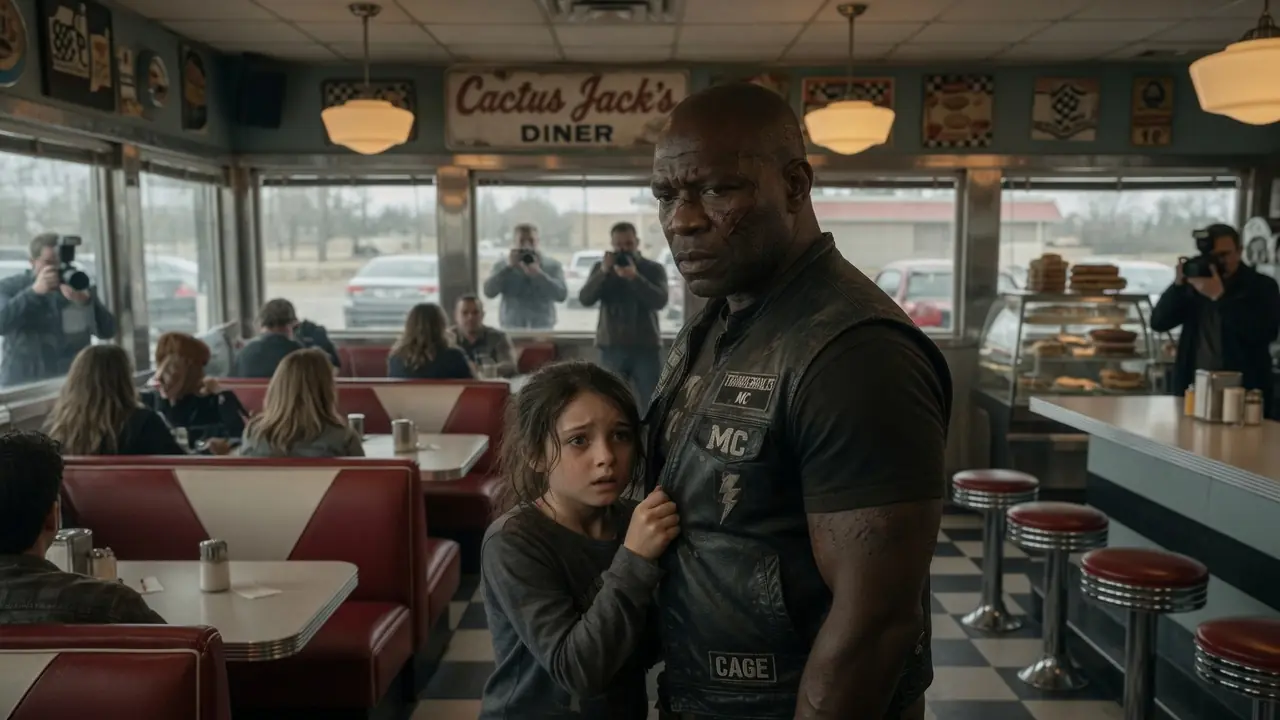
Live stream equipment. The kind of professional skepticism that came from 20 years exposing corruption and watching powerful people destroy evidence. She took one look at the scene and started broadcasting immediately. This is Sutton Blackwell reporting live from Phoenix, Arizona, where approximately 200 armed contractors are currently surrounding a family diner. The target appears to be a federal whistleblower and his six-year-old daughter.
We're going live on all platforms. The world is watching. The view counter climbed. 12,000. 80,000.
300,000. Social media algorithms recognized viral content and pushed it everywhere. News helicopters appeared overhead. Local police arrived, saw the size of the contractor force, and immediately called for backup. FBI.
US Marshals. Arizona State Police. The governor's office demanding explanations. Congressional representatives tweeting outrage. The standoff had gone from invisible corporate assassination to international incident in under an hour.
All because a six-year-old girl noticed wrong shoes and a biker with a dead daughter decided some things mattered more than survival. The contractors couldn't advance. Not with cameras broadcasting to 4.7 million viewers. Not with federal agents establishing perimeter control. Not without creating a massacre that would dominate news cycles for months and expose Vanguard Solutions to exactly the scrutiny they tried to prevent.
The lead contractor received a call. Listened. Nodded. Gave hand signals. The vans began retreating.
Methodical withdrawal, maintaining tactical formation, weapons still ready. But retreating. Marlow watched them go from Cage's arms. She'd been there for 2 hours, pressed against his chest, his heartbeat steady against her ear. Are they gone?
Are we safe? For now, little one. For now. But Cage knew the truth. Men like that didn't give up.
They regrouped. Adapted. Came back harder. This wasn't over. It was just beginning.
FBI Special Agent Vaughn Mercado approached once the vans disappeared. Mr. Kensington, we need to get you and your daughter into protective custody immediately. Can you guarantee their safety? Cage didn't release Marlow. Can you guarantee Vanguard doesn't have people inside your organization?
Mercado's silence was answer enough. Then here's what's happening, Cage continued. Desmond provides you with everything he knows. Every document, every encrypted file, every piece of evidence about Vanguard's surveillance network. And in exchange, the Thunderbolts MC becomes their official security detail.
We protect them. You investigate. And if you've got moles feeding information to Vanguard, they'll have to go through us first. That's highly irregular. So is a private military force trying to murder a witness and his kid in broad daylight.
Cage's voice carried enough edge to cut steel. You want regular? Arrest those contractors. Get warrants for Vanguard's executives. Do your job.
Until then, the kid stays with people who've already proven they'll die for her. The arrangement took 6 days to formalize. Unprecedented cooperation between federal law enforcement and an outlaw motorcycle club. Desmond and Marlow relocated to Boulder, Colorado. Cage quit his enforcer position and moved into their guest house.
Two to three bikers maintained rotating security shifts. Marlow attended school with plainclothes protection nearby. The evidence Desmond released destroyed Vanguard Solutions in 6 weeks. Stock price collapsed. Federal contracts terminated.
17 arrests of embedded personnel across multiple agencies. CEO Garrison Thorne found dead in his mansion, officially ruled suicide, though the ballistics report raised questions nobody seemed interested in answering. When intelligence agencies clean house, accidents happen. eight years passed. Marlow grew from terrified six-year-old to intensely focused 14-year-old.
Straight-A student. Advanced placement courses. Already taking college-level computer science. The FBI approached her for consultation on a counterintelligence case. She identified a foreign spy ring in 48 hours using open-source intelligence techniques.
They wanted to recruit her immediately. Desmond refused. She's 14. She deserves a normal life. But Marlow had never been normal.
Couldn't be normal. Normal died in a diner parking lot when 53 black vans taught her that surveillance wasn't abstract theory. It was men with guns deciding her life had no value beyond leverage. Cage taught her motorcycle maintenance. Combat skills.
The code that separated warriors from murderers. Power without honor is tyranny, he'd say, hands scarred from decades of violence teaching her how to escape violence. You've got power, little one. That brilliant mind of yours. Don't let it make you into what tried to kill you.
He taught her daughter, too. Marlow had named her Yara, after the mother she barely remembered. five years old, bright-eyed, learning to ride a training bike in Cage's patient hands. Clutch slow, throttle steady. Machine respects you when you respect it.
The heart attack came without warning. Massive coronary event. Cage collapsed mid-sentence, hands still on the handlebars, eyes going wide with surprise that death had finally caught him. Marlow performed CPR he taught her years ago, insisting she needed to know, but the paramedics shook their heads before they even checked vitals. Too much damage.
Too fast. He died in the hospital with Marlow holding his hand. You saved me first, he whispered, voice fading. In that diner. Reminded me I could still protect something pure.
Thank you for letting me be your dad. 400 bikers attended the funeral. Clubs from across the Western United States. Full honors. Motorcycle procession stretching for miles.
Marlow delivered the eulogy to a crowd of leather and steel and barely restrained grief. Society called him criminal. I call him my father. He taught me courage isn't the absence of fear. It's protecting others despite your fear.
They buried him next to Iris. He'd purchased the adjacent plot years ago wanting to rest beside the daughter he couldn't save. Marlow turned down every recruitment offer. CIA, FBI, NSA, private sector contracts offering six-figure salaries. She enrolled at Georgetown University.
Pre-law. Goal, privacy rights attorney. I won't become the thing that tried to kill me. She founded the Children's Surveillance Protection Project. Legal defense for families targeted by intelligence overreach.
Funded by the $47 million settlement Vanguard Solutions civil lawsuit. By age 20, she was testifying before Congress on surveillance reform. The hearing room was packed. National broadcast. Millions watching.
Marlow stood at the witness table holding a photograph of Cage. Scarred face. Gentle eyes. The monster who chose protection over violence. I was 6 years old when a defense contractor decided I was acceptable collateral damage, she began, voice steady despite cameras and senators and the weight of memory.
6 years old when I had to learn to identify kill teams instead of multiplication tables. They took my childhood. Made me into a tactical asset because they were watching everyone all the time. And when my father tried to stop them, they decided we should die. She held up Cage's photo.
This man was labeled criminal, outlaw, dangerous. But he's the one who protected me when every official institution failed. Because he understood something our surveillance state forgot. True security doesn't come from watching everyone. It comes from protecting anyone.
The questions came from senators who wanted sound bites and political advantage. But Marlow wasn't interested in politics. She was interested in truth. We've built systems that track every citizen, monitor every communication, create dossiers on children. We call it national security.
But when those systems turn on my family, when they weaponize surveillance into assassination, who protected us? Not the FBI initially. Not the police. Not the government agencies my father worked for. She paused letting the silence build.
Outlaws protected us. Criminals protected us. People society fears protected us. Because they still remember that some things matter more than orders. More than money.
More than power. The hearing room erupted in arguments and cross-talk, but Marlow had said her peace. She walked out past cameras and reporters, past senators scrambling for damage control, past the machinery of power that had tried to silence her father and failed. Years later, in her office at Georgetown Law, Marlow worked on privacy rights cases while Yara played nearby. The wall held photos.
Cage. Desmond. Her mother Yara. The MC brothers who'd stood guard through her childhood. Reminders that heroism wore unexpected faces.
Little Yara arranged her toys by color, the same compulsive organization Marlow had shown at that age. The same need for control in a chaotic world. Marlow watched her daughter and felt pride mixed with dread. Baby, come here. Yara climbed into her lap, small and warm and perfect.
Grandpa Cage taught me something important, Marlow said softly. Some things you need to notice. Dangerous things. Wrong things. But you don't have to live in fear.
You can be aware without being afraid. Strong without being hard. Protected without being alone. Understand? Like how Grandpa Cage protected you.
Exactly like that. They tried to silence a whistleblower by killing his child. Instead, they created the most effective privacy rights attorney in America. They tried to hide their surveillance empire. Instead, a six-year-old exposed them to millions.
They tried to eliminate witnesses. Instead, they united rivals into protectors. Because sometimes the smallest voice carries the loudest truth. Sometimes the most feared people are the most honorable. And sometimes angels wear leather instead of wings.
Marlow pulled Yara closer breathing in the scent of her daughter's hair, feeling the steady rhythm of her heartbeat. Outside, the world continued its surveillance. Cameras watched. Algorithms tracked. Databases expanded.
The machinery of control grinding forward. But in this moment, in this office, a mother held her daughter and remembered a scarred biker who'd chosen protection over profit. Who'd stood between innocent lives and overwhelming force. Who'd taught her that awareness wasn't paranoia and courage wasn't fearlessness. The fight wasn't over.
It would never be over. Vanguard Solutions had collapsed, but a dozen companies had risen to take its place. Surveillance expanded. Privacy eroded. The powerful watched the powerless and called it security.
But Marlow Kensington was watching back. And she'd learned from the best. Her phone buzzed. New case. Family in witness protection, location compromised, contractors closing in.
They needed legal intervention. They needed protection. They needed someone who understood that the system designed to protect witnesses sometimes fed them to wolves. Marlow kissed Yara's forehead. Go play with Aunt Keisha for a bit, baby.
Mommy has work. As she read the case details, her mind shifted into the mode Cage had recognized in that diner 15 years ago. Tactical assessment. Threat analysis. Pattern recognition.
The skills that had saved her life. The awareness that had exposed a conspiracy. The courage that had been forged in terror and tempered by love. They were watching. They were always watching.
But Marlow Kensington was done being afraid. She picked up the phone and started making calls. To lawyers. To journalists. To the network of bikers who still honored Cage's memory by protecting those who couldn't protect themselves.
Building the same wall of defiance that had saved her life. Extending that protection to others who'd stumbled into the crosshairs of power. Because the lesson wasn't that surveillance was evil or that government was corrupt or that corporations were villains. The lesson was simpler and harder. When systems fail, people matter.
When institutions become weapons, communities become shields. When power demands submission, courage says no. One person at a time. One family at a time.
One six-year-old girl who noticed wrong shoes and changed everything. The fight continues. The surveillance expands. The powerful still try to silence the witnesses.
But they have to go through Marlow first. And she learned from a Hells Angels enforcer that some things are worth dying for. Some people are worth protecting. Some battles are worth fighting even when victory seems impossible.