Winslow has a way of keeping old things.
Not in museums. Not in glass cases. It keeps them in the dust that blows across Route 66, in the train whistles that drift over the flatland after dark, in the sun-faded motel signs that buzz even when nobody is staying there. By noon, the wind has already dragged enough grit through town to make every storefront look older than it did that morning.
At three o’clock, all that silence breaks open in front of Desert View Elementary.
Kids spill through the gates with jackets falling off their shoulders, art projects crushed under their arms, lunchboxes swinging against their knees. Parents line up in trucks, SUVs, and dusty minivans. Teachers stand near the curb with tired smiles, waving traffic forward and trying to keep children from running before the crossing light turns.
The yellow light above Ash Street blinks and blinks.
Most people barely notice it anymore.
Then Marcus Boone shows up.
You hear the motorcycle before you see him. It comes from the east side of town, past the closed motel office and the tire shop, rumbling low like a storm trapped under the road. It is not loud in a show-off way. It is steady. Heavy. Impossible to ignore.
Every school day at 3:06, Marcus pulls his Harley to the curb.
He kills the engine.
For a second, the quiet feels bigger than the noise.
Then his boots touch the pavement.
Heavy black boots. Black gloves. Black helmet. Black leather vest. On the back of that vest is a faded patch from a small riding club nobody in town takes too seriously until they need something fixed, carried, donated, or buried.
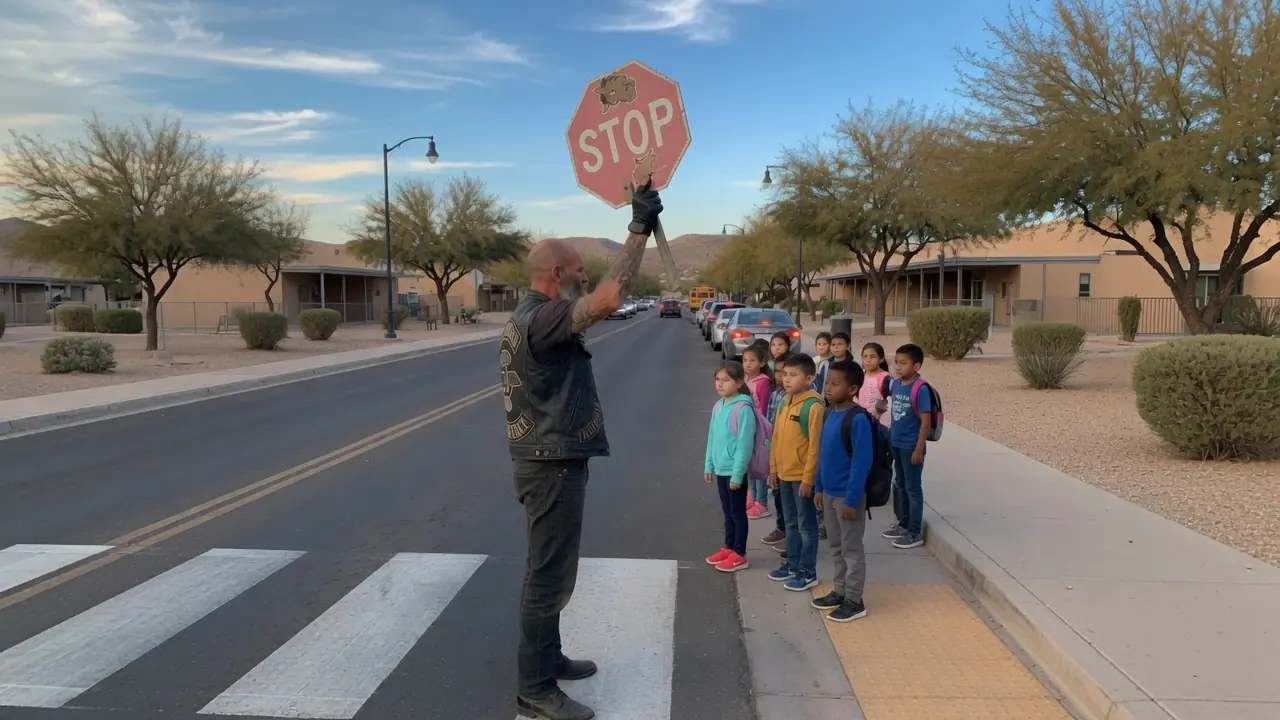
Marcus reaches into his saddlebag and pulls out a little pink stop sign.
The sign is chipped around the edges. A glittery horse sticker curls up at one corner. It looks like it belongs in a kindergarten classroom, not in the hands of a scarred biker with gray in his beard and tattoos running down both arms.
At first, people called him strange.
Then they called him dangerous.
By spring, even the impatient drivers started slowing down before they reached the crosswalk.
Marcus did not talk much to the kids. He was not the smiling volunteer type. His face looked like it had been shaped by heat, metal, and years of swallowing words before they could do damage.
But he watched them.
He counted every child who crossed.
One.
Two.
Three.
Four.
His eyes never rested long. He watched bumpers, tires, mirrors, phones in drivers’ hands, brake lights, windows, faces. He watched the road like he trusted children but not the world around them.
He never yelled.
He never slapped a hood.
He never pulled a child by the arm.
He simply stepped into the street before they did and stood there until they were safe.
That was what made him hard to explain.
My name is Lydia Mercer, and my daughter Annie was in third grade at Desert View that year. Like most mothers, I asked questions. In a town like Winslow, questions do not always get full answers, but they usually loosen something.
Marcus Boone had worked at a welding shop outside town for most of his adult life. His riding club called him Brick, because the story went that once, years ago, a piece of hot slag burned through his sleeve and he finished the job before he looked at the wound.
He rode with the Painted Desert Kings.
They were not famous. They were not one of those clubs people whisper about on television. They were thirteen old riders with bad knees, loud bikes, unpaid child support, worn-out marriages, and a strange habit of showing up when somebody needed a roof patched, a funeral escorted, or a truck pushed out of sand.
Marcus was not innocent.
Nobody who knew anything about him pretended otherwise. He had been arrested twice in his younger years for driving drunk. He had spent a short stretch in county jail after a fight behind a bar left a man eating soup through a straw. He had an ex-wife in Flagstaff who would not speak his name unless she had to, and a son somewhere in Nevada who answered his calls only on birthdays.
So Marcus Boone was not the kind of man people put on posters.
He was just a hard man standing in a school crosswalk with a pink sign.
And there was something else.
On the front right side of his leather vest, below the smaller club patch, there was a dark stain. Brown. Uneven. Shaped almost like fingers had dragged downward across the leather before drying there forever.
Maybe grease.
Maybe something from the welding shop.
Marcus never corrected them.
But every afternoon, before the bell rang, he touched that stain with two fingers.
Just once.
Then he stepped into the street.
I noticed it because mothers notice marks that do not belong. We notice stains on sleeves, backpacks, seat belts, sidewalks. We notice what other people learn to look past because looking too long makes them uncomfortable.
One afternoon, after Annie’s soccer practice, I drove past the old loading dock near the feed store where Marcus rented a small room and garage. The garage door was halfway open. I saw blue sparks jumping from a grinder. A brown dog slept in the shade with one eye open.
On the wall beside his workbench hung a child’s crossing vest.
Bright orange.
Tiny.
Too small for him.
I slowed down without meaning to.
Marcus looked up and saw me looking.
He lowered the garage door.
Not angry.
Frightened.
That was when I understood there was a story under all of it.
The second sign came on a Thursday in late April.
The day had that dry Arizona heat that rises off the asphalt before summer has officially arrived. The wind was dragging loose worksheets across the grass, and the children were louder than usual because testing had ended that morning. They came out of the building wild with relief.
Freedom makes children forget streets have teeth.
Marcus arrived at 3:06.
The same rumble.
The same silence.
The same boots.
The same pink sign.
My daughter stood next to me holding a paper turtle she had painted purple. She looked toward Marcus and whispered, “Mom, why does that motorcycle man always look so mad?”
I almost said, “Because some people are just mad.”
But I knew that was wrong.
Marcus did not look mad at the children.
He looked mad at anything that might touch them.
The truck came from the west.
A white Chevy with a ladder rack, dusty windshield, and a man in sunglasses behind the wheel. He was not swerving. He was not drunk. He was just going too fast in that ordinary careless way people do when they believe their hurry is more important than someone else’s life.
Marcus saw him first.
His head turned.
His shoulders tightened.
Three children had already stepped off the curb, one of them laughing so hard he was dragging his backpack behind him by one strap.
Marcus moved into the street.
Not smoothly.
Not like a young man.
More like an old injury suddenly forced to run.
He planted himself in the lane and lifted the little stop sign against his chest.
The truck braked.
The tires screamed so loud every child on the sidewalk went still.
The Chevy stopped a few feet from Marcus’s knees.
Dust rolled over his boots.
Nobody breathed.
Then the driver leaned on the horn.
One long, ugly blast.
Marcus did not move.
The children jumped back to the curb.
The driver threw his door open and stormed out.
“What is your problem, old man?”
Marcus lowered the sign.
His hands were trembling.
That is what stayed with me. Not the size of him. Not the tattoos. Not the truck. His hands. They shook like something inside him had been waiting for this exact sound for years.
The driver kept yelling.
He said he was late. He said Marcus had no authority. He said Marcus was blocking traffic. He said things men say when they know they were wrong but would rather get louder than get honest.
Marcus said nothing.
A teacher called the police.
A father across the street started recording.
Children watched through the fence with round, frightened eyes.
Then the driver slapped the pink stop sign out of Marcus’s hand.
It hit the asphalt and skidded.
That was when everyone expected Marcus to become the man they had imagined him to be.
His right hand closed into a fist. His jaw tightened. His chest rose under the leather. For one short second, I saw every rumor in town standing there with him.
Then Marcus looked down at the sign.
The glittery horse sticker had scraped white against the pavement.
He opened his fist.
Slowly, he bent down, picked up the sign, and walked it over to a little boy crying near the curb.
“Hold this a second, buddy,” Marcus said.
His voice was rough.
But soft enough not to scare him.
The boy took it with both hands.
Marcus turned back to the driver.
“If you’re late,” he said, “then be late alive.”
The police arrived a few minutes later.
Deputy Russell Haines knew Marcus by name. That seemed important, though I did not understand why yet. He spoke to him quietly, trying to get him out of the road.
Marcus refused.
The driver demanded charges.
Parents whispered.
The principal, Mrs. Talbot, hurried out with a radio in her hand and a face that had lost all its color.
Marcus stayed on the white lines.
Deputy Haines finally wrote him a citation for obstructing traffic. I remember Marcus taking the ticket, folding it without looking, and sliding it into his vest pocket like it weighed nothing.
Then he turned toward the children.
“Come on,” he said.
And they crossed.
That could have ended the whole thing.
Winslow might have argued for a few days. Some would call Marcus brave. Others would call him a problem. The driver would tell his version at the hardware store. The principal would promise to review school safety procedures. Then the town would move on, because towns are very good at moving on when the pain is not parked in their driveway.
But a woman had been sitting in a blue sedan across the street the entire time.
She had not recorded.
She had not shouted.
She had not moved during the argument.
She was a Black woman in her thirties, slim and tired-looking, with both hands gripping the steering wheel. In the back of her car, I could see a folded wheelchair.
When the last child reached the other side, she opened her door.
And Marcus Boone, who had not stepped back for a truck, went completely still.
Her name was Tasha Bell.
Everyone in Winslow knew her son’s name.
Eli Bell.
Three years earlier, Eli had been seven years old and in second grade at Desert View Elementary. He was quick, funny, and missing both front teeth. He wore one red shoe and one blue shoe because he told people matching shoes were boring.
On September 18, Eli stepped into that same crosswalk after school.
A woman driving an SUV rolled through the blinking light.
She was not drunk.
She was not evil.
She was looking down at her phone.
The SUV hit Eli hard enough to throw his little body across the lane.
That was the part people whispered about.
The part most people stopped saying was what happened next.
Marcus had been at the gas station on the corner, filling his bike. He heard the impact. He heard the scream. He dropped the nozzle and ran.
He reached Eli before the teachers did.
Before the ambulance.
Before Tasha, who was stuck four blocks away behind a stopped freight train.
Eli was on the asphalt with his backpack ripped open beside him. Crayons had spilled everywhere, bright little sticks rolling in the dust. His cheek was pressed against the burning road, and blood was pooling beneath him.
Marcus did what people tell you not to do unless there is no other choice.
He lifted the boy.
Not because he thought he was a doctor.
Because he could not leave a child face-down on hot pavement.
He held Eli against his chest until the ambulance came.
The blood soaked into the right side of his vest.
That was the stain.
Not grease.
Not oil.
A child’s blood.
Dried into leather because some afternoons do not end when the sun goes down.
Tasha walked toward Marcus slowly.
The whole street seemed to lower its voice.
Even the angry driver stopped talking.
Marcus’s face changed. The hardness did not disappear exactly; it fell apart. What was left behind was older than sadness. It was guilt that had learned to stand upright and pretend to be duty.
Tasha stopped in front of him.
“You were there,” she said.
Marcus looked down at the street.
“Yes, ma’am.”
“You were the man who held my son.”
“Yes, ma’am.”
“I never knew your name.”
“Marcus.”
She looked at the motorcycle, the little pink sign, the ticket sticking out of his pocket, the children now safe behind the fence.
Then she asked him the question nobody else had been brave enough to ask.
“Why do you keep coming back here?”
Marcus swallowed.
He did not look at her.
“Because I was here when it happened.”
Tasha shook her head.
“That is not why.”
Marcus touched the stain.
Two fingers.
Once.
“Blood don’t wash out of leather the way people think.”
Tasha stared at his vest.
At the dark mark under the patch.
At the shape that suddenly meant something terrible and holy.
Her face folded.
“Oh, Lord.”
Marcus’s voice dropped lower.
“I tried once,” he said. “Couldn’t get it out.”
Tasha covered her mouth with both hands.
For three years, she had thought Winslow remembered Eli as a bad thing that happened near the school. A safety meeting. A hospital update. A name spoken softly for a few months before people went back to speeding through Ash Street.
But Marcus had carried proof.
Every day.
Right over his heart.
Tasha whispered, “I thought people forgot him.”
Marcus finally looked at her.
His eyes shone, though no tears fell.
“Ma’am,” he said, “your boy’s been riding with me every day.”
Nobody knew where to look after that.
Mrs. Talbot cried into her hand near the school gate. Deputy Haines took off his sunglasses and stared down the road. The pickup driver got into his truck quietly and shut the door like he was afraid to make another sound.
Tasha looked at the stain for a long moment.
Then she reached toward it and stopped.
“May I?”
Marcus nodded.
She touched the mark with two fingers.
Not like she was touching leather.
Like she was touching the last place her child had been held before sirens arrived.
“My son is alive,” she said suddenly, as if the town needed to hear it. “He is alive. He is at therapy right now, and he hates every minute of it. Last week he threw a foam block at the wall and told the therapist her office smelled like wet crackers.”
A laugh came out of her.
It broke into a sob halfway through.
Marcus’s mouth moved almost into a smile.
“Sounds like a fighter.”
“He is.”
She wiped her face.
“But he thinks everyone remembers only the accident. He thinks nobody remembers who he was before the wheelchair.”
Marcus looked down.
“I do.”
That was when Deputy Haines told us the rest.
Marcus had helped pay for the newer crossing lights.
Not alone. Not officially. But through the Painted Desert Kings. Two years earlier, when the town council delayed upgrading the crossing because funding was “complicated,” Marcus and his club organized a ride from Winslow to Holbrook and back.
They called it the Slow Roll for Eli.
No cameras.
No speeches.
Just donation jars at the diner, helmets passed through the crowd, old riders pulling folded bills from worn wallets, and people giving money because grief needed somewhere to go.
That money went into a safety fund.
The town added a grant later.
The brighter lights went up.
But cars still came too fast.
So Marcus stood there.
The tiny orange vest in his garage was not the original one Eli had worn. It was a replacement from the school supply closet. Marcus had asked for it after the accident and hung it near his workbench where he would see it every morning before leaving the house.
His club had tried to stop him at first.
They watched him lose weight that first year. Watched him stop sleeping. Watched him park his bike after school and sit in the garage for an hour with his helmet still on.
One of the riders, Owen “Preacher” Voss, finally told him, “You can’t keep paying for a wreck you didn’t cause.”
Marcus punched the garage wall hard enough to split his knuckles.
Not because Owen was wrong.
Because part of him was.
The club nearly dragged him away from the crosswalk by force.
Then the oldest rider, Rafael Ortega, said, “If he has to stand there, then we stand close enough that he doesn’t disappear.”
After that, one rider sat in the diner every afternoon with a view of Ash Street. Another drove past at 3:20. Owen started leaving cold water in Marcus’s saddlebag when summer came.
Brotherhood does not always sound gentle.
Sometimes it sounds like men arguing in a garage because they refuse to let grief become a grave.
Tasha listened without moving.
Then she asked, “Have you seen Eli since that day?”
Marcus shook his head.
“No, ma’am.”
“Why not?”
His jaw tightened.
“Didn’t think I had the right.”
Tasha stared at him.
“You held my son until help came.”
“I held him after I failed to stop the car.”
“You did not hit him.”
“I heard it happen.”
“That is not the same.”
“It is in my head.”
The sentence landed without drama.
That made it worse.
Tasha understood then.
So did the rest of us.
Marcus had put himself on that crosswalk like a sentence.
No court.
No judge.
No end date.
Tasha stepped closer.
“You want to know what Eli remembers?”
Marcus did not answer.
She said, “He remembers leather. Gasoline. Your beard scratching his face. And somebody saying, ‘Stay with me, little brother.’ He does not remember the car. He remembers you.”
For one second, Marcus’s face broke.
Only one.
Then he looked away, ashamed to have been seen.
Tasha pulled out her phone.
Her hands trembled as she opened a picture.
Eli was ten now. He sat in a wheelchair near a basketball hoop, grinning like trouble had just asked permission to enter. One red shoe. One blue shoe. Still mismatched. Still Eli.
Marcus stared at the screen.
“He got big,” he whispered.
“He wants to meet you.”
Marcus stepped back like she had offered him fire.
The big man with tattoos and a bloodstained vest suddenly looked afraid.
Tasha held the phone out again.
“Not today if you cannot do it today,” she said. “But do not keep standing here thinking my son forgot you.”
The schoolyard had emptied by then.
The bell was no longer echoing.
For the first time in three years, Marcus Boone was standing in the crosswalk with no children left to protect.
He was standing there because somebody had finally come back for him.
The next week, Marcus returned at 3:06.
Same motorcycle.
Same silence.
Same boots.
Same pink sign.
But the town did not see him the same way anymore.
Parents stopped complaining about traffic. Some parked farther back so cars would not crowd the crossing. Mrs. Talbot put orange cones near the curb. Deputy Haines still drove by sometimes, but his ticket pad stayed inside the patrol car.
On the second Thursday in May, the Painted Desert Kings arrived.
Thirteen motorcycles rolled in from the east, slow and steady. Not loud enough to show off. Loud enough to remind every driver that the road had witnesses.
They parked along the shoulder.
Their engines ticked in the heat.
Marcus looked irritated.
Which meant he was grateful.
Owen handed him a bottle of water.
“Don’t start,” Marcus said.
“I didn’t say anything.”
“You were thinking something.”
“Always am.”
The children loved the bikes. The teachers looked nervous until the riders took off their gloves and started carrying backpacks, tying shoes, and helping kids find the right cars.
One old rider with a white beard let a first grader put a glitter sticker on his helmet.
He rode home with it still there.
That same afternoon, Tasha brought Eli.
Marcus saw the van before anyone else did.
His whole body stiffened.
Tasha lowered the ramp, and Eli rolled down backward, fast and confident, older than the photograph in everybody’s memory. His wheelchair wheels were scuffed. A sticker on the side said STILL FASTER THAN YOU.
He wore one red shoe and one blue shoe.
Marcus did not move.
Eli rolled right up to him.
“You the guy who stops cars?”
Marcus swallowed.
“Yes, sir.”
Eli looked at the Harley.
“That bike yours?”
“Yes.”
“Nice.”
Marcus blinked like he had expected a harder question.
Then Eli looked at the pink sign.
“That sign is ugly.”
A sound almost like a laugh came out of Marcus’s chest.
“A girl named Mia decorated it.”
“She needs help.”
“She’s seven.”
“Still needs help.”
Tasha laughed through tears.
Marcus looked like breathing had become complicated.
Then Eli’s eyes moved to the vest.
To the stain.
“My mom says that’s mine.”
Marcus kept both hands at his sides.
“Yes.”
“You kept it?”
“Yes.”
“Why?”
Marcus looked down at him.
Three years passed through that pause. The hot road. The sirens. The donation ride. The orange vest in the garage. The afternoons spent standing where time had broken open.
“Because I couldn’t set you down and walk away twice,” he said.
Eli did not cry.
Children often know how to survive a truth better than adults do.
He simply nodded.
Then he held out his fist.
Marcus stared at it.
Owen muttered from behind him, “Don’t leave the sheriff waiting.”
Marcus bumped Eli’s fist with knuckles scarred by work, age, and old mistakes.
After that, Eli came every Thursday.
Not to be pitied.
To supervise.
He sat near the curb and shouted at speeding cars like he had been elected mayor of Ash Street.
“Slow down, genius!”
Marcus pretended to scold him.
Tasha pretended not to hear.
The crosswalk changed after that.
It was not exactly a memorial anymore.
It was something stranger.
A wound learning how to stand in daylight without bleeding every time someone looked at it.
Every afternoon before stepping into the street, Marcus still touched the stain.
But now, sometimes, Eli touched his own chest back.
By the end of the school year, the town repainted the white lines across Ash Street. The principal organized a safety day. The mayor showed up for pictures. The local paper wanted Marcus in the center.
He refused.
“Put the kid there,” he said.
So they did.
Eli sat in the middle of the photograph, one red shoe and one blue shoe, grinning like he had stolen something important back from sorrow. Tasha stood behind him with both hands on his shoulders. Marcus stood off to the side, half out of frame, arms crossed, looking uncomfortable enough to be believed.
The article called him a hero.
He hated that.
“Heroes get to go home clean,” he told me once.
It was the most he ever said about it.
That summer, after the last school day, I saw Marcus alone at the crosswalk.
No children.
No parents.
No traffic.
Just him, his Harley, and the heat rising in waves off the pavement.
The pink stop sign leaned against his leg.
His engine ticked softly behind him.
He reached for the stain.
Two fingers.
Once.
Then a van pulled up.
Eli rolled down the ramp wearing those mismatched shoes. Tasha followed with a folded piece of cloth in her hand.
She handed it to Marcus.
It was a new patch.
Black background.
White letters.
NO KID WALKS ALONE.
Marcus stared at it for a long time.
Then he took off his leather vest and let Tasha pin the patch above the old brown stain.
Not over it.
Never over it.
Above it.
Because some memories should not be hidden.
They should be carried differently.
When Marcus finally started his Harley, the sound rolled low across Route 66. His red taillight moved past the school, past the diner, past the intersection that had held him in place for three years.
This time, before he rode away, he looked back once.
Then he kept going.