London, October 1874. The city doesn't wake up, it simply stops sleeping. By 5:00 in the morning, Whitechapel is already on its feet. The smell of coal and stale bread fills the alleyways before the light does. Seamstresses spill out with baskets on their arms, heads down, hands still half asleep inside thin gloves.
London has two faces, gilded and gaslit, and neither one is honest. Clara Garrard knew both. She'd been born on the gilded side. She'd landed on the other when her father died and the debts appeared, debts no one had thought to mention while there was still tea and pleasant conversation. The Garrard name still existed, the dowry did not.
And London is not particularly kind to women who have one and not the other. So, Clara sewed. She delivered orders herself through the shortest alleys, always calculating distance, weight, time, how much rent was still owed. What she hadn't calculated was that October goes dark faster than September. The alley between Covent Garden and Aldgate Street saved 20 minutes.
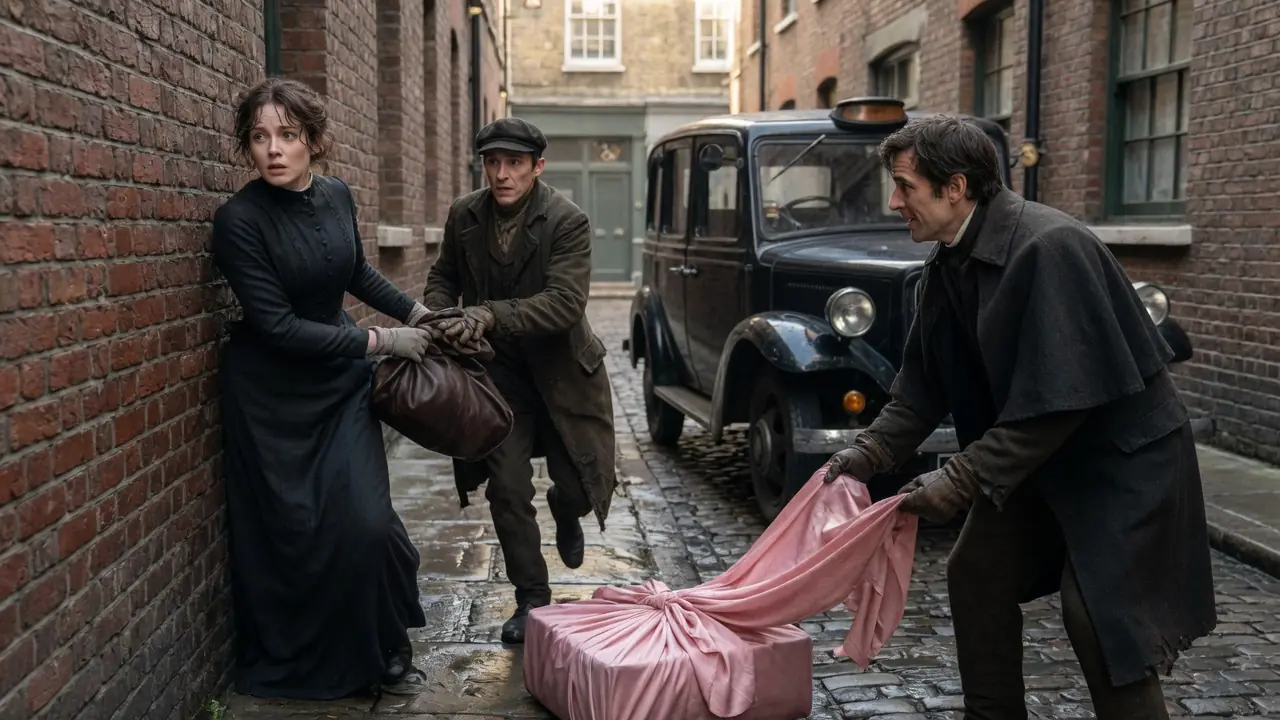
At 4:30 in the afternoon, it had no witnesses. The first man came from the left. She didn't see him. She felt him. The yank on her bag was so sudden that the leather strap cut into her wrist before she understood what was happening.
A month's payment. She closed both hands around the strap without thinking. Pulled back. The second shove didn't come from the bag. It came from an open hand against her shoulder, hard, fast, and the world spun before she could brace herself.
Her back hit the brick wall with a sound she heard more in her bones than in her ears. The silk parcel fell. The bag vanished. Both men vanished with it. She stood still.
Her shoulder throbbed. The pink silk parcel lay in the gutter. Three weeks of work. She breathed, closed her eyes, opened them, and then she heard footsteps, quick, heavy. A hackney cab had stopped in the middle of the street.
The driver had climbed down before the carriage had fully stopped and was crossing the road with the urgency of someone who doesn't stop to ask whether he should intervene. The two men saw him, disappeared. The coachman stopped two paces from her. He was tall, shoulders that took up space the way most tall men's don't. Not arrogance, just presence.
Dark brown hair disheveled from running, and he was looking at her with an attention that had nothing evaluative about it. Direct, quiet, like someone reading what needs to be done. First, he looked at the gutter, then at her. Then he turned back to the silk parcel, crouched down, and picked it up carefully. The specific carefulness of someone who recognizes that a thing has value without needing to be told, and held it out to her.
Clara took it, checked for damage. There was none. Only then did she notice that her hands were trembling slightly, enough that she pressed them together before he could see. He saw. He said nothing about it.
He simply waited. "Thank you," she said. Her voice came out quieter than she'd intended. "Truly, you didn't have to get down." "Yes, I did. "Said with such plainness that she stood there looking at him, not quite sure what to do with a sentence that asked for nothing in return.
"Your shoulder," he said. "How is it?" "Fine. "A pause. "Probably fine." "Probably isn't the same as yes." She laughed. She didn't plan to, didn't stop to check if it was appropriate.
She laughed, small, genuine, the kind that escapes before you decide to let it, and was surprised at herself, as if the laugh had come from somewhere she'd kept closed for a long time. "No," she agreed. "It isn't. "There was something at the corner of his mouth, not quite a smile, more the possibility of one, as though he was waiting to be sure she was all right before deciding whether any of this was funny. "I can take you wherever you're going.
I pass through here anyway. "The hesitation came automatically, the reflex of someone who'd learned that freely offered kindness was rare enough to warrant scrutiny. He noticed. He didn't repeat the argument. He simply stood there waiting.
"Aldgate Street," she said. "Number 14." "I know it." He opened the cab door and stepped back, giving her room. She climbed in. She felt the bench shift slightly when he returned to the driver's seat. The hackney began to move.
William looked at the road ahead, then looked quickly, almost involuntarily, at the side mirror reflecting the back seat. She was in profile. Dark brown hair pinned up without ceremony, a few strands loose at the sides. Her chin slightly lifted. Her hands, needle marks on her fingers, he noticed, and then felt vaguely unsettled for having noticed, folded in her lap with too much care, as if she were holding something she didn't want to drop.
She was beautiful, not in the way the West End defined beautiful. She was beautiful the way some people are without knowing it. Something in the amber eyes that noticed everything. Something in the mouth that always seemed on the verge of saying something more honest than the moment called for. He looked back at the road.
This was not what he'd come to Whitechapel to find, but he was finding it anyway. When they reached number 14, she stepped down and stood on the pavement. "Thank you," she said. And then," I'm Clara Garrard." He looked at her for a moment." William Cole," he said. William Cole.
Tuesdays and Thursdays, addresses in the West End. The silence between them comfortable in the way that silences rarely are with people you've only just met. He didn't ask unnecessary questions. When he did ask something, he wanted to know the answer. "What's the hardest delivery you've ever made?" he asked one afternoon, stopped in Belgravia.
"Hard how?" "The kind where you really needed to." She thought about it genuinely and told him about Christmas Eve 2 years ago. The hatbox carried four blocks through the snow, arriving at the servants' entrance at 7:00 in the evening with soaked feet, and the client had said, "You're late"without looking up at her. "What did you say?" "That the hats were in perfect condition." "You have a lot of patience for people who don't deserve it." "I have bills to pay. It's different from patience." He was quiet for a moment. "Maybe," he said.
"But it wouldn't be for everyone." She didn't know what to do with that, so she looked out the window and pretended she hadn't quite heard. He didn't repeat it, but he had said it. The rain came hard one afternoon, the kind that gives no warning and offers no apology. They were stranded under the awning of a closed shop waiting for the storm to pass, both of them soaked through. "Was the delivery made?" "It was." "Then everything's fine." "You're very optimistic for someone who works the streets of London." "I've learned that most problems that feel urgent in the rain feel smaller once it stops.
And the ones that don't, those I worry about once it stops. "There was a logic to that, simple enough to be true. The conversation opened on its own without either of them forcing it. She told him more than she'd intended about the houses where she delivered, about the women who ordered dresses she could never wear, not with bitterness, with the quiet humor of someone who lives in the space between two worlds. "You laugh too little for someone with so much to observe," he said.
"How do you know I observe?" "Because you noticed the hem on the client's coat was wrong before you went inside. "A pause. "And you smiled before you knocked on the door, as if you already knew you'd have to pretend you hadn't seen it." "You noticed, too." "I notice things, but you smiled." She looked across at the lit shop window on the other side of the street. "That mannequin there looks exactly like Mr. Pemberton from number 18, same expression of someone thinking about something else but pretending to pay attention." William looked and laughed, genuinely, briefly, surprised. She kept that sound with her for a while after the rain stopped.
William watched her while she straightened the parcel. There was a strand of hair loose at the side of her face, escaped from the arrangement, and she hadn't noticed. He noticed the strand, stayed quiet, said nothing. There were things he was noticing with a frequency that was becoming impossible to ignore. When the rain stopped, they both realized it at the same moment.
The silence afterward wasn't one of relief. It was the silence of someone doing something pleasant who has just discovered it needs to end. The cobblestones were treacherous after a morning of rain. Clara was stepping down from the cab, parcel on her arm, already thinking about the next client, when her foot slipped. She didn't fall.
William's hand closed around her arm before that, firm, fast, without hesitation. She steadied herself. They stayed like that for a second longer than necessary, him still holding on, her hand on his arm without having noticed when it had landed there. She looked at her hand on his arm. Then she looked at him.
He was looking at her, not at the hand, at her. And there was something in that look that was different from all the others. Not the usual quiet attention, something more direct, closer. He didn't let go. She didn't move her hand.
For a moment, two, three, neither of them did anything. The street carried on around them as though nothing was happening, which was technically true and entirely false at the same time. He let go slowly. "Thank you," she said. Her voice came out different than usual.
"Again, you're developing a pattern of needing to be rescued on rainy days. It's a character flaw. I'm working on it." He smiled, a real one this time, a smile that changed his whole face for just a moment. She went inside the delivery house with her arm still warm where he had held it. He stayed outside with his hand still faintly closed.
She knew this because she looked out the window. She hadn't planned to look out the window. Christmas Eve brought Lord Gerald Garrard. Clara had made a delivery on Grosvenor Street and was coming down the front steps when she spotted the coupe parked across the road. She'd recognize the man climbing out before she recognized the carriage.
Gerald was a distant cousin of her father's. Distant enough that no one had taken him seriously while her father was alive, but close enough that the lawyers had found him quickly after he died. He'd inherited what remained of the Garrard name with the speed of someone who'd been waiting. He was 32, possessed the kind of presence you learn at expensive schools, and had the particular talent for appearing at precisely the moments when Clara was least prepared to deal with him." Clara," the tone of someone who encounters someone but isn't very surprised. "What a coincidence.
"It was not a coincidence. Gerald didn't believe in coincidences. He believed in timing. William had climbed down from the cab when he saw her stop. Gerald looked at him slowly with the kind of expression a man uses when looking at something he considers beneath comment, but intends to comment on anyway.
"I see you've found transportation suited to your current circumstances. "A calculated pause. "It's a shame that someone with your background should have to rely on services of this kind. Your father would have worried, Clara. "As if Gerald had any right to that word.
Clara's father had left debts and a name. Gerald had kept the name and left her the debts. Clara felt her shoulders straighten automatically." Gerald," she said, "this man has more character in a single work day than you've managed to accumulate in your entire life. "A pause. "Good day." She didn't wait for an answer.
She walked back to the cab, settled the empty parcel in her lap and looked straight ahead. "We can go." He went. Neither of them spoke on the way back. William held the reins tighter than he needed to. She had said, "This man has more character," without knowing who he was, without anything to gain, without stopping to check whether she'd done the right thing.
The distance between them on the bench felt smaller than it had before. The new year passed. The cold stayed. There was one afternoon when Clara had finished her last delivery and was coming down the steps when she realized she was smiling. Not because of the client, but because of what came next.
The cab at the corner. William waiting. The ride back that had become the most comfortable part of her week without her ever having planned for it to be. She stopped on the last step. This was a problem.
It wasn't that she didn't know what she was feeling. The problem was that she did. He was a coachman. She was a seamstress with her dead father's debts. The world had specific ways of handling the two of them together and none of them were kind.
She stepped down from the last step and went anyway. That afternoon, on the way back, night had closed in early and the cab's lanterns made swaying circles of light in rhythm with the horse. She was tired and somewhere along the route without noticing, she'd tilted her head slightly. Not much, just enough that her shoulder was closer to the backrest. The kind of thing the body does when it's tired and feels safe.
Safe. She straightened her head immediately, but it was too late. She had noticed and he, she could tell from his back, from the ease in his shoulders, had noticed that she'd noticed. The silence that followed had a different weight than all the others. When they arrived, he climbed down and opened the cab door.
She stepped out. They stood on the pavement in front of her building, the street lamps coming on one by one." Clara," he said. She looked at him. There was something different about him in that moment, something she hadn't seen before, or had seen but hadn't let mean anything. He was looking at her with an expression that wasn't his usual quiet attention.
It was more direct, closer. "There's something I need to tell you," he said. Her heart did something inconvenient. "Then tell me," she said. He was quiet for a second.
Two. "I can't yet," he said finally. "But I need to." She stood looking at him. There was something in that sentence, not the hesitation, but the honesty of the hesitation, that she couldn't find a way to dismiss. "When you can," she said slowly," I'll listen." He nodded.
She climbed the steps. At the door, she turned. He was still there, looking up at her. She went inside. She stood on the other side of the door for longer than she cared to calculate.
The Richmond delivery was far, a full day's work. William waited while she worked inside the house. When she came out at 4:00 in the afternoon, he was in the side courtyard leaning against the carriage wheel reading. She stopped. A philosophy book, not the newspaper.
Philosophy. He looked up, saw her looking at the book, closed it without comment. "Ready?" he asked. "Ready," she said. The ride back from Richmond took over an hour.
Dark fell halfway through. The cab's lanterns lit the road ahead and there was something about that hour, the isolation, the darkness of the countryside before the city, that made the silence between them different from all the others. At some point, she said, "Philosophy." He didn't pretend not to understand. "Yes." "Coachmen don't usually read philosophy while they wait. "A pause.
"No," he agreed. "They don't." She looked out the window at the dark countryside passing by." William Cole," she said slowly," I don't know who you really are." He was quiet for a long moment. "No," he said, "you don't." "But I think I'd like to. "Silence. He turned his head slightly, not enough to see her, but enough that she knew he'd heard every word.
They reached London without either of them saying anything more about it, but something was different in the air between them, closer, more real than it had been when they'd set out that morning. It was on a night after a delivery that ran late. The client had delayed everything and by the time Clara came down the steps, it was dark and cold, the kind of winter night that settles into your bones. William had waited two hours past what they'd agreed without a word of complaint. She walked up to the cab and stopped.
"You waited too long," she said. "It was nothing. "It wasn't. She stood on the pavement looking up at him. "Thank you, William." He climbed down from the seat, stood in front of her less than a step away, too close to be casual, too far to be anything else." Clara," he said in a voice she hadn't heard from him before, lower, more direct.
She didn't step back. He raised his hand slowly, like someone leaving time to be stopped and touched her face. Just his fingertips at the side of her jaw, as if he were checking that she was real. She closed her eyes for half a second. When she opened them, he was looking at her with that expression she'd seen that night on the pavement, more direct than he usually let himself show, closer than was safe.
"There's something I need to tell you," he said again," and I can't." "Then don't," she said. Her voice came out quieter than she'd intended. "Not now." He tilted his head. His forehead touched hers lightly. One second, just one, before he found her mouth.
It was not a hesitant kiss. It was the kiss of someone who had waited too long and had decided to stop waiting. Firm, warm, one hand still at the side of her face and the other finding her waist as if it knew exactly where it was going. She put her hands on his coat without thinking, without checking whether it was right, because there are things the body decides before the rest of you has a chance to weigh in. When they stopped, both of them stayed in the same place, close enough that she could feel the warmth of him in the cold of the night." William," she said.
"I know," he said. "I know." She didn't know what he knew, but there was something in the way he said it, with a weight that didn't belong to the kiss, that she kept without examining. He helped her up, drove her home. At the door, he held her hand for a moment before letting go. She went inside.
She stood on the other side of the door smiling at it like someone with absolutely no intention of stopping anytime soon. The day everything came apart arrived without warning. The delivery was in Mayfair, iron gate, marble steps. William waited outside. When Clara came out, a group of gentlemen was approaching along the pavement.
She barely paid attention. She had her notebook in hand until she heard the voice. "Good God." "Harrow. "The gentleman had stopped in the middle of the pavement staring at the driver's seat of the cab with the expression of someone who cannot organize what he's seeing." William Harrow." "The Duke of Harrow is working as a hired coachman in Mayfair." Clara stopped. The man was staring at William, at the coachman's clothes, at the hired hackney, with the particular disbelief of someone who has just witnessed something that makes no sense whatsoever.
A duke with one of the oldest titles in England dressed as a working man driving a cab through the streets of London. "Harrow." "What the devil is going on? What are you doing out here dressed like that? "William had gone completely still on the driver's seat. William, who had not denied it.
He turned his head very slowly to find her eyes, and on his face was the expression of someone caught by a truth he had been trying to delay. Not surprise, not denial. The quiet weight of someone who had known this moment was coming and hadn't managed to make it better before it arrived. Clara stood on that pavement while everything rearranged itself at once. The man who drove a hired cab in Whitechapel, the plain clothes, the room in the tenement he'd mentioned once in passing, the philosophy book in his pocket, the I worked in estate management, the I can't tell you.
He had been pretending. He had been pretending from the very first day, and she had kissed this man two days ago without knowing a single thing. "The Duke of Harrow," she said. It wasn't a question. The silence confirmed it.
"How many times," she said in a voice that was very quiet and very controlled," how many times did I say something real to you while you knew it was all built on a lie? "He started to climb down from the cab." Clara." "No. "One step back. "Not now." He stopped, and she walked away. She didn't run. She walked at the same pace and with the same posture she'd carried through two years of pavements, but there was something different about this walk, which was the awareness that the man who had kissed her two days ago was not who she'd believed him to be, and that she had let him in anyway without knowing.
William stood on the pavement with the reins in his hand. She wasn't furious that he was wealthy. She was furious at having been the only one who didn't know, at having kissed someone who had chosen not to be honest with her. The note he sent three days later went unanswered. "I would like to explain if you'll give me the opportunity." She didn't reply.
He took the silence as a definitive answer. He gave up the room. He returned to Harrow House carrying the heavy feeling of someone dismantling something he had finally found. Clara had not taken the silence as surrender. She had taken it as the usual language of men with means, the initial attempt, and then the retreat once it becomes clear that things won't be simple.
He'd given up easily. That thought hurt her more than the revelation, more than the lie, that the man who had held her face on a cold night had tried once and then walked away as if she weren't worth more than a single attempt. She had spent the days since working, paying bills, not thinking about William Harrow, with completely inconsistent success. Gerald called her in for a conversation, said there was something she needed to know about the Duke of Harrow. The conversation took place in the library." He came to see me," Gerald said.
"I proposed an alliance between the families. He refused, said it was none of the Garrard family's business who he was courting. This Duke has no serious intentions toward you, Clara. If he did, he would have accepted my proposal. He doesn't love you." She saw a note on the desk half hidden beneath some papers with her name on it.
"What is that? "Clara asked. "Nothing," Gerald said, pushing the envelope aside. She picked it up before he'd finished the sentence. "I was going to forward it to you," Gerald said, "at the right moment.
"Inside was a short note. "Dear Clara, I know you're angry with me, but please forgive me. I'm at Harrow House. If you want to talk, I'll be here. If you don't, I'll understand, but I'd like you to know it wasn't for lack of trying.
W." He had gone. He hadn't given up. He had gone, and she had been here thinking he'd surrendered easily, and he had been there thinking she had said no. She folded the note, looked at Gerald. "Good afternoon, Gerald." She left, headed in a different direction this time.
Harrow House was 40 minutes by cab. She didn't have a cab. She was going on foot anyway. 40 minutes on foot. Clara had calculated that as she left Gerald's house and crossed the garden.
40 minutes if she walked fast. Her shoulder still ached on cold days, the same shoulder from the alley in October, the same man who had climbed down without thinking, who had waited in the rain, who had kissed her on a cold night with his hands on her face as if he knew exactly where he was going, who had lied to her every single day since the first. She walked fast. Harrow House stood on one of Mayfair's oldest streets, the kind of facade that doesn't need to announce anything because the stone itself says enough. Three stories, pilasters, a brass plate with the family name engraved with the confidence of people who never imagined having to explain who they were.
Clara stopped on the pavement across the street. She stood there looking at it. She had spent months in a hired cab with the Duke of Harrow without knowing he was the Duke of Harrow. She had told him things she told almost no one. She had laughed, genuinely, the kind of laugh she thought she'd lost.
She had kissed this man, and now she was standing outside one of the most imposing houses in Mayfair with mud on her boots from the walk. She crossed the street, climbed the steps, knocked. The butler who opened the door had the neutral expression of someone trained never to show surprise, but she saw his eyes move over her coat and make their calculation." Clara Garrard," she said before he needed to ask," for the Duke of Harrow." He had her wait in the hall while he went to inquire. The hall was exactly what she'd expected, high-ceilinged, cold, with a carpet that cost more than she earned in 6 months. She stood.
She did not sit in the brocade chairs lined up against the wall. Footsteps returned. Not the butler's. William stopped in the entrance to the hall. There was something different about him, and it wasn't only the clothes, though the clothes were entirely different.
The dark coat, the cravat, the buttons that cost what they cost. It was the posture, or rather, it was the absence of the coachman's posture she had learned so well. Without it, he looked slightly unfamiliar, like someone you know in one context and encounter in another, and your mind takes a moment to resolve it. He stayed 2 m away from her. Neither of them spoke for a moment.
"You walked," he said finally. It wasn't an accusation. There was something in his voice that was restraint, the effort of someone holding several things at once. "I don't have a cab," she said. "I should have come to you." "You did." She took the note from her pocket." Gerald held your letter for 3 weeks.
"Something moved across his face, the recognition of a missing piece falling into place. "Come in," he said. "Please. "The room where he received her was a working library, papers on the desk, two armchairs near the window. She stood.
So did he. Neither of them pretended this was a normal visit. "I should have told you sooner," he began. "Yes." "I was trying to find the right moment." "There was no right moment," she said. Not with anger, with precision.
"You knew that. "A pause. "What I can't understand is how you spent weeks listening to me say things I would never say to a Duke and didn't think I deserved to know who I was saying them to." He was quiet for a moment. "You deserved to know," he said, direct, without qualification. "I was wrong.
There's no other way to describe it. "That was the hardest thing to deal with, that he wasn't trying to minimize what he'd done. He was simply confirming that it had happened. "Why did you do it?" she asked. "The disguise." "Whitechapel, the cab." He looked at her for a moment as if deciding how much truth to put in the answer, and then deciding there was no longer any point in measuring it.
"Because every woman who'd come near me in the past 3 years only saw the title," he said. "The estates, everything that came with it. "A pause. "I wanted to find out if there was someone who would see me without all that, who would choose me without knowing what she was choosing." "And then you found me," she said. And then I found you.
And you lied to me anyway. "Yes." He didn't look away. "Because every time I got close to telling you, you said something that reminded me how much I had to lose if I did. And I kept putting it off until I could no longer control when you'd find out. Clara moved to the window.
She stood looking down at the street below. The same street where she'd stopped 20 minutes ago trying to decide whether to climb the steps. Two days ago, she said without turning. And you kissed me knowing you were lying. Silence.
Yes, he said. The word came out with weight. And it was the worst thing I've ever done because in that moment I had already decided I was going to tell you everything. That I wasn't going to wait any longer. A pause.
And then you found out first. She turned. There was something in that face. The quiet attention, the restraint that sometimes let more through than he planned. That was exactly what she'd learned to recognize during those afternoons in the cab.
The same man, the same one. And yet not. "I need time," she said. "I know. I'm not saying no." She picked up the coat she'd set on the armchair.
I'm saying I need to think without standing in front of you. He nodded. He didn't argue. He didn't ask for more. He stood in the middle of the library with the same patience he'd shown in that alley in October.
Waiting for her to decide. That was the detail she carried with her on the walk back. That he had waited again. She had said she needed time. What she hadn't calculated was how much time was time enough.
And that while she was calculating, she would keep making deliveries through the same streets, passing the same spot in Covent Garden where the cab used to wait. And that the empty spot would be harder to ignore than she'd anticipated. She had anticipated it would be difficult. She hadn't anticipated it would like this. William had sent one thing during that period.
Not a note asking for a response. Not flowers, which would have been the wrong mistake. He'd sent a book. No note. Just the book wrapped in plain paper with her name on the cover.
It was the same title she'd seen in his coat pocket that afternoon in Richmond. Philosophy. She'd stood looking at the book for a long time before setting it on the nightstand. It wasn't a declaration. It was a conversation continued.
What kind of man sends a conversation continued instead of an apology? She thought about that for longer than the book warranted. It was Eleanor who appeared first. Not what Clara expected when she opened the door one afternoon. She'd been expecting her landlady with the rent receipt.
Instead, there was a woman of 30 with the posture of someone who had grown up knowing exactly how much space she occupied in the world. A smile that was genuine but also evaluating. And the same dark brown eyes as her brother." Clara Garrard," said Eleanor Harrow, as if confirming a calculation. "I'm Eleanor. I think we need to talk." "Did he send you?" "Absolutely not.
He'd be horrified." Eleanor walked in without being invited with the ease of someone who rarely waits for invitations. But my brother has the particular talent for ruining his own chances with silence and someone has to compensate for that. There was no sitting room. There was the sewing room with bolts of fabric folded on a chair and a half-drunk cup of tea on the table. Eleanor looked at all of it carefully without judgment.
You can begin, Clara said. I can. Eleanor sat down also without being invited. William spent 4 months in Whitechapel because he was convinced that every woman who approached him only saw the title. It wasn't paranoia.
It was accumulated experience from an entire season of conversations that turned to the estates within 10 minutes. That doesn't justify. No, Eleanor agreed with surprising ease. It doesn't. I'm explaining, not defending.
She folded her hands in her lap. What I am defending is this. My brother is the kind of person who climbs down from a cab in a dark alley without thinking twice. A pause. That kind of person is rare enough to be worth the complication that comes with him.
Clara looked at her. You're very direct. I'm the older sister of a duke. I have to be. Eleanor stood signaling that she'd said what she'd come to say.
I'm not asking you to forgive him immediately. I'm asking you to consider that the man who was wrong and the man who climbed down from that cab are the same person. And that the second part doesn't disappear because of the first. She left as abruptly as she'd arrived. Clara stood in the middle of the sewing room for a long time looking at the closed door.
The man who was wrong and the man who climbed down from that cab are the same person. She already knew that. The problem was knowing what to do with people who were both things at once. Three days later a note in the handwriting she'd learned to recognize. There's a cafe on Bond Street that serves the best almond tarts in London.
Or so they say. I've never been with anyone worth going with. If you'd like to go Friday at 2:00, I'll be waiting outside. If you don't come, I'll understand. I won't send any more notes.
W. She read it twice, folded it, put it in the drawer with the delivery receipts. I won't send any more notes. It wasn't a threat. It was the promise of someone who had decided he wasn't going to beg, who had put the offer on the table and was leaving it to her to decide.
On Friday she had a delivery in Marylebone at 10:00 in the morning and an urgent alteration in Kensington at 11:30. At 2:00 in the afternoon, she was standing outside the cafe on Bond Street. She had planned entirely to be there. The cafe was exactly the kind of place she knew from the outside. She'd walked past it dozens of times making deliveries in the West End, had glanced briefly at the marble tables and the bronze chandeliers and kept walking because places like that weren't for her.
Not the way she lived now. William was already on the pavement. When he saw her, something in his face, which had been contained, careful, relaxed for just a moment before he could control it. "You came," he said. "I came." She stopped in front of him.
"But I need you to know I'm still angry." "I know." "And that I don't know what this is yet." "I know that, too." "All right," she said. "Then let's have almond tart. "Inside, the cafe was even lovelier than the window suggested. But in a quiet way, not a showy one. White linen tablecloths, fresh flowers in small vases.
The smell of butter and coffee and something with cinnamon she couldn't identify but immediately wanted. The maître d' greeted William by name. My lord, with the ease of someone accustomed to it. And Clara saw two women at a nearby table look at him with recognition and then look at her with the quick assessment that society women make and which she knew very well. She straightened her shoulders, sat down.
William ordered without consulting the menu. Not with arrogance but with the familiarity of someone who knows a place. Almond tart. Yes. And also a chocolate eclair.
And something the waiter described as a vanilla and raspberry mille-feuille. And a small plate of petit four and two coffees. She looked at the table when everything arrived. "That's a great deal for two people." "You're going to try each one and tell me which is best," he said. "It's an important study.
"An important study. Entirely scientific. There was something so different about him in that moment. Light, almost playful. That she looked at him a second longer than she intended.
She picked up her fork. Cut into the almond tart. The first bite was, she had no other word for it, absurd. The pastry dissolved before it reached the back of the palate. The filling was sweet but not cloying.
There was a hint of something floral she didn't recognize. She was quiet for a moment. How is it? He asked. I'm not going to give you the satisfaction of saying.
Your face already said. She looked at him. He had a small smile. Not the almost smile she'd learned to recognize in the cab but something a little more open. It's good, she admitted.
It's very good. Now the eclair. Are you giving me orders? I'm making a scientific suggestion. She tried the eclair.
Then the mille-feuille. With each bite there was something she had spent years looking at from the outside. Walking past pastry shops in the West End with parcels on her arm. Seeing things through windows. Never going in because the money was for rent.
For the debts. For the fabric. And there was something about tasting all of it now at this particular table with this particular man who had pretended to be poor while she was actually poor. That was complicated in a way she hadn't anticipated. She set her fork on the table.
Do you want to know what irritates me most about all of this? She said. He was quiet. Waiting. It's not that you have money.
She looked at the white linen tablecloth. The fresh flowers. The half-eaten mille-feuille. It's that I spent years walking past places like this telling myself they weren't for me. And now I'm here.
And they are. And it's because of you. She looked at him. And I don't know whether to feel glad or furious. He was quiet for a moment.
Both, he said. You're allowed to feel both at the same time. You don't have to choose. She looked at him. There was something in that answer, simple, making no attempt to resolve what she was feeling, that was harder to dismiss than any apology he could have offered.
Try the petit four on the left, he said, the orange one. She picked it up, tried it, closed her eyes for half a second. That's ridiculous, she said. It's the best. Don't tell me you knew before you ordered.
I knew. Then why didn't you just order that one? Because, he said, in the tone she'd learned to recognize as his version of trying not to smile. I wanted to watch you discover it. She looked at him.
And there was something so simple and so real in that moment, the table cluttered with sweets, the coffee going cold, the way he'd been watching her try each thing as if it mattered more than anything else in the room, that she felt something loosen in her chest. Not forgiveness, not yet, but something. William, she said. Yes. I came today because I needed to know if I could be somewhere with you without being angry the entire time.
He waited. "The answer," she said, "is that I can. Sometimes. "A pause. For now, that's what I have.
"For now," he said, "is enough. "It wasn't easy. The weeks that followed were the more complicated version of something that had been simple, the same conversations, the same rhythm, but with the new weight of her knowing who he was and him knowing that she knew. There were moments when it flowed like before. There were moments when she remembered something she'd said in the cab, something she wouldn't have said to a duke, and looked at him with an expression he recognized, and that made him go quiet.
He didn't try to rush it. He didn't try to convince her it was behind them. One afternoon in Kensington Gardens, she'd accepted an invitation to walk, which was different from accepting that everything was resolved. They stopped near the lake. A duck was doing something very determined near the bank.
I've kept thinking, he said, looking at the water, about all the times you said something and I wanted to answer with the truth and didn't. She was quiet. There was an afternoon when you talked about your father, about when he died. A pause. And I wanted to say I understood that my father died when I was 18 and the title arrived before I knew what to do with it.
But I couldn't say that without explaining the rest. Clara looked at him. 18 years old. She hadn't known that. Eleanor told me you were horrified when she came to see me, she said.
I was. A brief silence. Did she say the right thing? She said that the man who was wrong and the man who climbed down from that cab are the same person. He was quiet for a moment.
She's generous. She's honest. Clara looked at the lake. Those are different things. The duck had given up on whatever it had been attempting and was swimming in circles with the particular dignity of animals that do not admit defeat.
William, she said. Yes. The book you sent. You received it. I did.
She turned to him. It was the same one you were reading in Richmond. It was. Why that one? He looked at her for a moment with that expression she'd seen from the driver's seat on afternoons when he thought she wasn't watching.
The quiet attention that sometimes let more show than he planned. Because it was the only thing I had that was mine, he said. Not the titles, not the families, mine. And I wanted you to have something that was genuinely mine. She looked at him and there was something in that, not in the words themselves, but in the way he'd said them, like someone who had decided to stop measuring what he let show, that was harder to set aside than anything else he'd said until then.
Thank you, she said finally. He nodded. They kept walking. May arrived with Jasmine in the gardens and with Gerald. He appeared where she picked up her fabric every week, standing at the entrance like a coincidence, which it never was." Clara.
It's been a while." "Gerald." "I hear you and the Duke of Harrow have been seeing each other socially. I hear you held a letter from him for 3 weeks, she replied deliberately. Gerald had the particular quality of not being troubled by accurate accusations. I was managing the situation, he said, as a representative of the family. You don't represent anything, she said.
The Garrard name is as much mine as yours and I haven't appointed anyone to manage anything on my behalf. She picked up the bolt of fabric she'd come for. I'd suggest you think very carefully before making an enemy of me, Gerald. You won't like the outcome. She left without waiting for his answer.
There was something satisfying in that, not in the hostility, but in the clarity, in knowing exactly what she was worth and not needing Gerald to confirm it. Gerald's final move came at a soiree in Belgrave Square. A client had insisted Clara be present to oversee the finishing of her daughter's dresses before the event. Clara had stayed in a discreet corner, needle in hand, doing what she'd been paid to do. Gerald had arrived in the second hour.
He'd found a group near the fireplace and began speaking in the calibrated voice of someone who wants to be heard by exactly the right people. Poor Clara Garrard, he said, with the smile of someone sharing an amusing anecdote, was courted by a duke who disguised himself as a coachman to test her. Quite a story, isn't it? The kind of thing that happens in novels. The Duke of Harrow playing at poverty in the streets of Whitechapel to see if the little seamstress would choose him without knowing what she was choosing.
Silence in the group. Several heads turned. The most destructive possible truth delivered at the most destructive possible moment. Clara was 6 ft away, needle in hand, and had heard every word. She set the needle in the pincushion.
She walked over to the group. She stood beside Gerald with the calm of someone who had decided at some point in the past 2 years that certain situations only get worse when you pretend they aren't happening. Gerald is telling half the story, she said to the group in a clear, unhurried voice. What he doesn't mention is that yes, the Duke of Harrow wanted to find someone who would see him without the title. A pause.
And that he did without anyone needing to be tested or deceived to make it happen. I chose him without knowing who he was, and I go on choosing him knowing exactly who he is. She looked at Gerald. Good evening. And she went to retrieve her needle.
He was waiting outside when she came out, standing on the pavement, dark coat, hands in his pockets, looking at the street with the patience of someone who had arrived early and was in no hurry, like October, like always. He saw her, stayed quiet. You heard, she said. I heard. A pause.
You didn't have to do that. I know. She came down the steps and stood on the pavement beside him. I did it because it was true. He looked at her.
And there was something in that look that was different from all the others, not the restraint, not the quiet attention, something that had come to the surface and was staying there, visible, without him doing anything to pull it back. Clara, he said. His voice was different, too. Not the coachman's tone, not the duke's, the voice she'd learned to recognize during those afternoons in the cab when he said something he hadn't planned to say. She looked at him.
I know we haven't resolved everything, he said. I know you're still angry and that you have every right to be. A pause. But I need to tell you something I didn't say that night before you found out, something I was trying to tell you when I kissed you and couldn't. She waited.
I fell in love with you, he said, simple, direct. Not with the Clara I could present to society, with you. You are what matters to me. Only you. A pause.
I love you, Clara. William, she said. Yes. "You're still an idiot for lying." "Yes, I am. A lovesick idiot." She looked at him for a moment.
He extended his hand. She put her hand in his, and this time there was nothing left between them that needed to be resolved before that. He drew her in slowly, and the kiss was different from the first one. Not urgency, not a decision made in the dark, just the two of them on the pavement with no disguise between them at all. When they stopped, she stood looking at him.
I love you, she said, as if it were the most obvious thing in the world. What happens now? She asked. Now, he said, I take you home, and tomorrow, if you'll let me, I'll come to your door and we'll start from the beginning. No disguise, no lies, just me.
Come tomorrow, she said. And they walked. He appeared the next morning. Not with flowers, though there were flowers, a small bouquet of something simple that she didn't recognize but that smelled lovely, not with gifts or a calling card or any of the rituals a duke would use to court a society woman. He appeared as he'd said he would, no disguise, no strategy, at the front door at 10:00 in the morning with the flowers in hand the expression of someone who hadn't slept much but had made a decision.
She opened the door. "You came," she said. "I said I would." "I know. But I thought you might have changed your mind." "I didn't." He held out the flowers. These are from the market on the corner.
They're not the finest in London. She took them, looked at them. "They're perfect," she said. And there was something in that simple exchange, market flowers, not from the expensive florists of the West End, the honesty of choosing what was near rather than what would impress. That said more about who he was trying to be than anything else he had done.
She opened the door wider. "Come in. I'll make tea. "They started from the beginning, as he'd promised. Not from Whitechapel, further back.
His childhood at Harrow House, the summers in Shropshire, the father who had died in a gray autumn when William was 18 and had left behind not only the title, but the expectation that he would know what to do with it. The London seasons that had become over the years a performance he had grown increasingly unable to recognize as his own. She told him things, too. The childhood on the gilded side, the father who had been generous with what he didn't have, who had run up debts out of love and died without telling anyone how large they were. The first weeks afterward, the landlady, the lawyers, Gerald appearing with the speed of someone who'd been waiting.
The needles and the alleys and the accounting she had made with herself that she was going to survive it without asking anyone for help. "You survived," he said. "I did." She looked at her cup. "But it has a cost. Two years of calculating everything, every penny, every route, every delivery.
A pause. You stop knowing what it's like to simply trust something." He was quiet for a moment. "I know," he said. "Not the same way, but I know." She looked at him. And there was something in that conversation, not what was being said, but the fact of its being said, that was different from anything that had existed between them during the Tuesday and Thursday cab rides, more real, more difficult, and for that reason somehow closer.
It was on an afternoon in June that he said what he'd been putting off. He hadn't planned to say it that particular day. He'd planned to wait for the right moment and had learned over months that with Clara Garrard, there was no right moment. There was the moment when you decided to stop waiting and said it anyway. They were sitting on the back steps of her house, a small landing that opened onto an even smaller garden with a rusted iron chair and a pot of lemon balm she grew because it smelled good.
He'd brought bread from a bakery he'd discovered the week before and cheese and that bitter orange marmalade she'd mentioned once was the only thing that made winter mornings bearable. It was warm. London sometimes did that, forgot to be gray for a few weeks in June and turned golden and surprising. She had her back to him tending the herbs in the pot with the careful attention she gave everything, her hands with the needle marks on her fingers that he'd noticed that very first day in the cab. He stood watching her for a moment.
The needle marks, the hair loose at the side, the way she moved her hands with the same care she gave everything that mattered, and felt something tighten in his chest with a clarity that needed no more time to confirm itself. He stood up." Clara. "She turned. There was something in his voice, not the coachman's tone, not the duke's, that voice she'd learned to recognize during the cab afternoons when he said something he hadn't planned to say. She went still.
He took from his coat pocket a simple ring, plain gold, no stone, no ornament. He held it between his fingers. "I didn't bring this to impress you," he said. "I brought it because it's honest, like you." She looked at the ring, then at him. "Over these past months," he said, "I've learned that there is no right moment with you.
You don't move toward anything until you know what it is. "A pause. "So, I'll tell you what it is. I love you, Clara. Not the version of you that would be easier to present to the world.
You, the one who walked to Harrow House with mud on her boots, the one who defended me on a pavement without knowing I was listening, the one who laughed at a shop window mannequin as if it were the most natural thing in the world and made me remember what it felt like to do that." He lowered his gaze slightly to the ring, then brought it back to her. "Give me the honor of being your husband, not the Duke of Harrow. Me, William. "The garden went quiet. She looked at him with that expression that was neither closed nor open, processing something with the seriousness she gave to accounts and routes and everything that truly mattered.
Two seconds, three, and then, very slowly, she held out her hand. She didn't say yes. She held out her hand, the hand with needle marks on the fingers, the hand that had gripped silk parcels in dark alleys, that had been folded too carefully in her lap that first cab ride so he wouldn't see it trembling. He put the ring on. He held her hand between both of his for a moment, then looked at her." William Cole," she said quietly." William Harrow," he corrected gently." William Harrow." She left a small silence.
"You're still an idiot." "Yes." "But you're my idiot," she said. "So, yes." He pulled her to him right there in the small garden with the rusted iron chair and the pot of lemon balm with the bread and the cheese and the bitter orange marmalade still on the cloth spread on the ground with the June sun doing what the June sun does when it decides to show up. It was not a hurried kiss. It was the kind of kiss that happens when two people finally stop protecting themselves at the same time. Her father's debts were settled before the wedding, not as a gift.
Clara had made that clear before he'd finished suggesting it as part of the marriage settlement set down on paper, which she had read three times with the glasses she wore for sewing and signed when she was satisfied with every line. Gerald received his portion, too, enough for the Garrard name to stop being synonymous with poor credit in London. He had thanked them with the efficiency of someone who had obtained what he wanted and had no further use for the situation. He had exited Clara's life with the ease of someone who becomes unnecessary. For someone like Gerald, that was punishment enough.
The wedding was in July, small, at the Shropshire estate with Eleanor in the front row wearing the expression of someone who had seen this coming from the very beginning and was too pleased with herself to pretend otherwise. Clara wore a dress she had sewn herself, not because there wasn't money for another, but because there was something right about using her own hands for this particular thing. The dress was simple and perfect, and William had stood looking at her in the entrance to the church with the expression of someone who still hadn't finished believing his own good fortune. "You made it," he said when she reached the altar. "I did." "It's the most beautiful thing I've ever seen." "It's the most honest," she said.
And there was something in that exchange, 'It's the most honest,' that only the two of them understood completely. Five years later, Harrow House had changed, not in its walls, not in its furniture, not in the stone pilasters that had never needed to announce anything. It had changed the way houses change when someone who knows what they want comes to live in them. Clara had done this systematically and without asking permission. The second floor corridor gained shelves where empty frames had been.
The back library became an atelier in the afternoons. William's desk coexisted with bolts of fabric and scissors and that particular smell of cotton warmed by the iron that she had brought from Aldgate Street as if it were part of the trousseau. The back garden had lemon balm in a pot too large for the landing, overgrown and stubborn, and a stone bench where the rusted iron chair had been. William had watched all of this happen with the expression of someone who didn't merely accept it, who kept watching because he wanted to remember. They had a son, James, 4 years old, with his father's hair and his mother's amber eyes, who slept in the front bedroom and had very firm opinions about ducks.
Clara had learned that raising a child with someone reveals things that marriage had not yet revealed. William's patience with James's chaos, the way she handled fear without freezing, the discovery that the two of them had different and complementary instincts about nearly everything, and that this was far better than having the same ones. There were evenings when James fell asleep early and the two of them sat on the stone bench in the garden with tea and bitter orange marmalade because William had been ordering that marmalade every week since she'd mentioned once that it made winter mornings bearable, and 5 years later he hadn't stopped. There were conversations that carried over from one week to the next as if the interval didn't exist. There was the silence between them that still carried the comfortable weight of those cab afternoons.
Only now she knew what it was and let it. On one of those evenings he had been watching her sideways, the strand of hair loose at her face as always, the profile he had first learned in the side mirror of a cab on an October afternoon, and had said, "I still think about that alley sometimes." She had turned to him. "So do I," she said. "How do you remember it?" She was quiet for a moment. She looked at her hands in her lap, the same hands with needle marks that now sewed for pleasure as well as necessity, that had signed a marriage settlement line by line, that had held a newborn son at 3:00 in the morning with the same steadiness with which she had held silk parcels on rainy days.
"I remember the silk parcel in the gutter," she said. "And a man who climbed down without thinking." "That's all?" "That's all that matters," she said. "Everything else was consequence." He looked at her with the same expression from the alley, the quiet attention, the restraint that sometimes let more show than he planned. Five years and she was still learning things about this man. She thought she probably always would.
He held out his hand. She put her hand in his, not the formal clasp of a duchess, just her hand in his on the stone bench in the garden that had been hers and was now theirs with the lemon balm scenting the air around them and Harrow House quiet behind them. In October, the city doesn't wake up, it simply stops sleeping. But this was not the city.
Here, there was time enough for everything. The end.