The rain had turned every sidewalk in Portland into a ribbon of gray glass.
It slid down the office towers, gathered in the gutters, and splashed beneath the wheels of taxis that did not slow for anyone. Umbrellas bumped together at the corners. People hurried with their heads down, collars raised, phones glowing in their hands as if the whole city could be escaped by staring at a screen.
Near the entrance of the old Meridian Arcade, a girl stood with a bucket of roses pressed against her hip.
Her name was Clara Bell.
She was eleven years old, though hunger and worry made her look younger when she stood still and older when she spoke. Her coat was too thin for the weather. Her shoes had split at the seams. Rain had flattened her dark curls against her forehead and turned the cardboard sign hanging from her neck soft at the corners.
Roses. $2 each.
Most people passed her without seeing her.
A few saw her and looked away faster.
Clara had learned the difference.
Being unseen was easier than being noticed by the wrong person. Unseen meant no questions, no security guards, no women clutching their handbags, no men telling her she should be in school as if she did not already know that. Unseen meant she could sell enough flowers before dark to buy soup, bread, and maybe the medicine her grandmother had been rationing by cutting pills in half.
That day, the roses were not selling.
The rain had bruised the petals. The cold had made people impatient. By four o’clock, Clara still had twenty-two flowers left in the bucket and only six dollars folded inside her sock.
Her grandmother needed more than six dollars.
That thought sat inside Clara like a stone.
She shifted the bucket to her other arm and scanned the crowd. Across the street, the glass doors of the Langford Hotel opened and spilled warm light onto the pavement. A wedding party was gathered under the awning, laughing as photographers tried to protect white dresses and polished shoes from the weather.
Clara watched them carefully.
People celebrating sometimes bought flowers.
People in love sometimes felt generous.
She crossed when the light changed, moving fast between umbrellas and puddles. A man in a suit nearly knocked into her and cursed when one of her roses brushed his sleeve. Clara apologized, though he was already gone.
The wedding guests smelled like perfume, champagne, and money.
Clara stood near the edge of the awning.
“Roses,” she said softly. “Two dollars each.”
Nobody turned.
She tried again, louder.
“Fresh roses. Two dollars.”
A woman in silver heels glanced at her, then at the bucket, and gave a tight little smile that meant no. Another woman whispered something to her husband and pulled him closer to the hotel entrance. The photographer frowned as if Clara had wandered into a picture she did not belong in.
Clara stepped back.
That was when she heard the crying.
Not a baby.
A small child.
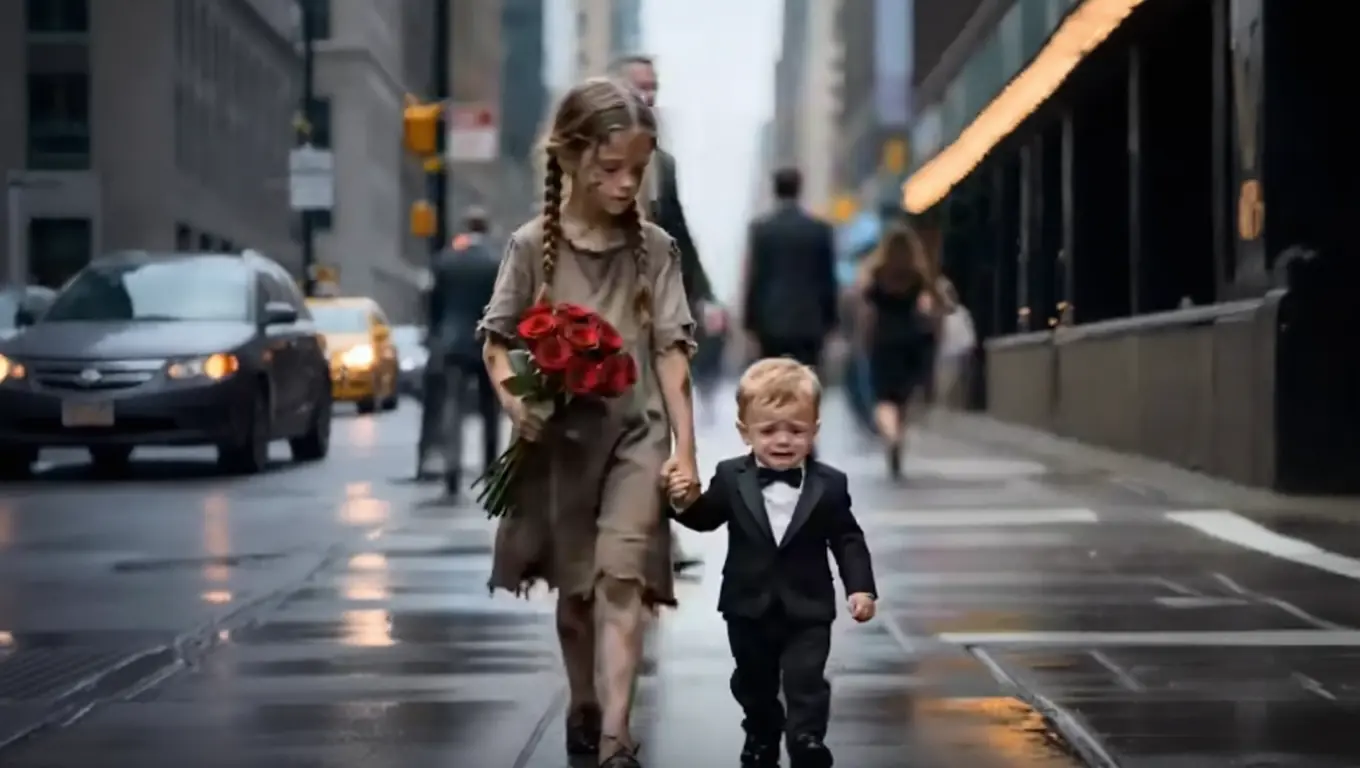
The sound came from the side of the hotel, near the taxi lane where black cars rolled in and out beneath dripping lights. Clara looked over and saw a little boy standing beside a stone planter, soaked at the shoulders, his face red from panic.
He was maybe five.
His little suit jacket was expensive. His shoes were shiny. His blond hair had been combed carefully at some point, but now rain had pushed it into his eyes.
He was alone.
Clara looked toward the adults under the awning.
Nobody had noticed.
The boy rubbed his eyes with both fists and cried harder.
Clara should have kept selling. She knew that. Every minute mattered. Rain ruined flowers quickly, and hunger did not care about lost children.
Still, her feet moved.
She crossed to him slowly, holding the bucket close so she would not frighten him.
“Hey,” she said gently. “Are you lost?”
The boy hiccuped and nodded.
“Where’s your mom?”
“I don’t know.”
“What’s her name?”
“Mommy.”
Clara almost smiled, then stopped herself. His fear was real. She looked around again, searching for a woman running, calling, panicking. Nobody seemed to be looking for him.
“What’s your name?” she asked.
“Oliver.”
“Okay, Oliver. I’m Clara.”
He sniffed.
“Are you a grown-up?”
“No.”
“Oh.”
He looked disappointed.
Clara lifted one rose from her bucket. It was red, still bright despite the rain, its stem wrapped in a strip of green paper.
“Here,” she said. “Hold this. It helps sometimes.”
Oliver took it with both hands.
“Is it magic?”
“Kind of.”
“What kind?”
That seemed to make sense to him. He held the rose against his chest and stopped crying long enough to breathe.
Clara crouched in front of him.
“We’re going to stay right here by the hotel door, okay? That way she can find you.”
Oliver nodded.
But before Clara could stand, a woman’s voice cut across the taxi lane.
“Oliver!”
The sound was sharp with terror.
A tall woman in a cream lace dress ran from the hotel entrance, one hand lifting the hem above the wet pavement. Her hair, pinned perfectly only minutes before, had come loose around her face. Diamonds flashed at her ears. A heart-shaped silver pendant bounced against her chest as she ran.
Behind her, two hotel staff and a man in a tuxedo followed.
The woman reached Oliver and dropped to her knees, pulling him into her arms so fiercely he dropped the rose.
“Oh my God,” she cried. “Oliver, where were you? I turned around and you were gone.”
Clara stood quickly.
Oliver pointed at her.
“She helped me.”
The woman looked up.
For half a second, Clara saw only relief in her face.
Then the woman saw the bucket of roses, Clara’s wet coat, her dirty shoes, and the cardboard sign.
Relief changed into suspicion.
“What were you doing with my son?” the woman demanded.
Clara stepped back.
“I found him crying. He was by himself.”
The man in the tuxedo grabbed Oliver’s shoulder and pulled him closer to the woman.
“Did she ask you for money?” he asked.
Oliver frowned.
“She gave me a flower.”
The woman looked down and saw the red rose lying in the dirty water near Clara’s shoes.
Her face hardened.
“Were you trying to use him to sell flowers?”
Clara’s cheeks burned.
“No.”
“You expect me to believe you just happened to find him?”
“He was lost.”
The woman rose, keeping one hand on Oliver. “Children like you should not be wandering around hotel entrances bothering guests.”
The words hit harder because Clara had heard versions of them before.
Children like you.
Girls like you.
People like you.
She bent quickly to pick up the fallen rose, but the woman stepped forward at the same time. Their shoulders collided. Clara slipped on the wet pavement, and the bucket fell from her arms.
Roses spilled everywhere.
Red and white petals scattered into the gutter. Stems rolled beneath shoes. Rainwater swallowed them almost immediately, dragging some toward the drain.
“No!” Clara cried.
She dropped to her knees, grabbing for them with both hands.
The woman caught Oliver against her side and stared down at the mess, breathing hard. For a moment, she looked shaken. Then embarrassment tightened her face again.
“You should leave,” she said.
Clara looked up from the roses.
Her hands were muddy. Her knees were soaked. Her sign had torn loose and was floating in a puddle beside her.
“I didn’t hurt him.”
“I said leave.”
The man in the tuxedo muttered, “Security should keep kids like this off the property.”
That was when Clara reached instinctively for the small silver pendant under her shirt.
She did it whenever she was scared.
The pendant was shaped like half a heart. It hung on a thin chain darkened by age. Her mother had given it to her before she died and told her never to sell it, no matter how hungry she got.
The woman saw it.
Everything about her changed.
Her eyes fixed on the pendant. Her hand slowly rose to her own neck, where the matching silver half-heart rested against cream lace and rain-damp skin.
The city kept moving around them.
Car horns.
Footsteps.
Umbrellas brushing past.
But the space between the woman and Clara went silent.
The woman’s voice came out very small.
“Where did you get that?”
Clara closed her fist around the pendant.
“My mother.”
“What was her name?”
Clara did not answer.
She had learned not to give pieces of herself to strangers.
The woman stepped closer, then stopped, as if afraid Clara might run.
“Please,” she whispered. “What was your mother’s name?”
Clara stared at her.
The same shape.
The same silver edge.
Two halves of one heart.
“My mother’s name was Rose,” Clara said slowly.
The woman made a sound like the word had gone through her.
“Rose,” she whispered.
Then she sank to her knees in the dirty water, not caring what happened to the lace dress.
Clara froze.
The woman pressed both hands to her pendant.
“My name is Vivienne Hart,” she said through tears. “Rose was my little sister.”
Clara shook her head at once.
“No.”
“Yes.”
“No. My mother said we had no family.”
Vivienne closed her eyes.
Those words seemed to hurt her more than the rain, more than the pavement, more than the judgment still hanging in the air.
“She believed that because of me.”
Oliver stepped from behind his mother, still holding the bent rose Clara had given him. Its petals were bruised, but it was not broken.
“Mommy,” he whispered, “why are you crying?”
Vivienne looked at her son.
Then at the girl kneeling among ruined roses.
“Because I was cruel to someone I should have found years ago.”
Clara gathered the flowers quickly, even the broken ones.
Her hands moved with desperate habit.
“I have to go.”
Vivienne reached toward her, then pulled her hand back.
“Wait. Please. Just tell me where you live.”
Clara’s mouth tightened.
“Behind the old laundromat on Eighth. My grandma is sick. I sell flowers so we can eat.”
Vivienne went still.
“Your grandmother?”
Clara nodded.
“She raised me after Mom died.”
Vivienne’s face turned pale.
“Is her name Eleanor?”
Clara stared at her.
“How do you know that?”
The answer seemed to drain the strength from Vivienne’s body.
“That is my mother.”
Clara looked from Vivienne to the pendant and back again.
“My grandmother is your mother?”
Vivienne covered her mouth with one hand.
“I thought she hated me.”
“She cries when she thinks I’m asleep,” Clara said. “Sometimes she says your name.”
Vivienne began to sob.
People under the hotel awning had gone quiet now. The wedding guests watched from a distance, their beautiful clothes protected from the rain while Clara’s roses floated in the gutter.
The man in the tuxedo looked uncomfortable.
Oliver moved closer to Clara and held out the rose again.
“Are you my cousin?” he asked.
Clara looked at him.
He had been lost only minutes ago. He was still wet-faced and scared, but now he was trying to understand a family story bigger than both of them.
“I don’t know,” Clara said.
Vivienne wiped her face.
“You are,” she whispered. “If Rose was your mother, then yes. You are his cousin. You are my niece.”
Clara stood up, clutching the ruined roses.
“You called me a thief.”
Vivienne flinched.
“Yes.”
“You thought I was using him.”
“Yes.”
“You pushed me.”
“I did.”
“You ruined everything I had to sell.”
Vivienne looked down at the flowers in Clara’s arms.
Rain had bent their heads. Many petals were torn. A few stems had snapped. What little money the evening might have brought was gone.
“I cannot undo that,” Vivienne said.
Clara’s voice grew smaller, but harder.
“People always hurt us first. Then, if they find out we matter to somebody, they start saying sorry.”
Vivienne stared at her.
The sentence left no room for defense.
Clara had not become worthy because she was family.
She had been worthy when she found a crying boy and gave him a rose for courage.
“You are right,” Vivienne whispered. “I should have thanked you before I knew who you were.”
Clara looked away.
Her chin trembled, and she hated that it did.
Oliver stepped between them and placed the bent red rose back into Clara’s bucket.
“You can have mine,” he said.
Clara’s face broke.
She knelt before him, and before she could stop herself, she wrapped her arms around the little boy.
“I’m glad you found your mom,” she whispered.
Oliver held onto her wet coat.
“I want you to find yours too.”
Vivienne pressed a hand over her mouth.
Then Clara stood, wiped her face with the back of her sleeve, and turned toward the street.
“I have to get back to Grandma.”
“Take me with you,” Vivienne said.
Clara hesitated.
The rain kept falling around them.
Behind Vivienne, the hotel glowed with warmth. Behind Clara, the city waited with alleys, shelters, and the cold space under a plastic sheet where her grandmother coughed through the night.
“You won’t like where we live,” Clara said.
Vivienne’s voice shook.
“I will hate myself more if you go there without me.”
Clara did not answer.
But she started walking.
Vivienne followed with Oliver beside her, his small hand gripping the bent rose. The man in the tuxedo called after her, but she did not turn around. Hotel staff stared. Wedding guests whispered. The rain swallowed the rest.
Clara led them away from the hotel lights.
They passed stores where security guards watched Clara whenever she came too close to the doors. They passed the bakery that sometimes gave her day-old rolls if the younger clerk was working, but never if the owner was there. They passed a pharmacy where she had once counted coins on the counter and been told she was short by three dollars.
Vivienne saw every place differently because Clara did not speak of them with self-pity.
She spoke of them as landmarks.
“The shelter line starts there.”
“That corner floods.”
“The bus stop is safer if Mr. Adrian is working at the newsstand.”
“The church gives soup on Wednesdays, but you have to get there before five.”
Oliver walked silently now.
He held his mother’s hand with one hand and Clara’s bucket with the other, though the bucket was nearly as big as his legs.
After ten minutes, they reached the old laundromat on Eighth Street.
Its sign flickered blue and white above the sidewalk. Two letters had burned out years ago. The front windows were fogged from the dryers inside, and the smell of detergent floated into the rain.
Clara did not go in.
She turned down the alley beside it.
Vivienne stopped for half a breath.
The alley was narrow, dark, and cluttered with broken pallets, garbage bins, and cardboard softened by rain. Water dripped from fire escapes overhead. At the far end, beneath a sheet of clear plastic tied between a fence and a rusted pipe, an elderly woman lay curled on a thin blanket.
“Grandma,” Clara called softly.
The woman stirred.
Her cough came first.
A deep, tearing cough that bent her whole body.
Clara hurried to her side and dropped the roses carefully near the blanket.
“I’m back.”
The old woman opened tired eyes.
“Did you sell enough, baby?”
Then she saw Vivienne.
For a moment, she did not seem to understand what she was seeing. Her eyes moved over the cream lace dress, the soaked hair, the trembling hands, the silver pendant at Vivienne’s throat.
Her breath caught.
“Vivienne?”
Vivienne stepped forward as if the ground had vanished beneath her.
“Mom.”
Eleanor Hart began to cry before Vivienne reached her.
Not graceful tears.
Not quiet tears.
The kind that come from years of being strong because weakness would have killed someone depending on you.
Vivienne dropped to her knees in the wet alley and took her mother’s cold hands.
“I wrote to you,” Eleanor sobbed. “Rose wrote too. We wrote for years.”
Vivienne bowed her head over her mother’s hands.
“I never got them.”
“They came back unopened.”
“I never saw them. Charles’s family told me you wanted nothing to do with me.”
Eleanor looked at her daughter with grief and anger mixed together.
“We thought you chose them over us.”
Vivienne shook her head desperately.
“I was eighteen. I was stupid. I thought love meant leaving with the man who promised to protect me. Then his parents said you had disowned me. They said Rose hated me. They said every letter I sent was returned because you wanted me erased.”
Eleanor closed her eyes.
“No.”
“I believed them because I was ashamed to come back without proof I had made the right choice.”
“Rose waited for you,” Eleanor whispered.
Vivienne made a broken sound.
“She died waiting,” Eleanor said. “She told Clara there was an aunt somewhere with the other half of a silver heart.”
Clara stood very still beside the plastic sheet.
Her arms were full of ruined flowers.
Her face was wet from rain and tears she had stopped trying to hide.
“My mother thought you would find me,” Clara said.
Vivienne turned toward her.
“I should have.”
Clara took one step back.
“Are you going to leave again?”
Oliver answered before his mother could.
“No,” he said firmly. “She can’t. I need my cousin.”
A tiny laugh escaped Clara.
It turned into a sob almost immediately.
Vivienne opened her arms, then stopped herself.
She did not grab Clara this time.
She waited.
Clara looked at her grandmother. Eleanor nodded through tears.
Slowly, Clara stepped into Vivienne’s arms.
The moment Vivienne held her, she felt the truth of the years she had missed.
Clara was too thin. Too cold. Too careful about taking up space. She held herself like a child who had learned that being easy to ignore was safer than needing anything.
Vivienne began crying into the girl’s wet hair.
“I am so sorry.”
Clara clutched the lace at her shoulder.
“The flowers were for food.”
“I know.”
“And medicine.”
“I know.”
Vivienne looked at Eleanor under the plastic sheet, then at the two children standing close together in the rain.
“You are coming with me.”
Clara stiffened.
“To the hotel?”
“No.”
“To the shelter?”
“No, sweetheart.” Vivienne’s voice broke on the word. “Home.”
Clara did not move.
She had heard that word before from people who meant temporary rooms, church basements, back seats, and promises that lasted only until morning.
Vivienne seemed to understand.
“Our family’s home,” she said. “Not charity. Not a favor. Your home, if you choose it.”
Eleanor coughed again, weaker this time.
Vivienne turned sharply.
“We need a doctor.”
Clara looked frightened.
“We don’t have money for that.”
“I do.”
The words came out before Vivienne could soften them. Clara’s face closed a little, and Vivienne hated herself for hearing how careless it sounded.
She knelt again.
“I don’t mean that the way it sounded,” she said. “I mean I have what I should have used to find you. Let me use it now.”
Clara stared at her for a long moment.
Then she nodded once.
Vivienne made three calls in the alley.
One to her driver.
One to her doctor.
One to the hotel, where she told them to send blankets, towels, and the largest car they had, and to stop asking questions.
Within fifteen minutes, black cars rolled up outside the laundromat.
People inside turned to look through the steamy windows. A hotel employee arrived with blankets and an umbrella large enough for three people. The man in the tuxedo from earlier came too, shame written all over his face.
Vivienne did not look at him.
She helped wrap Eleanor in warm blankets while Clara gathered the few things they owned: a backpack, a cracked photo frame, a jar of coins, two sweaters, and a small tin box that held her mother’s old letters.
The ruined roses stayed in the bucket.
Clara reached for them.
Vivienne gently touched her hand.
“We can buy more.”
Clara looked down.
“These are still mine.”
Vivienne swallowed.
“Yes. They are.”
So the roses came too.
They carried Eleanor carefully to the car. Clara climbed in beside her grandmother, still holding the bucket. Oliver sat beside Clara, close enough that their shoulders touched.
As the car pulled away from the laundromat, Clara looked out the window at the alley growing smaller behind them.
She expected to feel relief.
Instead, she felt afraid.
When you have lived too long with losing, rescue can feel like another kind of danger.
Vivienne watched her from the opposite seat.
She did not fill the silence with promises.
She had already learned that sorry was not a bridge by itself. It was only the first stone.
The Hart house stood on a hill outside the city.
Clara had seen houses like it only through iron gates or in pictures taped to real estate office windows. It was made of pale stone, with warm lights glowing behind tall windows and rain running down ivy-covered walls.
Inside, the air smelled like wood polish, soup, and clean laundry.
Clara stepped onto the marble floor and stopped.
Her shoes left wet marks.
She looked down immediately, ashamed.
Vivienne saw it.
“Leave them,” she said softly. “Floors can be cleaned.”
A housekeeper hurried forward with towels, then froze when she saw Clara’s expression. Vivienne gave her a look that stopped every question before it began.
“Mrs. Hart needs the blue room prepared,” Vivienne said. “Doctor Lennox will be here any moment. And bring food. Soup, bread, tea, anything warm.”
The house began moving around them.
Not coldly.
Not like a hotel.
Like a place startled awake.
Eleanor was taken upstairs beneath clean blankets. Clara followed until the doctor arrived, then stood outside the bedroom door with her arms wrapped around herself.
Oliver sat on the hallway floor beside her.
“You hungry?” he asked.
Clara hesitated.
“Yes.”
“Me too.”
“You ate at the wedding?”
“I was too lost.”
That made Clara smile a little.
A maid brought soup on trays to a small sitting room with a fireplace. Clara sat at the edge of the chair, careful not to lean back too hard. She held the spoon like someone might take it away if she moved too slowly.
Vivienne sat across from her.
She watched Clara take the first sip.
Then the second.
Then a third, faster.
“Slowly,” Vivienne said gently. “There is more.”
Clara froze.
Vivienne lowered her eyes.
“I’m sorry. I did not mean to correct you.”
Clara looked at the bowl.
“No. Grandma says that too.”
Oliver dipped bread into his soup and whispered, “I put too much in and it falls apart.”
Clara looked at him.
Then she tried it.
The bread broke off in the bowl.
Oliver nodded wisely.
“See?”
For the first time that evening, Clara laughed.
It was small.
But everyone in the room felt it.
Later, when the doctor came downstairs, Vivienne stood so quickly her chair nearly tipped.
“She has pneumonia,” he said. “And malnutrition. She is weak, but not beyond help. She needs rest, medicine, warmth, and steady care.”
Clara closed her eyes.
Vivienne took that as hope and punishment at the same time.
Steady care.
Such simple words.
Such impossible things when you were poor.
That night, Clara was given a room beside her grandmother’s.
The bed was too large.
The blankets were too soft.
A nightgown lay folded on the pillow, white cotton with tiny blue flowers at the collar. Clara touched it with two fingers, then looked around as if someone might appear and say there had been a mistake.
Vivienne stood in the doorway.
“Would you like help?”
Clara shook her head.
“All right.”
Vivienne turned to leave.
“Aunt Vivienne?”
The title came out uncertainly.
Vivienne stopped.
Clara looked down at the half-heart pendant in her palm.
“Can I keep this?”
Vivienne walked back slowly.
She reached beneath the neckline of her ruined lace dress and lifted her own pendant. Then she sat on the edge of the bed and held it beside Clara’s.
The two pieces fit together with a soft click.
One complete heart.
Vivienne’s face crumpled.
“Our father bought these for my mother after Rose was born,” she said. “When we were little, Rose and I used to press them together and say nothing could split us.”
“But something did.”
“Yes.”
Clara touched the joined heart.
“My mom said rich people took you.”
Vivienne nodded.
“They did. But I let them keep me too long.”
Clara looked up.
“Why?”
It was not cruel.
That made the question harder.
Vivienne folded her hands in her lap.
“Because I was young and proud. Because I thought if I admitted I was lonely, it meant everyone had been right about my husband. Because after he died, I told myself too much time had passed. Because shame is a very quiet prison, Clara. You do not always notice when you are helping lock the door.”
Clara listened.
Children who have suffered often know when adults are finally telling the truth.
“My mom cried when she talked about you,” Clara said. “But she never sounded angry.”
Vivienne covered her mouth.
“She should have been.”
“She sounded sad.”
Vivienne bowed her head.
“I was sad too.”
Clara separated the pendant halves and held Vivienne’s piece back to her.
Vivienne shook her head.
“No. Keep yours. Always.”
“It’s the only thing Mom gave me.”
“Then it belongs to you.”
Clara closed her fist around it.
“Will Grandma get better?”
Vivienne did not lie.
“I hope so. We will do everything we can.”
Clara nodded.
That answer frightened her less than a perfect promise would have.
The next morning, sunlight came through curtains Clara had not noticed in the dark.
For a moment, she forgot where she was. She woke ready to check whether the plastic sheet had collapsed in the night, whether her grandmother was coughing, whether their backpack was still under her arm.
Then she smelled toast.
Her body remembered hunger before her mind remembered the house.
She found Oliver in the hallway wearing pajamas with rockets on them.
“Breakfast is downstairs,” he said. “There are pancakes.”
Clara blinked.
“Like more than one?”
Oliver frowned.
“That’s usually how pancakes work.”
She followed him down.
In the dining room, Vivienne sat with Eleanor, who had been brought downstairs in a robe and blanket after insisting she was tired of “being treated like a museum vase.” She looked frail, but her eyes were clearer.
Clara ran to her.
“Grandma.”
Eleanor kissed her forehead.
“I’m still here, baby.”
Vivienne looked away, tears already in her eyes.
Breakfast was strange.
Not bad.
Strange.
Clara was used to counting food. Half a roll for now, half for later. Soup stretched with water. Apples eaten around bruises. Here, plates kept arriving.
She ate slowly at first.
Then with more trust.
Oliver told her about school. Clara told him about selling roses near the theater, where people paid better after sad plays than funny ones. Eleanor corrected Vivienne twice about family history. Vivienne accepted both corrections like someone receiving a sentence she deserved.
After breakfast, Vivienne asked Clara if she wanted to visit the cemetery.
Clara’s hand went to the pendant.
“For Mom?”
Vivienne nodded.
“And for Rose.”
They bought roses first.
Not from a florist who tied ribbons too perfectly.
Clara asked to go to Mr. Vasquez, the man who sold flowers from a cart near the bus station and sometimes gave her damaged stems to resell. When they arrived, he stared at the car, then at Clara stepping out of it.
“You all right, niña?”
Clara nodded.
“I need red roses.”
“How many?”
Clara looked at Vivienne.
Vivienne said, “As many as she wants.”
Mr. Vasquez did not ask questions.
He wrapped three dozen red roses in brown paper.
When Vivienne tried to pay, Clara stopped her.
“I want to pay some.”
She opened her sock and took out the six dollars from the day before.
Vivienne’s face softened.
“All right.”
Mr. Vasquez accepted the six dollars as if it were the full amount. Vivienne paid the rest when Clara turned to help Oliver carry the flowers.
At the cemetery, the rain had washed the headstones clean.
Rose Bell’s grave was near a maple tree at the edge of the older section. The marker was simple. Too simple, Vivienne thought, for a sister whose laughter had once filled entire rooms.
Clara knelt first.
She placed one red rose against the stone.
“I brought her,” Clara whispered.
Vivienne broke.
She sank down beside the grave and pressed her hand against the name.
“Rosie,” she cried. “I am so sorry.”
Eleanor stood behind them with one hand on Clara’s shoulder and one on Oliver’s. The old woman’s face was wet, but peaceful in a way Clara had not seen before.
For a long time, nobody spoke.
The city moved beyond the cemetery gates.
Cars passed.
Rainwater dripped from leaves.
A crow called from somewhere near the road.
Vivienne took her half-heart pendant and pressed it to the stone. Clara placed hers beside it. For one quiet moment, the heart was whole again in front of Rose’s name.
“I found Clara,” Vivienne whispered. “Or maybe she found me.”
Clara leaned against her grandmother.
Oliver put his rose down too.
“She helped me when I was lost,” he told the grave solemnly. “And now she lives with us, I think.”
Clara looked at him.
“I think?”
Oliver shrugged.
“I’m checking.”
Vivienne turned toward Clara.
“You do not have to decide anything today. You and Eleanor can stay as long as you want. Forever, if that becomes right. But I will not force you to call my house home before it feels like one.”
Clara studied her.
Adults had promised things before.
Not like this.
Most promises tried to hurry her into believing them.
Vivienne’s waited.
“I want Grandma warm,” Clara said.
“She will be.”
“And I want to go to school.”
Vivienne nodded.
“You will.”
“And I want to keep selling flowers sometimes.”
Vivienne blinked.
Clara lifted her chin.
“Not because I have to. Because I’m good at it.”
Eleanor laughed softly.
“She is.”
Vivienne smiled through tears.
“Then we will find a way.”
Weeks passed.
Not like magic.
Healing never moves that cleanly.
Eleanor had bad days when coughing left her exhausted and Clara sat beside the bed counting each breath. Clara woke from nightmares and hid food in drawers until Vivienne found it and quietly placed a basket in her room labeled Clara’s Snacks, so she would never have to steal from her own kitchen.
Oliver followed Clara everywhere.
He introduced her at school as “my cousin who saved me from a hotel.” Clara told him that was dramatic. Oliver said it was accurate.
Vivienne changed too.
She stopped attending the kind of events where people smiled without listening. She dismissed the man in the tuxedo from her personal staff after learning he had told security to “watch the flower girl” before Oliver even went missing. She spent evenings at the kitchen table with Eleanor, opening the old tin box of letters that had never reached her.
Some were from Rose.
Some from Eleanor.
Some were written in Clara’s childish handwriting after her mother died, addressed to an aunt she had never met because her grandmother once said writing to the lost was not foolish if love still had an address.
Vivienne read every one.
She cried over most.
One letter, written by seven-year-old Clara, said: Dear Aunt Vivi, Grandma says you have the other heart. If you come home, can you bring soup?
Vivienne kept that one in her desk.
Not to punish herself.
To remember what need looked like when it still had hope inside it.
By winter, Eleanor was strong enough to sit in the garden room with tea. Clara had gained weight in her cheeks. Her curls shone again. She still moved carefully through the house, but not like a guest waiting to be sent away.
One Saturday, Vivienne took Clara and Oliver back to the Langford Hotel.
Clara stood outside the same entrance where her roses had spilled into the gutter.
The awning had been repaired.
The pavement was dry.
People came and went without knowing what had happened there.
Vivienne held a new bucket of roses.
This time, the sign read: Roses for the Rose Bell Family Fund. Helping children who are lost, hungry, or unseen.
Clara had chosen the name.
Vivienne had created the fund.
Eleanor had insisted the first money go to the shelter, the laundromat alley outreach team, and Mr. Vasquez, whose flower cart now had a proper rain cover.
Oliver wore a small badge that said Assistant.
He took the job seriously for twelve minutes, then ate two cookies meant for donors.
Clara stood beside Vivienne and sold roses.
Not because she needed food.
Not because medicine depended on it.
Because she wanted people to look at a child with flowers and see a person before they saw a problem.
A woman in a pearl coat bought one rose and handed Clara a twenty.
“Keep the change,” she said kindly.
Clara smiled.
“Thank you.”
A man hurried past without looking.
Clara did not shrink.
She simply turned to the next person.
Near the end of the afternoon, Vivienne looked down and saw Clara touching her pendant.
“Are you all right?”
Clara nodded.
“I was thinking about Mom.”
“What about her?”
Clara watched Oliver explaining very seriously to a stranger that red roses were better because they had “more feelings.”
“She said the heart would bring me home someday. I thought she meant to her.”
Vivienne’s eyes filled.
Clara looked up at her.
“But maybe she meant all of you.”
Vivienne placed her arm around Clara’s shoulders.
Across the street, the city moved fast as ever.
Car horns.
Footsteps.
Umbrellas on a day that threatened rain but had not yet broken open.
Clara no longer felt like a poor girl standing outside someone else’s beautiful life.
She had found a crying boy and given him the only beautiful thing she had.
She had stood in the rain while a woman misjudged her.
She had carried half a heart through hunger, alleys, fear, and grief without knowing it was leading her somewhere.
And somehow, on the day she almost lost everything, she had brought a child back to his mother.
Then she had led herself home.