England, 1825. The storm had raged for three hours before the Duke of Westmore's stablemaster noticed that Perseus, his grace's favorite black stallion, had returned without his rider. The horse stood trembling in the courtyard of Westmore Manor, rain streaming down his flanks, his saddle askew, and something dark staining the leather saddlebag that hung loose from its fastenings. Gabriel Toriston, Duke of Westmore, was roused from his study by the urgent knocking of his headgroom. At two and thirty, Gabriel had learned to distinguish between ordinary household matters and genuine emergencies.
The look on the older man's face told him this was decidedly the latter. "Your grace," the groom said, his weathered face pale in the lamplight, "Perseus has returned." Alone, Gabriel was down the stairs and across the entrance hall before the man finished speaking. He had ridden Perseus that morning to inspect the northern boundaries of his Kent estate, but the horse had been stabled hours ago. No one should have taken him out, least of all in weather such as this.
In the courtyard, rain lashed against the cobblestones as Gabriel approached the agitated stallion. Perseus was ordinarily the steadiest of mounts, but now his eyes rolled white with distress. Gabriel placed a calming hand on the horse's neck, speaking low and soothing before turning his attention to the saddlebag. His fingers stilled as he drew out the contents. Papers rolled and bound with twine, their edges dark with moisture and something else: blood.
Beneath them was a woman's riding glove, delicate kid leather soaked through with crimson. "Bring lanterns," Gabriel commanded, his voice cutting through the sound of the storm, "and fetch Mr. Thornton." "Tell him to gather six men who know the estate well. We ride immediately." The stablemaster hesitated, "Your grace, in this weather, someone is injured and alone in the dark."
Gabriel interrupted, his tone brooking no argument, "Every moment we delay reduces the chance of finding them alive." As his men assembled, Gabriel unrolled one of the bloodstained papers. Even in the dim light, he recognized it immediately as a map. Not just any map, but an extraordinarily detailed survey of his own lands, showing features and boundaries with a precision that exceeded anything in his library. In the corner, executed in a neat, precise hand, was a notation: "Northern sector commission survey, S. Langford."
The name was unfamiliar, though Gabriel's elderly steward had mentioned something weeks ago about engaging a cartographer to update the estate maps. Gabriel had been occupied with parliamentary matters and had approved the expense without further inquiry. Now he wished he had paid closer attention. "The maps show the route," Gabriel told his men once they were mounted. "Whoever drew these knew the land well, so we follow the survey markers."
They rode north through sheets of rain, lanterns casting wavering circles of light across the darkness. Gabriel studied the maps as they went, noting the methodical progression of the survey work. The cartographer had been thorough, documenting not just property boundaries, but also old wells, abandoned structures, and natural landmarks. It was one such landmark, a tumbledown stone barn that had once served the tenant farms, that Gabriel recognized from the most recent map. The structure appeared at the edge of the surveyed area, marked with a small notation that read, "Potential shelter, sound roof."
"There," Gabriel called to his men, pointing toward the dark shape barely visible through the rain. They found her inside, collapsed against a pile of rotting hay bales, her face nearly as pale as the linen shirt she wore beneath a man's riding coat. She was a woman, perhaps six and twenty, with dark hair plastered to her face by rain and fever sweat. Her right arm was wrapped crudely in what appeared to be torn petticoat fabric. The makeshift bandage was soaked through with blood.
Gabriel dismounted and was at her side in an instant, his fingers finding the pulse at her throat. It was weak but present. "Miss Langford," he said clearly, hoping the use of the name from the maps might penetrate her unconscious state, "can you hear me?" Her eyelids fluttered, and for a moment, green eyes fixed on his face with startling clarity before clouding again with confusion. "The horse," she whispered, her voice fading, "did he make it?"
"The saddlebag?" "Both reached Westmore safely," Gabriel assured her. "Because of your foresight, we were able to find you, but you are badly injured. I am going to lift you now; try not to move your arm." She made a small sound of protest as he gathered her into his arms, but she was too weak to resist.
Gabriel was struck by how light she was, how cold. He could feel her shivering against his chest as he carried her from the barn. "Wrap her in my greatcoat," he instructed one of his men. "Mr. Thornton, ride ahead and wake Dr. Patterson. Tell him to prepare for a significant laceration and possible fever."
"The rest of you, we return to Westmore with all speed." The journey back took longer than Gabriel would have liked, though they moved as quickly as the darkness and weather allowed. He kept the woman cradled against him, sharing what warmth he could through the heavy wool of the coat wrapped around her. She drifted in and out of consciousness, occasionally murmuring fragments that made little sense. She spoke something about carriages and crates, about men with weapons, and about routes that appeared on no official maps.
By the time they reached Westmore, the storm had begun to break. Dr. Patterson, the estate physician who had served Gabriel's family for two decades, was waiting in the entrance hall with Mrs. Donnelly, the housekeeper. "The blue guest room is prepared, your grace," Mrs. Donnelly said, her experienced eye taking in the situation with swift efficiency. "I've had the fire built up and hot water brought." Gabriel carried Miss Langford up the grand staircase, acutely conscious of the trail of muddy water they left on the Turkish carpet.
Such concerns seemed trivial compared to the woman's labored breathing and the alarming pallor of her skin. In the prepared guest room, he laid her carefully on the bed while Dr. Patterson began his examination. The physician was a man of few words but considerable skill. He worked quickly, cutting away the makeshift bandage to reveal a deep gash that ran from Miss Langford's elbow nearly to her shoulder. "Blade wound," Dr. Patterson said grimly.
"Clean edges, which is fortunate, but deep. She has lost considerable blood." He glanced at Gabriel. "You found her in time, your grace. Another few hours and she would not have survived."
Gabriel stood back as the physician cleaned and sutured the wound, but he found himself unwilling to leave the room entirely. There was something about the woman's determined attempt to save herself, her clear-headed action in sending the horse back with evidence, that spoke of uncommon courage. "She will need rest and careful nursing," Dr. Patterson said as he applied a proper bandage. "The fever concerns me, but the wound itself is not beyond healing. If infection does not set in, I will leave detailed instructions with Mrs. Donnelly."
It was nearly dawn before Miss Langford stirred again. Gabriel had remained in a chair by the fire, reviewing the bloodstained maps by lamplight, trying to make sense of what he was seeing. The survey work was exceptional, far superior to anything he had encountered before. But it was the notations in the margins that troubled him: references to irregular movements and unauthorized traffic along routes that crossed his property. "Where am I?" the voice was soft but clear.
Gabriel rose and crossed to the bedside. Miss Langford's eyes were open, fever-bright but focused. She tried to sit up, then gasped at the pain in her arm. "Please do not move suddenly," Gabriel said. "You are at Westmore Manor."
"I am Gabriel Toriston. I believe you were conducting a survey of my lands when you were attacked." Recognition flickered across her face. "Your grace," she attempted a curtsy from her prone position, which would have been amusing under different circumstances. "Forgive me, I did not expect to meet you in this condition, or at all."
"Truly, your steward engaged my services by correspondence." "So I understand," Gabriel said. "Mr. Thornton mentioned the commission, though I confess I approved it without realizing I had engaged a woman cartographer. Your work name is rather ambiguous." A faint color touched her pale cheeks.
"By design, your grace; few gentlemen will hire a female surveyor, regardless of skill." "Their loss," Gabriel said simply. "Your maps are extraordinary, but tell me, Miss Langford, what happened to you? Who did this?" She was silent for a moment, as though weighing how much to reveal.
Finally, she said, "I was completing the northern section of your estate near the boundary with Lord Kemmore's Sussex properties. It was late afternoon, and I had climbed to higher ground to take elevation measurements. From that vantage, I could see down into a valley that spans both estates." She paused, accepting the glass of water Gabriel offered. Her hand trembled slightly as she drank.
"I saw carriages," she continued, "six of them moving in formation along a route that appears on no road map. They were heavily loaded and guarded by armed outriders. The movements seemed coordinated, purposeful. It struck me as unusual enough to note in my survey records." "And someone saw you observing them," Gabriel guessed.
Miss Langford nodded. "Three men rode up the slope and demanded to know who I was and what I was doing. When I explained I was conducting a legitimate survey, they became aggressive. One seized my survey case, and another grabbed for my horse." "I managed to break free, but one of them drew a knife."
Her fingers moved unconsciously to her bandaged arm. "I defended myself as best I could, but there were three of them, and in the struggle, I was cut." "How did you escape?" "I did not entirely," she admitted. "But my horse, your Perseus, is a brave creature."
"When I managed to climb into the saddle, he responded immediately. We outran them initially, but they pursued. I knew I could not lead them back to my lodgings. So I released Perseus with my saddlebag containing the survey maps and evidence of what I had seen, hoping he would return home. Then I took shelter in that barn, trying to staunch the bleeding until help arrived."
Gabriel felt a surge of admiration for her quick thinking. "You risked your life to preserve those maps." "The maps represent weeks of work," Miss Langford said. "But more importantly, they document something illegal occurring on your lands, your grace. Those men did not react like honest travelers who had taken a wrong turn."
"They reacted like criminals protecting a secret." Gabriel returned to the table where he had spread the maps. "Show me exactly where this occurred." Despite her obvious pain and exhaustion, Miss Langford rose carefully from the bed, steadying herself against the bedpost before crossing to join him. She studied the maps for a moment, then placed her finger on a specific location.
"Here, this valley where the boundary between Westmore and Lord Kemmore's estate becomes unclear due to the old forest." Gabriel examined the area closely. He knew the location, though he rarely rode that far north. It was rough country, heavily wooded, difficult terrain, ideal for concealing movement. "Lord Kemmore," he said slowly, "is a respected merchant."
"He deals in textiles and spices imported from the continent, but I have always found him rather evasive." "Perhaps with good reason," Miss Langford said quietly. A knock at the door interrupted them. Mrs. Donnelly entered with a breakfast tray, her motherly expression shifting to disapproval when she saw her patient out of bed. "Miss Langford, Dr. Patterson was most specific about rest," the housekeeper chided gently.
"Mrs. Donnelly is correct," Gabriel said. "You must recover your strength; we will have time to discuss this matter further once you have rested and eaten." Miss Langford looked as though she might argue, but another wave of pain or fatigue seemed to pass through her, and she allowed Mrs. Donnelly to guide her back to bed. "Your grace," she said as Gabriel moved toward the door, "my assistant, Hugh Mercer, is in Manchester delivering completed survey work to a client." "He will be expecting my correspondence."
"If I do not write to him soon, he will worry." "I will ensure a message is sent," Gabriel promised. "Rest now, Miss Langford. You are safe here." As he left the room, Gabriel's mind was already working through the implications of what he had learned.
A woman cartographer with exceptional skill, attacked for witnessing something she should not have seen. A neighboring landowner whose legitimate business might conceal something far less innocent, and maps that suggested organized illegal activity crossing his own estate. The dawn light was breaking over Westmore's gardens as Gabriel made his way to his study. He would need to investigate carefully, discreetly. But one thing was certain: Miss Sophie Langford had stumbled into something dangerous, and until they understood exactly what, she would need protection.
He found himself hoping she would accept his hospitality for as long as necessary. Not merely for her safety, though that was paramount, but because in the brief conversation they had shared, he had glimpsed a mind as sharp as any he had encountered in London's drawing rooms or Parliament's chambers. A mind, moreover, that belonged to a woman brave enough to face down three armed men, and clever enough to ensure the evidence of their crime survived, even if she did not. Gabriel settled at his desk and drew out fresh paper. He had letters to write to his solicitor in London, to certain contacts who might have information about Lord Kemmore's business dealings, and to Hugh Mercer in Manchester.
He would assure him that his employer was injured but safe, and ask him to return to Kent at his earliest convenience. The maps lay spread before him, bloodstained but legible. They were evidence of a mystery that demanded solving, and perhaps, Gabriel thought as he dipped his pen in ink, the beginning of something he had not expected to find. It was not merely a puzzle to unravel, but a person whose courage and intelligence matched his own careful deliberation. Outside, the storm had passed, leaving the morning clean and bright.
But Gabriel suspected that the true tempest was only beginning. The first week of Sophie's recovery passed with agonizing slowness for someone accustomed to spending her days outdoors, measuring distances and calculating elevations. Dr. Patterson visited daily, pronouncing himself cautiously satisfied with the healing of her wound, though he insisted she remain at Westmore for at least a fortnight. Gabriel found himself drawn to the blue guest room more frequently than propriety strictly warranted, though he justified each visit with some practical concern. The maps required clarification.
Sophie's account of the attack needed details for his correspondence with the magistrate. Her comfort and care were his responsibility as host. The truth, which he was not quite ready to acknowledge, was that he simply enjoyed her company. On the third morning, he found her seated by the window, sketching in a leather-bound notebook that Mrs. Donnelly had provided at her request. Her injured arm rested in a sling, but her left hand moved with surprising dexterity across the page.
"You are ambidextrous," Gabriel observed as he entered. Sophie glanced up, a faint smile touching her lips. "A necessary skill for a cartographer, your grace. One cannot always position oneself ideally for drawing, and weather conditions often demand speed over elegance. May I see?"
She hesitated, then turned the notebook so he could view the sketch. It was a detailed rendering of Westmore's south facade, executed with remarkable precision despite being drawn with her non-dominant hand. "You have captured it exactly," Gabriel said, genuinely impressed, "even to the ivy pattern on the eastern corner." "I observe carefully," Sophie replied. "It is the foundation of good surveying."
"One must see what is truly there, not what one expects to see." Gabriel took the chair opposite her, sensing an opening to the conversation he had been wanting to have since her arrival. "Tell me about yourself, Miss Langford. How does the daughter of a viscount come to be a cartographer?" Something shifted in her expression, a shadow passing across her features before she composed herself.
"My father was Viscount Langford of Surrey. Perhaps you knew of him?" "I did not have that honor." "You were fortunate in that regard," Sophie said with unexpected bitterness. "My father was a good man in many ways, but he possessed an unfortunate weakness for investments that promised much and delivered nothing."
"Railway schemes that never laid track, mining ventures in lands that held no ore. By the time I was twenty, our estate was mortgaged beyond recovery." She set down her pencil, her gaze distant. "My mother had died when I was fifteen. I have a younger brother, Timothy, who was eighteen when father passed three years ago."
"The creditors took everything: the house, the lands, even mother's jewelry. Timothy and I were left with a small inheritance from our maternal grandmother, enough to rent a modest cottage and live simply if we were careful." "I am sorry," Gabriel said quietly. "That must have been extraordinarily difficult." Sophie shrugged, though the gesture was not as casual as she likely intended.
"We were fortunate compared to many; we had our health and our wits. Timothy found employment as a clerk in a solicitor's office in the village near our cottage. He has a fine hand and a quick mind for legal matters." "And you found employment as a cartographer?" "Not immediately," Sophie admitted.
"At first, I had no profession at all. I had been educated as a gentleman's daughter. I could paint watercolors, play the pianoforte adequately, speak French and Italian, and manage a household. None of which generates income when one has no household to manage and no prospects of marriage." Gabriel noted the matter-of-fact tone in which she spoke of having no marriage prospects, as though it was simply an accepted reality rather than something that might cause distress.
"My mother's brother, my Uncle William, was a surveyor and topographer," Sophie continued. "He had never married and lived alone in a cottage in Dorset. When he learned of our circumstances, he invited me to visit. I spent six months with him and he taught me his trade. At first, I think he merely wished to provide me some occupation to distract from our losses, but he discovered I had an aptitude for the work."
"More than an aptitude," Gabriel interjected. "Your surveys are exceptional." A flush of pleasure colored her cheeks. "Uncle William was a patient teacher. He showed me how to use the theodolite and surveyor's chain, how to calculate elevations and angles, how to translate three-dimensional terrain onto two-dimensional paper."
"I found I loved the precision of it, the way mathematics and observation combined to create something useful and true." "And when your uncle died?" Gabriel guessed. "Two years ago," Sophie confirmed. "He left me his instruments and his reference library, also a collection of his completed surveys and the contacts he had established over thirty years of work."
"I wrote to his former clients introducing myself as S. Langford, his niece, who had trained under his guidance. Several responded with commissions, assuming I was male. When the work proved satisfactory, they recommended me to others." "You deliberately cultivated the ambiguity of your identity." "I did what was necessary," Sophie said without apology.
"A woman cartographer faces obstacles a man does not. If clients assumed I was my uncle's nephew rather than his niece, I saw no reason to correct that misapprehension until after they had seen the quality of my work." Gabriel found himself admiring her pragmatism. "And your brother, does he approve of your profession?" "Timothy understands necessity as well as I do," Sophie replied.
"My surveying brings in more income than his clerk's wages. Between us, we manage, not lavishly, but adequately. He handles correspondence with clients, manages the household accounts, and maintains our cottage while I travel for commissions. We are partners in survival." She met his eyes directly.
"I know this must seem strange to you, your grace. A woman dressed in men's riding clothes, tramping across the countryside with surveying equipment, sleeping in barns and taverns. But it is honest work, and it has allowed Timothy and me to maintain our independence." "I do not find it strange," Gabriel said carefully. "I find it resourceful and brave."
Sophie looked startled by the compliment, as though she had been bracing for criticism, and did not quite know how to receive praise instead. Before she could respond, a knock at the door announced Mrs. Donnelly with the midday meal. The housekeeper had taken it upon herself to ensure Sophie ate regularly and well, appearing at mealtimes with trays laden with nourishing food. "Dr. Patterson says you must build your strength," Mrs. Donnelly declared, setting the tray on the small table by the window. "Cook has prepared a lovely chicken broth and fresh bread."
After the housekeeper departed, Gabriel helped Sophie arrange herself comfortably for eating, then excused himself to attend to estate business. But his mind remained occupied with what he had learned. Sophie Langford was not merely a skilled cartographer. She was a woman who had faced circumstances that would have broken many people of her class, and had responded with determination and ingenuity. She had set aside the expectations of her upbringing to learn a trade, support her brother, and carve out a life of independence.
That evening, Gabriel spent several hours in his library, reviewing what little information he could gather about Lord Kemmore. The man was forty-five, a widower with no children, who had made his fortune in importing textiles and spices from France and the Orient. His estates in Sussex bordered Gabriel's lands in Kent, though the boundary was imprecise in the heavily forested northern reaches. On the surface, Kemmore appeared respectable. He attended the appropriate social functions, contributed to charitable causes, and maintained cordial, if not warm, relations with his neighbors.
But as Gabriel dug deeper into shipping records and customs documentation that his solicitor had provided, inconsistencies began to emerge. The volumes of goods Kemmore claimed to import did not quite align with the cargo manifests from the ports. There were gaps, unexplained periods where ships arrived, but no corresponding increase in warehouse inventory appeared in the records. And the routes Sophie had documented, those nighttime movements of heavily guarded carriages, suggested transportation of something far more valuable and far less legal than bolts of silk or bags of peppercorns. On the fifth day of Sophie's residence at Westmore, Gabriel brought the discrepancies to her attention.
She was well enough now to move about the house, though she still tired easily, and Dr. Patterson had forbidden any strenuous activity. They sat in the library, the autumn sunlight slanting through tall windows as Gabriel spread shipping manifests and customs records across his desk alongside Sophie's maps. "Look here," he said, pointing to a series of dates. "Kemmore's ships arrive at Hastings Port in Sussex on these dates, but the cargo recorded as unloaded does not match the volumes he claims in his business accounts." Sophie leaned closer, studying the documents with the same careful attention she gave to surveying.
"And here," she said, indicating a notation on one of her maps. "On this date, I observed unusual activity: six carriages moving at night along this route between his Sussex property and the Kent border." "The timing aligns," Gabriel observed. "Three days after the ship's arrival, the carriages move, always in darkness, always heavily guarded." "What could be valuable enough to warrant such secrecy?" Sophie asked.
"And illegal enough to attack someone who witnessed the movement?" "That," Gabriel said grimly, "is what we must discover." Sophie was quiet for a moment, her fingers tracing the routes on her map. Then she said, "I should continue the survey. Document these movements more thoroughly."
"Create a complete record of the routes and timing." "Absolutely not," Gabriel said immediately. "You were nearly killed. I will not permit you to put yourself at risk again." Her chin lifted with a stubbornness he was beginning to recognize.
"With respect, your grace, you do not have the authority to permit or forbid my actions. I am not your dependent." "You are my guest, recovering from an injury sustained on my lands while in my employ," Gabriel countered. "That gives me both moral authority and practical responsibility for your safety." "I am a professional surveyor engaged to complete a commission," Sophie replied, her tone level but firm.
"The survey is incomplete. Moreover, we now know that something illegal is occurring that directly affects your property and potentially puts your tenants at risk. Walking away serves no one." "Walking away keeps you alive," Gabriel said more sharply than he intended. Sophie met his gaze steadily.
"I did not survive my family's ruin and three years of fighting for independence only to become timid now. Those men attacked me because I witnessed something they wanted hidden. Running away will not make me safer. They know I saw them. The only protection is in exposing what they are doing."
Gabriel recognized the logic in her argument even as every instinct rebelled against it. "Then we investigate carefully and methodically, not alone in the field where you are vulnerable, but from here where you have resources and protection." He could see her weighing his words, the pragmatist in her acknowledging the sense even as her pride bristled at accepting limitations. "I have written to your assistant, Mr. Mercer," Gabriel continued. "I explained that you were injured during your survey work and are recovering at Westmore."
"I asked him to return from Manchester as soon as his current business allows. He should arrive within four or five days." "Hugh will be furious with himself for not being here," Sophie said quietly. "He takes his role as my protector seriously, too seriously sometimes." "A man who has seen combat learns to be cautious," Gabriel observed.
"Your brother mentioned in his last letter that Mr. Mercer served in the Peninsula War." "He served under many commanders," Sophie said. "Perhaps even under your father." Gabriel felt a flicker of surprise. "My father was Colonel Toriston before he inherited the duke."
"He commanded a regiment at Salamanca." "Then Hugh almost certainly knew him," Sophie said. "He speaks highly of the officers he served under. He has been with Timothy and me for two years now, since shortly after Uncle William died. He appeared one day, saying he had heard William's niece was continuing his surveying work and might have need of someone who could manage the practical difficulties of a woman traveling alone."
"A fortunate connection," Gabriel remarked. "A life-saving one on several occasions," Sophie admitted. "Hugh is the reason I have been able to maintain this profession. He handles the arrangements with innkeepers and livery stables, deflects unwanted attention, and ensures I can focus on the surveying rather than constantly defending my right to do it." A thought occurred to Gabriel.
"Your brother Timothy, where is he currently?" "At our cottage in Surrey," Sophie replied. "He will be managing correspondence with clients and wondering why I have not written in nearly a week. I should send him a letter explaining what has happened." "I have a suggestion," Gabriel said carefully.
"One that may not appeal to your independent nature, but which I ask you to consider. Remain here at Westmore as my guest until we have resolved this matter with Kemmore. Allow me to send for your brother to join you, so he is not isolated and potentially vulnerable if Kemmore's men learn you survived and go searching for you." Sophie's expression became guarded. "You are asking me to bring my brother into potential danger."
"I am suggesting that he might be safer here under my protection than alone in a cottage if men with violent intentions come looking for his sister," Gabriel said. "But I also believe there is wisdom in maintaining appearances. If Timothy continues his normal routines, traveling to his employment, managing your household, it suggests that you are simply away on an extended commission, which is in fact the truth. We gain time to investigate without alerting Kemmore that we suspect anything beyond a surveying project." He could see her turning the idea over, examining it from multiple angles as she would a complex survey calculation.
"Timothy would need convincing," she said finally. "He is protective of me as I am of him. He will not like the idea that I was attacked." "Then tell him the truth, but assure him that you are safe and recovering," Gabriel said. "Invite him to visit once Mr. Mercer has returned."
"Between the three of you and my household's resources, we can continue investigating while ensuring everyone's safety." Sophie was silent for a long moment. Then she nodded slowly. "I will write to Timothy tonight and to Hugh, adding my own assurances to yours that I am well." "Thank you," Gabriel said, feeling relief he had not quite expected.
As Sophie rose to return to her room to rest before dinner, she paused at the library door. "Your grace, why are you doing this? You could simply hire another cartographer to complete the survey. Send me away with compensation for my injury and be done with the entire affair." Gabriel considered his answer carefully.
"Because you are right that whatever Kemmore is doing affects my lands and potentially my people. Because I do not care to have criminals operating unchecked in my domain. And because," he stopped, surprised by what he had been about to say. "Because?" Sophie prompted. "Because I believe you deserve justice for what was done to you," Gabriel finished.
"And I find I have developed a rather stubborn determination to ensure you receive it." A smile, genuine and warm, transformed Sophie's face. "Then we are both stubborn, your grace. Perhaps that will serve us well." After she left, Gabriel remained in the library as afternoon faded toward evening.
Through the windows, he could see the autumn colors beginning to touch the trees of Westmore's Park. In a few weeks, the leaves would turn golden and red before falling. He found himself hoping that Sophie Langford would still be there to see them. Hugh Mercer arrived at Westmore Manor on a gray afternoon, five days after Gabriel's letter had been dispatched to Manchester. The man who dismounted in the courtyard was broad-shouldered and weathered, his face lined by years of sun and wind.
At forty-eight, he moved with the contained weariness of a veteran soldier, his eyes scanning the manor's facade and grounds before he approached the entrance. Gabriel received him in the study, noting the controlled fury in the older man's bearing. "Your grace," Hugh said, his voice rough with suppressed emotion. "I came as quickly as I could. Where is she?"
"How badly is she injured?" "Miss Langford is recovering well," Gabriel assured him. "The wound was serious, but Dr. Patterson is satisfied with her progress. She is upstairs in the guest wing. Mrs. Donnelly can take you to her."
Hugh's shoulders sagged slightly with relief, though tension still radiated from him. "I should never have left her alone. I knew the commission would take me to Manchester for at least a fortnight, but the payment was generous, and Sophie insisted the Westmore survey was straightforward enough that she could manage independently for a few weeks." "You could not have anticipated what occurred," Gabriel said. "From what Miss Langford described, the attack was sudden and unprovoked."
"Even had you been present, three armed men would have been formidable opponents." "Three armed men would have found themselves facing someone who knows how to kill them," Hugh said bluntly, "begging your pardon, your grace. But I have spent thirty years learning how to protect those under my care. I failed Sophie." "You did not fail her," came Sophie's voice from the doorway.
She stood there in a simple daydress, her injured arm no longer in a sling, though she held it carefully. "You were exactly where I sent you, Hugh, completing work that pays our rent. Do not take responsibility for the actions of criminals." Hugh crossed to her in three quick strides, his weathered face working with emotion. "Miss Sophie, if you had died because I was not there..."
"But I did not die," Sophie interrupted gently. "I am here recovering and in considerably more comfortable circumstances than our cottage. His grace has been extraordinarily generous in his hospitality." Hugh turned to Gabriel, and something shifted in his expression as he truly looked at the Duke for the first time. Recognition flickered across his features.
"Colonel Toriston's son," he said slowly. "I served under your father at Salamanca, your grace. Third regiment of foot. He was a fine commander, fair but demanding. He got us through that battle when others might have faltered."
Gabriel felt an unexpected warmth at hearing his father spoken of with such respect. "My father often said that the men of the Third were the finest soldiers he ever commanded. He would be pleased to know one of them is protecting Miss Langford." "It is my honor to do so," Hugh said. "Though I seem to be making a poor showing of it thus far."
"Then perhaps you will allow me to assist in that duty," Gabriel said. "Miss Langford has agreed to remain at Westmore while we investigate the circumstances of her attack. I would be grateful if you would accept my hospitality as well. Your military experience may prove valuable in what we are attempting to uncover." Hugh looked to Sophie, who nodded.
"His grace believes that Lord Kemmore, whose lands border Westmore to the north, may be involved in smuggling operations. The men who attacked me were protecting something they did not wish documented on my survey maps." "Then we document it anyway," Hugh said with grim satisfaction, "but carefully and with proper precautions." Over the following days, Sophie established herself in a sunny room in the guest wing that Gabriel had converted into a makeshift cartography office. A large table was brought in for spreading maps, and shelves were installed to hold the surveying instruments Hugh had transported from their cottage, along with Sophie's reference books and materials.
Gabriel found himself drawn to this improvised workspace more frequently than his own study. There was something compelling about watching Sophie work. The way her hands moved with precision across paper, translating measurements and calculations into visual representations of the landscape. Her injured arm still pained her occasionally. He could see it in the tightness around her eyes when she worked too long, but she refused to let it slow her progress significantly.
"You are pushing yourself too hard," he observed one morning, finding her already at work when he arrived with coffee and fresh correspondence. "I am pushing myself exactly hard enough," Sophie countered, accepting the coffee with a grateful smile. "Dr. Patterson says moderate activity promotes healing. This qualifies as moderate." "Dr. Patterson also said you should rest frequently, which I do."
"Between map sessions, I have been exploring your library," Sophie said. "You have a remarkable collection of historical surveys and property records. Some date back two centuries." "My grandfather was an enthusiastic collector of local history," Gabriel explained. "He believed that understanding the past was essential to managing the present. I have continued that tradition."
Sophie's eyes lit with genuine interest. "Would you permit me to examine those historical maps? If Kemmore is using old routes for smuggling, they might appear on older surveys that documented paths now forgotten or overgrown." "An excellent thought," Gabriel said. "I will have the relevant volumes brought up from the archive room."
That afternoon, they sat together at the large table with centuries-old maps spread before them. Sophie had a remarkable ability to correlate historical documents with modern surveys, identifying where ancient trackways and roads had once connected properties that were now separated by dense forest. "Here," she said, pointing to a faded line on a map dated 1742. "This shows a merchant road that ran between Kent and Sussex. It fell into disuse when the main coaching road was built twenty miles south, but the path itself would still exist."
"Trees would have grown over it, but the underlying route through the valleys would remain the most efficient way to move heavy wagons." Gabriel studied the old map, then compared it to Sophie's modern survey. "And it passes directly through this section where you observed the nighttime convoy." "Exactly. They are not creating new routes."
"They are reviving old ones that appear on no current maps and which most people have forgotten entirely." Over the next two weeks, a pattern emerged. Working together, often late into the evening, they documented a network of forgotten medieval paths that connected Kemmore's Sussex properties to various points in Kent and beyond. Sophie's cartographic expertise, combined with Gabriel's knowledge of local history and property ownership, created a detailed picture of how goods could be moved illicitly across the region. Sophie proved to be an excellent teacher, patiently explaining the principles of topographic surveying to Gabriel.
She explained how elevation lines indicated the shape of terrain, how water features could be used to triangulate positions, and how shadows and vegetation patterns revealed underlying geological features. In turn, Gabriel shared what he knew of the families and properties that had occupied the region for generations. He knew which estates had declined and been absorbed by neighbors, where old boundary disputes had left sections of land in legal ambiguity, and which land owners were struggling financially and might be vulnerable to offers from someone like Kemmore. "You have a natural aptitude for this work," Sophie told him one evening as they reviewed the day's progress. "You think systematically, seeing how individual pieces fit into larger patterns."
"I suspect that skill comes from managing estates and navigating parliament," Gabriel replied. "Both require understanding how seemingly unrelated elements connect to create a functional whole." They were developing an easy rhythm of collaboration, their different areas of expertise complementing each other naturally. Gabriel found himself looking forward to their working sessions with an anticipation that had little to do with the investigation itself, and much to do with the pleasure of Sophie's company. She was unlike any woman he had known in London society.
There was no artifice in her, no careful calculation of what to say or how to present herself. She spoke her mind directly, engaged with ideas rather than social pleasantries, and treated him as an intellectual equal rather than a title to be flattered or manipulated. The breakthrough came on the fourteenth day after Hugh's arrival. A rider from Gabriel's solicitor in London delivered a packet of correspondence that had been intercepted through means Gabriel chose not to examine too closely. Among the letters was one addressed to Lord Kemmore, written in a coded script that consisted of numbers and symbols rather than words.
"Can you make sense of this?" Gabriel asked Sophie, spreading the letter before her. She studied it intently, her finger tracing the patterns. "It is a substitution cipher, but not a simple alphabetic one. See how certain symbols repeat in positions that suggest geographical coordinates." "You can read it?"
"Not immediately, but I can decode it," Sophie said, her voice taking on the focused intensity she displayed when confronting a complex surveying problem. "Cartographers sometimes use similar systems to encode sensitive information about defensive positions or valuable resources. If I assume these number sequences represent map coordinates and work backwards from there..." She spent the next several hours at the table filling pages with calculations and cross-references. Hugh brought her meals that she consumed absently without looking up. Gabriel watched, fascinated by the workings of her analytical mind.
Finally, as the sun set beyond the windows, Sophie sat back with an expression of grim satisfaction. "I have it," she announced, "or enough of it to understand the essential message. This letter confirms a shipment arriving at Hastings Port in Sussex three weeks from now. But it is not textiles or spices." "What then?" Gabriel asked, though he suspected he already knew.
"Arms," Sophie said flatly. "French manufactured muskets and pistols. And something else: documents, identity papers, and travel permits forged presumably for criminals seeking to establish false identities or flee justice." Gabriel felt cold anger settle in his chest. "Kemmore is not merely a smuggler avoiding customs duties."
"He is arming criminals and helping them evade the law." "So it would appear," Sophie agreed. "The letter also references previous successful transactions and mentions expanding operations to include a new partner in Cornwall. This is not an isolated incident. It is an established criminal enterprise."
Hugh, who had been standing silently near the door, spoke for the first time. "We need to inform the authorities. The magistrate in London or someone with the power to mobilize soldiers." "Agreed," Gabriel said. "But we need irrefutable evidence."
"A decoded letter and survey maps showing old routes are suggestive but not conclusive. We need to document the actual shipment arriving, the goods being transferred, and the routes being used." "That will require observation of the actual criminal activity," Sophie said, "which means being present when the shipment arrives in three weeks." "Absolutely not," Gabriel said immediately. "You have already been attacked once."
"I will not permit you to put yourself at risk again." Sophie's expression took on the stubborn set he had come to recognize. "With respect, your grace, this is my investigation as much as yours. Those men attacked me. I have as much right as anyone to see them brought to justice."
"A right I do not dispute," Gabriel said carefully. "But there is a difference between seeking justice and seeking danger. We can document what we need without you personally confronting armed smugglers." "How?" Sophie challenged. "I am the only one who can accurately map the routes they will use, who can identify from terrain features where they are likely to pause, where they might be vulnerable to interception."
"You need my expertise, your grace." Whether you wish to admit it or not, she was right, and Gabriel knew it. But the thought of Sophie in danger again made something clench painfully in his chest. "Then we plan carefully," he said finally. "We contact the magistrate in London immediately, provide him with what we have discovered, and request his assistance."
"We do not act alone or rashly." "Agreed," Sophie said, and Gabriel saw relief flicker across her face. She had been arguing for inclusion, not for recklessness. That night, Gabriel sat in his study composing a detailed letter to Magistrate William Crosby, a man he had worked with on previous legal matters and whom he trusted to be both discreet and effective. He explained the situation, outlined the evidence they had gathered, and requested that Crosby come to Westmore to coordinate a proper response.
As he sealed the letter, Gabriel found his thoughts drifting to Sophie. In two weeks, she had become an integral part of his household, her presence as natural as the furniture in the library or the portraits in the gallery. He had grown accustomed to seeing her bent over maps in the morning, to debating the interpretation of historical documents over dinner, to the sound of her voice explaining some technical aspect of surveying while he struggled to follow the mathematics. More than accustomed, if he were honest with himself, which he was increasingly reluctant to be. He had grown dependent on her company.
The prospect of her leaving once this matter with Kemmore was resolved left him with a hollow feeling he did not care to examine too closely. Gabriel shook his head, dismissing such thoughts. Sophie Langford was a professional woman with her own life and career. She was here because of necessity, not choice. Once the danger passed, she would return to her cottage and her surveying commissions, and he would return to the orderly solitude he had maintained for three years since his wife's death.
The fact that such solitude no longer seemed appealing was something he would need to address. But not tonight. Tonight he had a letter to send and a criminal to stop. He rang for a servant to take the correspondence to the express post, then climbed the stairs to his chambers. As he passed the guest wing, he saw lamplight still glowing beneath Sophie's door.
Working late again despite Dr. Patterson's orders, Gabriel smiled despite himself. Stubborn, brilliant, brave Sophie Langford. Whatever happened in the coming weeks, he was grateful she had stumbled into his life, even if she had arrived bleeding and unconscious in an abandoned barn. Magistrate Crosby's response arrived within a week, confirming that he would travel to Westmore as requested.
However, his letter also contained a note of caution. Without physical evidence of the smuggling operation itself, documenting the actual routes and storage locations, any legal action would be vulnerable to challenge by a man of Lord Kemmore's wealth and social standing. "He is saying we need more than decoded letters and historical maps," Sophie observed, reading over Gabriel's shoulder in the library. "We need to prove the routes are actively being used for illegal purposes." "Which means reconnaissance," Gabriel said reluctantly.
"Documenting the actual warehouses, confirming they contain contraband, mapping the precise paths being used." Hugh, who stood by the fireplace, nodded grimly. "A military operation essentially. Scouts gathering intelligence before the main engagement." "Then we become scouts," Sophie said with a decisiveness that made Gabriel's stomach clench with worry.
"We?" he asked carefully. "You need my cartographic skills," Sophie replied, her tone brooking no argument. "And I need to see this through. Those men tried to kill me, your grace. I will not hide at Westmore while others finish what I started."
Gabriel recognized the futility of arguing. "Then we plan meticulously and take every precaution. Hugh, can you recommend men for this expedition? Individuals with military experience who can be trusted with discretion." "Two of your gamekeepers served in the same regiment as I did," Hugh replied. "Barnes and Pritchard."
"Good men in difficult situations. They would suffice." Over the next three days, they prepared for what Sophie insisted on calling a surveying expedition, though everyone understood it was considerably more dangerous than standard cartography work. They would travel light, camping rough rather than seeking accommodation that might be remembered and reported. Sophie prepared detailed plans showing where they needed to go and what needed to be documented.
Gabriel arranged supplies and ensured their absence from Westmore would not cause undue comment. They departed on a gray morning, the four of them mounted on sturdy horses with pack animals carrying surveying equipment, camping supplies, and carefully concealed weapons. Barnes and Pritchard, both weathered men in their forties, treated the expedition with the seriousness of a military campaign. The first day took them north and west, following the ancient paths Sophie and Gabriel had identified on historical maps. The routes were barely visible, overgrown with decades of vegetation, but the underlying geography remained unchanged.
Valleys and ridgelines guided them between Kent and Sussex, exactly as medieval merchants had traveled centuries before. Sophie documented everything, sketching landmarks and measuring distances with the methodical precision Gabriel had come to admire. Her injured arm still troubled her occasionally. He noticed how she favored it when fatigue set in, how she sometimes paused to flex her fingers as though testing for pain. But she never complained, and she never slowed their pace.
That evening, they made camp in a sheltered hollow where a stream provided fresh water. As Hugh and the gamekeepers saw to the horses and prepared a simple meal, Gabriel found himself sitting beside Sophie while she reviewed the day's observations by firelight. "You are in pain," he said quietly, nodding toward her arm. "Manageable pain," Sophie replied without looking up from her notes. "Dr. Patterson warned me the muscle would be tender for some weeks yet."
"It does not impair my work." "Nevertheless, you should rest it when possible." Sophie finally raised her eyes to meet his in the flickering firelight. Her face was half in shadow, her expression difficult to read. "Your grace, I appreciate your concern, truly."
"But I have been managing my own welfare for three years now. I understand my limitations." "I do not doubt your competence," Gabriel said carefully. "But accepting help is not an admission of weakness." Something softened in her expression.
"No, you are right. Forgive me. I have grown so accustomed to proving myself capable that I sometimes forget there is a difference between independence and stubbornness." "A distinction I also struggle with," Gabriel admitted, surprising himself with the honesty. Sophie smiled, genuine warmth lighting her features.
"Then perhaps we are well matched in our flaws, your grace." The words hung between them, carrying implications neither seemed quite ready to address. Gabriel found himself intensely aware of her proximity, the way the firelight caught copper highlights in her dark hair, the intelligence in her green eyes. The moment was broken by Hugh's arrival with tin plates of stew and bread. They ate in companionable silence, too tired for extensive conversation before spreading bed rolls around the fire for the night.
The second and third days followed a similar pattern. They mapped two of the three warehouses Sophie had identified from the historical routes. Both were located in abandoned properties, structures that had once served legitimate purposes, but now stood empty and forgotten. Yet clear signs of recent use were visible: fresh wheel ruts in the muddy approaches, disturbed vegetation where crates had been stacked. The warehouses themselves showed evidence of occupation.
Oil lamps recently burned, and straw spread on floors to cushion valuable cargo. "This one has been used within the past fortnight," Sophie said as they examined the second warehouse on the third afternoon. "See how the oil in this lamp has not completely evaporated, and these bootprints in the dust are crisp, not softened by settling." Gabriel studied the evidence, impressed by her observational skills. "Can you determine how many men were here?"
Sophie crouched to examine the floor more closely. "At least six based on the variety of bootprints, possibly more. They moved heavy crates, see the scrape marks? And they were here for several hours, long enough to rest and eat." She pointed to apple cores in a corner not yet fully rotted.
"Waiting for darkness to move the goods onward," Hugh suggested. "Standard smuggling practice. Transfer cargo during daylight to less conspicuous locations, then make the final transport at night when fewer eyes might witness." They documented everything. Sophie sketching the warehouse layout and surrounding terrain while Gabriel wrote detailed descriptions of what they observed.
By the time they finished, the sun was setting, painting the sky in shades of orange and purple. "The third warehouse is another four hours north," Sophie said, consulting her maps. "We could reach it tonight, but attempting to approach in darkness would be risky. Better to camp here and investigate at first light." They found a sheltered spot a mile from the warehouse, hidden by dense trees, and positioned where they could observe anyone approaching along the path.
That night, they kept watch in shifts. Hugh and the gamekeepers taking turns, while Gabriel insisted that Sophie rest fully to preserve her strength, but Gabriel found himself unable to sleep when his watch came. The expedition had gone smoothly thus far, perhaps too smoothly. They had encountered no patrols, seen no evidence of Kemmore's men. Either they had been fortunate, or they were being observed without realizing it.
The fourth morning dawned misty and cool. They broke camp quickly, eating cold provisions rather than lighting a fire that might be seen. The approach to the third warehouse required careful navigation through terrain that provided little cover. They left the horses tethered in a thicket and proceeded on foot, moving quietly through the undergrowth. The warehouse appeared suddenly through the morning mist, larger than the previous two and better maintained.
This was clearly a more significant facility in Kemmore's operation. Sophie immediately began documenting the structure, her pencil moving rapidly across paper as she captured details of the building and its approaches. Gabriel was watching her work, admiring the speed and accuracy of her sketching when Hugh hissed a warning. "Riders coming fast." They had mere seconds to react.
Gabriel grabbed Sophie's arm, pulling her toward a tumbledown stone wall that had once marked a property boundary. Hugh and the gamekeepers scattered in different directions, seeking whatever cover the terrain offered. Gabriel and Sophie pressed themselves against the far side of the wall. The ancient stones were barely tall enough to conceal them if they remained absolutely still and low. Through gaps in the stonework, Gabriel could see four mounted men approaching the warehouse.
They wore rough clothing, serviceable rather than fine, and all carried weapons openly. "Kemmore's patrol," Sophie breathed, her voice barely audible, even though her lips were inches from Gabriel's ear. They were trapped. The patrol would inspect the warehouse, and if they circled the building, they would almost certainly spot Gabriel and Sophie behind the inadequate cover of the wall. Gabriel's hand moved to the pistol concealed beneath his coat, though he desperately hoped he would not need to use it.
The riders dismounted, tying their horses near the warehouse entrance. Two entered the building while the other two remained outside, their eyes scanning the surrounding area with the weariness of men who knew they were engaged in criminal activity. Gabriel felt Sophie's tension. The way she held herself absolutely motionless despite the cramped position. Her injured arm was pressed between them, and he could feel the slight tremor that suggested the position pained her.
But she made no sound, no movement that might betray their presence. Minutes stretched into what felt like hours. The men inside the warehouse emerged, apparently satisfied with whatever they had come to check. They mounted again, speaking in low voices Gabriel could not quite hear, then rode off in the direction from which they had come. Gabriel and Sophie remained frozen for several more minutes, ensuring the patrol was truly gone.
Only when Hugh appeared from the treeline, signaling all clear, did Gabriel allow himself to move. "Are you injured?" He asked Sophie immediately, noting how stiffly she moved as she stood. "Only cramped," she assured him, though he saw her wince as she flexed her arm. "We were fortunate they did not conduct a thorough perimeter search."
"Too fortunate," Hugh said grimly, joining them. "They came, looked, and left quickly, almost as though they were simply checking that nothing had been disturbed rather than searching for intruders." "Which means they do not suspect surveillance," Gabriel said. "That is to our advantage." Sophie had already returned to her documentation, sketching the warehouse with renewed urgency.
"We should complete this and depart. That patrol may return, or another may come. We have been fortunate once; fortune is not reliable." They finished the survey work quickly, confirming evidence of recent use, similar to the other warehouses. Then they retreated carefully, moving through the forest rather than along the open paths until they reached their horses.
The return journey to Westmore took them through the afternoon and into evening. They pushed hard, wanting to put distance between themselves and Kemmore's operations before stopping to rest. By the time they made camp that night, all four were exhausted. Gabriel found Sophie sitting apart from the fire after they had eaten, her journal open on her lap as she reviewed the day's notes by lamplight. "That was closer than I would have liked," he said, settling onto the ground beside her.
"But we survived," Sophie replied. "And we have what we need. Complete documentation of the routes and warehouses. Evidence that will support legal action against Kemmore." "Evidence that nearly got us killed," Gabriel pointed out.
Sophie closed her journal and turned to face him fully. "Your grace, Gabriel, if I may use your given name for a moment without formality. Today was dangerous, yes, but it was also necessary. You know as well as I do that without this documentation, Kemmore would have continued operating with impunity." "Sometimes risk is the price of justice."
She was right, though Gabriel found himself wishing she were not. "I understand the necessity. But I find I am not as comfortable with that necessity as I once thought I would be." "Because it put me at risk?" Sophie asked perceptively. Gabriel hesitated, then decided honesty was warranted.
"Yes, because it put you at risk. I have grown rather accustomed to your presence these past weeks. The prospect of that presence being violently ended is not one I care to contemplate." Color rose in Sophie's cheeks, visible even in the dim lamplight. "I am accustomed to relying only on myself and my brother."
"Having someone else concern themselves with my welfare is unfamiliar, but not, I find, unwelcome." Their eyes met and held. Gabriel was acutely aware that they were sitting closer than propriety strictly allowed, that the lamplight created an intimate circle that separated them from Hugh and the gamekeepers on the other side of the fire, that Sophie's face was turned up toward his, her expression open and vulnerable in a way he had never seen before. "Sophie," he said quietly, testing the sound of her name without the formal "Miss Langford." "Gabriel," she replied, and the way she spoke his name sent warmth through his chest.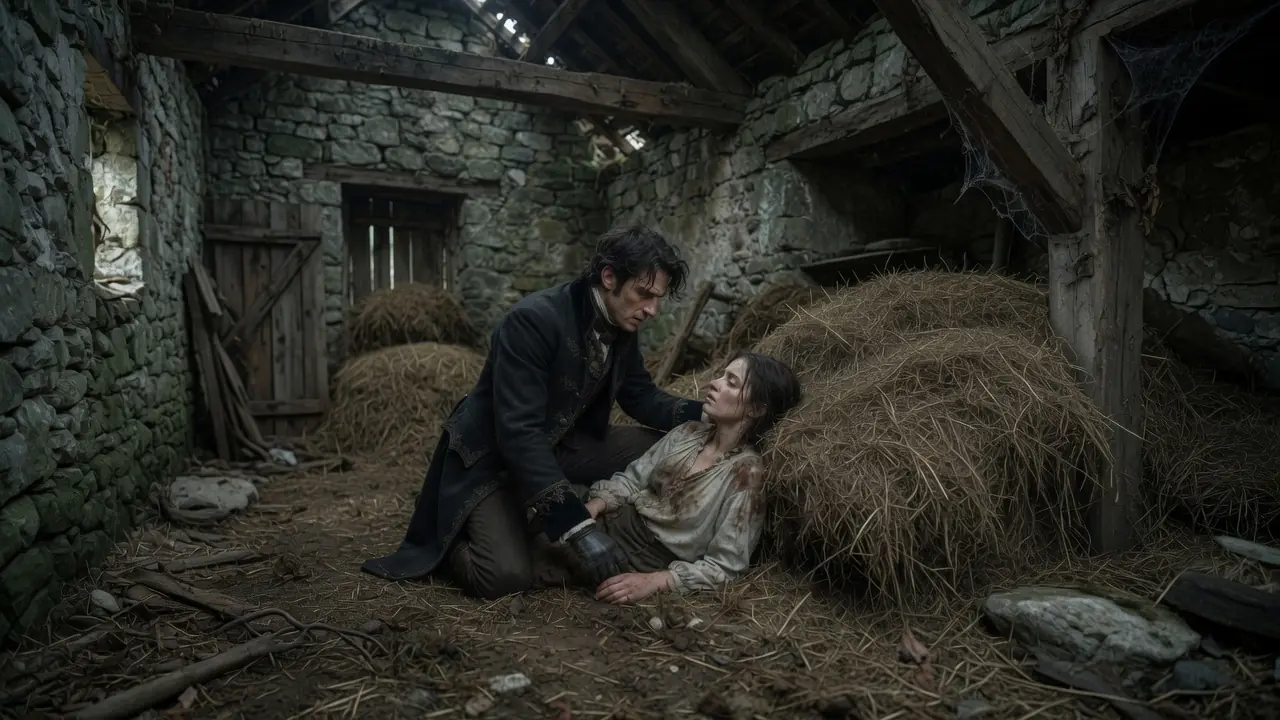
He was not certain who moved first. Perhaps they both did, drawn together by forces that had been building over weeks of working side by side, sharing ideas and efforts, learning to trust and rely on each other. His hand came up to cup her cheek, and she leaned into the touch. For a moment, they remained frozen in that position, poised on the edge of something that would change everything. Then Hugh's voice, calling that he was taking first watch, broke the spell.
Sophie drew back, and Gabriel let his hand fall, though he immediately regretted the loss of contact. "We should rest," Sophie said, her voice slightly unsteady. "Tomorrow will be another long day of travel." "Yes," Gabriel agreed, though what he wanted to say was something else entirely. They returned to Westmore the following afternoon, travel stained and exhausted, but triumphant.
Gabriel immediately dispatched his fastest messenger to London with a detailed report for Magistrate Crosby, including Sophie's completed maps and documentation. The reply came within three days. The magistrate would arrive at Westmore in ten days, exactly one week before the anticipated shipment, accompanied by soldiers sufficient to intercept and arrest Kemmore and his organization. "We have done it," Sophie said when Gabriel shared the news. "We have given the authorities what they need to act."
"You have done it," Gabriel corrected. "Without your cartographic expertise and courage, none of this would have been possible." Sophie smiled, but Gabriel noticed she appeared troubled. That evening, he found her in the library staring out the window at Westmore's gardens rather than working on maps. "What concerns you?" he asked gently.
Sophie turned to face him. "When this is finished, when Kemmore is arrested and the threat eliminated, I will need to leave Westmore. Return to my cottage and my surveying commissions, resume my actual life." "Is that what concerns you? Leaving?" "Yes," Sophie admitted.
"Which is foolish because I have always known my time here was temporary. But somewhere in the past weeks, Westmore began to feel less like a refuge and more like home. And you began to feel less like an employer and more like..." she trailed off, seeming unable or unwilling to complete the thought. "More like what?" Gabriel prompted softly, moving closer. Sophie met his eyes.
"More like someone I will miss desperately when I am gone." Gabriel took her hands in his, feeling the ink stains on her fingers, the calluses from holding surveying instruments. Working hands, honest hands, hands he had come to treasure. "Then perhaps you need not leave," he said. "Perhaps what began as temporary employment might become something more permanent, if you were willing."
He saw understanding dawn in her eyes, followed quickly by uncertainty. "Your grace, I am a cartographer without fortune or prospects. You are a duke." "The disparity in our stations matters considerably less than the compatibility of our minds and hearts," Gabriel interrupted. "These weeks working beside you have been among the happiest of my adult life."
"You challenge me intellectually, match my determination, and make me laugh when I forget how. I do not wish to return to the solitude I maintained before you stumbled bleeding into my life." "That is possibly the least romantic proposal I have ever heard," Sophie said. But she was smiling through tears that had begun to gather in her eyes. "Then allow me to improve upon it," Gabriel said and kissed her.
The week following their return from the reconnaissance expedition passed in a flurry of cartographic activity. Sophie worked with focused intensity, transforming field sketches and observations into polished maps suitable for presentation to Magistrate Crosby. Each document was meticulously labeled, cross-referenced with written descriptions, and organized to present irrefutable evidence of Lord Kemmore's smuggling operation. Gabriel found himself dividing his time between his usual estate management duties and assisting Sophie with the documentation. He wrote detailed accounts of what they had witnessed, provided historical context for the routes and warehouses, and compiled the financial irregularities his solicitor had uncovered in Kemmore's shipping records.
"This must be absolutely complete," Sophie said one afternoon, reviewing the assembled materials spread across the library table. "Kemmore will have access to excellent legal counsel. We cannot afford gaps or ambiguities that might be exploited to create reasonable doubt." "The evidence is overwhelming," Gabriel assured her. "Between your cartographic documentation, the decoded correspondence, the financial discrepancies, and eyewitness accounts of the warehouses in active use, no jury could acquit him."
"I hope you are right," Sophie replied, though worry shadowed her eyes. "Men of wealth and standing have escaped justice before on far more substantial evidence than this." Gabriel understood her concern. He had seen enough of the legal system to know that justice and the law did not always align perfectly. But he also had faith in Magistrate Crosby's competence and determination.
Security at Westmore had been quietly but substantially increased. Gabriel had positioned additional gamekeepers along the estate boundaries with instructions to report any unusual activity. The stable hands had been alerted to keep careful watch on the roads approaching the manor. Even the household staff without being told specific reasons understood that vigilance was required. It was this enhanced awareness that detected the visitor who arrived at the Langford cottage three days before the magistrate was expected.
The message came from Mrs. Hewitt, an elderly widow who lived near Sophie and Timothy's rented cottage in Surrey. Gabriel had taken the precaution of asking the woman to keep watch over the property during Sophie's extended absence, compensating her generously for the service. Her letter, delivered by express rider, was brief but alarming. "Three rough-looking men came to your cottage yesterday evening," she had written in a shaky hand. "They knocked aggressively, demanding to see Miss Langford."
"When your brother explained you were away on business, they became threatening. One grabbed Timothy and shook him quite violently, demanding to know where you had gone. Another searched the cottage, overturning furniture and scattering papers. Timothy managed to break free and ran to my house. The men followed, but did not force entry when I threatened to summon the constable."
"They left after perhaps an hour, but not before one told Timothy to tell his sister that Lord Kemmore does not appreciate interference in his affairs. Timothy is staying with me now. He is shaken, but not seriously injured, save for bruising on his arms where he was grabbed." Sophie's face went white as Gabriel read the letter aloud. Her hands gripped the edge of the table so tightly her knuckles showed pale.
"Timothy," she whispered. "They hurt Timothy because of me." "They hurt Timothy because they are criminals protecting their illegal activities," Gabriel corrected firmly. "This is not your fault, Sophie." "Is it not?" She turned to face him, anguish clear in her expression.
"I knew there was danger. I knew Kemmore's men were violent. Yet, I continued investigating, putting my brother at risk by association." "You could not have anticipated they would discover your identity and trace you to your home," Gabriel said. "And Timothy is safe now. Mrs. Hewitt showed considerable courage in protecting him."
"But for how long will he be safe?" Sophie asked. "If Kemmore's men return with greater numbers, Mrs. Hewitt cannot protect him. And if they learn he is connected to me, to this investigation..." Gabriel made a decision immediately. "I am sending a carriage to Surrey today with Hugh and four armed men."
"They will collect Timothy and Mrs. Hewitt, who deserves protection for her kindness, and bring them both to Westmore. Here they will be under my protection and my household security." Relief warred with guilt on Sophie's face. "Your grace, I cannot ask you to..." "You are not asking; I am offering and more than offering, insisting," Gabriel interrupted.
"Timothy is your family, which makes his safety my concern. And we discussed this possibility before. Bringing him here removes him from danger and allows him to verify your well-being with his own eyes." Sophie nodded slowly, blinking back tears she refused to shed. "Thank you. I will write to him immediately explaining what has happened and assuring him that I am well."
"And I will write to Mrs. Hewitt expressing my gratitude and inviting her to remain at Westmore as my guest for as long as she wishes," Gabriel added. "She has earned that consideration." Hugh departed within the hour, accompanied by Barnes, Pritchard, and two other men Gabriel trusted implicitly. The journey to Surrey and back would take two days if they traveled hard and encountered no difficulties. Gabriel ordered fresh horses positioned at coaching inns along the route to ensure maximum speed.
Those two days were among the most anxious Sophie had experienced since her initial injury. She tried to occupy herself with work, reviewing the documentation again and again, but Gabriel could see the worry that clouded her usually focused demeanor. She picked at her meals, slept poorly, and started at every unexpected sound. On the evening of the second day, as the sun set in brilliant oranges and purples beyond the library windows, the sound of carriage wheels on gravel announced Hugh's return. Sophie was at the entrance hall before Gabriel could rise from his desk, propriety abandoned in her need to see her brother safe.
Timothy Langford proved to be a younger, more slender version of his sister. At one and twenty, he had Sophie's dark hair and green eyes, though his features were more delicate, almost scholarly. He descended from the carriage with visible stiffness, and when Sophie embraced him, Gabriel saw him wince. "I am well enough, Sophie," Timothy said, though his voice betrayed the ordeal he had endured. "Bruised but intact."
"Mrs. Hewitt fussed over me like a mother hen until Mr. Mercer arrived." Mrs. Hewitt herself emerged next, a tiny woman of perhaps seventy with steel gray hair and eyes that missed nothing. "Miss Langford, I am relieved to see you recovered from your injury. Your brother was quite beside himself with worry when those dreadful men came calling." Gabriel stepped forward. "Mrs. Hewitt, I am Gabriel Toriston."
"Thank you for protecting Mr. Langford. Your courage and quick thinking may have saved his life." "Nonsense," Mrs. Hewitt said briskly, though she looked pleased. "I merely did what any decent neighbor would do. Those men were bullies, and I have never tolerated bullies." Mrs. Donnelly appeared to escort Mrs. Hewitt to prepared rooms, while Sophie led Timothy into the library where they could speak privately.
Gabriel followed after a discreet interval, giving the siblings a moment for reunion. When he entered, he found Sophie examining the bruises on Timothy's arms, her expression a mixture of fury and guilt. "This is my fault," she was saying. "I should have..." "You should have done exactly what you did," Timothy interrupted with surprising firmness.
"Sophie, you were attacked and nearly killed. Did you expect to simply ignore that and continue as though nothing had happened? These men are criminals. They would have continued their operations indefinitely if you had not investigated." "Timothy is correct," Gabriel said, making his presence known.
"And now we are in a position to end Kemmore's activities permanently. The magistrate arrives in five days with soldiers. One week after that, the major shipment arrives. We will intercept it, arrest everyone involved, and ensure they face justice." Timothy turned to Gabriel, studying him with an assessment that reminded Gabriel very much of Sophie.
"Your grace, my sister's letters mentioned your hospitality, but understated its extent. You have protected her, supported her investigation, and now extended that protection to me and Mrs. Hewitt. I am in your debt." "You owe me nothing," Gabriel replied. "Sophie's courage and expertise have been invaluable in uncovering a criminal enterprise operating on my lands. If anything, I am in her debt."
Something passed between the siblings, a look Gabriel could not quite interpret, but which seemed to involve understanding and approval. Timothy smiled slightly. "I am glad to hear it, your grace. My sister deserves to have her contributions recognized and valued." Over the following days, Timothy's presence at Westmore added a new dynamic to the household.
He proved to be intelligent and articulate with a dry wit that occasionally surfaced in conversation. He also served as an additional pair of hands for the documentation work, his clerk's training making him ideally suited for organizing and indexing the volumes of evidence they had compiled. Gabriel found himself liking the young man considerably. Timothy clearly adored his sister, deferring to her professional expertise, while also demonstrating a protective streak that Gabriel understood completely. They worked well together, Sophie and Timothy, their years of partnership evident in how smoothly they collaborated.
Three days before Magistrate Crosby's expected arrival, Gabriel was reviewing estate accounts in his study when Harrington announced an unexpected visitor. "Lord Kemmore, your grace. He presents his card and requests the honor of a brief audience." Gabriel felt cold calculations settle over him. Kemmore was taking a considerable risk by visiting Westmore openly. Either he was supremely confident in his own invulnerability, or he was attempting to assess how much Gabriel knew.
"Show him to the blue drawing room," Gabriel instructed, "and send word to Mr. Mercer that I wish him positioned discreetly nearby. Lord Kemmore should not leave without being observed." "At once, your grace." Gabriel took a moment to compose himself before entering the drawing room. Lord Kemmore stood by the window, examining a landscape painting with what appeared to be genuine interest.
He was a man of middling height and beginning corpulence, his once handsome features blurred by years of comfortable living. His clothing was expensive but conservative, the appearance of a successful merchant who understood his place in society's hierarchy. "Lord Kemmore," Gabriel greeted him with precisely calibrated courtesy. "This is unexpected. I trust all is well?"
"Quite well, your grace," Kemmore replied, turning with a practiced smile. "I apologize for calling without prior notice. I was riding in the area and thought I might pay my respects to a neighbor I have had too little opportunity to know." A transparent lie. Kemmore's estates in Sussex were a significant distance from Westmore; no one rode in the area without deliberate intent.
"You honor me with your attention," Gabriel said neutrally. "May I offer refreshment?" "Most kind but unnecessary. I will not trespass on your time extensively." Kemmore settled into a chair with the ease of a man accustomed to being welcomed.
"I have heard rumors, your grace, that you recently commissioned a survey of your lands." "I did," Gabriel confirmed, giving away nothing. "A routine matter of updating my maps and property records." "Of course, of course. Sound estate management requires accurate documentation," Kemmore agreed.
"I mention it only because I have been considering similar work on my own properties. Might I inquire as to who conducted your survey? If the work was satisfactory, I would be interested in engaging the same cartographer." The audacity of the question momentarily silenced Gabriel. Kemmore sat before him, inquiring pleasantly about the identity of the woman his men had attacked and whose brother they had subsequently threatened.
Either he did not realize Gabriel knew of his involvement, or he was conducting reconnaissance to determine exactly how much Gabriel had uncovered. "The cartographer I engaged is currently occupied with other commissions," Gabriel said carefully. "I would be hesitant to recommend anyone without certainty of their availability." "Naturally, professional discretion is admirable." Kemmore's smile did not quite reach his eyes.
"I have also heard concerning reports of men operating on the borders of our properties, poachers perhaps, or vagabonds. Have your gamekeepers noticed any unusual activity?" "My lands are well patrolled," Gabriel replied. "I am confident my gamekeepers would report anything suspicious." "I am reassured to hear it," Kemmore rose, apparently satisfied with whatever information he had gained or failed to gain from the visit.
"Forgive me for disturbing your afternoon, your grace. I merely wish to establish better acquaintance with a neighbor I have neglected to know properly." "You are always welcome at Westmore," Gabriel lied with perfect courtesy. After showing Kemmore out and watching his departure from the window, Gabriel immediately went to find Sophie in the library. She looked up from the map she was studying as he entered.
"Kemmore was just here," he said without preamble. Sophie's expression shifted to alarm. "Here at Westmore? What did he want?" "Information, I suspect; he inquired about my cartographer and mentioned hearing reports of men on our shared boundaries," Gabriel explained.
"He was testing, trying to determine what I know." "And what did you tell him?" "Nothing of substance, but his visit confirms that he is aware of being investigated, even if he does not know the extent of our evidence," Gabriel said grimly. "We must be even more careful these next few days." That evening at dinner, with Timothy and Mrs. Hewitt present, Sophie seemed distracted.
After the meal concluded, and Mrs. Hewitt had retired to her rooms, Sophie asked Gabriel and Timothy to join her in the library. "I have been reviewing the historical maps again," she said, spreading several documents across the table, "particularly those showing Kemmore's estate in Sussex. And I discovered something we missed previously." She pointed to a map dated 1768. "This shows the original manor house and grounds of what is now Kemmore's principal property."
"But look here, these dotted lines indicating underground features." Gabriel leaned closer. "Tunnels. Smugglers' tunnels, almost certainly." Sophie confirmed.
"This coastline was notorious for smuggling in the 18th century. Many properties had underground passages connecting to the shore, allowing contraband to be moved inland without being seen from the surface. Most have collapsed or been deliberately filled in over the decades. But if Kemmore's tunnels remain intact, he has a direct route from the port at Hastings to his estate, completely hidden from observation." Gabriel finished, understanding dawning, "Which means he could move the weapons shipment without ever being visible on the roads."
"Exactly. And more troubling, if he suspects he is being watched, those tunnels provide a perfect escape route," Sophie said. "He could flee to the coast and board a ship for the continent before anyone could stop him." Timothy studied the map thoughtfully. "Could the tunnels be blocked? Collapsed to prevent their use?"
"Not without alerting Kemmore that we know of their existence," Gabriel said, "and likely not quickly enough to matter. The shipment arrives in less than a week." "Then we ensure the magistrate knows of this route," Sophie said. "He must position soldiers to cover not just the surface roads, but the tunnel exits. We cannot allow Kemmore to slip away after all of this."
Gabriel nodded, already composing in his mind the addendum he would send to Magistrate Crosby. This discovery, this final piece of the puzzle, might make the difference between capturing a criminal organization and watching its leader escape justice. As they worked late into the night, adding the tunnel system to their documentation, Gabriel found himself watching Sophie. The lamplight caught her features as she bent over the maps, her expression intent, her inkstained fingers precise in their movements. She had come into his life bleeding and desperate, a stranger in need of help.
Now she sat across from him as partner, friend, and if he were honest with himself, something considerably more than either of those. Whatever happened in the coming days, whatever dangers they still faced, Gabriel knew with absolute certainty that Sophie Langford had changed his life irrevocably. And he would do whatever necessary to ensure she remained part of it. Magistrate William Crosby arrived at Westmore Manor precisely as planned, one week before the anticipated shipment. He was a man of perhaps fifty years with iron gray hair and the sharp assessing eyes of someone who had spent decades evaluating evidence and human nature in equal measure.
Ten soldiers accompanied him, experienced men who moved with military precision despite wearing civilian clothing to avoid drawing attention. Gabriel received them in his study where Sophie had prepared a comprehensive presentation of their findings. The maps covered every surface, each one meticulously labeled and cross-referenced. Timothy had created an index system that allowed them to locate any specific piece of evidence within moments. Crosby spent three hours examining the documentation, asking pointed questions, testing the strength of their conclusions.
Sophie answered with confidence, walking him through the cartographic evidence, explaining how historical routes aligned with observed smuggling activity, demonstrating how the coded correspondence matched the physical locations they had documented. "This is exceptional work," Crosby said finally, straightening from the table where he had been studying a particularly detailed map of the warehouse network. "Miss Langford, your expertise has provided the crown with evidence that would take a team of investigators months to compile. His grace was correct to speak so highly of your abilities." Sophie flushed slightly at the praise. "I merely documented what was there to be found."
"Sir, Lord Kemmore's organization was extensive, but not particularly subtle once one knew where to look." "Nevertheless, subtlety or lack thereof, you have given us what we need to dismantle a criminal enterprise that has operated with impunity for years." Crosby turned to Gabriel. "Your grace, I propose the following plan of action. My soldiers, augmented by trusted local constables, will position themselves at the port of Hastings to intercept the shipment as it arrives."
"Simultaneously, your men, who know this terrain intimately, will cover the inland routes to prevent any cargo that escapes the port from reaching Kemmore's warehouses." "A sound strategy," Gabriel agreed. "But we must also account for the tunnel system Miss Langford discovered. If Kemmore suspects the operation is compromised, he may attempt to flee through those underground passages." Crosby nodded thoughtfully.
"Then we position men at the known tunnel exits as well. The goal is total containment. No cargo escapes and more importantly, no smugglers evade arrest." "When do we move into position?" Hugh asked from where he stood near the door.
"We have six days before the shipment arrives," Crosby replied. "I propose we use three of those days for final reconnaissance and preparation. On the fourth day, we move our forces into position under cover of darkness. Then we wait." Sophie, who had been studying her maps during this exchange, spoke up.
"Magistrate Crosby, I should accompany your forces during the operation. I know these routes better than anyone, and if Kemmore's men deviate from expected paths, I can anticipate where they might go." "Absolutely not," Gabriel said immediately, his tone brooking no argument. Sophie's chin lifted with familiar stubbornness. "With respect, your grace, my knowledge could mean the difference between capturing Kemmore and watching him escape."
"These are my maps, my documentation. I know every alternate route, every hidden path." "Which you can communicate to the men who will be positioned along those routes," Gabriel countered. "There is no need for you to be physically present during what will almost certainly become a violent confrontation." "His grace is correct, Miss Langford," Crosby interjected gently.
"Your courage is commendable, but you are a civilian and more importantly a witness whose testimony will be crucial in the subsequent trial. I cannot in good conscience allow you to put yourself at risk." Sophie looked as though she might argue further, but Timothy placed a hand on her arm. "Sophie, please, you have already been attacked once. Do not ask me to watch you deliberately walk into danger again."
Gabriel saw the conflict on her face: professional pride warring with familial consideration. Finally, she nodded reluctantly. "Then I will remain at Westmore, but I want detailed reports of everything that occurs." "You have my word," Crosby promised. The following three days were consumed with preparation.
Crosby's soldiers scouted the port at Hastings, identifying optimal positions for observation and interception. Gabriel's gamekeepers and trusted men from nearby estates rehearsed their roles, learning the routes from Sophie's maps until they could navigate them blindfolded. Hugh coordinated between the military forces and the civilian volunteers, his decades of combat experience proving invaluable. Sophie threw herself into the planning with intensity that bordered on obsession. She created detailed instructions for each team, noting landmarks they could use for orientation in darkness.
She identified positions that offered tactical advantage, marking locations where communication between groups would be possible. Gabriel found her in the library late on the second night, still working by lamplight, though exhaustion shadowed her eyes. "You should rest," he said gently, entering and closing the door behind him. "I will rest when this is finished," Sophie replied without looking up from the map she was annotating. "When Kemmore is in custody and can no longer threaten anyone."
Gabriel crossed to her, taking the pencil from her hand despite her protest. "Sophie, you have prepared everything that can be prepared. The operation will succeed or fail based on execution and fortune, neither of which you can control by drawing more maps." She finally raised her eyes to meet his, and he saw the fear there that she had been suppressing through manic activity. "What if something goes wrong?"
"What if someone is killed because my maps were incomplete or my instructions unclear?" "Then it will be the fault of criminals who chose violence, not of a cartographer who provided every tool possible for their capture," Gabriel said firmly. He drew her to her feet, noting how she swayed slightly with fatigue. "Come, you need food and sleep in that order." In the small dining room, Mrs. Donnelly had left a cold supper under covers.
Gabriel served Sophie himself, insisting she eat while he told her about the preparations, keeping his tone light and reassuring. "Hugh has the men drilling like soldiers," he said. "Barnes complained that he signed on as a gamekeeper, not a cavalry officer, but I noticed he was the first to volunteer for a forward position." Sophie managed a small smile. "Hugh would volunteer for the most dangerous position; he cannot help himself."
"A trait you share," Gabriel observed, "which is why I am grateful Magistrate Crosby insisted you remain safe." "I hate being kept away from something I helped create," Sophie admitted. "These past weeks, I have felt useful in a way I never did before. Important, as though my work mattered beyond simply earning enough to pay rent." "Your work has always mattered," Gabriel said quietly.
"But I understand what you mean; having one's contributions recognized and valued changes how one sees oneself." They sat in comfortable silence for a while. The only sound was the ticking of the mantel clock and the occasional pop from the fireplace. Finally, Sophie spoke again. "When this is over, when Kemmore is arrested and the danger has passed, what happens then?"
Gabriel set down his wine glass carefully. "That depends on several factors. What you wish to happen, what I hope will happen, whether those two align." "And what do you hope will happen?" Sophie asked, her voice barely above a whisper. "I hope you will agree to remain at Westmore," Gabriel said, meeting her eyes directly.
"Not as a temporary guest, but as a permanent resident, as my wife, if you will have me." He saw her breath catch, saw surprise and hope and uncertainty cross her features in rapid succession. "Gabriel, I am a cartographer without fortune or social standing. You are a duke." "The disparity... the only disparity that concerns me is the one between my happiness before you arrived and my happiness now," Gabriel interrupted.
"You have shown me what partnership means, Sophie. Working beside someone whose mind matches yours, whose courage inspires you, whose presence makes every day more interesting than the last. I do not wish to return to solitude after knowing that." "I do not wish to return to it either," Sophie admitted softly. "These weeks at Westmore, working with you have been the happiest of my life. But marriage is more than partnership; it requires..."
"It requires trust, respect, shared purpose, and affection," Gabriel listed. "All of which we have developed naturally. Love, I suspect, is already present as well, though perhaps neither of us has named it yet." "Love," Sophie repeated, testing the word, then with more certainty, "Yes, I believe it is." Gabriel rose and moved to kneel beside her chair, taking her inkstained hands in his.
"Then, after this business with Kemmore is concluded, when the danger has passed, and you have had time to consider without the pressure of circumstance, I will ask you properly with a ring and a formal proposal. But I wanted you to know now before the operation begins that you have become essential to my happiness. Whatever happens in the coming days, that truth remains." Sophie freed one hand to cup his cheek, her touch gentle. "I suspect I will say yes, Gabriel Toriston." "But you are right that we should wait until this is finished; I would like to accept your proposal without the shadow of Kemmore hanging over us."
They remained that way for a long moment, hands joined, eyes locked, the connection between them palpable. Then Gabriel rose and drew Sophie to her feet. "Now you will sleep," he said. "Tomorrow begins three very long days, and I need you rested and ready to manage the communication center we are establishing here at Westmore." Sophie nodded, allowing him to escort her to her chambers.
At the door, she turned and kissed him briefly, a promise of things to come. Then she disappeared inside, leaving Gabriel standing in the corridor with his heart considerably lighter than it had been in years. On the fourth day, as planned, the forces moved into position. Crosby's soldiers traveled to Hastings in small groups, disguising themselves as merchants and travelers to avoid alerting Kemmore's watchers. Gabriel's men dispersed along the inland routes, concealing themselves in the woods and ruins that Sophie's maps had identified as offering optimal cover and sight lines.
Westmore Manor became a communication hub. Riders would carry reports between positions, converging at the estate where Sophie, Timothy, and Mrs. Donnelly would coordinate information and relay instructions. It was not the active role Sophie had wanted, but Gabriel could see she took satisfaction in orchestrating the operation from this central location. Three days of tense waiting followed. Each morning brought rider reports that positions remained secure, no unusual activity detected.
Each evening brought the same. The waiting was harder than action would have been. Then on the sixth night, word came from Hastings. A ship flying French colors had docked at sunset. Crates were being unloaded under guard, transferred to waiting wagons.
Crosby's forces were in position. The operation would begin within the hour. At Westmore, Sophie tracked movements on her master map, marking positions as riders brought updates. The initial reports were positive. Crosby's soldiers intercepted the wagons as they left the port, arresting drivers and guards with minimal resistance.
The cargo was secured, crates of French muskets and pistols exactly as the decoded letter had predicted. But Kemmore himself was not among those arrested at the port. And within the hour, a rider brought concerning news. A small group, perhaps six men, had been spotted moving rapidly along one of the secondary routes, heading inland toward Kent, away from the main smuggling operation, away from the warehouse network. "It is Kemmore," Hugh said grimly, studying Sophie's map.
"He knew the port might be compromised. This is his escape route." Sophie traced the route with her finger, her mind working rapidly. "They are heading toward this valley where multiple paths converge. From there, they could reach the Sussex border and the tunnel system within three hours. If they make it underground, we will never find them."
"Which route will they take?" Hugh asked. Sophie studied the map intently, considering terrain, distance, and what she knew of how Kemmore's organization operated. Finally, she pointed to a narrow path that wound through forested hills. "This one. It is longer but offers better cover."
"A man fleeing would choose concealment over speed." Hugh was already moving toward the door. "I will ride to intercept." "Not alone," Sophie said immediately. She turned to one of the waiting riders.
"Bring this map to his grace. Tell him Kemmore is escaping along the northern forest route and that Mr. Mercer and I are moving to delay him until reinforcements arrive." "Sophie, no," Timothy protested. "You promised." "I promised to remain at Westmore during the port operation," Sophie corrected, already pulling on her riding coat.
"That operation is concluded. Kemmore is escaping, and I am the only one who knows these routes well enough to predict where he might go. I must do this, Timothy." She was out the door before her brother could argue further, Hugh at her side. They rode hard through the darkness, guided by Sophie's intimate knowledge of the terrain. The moon was bright enough to illuminate their path, though shadows made footing treacherous.
"There," Sophie said after perhaps thirty minutes, pointing to a narrow defile between two hills. "They must come through there; it is the only route that makes sense." They dismounted, and Hugh quickly assessed the location. "We can create a blockade. Not enough to stop them, but enough to slow them, give his grace time to arrive with reinforcements." Working quickly, they dragged fallen logs and loose stones across the narrowest part of the passage, building an obstacle that would require time and effort to clear or circumvent.
Sophie positioned their horses to block the path as well, maximizing the barrier. They had barely finished when the sound of approaching riders echoed through the defile. Six mounted men appeared, moving at speed, their leader unmistakably Lord Kemmore, despite the darkness and his rough traveling clothes. "Stand aside," Kemmore commanded, pulling his horse to a halt before the barricade. His voice carried the fury of a man whose carefully constructed empire was collapsing.
"Move now, and I will let you live." "I think not, Lord Kemmore," Hugh replied, his hand resting casually on the pistol at his belt. "You are under arrest for smuggling, conspiracy, and assault. You will surrender your weapons and wait here for the magistrate's men." Kemmore's laugh was ugly.
"You think two people can stop six armed men? You are either very brave or very stupid." "Three people," came Gabriel's voice from behind Kemmore's group. He emerged from the shadows with Barnes, Pritchard, and four other men, all armed and positioned to cut off retreat. "You are surrounded, Kemmore. Your operation is destroyed."
"Your men captured, your cargo seized. Surrender now, and perhaps the court will show mercy." For a moment, Kemmore seemed to consider his options. Then his hand moved toward his weapon. Hugh's pistol cleared leather first, the shot echoing through the defile, but deliberately aimed to wound rather than kill. Kemmore's horse reared, throwing him to the ground.
His men, seeing themselves surrounded and outgunned, raised their hands in surrender. Gabriel dismounted and crossed to Sophie, his expression a mixture of relief and exasperation. "You were supposed to remain at Westmore." "I was supposed to coordinate," Sophie corrected, "which I did. We created a barrier that delayed Kemmore until you arrived."
"Coordination does not always occur from behind a desk, your grace." Despite everything, Gabriel found himself smiling. "No, I suppose it does not." As Kemmore and his men were placed in custody, Gabriel turned to Sophie. "You do realize that once we are married, I will spend the rest of our lives worrying about what dangerous situation you have ridden off to investigate."
"And you do realize that I will spend the rest of ours ensuring you remember that courage and caution are not mutually exclusive," Sophie replied. Hugh, overhearing this exchange, allowed himself a rare grin. "Miss Sophie, I believe his grace has met his match." "Ah, yes," Gabriel agreed, looking at Sophie with undisguised affection and admiration. "I rather believe he has."
Dawn broke over the hills of Kent with unusual brilliance, as though nature itself celebrated the victory won during the night. By the time the sun fully rose, Magistrate Crosby had arrived at the site where Kemmore and his men were being held under guard, transforming what had been a tense standoff into an orderly transfer of prisoners into crown custody. Gabriel stood with Sophie, watching as Kemmore was loaded into a reinforced carriage that would transport him to London for trial. The man who had conducted a criminal empire with such confidence now appeared diminished, his expensive clothing muddied and torn, his expression one of disbelief that his carefully constructed world had collapsed in a single night. "Fifteen men in total," Crosby reported, consulting a list one of his sergeants had prepared.
"Lord Kemmore, his chief lieutenant, and thirteen others involved in various aspects of the operation. The port seizure netted another twenty workers and guards. We estimate we have captured ninety percent of the organization." "What of the remaining ten percent?" Gabriel asked. "Minor figures who will either turn themselves in once word spreads or flee the region entirely," Crosby replied.
"Either outcome serves justice adequately. The leadership is destroyed and that is what matters." The cargo seized at Hastings proved to be exactly what Sophie's decoded letter had predicted. Crates containing two hundred French manufactured muskets, fifty pistols, ammunition, and a separate collection of forged identity papers and travel documents. The weapons alone represented a significant threat, potentially arming criminal enterprises or even seditious elements throughout England.
The documents were perhaps more dangerous still, enabling wanted men to establish false identities and evade justice. "This operation has been running for at least five years," Crosby explained as they reviewed the evidence later that morning at Westmore. "Lord Kemmore's account books, which we found at his estate, detailed transactions dating back to 1820, and the investigation has already revealed three other men of standing who were involved in facilitating the smuggling. A magistrate in Sussex who overlooked customs irregularities. A banker in London who laundered the proceeds."
"A shipping agent in Portsmouth who falsified cargo manifests." "All arrested?" Gabriel asked. "All in custody as of two hours ago," Crosby confirmed with satisfaction. "When a criminal enterprise of this scale collapses, it collapses completely. Associates scramble to save themselves by providing evidence against others."
"Within a week, we will have testimony sufficient to convict everyone involved." Sophie, who had been listening quietly while reviewing her maps one final time, spoke up. "What will happen to Lord Kemmore's properties and assets?" "Confiscated by the crown," Crosby replied. "Standard procedure for convicted smugglers and traitors."
"The properties will be sold with proceeds going to compensate victims of Kemmore's crimes and to fund the crown's ongoing efforts against smuggling operations." Over the following days, as the magnitude of what they had accomplished became clear, recognition arrived from London. The Lord Chancellor himself sent a letter commending Gabriel for his service to British justice and the security of the realm. Such recognition from the highest legal authority in the kingdom was rare, and it came with an invitation to discuss the matter personally when Gabriel next visited London. But it was the second letter addressed to Miss Sophie Langford that meant more to Gabriel than his own commendation.
It came from the Royal Society of Cartographers, an august body that rarely acknowledged anyone outside its membership, and never a woman. Sophie read the letter aloud in the library, her voice unsteady with emotion. "The society recognizes Miss Sophie Langford for exceptional cartographic work in service to the crown. Her surveys and documentation proved instrumental in dismantling a significant criminal enterprise. The precision and accuracy of her maps represent a standard to which all professional cartographers should aspire."
"While current regulations prevent the society from offering Miss Langford full membership, we extend honorary recognition of her expertise and contributions to the field." "Honorary recognition," Timothy repeated, grinning broadly. "Sophie, do you understand what this means? You are officially acknowledged as one of the finest cartographers in England." "It means I can sign my real name on my work," Sophie said softly.
"No more hiding behind ambiguous initials. No more pretending to be someone I am not." Gabriel felt profound satisfaction at seeing her honored properly. "It is no more than you deserve. Your work solved a mystery that might have continued indefinitely without your expertise."
The legal proceedings moved forward with remarkable efficiency. Kemmore's trial was scheduled for six weeks hence, with Sophie and Gabriel both listed as witnesses. In the meantime, Timothy remained at Westmore, and Mrs. Hewitt seemed content to extend her visit indefinitely, having formed a fast friendship with Mrs. Donnelly over their shared love of gossip and management of household affairs. Two weeks after Kemmore's arrest, life at Westmore had settled into a new rhythm.
The immediate danger had passed. The evidence had been delivered to the appropriate authorities. There was, Gabriel realized with growing unease, no longer any practical reason for Sophie to remain. He found her in the library one afternoon packing her surveying instruments into their protective cases. The sight sent an unexpected jolt of panic through his chest.
"You are preparing to leave," he said, keeping his voice carefully neutral. Sophie turned and he saw the same conflict he felt reflected in her expression. "The commission that brought me here is complete. My work is finished. I should return to Surrey, resume my professional activities."
"I have other clients waiting, other surveys to conduct." "Of course," Gabriel said, though the words felt like ashes in his mouth. "You have your own life and career to attend to." They stood in awkward silence for a moment, both acutely aware of what had grown between them during the week she had spent at Westmore. The partnership they had formed, the respect and admiration that had deepened into something far more profound, the careful kiss they had shared, and the half-formed promises that had been made in the shadow of danger.
"Would you walk with me," Gabriel asked suddenly, "in the gardens? There is something I wish to discuss." Sophie set down the theodolite she had been wrapping and nodded. "I would like that." The autumn gardens of Westmore were at their finest, the trees ablaze with gold and crimson, the last roses of the season still blooming along the formal pathways.
They walked in silence initially, their steps in unconscious synchronization until they reached the ornamental lake, where swans glided across the mirror-still water. "When you first arrived at Westmore, bleeding and half-conscious, I saw you as a problem to be solved," Gabriel began. "Someone in distress who required assistance. I provided that assistance out of basic human decency, nothing more." He paused, choosing his words carefully.
"But over these weeks, as we worked together, as I came to know your mind and your character, you transformed from a problem into a partner. Someone whose intelligence challenged me, whose courage inspired me, whose presence made every aspect of my life more interesting and more meaningful." Sophie remained silent, but he saw her eyes glisten with unshed tears. "I have been alone for three years," Gabriel continued. "Since my wife died, I convinced myself that solitude was preferable to the risk of loss."
"I focused on duty, on estate management, on parliamentary responsibilities. I told myself I was content. But the truth, which I only recognized after you arrived, is that I was merely existing, not living." He turned to face her fully, taking her hands in his. "You taught me to live again, Sophie. To engage not just with responsibilities but with ideas, with challenges, with another person in genuine partnership."
"I do not wish to return to solitude. More than that, I do not believe I can return to it. Not after knowing what partnership with you feels like." "Gabriel," Sophie whispered, his name a question and an answer all at once. "I know that your independence is precious to you," he said.
"I know that you have fought hard to establish yourself professionally, that you value your autonomy and your ability to support yourself through your own skills. I would never ask you to abandon that. What I am proposing is not that you give up who you are, but that you consider allowing who you are to include being my wife, my partner in all things." "The social disparity," Sophie began, but Gabriel shook his head. "Is irrelevant."
"You are the daughter of a viscount. I am a duke. In terms of the peerage, we are both nobility, merely at different ranks. More importantly, in terms of what actually matters, we are equals. Your mind matches mine, your courage equals mine, your integrity surpasses mine in many respects."
"That is the foundation for partnership, not titles or social standing." Sophie looked down at their joined hands, her inkstained fingers intertwined with his. "I am a working woman, Gabriel. I take commissions for money. I travel alone with my assistant, I wear men's clothing when surveying, I sleep in barns and taverns."
"Society will not look kindly on a duchess who behaves so unconventionally." "Then society can expand its narrow definitions," Gabriel replied with unexpected fierceness. "Or it can disapprove. I find I care very little. What I care about is spending my life with someone who makes me better."
"Someone who challenges me to think more clearly and act more courageously. Someone whom I love, Sophie, because that is the truth I have been avoiding naming. I love you." The tears Sophie had been holding back finally spilled over. "I love you as well. I have been fighting against it, telling myself it was impossible, that our circumstances were too different, that I should not allow myself to hope."
"But I do love you, Gabriel, so very much." Gabriel released one of her hands to reach into his coat pocket, withdrawing a small velvet box he had retrieved from the Westmore vault that morning. Inside was a ring that had belonged to his grandmother, a delicate band of gold set with an emerald surrounded by small diamonds. "This ring has been worn by Duchesses of Westmore for three generations," he said, opening the box. "My grandmother was a remarkable woman; she managed estates, supported her tenants, and spoke her mind in an era when women were expected to remain silent."
"She would have admired you greatly. I can think of no one more worthy to wear her ring." He knelt on the garden path, propriety abandoned in favor of traditional gesture. "Sophie Langford, will you do me the profound honor of becoming my wife? Will you allow me to be your partner in cartography and in life?"
"Will you help me transform Westmore from merely a well-managed estate into a true home?" Sophie pulled him to his feet, laughing through her tears. "Yes, Gabriel Toriston. Yes to all of it. I will marry you, I will be your partner, I will help you make Westmore home, but only if you promise never to kneel on cold ground again."
"Your title may make you a duke, but it does not make you immune to rheumatism." Gabriel laughed, a sound of pure joy, and slid the ring onto her finger. It fit perfectly, as though made for her hand. Then he kissed her, properly this time, without the shadow of danger hanging over them, a kiss of promise and partnership and love that had been earned through shared trials and mutual respect. When they finally separated, both somewhat breathless, Sophie held up her hand to admire the ring.
"It is beautiful, but you know people will talk. The Duke of Westmore marrying a cartographer who was recently attacked while surveying his lands. It has the makings of quite a scandal." "Let them talk," Gabriel said, drawing her close again. "We have nothing to hide. We met through professional circumstances, formed a partnership that became something deeper, and chose to build a life together."
"If that scandalizes society, society needs better things to occupy its attention." They remained in the gardens as the afternoon light shifted toward evening, making plans for the future. The wedding would be at Westmore with family and close friends in attendance. Sophie would maintain her cartography practice, using Westmore as a base for her professional work. Timothy would remain with them, training in estate management under Gabriel's guidance while continuing his legal studies.
"And Mrs. Hewitt," Sophie asked with a smile, "do we retain her as a permanent resident?" "She and Mrs. Donnelly have become quite inseparable. I believe Mrs. Hewitt has no intention of leaving," Gabriel replied, "and I find I am pleased by that. A home should have people in it who make it lively." That evening they announced their engagement to the household and to Timothy, who had suspected but tactfully said nothing until confirmation arrived.
Mrs. Donnelly wept with joy. Hugh shook Gabriel's hand and told Sophie she was getting a good man who had his father's honor. Mrs. Hewitt declared it the most romantic thing she had witnessed in seventy years and immediately began planning what advice she would offer for the wedding. Within days, word spread through the local society. The Duke of Westmore, who had remained unwed since his wife's death three years ago, was engaged to the cartographer who had helped dismantle a criminal empire.
The woman who had been recognized by the Royal Society itself for her exceptional skills. The reactions ranged from surprise to approval to delighted scandal. But Gabriel noticed that even the most critical voices were muted by the undeniable facts. Sophie's professional competence had been formally recognized. Her courage was a matter of public record, and Gabriel's own standing made any serious criticism of his choice unthinkable.
"We have done it," Sophie said one evening as they stood together on the terrace, watching stars emerge in the darkening sky. "We stopped Kemmore, preserved evidence that will convict him, and found something neither of us expected to find." "What is that?" Gabriel asked, though he knew the answer. "Each other," Sophie replied simply.
"And a future that is better than anything I dared imagine when I rode onto your lands with my surveying equipment weeks ago." "Our home." Gabriel drew her close, breathing in the scent of ink and paper and autumn air that had become so familiar. "Then I am grateful that Perseus returned home alone that night. Grateful that you left those bloodstained maps in his saddlebag."
"Grateful for every circumstance that brought you into my life." "Even the being attacked part?" Sophie asked with gentle teasing. "Perhaps not grateful for that," Gabriel admitted, "but grateful for your courage in surviving it. And grateful beyond measure that you trusted me to help you see justice done." They stood together as night fell completely.
Two people who had found partnership in unexpected circumstances and chosen to build something lasting from it. Tomorrow would bring new challenges, new surveys to complete, new aspects of their life together to navigate. But tonight they had each other. And for both of them, that was more than enough. Westmore Chapel had never looked more alive.
Sunlight spilled through its narrow arched windows, catching motes of dust and turning them into drifting flecks of gold that danced above polished pews and fresh autumn flowers. The air held a faint scent of beeswax and roses from the garlands twined along the simple stone columns. Outside, bells rang a clear, steady peal that seemed to hum in Sophie's bones as she stood just beyond the threshold, her hand resting lightly on Timothy's arm. "You can still bolt," her brother murmured, keeping his voice low enough that only she could hear. "I will create a diversion, collapse dramatically, perhaps."
Sophie huffed a soft laugh in spite of the tightness in her chest. "You would not make it three steps before Mrs. Hewitt diagnosed you as malingering." "True," Timothy conceded. "You do realize you are about to walk down that aisle and marry a duke." "I realize I am about to walk down that aisle and marry Gabriel," she corrected.
"The ducal part feels secondary." The doors opened. The murmur in the chapel stilled, sound drawing inward and coiling around the soft rustle of her skirts as she stepped inside. For a heartbeat, everything seemed blurred at the edges: faces, flowers, the pale shimmer of her own gown. Then her gaze found Gabriel at the far end of the aisle, and the world sharpened into sudden crystal clarity.
He stood before the modest altar, tall and straight in formal dark coat and immaculate cravat, hair tamed more thoroughly than she had ever seen it, blue eyes fixed on her with an intensity that turned her knees unexpectedly weak. The carefully contained duke was nowhere to be seen. What looked back at her was simply the man who had found her bleeding in a ruined barn and decided without hesitation that her life was now his concern. "Ready?" Timothy whispered. "Yes," she answered, and was surprised to discover that she meant it entirely.
They moved forward together, step by measured step, along the stone aisle. Sophie was dimly aware of those present. Mrs. Donnelly was already dabbing at her eyes with the corner of her apron despite her best attempt at maidly restraint. Mrs. Hewitt was erect and alert in the second pew, small hands folded like a commander inspecting a successful campaign. Hugh Mercer was near the front, shoulders squared, expression fierce with something that looked suspiciously like pride.
Yet each time her focus slipped outward, it snapped back to Gabriel. He did not look away, not even to greet the magistrate seated to one side, or the neighboring landowners who had come more out of respect for him than curiosity over her. As she drew closer, she could see the minute movements of his hands, the faint tightening and relaxing that betrayed nerves he would never have admitted aloud. At the front, Timothy placed her hand in Gabriel's with a quiet, "Try not to ruin her maps!" that made Gabriel's mouth curve for an instant. "I will do my best," he replied.
Then Timothy stepped back and the vicar began to speak. The words of the service were familiar phrases Sophie had heard at other weddings in other churches when she had stood at the fringes, an onlooker rather than participant. Yet spoken now with her hand anchored in Gabriel's, and his gaze steady on hers, the old vows seemed to take on new weight. "I, Gabriel James Toriston, take thee, Sophie Langford, to be my wedded wife," he said, voice low but carrying. "To share my home, my work, and my life, to honor your mind as much as your heart, to stand beside you in danger and in quiet days alike, to trust you and to be worthy of your trust."
It was more than the traditional formula, and Sophie saw the vicar's brows lift slightly in mild surprise, but no correction came. Gabriel could not have spoken the bare pattern of the ritual. It was not in his nature to leave unspoken what he now understood to be essential. When her turn came, Sophie drew a careful breath, felt the roughened warmth of his fingers wrapped around hers, and spoke into that steady blue gaze. "I, Sophie Langford, take thee, Gabriel Toriston, to be my wedded husband, to walk beside you, not behind you, to tell you the truth when it is comfortable and when it is not."
"To share in your burdens and in your joys. To use the skills I have, whether of maps or mind, in service of the life we build together, to choose you each day, even when the way ahead is not clearly drawn." The plain gold band slid easily onto her finger to rest against the emerald he had already given her, the two rings catching the light when she flexed her hand. When the vicar spoke the final blessing and invited the groom to kiss the bride, Gabriel did so with a reverence that made the chapel's simple stone seem, for an instant, like the most sacred place in England. The hall at Westmore later that morning held less solemnity and considerably more noise.
Sophie stood near the great fireplace for what felt like hours as a stream of well-wishers approached. Some were neighbors who had known Gabriel for years. Others were tenants who had heard of the Duke's upcoming marriage and had insisted on offering personal congratulations. A few were distant relations Sophie had never met before, all of whom seemed eager to claim her as cousin, niece, or something equally improbable now that she held a ducal title. "You will be insufferable now," Timothy said cheerfully when his turn came again, this time without the weight of escorting her down an aisle.
"I was insufferable before," Sophie retorted. "Ask any magistrate who received an unsolicited map correcting his jurisdictional boundaries." Timothy grinned. "True, but now they must listen." Hugh's congratulations came next, expressed more through the firm warmth of his handshake than through the few words he offered.
"You have chosen well, your grace," he said to Gabriel, then to Sophie, "And so have you." "I know," she said simply, meeting his gaze with all the gratitude she could not quite voice. "As do we all," Mrs. Hewitt declared, inserting herself neatly into the conversation. "Now, if no one objects, I will be in charge of ensuring no one drinks enough to fall into the ornamental lake. I do not trust that young Mr. Barnes after the third glass of punch."
"Under your command, Mrs. Hewitt, even the lake will behave," Gabriel said gravely, earning a satisfied sniff from the older woman as she bustled away. Later, when the meal had been eaten and the toasts given—Timothy's unexpectedly eloquent, Hugh's short and heartfelt, the magistrate's filled with dry humor about how he hoped never again to require the services of the Duchess's maps in such a capacity—Gabriel managed at last to draw Sophie out onto the terrace. The air beyond the doors was cool and startlingly quiet after the warmth and clamor of the hall. The garden stretched away in orderly lines of hedges and late-blooming roses, the lake catching the pale blue of the sky and holding it like polished glass. For a moment, Sophie simply breathed.
"Tired?" Gabriel asked, coming to stand beside her, his hand sliding naturally to rest at the small of her back. "Yes," she admitted, "and content, which is an odd combination." "A promising one, I think," he said. "If we can manage both at once on our wedding day, perhaps we are better prepared for ordinary Tuesdays than most couples."
She laughed softly, leaning into him. "Do you regret it, any of it? Do you regret needing to calculate longitudes?" "Yes," she said promptly, "frequently, they are tedious." "That does not mean they are not necessary."
Gabriel huffed a breath that was almost a laugh, then sobered. "No, Sophie, I do not regret any step that led us here. Not even the ones that frighten me, especially not those." Kemmore's trial took place in winter, weeks after the wedding, by which time the story of his arrest and the smuggling ring's dismantling had spread well beyond their quiet corner of England. Newspapers recounted the saga with varying degrees of accuracy and embellishment.
Some focusing on the sensational nature of the contraband, others on the unusual role of a female cartographer in exposing the scheme. In London for Sophie's testimony, Gabriel watched from the public gallery as his wife stood in the witness box, composed and clear, her voice never wavering as lawyers tried and failed to tangle her accounts of routes, distances, and observed movements. The courtroom, at first skeptical of this woman, soon became captive to the sheer command she held over her subject. "You speak of this valley as a natural conduit," Kemmore's council had challenged at one point. "Yet there are other paths on the map; why should the court believe your assertion that the carriages would consistently choose that particular route?"
"Because criminals prefer routes that balance concealment with efficiency," Sophie had replied without missing a beat. "That valley provides both. It offers cover from observation, tree growth and terrain, and a gentler gradient that allows heavier loads to be moved with less risk of breakdown. The other options are either too exposed or too steep. If one is smuggling large quantities of contraband, one does not choose to drag them up unnecessary hills."
The ripple of amusement that had passed through the courtroom then had not been at her expense. When it was Gabriel's turn, he spoke to character and broader patterns. He explained how Kemmore had positioned himself as a respectable merchant while quietly eroding the safety of the very communities he claimed to benefit. But it was Sophie's precise, irrefutable evidence that anchored the crown's case. The verdict, when it came, surprised no one who had been paying attention: guilty on all major counts.
Kemmore received a sentence long enough to amount to life. His properties were confiscated. His name was added to the growing list of men who had discovered too late that their titles and fortunes did not place them beyond reach of the law. On the carriage ride back to Westmore, Sophie sat with her forehead leaned lightly against the window, watching the winter landscape roll past. Bare hedges, smoke rising from distant cottages, fields lying until spring.
"It is done," Gabriel said quietly. "It is," she agreed. "I thought I would feel more relief, triumph, something dramatic." "And what do you feel?" he asked.
"Steady," Sophie answered after a moment's thought. "As though a line that was once uncertain has now been inked firmly on the map. There are still other lines to draw. Of course, there always are. But that one, at least, will not shift beneath our feet again."
Westmore, when they returned, greeted them with the familiar blend of domestic and practical concerns. There were tenant petitions waiting, a report from Hugh about a minor dispute over grazing rights, a letter from the Royal Society confirming that her work in the Kemmore case would be included in an upcoming publication on applied cartography. There was also, though neither of them remarked upon it immediately, a subtle but undeniable change in Sophie herself. She noticed it first in small things: a wave of nausea on a morning when she had not eaten anything unusual, a fatigue that settled more quickly than made sense after an afternoon of desk work, the sudden, inexplicable tightness of her bodice. It took three weeks of such signs, and one quietly missed monthly course, before she sent a discrete note to Dr. Patterson requesting a private consultation.
Gabriel's hands trembled almost imperceptibly when the physician delivered his verdict. "It is early, your grace," Dr. Patterson said, addressing them both in the sitting room of Sophie's office. "But there is no doubt the Duchess is with child." Silence followed, filled not with absence of sound, but with the hum of hearts beating a little too fast. Sophie was the first to speak.
"Is everything as it should be?" "Entirely so, at present," Dr. Patterson assured her. "You are healthy. There are no immediate concerns. You must take sensible precautions, of course."
"No galloping across the countryside, no long days on your feet. But there is nothing in your history to suggest undue risk." His eyes flicked for a moment to Gabriel, as if acknowledging the unspoken fear anchored in the memory of another pregnancy, another outcome. "Circumstances differ this time," he added gently. "We have better understanding, better care, and the Duchess has the advantage of a sturdy constitution and a habit of listening to instructions when they are sensibly given."
"Sometimes," Sophie said, managing a faint smile. When the doctor had gone, closing the door quietly behind him, Gabriel remained standing in the middle of the room as though movement might disturb something fragile and new. "We do not have to do this," Sophie said softly, misreading his stillness. "If the thought of going through this again hurts too much, if..." He crossed to her in two strides, dropping to his knees before her chair with a swiftness that belied his usual deliberate movements.
His hands found hers, holding them gently but firmly. "No," he said, voice roughened. "Sophie, no. I am afraid, yes, I would be a fool not to be, but I want this. I want our child."
"I want the chance to try again with you under different skies." Some of the tension left her posture. "Then we will do it together as we have done everything else." They did. The months that followed were not without anxiety.
There were days when Gabriel watched Sophie a little too closely, counting the breath she took in her sleep, measuring the color in her cheeks. There were nights when Sophie woke from dreams sharp with remembered pain that was not hers but his, absorbed through stories and shadows. But beneath the fear ran a steady current of partnership. Sophie adjusted her work: less time walking boundaries, more time at the drafting table, more emphasis on training. Two village girls with quick minds and steady hands, Mary Fletcher and Anne Cooper, began apprenticing under her guidance.
They learned how to hold a surveyor's chain, how to sketch a horizon line, how to read the subtle language of contour and elevation. "Why women?" one of the neighboring landowners asked Gabriel, confusion faintly shading disapproval when he learned of the arrangement. "Because they are capable," Gabriel replied evenly, "because the duchess wishes it, and because there is no rational reason why a steady hand and a keen eye should be wasted simply because they happen to belong to a female." In late summer, when the hedges were heavy with berries, and the air hummed with quiet insect life, Sophie delivered a healthy daughter in the same bed where she had once lain feverish and wounded after the attack on the northern boundary.
The room felt entirely different now, warm with lamplight, filled with the low, steady murmur of women's voices and the occasional barked instruction from Dr. Patterson. Gabriel, allowed to remain once the most critical moments had passed, watched in stunned silence as the tiny, squalling bundle was placed in Sophie's arms. "She is," the word beautiful felt inadequate, too small for the wild rush of feeling crashing through him. "Loud," Sophie said hoarsely, though her eyes were luminous with tears. "Decisive, entirely unexpected, and entirely right."
"What shall we call her?" Gabriel asked, sitting carefully on the edge of the bed. Sophie considered their daughter's scrunched features for a long moment. "Eleanor," she said finally. "For your grandmother, and because the name feels solid, like good stone underfoot."
"Eleanor, it is," Gabriel agreed. Eleanor grew into herself quickly. By two, she had ink stains on her fingers more often than not, and a disconcerting habit of repeating adult conversations word for word. By three, she had begun demanding her own scraps of paper whenever Sophie sat down to work, insisting that her squiggles were very important boundaries. "Perhaps we should be concerned," Timothy remarked one afternoon, watching his niece solemnly label a series of circles with the letters she knew.
"She appears to be turning into a smaller, louder version of you." "Ah, we can only hope," Sophie replied, though she did gently correct Eleanor's attempt to place the chicken coop on the wrong side of the orchard. Westmore itself changed in ways both subtle and profound under Sophie and Gabriel's joint stewardship. The estate's accounts grew healthier as Gabriel implemented modest but effective reforms, diversifying crops, investing in improved drainage for low-lying fields, supporting local craftsmen whose work in turn supported the estate. Cartographic projects became part of this broader plan rather than a separate solitary endeavor.
Sophie's detailed surveys of soil quality and water courses guided planting decisions. Her careful mapping of tenant holdings helped resolve boundary disputes before they could ripen into lasting resentment. A small school, which Gabriel's grandfather had once established and then largely forgotten, was revived with Sophie's encouragement and practical support. Children from the village learned reading, writing, arithmetic, and under Sophie's gentle influence, an appreciation for the shapes of their own landscape. "It is important," she told Gabriel one evening as they walked back from a visit to the school, "for them to know that the places they see everyday matter enough to be drawn carefully."
"It tells them that their lives are not trivial simply because they are spent far from London drawing rooms." "You have spent more than your fair share far from London drawing rooms," he observed. "And I am the better for it," she said. "So are you." He could not argue.
Five years after Lord Kemmore's sentence was pronounced, on a bright spring day threaded with birdsong, Sophie stood again on the rise above the ornamental lake. A map case was under her arm now. A serious child of four with her father's blue eyes and her mother's habit of frowning in concentration clutched a smaller case of her own. "Remember," Sophie said, kneeling to adjust the strap on Eleanor's satchel, "today we only observe. No measuring."
"No marching into hedges without warning. You are here to see how a map begins." "How a map begins is with everything being in the wrong place," Eleanor declared, "and then you fix it." "More or less," Sophie allowed, amused. Gabriel joined them a moment later, his presence as natural now as the shape of the hill itself in her awareness.
He bent to kiss the top of Eleanor's head, then Sophie's cheek. In the years since Kemmore's conviction, Timothy had found his own place in the world as well, dividing his time between London and Kent. What had begun as a temporary clerkship with Magistrate Crosby had become a permanent post in the man's chambers. His neat hand and methodical mind now underpinned inquiries that reached far beyond Westmore's boundaries. Hugh, for his part, had taken on the unofficial role of Westmore's guardian, his watchful presence as much a part of the estate as its ancient oaks.
He was equally at ease drilling the riders who patrolled the outer fields and lifting Eleanor into the saddle when impatience to see the world made her feet stray from the front steps. "Your riders are ready, Duchess," he said. "They have promised not to jostle your instruments, and to remember that the person carrying the largest map case is in charge, regardless of rank." "Then we are prepared," Sophie replied. "Come along, Ellie, let us see if Westmore has been so bold as to alter itself without notifying us."
As they descended the hill together—Duke, Duchess, child, and a landscape that had become as familiar as their own hands—Sophie felt a quiet, satisfying click inside, as though some last line on a very complicated chart had finally been drawn true. There had been a night of storm and blood, a horse returning alone with a woman's glove in its saddlebag, a choice to ride out into the dark. There had been danger and fear and hard necessary work. There had been maps inked with shaking hands, routes traced across rough paper, decisions made that could not be unmade. From all of that had come this, a home built not only of stone and land, but of choices shared.
A partnership that had grown from necessity into something chosen again and again, a life that, like a well-made map, acknowledged every hazard honestly while still pointing the way forward. It was not perfection. No map ever was, but it was accurate in the ways that mattered. And as Sophie walked, feeling Gabriel's shoulder brush hers and Eleanor's smaller fingers swinging at her side, she knew with a surveyor's deep instinctive certainty that she was exactly where she was meant to be.