Part 1 — The Tunnel Beneath Petersburg
Prologue
By the summer of 1864, the American Civil War had become a war of exhaustion.
For three years, armies had marched, charged, and bled across the eastern United States. But now, outside Petersburg, Virginia, the fighting had settled into something darker and more modern: trench lines, earthworks, artillery, and men living under constant fire.
The Union Army, commanded overall by Lieutenant General Ulysses S. Grant, needed Petersburg because the city served as a crucial rail hub supplying the Confederate capital of Richmond.
If Petersburg fell, Richmond would become almost impossible for Robert E. Lee's Army of Northern Virginia to defend.
But Lee's men dug in.
The Union Army could not break through by ordinary assault.
Then a Pennsylvania officer named Henry Pleasants proposed something extraordinary.
He would not attack over the Confederate line.
He would go under it.
The Siege of Petersburg
The Siege of Petersburg began in June 1864, after Grant's Overland Campaign failed to destroy Lee's army in open battle.
Grant understood that Lee's greatest weakness was supply. Petersburg's railroads connected Richmond to the rest of the Confederacy. Cut those lines, and the Confederate war effort in Virginia would slowly collapse.
But Petersburg was defended by miles of trenches, forts, and artillery positions.
One of those Confederate strongpoints stood opposite the Union Ninth Corps.
To most officers, it looked nearly impossible to take without enormous casualties.
But in the 48th Pennsylvania Infantry, many soldiers saw the ground differently.
They were not only soldiers.
Many had been coal miners from Pennsylvania's anthracite region.
They understood tunnels, shafts, ventilation, soil, timber supports, and the dangerous mathematics of digging underground.
Their commander, Lieutenant Colonel Henry Pleasants, believed his men could dig a mine beneath the Confederate fort, pack it with explosives, and blast a hole through Lee's line.
At first, many senior officers dismissed the idea.
Some thought the tunnel would collapse.
Others doubted that volunteer soldiers could dig that far under enemy lines.
But Grant and Major General Ambrose Burnside eventually allowed the experiment to proceed.
If it failed, little would be lost.
If it succeeded, it might tear open Petersburg's defenses.
The Miners Go Underground
In late June 1864, Pleasants and the men of the 48th Pennsylvania began digging.
The work was brutal.
The main tunnel eventually stretched approximately 511 feet beneath no-man's-land toward the Confederate position. At the end, miners dug lateral galleries extending beneath the enemy works.
They had little proper equipment.
Instead of military mining tools, the soldiers used improvised picks, shovels, cracker boxes, and wooden materials scavenged from the camp.
One of the greatest challenges was ventilation.
A tunnel hundreds of feet long could quickly fill with stale air, making it impossible for men to work.
Pleasants solved the problem with an ingenious system: a fire near the entrance created an updraft that pulled bad air out through a wooden duct, while fresh air was drawn into the tunnel through a separate passage.
Slowly, foot by foot, the miners advanced.
Above them, Confederate soldiers heard rumors of digging but did not fully grasp the scale of what was happening beneath their feet.
By late July, the tunnel was complete.
The Union soldiers packed the galleries with roughly 8,000 pounds of gunpowder.
If everything worked, the explosion would destroy the Confederate fort above and open a path straight through the line.
The plan was bold.
It was technically brilliant.
And it was about to become one of the most tragic missed opportunities of the Civil War.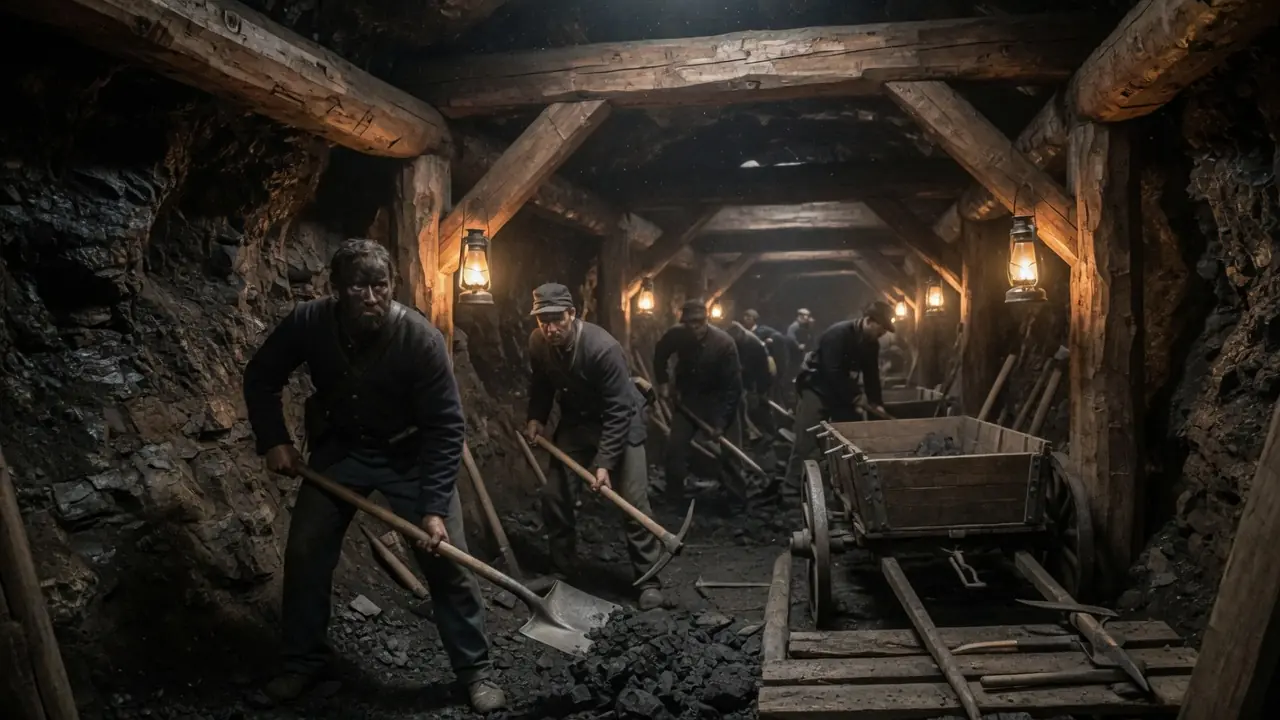
Part 2 — The Explosion That Shook the Earth
4:44 A.M.
Before dawn on July 30, 1864, Union soldiers quietly assembled inside their trenches.
The plan was straightforward.
The underground mine would destroy the Confederate fort known as Elliott's Salient. Immediately afterward, Union assault troops would rush through the gap, move around the enormous crater left by the explosion, capture the high ground beyond, and open the way toward Petersburg.
Everything depended on speed.
At approximately 3:15 a.m., engineers lit the fuse.
The men waited.
Nothing happened.
Minutes passed.
Then nearly half an hour.
Silence.
The fuse had gone out somewhere inside the tunnel.
Two volunteers, Lieutenant Jacob Douty and Sergeant Henry Rees, crawled hundreds of feet through the dark, smoke-filled passage to locate the problem.
Working by candlelight, they discovered the break, relit the fuse, and hurried back toward the entrance.
Once again, everyone waited.
At 4:44 a.m., the earth erupted.
The explosion was unlike anything most soldiers had ever witnessed.
More than 8,000 pounds of gunpowder detonated beneath Elliott's Salient, instantly destroying the Confederate position.
An enormous column of earth, timber, artillery pieces, and human bodies shot skyward.
Eyewitnesses described the blast lifting debris more than 100 feet into the air, though the exact height can never be known with certainty.
When the dust began to settle, a gigantic crater had replaced the Confederate fort.
It measured roughly 170 feet (52 meters) long, 60 to 80 feet (18–24 meters) wide, and about 30 feet (9 meters) deep.
Hundreds of Confederate soldiers had been killed, wounded, or buried beneath the collapsing earth.
For a brief moment, the Union Army possessed exactly what it had hoped for.
A massive opening in Lee's defensive line.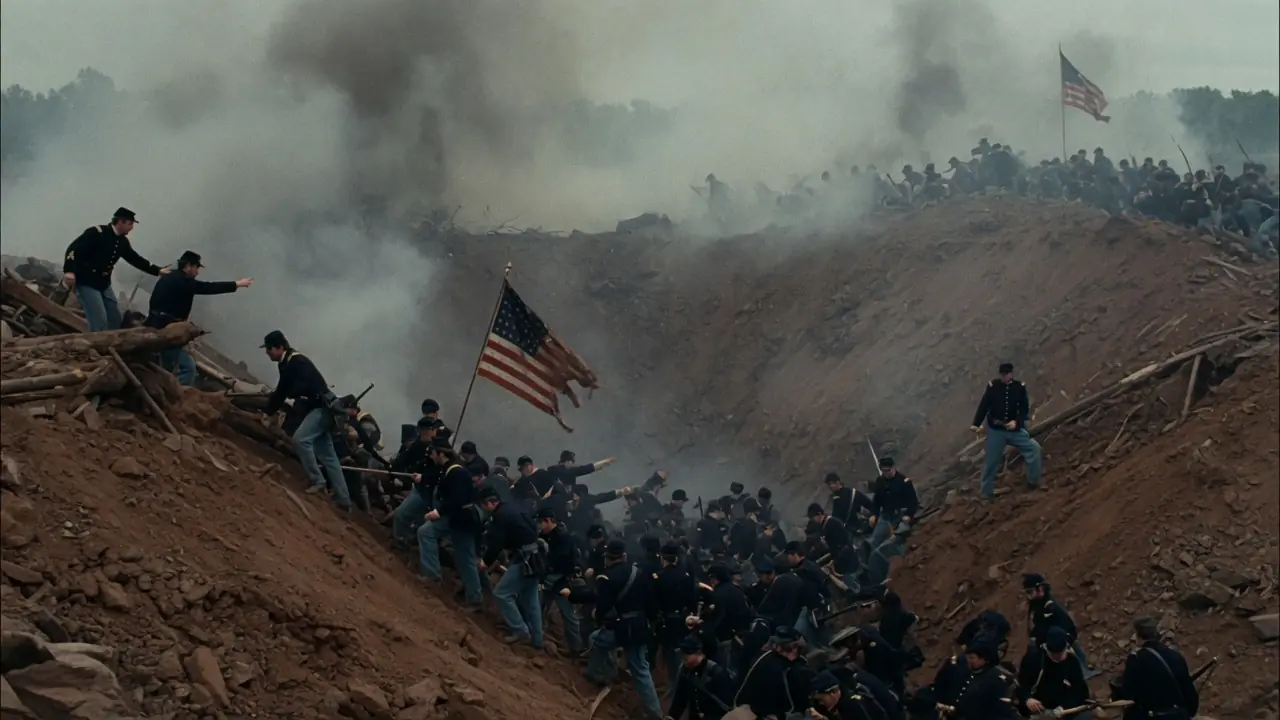
A Brilliant Plan Begins to Unravel
The explosion had stunned Confederate defenders across the front.
Many survivors were disoriented.
Some rushed toward the crater, trying to understand what had happened.
Others fled nearby trenches.
This was the critical moment.
The Union assault force should have moved quickly around both sides of the crater, seized the higher ground beyond, and prevented Confederate troops from reorganizing.
Originally, Brigadier General Edward Ferrero's division of United States Colored Troops (USCT) had trained specifically for this task.
For weeks, they rehearsed how to avoid the crater, bypass the destroyed fortifications, and continue directly toward their objectives.
However, only hours before the attack, Major General George G. Meade ordered that the USCT division not lead the assault, fearing that if the operation failed, the political consequences of sending Black troops first would be severe.
Instead, Major General Ambrose Burnside selected a replacement division by drawing lots.
The troops chosen had not practiced the plan to the same extent.
As they advanced through smoke and confusion, many soldiers naturally headed toward the enormous gap created by the explosion.
Instead of moving around the crater, thousands climbed directly into it.
The Crater Becomes a Trap
What appeared from a distance to be the perfect breach quickly became a deadly obstacle.
The crater's steep walls were composed of loose dirt, broken timber, shattered artillery, and debris from the explosion.
Soldiers who jumped inside discovered that climbing back out was far more difficult than expected.
Units became mixed together.
Officers lost contact with their commands.
Men struggled through loose earth while trying to carry rifles, ammunition, and equipment.
The attack lost momentum.
Every passing minute allowed Confederate commanders to recover from the shock.
General Robert E. Lee's officers rapidly organized reinforcements.
Among them was Major General William Mahone, whose division moved quickly toward the breach.
As Confederate artillery and infantry reached positions overlooking the crater, they found Union soldiers packed tightly together with little cover and few routes of escape.
From the surrounding rim, Confederate troops fired downward into the crowded crater.
The Union soldiers below found it almost impossible to mount an organized advance or retreat.
What had begun as one of the most ingenious engineering operations of the Civil War had become a battlefield disaster.
The opening created by the explosion had turned into a deadly trap.
By midday, the Battle of the Crater was rapidly slipping away from the Union Army.
The consequences would be devastating.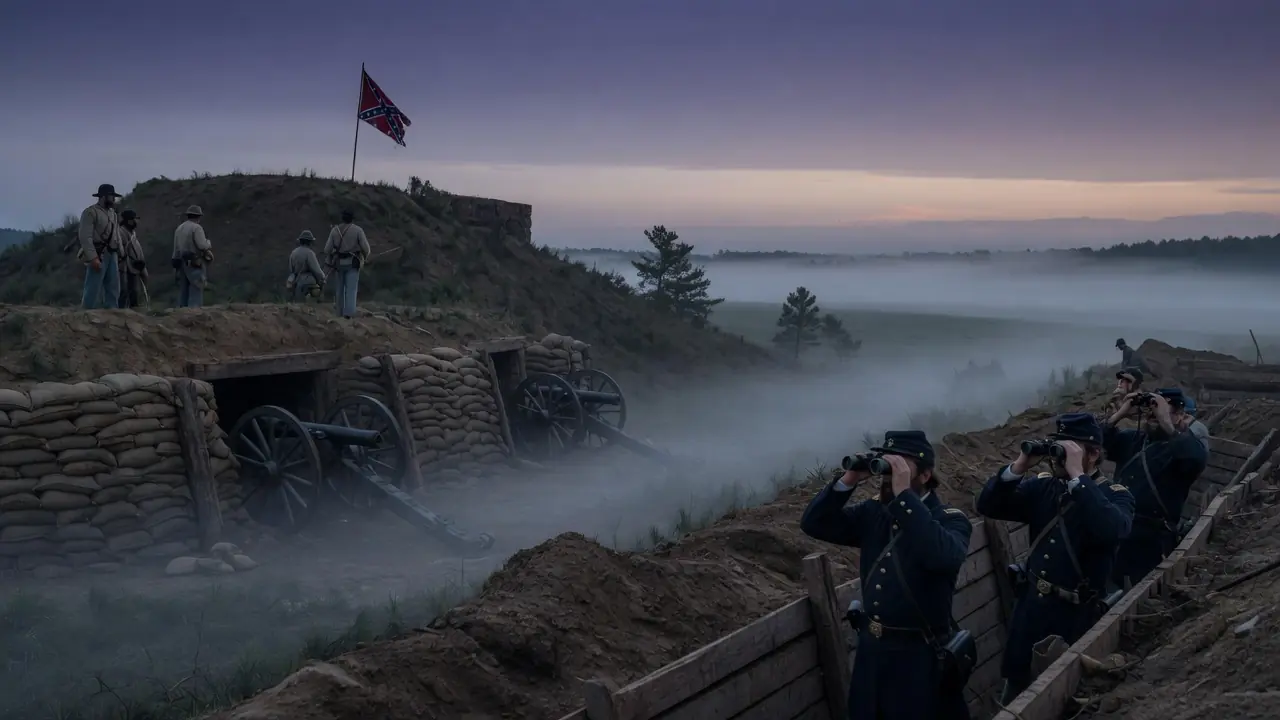
Part 3 — The Battle Lost
The Counterattack
By mid-morning on July 30, 1864, the enormous explosion that had stunned the Confederate defenders was no longer an advantage for the Union Army.
Instead of breaking through the enemy line, thousands of Union soldiers were crowded inside the crater, struggling to climb its steep walls while under constant fire.
Confederate commanders acted quickly.
Among the first to organize an effective response was Major General William Mahone, whose division marched rapidly toward the breach.
Mahone recognized that the Union troops trapped inside the crater occupied one of the worst possible positions on the battlefield.
The crater's walls offered little protection from soldiers firing from the surrounding rim.
Rather than launching an immediate frontal assault, Confederate artillery opened fire while infantry occupied the higher ground around the crater.
From above, they poured musket fire into the densely packed Union troops below.
Several eyewitnesses later described the scene as resembling target practice.
It was this one-sided exchange that led many participants and later historians to compare the battle to a "turkey shoot." The phrase was not the official name of the battle, but a description of the devastating position in which many Union soldiers found themselves.
Repeated attempts to escape the crater failed.
Some soldiers tried climbing the loose dirt only to slide back down under heavy fire.
Others attempted to organize new attacks but found themselves pinned in place.
What had been intended as the doorway to Petersburg had become a deadly bowl from which escape was extraordinarily difficult.
A Crushing Defeat
The fighting continued for several hours.
Confederate counterattacks gradually tightened around the crater until organized Union resistance collapsed.
By early afternoon, surviving Union soldiers began surrendering in large numbers.
The operation had ended in disaster.
Union casualties during the Battle of the Crater totaled approximately 3,800 men killed, wounded, missing, or captured.
Confederate losses were significantly lower, at roughly 1,500 casualties, although exact figures vary slightly among historical sources.
Among the Union casualties were many soldiers of the United States Colored Troops (USCT), who entered the battle after the initial assault stalled.
Several Black soldiers who attempted to surrender were killed during or immediately after the fighting, an event documented in numerous contemporary accounts and later historical studies.
The battle became one of the darkest episodes of the Petersburg Campaign.
Instead of opening the road to the city, the failed assault strengthened Confederate confidence and prolonged the siege.
Petersburg would not fall for another eight months.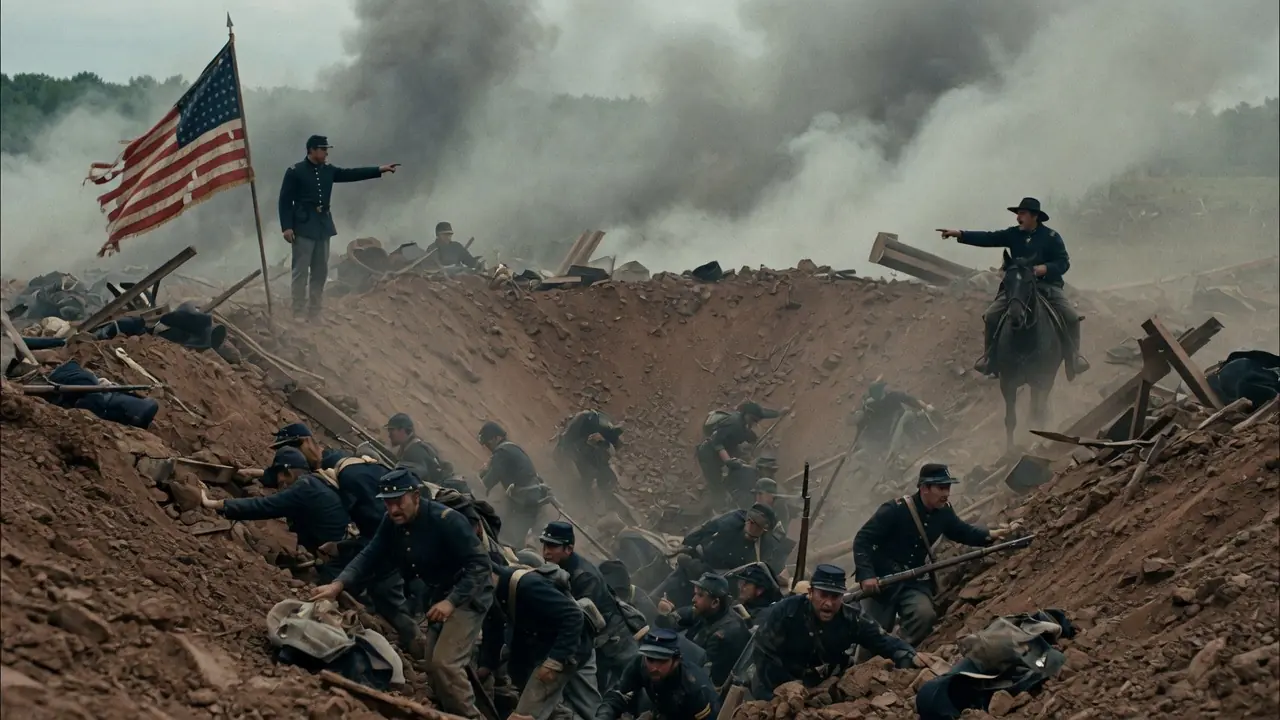
Henry Pleasants Vindicated
In the immediate aftermath, accusations spread throughout the Union command.
Many officers sought someone to blame for the catastrophe.
Some initially criticized Lieutenant Colonel Henry Pleasants, the engineer whose tunnel had made the attack possible.
But investigations soon reached a different conclusion.
The mine itself had worked almost perfectly.
The tunnel had been successfully constructed despite limited resources.
The explosion had destroyed exactly the section of Confederate line that Pleasants intended.
The failure occurred after the blast.
Subsequent inquiries—including the Joint Committee on the Conduct of the War—concluded that poor leadership, confusion, and changes to the assault plan had squandered the opportunity created by the explosion.
Pleasants was largely cleared of responsibility.
Many historians have since described the mining operation as an impressive feat of military engineering whose success was undone by failures in execution.
The greatest criticism instead fell upon Major General Ambrose Burnside, commander of the Union Ninth Corps.
Following the battle, Burnside was relieved of command and never again held a major field command during the Civil War.
The Long Road to Victory
Although the Battle of the Crater ended in failure, the broader campaign continued.
General Ulysses S. Grant maintained pressure on Petersburg throughout the remainder of 1864 and into 1865.
Rather than relying on another dramatic assault, Union forces gradually extended their lines westward, cutting one Confederate supply route after another.
By April 2, 1865, Lee's defenses finally collapsed.
Confederate forces evacuated Petersburg and Richmond.
One week later, on April 9, 1865, General Robert E. Lee surrendered the Army of Northern Virginia to Grant at Appomattox Court House, effectively ending the Civil War in Virginia.
The tunnel beneath Petersburg had not won the war.
But the siege itself eventually accomplished what the explosion could not.