Part 1 — The Birth of the Night Witches
Prologue
On countless nights during the Second World War, German soldiers stationed along the Eastern Front would suddenly hear an eerie sound drifting through the darkness.
It was not the roar of powerful bomber engines.
It was not the scream of diving aircraft.
Instead, it was little more than the whisper of wind passing over wooden wings.
Seconds later, bombs exploded around their positions.
The aircraft appeared almost out of nowhere before disappearing back into the night.
To exhausted German troops, the attacks seemed almost supernatural.
Many began referring to the mysterious Soviet aviators as "Nachthexen"—the Night Witches.
The nickname would become one of the most enduring legends of the Second World War.
Yet behind the legend were not mythical figures, but young women—many barely out of their teenage years—flying some of the oldest and slowest military aircraft still in service.
Their story began not with the airplanes themselves, but with one remarkable woman determined to prove that Soviet women could fight in the skies alongside men.
Historical Background
When Nazi Germany launched Operation Barbarossa on June 22, 1941, the Soviet Union faced the largest invasion in human history.
More than three million Axis soldiers, supported by thousands of tanks and aircraft, crossed the Soviet frontier.
Within months, entire Soviet armies had been surrounded.
Major cities fell.
Millions of civilians fled eastward.
The Red Army suffered catastrophic losses.
The Soviet Air Force was hit particularly hard.
Thousands of aircraft were destroyed during the opening months of the invasion, many before they could even take off.
As casualties mounted, the Soviet Union faced an urgent shortage of trained personnel.
Factories worked around the clock producing tanks, guns, and aircraft.
Entire industries relocated east of the Ural Mountains to avoid advancing German forces.
The nation mobilized on a scale never before seen.
Women entered factories, farms, hospitals, and transportation networks in unprecedented numbers.
Many also wanted to fight.
Thousands wrote letters requesting permission to serve on the front lines.
Most military leaders, however, remained reluctant to place women in combat aviation.
One woman refused to accept that answer.
Marina Raskova
That woman was Marina Mikhailovna Raskova.
Long before the war, Raskova had become one of the Soviet Union's most celebrated aviators.
During the 1930s, she set several long-distance flight records and became a national hero.
In 1938, she gained international fame after participating in the record-breaking nonstop flight of the Tupolev ANT-37 "Rodina", covering more than 5,900 kilometers (3,600 miles) from Moscow to the Soviet Far East.
When the aircraft became lost in poor weather and dangerously low on fuel, Raskova parachuted from the plane and survived alone in the wilderness for several days before being rescued.
Her courage made headlines throughout the Soviet Union.
She became one of the country's first women to receive the title Hero of the Soviet Union, the nation's highest honor.
By the time Germany invaded in 1941, Raskova possessed something few Soviet women enjoyed.
She had direct access to the highest levels of government.
Recognizing both the desperate military situation and the enthusiasm of thousands of female volunteers, she appealed directly to Joseph Stalin.
Her proposal was unprecedented.
She requested permission to establish combat aviation units staffed entirely by women.
Stalin approved.
On October 8, 1941, the Soviet State Defense Committee authorized the creation of three all-female aviation regiments.
It was one of the most remarkable decisions in military aviation history.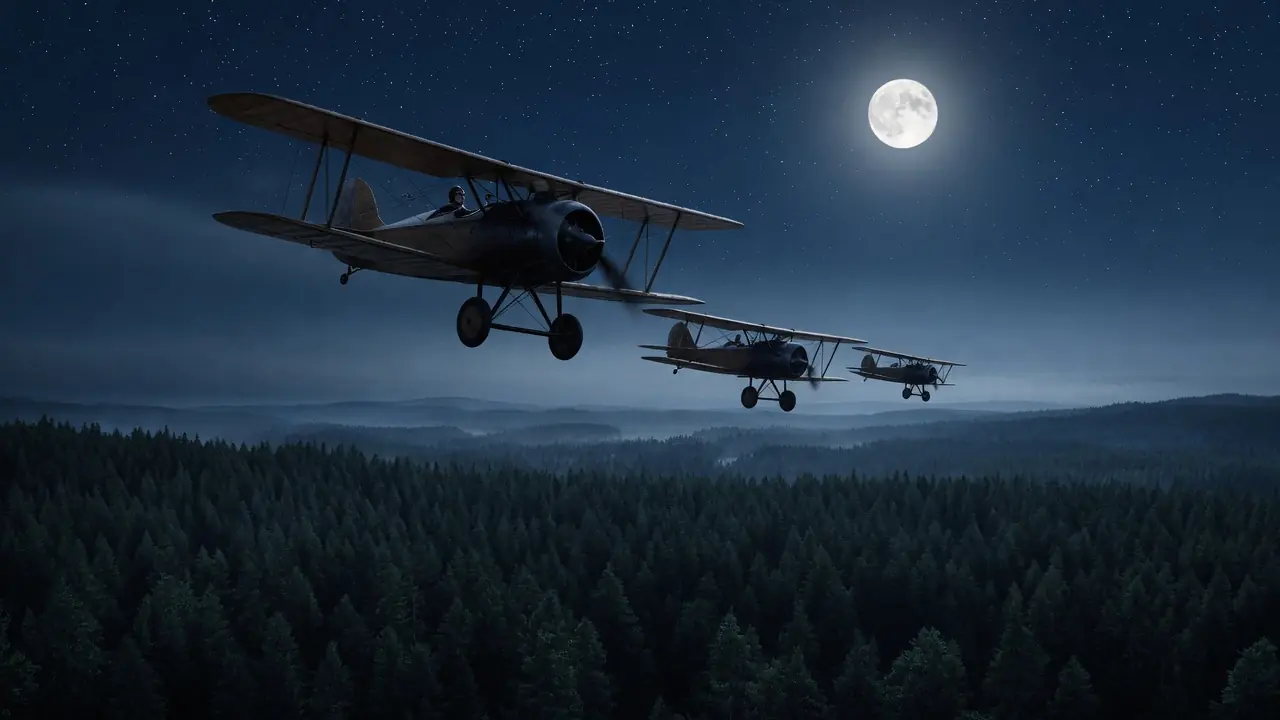
Three Extraordinary Regiments
The Soviet government authorized three separate all-female aviation units.
The 586th Fighter Aviation Regiment would fly Yakovlev Yak-1 fighters.
The 587th Bomber Aviation Regiment would eventually operate the modern twin-engine Petlyakov Pe-2 dive bomber.
The third unit would become the most famous of all.
It was officially designated the 588th Night Bomber Regiment.
Its mission would be nighttime harassment bombing.
Unlike large strategic bombers that carried heavy payloads over long distances, the regiment specialized in striking enemy positions repeatedly throughout the night.
The constant attacks disrupted troop movements, prevented soldiers from resting, and forced German units to remain on alert for hours.
Although each aircraft carried only a small bomb load, the psychological effect could be enormous.
What the regiment lacked in firepower, it hoped to make up for in persistence.
Learning to Fight
Recruitment drew women from across the Soviet Union.
Many were university students.
Others had worked as teachers, engineers, factory workers, or members of civilian flying clubs before the war.
Some were only 17 or 18 years old when they volunteered.
Training took place primarily at the Engels Military Aviation School, near the Volga River.
The schedule was relentless.
Cadets studied navigation, meteorology, aircraft mechanics, radio procedures, formation flying, and night operations.
Unlike many male units, where responsibilities were divided among larger ground crews, women in the new regiments often learned to perform multiple roles themselves.
Pilots helped maintain aircraft.
Navigators studied bombing techniques.
Mechanics worked long hours repairing damaged machines between missions.
Resources were scarce.
Uniforms designed for men were often far too large.
Boots sometimes required extra socks or improvised padding to fit properly.
Equipment shortages were common throughout the Soviet military during the early years of the war.
Nevertheless, morale remained remarkably high.
The volunteers understood they were making history.
An Airplane from Another Era
The aircraft assigned to the 588th Night Bomber Regiment surprised many of its new crews.
Rather than receiving modern combat bombers, they were issued the Polikarpov Po-2.
Originally introduced in 1928, the Po-2 had been designed primarily as a trainer and utility aircraft.
Constructed largely of wood and fabric, it featured an open cockpit, fixed landing gear, and a modest five-cylinder radial engine.
By 1942, it was already considered obsolete.
Its maximum speed was barely 150 kilometers per hour (about 94 miles per hour)—so slow that some German fighters risked stalling if they attempted to fly alongside it at minimum speed.
The aircraft carried only a small bomb load, typically requiring crews to fly multiple missions during a single night.
It had no armor protection.
No onboard radar.
No forward-firing machine guns.
The crews flew exposed to freezing temperatures, rain, and enemy fire in open cockpits.
To many observers, assigning such an aircraft to frontline combat appeared almost unbelievable.
Yet before long, these simple wooden biplanes would become one of the most feared psychological weapons on the Eastern Front.
The tactics that earned their legendary nickname were about to emerge.
Part 2 — The Tactics of the Night Witches
Baptism by Fire
By the spring of 1942, the women of the 588th Night Bomber Regiment had completed their accelerated training and arrived at the front.
There was little time to ease into combat.
Germany's summer offensive was gathering momentum, and Soviet forces desperately needed every available aircraft.
The regiment was assigned to conduct night harassment bombing—missions designed not to destroy entire armies with massive bomb loads, but to exhaust, confuse, and constantly pressure German forces.
The concept was simple.
If enemy soldiers could never sleep peacefully, they would become less effective in battle.
Every night, the Po-2 crews flew toward German positions carrying small bomb loads.
Each aircraft typically carried only two to six bombs, depending on the mission and bomb size. Compared with larger bombers capable of carrying several tons of explosives, the Po-2's payload was tiny.
To compensate, the crews flew again.
And again.
Some nights, a single crew completed eight, ten, or even more than a dozen sorties before sunrise.
After every landing, mechanics rushed to refuel the aircraft while armorers loaded fresh bombs.
The pilots often remained in the cockpit, waiting only a few minutes before taking off again into the darkness.
By dawn, they were physically exhausted.
The following night, they did it all over again.
Flying an Obsolete Airplane
To outside observers, the Polikarpov Po-2 seemed completely unsuited for modern warfare.
The aircraft was built largely from wood, plywood, and fabric stretched over a wooden frame.
Its open cockpits left both pilot and navigator exposed to freezing wind, rain, and snow.
The plane carried no armor.
No parachutes were issued on many missions because the added weight reduced the already limited bomb load and performance.
The maximum speed was so low that German fighter pilots often found interception surprisingly difficult.
Modern fighters such as the Messerschmitt Bf 109 were designed for much higher speeds.
If they slowed too much while pursuing a Po-2, they risked losing lift and stalling.
The Po-2 could also operate from rough grass strips close to the front lines.
Its simple construction made repairs relatively quick, even under difficult wartime conditions.
What appeared to be weaknesses gradually became unexpected advantages.
The Silent Approach
The regiment soon perfected the tactic that would make it famous.
As the aircraft approached its target, the crew climbed to a suitable altitude.
Then, just before reaching the objective, the pilot reduced power and shut off the engine.
The Po-2 became a glider.
Without the engine's noise, the aircraft descended almost silently through the darkness.
The only sound was the rush of air passing over the wings, struts, and bracing wires.
German soldiers later described the eerie whisper as resembling the sound of a broom sweeping through the night sky.
Only seconds before reaching the target would the crew release their bombs.
Immediately afterward, the pilot restarted the engine and flew away before anti-aircraft crews could react effectively.
The technique demanded exceptional skill.
Flying an unpowered aircraft at night over enemy territory left almost no margin for error.
The pilots had to judge altitude, speed, wind direction, and timing almost entirely by experience.
One mistake could mean striking trees, hillsides, or the ground itself.
Yet the women of the 588th repeated the maneuver night after night.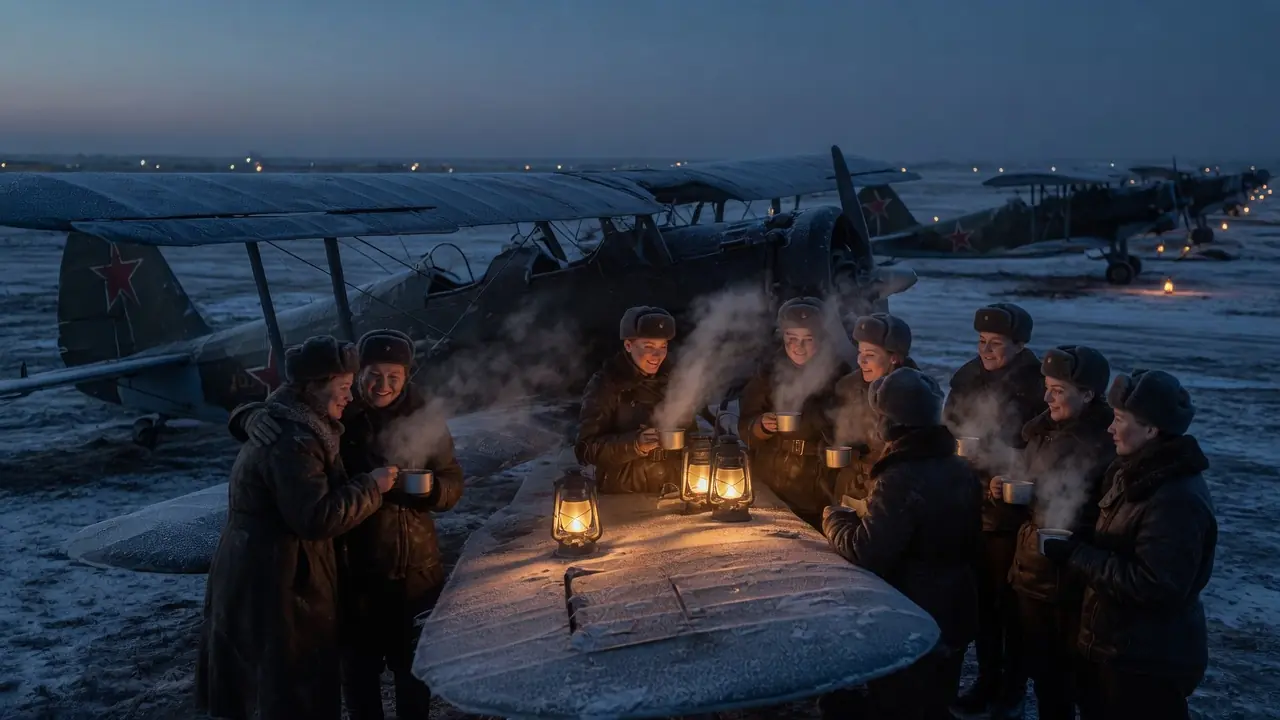
"The Night Witches"
German troops soon learned to fear the attacks.
The bombs themselves were often relatively small.
The greater burden was psychological.
Harassment bombing rarely allowed enemy units to enjoy an uninterrupted night's rest.
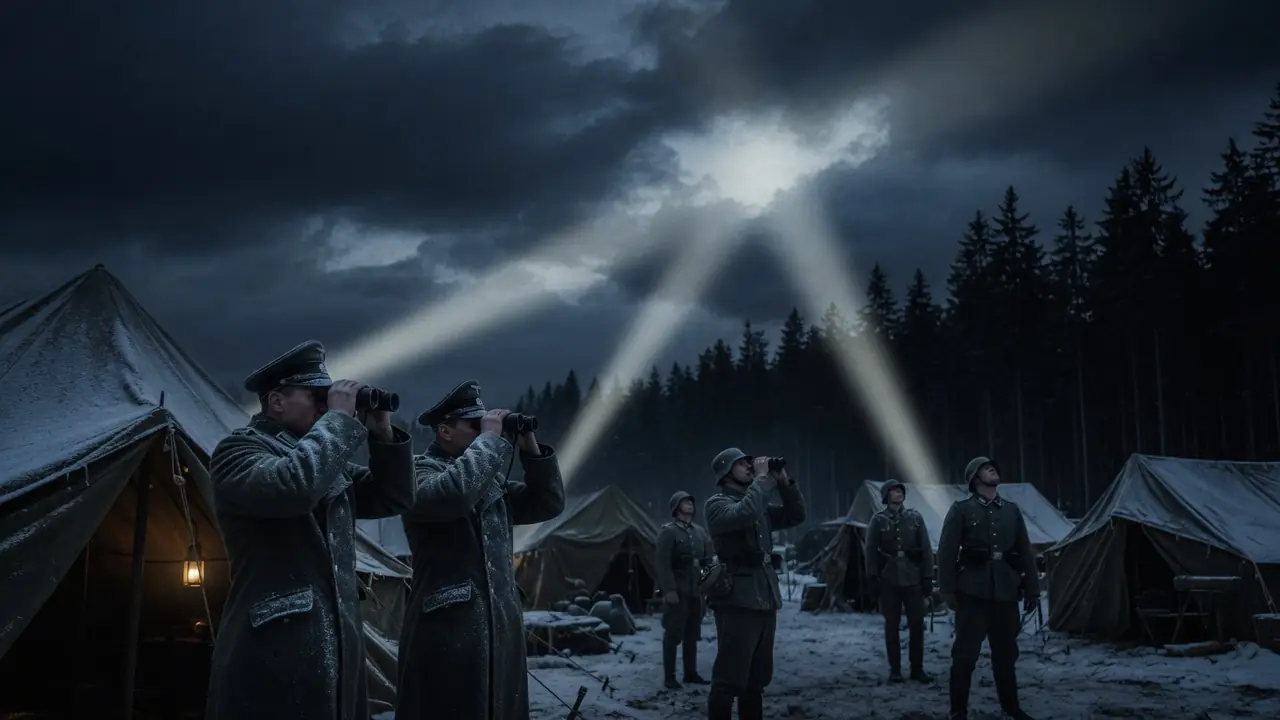
Searchlights swept endlessly across the sky.
Anti-aircraft guns opened fire repeatedly.
Soldiers were awakened again and again by explosions that seemed to come without warning.
According to numerous postwar accounts, German troops began referring to the women as "Nachthexen," meaning "Night Witches."
The nickname is generally believed to have been inspired by the whispering sound of the gliding Po-2 aircraft, which reminded some German soldiers of witches flying through the night on broomsticks.
The name spread widely and eventually became inseparable from the regiment's history.
Another story has often accompanied the legend.
It is frequently claimed that any German pilot who shot down a Night Witches aircraft automatically received the Iron Cross.
This story appears in many popular books, documentaries, and online accounts.
However, historians have found no surviving official German military regulation confirming such an automatic award policy.
German pilots certainly received Iron Cross decorations for a wide variety of combat achievements during the war, but there is no documented evidence that destroying a Po-2 from the 588th Regiment guaranteed the decoration.
The legend reflects the respect and frustration many German soldiers felt toward the regiment, but it should not be presented as established historical fact.
Life Between Missions
Combat was only part of the hardship.
The women often lived in simple tents or crude shelters close to improvised airfields.
Supplies remained scarce.
Winters on the Eastern Front brought freezing temperatures that affected both people and machinery.
Before dawn, mechanics worked by lantern light repairing damaged aircraft.
Fabric torn by bullets had to be patched.
Wooden wings required constant inspection.
Engines demanded careful maintenance despite shortages of spare parts.
The pilots themselves received little rest.
After flying repeated sorties through the night, they attended mission briefings, debriefings, and planning sessions before trying to sleep during daylight hours.
Many crews developed extraordinarily close friendships.
Each mission depended on complete trust between pilot and navigator.
In the darkness, often without radio communication, each relied upon the other's judgment for survival.
The regiment's growing experience steadily increased its effectiveness.
What had begun as an experimental all-female unit was becoming one of the Soviet Air Force's most reliable night bombing formations.
Its greatest achievements, however, still lay ahead.
The battles over the Caucasus, the Kuban, Crimea, Belarus, Poland, and ultimately Germany itself would transform the Night Witches into one of the most decorated aviation units of the war.
Part 3 — Legacy of the Night Witches
Fighting Across Europe
As the war on the Eastern Front gradually turned in the Soviet Union's favor after 1943, the women of the 588th Night Bomber Regiment found themselves supporting one major offensive after another.
They flew during the Battle of the Caucasus, helping disrupt German supply lines and troop movements as Soviet forces resisted the German advance toward the oil fields.
Later, they participated in operations over the Kuban Bridgehead, where German forces struggled to maintain positions in southern Russia.
Their missions continued during the liberation of Crimea in 1944, followed by campaigns through Belarus, Poland, and eventually into eastern Germany.
Unlike heavy bomber crews who often flew a single long-range mission before returning to base, the Night Witches rarely enjoyed such respite.
Because each Polikarpov Po-2 could carry only a small bomb load, crews often flew repeated sorties throughout a single night.
Ground crews worked continuously.
As one aircraft landed, mechanics immediately refueled it while armorers attached fresh bombs.
Minutes later, the crew would climb back into the open cockpit and disappear into the darkness once again.
The pace was relentless.
By the end of the war, some individual pilots had completed hundreds of combat missions.
Several flew more than 800 sorties, an extraordinary achievement in military aviation.
Among the regiment's most accomplished members was Nadezhda Popova, who ultimately completed 852 combat missions during the war.
Another legendary navigator, Irina Sebrova, flew over 1,000 sorties, making her one of the most experienced combat aviators of the conflict.
These numbers reflected not only courage, but also remarkable endurance.
Night after night, year after year, they returned to the cockpit.
Becoming a Guards Regiment
The regiment's consistent performance did not go unnoticed.
On February 8, 1943, in recognition of its distinguished combat service, the 588th Night Bomber Regiment received one of the Soviet military's highest honors.
It was redesignated the 46th Guards Night Bomber Aviation Regiment.
The title "Guards" was reserved for units that had demonstrated exceptional bravery, discipline, and effectiveness in combat.
Receiving the designation marked the regiment as one of the Soviet Air Force's elite formations.
Throughout the remainder of the war, the regiment continued operating under its new title while retaining the tactics that had already made it famous.
Its aircraft changed little.
The Po-2 remained slow, vulnerable, and technologically outdated.
Yet the women flying them had become experts at exploiting every advantage the little biplane offered.
By the spring of 1945, as Soviet forces advanced toward Berlin, the Night Witches were still flying combat missions.
When Germany surrendered on May 8, 1945 (May 9 in Moscow due to time zones), their long campaign finally came to an end.
Extraordinary Achievements
Over the course of the Second World War, the regiment flew more than 23,000 combat sorties, according to Soviet military records.
It dropped approximately 3,000 tons of bombs and thousands of incendiary devices against enemy positions.
The unit also paid a heavy price.
Thirty-two members of the regiment lost their lives during the war.
Despite the dangers they faced—enemy fighters, anti-aircraft fire, poor weather, and mechanical failures—the regiment continued operating until Germany's defeat.
Their courage earned widespread recognition within the Soviet Union.
Twenty-three members of the regiment were awarded the title Hero of the Soviet Union, the country's highest military distinction.
In later decades, additional former members received equivalent honors established after the dissolution of the Soviet Union, including the titles Hero of the Russian Federation and Hero of Kazakhstan.
The regiment had proven something many military leaders had doubted in 1941.
Women were fully capable of serving—and excelling—in front-line combat aviation.
After the War
With peace restored, the regiment was gradually disbanded as part of the Soviet military's postwar demobilization.
Many former pilots returned to civilian life.
Some became engineers, teachers, doctors, or professional aviators.
Others quietly resumed lives interrupted by years of war.
Unlike many famous military units whose reputations spread immediately around the world, the Night Witches remained relatively unknown in the West for decades.
Much of their story was preserved primarily in Soviet publications, veterans' memoirs, and military archives.
Following the end of the Cold War, historians gained greater access to these materials.
Interest in the regiment grew rapidly.
Books, documentaries, museum exhibitions, and academic studies introduced new generations to the remarkable achievements of the all-female unit.
Today, the Night Witches are widely recognized as one of the most extraordinary aviation formations of the Second World War.