Part 1 — The Great Diamond Hoax Begins
Prologue
On a spring day in 1872, two dusty prospectors walked into the offices of the Bank of California in San Francisco carrying what appeared to be an ordinary leather bag.
There was nothing particularly remarkable about the men themselves.
They were not famous geologists.
They were not wealthy businessmen.
They looked like countless prospectors who had wandered the American West searching for fortune.
Then they emptied the bag onto a table.
Diamonds.
Rubies.
Sapphires.
Emeralds.
The room fell silent.
The men claimed they had stumbled upon an astonishing discovery somewhere in the remote American West—a mountain so rich in precious stones that it could rival the legendary diamond fields of South Africa.
They refused to reveal its location until they secured financial backing.
For investors, the timing seemed almost miraculous.
The United States was still gripped by dreams of sudden wealth born from decades of gold and silver discoveries.
If the prospectors were telling the truth, this could become the richest gemstone mine ever found in North America.
Within months, some of America's most influential businessmen would risk fortunes pursuing the mysterious mine.
Almost all of them would be deceived.
Two Unlikely Conspirators
The masterminds behind the scheme were Philip Arnold and John Slack.
Neither man resembled the polished financiers they would eventually fool.
Arnold had experience as a prospector and possessed practical knowledge of mining operations.
Slack had also spent years working in mining regions throughout the American West.
Both men understood something extremely valuable.
They knew how prospectors thought.
More importantly, they knew how investors thought.
Throughout the mining frontier, stories constantly circulated about lucky discoveries that transformed ordinary laborers into millionaires overnight.
Most of those stories were exaggerated.
Some were completely false.
But enough were true to keep investors searching for the next great strike.
Exactly when Arnold and Slack first conceived their plan remains uncertain.
Historians agree, however, that by 1871, they had begun preparing one of the most elaborate financial deceptions of the nineteenth century.
Unlike many frauds, their scheme did not depend upon forged documents or counterfeit money.
Instead, they intended to manufacture something far more convincing.
Evidence.
Building a Fake Mine
Creating a convincing gemstone deposit required careful planning.
Simply scattering colorful stones across the ground would never fool experienced mining experts.
The conspirators first needed authentic gems.
Records indicate that Arnold traveled to London, then one of the world's leading centers for the international gemstone trade.
There, he purchased a collection of relatively inexpensive uncut and industrial-grade diamonds, along with rubies, sapphires, emeralds, and other gemstones that possessed little commercial value individually.
The purchases attracted little attention.
There was nothing unusual about buying loose stones through established dealers.
Once back in the United States, Arnold and Slack selected an isolated area somewhere near the borderlands of what are now Wyoming and Colorado—although the exact location remained secret from nearly everyone involved.
There they carried out what miners call "salting."
Instead of discovering a gemstone deposit, they created one.
Over multiple visits, they buried gemstones throughout the ground, carefully distributing them so that anyone digging test holes would eventually uncover valuable stones.
It was a simple idea.
It was also remarkably effective.
Because the gems were genuine, every stone recovered appeared to confirm the existence of an extraordinary natural deposit.
The ground itself had become part of the deception.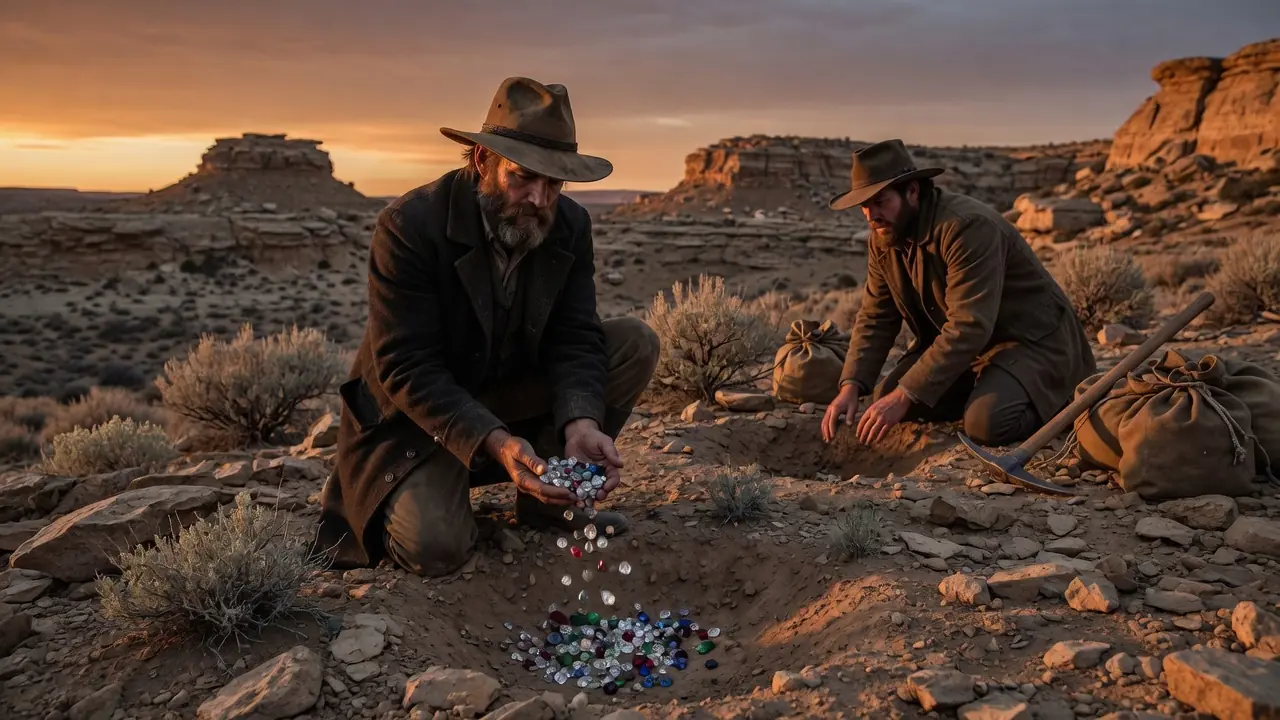
A Carefully Planned Performance
By early 1872, Arnold and Slack believed their artificial mine was ready.
Now they needed investors.
Rather than immediately asking for millions of dollars, they adopted a far more believable strategy.
They presented themselves as cautious prospectors uncertain about what they had found.
They claimed they had accidentally discovered a remote gemstone field while traveling through the West.
They refused to reveal its location publicly, explaining that doing so would trigger a stampede of competing prospectors before legal ownership could be secured.
To support their story, they produced a handful of gemstones supposedly collected from the site.
The stones were impressive.
Professional jewelers confirmed they were genuine.
Few people stopped to ask the more important question:
Had the stones actually come from the same place?
Instead, excitement spread rapidly through San Francisco's financial community.
Rumors reached some of California's wealthiest businessmen, including William C. Ralston, founder of the Bank of California, one of the most influential financial institutions in the American West.
Soon the story reached New York as well.
Among those drawn into the mystery was Charles Lewis Tiffany, founder of Tiffany & Co., whose expertise in precious stones made his opinion especially influential.
If Tiffany believed the gems were authentic—and he did believe the stones themselves were genuine—many investors assumed the discovery must be real.
The stage had been set.
Two prospectors with an invented mine were about to persuade some of the most powerful financiers in America that they stood on the edge of the greatest gemstone discovery in the nation's history.
None of them yet realized they were walking into one of the most ingenious scams of the nineteenth century.
Part 2 — Selling a Fortune That Never Existed
Investors Take the Bait
By the summer of 1872, the mystery surrounding the supposed diamond field had become the subject of intense discussion among America's financial elite.
The gemstones that Philip Arnold and John Slack displayed were undeniably real.
Jewelry experts examined them.
Professional gem dealers confirmed that the diamonds, rubies, sapphires, and emeralds were genuine natural stones.
That fact gave the prospectors tremendous credibility.
Very few people asked the question that mattered most:
Had all of these gems actually come from the same place?
Instead, investors focused on another possibility.
If even a fraction of the prospectors' story proved true, the discovery could rival the world's richest gemstone deposits.
The potential profits were almost unimaginable.
Among those intrigued was William Chapman Ralston, the influential founder of the Bank of California.
Ralston had already built his reputation financing mining ventures throughout the American West.
He understood both the enormous risks and extraordinary rewards of mineral exploration.
The prospect of America's first great diamond mine was too significant to ignore.
Joining him were several other prominent businessmen, including mining investor Asbury Harpending and George D. Roberts, a respected mining engineer.
The involvement of Charles Lewis Tiffany, founder of Tiffany & Co., further strengthened confidence.
Tiffany carefully examined the gemstones themselves and concluded that they were authentic.
Importantly, Tiffany did not certify that they all came from a single natural deposit.
His assessment was limited to the stones themselves.
As later events would reveal, that distinction made all the difference.
Keeping the Secret
Arnold and Slack insisted that revealing the location of the mine too early would destroy its value.
They claimed prospectors across the West would immediately rush to stake claims if the site became public.
To protect everyone's investment, they proposed an unusual arrangement.
Only a small group of trusted investors would be allowed to visit the location.
Even then, the exact route would remain confidential.
The strategy worked perfectly.
Rather than creating suspicion, the secrecy increased excitement.
In the mining business, hidden claims were not unusual.
Successful prospectors often guarded new discoveries until legal ownership had been secured.
Arnold and Slack simply exploited a practice investors already understood.
Eventually, arrangements were made for an inspection.
The investors would see the mine for themselves.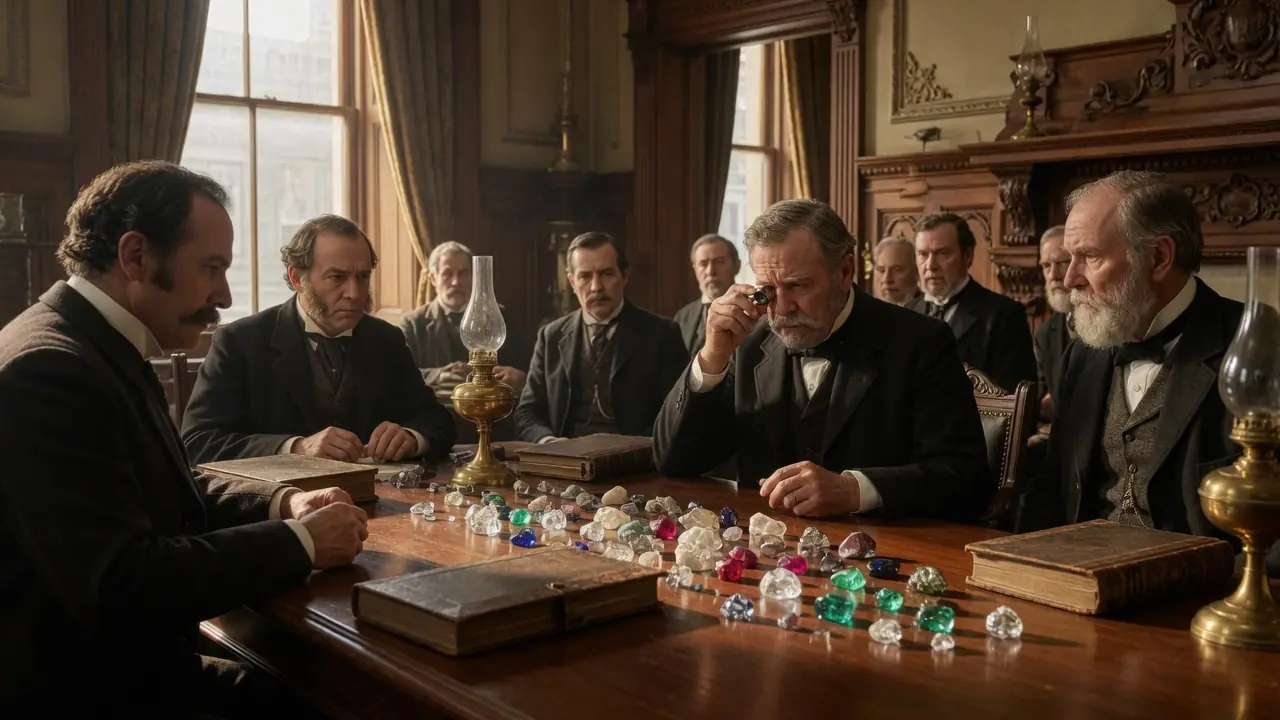
A Convincing Discovery
The expedition into the western wilderness unfolded almost exactly as Arnold and Slack had planned.
The route itself was intentionally confusing.
According to later accounts, the prospectors led the investors across long stretches of rugged country, making frequent changes in direction.
Whether every twist and detour occurred exactly as later witnesses described remains uncertain, but historians generally agree that the prospectors deliberately concealed the location of the site.
When they finally arrived, the visitors began examining the ground.
Within a short time, remarkable discoveries followed.
One gemstone.
Then another.
Soon more diamonds appeared.
Rubies were uncovered nearby.
Not far away lay sapphires.
Several emeralds also emerged from the shallow soil.
The excitement was overwhelming.
Experienced men who had spent years evaluating mining properties watched valuable stones emerge from the earth before their own eyes.
To them, the evidence seemed undeniable.
They believed they had witnessed the discovery of one of the richest gemstone deposits ever found in North America.
In reality, they were finding exactly what Arnold and Slack wanted them to find.
The mine had been carefully salted.
Each gemstone had been planted in advance.
The prospectors merely allowed the investors to uncover the evidence themselves.
That simple psychological trick made the deception extraordinarily persuasive.
People tend to trust discoveries they believe they have made with their own eyes.
Millions Begin to Flow
Convinced that the discovery was genuine, the investors moved quickly.
Late in 1872, they organized the San Francisco and New York Mining and Commercial Company to acquire rights to the supposed diamond field.
Historical records indicate that the syndicate agreed to purchase Arnold and Slack's interest for approximately $700,000—an enormous sum in the nineteenth century and equivalent to many millions of dollars today.
The agreement instantly transformed the two obscure prospectors into extraordinarily wealthy men.
Newspapers across the country began reporting rumors of a fabulous American diamond mine.
Speculation spread rapidly.
Some articles compared the discovery to the famous diamond fields recently found in South Africa, which had captured worldwide attention after significant diamond discoveries near Kimberley beginning in the late 1860s.
If America possessed a similar deposit, the economic consequences could be enormous.
Mining shares attracted growing interest.
Financial circles buzzed with optimism.
Few suspected that the entire enterprise rested on a carefully staged illusion.
Yet not everyone was convinced.
Among the small number of skeptics was one of America's most respected geologists.
His name was Clarence King.
Unlike most investors, King believed extraordinary discoveries demanded extraordinary evidence.
Rather than accepting the story at face value, he decided to investigate personally.
His scientific training would soon reveal details that others had completely overlooked.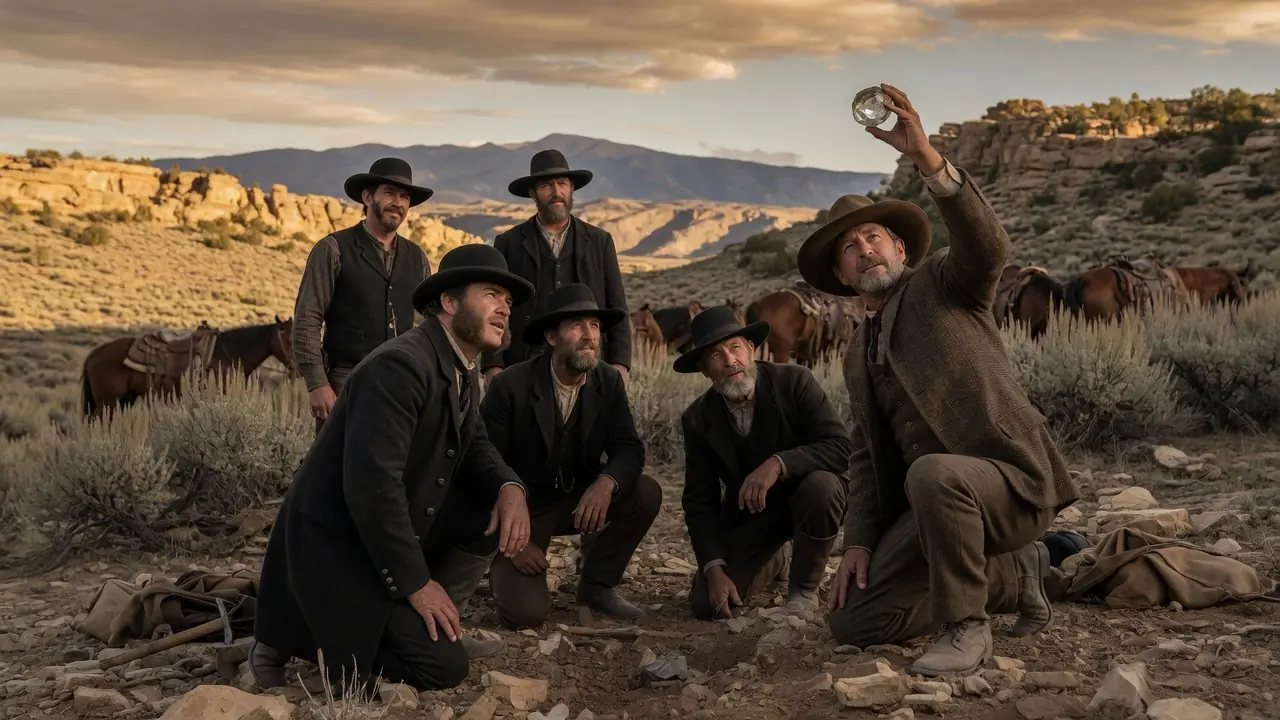
A Scientist Begins to Doubt
While newspapers celebrated the supposed discovery, Clarence King, director of the United States Geological Exploration of the Fortieth Parallel and one of the country's foremost geologists, found the reports increasingly difficult to believe.
Years of studying the geology of the American West had taught him that nature followed patterns.
The more he learned about the alleged mine, the less those patterns seemed to fit.
Diamonds, rubies, sapphires, and emeralds rarely formed under the same geological conditions.
Finding all of them concentrated within a single small area would be extraordinarily unusual.
King decided that speculation was no substitute for science.
He assembled a team and prepared to examine the mysterious mine himself.
What he would discover would expose one of the most ingenious financial frauds in American history.
Part 3 — The Geologist Who Saw Through the Fraud
Clarence King Takes the Case
As excitement surrounding the supposed diamond discovery swept across the United States, one man remained unconvinced.
His name was Clarence King.
At just thirty years old, King had already established himself as one of America's most respected geologists. He directed the United States Geological Exploration of the Fortieth Parallel, one of the federal government's most ambitious scientific surveys of the American West.
Unlike investors, King was trained to read landscapes.
He understood how mountains formed, how minerals were deposited, and where certain gemstones could—and could not—occur naturally.
When newspapers reported that a single mine contained diamonds, rubies, sapphires, and emeralds together, King immediately became suspicious.
Each of those gemstones forms under very different geological conditions.
Finding all of them concentrated in one small area would be extraordinarily unlikely.
Rather than dismissing the story outright, King chose the scientific approach.
He would examine the site himself.
The Investigation
King assembled a small team of experienced geologists and traveled west to inspect the mysterious mine.
Unlike the investors who had arrived expecting to confirm a fortune, King arrived looking for evidence.
At first glance, the expedition appeared promising.
Members of King's party quickly began finding gemstones scattered across the ground.
To an inexperienced observer, this seemed to confirm everything Arnold and Slack had claimed.
But to King, the discoveries raised even more questions.
The stones were lying almost on the surface.
Very little excavation was required.
There was no geological structure explaining why so many different minerals had accumulated together.
The more King studied the area, the more unnatural it appeared.
Then came one of the most revealing discoveries.
King picked up a diamond and immediately noticed something impossible.
The stone had already been cut and polished by human hands.
Natural diamonds emerge from the earth as rough crystals.
They do not appear underground already shaped by a jeweler.
The implication was unmistakable.
Someone had planted the gemstones.
More Clues Emerge
As the investigation continued, King found additional evidence pointing toward deliberate fraud.
The distribution of the stones made little geological sense.
Instead of being embedded naturally within mineral-bearing rock formations, many appeared to have been scattered across the surface or buried only shallowly beneath loose soil.
Even more suspicious was the variety of gemstones.
Diamonds originate deep within the Earth's mantle and are typically brought to the surface through volcanic formations known as kimberlite or lamproite pipes.
Rubies and sapphires are varieties of the mineral corundum, usually formed under very different geological conditions.
Emeralds develop in yet another distinct environment.
The probability of finding commercially significant deposits of all these gems concentrated in one small location was extraordinarily remote.
King realized that the investors had not discovered a miracle of geology.
They had discovered a carefully staged performance.
The mine had been salted.
Every gemstone recovered had almost certainly been placed there intentionally.
The evidence was overwhelming.
The Fraud Exposed
Returning from the expedition, Clarence King quickly informed the investors of his conclusions.
The supposed diamond mine was a fabrication.
There was no vast underground deposit.
No hidden mountain of precious stones.
No geological wonder waiting to transform the American economy.
The gemstones were genuine.
The mine was not.
The revelation sent shockwaves through financial circles.
Newspapers that had enthusiastically reported the discovery now devoted their front pages to the extraordinary deception.
One of the greatest mining investments of the century had collapsed almost overnight.
For many investors, the financial losses were substantial.
Although some funds were eventually recovered through legal settlements, the syndicate never realized the fortune it had imagined.
The reputations of several prominent businessmen suffered as well.
The scandal demonstrated that even experienced financiers could be deceived when greed outpaced careful investigation.
Arnold and Slack Disappear
By the time the fraud became public, Philip Arnold and John Slack had already received payment for their supposed discovery.
Historical records indicate that Arnold negotiated a settlement with several investors after the hoax was uncovered, while Slack largely disappeared from public attention.
Unlike many notorious swindlers of the nineteenth century, neither man spent years in prison for the scheme.
The legal situation proved complicated.
Much of the transaction had been based on private agreements rather than outright theft, making criminal prosecution difficult.
Arnold eventually returned to Kentucky, where he lived a relatively quiet life.
He died in 1878, only six years after the fraud had been exposed.
Slack faded almost completely from the historical record.
The men who had fooled some of the most powerful financiers in America vanished almost as quietly as they had appeared.
Lessons Learned
The Great Diamond Hoax became far more than an embarrassing financial scandal.
It changed how mining ventures were evaluated.
Investors increasingly recognized the importance of independent geological surveys before committing large sums of money.
Scientific expertise gained greater respect in an era when speculation had often overshadowed evidence.
Clarence King's reputation, meanwhile, grew even stronger.
His careful investigation demonstrated the value of objective scientific analysis over excitement and rumor.
His work became one of the earliest and most famous examples of geology exposing financial fraud.
The case also highlighted an important psychological truth.
Arnold and Slack had not fooled investors because the gemstones were fake.
The gemstones were completely real.
Instead, they deceived people by placing genuine evidence into a false context.
When investors uncovered the stones themselves, they believed they had verified the discovery.
In reality, they had simply followed a script written by the con artists.