The first coin hit the pavement and spun in a bright little circle.
Then another fell.
Then three more.
They scattered across the sidewalk outside Whitmore Market, rolling between wet shoe prints, cigarette butts, and the gray slush left behind by a morning snow that had already turned dirty. A few people glanced down. Most kept walking.
That was how the city treated small losses.
If something fell from the hands of someone important, people stopped. If a wallet dropped, someone called out. If a diamond earring slipped loose, strangers bent down and helped search.
But coins from a paper cup?
Coins from a boy with torn gloves and a coat too thin for January?
Those could roll into the gutter and disappear.
Nobody would call that a tragedy.
Evan Miles watched them scatter with the frozen terror of someone watching dinner roll away.
He was ten years old, though the cold had made him look smaller. His hair stuck out beneath a faded blue knit cap. His cheeks were raw from wind. One sleeve of his coat had ripped at the seam, and the tape around his left shoe had started peeling loose near the toe.
He lunged for the nearest nickel.
His hand shook so badly he missed it.
“Please,” he whispered, not to anyone exactly. “Please don’t go in the drain.”
The nickel tapped the curb.
It wobbled.
Then it stopped.
Evan breathed once and reached for it again.
That was when the stroller screamed.
Not the baby.
The stroller.
Its wheels hit a broken patch of sidewalk, twisted sideways, and shot toward the curb where traffic hissed past on Madison Avenue. The woman pushing it had looked away for only a second to answer her ringing phone. One second was enough.
The stroller rolled.
The baby inside began to cry.
The woman screamed.
Evan saw the whole thing from the ground.
He forgot the coins.
He forgot his empty stomach.
He forgot the cup, the cold, the promise he had made to his little sister waiting behind the store.
He pushed himself up and ran.
The stroller bumped off the curb just as a delivery van came through the light too fast, tires spraying slush behind it. The baby’s pink blanket fluttered loose. The woman dropped her phone and reached too late.
Evan threw himself forward.
He caught the stroller handle with both hands.
The force yanked him off balance. His knees hit the street first. Pain shot up his legs so sharply that white dots burst across his vision, but he held on.
The stroller turned sideways.
The van horn blasted.
Someone shouted.
The driver slammed the brakes so hard the van slid half a foot before stopping.
Evan pulled with everything he had.
The stroller bumped back onto the curb.
The baby was still crying.
Alive.
Safe.
The woman grabbed the stroller and dragged it against her chest as if she could pull the child back inside her own body. Her cream wool coat flared around her knees. Her hair had come loose from a smooth twist at the back of her head. One diamond earring swung against her neck.
“Oh my God,” she cried. “Sophie! Sophie!”
The baby wailed louder.
People stopped then.
They always stopped after the danger had already passed.
A man in a black overcoat took out his phone. A teenage girl near the bus stop began recording. Someone said, “Did that kid just grab the stroller?” Someone else said, “The van almost hit him.”
Evan stayed on the pavement.
His palms burned.
His knees throbbed.
The side of his face had scraped against the cold street, and he could feel blood mixing with melted slush near his chin.
He tried to sit up.
His arm gave out.
The woman looked at him then.
Really looked.
Before that moment, he had been part of the sidewalk to her. A small shape beside the market entrance. A paper cup. A boy people stepped around while deciding whether to buy organic apples or sourdough bread.
Now he was the child who had saved hers.
Her mouth opened.
Nothing came out.
The baby cried in the stroller.
But Evan’s question hurt her more.
“They were for food,” he whispered.
The woman blinked.
“What?”
Evan looked past her toward the coins near the curb.
“They were for food. Not toys. Not candy.”
His voice was thin, embarrassed by its own need.
“Food.”
The woman looked at the coins.
Then at the paper cup lying on its side.
Then at the boy on the pavement with blood on his chin and holes in his gloves.
Only minutes earlier, she had noticed him by the market door and tightened her hand on her purse.
She remembered that now.
The memory struck her with such force she almost stepped back.
Her name was Natalie Voss.
But when she saw Evan sitting outside the market, she had thought, Not today.
She had been tired.
The baby had been fussy.
Her driver was late.
She had a dinner reservation she did not even want to attend.
So she had looked past him.
Worse than that, when the stroller wheel caught near his cup, she had snapped, “Move away from my baby.”
Evan had flinched.
His elbow had hit the cup.
The coins had spilled.
Then the stroller had rolled.
And he had still run after it.
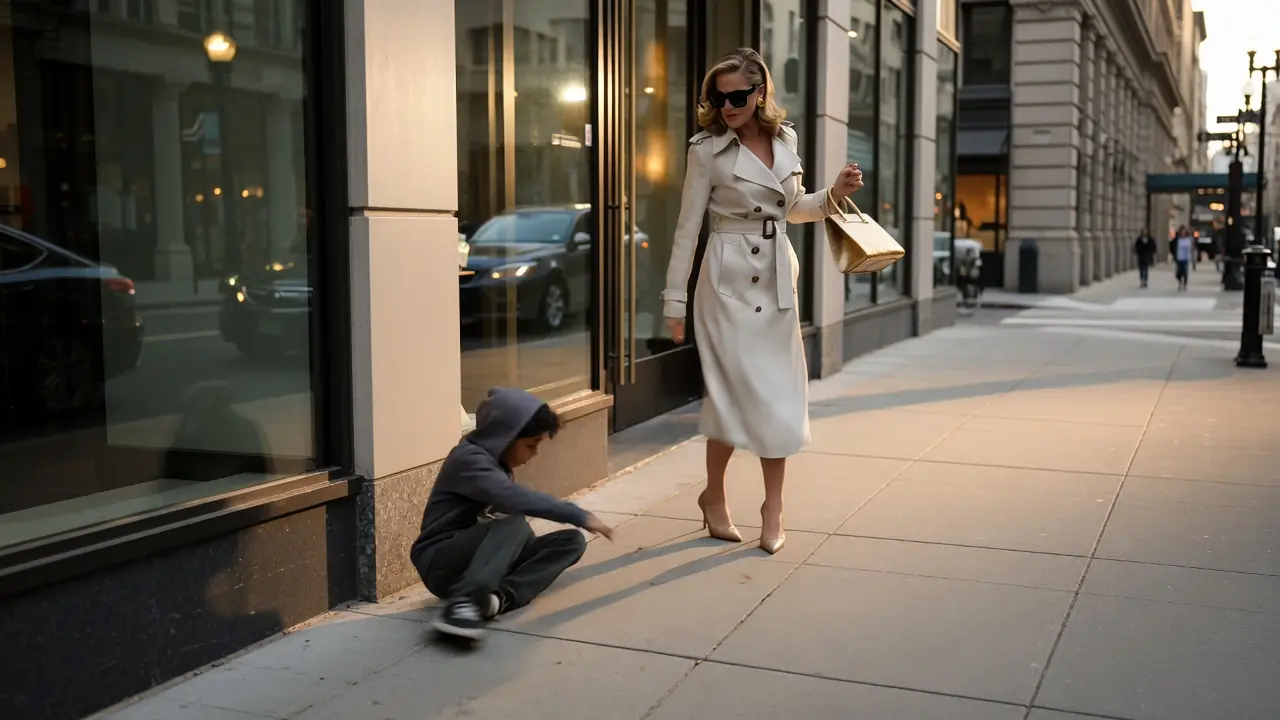
Natalie slowly knelt beside him.
Her cream coat touched the dirty pavement.
People stared harder.
Several phones lifted.
Evan tried again to push himself upright, ashamed to be seen lying there.
“I’m sorry,” he said. “I didn’t mean to scare her.”
Natalie covered her mouth.
He had saved her child.
And he was apologizing.
The baby, Sophie, reached toward him with tiny fingers, her cheeks wet, her mitten half falling off.
Evan gave her a weak smile.
“Don’t cry,” he whispered. “You’re okay.”
Natalie looked back at the coins.
They were everywhere now. Pennies near the curb. A dime under a boot print. Two quarters shining beside a gum wrapper. One nickel balancing at the edge of the storm drain like it was still deciding whether to vanish.
Natalie rose and began picking them up.
Not quickly.
Not for the crowd.
One by one.
She bent down in her expensive coat, her hands trembling as she lifted pennies from dirty slush and wiped them against her sleeve before placing them back into the paper cup.
A man recording lowered his phone a little.
No one spoke.
Natalie found the nickel by the drain last.
She held it in her palm for a long moment.
Then she placed it into the cup with the others and handed the cup back to Evan as though it were something fragile and sacred.
He stared at her, confused.
Natalie opened her handbag.
She pulled out every bill inside.
Twenties. Tens. A fifty folded behind a receipt.
She tried to press the cash into his hand.
Evan did not look at the money.
He looked at the stroller.
Then back at Natalie.
“Can some of it buy milk for my little sister too?”
Natalie froze.
“You have a little sister?”
Evan nodded.
“She’s behind the store. I told her I’d come back with food.”
Natalie’s eyes filled.
The crowd seemed to shift around them, suddenly uncomfortable with the difference between watching and helping.
Natalie stood slowly, still holding the boy’s cup.
Then she turned toward the people with phones.
Her voice was quiet, but everyone near her heard it.
“I almost stepped over the child who saved mine.”
No one answered.
She looked back at Evan and offered her hand.
This time, she did not pull away from the dirt.
“Take me to your sister,” she said. “No child is eating from a cup tonight.”
Evan stared at her hand.
He did not take it right away.
Children who live too long on the edge of adult kindness learn to inspect it before trusting it. Kindness can be a doorway. It can also be a trap. Sometimes people help loudly and leave quickly. Sometimes they ask questions that bring police, shelters, and strangers who separate siblings “for their own good.”
Natalie saw the hesitation.
It hurt, but she deserved it.
“I won’t make you go anywhere you don’t want,” she said. “I just want to help you both eat. And get that cut looked at.”
Evan touched his chin and looked at the blood on his fingers.
“It’s okay.”
“It is not okay.”
“My sister gets scared if I’m gone too long.”
“Then let’s not make her wait.”
He finally took her hand.
His fingers were freezing.
Natalie almost gasped at how cold they were, but stopped herself. He did not need her shock. He needed steadiness.
She turned to the man in the black overcoat who had been recording.
“Call an ambulance or a clinic,” she said.
The man blinked.
“Uh—yeah. Sure.”
“And stop filming him.”
His face flushed.
The phone lowered.
Natalie took Sophie from the stroller and held her against one shoulder. The baby sniffled, still upset but settling now, her little hand clutching the collar of Natalie’s coat.
With her other hand, Natalie pushed the stroller.
Evan walked beside her, limping slightly.
His paper cup rattled with coins.
The market entrance slid open behind them, spilling warm air and the smell of roasted coffee onto the sidewalk. For one strange second, Natalie thought of the grocery list still folded in her pocket. Baby yogurt. Lemons. Fresh pasta. A bottle of white wine.
Then she looked at Evan.
Food had meant something entirely different to each of them that day.
He led her around the side of Whitmore Market, past the loading dock where workers smoked during breaks, past stacked crates and flattened cardboard boxes, toward a narrow alley hidden between the market and an old pharmacy.
The alley smelled like damp brick, garbage, and fryer oil from the restaurant behind the next building.
Natalie’s boots splashed through shallow puddles.
Evan moved faster now despite the limp.
“Mia?” he called.
A tiny voice answered from behind a green dumpster.
“Evan?”
The sound made Natalie’s chest tighten.
Evan let go of her hand and hurried ahead.
“It’s okay,” he said. “I’m here.”
Behind the dumpster, beneath a piece of cardboard propped against the wall, sat a little girl wrapped in a brown coat much too large for her. She was maybe four years old. Her dark hair was tangled around her face. She held a stuffed rabbit with one missing ear and stared at Natalie with enormous frightened eyes.
Her lips were chapped.
Her hands were tucked under her arms for warmth.
“Mia, this lady is helping,” Evan said quickly.
Mia did not move.
Natalie crouched several feet away, careful not to crowd her.
“Hi, Mia,” she said softly. “My name is Natalie. This is Sophie.”
Sophie hiccuped against her shoulder.
Mia looked at the baby.
“Baby crying?”
“She got scared. Your brother helped her.”
Mia turned to Evan.
“You got food?”
Evan’s face changed.
It was the smallest flinch, but Natalie saw it.
He had left with a promise.
He had returned with a stranger and blood on his face.
“I’m getting it,” he said. “I didn’t forget.”
Mia’s chin trembled.
“I’m hungry.”
“I know.”
Natalie set the stroller brake and took off her scarf. It was cashmere, pale gray, expensive enough that she had once argued with herself for three days before buying it.
She wrapped it around Mia’s shoulders.
The little girl stiffened.
“It’s okay,” Natalie said. “You can keep warm.”
Mia touched the scarf with suspicious fingers.
“It’s soft.”
“Yes.”
“Do I have to give it back?”
Natalie swallowed.
“No.”
Mia looked at Evan for permission.
He nodded.
Only then did she pull the scarf closer.
Natalie looked around the alley. There was no adult. No bag except a small backpack with a broken zipper. No blanket beyond the cardboard. No sign that this was temporary in the way people liked to imagine child poverty was temporary.
“Where is your mother?” Natalie asked gently.
Evan’s expression closed.
“At work.”
“What kind of work?”
“Cleaning. When she can.”
“Where?”
“Different places.”
Natalie waited.
Evan looked at Mia.
Then at the alley wall.
“She went to the free clinic this morning. She was coughing blood. She told us to stay where people could see us, but the market manager said we couldn’t sit by the front door together. He said Mia made customers uncomfortable.”
Natalie felt something cold move through her.
“So you left Mia back here?”
Evan’s jaw tightened.
“I put her where the wind was less.”
It was not defiance.
It was defense.
Of the only choice he had.
Natalie softened her voice.
“You were trying to keep her safe.”
He nodded once.
Mia hugged the stuffed rabbit.
“Mommy said Evan’s in charge.”
Natalie closed her eyes for one second.
When she opened them, Evan was watching her carefully.
Waiting for the moment she would become another adult who judged without understanding.
She did not want to be that person again.
Not after what had already happened outside the market.
“Okay,” she said. “First, food. Then we find your mom. Is that all right?”
Evan’s eyes sharpened.
“You won’t call the police?”
Natalie hesitated.
A lawyer’s mind moved through rules, obligations, risk, liability, what should happen next.
A mother’s heart looked at two cold children in an alley.
“I will call for medical help if someone is hurt,” she said carefully. “But I will not try to separate you from your sister. And I will not make decisions about your family without telling you.”
Evan studied her.
That answer was not perfect.
Maybe that was why he trusted it a little.
“Okay,” he said.
Natalie lifted Mia carefully.
The girl weighed almost nothing.
Too little.
Far too little.
Mia wrapped both arms around Natalie’s neck, not with trust exactly, but with exhaustion. Natalie held Sophie on one hip and Mia on the other for a few seconds, one child warm from a stroller blanket, the other cold through every layer.
The difference between them was unbearable.
Evan picked up the broken backpack and the stuffed rabbit.
Then he reached for his paper cup.
Natalie stopped him.
“I have it.”
He looked alarmed.
She held it out immediately.
“Sorry. I should have asked.”
He took the cup.
The coins rattled.
“They’re ours,” he said.
“Yes,” Natalie replied. “They are.”
Inside Whitmore Market, warmth hit them all at once.
People turned.
Of course they turned.
A woman in a cream coat carrying a cold little girl, pushing a stroller, followed by a scraped-up boy with a paper cup was not something the afternoon shoppers knew how to ignore.
The manager near the floral display recognized Evan.
His face tightened.
“You can’t bring them in here,” he began.
Natalie turned slowly.
Her voice was quiet enough that people nearby leaned in to hear it.
“This boy just saved my daughter’s life outside your store.”
The manager’s mouth closed.
Natalie kept looking at him.
“He also says you made his four-year-old sister sit in an alley because she made customers uncomfortable.”
The silence around them grew sharp.
The manager glanced at the shoppers.
“I didn’t— That’s not exactly—”
“Get a cart,” Natalie said.
He stared.
“Excuse me?”
“A cart. Now.”
Something in her tone made him move.
He brought one.
Natalie placed Mia gently in the child seat area and tucked her scarf around the girl’s legs. Sophie sat in the stroller beside them, calmer now, watching Mia with curious eyes.
Then Natalie looked at Evan.
“What does your sister like?”
He seemed startled by the question.
“Milk.”
“What else?”
“Bananas. The yellow ones, not too spotted.”
Natalie nodded.
“What do you like?”
Evan shrugged.
“Anything.”
“That was not the question.”
He looked down.
“Chicken soup.”
“Then chicken soup.”
They moved through the aisles.
Natalie did not shop the way she usually did, comparing brands and checking labels and wondering whether Sophie would eat spinach if it came in a pouch with a cartoon pear on it. This time she listened.
Evan pointed rarely, almost reluctantly.
Milk.
Bananas.
Bread.
Peanut butter.
Canned soup.
Apples.
Crackers.
Diapers for Mia, though he whispered that one so quietly Natalie almost missed it.
Mia perked up near the cereal aisle.
“Evan, the stars.”
Evan shook his head quickly.
“Not today.”
Natalie put two boxes of star-shaped cereal into the cart.
Evan’s eyes widened.
“That costs too much.”
“Today it doesn’t.”
He looked uncomfortable.
Natalie understood that buying too much could feel dangerous to a child who had spent all day counting coins.
So she said, “You saved Sophie. Let me say thank you in groceries.”
Evan looked at the baby.
Sophie waved one damp mitten at him.
He nodded.
At the checkout, the cashier scanned quietly, eyes flicking again and again toward Evan’s scraped face. Natalie added children’s medicine, bandages, gloves, socks, and a small stuffed bear Mia had touched and then quickly put back.
When the total appeared, Evan stared at the screen as if it were a number from another planet.
Natalie paid.
The paper cup stayed in Evan’s hand.
He had not offered the coins.
She had not asked.
Outside, the man in the black overcoat was waiting by the curb.
“I called a clinic,” he said awkwardly. “There’s an urgent care two blocks over. They said they can look at the boy’s knees and face.”
Natalie nodded.
“Thank you.”
He looked at Evan.
“I’m sorry I filmed.”
Evan did not answer.
The man looked ashamed enough that Natalie did not make it worse.
They loaded groceries into a rideshare Natalie ordered because her driver still had not arrived. Evan sat by the window with Mia pressed against his side. Natalie sat opposite with Sophie on her lap.
For the first few minutes, no one spoke.
Then Mia opened the stuffed bear.
She looked at Natalie.
“This for me?”
“Yes.”
Mia hugged it to her chest.
“My bunny has a friend.”
Evan watched his sister.
His face softened for the first time.
At urgent care, the nurse cleaned his cuts.
Evan tried not to wince, but his fingers dug into the edge of the chair. Natalie saw his knees properly then, both scraped open, one bruised deep purple from hitting the street.
“You should have told me it hurt,” she said.
He glanced at her.
“It always hurts less if you don’t talk about it.”
Natalie had no answer to that.
The nurse gave him bandages and a juice box. Mia got one too, after she asked if being cold counted as injured.
While they waited for the doctor to return, Natalie called the free clinic.
She had to give descriptions, not names, because Evan did not want to say too much. A woman matching their mother’s description had been transferred to St. Anne’s Hospital before noon with pneumonia and severe dehydration.
Natalie told Evan.
His face went white.
“She’s at the hospital?”
“Yes. Alive. They moved her because she needed more care.”
“We have to go.”
“We will.”
“What about the food?”
“It will come with us.”
“What about Mia?”
“She will come too.”
“What about—”
“Evan.” Natalie leaned forward. “You are not alone in this next part.”
He looked at her like he wanted to believe that but did not know where to put the belief.
At St. Anne’s, the waiting room smelled of disinfectant, old coffee, and wet coats. Natalie carried Sophie. Evan held Mia’s hand so tightly the little girl complained, and he loosened his grip without letting go.
Their mother was named Rachel Miles.
She was twenty-nine years old and looked much older when they found her in a hospital bed with an oxygen tube beneath her nose. Her face was pale. Her hair lay flat against the pillow. One hand rested on top of the blanket, thin and cracked from cleaning chemicals and winter air.
Mia ran first.
“Mommy!”
Rachel’s eyes opened.
For one confused second, she looked frightened.
Then she saw both children.
“Oh, thank God.”
Evan reached her bedside and stopped, trying to be strong until she lifted one weak hand toward him.
Then he broke.
He leaned into her and began to cry without sound.
Rachel touched the back of his head.
“I told you to stay by the store.”
“I did,” he said. “Then Sophie rolled.”
Natalie stepped closer.
Rachel looked at her.
“I’m Natalie Voss. Your son saved my daughter today.”
Rachel’s tired eyes moved to Sophie.
Then to Evan’s bandaged knees.
“What happened?”
Evan wiped his face quickly.
“I’m fine.”
“He pulled her stroller out of the street,” Natalie said. “A van nearly hit him.”
Rachel covered her mouth.
“Evan.”
“I had to.”
“I know.” Rachel’s voice broke. “But you’re ten.”
Evan looked down.
“Mia was hungry.”
Rachel closed her eyes.
Shame moved across her face so visibly Natalie wanted to look away.
But looking away was what she had done outside the market.
She would not do it again.
“I tried to get back,” Rachel whispered. “They said they were only giving me fluids. Then they brought me here. My phone died. I didn’t know how to reach them.”
Natalie pulled a chair closer.
“They’re here now. They’re safe.”
Rachel looked at her with sudden fear.
“You called child services?”
“No.”
Rachel’s body tensed.
Natalie spoke gently.
“I am not saying no one ever needs help from the system. I’m saying I did not call anyone behind your back. Your children were scared of being separated.”
Rachel started crying.
“That’s what happened before.”
Evan looked sharply at his mother.
She shook her head, too tired to explain.
Natalie understood enough.
Poverty did not only make people hungry.
It taught them to fear help.
A doctor came in and explained Rachel’s condition. Pneumonia. Exhaustion. Poor nutrition. She needed to stay at least two nights, maybe longer. Rest mattered. Medication mattered. Follow-up care mattered.
Each sentence seemed to land on Rachel like a bill.
“I can’t miss that much work,” she said.
The doctor paused.
Natalie knew that pause. Professionals had different pauses for patients who had options and patients who did not.
She stepped forward.
“She will stay as long as medically necessary.”
Rachel looked at her.
“I can’t pay for—”
“We will talk about that later.”
“I don’t know you.”
“No,” Natalie said. “You don’t.”
Rachel pulled Mia closer with her free arm.
“Then why are you doing this?”
Natalie looked at Evan.
He sat beside the bed, exhausted, clutching the paper cup of coins in both hands.
“Because this afternoon I saw your son outside a grocery store and decided he was not my problem,” Natalie said. “Then he saved my child anyway.”
Rachel stared at her.
Natalie’s voice shook.
“I am trying to become the kind of person I thought I already was.”
Nobody spoke for a moment.
Then Rachel nodded once.
Not acceptance exactly.
Permission to continue.
That evening, Natalie’s life split into before and after.
Before, charity had been something she scheduled. Donations made in December. Checks written after galas. Baby clothes dropped off in clean bags at church drives. It had made her feel decent, and perhaps some good had come from it.
After, charity had Evan’s scraped knees.
Mia’s cold hands.
Rachel’s fear of being helped.
Coins in a paper cup that had meant dinner.
Natalie called her assistant and canceled her evening. She called her husband, Daniel, and told him to meet her at the hospital, not the restaurant. He arrived thirty minutes later in a dark suit, carrying Sophie’s diaper bag and confusion he tried to hide.
Daniel listened.
Then he looked through the glass at Evan sleeping upright in a chair beside his mother’s bed, the paper cup still in his lap.
He did not ask whether Natalie was overreacting.
That was one of the reasons she had married him.
“What do they need tonight?” he asked.
Natalie exhaled.
“Everything.”
So they started with tonight.
Daniel took Evan and Mia to the hospital cafeteria while Natalie stayed with Rachel. He bought them dinner and did not comment when Evan wrapped half his sandwich in napkins to save for later. He simply bought another one and asked if Evan could help him choose a soup for Rachel.
Mia fell asleep against Daniel’s side before dessert.
Evan did not.
He watched everything.
The elevators.
The nurses.
The exits.
The way adults spoke when they thought children were not listening.
Later, Natalie arranged a hotel room across from the hospital for the children and herself. Rachel resisted until the doctor reminded her that rest would be impossible if she spent all night worrying where her children were sleeping.
Evan resisted too.
“I stay with Mia.”
“You can,” Natalie said. “There are two beds.”
“And Mom?”
“We’ll come back first thing in the morning.”
“What if she needs us?”
“She has nurses.”
“What if nurses forget?”
Natalie paused.
Then she wrote her phone number on the whiteboard near Rachel’s bed and asked the night nurse to call if Rachel woke frightened or asked for the children. She gave Evan her phone and let him call the hospital desk from the hallway to test that someone answered.
Only then did he agree.
In the hotel room, Mia fell asleep after two bites of a banana.
Evan sat on the second bed, staring at the bag of groceries lined against the wall.
Natalie sat in the chair near the window with Sophie asleep in her stroller beside her.
“You can sleep,” she said.
“I know.”
“But you won’t?”
He shrugged.
She looked at the paper cup on the nightstand.
“May I ask how much you had saved?”
Evan looked at it.
“Three dollars and forty-eight cents.”
“You counted?”
“Twice.”
“What were you going to buy?”
“Milk for Mia. Bread if there was enough. Maybe soup if the man at the corner store let me be short.”
Natalie swallowed.
“And for you?”
He looked confused.
“I eat after Mia.”
She turned toward the window.
Outside, Madison Avenue glowed with traffic and wet pavement.
Inside, the room was warm.
That warmth no longer felt like comfort.
It felt like evidence.
The next morning, a short video appeared online.
It showed Evan on the pavement, the stroller beside him, Natalie kneeling in her cream coat, coins scattered everywhere. The caption said: Rich mom ignores homeless boy until he saves her baby.
By noon, thousands had seen it.
By three, a local news station called Natalie’s office.
By evening, strangers were arguing in the comments about poverty, parenting, privilege, homelessness, gratitude, race, class, and whether the boy’s mother should be blamed.
Natalie watched none of it after the first minute.
Evan saw only the beginning before she turned it off.
“Am I in trouble?” he asked.
“No.”
“People are mad.”
“At many things. Not at you.”
He touched the bandage on his chin.
“I don’t want people to know Mia was behind the store.”
Natalie felt a fresh wave of shame.
The internet loved a rescue.
It rarely knew how to protect the rescued.
“I’ll ask them not to use your full name,” she said.
“They already know?”
“Some might.”
His face closed.
Natalie crouched in front of him.
“I am sorry. I should have stopped the filming faster.”
“You were helping Sophie.”
“I was also late to understand what was happening.”
Evan looked at her for a long moment.
Then he said, “You picked up the coins.”
It was not forgiveness.
But it was something.
Rachel improved slowly.
Over the next few days, Natalie learned pieces of their life, never in one clean explanation because real hardship does not arrive in a neat speech.
Rachel had left a violent boyfriend eighteen months earlier. Not Evan and Mia’s father, but a man who had become dangerous when Rachel refused to let him discipline Evan. They had stayed in a shelter, then with a cousin, then in a rented room that disappeared when the landlord sold the building.
Work came through cleaning agencies that paid late.
Childcare cost too much.
One missed week became two.
Two became eviction.
Winter did the rest.
Rachel did not tell the story as an excuse.
She told it like a woman inventorying damage after a storm.
Natalie listened.
Daniel listened too.
They did not try to fix every sentence as it was spoken. That was harder than writing checks. Money could move fast. Trust could not.
On the fourth day, Rachel was discharged.
Natalie offered a short-term furnished apartment owned by a client’s nonprofit partner. Rachel refused at first. Then Evan asked if it had a lock on the door and a place where Mia could sleep without her coat on.
Rachel said yes after that.
The apartment was small.
To Evan and Mia, it looked enormous.
Mia ran from the bedroom to the kitchen and back three times.
“There’s a table,” she announced.
Evan checked the windows.
Then the locks.
Then the fridge.
Natalie had stocked it, but carefully this time. Not extravagantly. Milk, eggs, bread, fruit, soup, chicken, rice, vegetables, cereal stars, and enough snacks that Evan stood staring until Rachel touched his shoulder.
“You don’t have to count it today,” she whispered.
He nodded.
But later Natalie saw him counting anyway.
That habit would take longer to heal than hunger.
The paper cup sat on the kitchen counter.
Rachel had tried to throw it away once, thinking it was trash.
Evan stopped her so sharply Mia cried.
After that, Rachel washed it gently and dried it by hand.
Natalie watched him place the coins back inside.
Three dollars and forty-eight cents.
Not much money.
A whole chapter of his life.
Weeks passed.
Natalie did not become a saint.
That mattered.
She still lost patience in traffic. She still forgot appointments. She still caught herself making assumptions about people on sidewalks and had to force herself to look again. Change was not a golden light pouring through her life. It was a daily discomfort.
But she kept showing up.
She helped Rachel find legal aid to handle old debts and housing paperwork. Daniel helped Evan enroll back in school without the missing documents becoming a wall. Natalie arranged childcare support through a community program and then donated enough to that program that other families were not pushed aside because of one family’s emergency.
Rachel insisted on working.
Natalie respected that.
They found her a steadier position cleaning offices for a company that paid legally, on time, with sick days. Rachel cried when she received her first proper pay stub. Then she pretended she had allergies.
Evan started school again in February.
On his first morning, he wore new gloves but kept his old blue hat. Natalie offered to replace it. He said no.
“That hat knows stuff,” he explained.
Mia went to preschool three mornings a week and told everyone her brother stopped a van with his knees.
Evan hated that story.
Mia told it anyway.
Sophie, too young to know she had nearly been lost, loved Evan with the uncomplicated devotion of babies. Whenever he visited, she reached for him. He always pretended to be annoyed, then let her hold one of his fingers.
One Saturday in March, Natalie invited Rachel, Evan, and Mia to the park.
The snow had melted. The city still looked gray, but there were small green points pushing up through the soil near the benches. Sophie sat in her stroller, chewing on a toy giraffe.
Evan walked beside the stroller with one hand hovering near the handle.
Natalie noticed.
“You don’t have to guard it.”
“I know.”
“But you are.”
He shrugged.
“Just in case.”
Natalie did not tell him to stop.
Some instincts fade only when they feel unnecessary for a long time.
Rachel and Daniel walked ahead with Mia, who was explaining that ducks were rude because they took bread and never said thank you.
Natalie looked at Evan.
“I’ve been thinking about the cup.”
His hand moved toward his backpack.
“It’s at home.”
“I know. I don’t want to take it.”
He relaxed slightly.
“I was wondering if you would let me make a copy of the coins.”
His brow furrowed.
“What does that mean?”
“A photograph. Or maybe we frame three dollars and forty-eight cents in new coins. For the community center we’re helping start.”
“What community center?”
Natalie smiled a little.
“The one you accidentally inspired.”
Evan looked suspicious.
“I didn’t inspire anything.”
“You reminded a lot of adults that hungry children should not have to sit outside stores hoping strangers feel generous.”
He looked away.
“I don’t want my name on it.”
“Then it won’t be.”
“I don’t want people saying I’m sad.”
“Then they won’t.”
“I don’t want Mia’s alley talked about.”
Natalie nodded.
“That story belongs to your family. Not to people who want to feel something for five minutes online.”
Evan studied her.
“What would the center do?”
“Food. Warm clothes. Help finding clinics. A place where families can ask for help before kids are sent outside with paper cups.”
He was quiet.
Then he said, “It should have snacks kids can take without asking.”
Natalie looked at him.
“What kind?”
“Granola bars. Crackers. Apples. Not just weird cans nobody knows how to open.”
She nodded seriously.
“Done.”
“And diapers. People forget diapers.”
“Done.”
“And don’t make moms feel bad.”
Natalie swallowed.
“We’ll try very hard not to.”
Evan kicked a pebble along the path.
After a while, he said, “You can use the number.”
“The number?”
“Three forty-eight.”
So that became the name.
The 348 Table.
Not a shelter.
Not a charity with glossy photos of sad children.
A warm storefront two blocks from Whitmore Market, with shelves of food, diapers, formula, socks, coats, clinic information, and a corner where children could take snacks without asking anyone for permission.
A small framed sign near the entrance read:
No child should have to count coins for dinner.
Evan approved that because it did not mention him.
The opening day was crowded.
Reporters came, but Natalie kept them outside unless families agreed to speak. Rachel stood beside the snack shelf, helping unpack apples. Mia wore a yellow sweater and handed crackers to every child who came near her, including some who had not asked.
Daniel carried boxes.
Sophie toddled unsteadily between chairs, watched by three adults and Evan, who still did not entirely trust wheels, stairs, streets, or gravity.
The manager from Whitmore Market came too.
His name was Mr. Alden, and he looked deeply uncomfortable holding a box of donated food.
He found Evan near the back door.
“I owe you an apology,” he said.
Evan said nothing.
Mr. Alden cleared his throat.
“I should not have made your sister leave the front of the store.”
“No,” Evan said.
The man blinked.
It was not the answer he expected.
“No, you shouldn’t have,” Evan said.
Mr. Alden’s face reddened.
“You’re right.”
Evan looked toward Mia.
“She was cold.”
“I know.”
“You didn’t care.”
Mr. Alden swallowed.
“I care now.”
Evan looked at him for a long time.
Then he said, “Caring now means snacks go near the front where kids can reach.”
Mr. Alden nodded.
“I can do that.”
“And don’t call them suspicious just because they’re hungry.”
The man’s eyes dropped.
“I won’t.”
Evan did not forgive him out loud.
But he handed him a box of granola bars.
Sometimes that was enough for a beginning.
Months later, Natalie still carried one coin in her wallet.
A nickel.
Not Evan’s original nickel by the drain, but one like it. She kept it in a small pocket behind her driver’s license, where she would see it whenever she reached for a credit card.
It reminded her that a person could stand close enough to need and still not see it.
It reminded her that almost was a terrible word.
She had almost stepped over Evan.
Almost dismissed him.
Almost protected her child from the wrong danger.
Almost missed the two children waiting behind the store.
Almost let three dollars and forty-eight cents roll into the gutter.
One rainy afternoon in late spring, she returned to Whitmore Market with Sophie in the stroller.
The sidewalk was slick again.
The same curb shone dark with water.
Natalie stopped where the coins had scattered that day.
Sophie babbled at a passing bus.
Natalie looked toward the alley.
No cardboard shelter now.
No little girl behind the dumpster.
No boy counting coins with frozen hands.
A voice behind her said, “You’re blocking traffic.”
She turned.
Evan stood there with his backpack over one shoulder, new shoes on his feet and the same old blue hat on his head. Mia stood beside him holding Rachel’s hand, waving a half-eaten granola bar. Rachel looked healthier now, though still tired in the way working mothers often are.
Natalie smiled.
“Am I?”
Evan nodded toward the stroller.
“You should lock the wheels.”
She did.
He checked.
Then he nodded.
Sophie reached for him.
“Ev!”
He sighed dramatically and let her grab his finger.
Mia looked up at Natalie.
“We have a table now.”
“You do.”
“With snacks.”
“Yes.”
“And diapers.”
“Yes.”
“And apples.”
“Lots of apples.”
Mia nodded, satisfied.
Rachel touched Natalie’s arm.
“Thank you.”
Natalie shook her head.
“You don’t have to keep saying that.”
Rachel smiled faintly.
“I know. I’m saying it anyway.”
Evan looked at the market entrance.
Then at the curb.
Then at Natalie.
“You still have the coin?”
She was surprised he remembered.
“Yes.”
“Good.”
“Why?”
He shrugged.
“So you don’t forget.”
Natalie’s throat tightened.
“I won’t.”
The light changed.
People began to cross.
Evan walked on the outside, closest to the street, one hand still lightly on Sophie’s stroller handle. Natalie did not tell him she could manage. Rachel did not tell him to stop worrying.
They simply crossed together.
On the other side, the city kept moving.
Cars hissed through puddles.
Shoppers hurried under umbrellas.
A delivery van honked somewhere down the block.
Nothing about Madison Avenue looked sacred.
But Natalie knew better now.
A sidewalk could be a place where coins fell.
A curb could be a place where a child chose another child’s life before his own hunger.
A paper cup could hold more than change.
It could hold the exact weight of what adults failed to see.
And a boy who had once apologized for saving a baby could become the reason a whole city block learned to look down, look closer, and stop stepping over children who were only trying to eat.
The coins stayed in Evan’s cup.
The nickel stayed in Natalie’s wallet.
The 348 Table stayed open.
And every time rain darkened the pavement outside Whitmore Market, Natalie remembered the sound of money scattering near the curb.
Not toys.
Not candy.
Food.
She remembered the boy’s shaking voice.
She remembered kneeling in her clean coat on dirty pavement.
Most of all, she remembered the small, terrible truth that changed her life.
Sometimes the child you almost ignore is the one who saves everything you love.