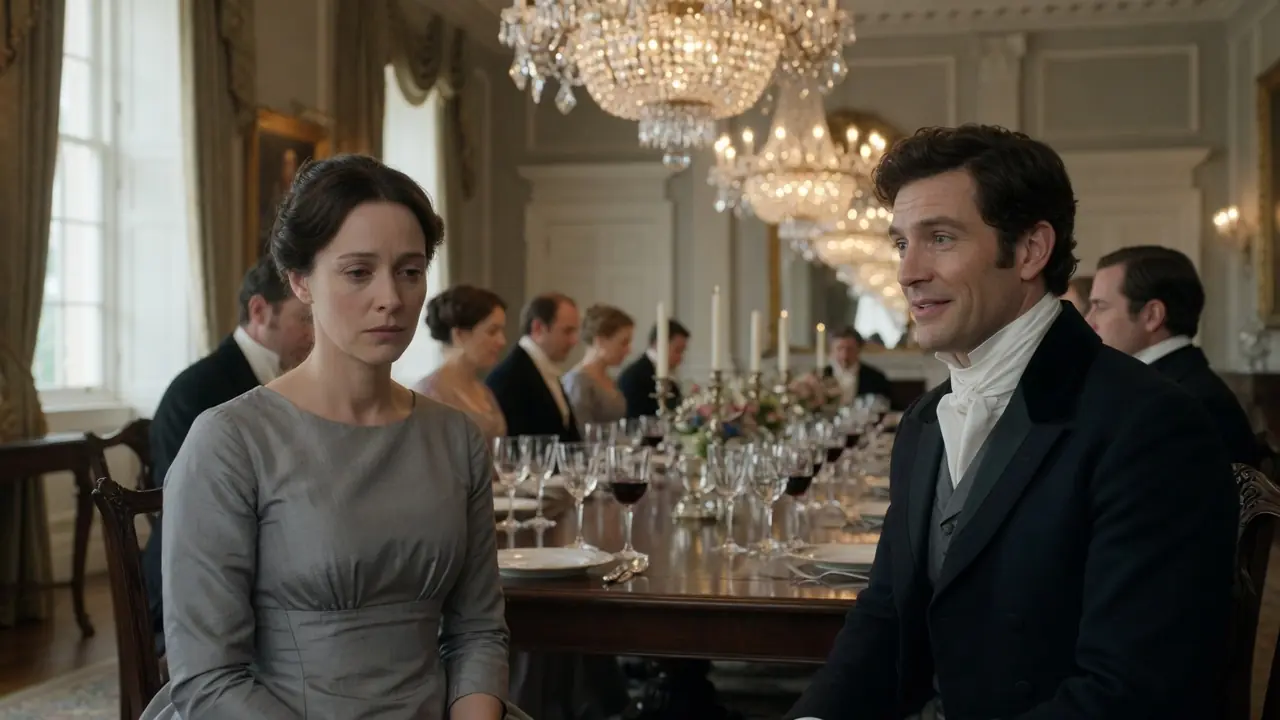
"You promised to marry me when we were children," the duke joked with a smile, expecting laughter. "I still would," Lydia Harrington whispered. The laughter died instantly. 20 guests sat beneath glittering chandeliers. Not one of them spoke.
Because everyone in that room knew something the Duke of Eastford had forgotten. Lydia Harrington was 30 years old. Unmarried. Dependent upon relatives who barely concealed their resentment. And for 15 years, society had whispered that she had refused every respectable offer because she was waiting for a boy who had ridden away and never returned. Nathaniel Vale's smile disappeared.
He had meant it as a harmless jest. A fond memory. But the look in Lydia's eyes was not fond. It was quiet. Resigned. Worse, it was honest.
And as the silence stretched across the dining room, Nathaniel began to realize something terrifying. The promise he had forgotten might have shaped the entire course of Lydia's life. Before the evening ended, he would discover just how much she had lost because of him. And before the week was over, the Duke of Eastford would have to decide whether he was willing to walk away from Lydia Harrington a second time. The candles had not yet been lit when Lydia Harrington decided, once again, to make herself small.
It was a skill she had perfected over 15 years. Sit near the edge of the room. Speak only when addressed. Smile before anyone notices you have forgotten how. Tonight, like every night, she wore gray.
Not mourning gray. Not fashionable gray. The gray of a woman who has stopped trying to be seen. Her cousin Margaret's dining room glittered with borrowed candlelight, the kind reserved for guests who mattered. Lydia was not a guest.
She was a resident. A permanent fixture, like the umbrella stand in the hall, useful, unremarkable, never quite belonging to anyone. She heard her aunt's voice before she saw her. "Lydia, do sit nearer the foot of the table. We've a full party tonight."
A full party meant important people. Important people meant Lydia at the foot, where her presence could be forgotten without being rude about it. She did not argue. She never argued. She simply moved.
That was when the doors opened and the room changed. A footman announced him before anyone was ready to hear it. "His Grace, the Duke of Eastford." Forks paused midair. Conversation died into a ripple of whispers.
Lydia did not need the footman to tell her who he was. She had known that voice, that walk, that careless tilt of the chin since she was 15 years old. Nathaniel Vale. Only he was not a boy anymore. He filled the doorway the way certainty fills a room, broad-shouldered, composed, entirely unaware that he had just detonated a quiet woman's carefully constructed peace. Lydia's hand tightened around her fork. 15 years.
15 years since he had ridden away with a promise tucked behind his smile, and she had been foolish enough to believe a boy's words could survive a man's ambitions. He had not written. He had not returned. He had simply vanished the way wealthy young men do when the world offers them better things than a country promised to a forgettable girl. And now he stood in her cousin's dining room, dressed as a duke, smiling like a man who remembered nothing at all.
Dinner began the way dinners always began in houses like this. Too much wine, too much performance, everyone watching everyone else for cracks in their composure. Nathaniel was seated near the head of the table, the guest of honor, the prize everyone wished to claim for a daughter or a niece. Lydia sat far enough away that she could watch without being watched. She told herself this was safer.
She told herself a great many things. It was somewhere between the fish course and the second round of wine that the conversation turned, as conversations among bored, well-fed people often do, toward nostalgia. "Do you remember?" said Mr. Aldridge, an old family friend with a fondness for stirring quiet rooms, "when you two were children? Always underfoot together.
I dare say half the county thought you'd marry before you were 12." Laughter rippled down the table. Lydia's stomach turned cold. Nathaniel laughed, too, easily, lightly, the laugh of a man who has never once feared what laughter might cost someone else. "I do recall," he said, smiling toward Lydia with the careless warmth of a man revisiting a fond, harmless memory.
"I believe I even tied a ribbon round her finger and declared us engaged." "Quite serious about it, too, as I remember." More laughter. Warmer this time. "You promised to marry me when we were children," he said, directly to her now, his eyes bright with amusement, expecting her to laugh along, to wave it off as the silliness of youth. It was meant as nothing. A jest. A pleasantry.
A bridge across an awkward silence. The table was already smiling, already waiting for Lydia to smile, too, to say something light and forgettable so the conversation could move on to easier things. Lydia opened her mouth and the truth came out instead. "I still would." Three words. Soft. Quiet. Utterly without performance.
The room did not laugh. The room did not breathe. 20 guests sat beneath glittering chandeliers and not one of them spoke because every person at that table, every single one, understood instantly what those three words meant. They understood what Nathaniel, in his careless ease, had forgotten. That Lydia Harrington was 30 years old.
That she was unmarried. That she lived on her cousin's charity, tolerated rather than loved. And that for 15 years, society had whispered, cruelly, knowingly, that she had refused every respectable offer because she was waiting. Waiting for a boy who rode away and never came back. Nathaniel's smile did not fade slowly.
It collapsed all at once, like a structure built on ground that had just given way beneath it. He looked at her, really looked, and Lydia watched the precise moment understanding reached him. It was not fond memory in her eyes. It was not nostalgia, or sentiment, or a woman playing along with an old joke. It was exhaustion.
It was honesty. It was 15 years of a wound that had never been permitted to close. Margaret's fork clattered against her plate, too loud in the silence. Someone coughed. Mr. Aldridge, sensing too late what he had unleashed, attempted a laugh that died halfway out of his throat. Lydia did not look away from Nathaniel.
She would not give the table the satisfaction of watching her flinch. "Forgive me," she said, rising with the steady grace of a woman who had spent years learning how to leave a room with her dignity intact, even when her heart was not. I find I am rather tired this evening." No one stopped her. No one dared.
She walked from the dining room with her spine straight and her chin level, the way she always walked away from rooms that had just humiliated her, as though humiliation were simply weather, something to be endured rather than discussed. It was only in the hallway, alone, with the door closed behind her, that her hand pressed flat against the wall to keep her steady. 15 years of silence, and she had finally said it aloud. She had not meant to. She had meant to laugh, to deflect, to do what she always did.
Instead, the truth had simply escaped, the way water escapes a cracked vessel no matter how carefully one tries to hold it together. Behind her, in the dining room, the silence had not ended. Nathaniel sat utterly still, the wine forgotten before him, the laughter of moments ago still hanging in the air like smoke after a fire. He had meant it as nothing. A harmless jest.
A fond memory revisited for the amusement of a dinner table. But the look on Lydia's face had not been fond. It had been quiet. Resigned. Worse, it had been true. And as the other guests began awkwardly to resume their conversation, pretending nothing of consequence had occurred, Nathaniel Vale began to understand something that turned his blood to ice.
A promise he had made as a careless boy and forgotten as a careless man might have shaped the entire course of a woman's life. He needed to know how. He needed to know what, exactly, 15 years of silence had cost her. Because the woman who had just left that room was not the girl he remembered. And he was beginning to suspect that he was the reason why.
He found her the next morning in the garden, cutting roses she did not need for a vase no one would notice. Nathaniel was beginning to understand what Lydia did when she needed her hands occupied and her face composed. "Miss Harrington." She did not turn. "Your Grace. I had hoped you would have the decency to leave me my mortification in private." "I came to apologize."
"Then you may save your breath. I require no apology." "Lydia." She turned then, shears still in hand, and the look she gave him was not the quiet resignation of the dinner table. It was sharper. Older. A woman who had buried something and resented being made to dig it up.
"Do not," she said, "look at me as though I am a tragedy you have stumbled upon. I am not a wound for you to dress, Your Grace. I am a woman who has managed perfectly well without your concern for 15 years." "I never meant" "I know what you meant." Her voice did not rise.
It never rose. That, Nathaniel was learning, was somehow worse than shouting. "You meant nothing at all. That has always been rather the trouble." He absorbed that in silence.
"I did not spend 15 years sitting at a window, Your Grace, watching the road for a man who had clearly found better uses for his time. I am not a character in a sentimental novel, weeping into handkerchiefs. I nursed my mother through a long illness. I raised my younger cousins when their own mother could not. I managed a household on a budget that would have humbled a more practical woman to tears. I lived.
I never imagined otherwise." "Did you not?" Her chin lifted. "Then you imagine very little about me at all, which is, I think, rather the point." She set down the shears.
"I will tell you the truth since you seem so determined to excavate it. Yes, your promise, your foolish, careless, childish promise became a stone around my neck. Not because I clung to it, because others would not let me set it down." His jaw tightened. "What do you mean?"
"I mean that a girl who turns away a respectable offer once is thought particular. A girl who turns away two is thought proud. By the third, Your Grace, she is no longer thought anything at all. She is simply discussed. "You refused offers."
"I refused men I could not respect," she said evenly. That is not the same as refusing marriage. But society does not trouble itself with such distinctions. It is far easier to say a woman is waiting for a duke than to admit she simply has standards inconvenient to other people's comfort. She walked past him back toward the house and Nathaniel, Duke of Eastford, a man accustomed to rooms rearranging themselves around his wishes, found himself standing alone among the roses, thoroughly, deservedly dismissed.
He did not leave the matter there. That, he supposed, was the only decent instinct he had left. Over the following days, Nathaniel did what he had never troubled himself to do as a careless young man, he listened. Not to Lydia, who would tell him nothing further, but to the small, careless remarks of people who did not know they were confessing anything at all. He found Mr.
Aldridge in the card room two evenings later, flushed with port and indiscretion. "Harrington girl," Aldridge said, when Nathaniel steered the conversation with practiced ease. Pity, that one. Could have married well, you know. Young Pelham offered for her, oh, a dozen years back. Good family. Steady income.
She refused him flat. "Did she give a reason?" "Pelham gave his own soon enough." Told anyone who'd listen she thought herself too fine for an ordinary gentleman. Word spreads quick in the country, Your Grace.
Folk do love a story. Nathaniel kept his expression carefully neutral. "And after Pelham?" "Caro tried his luck a year or two later." Decent enough fellow.
She refused him, too. By then, the talk had already turned. Said she fancied herself waiting for someone grander. A title, mind. Someone said Duke, and once that word gets loose, well.
Aldridge spread his hands as though the matter had settled itself. No man wants to court a woman everyone believes is holding out for another. "And was she?" Aldridge laughed, missing the question entirely. "Couldn't say. Though I do recall she was rather fond of you as a girl.
Children's nonsense, surely." Nathaniel said nothing. He had learned, in matters of war and diplomacy both, that silence drew out more truth than questions ever could. He found more of it in the servants' quarters, where an old housekeeper named Mrs. Pruitt, who had once mended his torn coat sleeves as a boy and now mended linens for Lydia's relatives, spoke with the particular bluntness of a woman who had nothing left to lose by honesty.
"Miss Lydia were a bright girl," she said, folding a tablecloth with brisk, practiced hands. "Bright and kind, which is a rarer combination than folk credit. But bright girls who say no to convenient marriages get talked about, Your Grace, and talked about girls get fewer invitations, and fewer invitations means fewer chances until one day the chances simply stop coming altogether." "And her family?" Mrs. Pruitt's hand stilled briefly.
"Her family loved her well enough when she were useful to them. Nursing the mistress, minding the children. But love and usefulness aren't always the same coin, are they? I've heard her aunt call her a burden more than once, and not always quiet about it, either. Nathaniel left that conversation with something cold settling in his chest.
He had ridden away from a country promised 15 years ago and built himself a life of titles and ledgers and minor, manageable regrets. He had not once considered that the words he'd spoken so lightly might have followed Lydia through every drawing room she'd ever entered, a quiet, persistent rumor that closed doors before she ever reached them. He had not ruined her with cruelty. He had ruined her with carelessness, which was, he was beginning to suspect, very nearly the same thing. Lydia, for her part, found Nathaniel's continued presence in her relatives' house an exercise in restraint she had not anticipated needing.
He did not corner her again. He did not press for further conversation in gardens or attempt grand speeches at dinner. Instead, he simply appeared beside her on the morning walk her aunt insisted upon for propriety's sake, across from her at the small, unremarkable family meals no one of consequence attended, in the margins of her days, quietly, persistently, asking nothing of her except that she allow him to exist nearby. She resented it. She resented it more than she resented his joke at dinner because a joke could be dismissed as thoughtlessness, and this, this patient, careful attention could not be dismissed at all.
"You needn't trouble with my company, Your Grace," she told him on the fourth such walk, when his presence beside her had become a habit she had not given permission for. "I'm not troubling myself. I find I prefer it." "You prefer the company of a woman you humiliated at dinner not for days past." "I prefer the company of a woman who told me the truth when everyone else in that room would have let me believe a comfortable lie.
She had no immediate answer for that. They walked in silence a while, the hedgerows damp from morning rain, the air smelling of wet earth and early autumn. "I am not asking you to forgive me," he said finally. "I am not even certain I deserve the chance to ask. I am only asking you to let me know you. Properly.
As you are now, not as I left you. And if I refuse then I will walk beside you in silence, and that will have to be enough." It was infuriatingly the correct answer. The answer of a man who had finally learned not to demand what he had not earned. Lydia hated how much she noticed it.
She hated more the small unguarded warmth that rose in her chest each time he looked at her, not with pity, which she could have despised cleanly, but with something gentler. Guilt, yes. But also genuine concern, genuine interest, the particular attentiveness of a man actually listening rather than waiting for his turn to speak. It frightened her terribly. Because some small, foolish, 15 years buried part of her recognized that look. It was the same look a boy had once worn while tying a ribbon round her finger in a garden much like this one, promising her a future neither of them yet understood the cost of.
She had survived his absence by training herself never to want anything from him again. And here he was undoing 15 years of careful discipline with nothing more than consistency and quiet attention, the two things she realized bitterly she had wanted from him most and received least. "You are not repairing anything, Your Grace," she said quietly as they reached the garden gate and the walk's natural end. Attention is not amends. Kindness now does not undo 15 years of its absence. I know.
Then why persist? He considered the question with the same careful weight he seemed to give everything now. A man who had clearly learned, somewhere in his years away, that words mattered more than he had once believed. "Because I would rather spend the next 15 years learning who you became," he said, "than spend one more pretending I do not wish to know." Lydia said nothing.
But that night, alone in her small, borrowed room, she found herself thinking of ribbons and gardens far longer than dignity or self-preservation would have advised. The letter from Nathaniel's aunt arrived on a Tuesday, and by Thursday, half the county seemed to know its contents. Nathaniel did not show it to Lydia. He did not need to. The shift in the room told her everything before a single word was spoken.
"Your Grace," his aunt, the dowager Lady Eastford, had written in the careful hand of a woman accustomed to being obeyed, "you are 32 years old and unmarried, and the estate cannot continue to wait upon your sentiment. Miss Caroline Whitmore is 18, well-dowered, and her family has made their interest plain. I beg you not to let a foolish entanglement with a penniless spinster cost this family its future." He had not told Lydia the words exactly, but she had heard enough from Margaret, who had heard it from a maid, who had heard it from someone in Nathaniel's own household, to understand the shape of it. A younger bride.
A wealthier bride. A sensible bride. Everything Lydia was not. "You needn't look so satisfied," she told her aunt, when Margaret raised the subject over breakfast with poorly disguised relief. "I am not satisfied, Lydia. I am relieved. Do you not understand what this household risks if people believe you still hope for him? We are already whispered about for harboring you. If it's thought you've set your cap at a duke who has no intention of marrying you, we shall be a laughingstock from here to London." "I have set my cap at no one."
"Then perhaps you might begin behaving as though that were true. No more garden walks. No more lingering at dinner. Let the matter die quietly as it should have died years ago. Lydia said nothing.
There was nothing to say that her aunt would hear. She understood with a clarity that felt almost peaceful in its bitterness that everyone wanted the same thing now. Nathaniel's family wanted the old promise forgotten because it threatened a more advantageous match. Her own family wanted it forgotten because it threatened their respectability. The promise itself had become an embarrassment to be buried regardless of what it had cost the woman who carried it.
No one asked what Lydia wanted. No one ever had. The country gathering at the Aldridges' that Saturday was meant to be unremarkable, a modest assembly, cards and dancing and the usual parade of county gossip dressed up as conversation. Lydia had not wished to attend. Margaret had insisted in that particular tone that made refusal more trouble than acceptance.
"You will go," Margaret said, "and you will smile, and you will give no one cause to discuss us further." So Lydia went in her gray dress and took her usual place near the edge of the room and told herself the evening would pass the way every evening passed, quietly, forgettably, without incident. It did not. It was Mrs. Aldridge, flushed with wine and the particular cruelty of a woman who missed a gossip for wit, who raised it.
"I do think it's rather sweet," she said to a small cluster of guests that included Lydia, though her eyes did not quite settle on her. "Childhood promises and the like." "Charming, really, when both parties are still young enough to be forgiven for believing them." A ripple of polite laughter. "Of course," Mrs.
Aldridge continued, warming to her audience, "there comes an age when clinging to such things stops being charming and starts being, well, one does hope Miss Harrington has more sense than to mistake a boy's nonsense for a man's intention. 30 is rather old for fairy stories, is it not?" The laughter this time was less polite. Sharper. Aimed. Lydia felt the heat climb her throat, felt every eye in the small cluster turn toward her, waiting to see how deeply the blade had landed. She did not flinch.
She had survived worse rooms than this one. "I'm sure you're quite right, Mrs. Aldridge," she said, her voice perfectly level. "30 is rather old for fairy stories. Fortunately, I have never mistaken one for the truth."
It was a fine answer. A dignified answer. It did not stop the laughter from lingering, or the eyes from staying on her a moment too long, cataloging her humiliation for later retelling. That was when Nathaniel crossed the room. He had been speaking with Lord Pelham near the card tables, but he crossed the room without hesitation, without consultation, and placed himself beside Lydia with the unmistakable bearing of a man who intended to be heard.
"I believe the joke in question was mine, Mrs. Aldridge," he said, and his voice, though pleasant, carried the particular weight of a man whose displeasure was rarely required and therefore rarely ignored. "I made it carelessly, and at Miss Harrington's expense, at a dinner not long past. The promise was mine as a boy. The fault in recalling it was mine as a man.
If there is shame to be found anywhere in this matter, I assure you it belongs entirely to me. The room had gone quiet in the particular way rooms went quiet around Dukes who had decided to be displeased. "I would ask," Nathaniel continued, "that anyone inclined to discuss Miss Harrington's dignity direct their commentary toward me instead. I find I have rather broad shoulders for it and considerably less use for them than she has for her peace. No one laughed now. Mrs.
Aldridge, to her credit, had the grace to flush and busy herself with her wine glass. Lydia stood very still beside him, aware of every eye in the room, aware that something had shifted in the air, though she could not yet name what. The conversation resumed awkwardly, the way conversations always resumed after someone with more power than tact had reminded a room of its manners. But it resumed differently. Quieter. More careful. Lydia said nothing to Nathaniel for the rest of the evening.
She did not trust herself to. It was only in the carriage home, with Margaret dozing against the window and the night dark beyond the glass, that she allowed herself to feel the full weight of what had happened. He had defended her. Publicly. Without hesitation, without calculation, in a room full of people whose good opinion he could ill afford to lose if his family's wishes were to be honored. It should have felt like vindication.
Instead, it felt like grief. She found him the next morning, before breakfast in the small walk behind the house where he had taken to waiting for her, not presuming entry into the house itself, simply present the way he had been present for weeks now. "Thank you," she said, "for last night." "You needn't thank me for stating the obvious." "It was not obvious to anyone else in that room."
"Then the room was full of fools, and I have never much cared for their opinion." She studied him a long moment, the morning light catching the gray that had begun faintly at his temples, a man no longer young, no longer careless, though she was not yet certain how much of that change was real and how much was simply guilt wearing a more convincing coat. "You must understand something, Your Grace." "Nathaniel." "You must understand," she continued, not granting him the familiarity, "that defending me in a drawing room costs you very little." "A moment's discomfort."
"A morning's gossip." "It is easily done and easily admired, and costs you nothing you cannot afford to lose." "Lydia." "Private constancy is a different matter entirely." "It is not performed before an audience." "No one applauds it."
"It asks something of you every single day with no one watching to confirm you've paid the price." Her voice did not waver, though something beneath it had grown very tired. "I do not doubt that you meant what you said last night." "I doubt whether you understand the difference between a single brave moment and 15 years of small, unglamorous choices." He absorbed this in silence, the way he had learned to absorb her truths rather than argue against them.
"If you choose me now," she said, "you must not be choosing guilt." "You must not be choosing penance because it would ease your conscience to repair what you broke. And you must not be choosing nostalgia, some idea of the girl I was at 15 with a ribbon round her finger, believing every word a boy told her. She met his eyes directly. You must choose the woman standing in front of you.
Tired, plain-spoken, 30 years old and entirely unimpressed by dukes. If you cannot choose her specifically, then choose nothing at all and spare us both the trouble of pretending otherwise. Nathaniel was quiet for a long moment. When he spoke, his voice had lost the practiced ease she had grown accustomed to, the smooth confidence of a man who had always known how to make a room comfortable around him. "I left as a boy," he said slowly, "who believed the world owed him whatever he wanted simply for wanting it.
I returned as a duke who believed the past would remain harmless because harmlessness was convenient for me. I did not consider you in either version of myself, Lydia. That is the truth, and I am ashamed of it. I cannot give you back the years you lost. I cannot undo the suitors you refused, or the gossip that followed, or the family that began to treat you as a burden rather than a daughter.
I cannot make any of it not have happened." His jaw tightened. "But I can stop treating it as nothing. I can stop pretending it was a harmless joke, a fond memory, a children's game with no consequence. It was not nothing.
You were not nothing. And I have spent far too many years allowing myself to believe otherwise." Lydia felt something dangerous loosen in her chest, something she had spent 15 years training herself not to feel. "That is a fine speech," she said quietly. "It is not a speech.
It is the truth badly delivered by a man who has had very little practice at honesty. She almost believed him. That was the trouble. She wanted, with a desperation that frightened her, to believe him completely, to let herself fall into the relief of being chosen, finally, after 15 years of being overlooked. But beneath the wanting sat an older, colder fear that if she accepted him now, the world would not see a woman finally valued.
It would see a woman grateful for scraps, grateful that a duke had finally noticed what he ought to have noticed at 15, grateful enough to forgive a decade and a half of carelessness simply because the alternative was remaining unchosen forever. "I need time, Nathaniel," she said, and it was the first time she had used his given name aloud. Something in his face eased, faintly, at the sound of it. "Then I will give you time," he said. "I find I am rather better at waiting than I once was."
The note arrived without ceremony. No seal pressed with ducal weight. No formal hand, no flourish to impress. Just Nathaniel's own handwriting, slightly uneven, as though written in haste before he could talk himself out of it. "The old garden.
This evening, if you'll come. No witnesses. No dinner table. Only the truth, finally said properly." Lydia read it three times before she allowed herself to understand what it meant. She had expected, if anything came at all, something grander.
A public declaration, perhaps, to undo the public humiliation. A gathering of family, an announcement dressed in velvet and gossip, the kind of spectacle a duke might stage to silence doubt with sheer ceremony. This was not that. This was smaller, quieter, and somehow, for that very reason, it frightened her more than any spectacle could have. She went.
The garden had not changed in 15 years, or perhaps it had changed entirely and memory had simply preserved it wrong. The same low stone wall, the same crooked apple tree, older now, its branches heavier with years it had spent growing while she had spent hers waiting. Nathaniel stood beneath it, hands clasped behind his back, the posture of a man trying very hard not to look as uncertain as he felt. He did not smile when he saw her. That, more than anything, told her this evening would not resemble the last time they had stood in this garden together.
"You came," he said. "You asked me to." "I half expected you wouldn't." "I half expected I wouldn't, either." A silence settled between them, not uncomfortable, simply full, the particular quiet of two people who had finally run out of careless things to say to one another.
"I have thought a great deal," Nathaniel said, "about what I owed you an explanation for. I kept composing speeches, defenses, apologies elegant enough to deserve forgiveness. I have discarded every one of them because I think you have had quite enough of elegant words that meant nothing. That would be a welcome change." "I remember it properly now," he said.
"Not the version I told at that dinner table, the harmless little anecdote about a boy and a ribbon. I remember the actual evening. It had been raining. You were furious with me for ruining your slippers dragging you out here, and I picked a ribbon off the ground, yours, I think, fallen from your hair, and tied it round your finger because I did not have the first notion what a proper engagement required, only that I wanted you to know I meant it. Lydia said nothing.
Her throat had gone tight. "I remember your face," he continued, "quieter now. You did not laugh. You did not treat it as a game, the way I did. You looked at me as though I had just handed you something solid, something you intended to hold onto.
I saw it, Lydia. I simply did not understand at 15 what it would cost you to be the only one of us who meant it. "You were a boy." "I was a boy who became a careless man who rode away to a world that offered him a great many distractions from a promise made in the rain, and who never once stopped to ask what that promise might mean to the girl left holding it." His voice did not waver.
"I did not protect what my words meant to you. That is the truth of it, plainly, without elegance to soften it. Lydia found she could not speak. She had waited 15 years to hear something resembling this honesty, and now that it stood before her, she did not know what to do with the weight of it. I am not here to ask forgiveness for that," Nathaniel said.
"I do not think it is mine to ask for, and I do not think you owe it to me regardless. I am here for something else." He stepped closer, and this time there was no joke waiting behind his eyes. No careless ease. Only a kind of quiet gravity she had not seen in him since he was a boy who did not yet know how much his words could cost.
"I am asking you to marry me," he said. "Not because of a promise made by children who understood nothing of what they were saying. Not because guilt demands I correct an old mistake, and not because some sentimental notion of the girl you were has followed me these 15 years." "Then why?" "Because of who you are now." His eyes held hers steady.
Because you are steady in a way I have rarely encountered in anyone, man or woman. Because you are intelligent and plainspoken and entirely unimpressed by titles, which I find I value rather more than I ever expected to. Because you have been wounded, badly, and by me more than anyone, and yet you have not allowed it to make you bitter. You have simply become careful, dignified, a woman who survived being forgotten without ever once becoming small enough to deserve it. Lydia's eyes had begun, despite every effort, to burn.
"I am asking the woman standing in front of me," Nathaniel said, "not the girl in the rain." "Only her." For a long moment, Lydia said nothing at all. She studied his face, searching as she had searched it 15 years ago for some sign that the words were merely convenient, easier to say than to mean. She found none. Or perhaps she simply no longer trusted herself to find what she wished to find.
"Can you bear it?" she asked finally. "Bear what?" "The whispers. That you married a spinster of 30 out of guilt. That the great Duke of Eastford, who might have had his pick of younger, wealthier, more fashionable brides, settled instead for the woman everyone pitied at a dinner table not 3 months past. Can you bear being known for the rest of your life as the man who married out of penance?"
"I can bear society perfectly well, Lydia. I have borne worse opinions than that for less worthy causes." His voice softened, but did not waver. "What I cannot bear, what I find after 15 years of practice I am entirely unwilling to do again, is leave you unseen. I have done that once already. I do not intend to spend the rest of my life repeating my one significant failure simply because it would be more comfortable than correcting it." Lydia felt something inside her, something old, something guarded, something she had built brick by brick over 15 patient years, finally, quietly, give way. Not because he had apologized well enough to earn it, but because for the first time she believed he was choosing her, not the memory of her, not the guilt of her, but the woman standing before him in a worn gray dress, 30 years old, plain-spoken, and entirely her own. "Yes," she said. It was a small word for 15 years of waiting.
It felt, somehow, exactly large enough. The engagement, when it became known, did precisely what Lydia had feared and Nathaniel had promised to prevent. Tongues wagged. Mrs. Aldridge, predictably, found a great deal to say about dukes and their curious sentimental lapses. Margaret's relief curdled quickly into a different anxiety, the fear that Lydia's sudden elevation would somehow reflect poorly on a family that had spent 15 years treating her as a burden. But Nathaniel, true to his word, gave the gossips nothing to feed on for long.
He did not present the match as charity. He did not allow a single drawing-room conversation to frame Lydia as a pitiable spinster rescued by a guilty conscience. When anyone attempted it, and several did, in the early weeks, he corrected them with the same calm, unhurried authority he had shown at the Aldridges' gathering. "I am not correcting a mistake," he told Lord Pelham at a card party where the old gossip had resurfaced with predictable curiosity. "I am marrying the most sensible woman I have ever encountered, who happens also to be the only person of my acquaintance entirely unimpressed by my title. I consider myself fortunate she agreed to have me at all." Slowly, the whispers changed shape. Pity gave way, grudgingly, to something nearer respect, the particular respect society reserves for those it can no longer comfortably pity. They were married in early spring in a small ceremony Lydia had insisted upon, no great spectacle, only family and the few friends who had remained true to her through 15 quiet years. She wore blue, not gray.
It was, Margaret remarked afterward, the first time in a decade anyone had seen Lydia Harrington in a color that did not apologize for itself. Afterward, in the garden of Eastford House, not the garden of childhood promises, but a new one, hers now as Duchess, Nathaniel found her standing alone beneath an arbor heavy with early roses. She no longer stood at the edge of rooms. She no longer made herself small for other people's comfort. She was simply present, visible, valued, no longer a dependent tolerated in someone else's house, but a woman standing fully in her own life.
Nathaniel came to stand beside her, his hand finding hers with the easy familiarity of a man who had finally earned the right to it. "You promised to marry me when we were children," he said quietly, the old words returning, though his voice held none of the careless humor it once had. Lydia smiled, not the careful, composed smile she had worn for 15 years to survive rooms that wished her elsewhere, but something warmer, freer, entirely her own. "No, Your Grace," she said. "This time, I chose you as a woman."