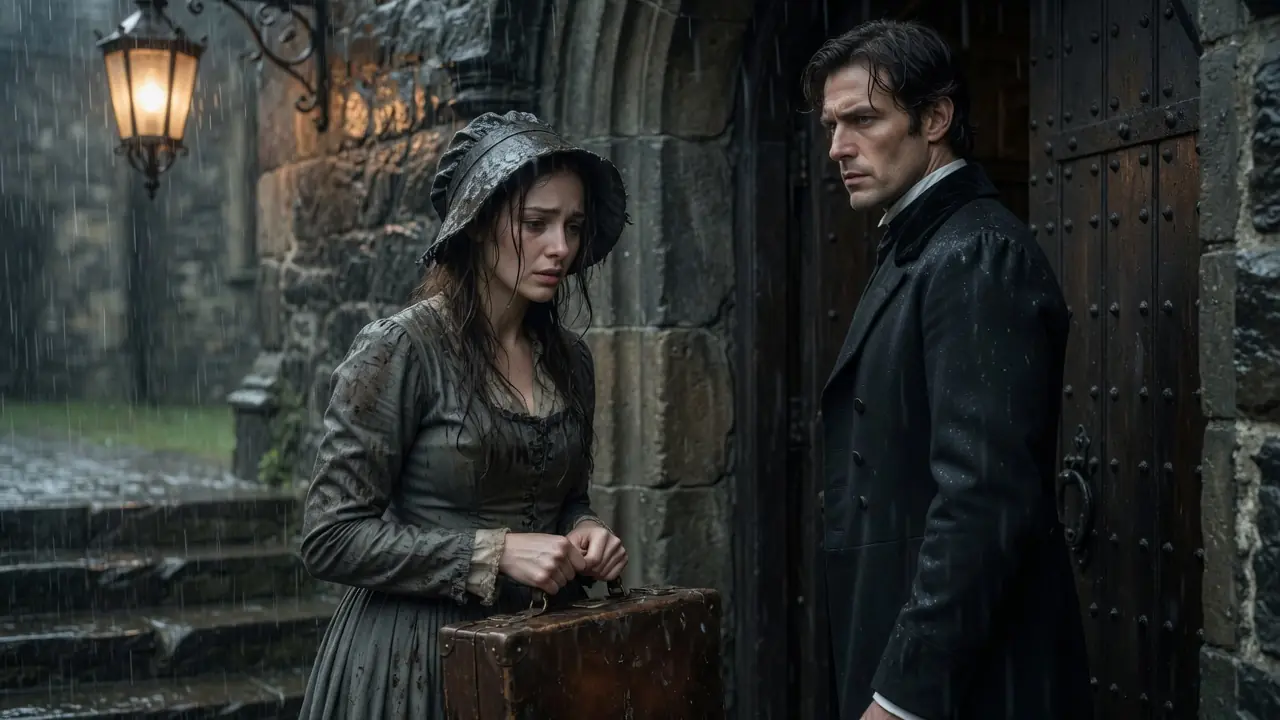
"My father said you needed a wife," Lydia Fenick whispered. "A wife." The Duke of Blackthorne looked at her road-worn gown, her trembling hands, the worn valise at her feet, and the shame she was fighting not to show. Then he said he was right. Lydia had expected the feared widower to shut the door in her face. She had expected disgust.
But Edmund Harrow did not ask why she had come alone at dusk. He did not ask whether the village had seen her. He only opened the door wider, and that frightened Lydia more than rejection, because every soul in Yorkshire knew what had happened to the first Duchess of Blackthorne. "She had entered this house as a bride and left it dead." "My father said you needed a wife," Lydia Fenick whispered again, as if the words might sound less desperate the second time. They did not.
They trembled in the cold air between her and Edmund Harrow, Duke of Blackthorne, while rain dripped from the edge of her bonnet and gathered darkly at the hem of her traveling gown. The Duke did not laugh. That was the first shock. The second was that he did not look at her as if she had dragged Scandal to his threshold, though she knew very well she had. Her fingers tightened around the handle of her old valise.
"Lady Caroline Whitmore dismissed me this morning," she forced herself to say. She accused me of stealing her sapphire brooch. She said she found it among my things, though I swear to you, Your Grace, I never touched it. Her voice almost failed on the last word, but Pride held it upright. My room is no longer mine.
Her servants were told not to speak to me. By noon, the village already knew. By evening, no respectable household would take my name." Edmund's gaze shifted from her face to the valley, then back again. "And Sir Albert?" he asked quietly, though of course he knew the answer. Lydia's throat tightened.
"My father is six months in his grave." That was the sentence that nearly broke her. Not the accusation, not the road, not even the shame of standing before a duke with nothing left to bargain except the last strange message of a dying man. His creditors have begun sending letters. Lady Caroline said, "I should be grateful she did not summon the magistrate." "Grateful?" Lydia gave a small, bitter breath, as if mercy were another name for ruin. Edmund stepped aside, leaving the doorway open, but he did not reach for her.
He did not command her to enter. He gave her a choice when the rest of the world had taken every choice away. "Your father once told me," he said, "that you would rather starve politely than ask for bread." Lydia looked up sharply. Edmund's expression had not softened exactly. It was too controlled for that.
But something old and loyal moved beneath it. "Sir Albert stood by me when no one else would enter this house without looking over his shoulder," he continued. He warned me that if trouble ever came for you, you would come late, cold, and ashamed, and still try to make it sound as if you were offering help instead of asking for it. Lydia's eyes burned. "Then he knew me too well." "He loved you too well," Edmund said.
And with that, the first wall inside her cracked. Lydia had heard the stories before she ever saw Blackthorne Hall. Every woman in Yorkshire had. Edmund Harrow's first wife, Mabel, had fallen from the Western Tower 3 years earlier during a storm so violent that villagers still spoke of it as if the heavens themselves had come to accuse the house. No court had condemned him.
No witness had seen his hand upon her. No servant had dared claim more than whispers and shadows. But society had judged him with the speed and cruelty of people who preferred rumor to evidence. Invitation stopped. Mothers turned daughters away from him. Newspapers wrote careful sentences that said nothing and suggested everything.
The name Blackthorne became a warning spoken behind fans in drawing rooms, in churchyards, in market stalls. The Blackthorne Widowmaker, some called him when they thought no one important could hear. Lydia had never repeated that name, but she had heard it. And now she stood inside his entrance hall with the door closed behind her and the wind shut out, wondering whether desperation had made her brave or foolish. Edmund took her cloak from her shoulders only after she nodded permission.
Even then, his movements were measured, almost formal, as if he knew how easily any gesture from him could become another accusation. He called for no crowd of servants to inspect her disgrace. He summoned only an elderly housekeeper, Mrs. Vale, and asked that tea and a fire be brought to the small morning room. Lydia noticed that he did not say, "The young lady is distressed." He did not say, "This poor creature needs shelter." He said, "Miss Fenick is our guest." That mattered, more than the fire, more than the tea, more than the dry shawl Mrs. Vale laid over her shoulders with suspicious but obedient hands. When Lydia finally sat, her knees nearly failed from the relief of it. Edmund remained standing at a careful distance. "Did you steal the brooch?" he asked. There was no softness in the question, but there was no insult either.
Lydia lifted her chin. "No." "Did you know where it was before Lady Caroline claimed to find it?" "No." "Did anyone have reason to wish you dismissed?" Lydia thought of Caroline's cool smile, the sudden search of her room, the servants who would not meet her eyes. "I do not know." Edmund studied her in silence and Lydia forced herself not to plead. At last he said, "I believe you." Three words, nothing more. Yet they struck harder than comfort.
Lydia pressed her fingers into the shawl to keep from shaking. "You should not say that so easily, Your Grace." "I do not say anything easily," he answered quietly. "That is why you may trust it." The proposal came not with romance, but with arithmetic. That oddly made it easier to hear.
Edmund did not kneel. He did not speak of affection neither of them could honestly claim. He stood by the mantle while Lydia sat near the fire, and the flames threw sharp shadows across a face society had turned into legend. "Lady Caroline has not merely dismissed you," he said. "She has marked you.
"This duke can." His voice remained even. The accounts are neglected. The steward who served before my withdrawal is gone. The tenants send petitions that go unanswered because every man I hire is either afraid of the house, curious about scandal, or secretly loyal to someone else. My servants obey, but they do not organize.
My estate is large, empty, and watched by enemies who would enjoy seeing it collapse. Lydia looked toward the shuttered window. Outside, rain struck the glass like thrown gravel. "And you think I can mend that?" "I think Sir Albert trained you to read a ledger faster than most gentlemen read Latin. I think you know correspondence, household discipline, rents, repairs, receipts, and the difference between poverty and waste.
I think you have been underestimated all your life because you were useful in rooms where men preferred you invisible. That struck too close. Lydia looked down. "And what would this marriage demand of me?" The room stilled around the question. Edmund's answer came without hesitation.
Respect, honesty, your counsel where the estate is concerned. Nothing else that is not freely given." Lydia's eyes rose to his. "Separate rooms." "Yes." "No false tenderness in public." "No performance beyond what protection requires. No expectation that gratitude should make me obedient. For the first time something like anger flickered in him, but not at her.
"Never." Lydia swallowed. She had come to his door with one impossible sentence, but the shape of it now stood before her, practical and terrifying. To marry the Duke of Blackthorne was to step into the very scandal other women fled. yet to leave was to return to no room, no wage, no name, and Caroline Whitmore's lie waiting like a locked gate. Edmund seemed to read the calculation on her face. I will not pretend the choice is fair.
Lydia gave a faint, broken smile. "No choice offered to a ruined woman is fair." Then she stood. "But some are survivable." They were married two mornings later in the village church, and by then every whisper in three parishes had found its way to the pews. The ceremony was meant to be quiet. It was not.
Only the vicar and two witnesses stood officially near them, but half the village seemed to have business outside the churchyard wall, and the other half had suddenly developed urgent reasons to pass the open doors. Lydia felt their eyes before she heard their voices. "There she is. The companion accused of theft." "No, the solicitor's daughter." "Poor thing." "Clever thing, more like. Imagine trapping a duke." "Imagine marrying that duke.
Does she know what happened to the first one?" The words came in fragments, soft enough to deny, sharp enough to wound. Lydia kept her gaze on the altar. Edmund stood beside her in black, tall and still, offering no smile for gossip to twist and no anger for it to enjoy. When the vicar asked whether she came freely, Lydia felt the entire church lean toward her answer. She could have said no.
She could have let fear save her from one danger and deliver her back to another. Instead, she said, "I do." Edmund's voice followed, lower, steadier, carrying through the small stone church without effort. I do. Then he took a ring from his pocket. It was not grand, not a glittering ducal jewel meant to dazzle a woman into silence. It was an old silver band worn smooth at the edges, polished by years rather than vanity.
It belonged to my mother," he said quietly enough that only Lydia and the vicar could hear. "You need not wear it after today if you do not wish." That was the moment Lydia nearly wept. Not because of the ring, but because he still left room for refusal, even while making her his duchess. She held out her hand. His fingers touched hers only as long as necessary.
No tightening grip, no display, no claim that felt like possession. When the ring slid into place, the murmurs outside seemed to swell. Someone laughed under her breath. Someone else muttered that Duchess Mabell's jewels had barely gone cold before another woman came to take her place. Lydia's face burned, but Edmund turned his head slightly toward the open doors, and the sound died.
He did not speak. He did not need to. The kiss, when it came, was barely a touch against her gloved knuckles rather than her mouth. Gasps fluttered near the entrance. Lydia understood the meaning at once.
He had refused to make a spectacle of her. He had refused to let anyone measure how much of a wife she was by, how publicly he handled her. As they left the church, the villagers parted. Not out of respect for Lydia. Not yet, out of fear of him.
But for the first time that morning, Lydia did not walk alone through their judgment. Blackthorne Hall received its new duchess without celebration. No garlands hung from the door. No tenants cheered. No footmen lined the steps with bright faces and practiced bows.
The house waited under a hard gray sky. massive, silent, and suspicious, as if it had swallowed too much grief to welcome anyone easily. Lydia noticed everything because noticing was safer than feeling. The portraits in the gallery were covered with Holland cloth. The great staircase had been polished, but not loved. Several rooms remained locked.
The servants moved quietly, not with efficient calm, but with the caution of people who had learned that sound carried in unhappy houses. At dinner, the meal was correct and cold. Edmund asked whether she was comfortable, and Lydia answered that she was, though comfort was too large a word for what she felt. She was sheltered. She was married.
She was no longer legally alone. But every corridor reminded her that another duchess had once walked here, and that the world believed she had not left by God's choosing. After dinner, Edmund showed Lydia to her room himself, stopping at the threshold rather than entering. "This chamber was prepared for you," he said. "It was simple, not neglected.
A fire had been laid. Fresh linen waited on the bed. A small writing desk stood near the window, stocked with paper, ink, and a ledger book bound in plain brown leather. On the wash stand sat a single vase of late autumn roses, pale and stubborn against the gloom. Lydia touched the back of the chair, then the edge of the desk.
You remembered I would need a place to work. I remembered whose daughter you are. The answer was so quiet that she had to turn away before her face betrayed her. Beyond the room, Blackthorne remained cold and watchful. covered portraits, unused parlors, sealed memories, servants afraid to hope, and a duke who stood outside his wife's chamber as if even kindness required permission. Lydia rested her hand on the door.
"Good night, Your Grace." Something passed through his expression, gone almost before she saw it. "Good night, Duchess." The title struck her strangely, not like triumph, like responsibility. She opened the door, stepped inside, then paused before closing it. Pride told her to say nothing more. Loneliness made a different choice.
"Good night," she said softly. "Husband." Then she closed the door before courage failed. In the corridor, Edmund Harrow stood unmoving for a long time. Behind him stretched a house full of dust, suspicion, and ghosts. Before him stood one closed door with firelight beneath it, and for the first time in 3 years, Blackthorne Hall did not feel entirely dead.
Lydia woke before the maid came to light the fire, and for one disorienting moment, she forgot she was a duchess. Then she saw the silver ring on her hand, the unfamiliar bed, the writing desk by the window, and the strip of gray morning light beneath the curtains. She was not Lady Caroline's dismissed companion anymore. She was not the girl with a dead father and nowhere to sleep. She was the Duchess of Blackthorne.
But Lydia knew at once that if she allowed that title to become a cushion, she would lose the only dignity she had left. She did not intend to be rescued and displayed like a fragile ornament. By breakfast, she had requested the household keys, the linen inventory, the kitchen accounts, the list of servants, the unanswered correspondence, and every ledger connected to household expenditure. Mrs. Vale looked as if Lydia had asked to inspect the family crypt. "Your Grace," the housekeeper said carefully.
The late Duchess did not concern herself with such matters. Lydia's hand paused over the tea tray. The words hung there, dangerous and deliberate. Then Blackthorne shall experience a change, she replied. By noon, the kitchen knew stale bread would no longer be served to the servants while flour sat unused in the stores.
By afternoon, she had found three unpaid coal bills, two duplicated linen orders, and a stack of tenant letters left unanswered beneath a blotter in the estate room. When Edmund entered and saw her seated among papers, sleeves pinned back, ink on one finger, he stopped in the doorway. You have been busy. Lydia did not look up. "No, Your Grace.
I have been useful." That made him silent. She expected correction. Instead, he came closer and examined the sorted piles. "You found the coal discrepancy, and the soap and the candles and the strange habit of ordering twice as much lamp oil as this house uses." Edmund's eyes sharpened. Surprise became interest.
Interest became something Lydia had not expected from him so soon. Respect. That evening, hot food reached every servant on time. Fires were lit in rooms that had been cold for years. Curtains were opened. Dust covers were removed from two chairs in the morning room.
Blackthorne did not become cheerful in a day, but it began quietly to breathe. The next morning, Edmund took Lydia beyond the house, and what she saw troubled her more than the covered portraits. Blackthorne's grandeur had been visible from the road, but its wounds were hidden in the tenant lanes, the stable yard, the lower fields, and the grain stores. where neglect had become almost ordinary. Edmund rode beside her in controlled silence while she studied everything with the careful eyes her father had trained into her. The first cottage had a roof patched with boards that would not survive winter.
The second had a broken pump the tenant claimed had been reported three times. The kitchen gardens were underworked. The stable accounts listed feed deliveries larger than the horses required. Near the grain store, Lydia found sacks stacked too close to a damp wall and said so before she remembered she was speaking to a duke. Edmund turned toward her.
"You are certain?" "Unless grain behaves differently because it belongs to a nobleman, yes." A stable boy nearby coughed to hide a laugh. Lydia flushed, but Edmund only looked at the wall, then at the sacks, then back at her. "Move them," he ordered. The boy obeyed her once. At the cottages, Lydia asked questions Edmund had stopped expecting anyone to ask.
How long had the pump been broken? Who recorded the repair request? Had rent been collected before the failed harvest was considered? Were widows charged the same arrears as full households? Edmund watched as tenants answered her first with suspicion, then with cautious relief.
Lydia noticed something else as well. No one truly feared Edmund when he spoke directly to them. They feared his silence, his title, the rumors attached to him. But he did not threaten. He did not sneer.
He listened even when anger tightened his jaw. At the far field, where drainage ditches had been left clogged, Lydia looked across the waterlogged ground and said, "This is not merely poor management. This is expensive neglect. Edmund's gaze moved sharply to her face. Your father used that phrase once because it is the sort of neglect that benefits someone.
For a moment the wind seemed to still. Lydia realized she had said too much too soon. But Edmund did not dismiss her. He looked at the fields again, and when he spoke, his voice was low. "Then we shall find who benefited." It was the first time he said "we" about Blackthorne.
Lydia heard it. So did he. After that, their marriage began to change in ways too small for gossip and too important to ignore. It changed at breakfast when Edmund stopped eating in silence and began placing letters beside Lydia's plate because he wanted her opinion before he answered them. It changed in the estate room where two chairs became permanent before the same desk, one for the duke and one for his duchess, though neither of them remarked upon it.
It changed at dinner when Lydia noticed he never began until she lifted her fork, and Edmund noticed she saved the best arguments for the final course, when she thought he was too weary to resist them. They spoke of repairs, rents, servants, grain, creditors, and petitions. Then slowly they spoke of other things. Lydia told him her father had taught her accounts by giving her household bills as puzzles. Edmund told her his mother had loved the western gardens before illness made stairs impossible.
Lydia spoke of Lady Caroline's household only when necessary, but Edmund learned to hear the pain beneath what she left unsaid. She had been useful there, too, until usefulness became inconvenient. Edmund spoke even less of Mabel. But one night, when rain struck softly against the windows and the fire burned low, he said, "She laughed easily when she first came here." Lydia looked up from the ledger. "Mabel?" He nodded once.
The room tightened around the name. People forget that they speak of her only as a dead duchess, never as a woman who once liked sugared almonds and complained that Yorkshire wind ruined every bonnet she owned. Lydia did not ask the question everyone else asked. She did not ask how Mabel died. She only said, "It must be a terrible thing to have grief taken from you and turned into accusation." Edmund's hand stilled over the page.
For a moment, the guarded duke was simply a lonely man who had been standing trial in every room for 3 years. "Yes," he said. "Nothing more." Yet after that night, the silence between them lost some of its sharpness. Lydia still slept in her own room. Edmund still stopped at thresholds.
The marriage was still practical, still careful, still built on terms spoken beside a fire. But the house knew before they did. Servants began leaving lamps lit in rooms they both used. Mrs. Vale began setting two cups near the estate papers, and Blackthorne, which had once held its breath, began listening for their footsteps together. The first public test came at the village market, where Lydia went, because the tenants needed to see their duchess not as a rumor behind stone walls, but as a woman willing to hear them.
Edmund advised caution. Lydia mistook that for doubt and lifted her chin. "I have survived Lady Caroline's drawing room, Your Grace. I believe I can survive cabbages." He almost smiled. Almost. The market was crowded when they arrived, and every conversation weakened as Lydia stepped from the carriage. Women turned.
Men removed hats too late or too quickly. A child asked loudly whether that was the new duchess who had stolen jewels, and his mother pulled him back with a horrified whisper that carried farther than the question. Lydia kept walking. She bought thread from a widow, asked after a tenant sick daughter, and listened while an old farmer complained about drainage near the lower meadow. For half an hour, she almost believed dignity could outlast scandal.
Then Lady Caroline Whitmore appeared beside the ribbon stall, dressed in pale lavender, smiling as if cruelty were a social grace. "Your Grace," Caroline said, dipping into a curtsy so shallow it became an insult. "How quickly you have risen. Only last week you were searching my cupboards. Now you inspect the village as if it belongs to you." The market quieted with indecent speed.
Lydia felt heat climb her neck. "Lady Caroline." No denial. Caroline's smile widened. "How wise. Denials are so awkward when brooches are found in one's belongings.
A murmur passed through the crowd. Lydia's fingers tightened around her reticule. "I did not steal from you." "Of course," Caroline said softly. "You merely lost your position, your room, your reputation, and then somehow found your way to a duke's bedchamber before the week was finished." Gasps rose. Lydia went pale, but Caroline had not finished.
Though I suppose one cannot be selective when no decent man will take one. Still, I admire your courage. Most women would hesitate before marrying a widower with such unfortunate history. The implication struck the crowd like a bell. Mabel, the tower, the storm, Edmund.
Caroline leaned closer, voice sweet enough to poison tea. "Do be careful at Blackthorne. My dear first wives are not the only ones who can fall." Lydia's breath caught. Not because she believed her, because the villagers looked hungry to believe her. Lydia tried to answer, but for one terrible second, no words came.
That was what public shame did. It did not merely accuse. It stole the voice required to survive accusation. Caroline saw it and smiled. The crowd saw it and leaned closer.
Then a shadow fell beside Lydia, and the market changed before anyone spoke. Edmund Harrow stood at her side, tall, still, and colder than the stone church where he had married her. He had not rushed. He had not shouted. Somehow that made his arrival worse for everyone who had been enjoying her humiliation.
"Lady Caroline," he said. Two words, yet Caroline's smile faltered. "Your Grace," she replied, recovering quickly. I was merely welcoming your new duchess into society. "No," Edmund said.
"You were insulting my wife in a public square because private cruelty no longer satisfied you." The word "wife" moved through the market more powerfully than any threat. Lydia felt it settle around her, not as a cage, but as shelter. Caroline's eyes flashed. "You defend her very fiercely for a marriage born of convenience." Edmund turned slightly, enough for the crowd to see that he stood with Lydia, not before her, as if hiding her. "My marriage is not yours to measure." "And her honesty?" Caroline asked.
"Is that yours to invent?" Lydia found her breath. "My honesty existed before your accusation." Her voice shook, but it carried. Edmund did not speak over her. He let the village hear her. That mattered more than rescue.
You searched my room after dismissing two servants from the corridor. You claimed to find a brooch no one saw me touch. You cast me out before I could defend myself. If you have proof, bring it before a magistrate. If you have only performance, then perform elsewhere.
A stunned silence followed. Caroline's face hardened. "You will regret learning confidence from him." Edmund's voice dropped. "Enough." No anger, no raised hand, no violence. Only authority sharpened into a line no one dared cross.
"You will not threaten the Duchess of Blackthorne in front of my tenants, my neighbors, and my parish." For the first time, the villagers looked not at the widow maker, but at the husband standing beside a woman who did not flinch from him. Lydia realized then what had shifted. Edmund had not dragged her behind his title. He had placed his title beside her truth. As Caroline turned away, humiliated but not defeated, Lydia felt Edmund's hand hover near her elbow, asking without touching.
She moved closer by choice. And as the market slowly began breathing again, Lydia understood they were no longer two ruined people sharing a roof. They had begun dangerously and publicly to stand together. The storm came three nights after the market, and every servant at Blackthorne felt the memory of the last one before the first window began to shake. By afternoon, the sky had turned the color of iron.
By supper, rain struck the glass hard enough to silence conversation. By nightfall, the wind moved through the chimneys like something trapped and grieving. Lydia saw the change in the servants first. Mrs. Vale crossed herself when thunder rolled over the western wing. A footman dropped a tray when lightning flashed against the tower windows.
No one said Mabel's name, which made the name feel louder. Edmund stood at the entrance hall with orders already forming. The horses were to be brought fully inside the stables. The lower shutters secured. The kitchen stores moved away from the leaking passage.
Candles placed along the servant stair. Lydia did not wait to be protected out of usefulness. She took charge of the maids, sent two to gather blankets, sent another to help the cook cover the flower bins, and ordered lanterns brought to the back corridor where the plaster had begun to shed dust. Edmund looked once across the hall at her, and in that look was surprise, fear, and trust. Then a crack of thunder shook the house.
Somewhere in the western wing, glass shattered. A young maid screamed. Lydia turned before anyone could stop her. "Where?" she demanded. The girl pointed toward the old passage beneath the tower.
Edmund's face changed. "No one goes near that wing." But another cry came, thinner this time, from the direction of the damaged corridor. One of the younger servants had gone to fetch linens before the order came to clear the passage. Lydia lifted her skirts and ran. Behind her, Edmund shouted her name, not as a duke giving command, but as a man suddenly terrified.
The western corridor was already wet, rain blowing through a broken casement, candles guttering in the draft. Lydia saw the servant crouched near the wall, frozen with fright as stone dust fell from above. "Come to me," Lydia called. The girl stumbled forward. Lydia reached for her, pushed her toward the safer side of the passage, and heard the sound before she understood it.
A deep grinding shift inside the tower wall. Edmund appeared at the far end of the corridor, his face white in the lightning. "Lydia, move." She turned. For one awful second, the ceiling above her seemed to breathe. Then part of the old stonework broke loose.
Edmund reached her before the stones did. He seized Lydia around the waist and pulled her backward with such force that they both struck the floor near the archway as rock crashed down where she had been standing. The sound swallowed the storm. Dust filled the corridor. The maid sobbed somewhere behind them.
Lydia could not breathe, not from injury, but from the sight of the broken stone scattered across the exact place where her feet had been. Edmund's arms were still around her. His hands were shaking. She had never seen his control fail. Not at the church, not in the market, not when Caroline spoke Mabel's name like a weapon.
But now his restraint had shattered as completely as the tower wall. "Are you hurt?" he demanded. Lydia tried to answer, but her voice would not come. He touched her shoulder, her arm, her face, stopping himself each time as if permission still mattered even in panic. "Lydia, answer me." "No," she whispered.
"I am not hurt." His eyes closed for one brief, terrible moment. When they opened again, they were no longer the eyes of the feared Duke of Blackthorne. They belonged to a man who had already found one wife too late beneath a storm and believed for one breath that history had come to take the second. Servants gathered at the corridor entrance, but Edmund did not seem to hear them. Lydia placed her hand over his hand.
"Edmund." His name changed something. He looked at her as if she had reached him from far away. Later, after the servants were accounted for, after the damaged wing was barred, after Mrs. Vale had wrapped Lydia in a blanket near the library fire, Edmund stood apart, soaked, pale, and silent. Lydia understood then that duty did not make a man look like that.
Obligation did not make fear so raw. She rose and crossed the room. "You thought I would die?" His jaw tightened. "Yes." "And that frightened you beyond duty." He looked away. "Do not ask me to make this tidy." "I am not asking for tidy." His voice broke low.
"I cannot lose you." The words altered the room. Lydia's breath caught. Edmund looked at her fully then with no arrangement left between them. I told myself protection was enough. Respect was enough.
Separate rooms would keep you safe from expectation and me safe from wanting more than I deserved. But when the stone fell, I understood I had already failed. "I love you." Lydia's eyes filled. "Then we have both failed," she whispered, "because I love you, too." Morning brought no mercy. The storm had broken the western tower, but Lady Caroline Whitmore used the wreckage as if heaven itself had provided evidence.
Before noon, a letter arrived from a creditor in York requesting immediate clarification on Blackthorne's solvency. By one, another came questioning whether recent household decisions had been made under improper influence. By two, the vicar sent word that Lord Ashkam, Mabel's brother, had arrived in the county and was speaking openly of reopening old concerns about his sister's death. Lydia read the messages at the estate desk with Edmund standing beside her, and the warmth of the night before sharpened into danger. This was no longer gossip at a ribbon stall.
This was a net. Caroline had smiled in public, retreated in public, and attacked in private. "She is pressing the creditors," Lydia said, "and Ashkam is giving the attack a moral face." Edmund's expression hardened. "He always wanted Blackthorne weakened because of Mabel, because of money. Grief made him respectable.
Greed made him persistent." Lydia picked up the third letter. It questioned whether their marriage had been entered freely, whether Lydia had exploited Edmund's isolation, whether Edmund was mentally fit to oversee property decisions after years of withdrawal. The insult was so neat it chilled her. If Edmund defended himself fiercely, they would call him unstable. If he stayed silent, they would call silence guilt.
If Lydia spoke, they would call her a schemer. "They are not trying to shame us," she said slowly. "They are trying to make the bank doubt you." Edmund did not deny it. Blackthorne carries old debts. Manageable debts, but enough that fear could make them dangerous.
Lydia looked toward the sealed western wing. The tower falls and suddenly the old story rises. "That is what they want." "Then we stop answering the story they wrote," Lydia said. "We find the one they buried." Edmund turned to her. The question he had avoided for weeks stood between them now.
Lydia asked it quietly. "What truly happened to Mabel?" For a long moment, only rainwater dripped from the eaves outside. Then Edmund said, "She was afraid before she died. Not of me." Lydia did not move. "Of whom?" "She would not say until she had proof.
She had found irregularities in estate papers. Missing funds. transfers I never approved. She wrote to your father asking to meet him. She died before she could leave Blackthorne. Lydia felt the floor tilt beneath the meaning.
Sir Albert had known something. Mabel had known something. And now Caroline was trying to destroy Lydia before she could learn it, too. Lydia led the search because grief had made Edmund too careful. An accusation had made him mistrust his own memory.
She began with her father's preserved papers, the small locked box she had brought from her former room when Lady Caroline cast her out. Until then, she had not opened it at Blackthorne. It felt too much like disturbing the last place Sir Albert still belonged to her. But now she placed it on the estate desk, unlocked it, and found letters tied with faded blue thread. Edmund stood opposite her, silent.
The first letters were ordinary receipts, legal notes, household copies. Then Lydia found a page marked only with initials. C. W., L. A., Merrick. Edmund went still at the final name. Hugh Merrick was my former steward, the one who left after Mabel died. Yes, Lydia read further.
Her father's handwriting precise even where the ink had faded. False arrears entered against tenants who had already paid. Repair funds approved but never delivered. Land transfers drafted in language meant to obscure ownership. Debt instruments tied to outside lenders.
The same three names appeared again and again. Caroline Whitmore, Lord Ashkam, and Hugh Merrick. With the vicar's help, they searched the parish records and found that two tenants listed as in arrears had buried children the same winter their rent payment supposedly vanished. An old tenant named Mr. Vale, stooped but sharp-eyed, swore he had paid Merrick directly and received no receipt.
"Told Sir Albert, too," the old man said. "He came asking before he died. Said the account smelled wrong." Lydia's hands trembled, but she kept writing. Then Mrs. Vale brought a packet found years earlier behind a loose panel in the late Duchess's sitting room. No one had dared give it to Edmund.
Servants had feared what any paper of Mabell's might reopen. Lydia unfolded the note with care. Mabel's hand was hurried but clear. Sir Albert, I believe Blackthorne is being drained through forged obligations. Edmund knows nothing.
I fear Merrick is not acting alone. If I cannot come tomorrow, look to Ashkam's last settlement and Caroline's purchase near the north boundary. Lydia read the last line twice. Edmund stepped back as if struck. "She knew I was innocent." Lydia looked at him through tears. she refused to let fall.
"She was trying to prove it before anyone accused you." The truth changed Mabel in the room. She was no longer only the dead first Duchess. She became a witness and Lydia understood why Caroline had moved so quickly against her. The theft accusation had not been punishment for poverty. It had been prevention.
Lydia had been Sir Albert's daughter, trained by the man who had followed the trail. If she entered any respectable household, she might have been ignored. But inside Blackthorne beside Edmund, she became dangerous. That night, someone tried to burn the grain store. Lydia was still awake, copying Mabel's note and her father's records into a clean packet for the county hearing Edmund now meant to demand when she smelled smoke before the alarm bell rang.
For one breath, she thought the fire was in the hall. Then a shout rose from the stable yard. Edmund was already moving. Lydia followed with the documents clutched beneath her shawl, refusing to leave the evidence behind where flame or theft could reach it. Outside the air was sharp with wet earth and smoke.
The grain store stood beyond the stables, lantern light jerking wildly around it as servants ran with buckets. Near the rear wall, a man bolted from the shadows. A groom tackled him at the fence. Mr. Vale and two tenant farmers, alerted by the storm damage and already on watch, closed in before he could rise. Edmund reached him first, but he did not strike him.
That restraint frightened the man more than rage would have. "Who sent you?" Edmund asked. The man spat mud and said nothing. Lydia stepped closer, the packet pressed to her chest. "Fire light lit her face.
"You were not sent merely to burn grain," she said. "You were sent to destroy records before they could be read." The man's eyes flicked to the papers. It was enough. Edmund saw it. So did every servant standing nearby.
The groom dragged a small oil flask from the man's coat. Mrs. Vale recognized him as one of Caroline Whitmore's hired carriers, a man seen twice at her stable yard. Still, he refused to speak until the vicar arrived, summoned from the village by a tenant boy. Under threat of magistrate and transportation, the man broke. Caroline's people had paid him.
Not directly by her hand, he insisted, but through a servant attached to Lord Ashkam's lodgings. He had been told the grain store held old estate books. He had been told no one would be hurt. He had been told Blackthorne would be ruined by week's end. Lydia listened without moving.
Around her, the servants changed. Fear became anger. Suspicion became loyalty. The estate that had once whispered about Edmund now watched enemies try to burn its proof. Edmund turned to Lydia, his face grim, but his eyes alive with something that had been absent for years.
Not hope exactly. Hope was too soft for what stood between them. This was a weapon made of truth. Lydia looked down at Mabel's hidden note, Sir Albert's preserved letters, and the confession forming in front of witnesses. For the first time since Lady Caroline had spoken the word thief, Lydia smiled.
"Now," she said quietly. "We have the thread." The county hearing began under a sky so clear it felt almost insulting after everything Blackthorne had survived. By ten o'clock, the hall was full. Tenants stood beside shopkeepers. Servants whispered near the back.
Villagers who had once crossed the street to avoid Edmund Harrow now stretched their necks to see him enter. Caroline Whitmore arrived first, dressed in deep blue silk, her face composed with the confidence of a woman who had ruined reputations before breakfast, and slept soundly afterward. Beside her stood Lord Ashkam, Mabel's brother, pale and solemn, one hand pressed to his heart as if grief required an audience. When Edmund entered, the old reaction moved through the room. Silence, unease, remembered fear.
Then Lydia stepped beside him, carrying her father's leather document case. The silence changed. She did not look like a desperate companion. She did not look like a thief. She looked like a woman who had walked through shame and brought the truth back with her.
Caroline saw the case and her expression tightened. Lord Ashkam rose at once, voice heavy with practiced sorrow. He spoke of Mabel, of unanswered questions, of a sister lost in a storm and a husband too powerful to be examined. Then Caroline added her softer poison. Lydia, she implied, had married Edmund to escape disgrace.
A woman accused of stealing jewels could hardly be trusted with estate records. A widower surrounded by rumors could hardly be trusted with a wife. The room listened hungry and horrified. Then Lydia stood. She did not raise her voice.
She did not plead. "My father taught me," she said, "that lies survive by confusion. Truth survives by order. So I will proceed in order." Edmund turned toward her and every soul in that hall saw the Duke of Blackthorne look at his wife not as property, not as protection, but as his equal. Lydia opened the case.
First came the altered accounts. Lydia placed them before the magistrate with her father's notes beside them. Each discrepancy marked in Sir Albert's precise hand. Tenant rents had been recorded unpaid after they were collected. repair funds had been approved, withdrawn, and never spent. Grain profits had vanished through false transport charges.
Then came the forged debt papers linked to lenders who had business ties with Caroline Whitmore. Then the false land transfers written to move small pieces of Blackthorne land through names connected to Lord Ashkam. The room began to murmur. Caroline's face sharpened. Lord Ashkam interrupted twice, but the magistrate ordered him silent. Lydia continued.
She produced Mabel's hidden note. At the sound of the first Duchess's name, the hall stilled. Lydia read it aloud. Mabel had discovered missing funds. Mabel believed Hugh Merrick, the former steward, was not acting alone.
Mabel had written to Sir Albert. Mabel had stated clearly that Edmund knew nothing. The story in the room began to turn. Not slowly, not gently. It broke open.
The dead duchess was no longer a victim in Caroline's version. She was a witness against it. Lydia then presented Sir Albert's preserved correspondence and the confession from the hired man caught near the grain store. The accusation against Lydia became clear for what it was. Not justice, but prevention.
Caroline had cast her out because Sir Albert's daughter knew how to read the very records that could expose them. Lydia looked across the room at Caroline. "You did not accuse me because I stole from you," she said. "You accused me because you feared what I might find." For the first time, Caroline had no graceful answer. After that, the collapse came quickly.
Lord Ashkam tried to reclaim dignity with grief, but grief could not explain forged transfers. Caroline tried to blame Hugh, but Merrick signed receipts linked back to payments from her circle and Ashkam's agents. The magistrate declared that the marriage between Edmund Harrow and Lydia Fenick had been entered freely and lawfully. No evidence supported Caroline's claims of coercion or deceit. Lydia's name was cleared of theft.
The Sapphire Brooch accusation was recorded as malicious and unsupported. Then came the words the county had waited 3 years to hear. There was no evidence that Edmund had harmed Mabel, and new evidence strongly supported that she had died after uncovering fraud within the estate. A sound moved through the room, not applause yet, not celebration, but release. Edmund closed his eyes.
Lydia reached for his hand beneath the table. He held it like a man holding the edge of life. Caroline's face had gone white. Lord Ashkam sat as if his bones had left him. The former steward was named for further inquiry.
Creditors were ordered to pause action pending full review of the fraud. Blackthorne, once nearly strangled by rumor, had air again. When Edmund and Lydia stepped outside, the village waited. These were the same people who had whispered, "Murderer, thief, desperate, cursed." Now they looked at Lydia as if seeing her for the first time. Mrs. Vale began to cry.
The old tenant, Mr. Vale, removed his hat. One by one, others followed. No one shouted. No one dared cheapen it.
Lydia had not only saved her own name, she had saved Edmund's, Mabel's, Sir Albert's, and Blackthorne's future. That evening, the village gathered in the square, not for a grand celebration, but because relief needed somewhere to go. Lanterns were hung between posts. Bread, cheese, apples, and warm cider appeared on long tables. Tenants who had once avoided Edmund now bowed with real respect.
Servants who had once feared hope smiled openly at Lydia. Edmund accepted apologies with restraint, but Lydia could feel how deeply each one cut and healed at once. Later she found him away from the crowd near the churchyard wall where the lantern light barely reached. For a moment, neither spoke. They simply stood together while the village murmured behind them, no longer against them.
Lydia looked up at him. Do you remember what I said at your door? Edmund's mouth softened. "I remember every word." "My father said you needed a wife." The sentence carried all of it now: the rain, the shame, the valise, the open door, and the first impossible bargain. Edmund turned fully toward her.
"He was right," Lydia whispered. Edmund shook his head. "No." Her heart paused. He took her hand, the old silver ring glinting between them. "I was wrong, Lydia.
I did not need a wife." Her eyes searched his then. What did you need? His voice lowered. "You. Not a title beside mine.
Not a woman to make the house respectable. Not someone to silence gossip by standing in a duchess's place. I needed you. My partner, my defender, my courage when mine had been buried. My home when Blackthorne was only walls." Lydia's eyes filled, but this time she did not fight the tears.
Edmund touched her cheek with the same restraint that had first made her trust him. "You came to me asking for shelter," he said. "And somehow you gave me back my life." Lydia leaned into his hand. "Then we saved each other." Behind them, the village bells began to ring. Months later, Blackthorne Hall no longer looked like a house waiting to be accused.
Curtains were open. Fires burned in rooms that had been shut for years. Tenants came through the gates without lowering their voices. The stolen funds were being recovered, the false debts untangled, and the estate books finally balanced under Lydia's careful hand. She was Duchess of Blackthorne, not because Edmund had placed a ring on her finger, but because the house, the tenants, and even the servants had learned to turn toward her when truth, order, or mercy was needed.
The western tower was not rebuilt as it had been. Lydia asked that part of it remain open to the sky, transformed into a memorial garden for Mabell, with pale roses, climbing ivy, and a stone bench facing the moors. Edmund stood there often, not as a man accused by the dead, but as one finally allowed to grieve her. On a soft spring afternoon, he found Lydia beneath the old cedar tree where Sir Albert had once asked him to protect his daughter. She was waiting with one hand resting lightly over her stomach.
Edmund stopped before she spoke, as if his heart already knew. Lydia smiled through sudden tears. "You are going to be a father." For a long moment, he could not move. Then he crossed the grass and took her into his arms with a tenderness that needed no witness. Lydia rested her head against him and looked up through the cedar branches.
"Thank you, Father," she whispered. "You were right." Edmund held her closer. Lydia touched the silver ring, then the life growing beneath her hand, and understood the truth more fully than she had on the night she came to Blackthorne in the rain.
Her father had said Edmund needed a wife, but Edmund had needed more than a wife. Lydia had needed more than protection. Together, they had needed a family.