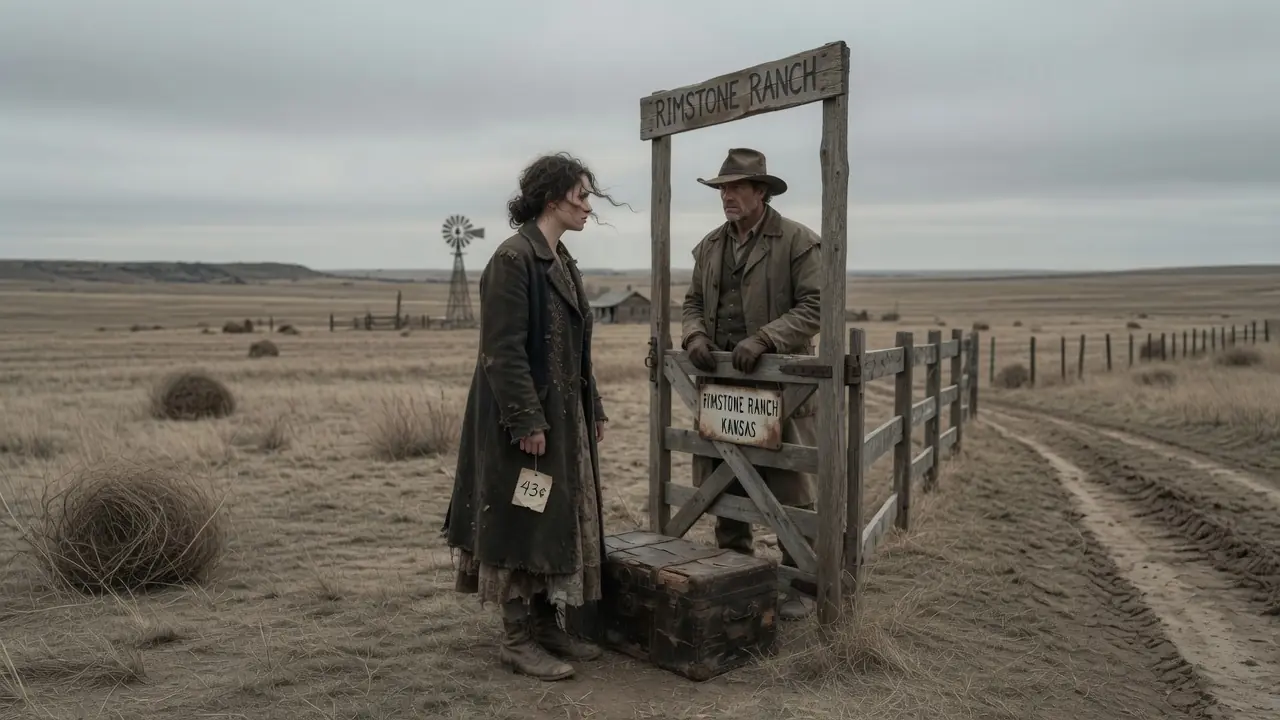
She walked 11 miles in cracked boots to answer a stranger's telegram because the alternative was dying in a Kansas ditch before the first snow fell. Adelaide Mercer had buried her father in August, been robbed of her inheritance by September, and now stood at the edge of a man's property in October with nothing but a broken trunk, 40 cents, and the kind of desperation that either kills a person or turns them into something unbreakable. The man who opened that door didn't want a woman on his ranch. He made that clear before she even set her bag down.
What neither of them knew yet was that she was the only reason any of them would survive the winter. The telegram had been tacked to the post outside Caldwell's General Store for what looked like 3 days, maybe four. The paper had curled at the corners from morning damp, and someone had smudged the ink on the left edge with a careless thumb. Adelaide read it twice standing in the dirt, her shadow stretching long and thin across the boardwalk in the flat October light.
Harvest help needed. Rimstone Ranch, 12 miles northwest of Granger Crossing. Room and wages. Inquire seriously only. G. Holt. She pulled the tack out, folded the paper, and put it in her coat pocket.
That was a Thursday. By Friday morning, she was walking. The road, if you could call it that, was really just two-wheel ruts pressed into the buffalo grass, barely visible where the summer had been dry enough to bake them hard. Adelaide kept her eyes on the horizon and her hands wrapped in the ends of her sleeves because the October wind off the Kansas plain didn't bother with politeness.
It came straight and flat and cold, and it didn't matter how many layers you had on. It found the gaps. Her boots were the worst part. She'd bought them secondhand in Granger Crossing when her own pair finally split at the left sole, and whoever had worn them before her had walked unevenly.
The right heel was worn down at an angle that threw her whole stride off. By the fourth mile, she had a blister forming on the outside of her right ankle. By the seventh, she'd stopped feeling it much, which she knew from experience was not a good sign. She carried a trunk. It was a small trunk, old, with a brass latch that no longer latched properly, and had to be held shut with a length of rope tied in a flat bow.
Inside it, two dresses, one good and one for work. Her mother's shawl, the dark green one with the loose fringe, a tin box of sewing needles, thread, three buttons she'd saved from a ruined coat because the buttons were good quality and you never threw away good buttons. A folded photograph, 43 cents in a leather purse, which she had counted twice that morning to be sure. She'd sold everything else.
The farm had been her father's, and before that his own father's, brought over in pieces from a village in Western Bohemia, along with the family name and a working knowledge of soil and weather that didn't fully translate to American prairie, but had been adapted year by year with a stubbornness that Adelaide had absorbed somewhere between childhood and adulthood without quite realizing it was happening. Her father had spent 23 years building something on that quarter section outside of Granger Crossing. Not much by any measure. A house, a barn with half the shingles replaced, a kitchen garden, a modest corn crop, a few good hogs, but it was his and it was paid for, and it was enough.
Then the summer fever had come in July, fast and merciless, and her father was gone by the first week of August. Her uncle, her father's younger brother, had arrived from Wichita with a lawyer and a document inside of two weeks. The document, as best she could understand it, said that her father had borrowed money from her uncle 3 years prior, that the land had been pledged as security, and that with her father's death, the debt came due immediately. The lawyer was a small, precise man who explained this to her standing on her own porch without ever quite looking her in the eye.
Her uncle had stood beside him, looking at something off in the middle distance. A posture she recognized as a man trying to believe he was not doing what he was doing. She'd asked to see the original loan papers. The lawyer said they were in his office in Wichita. She'd asked why her father had never mentioned the debt.
Her uncle had said her father was a proud man who didn't like to discuss his difficulties. Both of those things might have been true. They also might not have been. Either way, by the middle of September, the farm was being inventoried, and Adelaide was in a rented room in Granger Crossing with $30 in her pocket.
Her uncle had given her that much at least, and she supposed she should have been grateful. Trying to figure out what came next. The $30 had not lasted as long as she'd planned. The room cost more than she'd expected. She'd gotten sick herself in late September.
Nothing as serious as what had killed her father, but bad enough that she'd lost a week lying on a narrow cot while her money trickled away on medicine and soup and the landlady's patience. By the time she was back on her feet, the money was down to $11. The job she'd been hoping to find at the seamstress shop had been given to someone else while she was ill. And the first real cold snap had hit overnight like a door slamming shut on everything that had felt possible.
She'd walked past Caldwell's store that Thursday afternoon with $9.43, and she'd read that telegram, and she thought, "12 miles northwest." A room and wages. She thought, "Winter is coming and I have nowhere to go." She thought, "I can walk 12 miles." Rimstone Ranch announced itself gradually, the way most things on the Kansas plain did.
Not with any drama, just a slow accumulation of detail that eventually added up to something. First, the fence line appeared, running straight as a ruled line into the north distance. Good cedar posts, but with wire that needed tightening in a few stretches. Then a windmill, still turning slowly against the flat gray sky.
Then the barn, which was large and practical and dark red. And then behind it the house, which was two-story, unpainted, the wood weathered to the color of old pewter. Adelaide set down her trunk at the gate, a simple wire gate hung between two posts, and straightened her back and looked at the place for a moment. A wagon was pulled up near the barn.
Someone was working on the near wheel, crouched down with a hammer. She could see only the back of him. Broad shoulders under a canvas work coat, dark hair under a hat that had been reshaped one too many times. She picked up her trunk and opened the gate. The man heard her when she was about 20 feet away and stood up and turned around.
And that was the first time she saw Garrick Holt. He was not what she'd been expecting, though she'd be hard-pressed to say exactly what she had been expecting. He was maybe 40 or thereabouts. Hard to tell with men who worked outdoors. The sun and wind aged them in ways that could add 10 years or take off five, depending on how you read a face.
He was tall, with a kind of build that came from actual labor rather than any deliberate effort. And he had a face that was not unkind, but not open either. Just closed. Like a window with the shutters pulled. He held the hammer at his side and looked at her with an expression she couldn't quite read.
"Help you with something?" he said. His voice was flat, not unfriendly, but not warm. Like the landscape, she thought. Just flat and direct and leaving no room for misreading. "I'm here about the telegram," Adelaide said.
"The harvest help position." Something crossed his face. Not surprise, exactly. More like a recalculation. You're here about He stopped, started again.
The telegram said inquire seriously. "I am inquiring seriously," she said. She kept her voice even. She'd learned early that the best response to a man who was skeptical of you was to simply refuse to be rattled by it. He looked at her trunk.
He looked at her boots, which she was acutely aware were not in good shape. He looked at her face for a moment, not rude, just assessing. And then he looked out at the sky to the west, which was bruising up at the edges in the particular way that meant weather was coming. "I was expecting," he said.
And then seemed to decide that finishing that sentence was not worth the trouble. "Where'd you come from?" "Granger Crossing." "That's 12 miles." "I'm aware of that."
"You walked 12 miles?" "My trunk doesn't walk on its own, no." He looked at the trunk again. And she thought she she saw something. Not quite amusement, but the shadow of a thing adjacent to it pass across his face before it closed back up.
"I need harvest work," he said. "Feeding, storage prep, crop work, hard physical labor." "I'm not looking to hire on a" He stopped again. "A woman," she said. "I didn't say that."
"You were thinking it." He didn't deny it, which she respected slightly more than if he had. "Look," he said. "I appreciate that you walked out here. That's He seemed to weigh words carefully.
That takes something. But the work is hard, and the winter is coming in fast, and I need someone who can keep up with what this place demands. I don't mean any offense." "Mr. Holt." She said, because she'd read his name on the telegram, and had been using it in her head all morning.
"I have been doing farm work my entire life. I can read weather. I know crops. I can cook, sew, handle animals, fix things that need fixing, and make do with less than most people think is possible. I have nowhere else to go before winter hits, and I'm asking you plainly to give me a chance to show you what I can do.
She paused. I'm not asking you to like me. I'm asking you for work. The wind moved between them, carrying the first real bite of cold she'd felt all day. Garrick Holt looked at her for a long moment.
Then he looked out west again at the darkening sky. Then he looked down at his hammer as if it might offer an opinion. "The room is small," he said finally. "It's off the kitchen. Used to be a pantry."
"That's fine." "Wages are $6 a month, board included." "That's acceptable. I have a son. He's eight.
He's not" He paused, searching for something. "He's quiet." "He keeps to himself mostly." "I won't bother him if he doesn't want to be bothered." Another long pause.
The windmill behind him creaked in a gust. "What's your name?" he said. "Adelaide Mercer." "Where are you from originally? Your accent."
"Bohemia. My family came over when I was four." He nodded slowly as if that answered something. "Come inside then," he said. "I'll show you the room.
You can start in the morning." She picked up her trunk. "I can start now," she said. "There's still 2 hours of light." He looked at her again with that recalibrating expression, and this time she was certain she saw something shift behind it.
"All right," he said. "Come on then." The room off the kitchen was small. She'd said it was fine before seeing it, and it was fine, but barely. A cot with a thin mattress, a wooden crate that served as a side table, a hook on the wall for hanging things, a single small window that looked out at the side of the barn.
The room was clean, at least recently swept, which she thought meant someone had done it in anticipation of the position being filled. Which meant Garrick Holt had been expecting someone before her. Someone different. And had cleaned the room for them. She set her trunk at the foot of the cot and sat down on the edge of the mattress for exactly 30 seconds to let her feet recover.
Then she untied her boots, carefully, because the right one hurt on the way off. And assessed the blister on her ankle. It had broken on the walk in without her noticing. She cleaned it as best she could with water from the pitcher on the kitchen window sill, tore a strip from the hem of her worn underskirt, and wrapped it.
Then she put her boots back on and went to find what needed doing. The kitchen was large and functional, and slightly chaotic in the specific way of a household run by a man who cooked because he had to, rather than because he wanted to. There were three cast iron pots hanging near the stove, two of them in need of seasoning. A bin of dried beans that had not been sorted, a bread crock that was empty, the inside still dusted with old flour, dried herbs hanging from the ceiling beam, sage she recognized, and what looked like it might be thyme, though they were so dry they'd lost most of their color.
A boy was sitting at the kitchen table when she came in. He was small for eight, or maybe he just sat small. Knees pulled up slightly, shoulders curved inward, both hands wrapped around a tin cup. He had his father's dark hair, but his face was different, softer, still holding the roundness of childhood, but with something watchful behind the eyes that belonged to a child who'd learned early to pay attention to the room.
He looked at her when she came in and didn't say anything. "Hello," Adelaide said. "Hello," he said, very quiet. "You must be Evan." "Yes."
A pause. "You're the lady from the telegram." "I am. My name's Adelaide." He turned the tin cup in his hands.
The boy seemed to think about this for a moment, then he said in the tone of someone reporting an observation rather than making a judgment. My pa is out checking the north fence line before dark. He does that when there's weather coming. Smart, she said. She began moving through the kitchen, opening the bread crock, checking the bean bin, finding the flour sack behind the lower cabinet door.
Have you eaten today? Pa made something this morning. What about tonight? A small shrug. Adelaide found a bowl, found a spoon, began sorting the beans by feel.
I'm going to make soup, she said. You don't have to talk to me while I do it. The boy watched her for a long moment, then he set down his cup and got up from the table and disappeared through the doorway toward the stairs. She heard his feet on the steps, slow and deliberate, the tread of a child used to moving quietly in a house.
She sorted beans and built the fire up in the stove and put the pot on, and by the time the kitchen began to smell like something other than cold air and old iron, Garrick Holt came in through the back door stamping mud from his boots. He stopped when he smelled the soup. He didn't say anything for a moment. "Did Evan eat?" he said finally.
""Not yet. I'll call him when it's ready."" Another 20 minutes. He took his coat off and hung it. He went to the basin and washed his hands methodically, like a man who'd done the same sequence of motions 10,000 times.
He stood looking at the pot on the stove, and she was aware of him reassessing something, though she couldn't have said what. Where'd you find the beans? He said. Lower cabinet, behind the flour. I was going to get to those.
I know, she said neutrally. She wasn't trying to make a point, She was just making soup. He pulled out the chair at the head of the table and sat down heavily, like a man whose body was used to being tired. He rubbed a hand over his face. Storm's coming in from the northwest, he said.
Could be the first real one of the season. How much warning do we have? Day. Maybe a day and a half if we're lucky. She stirred the pot.
What's most exposed? He looked at her sideways. What do you mean? If the storm hits hard, what on the ranch is most at risk? Fencing, animals, stored crops?
He was quiet for a moment, and she could feel him recalibrating again, the same way he had at the gate earlier, like a man who kept preparing himself for one kind of conversation and getting a different kind instead. There's a section of the east pasture fence that's weak, he said slowly, and I've got corn still in the shock in the near field. Should have been moved to the barn by now, but we've been He stopped. There's only me and one hand, and Colby's been sick this week.
I can help move the corn shocks tomorrow morning, she said. Early. If the storm's coming from the northwest, we'll have most of the day before it hits. He looked at her with that expression again. The shuttered, recalibrating look.
And she met it steadily. "You can handle corn shocks?" I have handled corn shocks since I was 12 years old, Mr. Holt. A pause. "Garrick," he said.
Nobody out here calls me Mr. Holt. "Garrick, then." The soup came to a simmer. She turned the heat down and called up the stairs for Evan, and the boy came down and sat at the table, and the three of them ate together in the kind of silence that wasn't uncomfortable exactly, but was full of the awareness of being strangers suddenly sharing a table.
Halfway through the meal, Evan said quietly, without looking up from his bowl, "It's good." Adelaide said, "Thank you." Garrick said nothing, but he ate two full bowls, and she thought that was enough. The storm came in faster than expected. She woke in the dark to the sound of wind that had changed character in the night, deeper, with a low freight train moan along the eaves that meant it had turned mean.
She lay still for a moment listening to it, orienting herself in the unfamiliar room, the small window showing nothing but blackness, and then she got up. She dressed in her work dress and pulled her mother's shawl around her shoulders and went to the kitchen window to look out. The moon was up somewhere behind the clouds, enough to give the world a faint gray glow, and she could see the near cornfield well enough to judge what she was looking at. The shocks were still there.
For now. She put the stove on and started water and went to find her coat. Garrick was already in the barn when she got there, moving in the lamplight, and he stopped when he heard her come through the door. "You shouldn't be out here," he said. "The corn shocks need to come in."
"It's 4:00 in the morning. I can see that." "The wind's going to pick up before dawn." He looked at her in the lamplight for a moment. He was holding a bridle he'd been untangling, and he turned it over in his hands once, and then hung it on the nail by the stall.
"You're sure about weather like this?" he said. "My father taught me to read it. The wind shifted east before it went north. That means the cold front's moving faster than it looked yesterday. We've got three, maybe four hours before it's too bad to work outside."
He held the lamp up slightly as if the extra light would help him decide something. "All right," he said. "Let's move the corn." They worked in near silence for 3 hours, she and Garrick and a sleep-rumpled ranch hand named Colby, who appeared from the bunkhouse around 5:00 in the morning, sniffling and clearly not entirely well, but unwilling to be the only one in bed while the others worked.
Colby was young, not more than 22, with a round, sun-reddened face and a general air of good-natured bewilderment. He'd taken one look at Adelaide appearing in the pre-dawn dark hauling corn shocks across a frozen field and had simply adjusted his worldview to accommodate the fact without comment, which she'd found admirable. They got the bulk of it in. Not all.
The wind rose faster than even she had calculated, and there was a stretch in the last hour where she was working half blind in the blowing ice crystals, following the fence line by feel, stacking shocks against the barn wall with fingers that had gone past cold into a kind of wooden numbness. But they got most of it. When Garrick finally called it and they came in, Colby to the bunkhouse, she and Garrick to the kitchen. The sky was the color of a bruise and the wind was building behind them in a way that made her walk fast for the last 50 yards.
Inside was warm. Evan had woken and in a gesture that surprised her had built the stove fire up and put the coffee on. He was sitting at the table reading when they came in and he looked up at his father's face and then at Adelaide's face and then at the storm outside the window and back at his father. "Did you get it?" he said.
"Most of it," Garrick said. He pulled off his coat. His hands were red from cold. "That's good," Evan said. He said it carefully, like a child who'd been around enough near misses to understand what most of it meant.
Adelaide poured coffee and set a cup in front of Garrick without asking. He looked at it for a moment and then looked at her. "Thank you," he said. Not reflexively, meaning it. "Thank Evan," she said.
"He put the coffee on." Garrick looked at his son. Evan had gone back to his book, but she saw the small straightening in the boy's shoulders. Barely perceptible, the almost invisible adjustment of a child who'd been noticed. The storm lasted 2 days.
She had not expected to be stuck inside with a man she'd met 24 hours ago and his silent 8-year-old son for 2 days, but that was the Kansas frontier and the Kansas frontier did not consult you on your preferences. She sewed. She found a pile of Garrick's shirts in a basket near the bedroom doorway. She stayed a careful distance from the bedroom doorway.
Not her space, not her territory. And the shirts were in bad shape. One was missing two buttons and had a cuff coming apart at the seam. Another had a tear along the side that had been poorly mended and come open again. She sat by the kitchen stove with her needle and thread and fixed them.
Garrick came in from checking the livestock. He went out twice a day even in the storm, just to the barn and back, moving hunched against the wind, and found her working on his shirts and stopped in the kitchen doorway. "You don't need to do that," he said. "I know I don't need to," she said.
"I'm doing it because it wants doing." He stood there for a moment. Something moved across his face that she couldn't read. "Where'd you learn to do that?" he said. "The storm reading, the corn."
She kept her eyes on her needle. "My father," she said. "He was a practical man. Believed every person in a household should know everything the household needed. He taught me the same things he taught himself."
A pause. "What happened to him?" "Summer fever, August." Garrick was quiet for a moment. "I'm sorry," he said, and it didn't sound like something he was saying automatically.
It sounded like something he actually was. "Thank you," she said. He went to the stove and poured a cup of coffee and sat down at the table with it, and they were quiet together, which was a different kind of quiet from the strained quiet of the first night. More settled. "Evan's mother," she said after a while.
She wasn't sure why she said it. Maybe because the house still carried the particular quality of absence that she'd learned to recognize. Certain silences, certain gaps in the domestic landscape where a woman's presence had been and wasn't anymore. Three years ago, Garrick said. He said it flat, not inviting more questions, and she didn't ask any.
Three years, she thought. Evan would have been five. Old enough to remember. Young enough for the memory to be confused with other things. He's a good boy, she said.
Garrick turned his cup in his hands, the same unconscious gesture she'd seen in Evan two nights ago at the same table. He is, Garrick said quietly. He's the best thing I've done. She tied off her thread and started on the next shirt. By the second day of the storm, she'd begun to map the house in the practical way she always had with any new place.
Not out of nosiness, but out of the ingrained habit of a woman who believed you couldn't properly manage something you didn't understand. She walked the pantry and made a rough inventory in her head. Flour, enough. Salt, good. Dried beans, good now that she'd sorted them.
Root vegetables, the bin was low, worryingly low for a ranch expecting to winter. Only a half bushel of turnips and some dried-up parsnips. The smoked meat rack held two sides of pork and a small haunch of venison. Coffee, nearly a full tin. Sugar, half a tin.
The half bushel of turnips was the thing that stayed with her. When the storm broke on the second afternoon and the sky cracked open into the cold, clear, pale blue of post-front Kansas sky, she stood in the pantry doorway with her hands at her sides thinking about root cellars and winter and how far they were from the nearest town. Garrick found her standing there. Counting things?
He said. Your root vegetable stores are low, she said. For a ranch this size wintering with three people and a hand, you'd want twice what you have. He leaned against the doorframe. Colby usually goes back to his family in Abilene for the winter, he said.
It's just been Evan and me the last couple years. That explained some of it, she said, but even so she turned to look at him directly. "Have you traded with any of the neighboring settlers for root crops, stored grain? Traded? Labor for goods or goods for goods.
There are ways to fill gaps in stores that don't require cash money. He looked at her with the expression she was beginning to recognize. The one that meant she'd said something that required him to adjust his thinking. I tend to manage on my own, he said. "I know," she said.
I can see that. But managing on your own has its limits when the limits are 43 cents and a thin root bin. She hadn't meant to say the 43 cents part. It slipped out because she'd been thinking about her own morning in Granger Crossing counting her money and the parallel had struck her too clearly.
He looked at her for a moment. 43 cents, he said. That was my situation, she said, not yours. I was making a point about limits, not a comparison. How close were you cutting it, he said, before you walked out here? She looked at the low turnip bin.
Close enough, she said. A long pause. Outside the last of the storm wind was dropping and in the stillness she could hear the windmill beginning to turn again as the gusts subsided. I'll think about the trading, he said, who I might approach. I know the names of three families within 5 miles from when Colby mentioned them, she said.
I can help you think through what to offer. He looked at her for another moment and she saw something working in his face. Not suspicion, not quite, but the particular resistance of a man who'd been managing alone long enough that someone else's competence felt like a commentary on his own. She recognized it.
She'd seen it in her father sometimes before he'd gotten comfortable with her help. All right, he said finally. Tonight, after supper. She nodded and turned back to the pantry. Adelaide, he said.
She looked over her shoulder. You're He paused, and she could see him struggling with something, choosing words carefully. You're not what I was expecting. She thought about saying something light, something that would take the weight out of the moment. Instead, she said, I know, but winter doesn't care much about what we expect.
He considered that. Then he pushed off the doorframe and went to get his coat, and she heard him go out through the back door to check on the livestock. And she stood for another moment in the pantry doorway, looking at the thin turnip bin, doing the math in her head with the particular quiet focus of a woman who had walked 12 miles on blistered feet and arrived in a stranger's house with 43 cents, and had already decided, without quite saying it out loud, that she was not going anywhere. That first week settled into a rhythm that felt, at its edges, precarious in the way all new arrangements do.
Each person adjusting the weight of the new presence, finding the spots where it pressed and where it fit. Adelaide worked from first light to lamplight without anyone having to ask her to, because that was simply what the work required. And she had never needed someone to tell her what was obvious. She noted things without speaking them aloud.
The way Garrick moved through his own house with a slight carefulness, like a man conscious of the space his body took up in rooms that had once held more people. The way Evan materialized in doorways at mealtimes, but never asked for anything directly. Always waited to be noticed and included. The way certain cabinets were never opened.
A small one above the main hearth, a box under the stairs. And she didn't open them, either. She fixed the fence post that had rotted at the base on the south side of the kitchen garden. She found a neighbor 2 miles east, a Czech family named Dvorak, and traded 2 days of her labor helping the wife with a large sewing job in exchange for a full bushel of dried beans and a sack of late turnips.
She reorganized the barn's south loft to double the dry hay storage capacity, which required moving 3 years worth of accumulated equipment and miscellany that had simply been stacked up there because no one had found the time to sort it. Colby helped her with the heavy pieces, working with the cheerful willingness of someone glad to have direction. Garrick came to the barn loft on the second afternoon of the reorganization and stood at the top of the ladder looking at what she'd done. And the expression on his face was not the recalibrating look this time.
It was something quieter, something more complicated. "How long has this stuff been up here?" she said because she genuinely wanted to know. "Some of it since I bought the place." he said. "Eight years." "You've been on this ranch eight years."
"Bought it young before I was entirely sure what I was doing." He stepped up onto the loft floor and walked the length of it slowly, hands in his coat pockets, taking in the newly organized space. "My wife thought I was out of my mind." he said. "She might have been right." He said it easily, without the careful flatness he'd used when she'd brought up Evan's mother before.
As if this memory was one he'd made enough peace with to carry without bracing. "Was she a farmer?" Adelaide said. "No." A short real laugh, the first she'd heard from him.
"She was from St. Louis. I She thought Kansas was the edge of the world." He paused. "She got used to it eventually. She was stubborn that way."
"What was her name?" "Helen." Adelaide nodded. She turned back to the equipment she'd been sorting. "The loft will hold a third more hay now." she said.
"I can see that." he said quietly. They worked for the rest of the afternoon in companionable near silence, the kind that had started to feel less like the silence of strangers and more like the silence of two people who had each determined that the other one was trustworthy and simply didn't need to keep proving it with words. At the end of the first week, Garrick paid her $6, and she put it away in her leather purse and felt the specific relief of a person who now had more than 43 cents again. That relief was private, and she kept it private.
Evan, by the end of the first week, had started leaving his book on the kitchen table in the evenings rather than taking it upstairs. He still didn't talk much, but he was present, and that was different. One evening, she was sitting by the lamp mending a pair of Evan's wool stockings, worn through at both heels, which told her he had a habit of dragging his feet when he walked, something she found for some reason endearing, when he came and sat across from her and watched her work. "My mother used to do that," he said, very quietly.
Adelaide kept her needle moving. "Men's stockings? So, in the evenings, by the lamp?" He looked at his hands. "She said the lamplight was the right color for it."
Adelaide looked at the lamplight. It was yellow and warm and fell across the table at a low angle. "She was right," Adelaide said. "It is." Evan was quiet for a while.
"Do you miss your papa?" he said eventually. She understood he meant her own father, the way children sometimes ask the question that is actually about themselves. "Every day," she said. "Not as sharp as it was, but it doesn't go away." He thought about this.
"Does it get different?" he said. "It gets different," she said. "Not smaller, just you get bigger around it. Does that make sense?" He thought about it for a moment.
Then he nodded, slow and serious in the way of a child who has genuinely understood something. "Okay," he said. He stayed at the table until she finished the stockings, and she set them on his side of the table without comment and he took them and went up to bed and Adelaide sat for a moment alone in the lamplight with her needle and thread and thought about her father's hands and the green shawl in her trunk and the particular quality of the silence in a house where people are present but not crowded, the good silence, the kind that means something is being built, slow and tentative and imperfect and real. The first week was done.
The winter had not yet truly begun. And Rimstone Ranch, with all its gaps and worn places, its thin root bins and crooked fence posts, and the long raw grief of a man, a boy, and a woman each carrying their own unfinished losses, was still standing. For now, that was enough. The second week was harder than the first which Adelaide had expected.
The first week carried the energy of novelty. New place, new people. The body running on alertness and the particular sharpness that comes from not yet knowing the shape of your situation. The second week was when the reality of it settled in. When the strangeness wore off and left behind only the actual work, which was considerable.
The harvest was in worse shape than she'd initially understood. She'd known from the first day that the corn yield was smaller than it should be. She could read that in Garrick's face when he looked at the barn loft, in the way he calculated distances between the storage and the livestock with his eyes when he didn't think anyone was watching. But it wasn't until she helped Colby finish tallying the grain stores in the second week that she grasped the full picture.
They were short. Not catastrophically, not yet, but short in the way that a frayed rope is not yet broken. You could see the weak point. You just didn't know exactly when it would give. She didn't say anything to Garrick immediately.
She needed to think it through first because she'd learned early that there was no point in telling a man his situation was bad unless you had something useful to add to that information. She thought about it while she worked, which was how she did her best thinking. The neighboring properties were, by varying degrees, in similar straits. The Dvorak family to the east had a better root cellar but a sicker herd.
Two of their milk cows had gone lame in October, and she'd heard from Mrs. Dvorak during the sewing exchange that they were worried about getting through February if the winter ran long. A half mile to the north, a bachelor rancher named Tupper had good grain stores but no help and had already lost one outbuilding to the early storm. She'd never met him, but Colby talked about him with a mix of respect and exasperation. "He's stubborn as a post, that man.
Won't ask for help if his own house is on fire." She filed this away. Three miles west, the Aldridge family, a husband and wife and four children, the children ranging from toddler to teenage, had good labor capacity but were thin on supplies, having come out from Ohio only 18 months ago and still in the ragged early years of building a farm from raw land. She turned all of this over in her head like pieces of a puzzle that hadn't revealed its full picture yet.
It was Colby, surprisingly, who gave her the last piece. They were working together in the barn on a gray Thursday morning repairing the damaged section of the east pasture fence that the first storm had weakened when Colby straightened up and looked out across the flat brown land to the north and said, almost to himself, "Last year about this time, Tupper lost two dozen head of cattle. Fence came down in the November blow. Took him 3 days to round up what he could, and by then some of them had drifted 4 miles.
Lost eight head total." He shook his head. "Man wouldn't ask for help is the thing. I heard about it 2 weeks later. If someone had helped him get them back in a day," Adelaide said slowly, "he'd have lost none."
Probably not. And would he have been willing to trade something for that help if it had been offered before he needed it badly enough to ask? Colby looked at her sideways. Trade what? That's what I'd need to find out.
He squinted. You're thinking about something. I'm always thinking about something, she said. She handed him the next section of wire and they went back to work, but her mind was already moving ahead, arranging pieces, looking for where they fit. That evening she brought it to Garrick.
He was in the kitchen after supper doing the accounts. A battered ledger spread open on the table, a pencil worn down to a stub. He looked up when she came in and sat across from him. Evan had already gone upstairs. The lamp between them threw a yellow circle across the ledger page and she could see, even upside down, that the numbers were not telling a good story.
I want to tell you something, she said, about the stores and the winter. He set down the pencil. He didn't look surprised that she was bringing it to him. She'd begun to notice that he had a way of reading people, quiet and careful, the same way he read weather. And she thought he'd already known this conversation was coming.
Go ahead, he said. She laid it out plainly. The grain shortfall. The root vegetable situation, which the Dvorak trade had helped but not fully resolved. The length of a Kansas winter in a year that had already shown itself to be running cold and early.
She didn't soften it and she didn't dramatize it. She just said what was true. He listened without interrupting. His hands were flat on the table on either side of the ledger and he didn't look at the ledger while she talked. He looked at her.
When she finished, he was quiet for a moment. "I know," he said. I figured you did. I've been trying to work out how to get through February without drawing on what I'd set aside for spring. He rubbed the back of his neck.
I might be able to sell one of the horses. Probably should have done it in September. You'd get less for it now. I know. She put her hands on the table.
I have another idea. I don't know if you'll want to hear it. Tell me. She told him about Tupper and the Dvoraks and the Aldridge family, about the pattern she'd seen. Each of them strong in something the others lacked.
Each of them trying to carry the winter alone. She laid out a rough structure. A labor exchange among the four properties. Tupper's fence reinforced properly before the next storm, using Aldridge's boys and Colby and herself. The Aldridges receiving a portion of Rimstone's grain stores in exchange.
The Dvoraks contributing from their root cellar depth in exchange for help with the lame cattle situation, which she thought she might be able to do something about if she had access to the tools and the time. Garrick listened to all of it. You've been planning this for a week, he said when she finished. Thinking about it.
Not planning. I wanted to know if the pieces were actually there before I brought it to you. He looked at her across the lamp. Tupper won't like it, he said. He's a particular kind of proud.
You walk up to a man like that and tell him you're bringing help, whether he wants it or not, he'll run you off his property. I wasn't going to walk up and tell him that. What were you going to do? Ask him to help me, she said. Men like Tupper, they don't like receiving help, but they'll work themselves half to death giving it.
If I go to him and say I need someone who knows how to reinforce a fence line in frozen ground, and ask him if he'd be willing to show me how it's done. Garrick was quiet for a second. Then something moved across his face that she was beginning to recognize as the expression he got when he was slightly annoyed at himself for not having thought of something first. That might work, he said reluctantly.
It might. Or he might see through it and tell you to get off his land. Then I'll have learned something and will think of something else. He picked up the pencil and turned it over in his fingers, looking at the ledger without reading it. She waited.
She'd learned that Garrick Holt made decisions properly. He didn't make them fast and then defend them. He actually sat with them first, which she respected. "You'd be taking on a lot," he said finally, "negotiating with three different families on my behalf. People you barely know."
"I know Mrs. Dvorak reasonably well by now," she said. "And I'd rather have something useful to do than sit here watching the grain bin get lighter." He looked at her directly. "You don't have to fix everything," he said. And it didn't come out defensive.
It came out almost careful, like someone saying, "Don't carry more than you should," which was a different thing entirely. She held his gaze for a moment. "I know I don't have to," she said. "I want to. There's a difference."
He nodded slowly. "All right," he said. "Try Tupper first. He's the wild card. If you can bring him in, the Dvoraks and Aldridges will follow.
They've been looking for something to organize around for 2 years." "That's what I thought." She pushed back from the table. "Adelaide," he said. She looked at him.
"I'm" he started and then seemed to find it difficult, the way he sometimes did with sentences that required him to be more exposed than he was comfortable with. What you're doing for this ranch, it's more than what I hired for. "You hired me for harvest help," she said. "The harvest has complications.
I'm helping with the complications." He almost smiled. She could see it at the corner of his mouth, small and real. "That's one way to put it," he said. She went to bed and lay looking at the small window and listening to the wind and thought, "Tomorrow, Tupper."
She was up before dawn. The walk to Tupper's property took 40 minutes in the cold morning air, past the frozen edge of the north pasture, and along a creek bed that had iced over at the edges, but still ran in the middle, dark and quick. She found him at the fence line on his south border, exactly where Colby had said he'd likely be. A rangy man in his 50s with a face like weathered fence post, and the general posture of a person who had been told no a hundred times, and had simply developed the habit of not asking.
He saw her coming from 50 yards out, and watched her approach with the particular stillness of a man deciding whether to be hostile. "You're the woman from Rimstone," he said when she was close enough. "Adelaide Mercer," she said. "I work for Garrick Holt." "I know who you are."
He didn't say it unkindly, just flatly. "What do you want?" She thought carefully about how to open this. She'd gone back and forth on it the night before, lying in the narrow cot, and had eventually settled on the most direct version because she thought direct was the only language Tupper would actually hear.
"I want to know if you'd be willing to help me think through a problem," she said. "A fence problem." "The east pasture line at Rimstone took damage in the first storm. Mr. Holt and Colby have done what they can, but there's a section I'm not sure is going to hold through another blow, and I don't have the experience with frozen ground post work to know what I'm looking at."
Tupper studied her. "You walked 40 minutes to ask me about fence posts," he said. "You're the best rancher in this valley," she said. "Colby told me." Something shifted in his face, not vanity, he wasn't a vain man, but something more genuine than that.
The flicker of a person who had been doing difficult work in obscurity for a long time, and had mostly stopped expecting it to be noticed. "Colby talks too much," Tupper said. "He respects you." A pause. "The east pasture line," Tupper said.
"That's the stretch that runs along the dry creek bed?" "Yes." He was quiet, looking out at his own fence line. The morning was very still and very cold and pale white in the early light. "Frost heaving," he said finally.
"That's your problem, probably. When the ground thaws fast after a hard freeze, the posts can heave up and loosen. You need to go down deeper on the corner posts and pack them different." "Would you show me?" He looked at her.
"I'm offering to help in return," she said before he could answer. "Not today. When it's needed. I heard about the November storms last year and what happened with your cattle. If that happens again, I want you to have more hands available than you did then."
She kept her voice matter-of-fact. "I'm not saying this is charity. I'm saying I would rather have an agreement in place before something goes wrong than try to arrange help after." Tupper stared at her for a long time. She let him stare.
"You're a forward woman," he said. "I've been told that," she said. "Holt know you're out here?" "He knows." Another long pause.
The creek made a small sound somewhere in the frozen grass. "I'll come look at your fence line," Tupper said. "Tomorrow if the sky holds. I'm not promising anything else." "That's all I'm asking," she said.
He came the next day and the day after that. By the end of the week, he was sharing noon dinner at the Rimstone kitchen table with a silent weariness that was not unfriendliness. And on the fourth day, Evan asked him a question about cattle. A direct, serious question, child to adult, without preamble.
And Tupper had answered it with equal seriousness, and Adelaide had watched Garrick watching that exchange from across the kitchen, and had seen something shift in Garrick's face that had nothing to do with fences. The Aldridge family came in easier. She rode out with Garrick to meet them on a Saturday, taking the wagon along the western track, and found a household in the controlled chaos of a family too big for the resources they currently had. Four children ranging from a girl of about four to a 16-year-old boy named Prentice who had the look of someone carrying twice his share.
The mother, Ruth Aldridge, was a capable woman who immediately assessed Adelaide with the brisk efficiency of someone who didn't have time for pretense, and they'd reached an agreement over a kitchen table inside of an hour. Ruth Aldridge was not going to let pride cost her family a winter. Her husband, Dale, was a different matter. He was not a bad man, but he had come from Ohio with a certain idea of what it meant to be a man who provided.
And he sat at the table listening to the arrangement being worked out by his wife and the stranger, and his discomfort was written clearly enough in his jaw. Adelaide let Ruth handle it. Ruth handled it. On the walk back to the wagon, Garrick said quietly, "Dale Aldridge is going to have a hard time with this."
"He'll have a harder time if his family doesn't make it to March," Adelaide said. "I know." He helped her up onto the wagon seat. "I'm just saying he might not make it easy." "That's fine," she said.
"Easy would be suspicious." He climbed up on his side and gathered the reins, and she felt him look at her sideways with that expression, the almost smile that lived at the corner of his mouth, before he clicked the horse forward. The Dvoraks were already partly in because of the earlier sewing exchange, and Mrs. Dvorak had, Adelaide discovered, already spoken to Ruth Aldridge on her own, which meant the community network had been doing its own thinking before Adelaide had arrived to organize it. She found this both humbling and useful.
The lame cattle situation turned out to be a hoof problem rather than a joint problem, something her father had dealt with once and had walked her through. And she spent an afternoon with Mr. Dvorak working on the worst of the two cows, and the cow was considerably better by the next morning, and Mr. Dvorak looked at her after that with an expression of pure puzzled respect that she found quietly funny.
All of this was happening, she was aware, in the foreground of the larger story. The one that lived in the evenings, at the kitchen table, in the short conversations between tasks that kept surprising her with their depth. She and Garrick had begun to talk in the way that people do when they've stopped performing for each other and are simply thinking aloud in the same space. One evening, about 3 weeks into her time at Rimstone, they were sitting after supper, Evan upstairs, Colby long since to the bunkhouse, and Garrick was reading the week's paper that the Aldridge boy, Prentice, had brought over.
She was at the other end of the table with her sewing, mending a quilt that had come apart at two corners. "There's a piece in here about the land speculators," Garrick said, not looking up from the paper. He said it flat. The way he always said things that mattered to him. Adelaide looked up.
"Colby mentioned something about that," she said carefully. "Sutton and Briggs?" "They've been buying up distressed properties around the county since summer." He turned the page, but she could tell he wasn't actually reading it anymore. "They were out here in September."
"Before you came." She set down the quilt. "What did they want?" "What do you think?" He folded the paper and set it down.
"They made an offer. Not a good one, but they made it." "What did you tell them?" "I told them no." He said it simply.
"But they have a way of coming back when circumstances change." He looked at the lamp. "And circumstances have been changing." She thought about the grain stores. The ledger she'd seen upside down.
The winter running early and cold. "Is the ranch in trouble?" she said. Not as a judgment, just as a question. He was quiet for a moment. "It's been a bad 2 years," he said.
"The year Helen died was a drought year." "The year after that I made a decision about what to plant that I shouldn't have made." A pause. "I was" He stopped. "I wasn't thinking clearly after she died.
For a while I wasn't thinking clearly. She said nothing. She waited. I fell behind on the property tax. I caught up, but it cost me most of what I had in reserve.
He turned the pencil over in his hands, that same gesture she'd noticed before. This year was supposed to be the recovery year. And then the harvest came in small and the winter came in early. And Sutton and Briggs are watching, she said. Sutton and Briggs are always watching.
She picked the quilt back up. She thought for a moment about what to say and decided that honesty was more useful than comfort. The arrangement with the four properties, she said. If it holds through the winter, if the stores spread correctly and the labor exchange works, you'll have less loss than you'd have alone.
Less loss means less debt. I know. He looked at her. That's why I let you run with it. You let me run with it because it was a good idea, she said mildly.
It was a good idea, he agreed. But I also trusted you with it. That's He paused. That's not nothing for me. I want you to know that.
The lamp flickered once in a draft from under the door. Outside the wind was starting to build again. A different sound from the last storm, higher and thinner, the kind that meant dry cold rather than wet. "I know," she said. I don't take it lightly.
He nodded slowly. He looked at the lamp. Evan likes you, he said. She looked up. He hasn't Garrick searched for words.
Since Helen died, he doesn't take to people easily. He watches them, decides about them slowly. He paused. He decided about you fast. She didn't know what to say to that.
She felt it somewhere deep in her chest, a warmth she didn't quite have the language for, and she looked back down at the quilt so she didn't have to manage her expression. "He's a good judge." She said finally. Garrick looked at her for a moment longer than the sentence required. Then he picked up the paper again, and they sat in the yellow lamplight while the wind picked up outside, and neither of them said anything else.
And it was the most comfortable quiet she'd felt in a very long time. What she didn't tell him, what she turned over privately in her mind later, lying on the narrow cot listening to the wind lean against the house, was that Sutton and Briggs were not just watching Rimstone Ranch. She'd heard from Ruth Aldridge, almost in passing, that the men had been around asking questions in the valley about yields, about who was behind on what, about which families were weakest. The Aldridge name had come up.
The Dvorak name had come up. This was not, she thought, purely about Rimstone Ranch. And the winter was just beginning to show what it intended. She lay in the dark listening to the wind and thought about root cellars and grain stores, and the thin margin between survival and not, and the way Garrick's face had looked when he said, "I wasn't thinking clearly."
The specific quality of a man confessing something he'd never said out loud before. And the way Evan sat a little taller when someone talked to him like his words mattered. She thought about the telegram she'd pulled off the post with a thumbtack 3 weeks ago, and what she thought in that moment standing in the dirt outside Caldwell's store. "I can walk 12 miles."
She had walked 12 miles. She was still walking. The blizzard came on a Tuesday, and it came without the usual warnings. Adelaide had been watching the sky since Sunday. A particular shade of yellow-gray at the western horizon that she'd learned from her father meant the kind of cold that didn't negotiate.
She'd said as much to Garrick on Monday evening, and he'd agreed, and they'd spent Monday doing everything they could, moving the livestock to the south barn, banking hay against the north wall, pulling the remaining feed sacks into the dry space under the loft stairs. Colby had ridden out to warn the Dvoraks and had come back saying they were already battening down. But, the storm that arrived Tuesday morning was not what the sky on Sunday had been suggesting. It was worse.
It started as snow and was wind by noon and was something else entirely by mid-afternoon. A grinding horizontal assault of ice crystals and wind that turned the world down to 30 feet of visibility and made the barn feel like it was breathing against the pressure. Adelaide stood at the kitchen window watching it and felt a cold that had nothing to do with temperature. The south roof section, she said.
Garrick was already pulling on his coat. "I know," he said. The south section of the main barn roof had a weak rafter. She'd noticed it 3 weeks ago when reorganizing the loft, had mentioned it to Garrick, and he'd put it on the list of things to fix when time allowed. Time had not allowed.
Time had, in fact, run in the opposite direction. And now the weak rafter was under a load of wet, heavy snow that had accumulated in the hour before the wind turned it to ice. They heard it go from inside the house. A crack that came through the howl of the storm with horrible clarity, followed by a lower groan, followed by silence that was somehow worse than the crack had been.
Garrick was out the door before the silence finished. She followed him. The cold hit her face like a flat hand. She'd grabbed her coat and her mother's shawl both and had them pulled tight. But, the wind found every gap in seconds and she was squinting against the ice crystals before she'd taken 10 steps.
She could barely see Garrick ahead of her, a dark shape moving fast toward the barn. What they found was not a catastrophe. It was close to one. The rafter had given way on the southeast corner, pulling two others with it and opening a triangular section of roof about 8 feet across.
The snow had come in through it and was piling on the stored feed below. Two of the grain sacks had taken the weight of the fallen rafter directly and were split. Another three were soaked. Garrick stood looking at it with his jaw tight and his hands at his sides. Adelaide moved before she said anything, crossing to the split sacks, assessing.
The grain inside the broken ones was a partial loss, mixed with debris, wet at the edges. The soaked ones could be dried if they moved fast. She started dragging them back from under the hole, away from the continuing snowfall. "I need a tarp," she said, "and rope." "The loft, left side near the wall."
"I know where the tarp is," he said. His voice was flat in a way that she'd learned meant he was angry. Not at her, but the flatness was a thing she could feel from across the barn. "Then get it," she said, not unkindly. "We can argue about the roof later."
He got the tarp. They rigged it together, working in the cold barn with numb fingers. Adelaide holding one end on a ladder while Garrick nailed it to the broken edges of the rafter. It took 20 minutes and her fingers were past useful feeling by the time they finished. The tarp would hold for a day, maybe two, depending on what the storm did next.
When they came back inside, Evan was at the kitchen table with his coat on, clearly having been trying to decide whether to come out and help. "Is it bad?" he said. Garrick pulled off his gloves and went to the stove without answering. Adelaide sat down across from Evan. "We lost some feed grain," she said.
"Not all of it. We're going to have to work out what we have left." "How much did we lose?" She looked at Garrick's back. "Enough that it matters," she said honestly.
"We'll know better in the morning." Garrick turned around from the stove. He had a cup in his hand, but he wasn't drinking from it, just holding it, which she recognized as what he did when he needed something to do with his hands while he thought. "The Aldridge grain, he said, "What we sent over 2 weeks ago."
"We can't ask for it back," she said immediately. "I know we can't." He said it sharp, sharper than she'd expected, and then caught himself. "I know," he said again, quieter. "I'm just counting."
"I know you are," she said. They counted for a long time that night, the three of them at the kitchen table. Adelaide with her notebook where she'd been keeping the running tally of all four properties stores, Garrick with the ranch ledger, Evan sitting with his knees pulled up listening in the way he had of absorbing information without appearing to. What emerged from the counting was not good.
The grain loss in this barn roof collapse was roughly a quarter of Rimstone's stored feed grain. That on its own would have been manageable, a tight thing, but manageable. The problem was the context around it. The early winter had already compressed their timeline. They'd been burning through feed faster than projected because the cold had come in 6 weeks ahead of normal.
The arrangement with the four properties had improved the food stores for people, but the animal feed situation was a separate calculation, and it was that calculation that was now coming up short. "February," Garrick said looking at the numbers, "we run short in February on feed grain if the winter runs as long as it's been running early." "That's if nothing else changes," Adelaide said. "What's going to change?"
"I don't know yet." He looked at her across the table. "I need you to be straight with me," he said, "not optimistic, straight." "I am being straight with you. I don't have an answer right now.
I'm telling you I don't have one yet." He nodded, jaw tight, and looked back at the numbers. "There's another option," he said, very level. "I've been thinking about it for 2 days and I didn't want to say it, but I need to say it." Adelaide waited.
"Sutton and Briggs made a standing offer," he said, "not for the whole ranch, for the north 40 and the east pasture. The two parcels together, that's almost a third of the property. He set the pencil down. They offered $1,400 in September. That would clear the tax debt, cover the spring seed costs, and leave enough in reserve to get through whatever the winter brings.
The kitchen was quiet. The storm was still going outside, a constant pressure against the walls. "Selling to them?" Adelaide said carefully. "Do you know what they want those parcels for?"
"I know what they say they want them for." "What do you think they want them for?" He looked at the lamp. "The north 40 has the best water access on this whole stretch of valley. Creek runs through it year-round.
If they own that, they own the water access for half the valley." He paused. "And if they're buying up distressed properties the way Ruth Aldridge said He stopped. "They'd have leverage over everyone who needs that water," Adelaide said. "Yes.
Including the Dvoraks, including Tupper." "Yes." She was quiet for a moment. "Garrick," she said, "if you sell those parcels and they use the water access to squeeze the other properties, you'd be the reason those families lose their ranches." He looked at her directly, and she could see that he already knew this, had been sitting with it, that it was the exact weight pressing on him.
"I have a son upstairs," he said. "I have a ranch that his mother helped me build and that I've been trying to hold together for 3 years on my own." His voice was still level, but something had frayed at the edges of it. "I know what it would mean for the valley. I also know what it means for Evan if I lose this ranch entirely."
"I know," she said. "I'm not I'm not telling you it's a simple choice. I'm saying give me some time before you make it." "How much time?" "2 weeks?"
He looked at her. "Adelaide, 2 weeks?" she said. "I have an idea. It's not finished yet, but it's there. Let me work it through before you call Sutton and Briggs.
What's the idea? The root cellars, she said. All four properties have them, but none of them are built right for maximum cold storage. My family's village had a method, common root cellar in shared storage in a central pit dug deeper and insulated differently than what I've seen out here.
Done right, it extends the life of everything stored by 6 weeks minimum. If we pooled the remaining feed grain across the four properties, stored it properly, rationed it through a shared system. You're talking about convincing three other families to hand over their feed grain into a communal store, Garrick said. I'm talking about convincing them.
It's the difference between making it to March and not. Tupper will never Let me talk to Tupper. He looked at her for a long moment, and she could see the calculation running in his face. The cost of 2 weeks against the cost of the decision he'd already been considering for 2 days. She held his gaze and didn't fill the silence, which she'd learned was sometimes more persuasive than anything she could actually say. 2 weeks?
He said finally. Thank you. He closed the ledger. If this doesn't work, he said, I'm going to have to call them. I understand.
I mean it, Adelaide. I'm not going to let the ranch go under out of principle. I know you mean it, she said. I'm not asking you to. I'm asking you to give me a chance to find a way that doesn't require it.
He looked at the lamp for a long moment. Then he looked at the closed ledger. Then he looked at her. Get some sleep, he said. You can't fix anything tonight in a blizzard.
She went to bed. She did not sleep for a long time. The blizzard ran for another day and a half. When it broke, the landscape outside was transformed in the way that only a true hard winter storm can manage. Every familiar line altered, fence posts buried to their middles, The barn roof's damaged corner visible from the house as a dark gap in the white.
The cold that followed the storm was the serious kind. The kind that didn't lift in the afternoons, that glazed everything with a skin of ice that caught the flat winter sun and threw it back bright and useless. She went to Tupper the morning after the storm broke. She did not ride.
The track was too drifted. She walked following the fence line where the snow was compressed enough to bear weight. She found him digging out his south gate. He didn't look up when she approached. He'd heard her coming.
He always heard everything, she'd noticed. The stillness in him was the stillness of someone always listening to the perimeter. "The Holt barn roof." he said before she spoke. Word traveled fast in a valley where there were only four properties and nothing else to talk about. "Part of it." she said.
"How bad?" "Feed grain loss." "Roof is patched, but it won't hold another storm like that one." He straightened and looked at her. His face was red from cold and his breath came in clouds.
"You walked out here to tell me that." he said. "I walked out here because I need to talk to you seriously and I didn't want to do it with other people around." Something in his expression shifted slightly. He planted the shovel in the snow and waited. She laid it out.
All of it. The grain situation at Rimstone, the calculations, the proposal about the pooled root cellar storage. She didn't soften it and she didn't dress it up. She told him what the situation was and what she thought could be done about it and what she needed from him specifically.
Not just his agreement, but his visible endorsement because she knew and she told him this directly that the other families would follow his lead more than anyone else's. When she finished he was quiet for a while. "You're asking me to mix my stores with Holt's stores and the Aldridge's stores." he said. "And trust that the rationing gets done fairly.
I'm asking you to trust a system, she said. Not a person. Same thing out here. Then trust me, she said. You've worked with me for 3 weeks.
You know what I am. He looked at her with those careful, weathered eyes. You're too organized for a hired woman, he said finally. No offense. None taken.
Where'd you learn the root cellar method you're talking about? My father. His family used it in the old country going back generations. The principles are sound. Deeper excavation, specific insulation layers, controlled ventilation.
I can show you the construction. You're not talking about using the existing cellars. I'm talking about expanding the Rimstone one. It has the best starting depth and the drainage is right. We'd need maybe 4 days of labor to do the expansion properly. 4 days of labor in this cold.
People have done harder things in worse cold, she said. To keep their families fed. Tupper looked out at his frozen south pasture. He was quiet for so long she started to wonder if the conversation was over, if she'd pushed too far, too fast. Sutton and Briggs have been by twice this fall, he said, not looking at her.
She waited. I told them no both times, he said. But the second time it was a little harder to say. He paused. They know things about what the yield was.
About the tax records. They always know more than they should. Because someone in the county clerk's office is giving them information, Adelaide said. He looked at her sharply. That's a serious thing to say.
I know it is. I don't have proof. But the pattern of what they know and when they know it, she shook her head. It's not bad luck. It's information.
He looked at her for a long moment. You think they're waiting for the valley to fail, he said. I think they're helping it fail where they can. The wind moved between them, picking up snow crystals from the fence post tops and spinning them. "All right," Tupper said.
She looked at him. "I'll put in my feed grain," he said, "and my labor for the cellar expansion." He pointed at her with one blunt finger. "But I want to see the construction plan before we break ground, and I want it built on Holt's property, not the Aldridges'." "No offense to Dale Aldridge, but the man can't keep a secret, and I don't want Sutton and Briggs knowing what we're doing until we're already doing it."
"Agreed," she said. "And Adelaide." He said her name like it cost him something. "If this doesn't work the way you're saying, if we pool the stores and the rationing goes wrong, or the winter runs longer than February then we all lose together instead of separately," she said. "And at least we tried the right thing first."
He looked at her hard for a moment. "Yeah," he said. "All right." She walked back to Rimstone with the wind at her back and the cold in her lungs and the specific exhaustion of someone who has spent the last 3 hours being completely in control of themselves and can finally let it drop.
Garrick was in the barn when she got back, working on the roof rafter repair. He heard her come in and looked down from the ladder. "How'd it go?" he said. "Tupper's in," she said. He stared at her.
"Tupper's in," he said slowly, like a man verifying that he'd heard correctly. "He wants to see the construction plan before we break ground," she said. "And he wants it built here, not at the Aldridges'." Garrick came down the ladder. He had a nail between his teeth, and he took it out and held it, looking at her.
"How in the hell did you get Tupper to agree to pool his stores?" he said. "I told him the truth," she said. "I found that works more often than people think." He looked at her for another moment. Then he did something she hadn't seen from him before.
He laughed. A real one, not the short, controlled sound she'd heard once or twice. A full laugh, brief but genuine, that came from somewhere unguarded. "All right," he said, when it passed. "Show me this construction plan."
The next 2 weeks were the most exhausting she'd experienced since arriving, and she'd arrived with blistered feet after a 12-mile walk. The cellar expansion was the physical centerpiece. She drew the plan out at the kitchen table three evenings in a row, adapting what her father had taught her to what the Kansas soil and climate required. The basic principle was straightforward, but the execution was anything but.
Digging down in frozen ground required fire-warming the surface first, which required keeping small, controlled fires burning in the pit through the night, which required someone awake and watching through the coldest hours. She did most of those watches herself. She sat in the shallow excavation at 2:00 and 3:00 in the morning, wrapped in every layer she owned, feeding small pieces of wood to the warming fires, and listening to the stars crack in the cold, and thinking about her father's voice explaining how the earth gave up its frost if you asked it patiently. And she thought about Garrick's ledger and the numbers, and Evan's face when he'd asked, "Does it get different?"
And Ruth Aldridge feeding four children in a cold kitchen in Ohio 2 years ago before any of this had been her life. She thought about what she was building here in this frozen ground at 3:00 in the morning. She wasn't sure yet exactly what it was, but she knew it was real. By the end of the first week of construction, Dale Aldridge, who had been, as Garrick had predicted, difficult about the arrangement, showed up unasked one morning with Prentice and two shovels, and worked from sunup to late afternoon without saying much.
When he left, he shook Garrick's hand at the gate. Garrick told her about it that evening, neutrally, but she caught the look on his face. By the second week, the expansion was three-quarters complete, and the Dvorak family had contributed not only grain, but three large crocks of preserved root vegetables that Mrs. Dvorak appeared to have been secretly holding in reserve. She produced them with the air of someone who had been waiting for the right moment to deploy an ace.
That was the moment Adelaide understood that the community she'd been trying to build had started doing some of its own building while she wasn't watching. But the cold didn't care about the building. It came back the second week with a particular viciousness. Four days of temperatures that drove the livestock against the South barn wall and kept everyone inside to the degree the chores allowed.
The cellar work stopped. The roads glazed over. And Sutton and Briggs appeared. Not in person. She hadn't met them and didn't want to.
They sent a man. A thin, careful man in a good coat who arrived at the Rimstone gate on the third day of the cold snap and stood there until Garrick came out to meet him. She watched from the kitchen window. She couldn't hear what was said. She watched Garrick's back, the set of his shoulders, the stillness in them.
And she read it the way she'd learned to read weather. The conversation lasted about 10 minutes. The man in the good coat handed Garrick an envelope and left the way he came. Garrick came inside and stood at the kitchen table and set the envelope down without opening it. Evan came in from the sitting room and looked at his father's face and then at the envelope.
"What is it?" Evan said. "Nothing you need to worry about," Garrick said. "Pa." Evan said it quietly, the way he said things that mattered.
"What is it?" Garrick looked at his son for a moment. Then he picked up the envelope and opened it. He read it standing up and she watched his face while he read. When he set it down, she crossed the kitchen and read it herself.
She didn't ask permission. He didn't object. It was a revised offer. Not for the north 40 and the east pasture, for the whole ranch. The number was not generous.
It was adequate. The kind of number designed to look like a lifeline to a man who was drowning rather than a purchase price that reflected what the land was worth. There was a timeline on the offer, 30 days. And there was a line at the bottom of the letter that was carefully worded enough to be almost polite.
That the offer was being extended now in recognition that the winter conditions would make the property increasingly difficult to maintain. And that the price would be adjusted downward should the condition of the property deteriorate further before the deadline. Adelaide read that line twice. "They're telling you the offer goes down if you don't take it quickly," she said.
"I can read," Garrick said. Garrick. I know. He pulled out the chair and sat down heavily. He put both hands flat on the table and looked at the wall.
"I know what it is. I know what they're doing." He paused. "Doesn't change the math." "Yes, it does," she said.
"Because the cellar expansion is three-quarters done. We have two more days of work on it and it's finished. And the pooled stores have another 6 weeks of margin in them once they're moved in." "6 weeks, Garrick. That gets us to March.
And if the winter runs past March then we deal with March when it gets here." "That's not an answer." "No," she said. "It's not. But neither is selling everything your family has ever had to a man who's already planning what he's going to do to this valley once he owns the water."
Garrick looked at her. Evan, who had been standing in the kitchen doorway through all of this, said quietly, "Don't sell it, Pa." Garrick turned to look at his son. Evan's face was composed, serious. That old quality of his that Adelaide had first noticed at the kitchen table 3 weeks ago with the tin cup in his hands.
He wasn't asking for anything. He was just saying what he thought the way she'd been trying to help him understand was allowed. "It's not that simple, Evan," Garrick said. His voice was gentler now. "I know it's not simple," Evan said.
I know. He paused. "But you said the ranch was what you and Mama built, and if you sell it to people who are going to use it to hurt everyone else He stopped, choosing his words with the careful precision of a child who has thought more than he's spoken. Then that's not what Mama built.
That's just a number. The kitchen was very quiet. Garrick looked at his son for a long time. Then he looked at the letter. Then he looked at Adelaide.
She said nothing. She'd said what she had to say. The rest of it was his. He folded the letter and put it back in the envelope. Two more days on the cellar, he said.
Two days, she confirmed. And then the stores go in. Yes. He looked at the envelope in his hand for one more moment. I'll write them back, he said.
Tell them the property isn't available. He looked at Evan when he said it, not at the letter. Evan gave a small nod, the most he'd offer, and turned and went back into the sitting room. Adelaide let out a breath she hadn't quite realized she'd been holding. Outside the cold pressed against the house with the patience of something very large and not particularly concerned with the small decisions being made inside.
The winter still had months left in it. The cellar wasn't finished. The grain was still short, and the roads were still iced, and Sutton and Briggs had 30 days before their offer expired and would not take the refusal quietly. Nothing was resolved. Nothing was over.
But Garrick Holt had folded the letter, and the ranch was still his. And 2 days from now the cellar would be finished, and Adelaide was already thinking about March. The cellar was finished on a Thursday. Adelaide knew it was finished because she walked down into it alone that morning before anyone else was up, holding a lamp at the bottom of the new stairs.
Proper stairs now, not a ladder, cut from the cedar posts they'd pulled from the old south fence replacement. And stood in the expanded space and felt, for the first time in 3 weeks something loosen slightly in her chest. It was not a beautiful thing. The walls were rough-cut earth, shored with timber where the soil was soft, and the smell was the cold mineral smell of deep ground.
The ventilation shaft ran at the angle she'd calculated from what her father had taught her. Low intake on the north face, high exhaust on the south, which would keep the temperature in the right range without allowing the freeze-thaw cycling that destroyed stored food. The insulation layer, packed straw between the earth wall and a secondary timber lining, was the piece she'd been most uncertain about, adapted from something designed for Bohemian winters to something she hoped would work in Kansas. She was still not entirely certain it would, but it was the best she could do with what was available.
And she had learned long ago that the best you could do with what was available was the only metric that actually mattered. She heard boots on the stairs and turned. Garrick came down carrying a second lamp, ducking slightly at the header beam the way tall men always did in low spaces. He stood beside her and held his lamp up and looked at the expanded space without speaking for a moment.
"It's bigger than I thought it would be," he said. "We needed the depth more than the width. The temperature regulation depends on it." He walked the length of it slowly, the way he'd walked the reorganized loft in the first week. That same careful taking inventory quality.
He checked the ventilation shaft with his hand, feeling the air movement. He pressed his palm against the insulated wall. "When do we move the stores in?" he said. "Today, if Tupper can bring his grain over. Tomorrow at the latest."
"I'll ride out and tell him." She started back toward the stairs. "Adelaide," he said. She stopped. "This is going to work," he said.
Not as encouragement. He wasn't a man who dealt in encouragement for its own sake. He said it the way he said things he'd actually decided about. "I just wanted to say that before the hard part begins." She looked at him in the lamplight.
"You don't know that," she said. "No," he agreed, "but I believe it." He paused. "I haven't believed much for a while, so I thought it was worth saying out loud." She held that for a moment.
It was more than he usually gave her, and she was careful with it. "Thank you," she said. She went back up the stairs into the cold kitchen morning, and she put the coffee on, and she did not let herself think too much about what he'd said or how it had landed in her because there was too much to do, and she had learned in the particular school of loss and rebuilding she had attended since August that certain feelings had to be set aside in their box until the work was done, or they would get in the way of the work. But she thought about it a little.
She was only human. The stores went in over 2 days. Tupper arrived first, of course he did, with his grain on a flatbed wagon, driving himself. No explanation for why he hadn't sent Colby equivalent help, just arriving and beginning to unload with the wordless efficiency of a man who decided something and was executing it.
Prentice Aldridge came with the family's contribution in the afternoon. The 16-year-old moving the heavy sacks with the contained pride of someone performing an adult task and knowing it. The Dvoraks sent Mr. Dvorak and their oldest son, and Mrs. Dvorak sent a covered crock of preserved cabbage and a note that said, in her careful English, that it was extra, and she didn't want to see it wasted, and Adelaide should please keep it for the household.
Adelaide kept it. She would not waste it. By the end of the second day, the cellar held more consolidated stored food and feed grain than she dared calculate when she first proposed the plan. The rationing system she'd worked out, each family drawing on the stores according to a predetermined schedule with a weekly accounting, was written out in her notebook in three copies, one for each property.
Tupper looked at his copy for a long time when she handed it to him. "You've been doing this kind of thing all your life," he said. "What kind of thing?" "Organizing people who don't think they want to be organized." She considered that.
"My father ran a farm with seven workers and a wife and four children and an elderly grandmother and a neighbor who showed up for meals three times a week," she said. "He said the only way to manage more people than you could watch at once was to make the system so clear that people could manage themselves." Tupper looked at the notebook page again. "Smart man," he said.
"He was," she said. She meant it the way she always meant it when she talked about her father, with the particular mix of pride and grief that had become so familiar it barely registered as grief anymore. Just a permanent texture in the background of things. The week after the cellar was stocked was the quietest of the winter.
The cold continued, deep and settled, the kind of cold that wasn't going anywhere. But the specific anxiety that had been living in the ranch, in Garrick's face, in the way Colby checked the grain bin twice daily, in the small tightness around Evan's eyes when the subject of supplies came up, began to ease. Not disappear. Ease.
Adelaide noticed other things easing, too. Garrick had started talking to her differently, not more. He was still a man of economy with words, but differently. The conversations had less of the quality of a manager speaking to an employee and more of the quality of two people thinking through the same problems from adjacent positions.
He'd started asking her opinion on things that had nothing to do with stores or weather, what she thought about the east pasture fence long term, whether the milk cows milk production drop was feed related or age related, what she'd do about the bunkhouse roof if she had to prioritize it against the house gutters. These were the questions of a man who had decided to treat her judgment as a resource rather than pleasant surprise. She answered them plainly and he listened the same way. One evening, January now, deep and dark by 5:00, Evan came and sat beside her while she was working on her accounts at the kitchen table.
He had his book with him, but he didn't open it. He just sat. After a while he said, "Are you going to stay?" She looked up from the accounts. "What do you mean?" she said, though she knew what he meant.
"After winter," he said, "when it gets to spring and the harvest help isn't needed anymore." He looked at the table. "Are you going to go somewhere else?" She set down her pencil. "I don't have anywhere else to go," she said.
It was honest and she'd found he responded to honesty better than to comfort. "That's not the same as staying because you want to," he said. She looked at him. Eight years old, this child with the careful eyes and the deliberate words and the tin cup he'd been holding the first night like an anchor.
"No," she said, "it's not the same thing." She thought for a moment about how to answer truly. "I don't know yet what spring looks like. I think that's something your father and I would need to talk about." She paused, "but I don't want to leave if that helps."
He thought about this with the seriousness he brought to most things. "It helps," he said. He opened his book. She went back to her accounts. Outside the kitchen window, the January dark was complete and starless and the temperature was something you didn't want to think about directly.
Then February arrived and with it the full weight of what the winter had been building toward. It began with three days of ice storm, not snow, which had texture and could be managed, but freezing rain that coated everything in a shell of clear ice an inch thick. Fence posts became glass sculptures. The barn roof groaned under the added weight.
The road to Granger Crossing disappeared entirely, not from snow, but from a surface no horse could navigate without going down. On the fourth day, Colby's horse slipped on the ice crossing from the bunkhouse to the barn and went down hard. The horse was unhurt, shaken, scraped, not broken, but Colby's left wrist had taken the impact of catching himself in the fall. And by evening, the wrist was swollen badly enough that he couldn't use his hand for anything that required grip.
He sat at the kitchen table that night with his wrist wrapped, looking at it with the expression of a man personally offended by his own body. "It's not broken," Adelaide said, because she'd checked it as carefully as she knew how. "But you shouldn't use it for at least a week." "Can't not use it," Colby said.
"You can and you will," she said, "because if you use it wrong now and it doesn't heal right, you'll lose strength in it permanently. And then you'll wish you'd taken the week." He looked at her. He was young enough that this kind of plain authority from a woman still surprised him slightly.
She could see it. But he'd been at Rimstone long enough now to have learned the particular lesson that Adelaide Mercer generally knew what she was talking about. "Fine," he said with the grace of someone surrendering to the unavoidable. His chores fell to her and Garrick. Garrick didn't mention it.
He simply adjusted his own schedule to absorb the additional work. And she adjusted hers. And they moved through the ice-locked days with the wordless coordination of two people who had been working beside each other long enough to read the other's intentions without needing to narrate them. It was hard.
She was tired in a way that went past muscle and into something deeper. The accumulated fatigue of months of sustained effort and cold. And she let herself feel it in the morning sometimes when she was alone in the cellar doing the weekly accounting. Just sat on the stairs for 5 minutes and let the tiredness be there before she pushed it back down and went on.
She did not say this to Garrick. She didn't need to. He knew, she thought. He had the same tiredness. She could see it.
And there was a kind of solidarity in both of them carrying it without comment. The rationing system was tested hard in February. The Aldridges had a difficult week. Two of the younger children sick, Ruth Aldridge running on no sleep, Dale Aldridge burning through their feed grain allocation faster than the schedule allowed because he hadn't adjusted for the ice storm extending the livestock time indoors.
She rode out to their property. Rode because the Rimstone horse had better shoes for ice than anyone else's. And sat at their kitchen table and reworked the numbers with Ruth. Dale came in partway through this and stood by the door with his hands in his pockets watching. We're behind on our draw, he said finally.
You're a little over, she said. She kept it matter-of-fact, not accusatory. It's correctable. We'll adjust the next 3 weeks draw downward to compensate, and I'll see if Tupper can front a small amount on his allocation. He's been underdrawing.
He's more conservative than I calculated for. Tupper won't want to front anything to us, Dale said. There was something under it. Not quite hostility, more like the shame of a man who knew he was in someone else's debt. Let me ask him, she said.
Why would he do it for you when he wouldn't do it for me, Dale said. He didn't say it meanly. He said it like a genuine question. Because I'll tell him the whole system benefits when every part of it holds, she said. And he understands systems.
He just doesn't advertise it. Dale looked at her for a moment. You understand people, he said. It sounded slightly reluctant, like a concession he hadn't intended to make aloud. I understand that most people are doing the best they can with what they have, she said.
And that they respond to being treated like they are. Ruth caught her eye over the table and gave her a small, private look that Adelaide read as, "Don't push him. He's almost there." She didn't push. She finished the adjusted schedule and put it in Ruth's hands and left.
Tupper fronted the allocation without being asked twice. She'd been right about him understanding systems and about the fact that he'd been under drawing. He'd been rationing himself more severely than the schedule required, which was the kind of thing a man did when he was more comfortable trusting himself than trusting any arrangement, however well designed. "You're not required to go short on your own allocation," she told him when she brought back his reworked numbers.
"I know I'm not required," he said. "You're doing it on purpose." "I'm doing it because I can and the Aldridges can't," he said flatly. "So, don't make a thing of it." She looked at him.
"All right," she said. She made her way back along the fence line thinking about the strange, imperfect generosity of people. The way it came out sideways, disguised as practicality or stubbornness, rarely announced, real in ways that the announced kind sometimes wasn't. The second week of February was when Sutton and Briggs came back.
Not their man in the good coat this time. Sutton himself, and someone Adelaide took to be Briggs, arrived at the Rimstone gate on a Tuesday morning in a good buggy that was thoroughly impractical for the current road conditions and that had clearly been chosen for its appearance of prosperity rather than its utility. Two men. Sutton was heavy-set and well-dressed with the manner of someone who had decided long ago that he was more important than most of the people he dealt with.
Briggs was quieter, thinner, watchful. She noticed Briggs more. He was the one actually taking things in, filing them away. She was in the yard when they arrived because she'd been checking the ice on the water trough. She saw them before they saw her, which gave her a moment to settle herself.
Garrick came out of the barn at the sound of the buggy. "Mr. Holt," Sutton said from the buggy. He didn't get down immediately. Another calculation, she thought. The elevation of the buggy seat as a small assertion of status.
We've been hoping to find you in. We didn't hear back about our letter. You heard back, Garrick said. I sent a reply. We thought perhaps you'd want to reconsider given how the winter's been running.
I don't, Garrick said. Sutton smiled. It was a patient smile, the kind that said the conversation wasn't over just because the other person thought it was. He got down from the buggy then, Briggs following, and Sutton's eyes moved across the yard in a sweep that was trying to look casual and wasn't.
Adelaide stayed where she was, at the water trough, watching. The thing is, Holt, Sutton said, the conditions on a property this size, with the winter you've had, the ice damage, the roof repair we heard about, these things affect valuation. I want to make sure you're not holding on to an inflated idea of what the ranch is worth in the current. My property isn't for sale, Garrick said.
He said it flat and without heat, which she thought was the right register entirely. Now, there's no need to be I'm not being anything, Garrick said. I'm telling you plainly. I've told you in a letter, and I'm telling you now in person. The ranch isn't for sale.
I'd appreciate you not coming back. Sutton's patient smile didn't falter, but something behind it did. Briggs was looking at the barn, at the yard, at the organized state of things. She watched him look. You've had help this winter, Briggs said.
It wasn't addressed to anyone in particular, just said, like a note taken aloud. I have, Garrick said. Briggs looked at Adelaide. She met his gaze without expression. The pooled storage arrangement in the valley, Briggs said, still that same note-taking tone.
That you're doing? She didn't answer immediately. She was thinking about what answering admitted and what not answering suggested. The arrangement belongs to the families involved, she said, "not to any one person." Briggs looked at her for another moment, then he looked at Garrick.
"You're making this harder for yourself than it needs to be," Sutton said to Garrick. The patience in his tone had worn slightly thinner. "Maybe," Garrick said. "That's my business." A pause.
The two men looked at each other with the look of a calculation being revised. "The offer won't stay at its current number," Sutton said. "I want to be clear about that." "You've been clear," Garrick said. "So have I."
"We don't have anything more to talk about." Sutton held for a moment longer. The pause of a man deciding whether to escalate. And then he looked away first. He got back in the buggy.
Briggs got in after him, last glance at Adelaide before he did. They drove away on the ice track, the buggy moving with uncomfortable lurches that she found privately satisfying. Garrick stood watching them go for a moment, then he turned and looked at Adelaide. "That went all right?" she said.
"Did it?" he said. He didn't look entirely convinced. "Briggs knows about the storage arrangement," she said. "That means they've been asking around, but knowing about it and being able to use it against you are different things." "What can they use against me?"
She thought about it honestly. "Nothing," she said, "as long as the arrangement holds and the winter doesn't break anyone." She paused. "They're betting the winter breaks someone." "Possibly us."
"Will it?" She looked at the cellar entrance, just a frame and a door, nothing dramatic sitting in the frozen yard. "Not if I can help it," she said. February ground on. The Dvoraks lost a calf in the third week, not from cold, from a difficult birth that no one could have prevented, but it was a blow and Mrs. Dvorak cried about it in Adelaide's presence one afternoon in a way that she clearly hadn't planned to.
The grief for the calf releasing something larger, the accumulated weight of the winter coming out sideways in tears over a dead animal that was also about everything else. Adelaide sat with her until it passed and did not say much and did not minimize it. She just stayed, which was sometimes the only useful thing. She thought about that on the walk back to Rimstone.
The things that were useful and the things that merely felt useful. She'd been doing a lot of the former and trying to avoid the latter. And she thought she'd mostly succeeded, but the winter had a way of revealing the gap between what you thought you were doing and what you were actually doing. On the last day of February, she did the accounting in the cellar and found what she'd been hoping she'd find.
They were going to make it to March. Not comfortably. It would be close. The last 10 days would require the tightest rationing of the winter. But they were going to make it.
The numbers were unambiguous. She sat on the cellar stairs in the lamplight with the notebook in her hands and felt something she hadn't let herself feel since October. Not relief exactly, something quieter, a kind of settling. She heard the door above and looked up. Garrick came down the stairs, moving slowly, ducking the header beam.
"I saw the light," he said. "I was doing the end of month accounting." He sat on the step above her, which put them at similar heights, and she turned the notebook toward him so he could see the numbers. He looked at them for a moment. "March," he said.
"March." He was quiet, looking at the numbers. The lamp between them threw the same yellow light it always did, and she was aware of how many evenings they had sat in lamp-lit rooms over numbers and plans. How completely ordinary that felt now. How much had been built in the interval between extraordinary and ordinary.
"We're going to have to talk about spring," he said. His voice was careful, the way it got when he was approaching something that mattered. "I know," she said. "I mean He stopped. He turned the pencil over in his hands.
That gesture, the one she'd learned was his tell for when a thing was difficult to say. "I want you to stay, not as hired help. I want He stopped again. She waited. She did not rush him.
"I don't know how to say this right," he said. "I've been trying to work out the right way to say it for 6 weeks and I don't have it. I'm not a man who He paused. "Helen used to say I was better at showing things than saying them. "She was right," Adelaide said quietly.
"But I'm listening anyway." He looked at her. "You walked 12 miles in broken boots," he said. "You moved into a pantry and reorganized my barn and talked Tupper into something no one has ever talked Tupper into and kept this ranch alive through the worst winter I can remember. He paused.
And somewhere in all of that He stopped. The pencil was still in his hands. "I stopped thinking of this as my ranch and started thinking of it as ours." The cellar was very quiet. The lamp made a small, steady sound.
"Garrick," she said. "You don't have to say anything right now." He said quickly, "I'm not I know it's not He made a frustrated gesture that was the most unguarded thing she'd seen from him. "I'm saying it badly." "You're not saying it badly," she said.
He looked at her. She thought about the pantry room with the crate for a table and the window that looked at the barn. She thought about the 43 cents. She thought about her mother's green shawl in the trunk and the folded photograph in the broken latch held with rope. And she thought about what it meant to have somewhere to go when you had nowhere to go.
"I don't want to leave," she said. "I told Evan that." Something shifted in his face. "You told Evan," he said. "He asked me directly," she said.
"He had a right to know." Garrick was quiet for a moment, and she could see him absorbing this. The fact of Evan having asked, the fact of her having answered, the implications of both. "What exactly did you tell him?" he said. "That I didn't want to leave."
She paused. "And that what spring looked like was something you and I needed to talk about." He looked at her for a long moment in the lamplight. "Then I guess we're talking about it," he said. "I guess we are," she said.
It was not a neat moment. He didn't reach for her hand or say anything that would have sounded well in a story. They sat on the cellar stairs in the cold underground space that she'd designed and he'd helped build, with the notebook of numbers between them. And outside the winter was still firmly in control of everything, and there was nothing resolved yet, really.
Just the beginning of something being said that had been unsaid for a long time. But the numbers said March. And March was coming. That was enough for now. March came in the way it always did on the Kansas plain, not gently, not with any particular fanfare, but with a kind of grudging, reluctant shifting.
Like a door that had been frozen shut all winter and was now slowly beginning to give. The first sign was the light. Not warmth. Warmth was still weeks away. But the light changed, came in at a different angle through the kitchen window in the mornings, lay differently across the floor.
Adelaide noticed it on a Tuesday, the fourth day of the month, standing at the stove with her coffee. The light was the same light it had always been, but the angle of it told a different story than January's angle had told. She stood there for a moment just looking at it on the floorboards. They had made it, not comfortably.
The last 10 days of February had been as tight as she'd calculated. There were two evenings when supper at the rimstone table was was thinner than anyone wanted it to be, And she'd gone to bed on both of those nights with the specific hollow feeling of a person who has made sure everyone else ate enough before they considered themselves. She didn't tell anyone she'd done this. Garrick, she thought, probably knew.
He was observant in the way of people who watched carefully and said little. And she'd caught him looking at her plate once with an expression she'd deflected by asking him something about the spring planting. The Aldridges had come through. Barely. Dale had spent the last week of February with the haunted efficiency of a man determined to prove something, and he'd done it.
And on the 1st of March, when Adelaide rode over to do the final accounting, he'd met her at the gate himself. He didn't say much. He shook her hand, which was unusual enough that it took her slightly off guard, and then he went back to his work. Ruth, watching from the doorway, had given Adelaide one of those small private looks that said, "That's the most you're going to get from him, and it's more than you might think."
Adelaide had understood. Tupper had finished the winter with grain to spare. Not a large surplus, but a real one. And he'd said flatly and without ceremony that the surplus could go back into a common reserve for spring emergency use. Adelaide had written this down in her notebook and reflected privately that of all the things she'd managed to accomplish in the past 4 months, getting Tupper invested enough in a communal arrangement that he was voluntarily contributing to its future was perhaps the one she was most quietly proud of.
She didn't tell him this. He would have found it embarrassing, and she respected him too much to embarrass him. The Dvoraks had their own kind of spring beginning. Mrs. Dvorak came by the Rimstone kitchen in early March with a crock of something preserved, and her daughter, a girl of about 12 named Anna, who had, according to her mother, decided that she wanted to learn to sew properly, and would Adelaide possibly be willing to teach her.
Adelaide looked at the 12-year-old who had her mother's practical eyes and was looking back at her with the careful assessment of a child deciding whether an adult was worth her time. "Bring your fabric next time," Adelaide said. "We'll see what you know already." Anna nodded seriously as if a formal agreement had been reached.
She started coming on Wednesdays. None of this was resolution exactly. It was more like the resumption of ordinary life after a long suspension of it. And ordinary life had its own texture. The slow accumulation of small things that taken individually meant nothing much but assembled into something that looked after a while like a life being lived.
There was still the matter of Sutton and Briggs. Garrick had thought they would simply move on. Other properties, other valleys, other distressed ranches to circle. He'd said as much in early March with the measured optimism of a man who wanted to believe the difficulty was behind him.
Adelaide had not agreed but had not said so directly because she had no specific information, just the instinct of a woman who had read Briggs's eyes at the gate in February and had not liked what she'd read there. She was right to have been cautious. The information came from Prentice Aldridge who was 16 and had the habit of young men who move quietly through adult spaces and absorb more than the adults realize. He arrived at the Rimstone gate on a Thursday afternoon in the second week of March, ostensibly to return a tool his father had borrowed, and lingered in the yard in a way that told Adelaide he had something to say that he hadn't yet worked out how to say.
She gave him the time. "I was in Granger Crossing last week," he said finally when she'd handed him a cup of coffee at the kitchen table. "Pa sent me for supplies." "I remember," she said, "you brought back the salt we needed." "I heard some men talking in Caldwell's store," he said.
"I wasn't trying to listen. They were just talking loud." He turned his cup in his hands, the same gesture she'd seen in Garrick, in Evan, in Tupper. Something about cups and hands, she thought, the way people anchored themselves. One of them was the man who came here.
Briggs. She looked at him carefully. "What were they talking about?" she said. "The county water rights petition," he said. "I didn't know what that was, but the man with Briggs I I didn't know him, he he was talking about a petition to the county clerk to have the water access rights along the North Creek Valley reassigned.
He said something about there being existing legal grounds." Prentice looked at his cup. "I don't know what that means, but they said the Holt property name." Adelaide was very still. "Did you hear anything else?" she said.
"They said something about a survey, that a survey had been filed showing the creek boundary ran differently than the existing property map." He looked up at her. "I don't know if that's true or not. I didn't know if I should say anything." "You absolutely should have," she said.
"You did the right thing coming here." He looked relieved in the way of someone who had been uncertain they were doing the right thing and needed confirmation. She went to find Garrick. He was in the south field, walking the fence line that had heaved in the winter. The frost heaving Tupper had diagnosed back in October.
She could see him from the house, a figure moving slowly along the wire, checking each post. She went out to him. He heard her coming and stopped and looked at her face and his own face changed. "What happened?" he said. She told him what Prentice had said.
All of it, plainly, the way she always told him difficult things. He listened without speaking. When she finished, he was quiet for a moment, looking out across the field. "A survey," he said. "A false one, presumably, or one that's been adjusted."
"Can they do that?" "I don't know the law well enough to say what's possible," she said. "But I know that someone in the county clerk's office has been giving them information all winter, and a person who can give information can probably help file a petition." Garrick was quiet for a long time.
The March wind moved across the field, cold still but different, less aggressive, more distracted, as if it had other things to get to. "If they file that petition and it holds," he said, "the North Creek access goes to them. And everyone downstream of the North Creek depends on that water." "The Dvoraks, Tupper."
"Yes." He turned the fence post wire over in his hands. "We need a lawyer," he said. "We need someone who knows the county land records," she said, "someone who can find out if a survey has actually been filed and what it says." "That's the same thing."
"It might not be. There may be a faster way." She'd been thinking about this on the walk across the field. Mrs. Dvorak's brother works in the county assessor's office in Granger Crossing. She mentioned it in the fall, in passing.
Garrick looked at her. "You remember that," he said. "I remember most things," she said. "Is that a problem?" He almost smiled.
"No," he said. "It's not a problem." She rode to the Dvoraks the next morning. Mrs. Dvorak's brother was named Karol, and he was a careful, thorough man who took his work in the county assessor's office seriously, in the way of someone who had come from a country where such offices were weapons, and had decided that in this country they would, at minimum in his small corner of them, be tools instead.
She explained the situation at the Dvorak kitchen table with Mrs. Dvorak present, and Karol listened with a stillness that reminded her of Tupper. "I can look at the public filings," he said. "That's not irregular. Anyone can request to view them." "I'm not asking you to do anything irregular," she said.
"I'm asking you to look at what's publicly available and tell us what you find. He looked at her for a moment. You're the woman from Rimstone, he said. It wasn't a question. His sister had clearly talked.
Adelaide Mercer, she said. My sister says you saved the valley this winter, he said in the flat tone of someone reporting a fact. Your sister is generous, Adelaide said. Everyone saved the valley this winter. I just helped organize the saving.
He looked at her for another moment, then he nodded slowly. I'll look at the filings, he said. What Karol found 3 days later was both worse and better than she'd feared. A survey had indeed been filed, a preliminary one, not yet formally petitioned to the county commissioners, but filed as a precursor document.
The survey showed the North Creek boundary running 50 yards east of where the existing property map placed it, which would, if accepted, put the primary water access point on the north 40 outside the Rimstone boundary. The survey had been filed by a land assessment firm out of Wichita. The firm's listed principal was a man named Aldous Briggs. The better part was this.
Carol had found in the older filings the original land grant survey from when the property was first claimed. A document that predated the Holt purchase by 15 years and that placed the creek boundary clearly where Garrick's existing map showed it. The original survey had been filed by a federal land surveyor and bore the federal seal. A county-level filing can not supersede a federal land grant survey, Karol said at the Rimstone kitchen table, where she had brought him to tell Garrick directly.
They would need to challenge the federal document, which requires a federal process. That takes years and significant resources, and it requires demonstrating an error in the original federal survey. He paused. Their preliminary filing will not survive a formal review. Garrick had been listening with his hands flat on the table.
Then why file it at all? He said. Because most people don't know that, Adelaide said. Garrick looked at her. They filed it to scare you, she said.
To make you think the water rights were in jeopardy, so you'd take the offer before the petition became public. They were betting you didn't know the law well enough to fight it, and that the fear of losing the water would do what the winter hadn't. She looked at the table. It's not a legal strategy, it's a pressure strategy.
The kitchen was quiet for a moment. What do we do? Garrick said. We respond formally, Karol said. I can help draft a response to the county clerk citing the original federal survey document.
The response becomes part of the public record. Once it's in the public record, the preliminary filing effectively dies. No county commissioner will take it to a formal hearing when there's a federal survey document sitting on the other side of it. How long does that take? Garrick said.
A week. Perhaps 10 days. Garrick looked at Adelaide. She looked back. Do it, he said to Carol.
She drafted the letter with Karol that same evening at the kitchen table with Garrick beside them and Evan quietly present in the doorway. It took 2 hours and three versions, and she rewrote the third version twice because she was not satisfied with the precision of one clause, and Carol watched her do this with an expression of professional appreciation that she found flattering and slightly funny. When they were done, Evan said from the doorway, Is that going to stop them? It's going to make it very difficult for them to continue, Adelaide said.
But it doesn't stop them. No, she said. There's probably no document that stops them entirely, but this one takes their main tool away. She looked at him. After that, they'd have to try something with less legal cover.
And things with less legal cover are easier to fight. Evan thought about this. Because it makes them do things in the open, he said. Yes, she said, exactly that. He nodded and went to bed, and she thought, not for the first time, that this child understood things more thoroughly than most adults gave him credit for, and that whoever he grew into, he was going to be someone worth knowing.
The response was filed on a Wednesday, 10 days later. Two days after that, a rider came to the Rimstone Gate with a letter from the office of Sutton and Briggs, stating that in light of changed circumstances, they were withdrawing their offer for the Holt property, and wished Mr. Holt well in his future endeavors. Garrick read the letter in the yard and then folded it and put it in his coat pocket. Colby, whose wrist had healed well enough that he'd been working at three-quarters capacity for 2 weeks, said, is that Did they They're done, Garrick said.
Colby looked at Adelaide. She shrugged. The letter says what it says. That's it? Colby said, they just go away?
Men like that go where the easy money is, Garrick said. We stopped being easy. He turned toward the barn. Come on. Those fence posts won't reset themselves.
She watched him go, and she felt something in her chest that was partly the simple relief of a problem resolved and partly something harder to name. The particular feeling of having carried a weight for a long time and setting it down, and the strangeness of the absence. She'd been carrying a lot of weight since August. Her father's death, her uncle's betrayal, or whatever it properly was, the 43 cents, the 12-mile walk, the pantry room and the thin mattress, and the work of building trust with people who had no reason to trust her, and the winter, and the cellar, and Sutton and Briggs, and their careful legal pressure, and the way Garrick had looked at that first letter with his hands flat on the table, and something fraying at the edge of his voice.
All of it had been weight. She'd carried it because there was no one else to carry it and because she had the constitution for it, she'd learned that about herself in the last months, which was not a nothing thing to learn. But it was heavy. She was glad to put some of it down. Spring came properly in April.
It came the way it always did on the plain, not a grand arrival, but a slow accumulation of warmth that one day tipped past a threshold and suddenly everything was different. The grasses greened, the creek ran full with snowmelt, clear and cold and high on its banks. The Rimstone cattle, who had wintered in the south barn and emerged in March looking thin and relieved, began to fill out in the good April grass. The kitchen garden that Adelaide had planned on paper through February, she now began to plant in actual soil, her hands in actual dirt.
And there was a specific satisfaction in that which she had missed without knowing she'd missed it. Evan helped her plant. He was not, she should say, a natural gardener. He had his father's patience with physical work, but not the instinct for it. He put the bean seeds in too deep on the first row and she had to show him twice how deep before it stuck.
But he stayed with it, row by row, the two of them working down the length of the kitchen garden while the April sun sat on their backs like a mild hand. "My mother used to have a garden," he said, at some point in the middle of the second row. "I know," she said. "There were still some of her markers in the bed when I cleared it."
He was quiet, pushing soil over her seed. "I moved the markers to the side of the barn," she said. "I didn't want to throw them away. They're on the east wall where the sun hits in the morning." He looked at her.
"I found them," he said. "Last week." She kept working. "Thank you," he said. Quiet, the way he said things that mattered.
"They were hers," she said. "They belonged somewhere." He nodded and went back to his seeds and they finished the row and started the next one. There was a conversation she and Garrick still needed to finish. They both knew it.
It had been sitting half said since the cellar stairs in February and the intervening months had been so full of urgency and practical crisis that there'd been no space for it. Or perhaps, she was honest enough with herself to consider this. They had each found the practical urgency slightly convenient as an excuse not to push into territory that required more vulnerability than surviving a blizzard. It happened on an evening in late April after supper when Evan had gone to bed early because he'd been up since before dawn helping Colby repair the north pasture fence line.
The kitchen was quiet and the windows were open for the first time since October. A soft warm air moving through that smelled like green things coming back. Garrick was at the table with the spring planting ledger not quite looking at it. Adelaide was finishing the dishes. "I've been thinking about what I said in February," he said, "in the cellar."
She set the last dish in the drying rack and turned around. "I said I'd stop thinking of it as my ranch and started thinking of it as ours," he said. He looked at the table. "I meant it. I want to make sure you know I meant it."
"I know you meant it," she said. "I don't want you to stay because you don't have anywhere else," he said. "I want you to stay because you want to be here. Because this" he gestured vaguely at the kitchen, at the house, at the range beyond the window "is where you want to be." She dried her hands on the kitchen cloth and came and sat across from him.
"Garrick," she said, "I walked 12 miles to answer a telegram. I have done nothing since October except pour everything I have into this place." She looked at him directly. "When have I ever done anything I didn't want to do?" He looked at her.
Something in his face shifted. That same thing she'd seen in February. The opening of something that had been long closed. I want to ask you something properly, he said, not as hired help, not as He stopped. I want you to stay here as my wife, if you'll have me.
If that's what you want. The April air moved through the kitchen. Outside the windmill turned slowly in the evening wind. She looked at this man, the reserved, careful, imperfect man who had told her the room was small before she'd even set her trunk down, who had walked out into a pre-dawn blizzard without asking her to follow and hadn't been surprised when she did, who had sat with his hands flat on a table looking at a letter that could have taken everything and had folded it and put it away because his son had said it wasn't what his mother had built.
This man who still turned a pencil in his hands when he had to say something difficult, who had laughed once with his full chest in a barn in November and she had thought, there he is. There's the person behind the shuttered window. Yes, she said. He looked at her. Yes, she said again, more plainly.
That's what I want. He let out a long, slow breath like a man setting down something he hadn't realized he'd been carrying. They were not demonstrative people, either of them. What happened next was quiet. He reached across the table and covered her hand with his and she turned her hand over and held his back and they sat there in the lamplight in the April air for a while without saying anything, which was enough.
More than enough. She would think about this later, not that evening, which was simply itself, but later in the long view. And she would think about what it meant that the thing she'd found at the end of a 12-mile walk in broken boots was not rescue, not salvation, not someone who fixed her broken life for her. What she'd found was work, hard, unglamorous, sometimes brutal work in a cold house with a man who couldn't easily say what he meant and a boy who'd forgotten how to take up space in a room.
And she had done the work. And the work had done something to her in return. Had built something in her that she hadn't had before she arrived. And what it had built was the understanding that home is not a place you find. It is a place you make.
Out of stubborn effort and imperfect people and the accumulated weight of days that don't feel like anything much at the time. She had made this one. She was still making it. Evan found out the next morning not because they announced it formally, but because he was 8 years old and perceptive and he came downstairs to find the kitchen atmosphere changed in the particular way that atmospheres change when something has settled.
And he looked from his father to Adelaide and back to his father and said with his characteristic directness, "Did something happen?" "We're getting married," Garrick said. He said it plainly, the way he said things once he'd decided them. Evan looked at Adelaide. She looked back.
"Okay," he said. In the same tone he'd used in October when she'd told him grief got different rather than smaller. The tone of someone who has genuinely understood something and is filing it in the right place. Then he sat down and asked what was for breakfast, which was the most Evan thing he could possibly have done.
And Adelaide turned to the stove so he wouldn't see her face because her face was doing something she'd rather manage privately. They were married in May in Granger Crossing in the kind of small practical ceremony that was all the situation required and more than enough for what it meant. Ruth Aldridge came and Mrs. Dvorak and Tupper who stood in the back with his arms folded and his expression carefully neutral throughout and afterward shook Garrick's hand at some length and nodded at Adelaide with the particular gravity of a man bestowing something he didn't give easily. Colby wore his good shirt which he'd mended twice and which fit him reasonably well as a result.
Karol Dvorak attended as something between a witness and a friend of the proceedings, which was how he'd ended up in most of their lives by that point anyway. Evan stood beside his father and held himself straight and still with the dignity of a child who understood the weight of the occasion and at some point during the proceedings reached out and took Adelaide's hand without looking at her, just briefly, a fact presented without explanation. And she held it until the moment passed and then let it go. The summer came in green and warm and generous, the way Kansas summers sometimes did after brutal winters, as if the land was offering something back.
The Rimstone cattle put on weight fast in the rich spring grass. The kitchen garden Evan had helped plant came in better than she'd expected, the beans especially, and she served them three nights running until Colby began making specific faces at the sight of them, which she found entertaining enough to do a fourth night. The four-property arrangement didn't dissolve with the end of the crisis. It evolved.
The weekly accounting became monthly. The communal cellar became a permanent fixture, improved further in the summer, given a proper wooden door and a drainage channel. And the Aldridge boy, Prentice, who had demonstrated a gift for construction that summer, built the drainage channel himself under Tupper's direction, which was the first time Tupper had voluntarily taught someone something and which both of them apparently found awkward and worthwhile in equal measure. Adelaide watched all of this from the middle of it, which was different from watching it from the outside, and she noted the difference.
There was a moment in July, a hot July afternoon, the sun direct and white bright and the prairie grass waist high in the far field, when she was standing at the kitchen garden fence watching Evan and Anna Dvorak chase a hen that had gotten out of the coop and was expressing its freedom with the deranged energy of a bird that had not been outside in months. Evan was laughing, a full unguarded laugh that she had begun to hear more frequently, and Anna was shouting instructions that were not helping, and the hen was committed to its own agenda. The farm sounds came from all directions. Colby in the far barn, the cattle in the north pasture, the windmill turning in the afternoon air.
Garrick came up beside her and stood looking at the same scene. "I haven't heard him laugh like that in 3 years," he said quietly. Not quite to her. She didn't say anything. "I keep He stopped, tried again.
"I keep thinking about last October when you came through that gate with that broken trunk." He shook his head slightly. "I almost sent you back." "I know," she said. "I don't know what I was thinking."
"You were thinking you'd expected someone different," she said. "And you were tired and worried, and it was easier to send someone away than take a chance on them." He looked at her. "What made you stay?" he said. "That first day when I was" He gestured, the gesture of a man acknowledging he had not been his best.
She thought about it honestly. "I had nowhere else to go," she said. "And you didn't actually send me away." He laughed, short, real. "That's a low bar," he said.
"It was a low bar," she agreed, "but then the bar got higher." He looked out at Evan and Anna and the aggrieved hen, and she looked at the same thing, and the afternoon sat around them warm and ordinary and full of small sounds, and she thought, "This is what you're fighting for when you fight for a place, not the land itself, not the fence lines or the grain stores or the water rights on the North Creek. Those things matter, and you fight for them because without them everything else falls apart, but they're not the actual thing. The actual thing is this: the afternoon, the child's laugh, the man beside you who has opened the shuttered window and left it open.
The feel of the soil on your hands from a garden you planted yourself in ground you helped save. The ordinary weight of a life being lived with people who have chosen each other through something difficult, which is the only way the choosing ever means anything. She had walked out of Granger Crossing with 43 cents and a broken trunk and no clear future. And she had walked toward the only specific thing available to her, which was work.
She had done the work. And the work had given her back something she hadn't known she'd lost when she'd buried her father in August and watched her uncle drive away with the deed to the only home she'd ever had. Not the home itself. Not the specific land or the specific house. Something more portable than that and more durable.
The knowledge that she could build it again. That she had what it took to build it again from nothing in frozen ground in an unfamiliar place with people who didn't know her yet. That is the thing worth knowing about a person: not what they do when everything is working, but what they do when the frost heaves the posts and the roof gives in and the grain runs short and the men in good coats show up with their legal pressures and their patient smiles. What they do when there is no good option, only the least bad one, is whether they keep their hands on the work when the work is hard.
She had kept her hands on the work. So had Garrick. So had Tupper and the Dvoraks and even Dale Aldridge, who had never found it easy to be helped and had done it anyway because his family needed him to. So had Evan who had asked a direct question at the kitchen table about things that mattered and had not flinched from the answers.
They had all kept their hands on it. And Rimstone Ranch was still standing. Better than standing, changed, deepened, knit into something larger than one man's property on the Kansas plain. The valley was different now, connected by a winter's worth of shared necessity, and those connections didn't dissolve with the thaw.
They became the thing that was already there the next time the weather turned ugly, which it would, because this was Kansas, and the weather always turned ugly eventually. But now there were people who already knew how to find the cellar in the dark. Evan caught the hen. He stood up in the kitchen garden with it tucked under his arm, feathers in his hair, still laughing, and he looked over at his father and Adelaide at the fence and called out, "I got her."
"I can see that," Garrick called back. "She's heavier than she looks." "Put her back before she makes a break for it again," Adelaide said. Evan turned toward the coop, the hen objecting under his arm, and Anna Dvorak beside him still offering instructions, and the afternoon went on around them, warm and green and entirely ordinary.
Adelaide looked at the kitchen garden. The bean rows, slightly crooked where Evan had planted them. The staked tomato plants. The sage she'd transplanted from the wild stand near the creek. The garden markers from Helen Holt's time that she'd moved to the east wall of the barn where the morning sun hit them, still there, still belonging.
She looked at all of it. She thought of her father's hands in the soil of a farm that no longer existed, on land she would never see again. She thought of his voice telling her that the earth gave up its frost if you asked it patiently. She thought, "I am asking patiently." And the earth this April had answered.
She turned away from the fence and went back to the kitchen because supper wasn't going to make itself, and there was still work to do. There was always still work to do. She was finally home.