Faith
Your grandchildren are growing up in a world that often treats faith as optional, outdated, or even suspect. National trends show younger generations walking away from church at higher rates than their parents did. Yet landmark longitudinal research following American families over thirty years reveals something hopeful: grandparents exert a distinct influence on their grandchildren’s religiosity, sometimes independent of what the parents themselves practice or model. Grandmothers, in particular, appear to play a outsized role—especially with granddaughters—in keeping the flame of sincere faith alive across the generations.
The apostle Paul understood this when he wrote to Timothy, “I am reminded of your sincere faith, which first lived in your grandmother Lois and in your mother Eunice and, I am persuaded, now lives in you also” (2 Timothy 1:5). Lois did not simply believe in private; her faith was visible and relational enough to shape her daughter and, through her, her grandson. That transmission rarely happens through occasional holiday appearances or vague spiritual talk. It happens when a grandmother opens her Bible with a child on her lap, when she prays out loud at the dinner table without embarrassment, when she speaks naturally about how God carried her through the loss of a spouse or a frightening diagnosis. These moments become living memories that later surface when a teenager faces doubt or a young adult encounters cynicism on a college campus.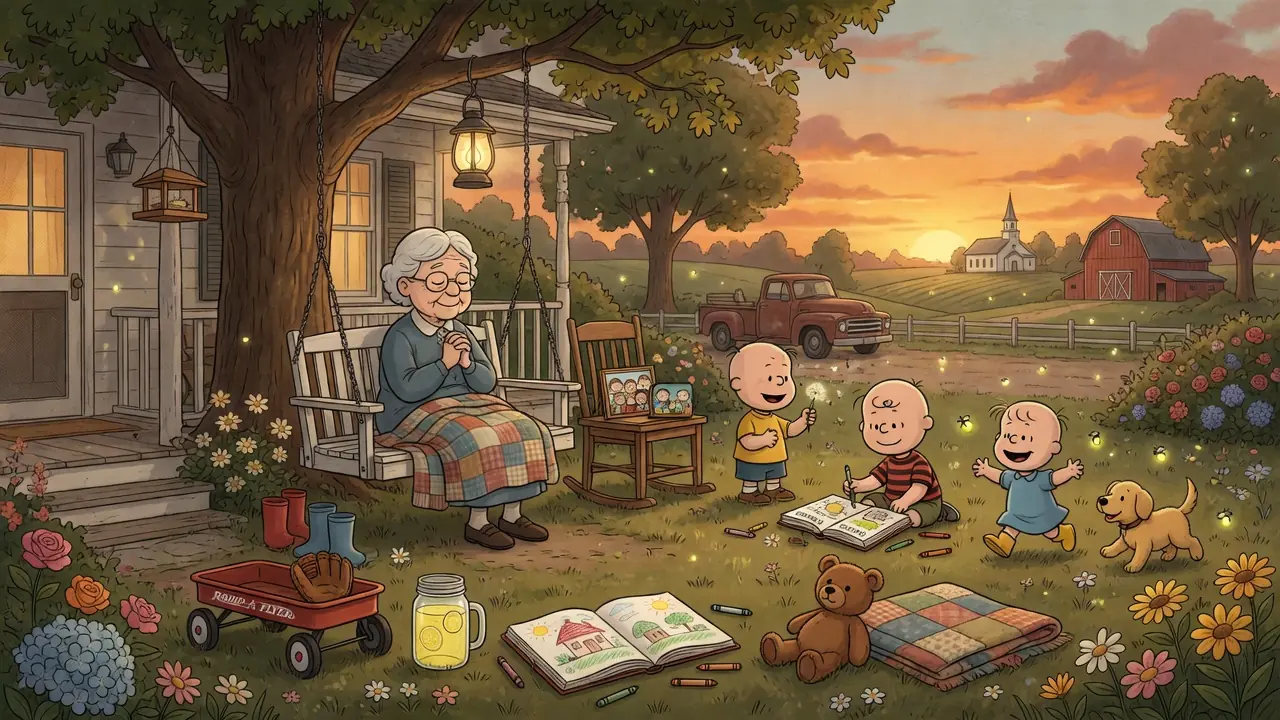
When grandparents are not actively present in faith formation, the drift becomes more likely. Children and teens absorb the dominant messages around them—messages that often contradict the gospel of grace, forgiveness, and eternal hope. They may still attend youth group because friends go, but the personal anchor weakens. Studies of three-generation families confirm that when grandparents invest time and emotional connection in passing on religious values, continuity is more common. When that investment is absent, secularization often accelerates within the family line.
Imagine your granddaughter at fifteen, scrolling through social media that mocks belief while her parents juggle work and exhaustion. If her only memories of faith are hurried Sunday mornings or abstract holiday talks, the world’s voices grow louder. But if she carries the image of you, Bible open on the kitchen table, pausing to thank God for the rain or for her safe arrival, that image stays. It becomes a quiet counterweight. Your involvement does not guarantee she will never wander, but it dramatically increases the chance she will find her way back. Faith is caught as much as it is taught, and you are still one of the primary people positioned to let her catch it from someone whose life has already proven its worth.
Identity
No one else on earth remembers your daughter at age three the way you do. You alone hold the precise way her curls stuck to her forehead when she napped, the exact phrase she used for her favorite blanket, the afternoon she cried because the ice cream melted before she could finish it. These details are not sentimental trivia. They are the raw material from which your grandchildren build their sense of who they are and where they belong.
Psychological research on intergenerational narratives shows that stories passed from grandparents help young people construct what scholars call an “intergenerational self.” Children and young adults who hear vivid accounts of their parents as children—and of the larger family story—develop a stronger sense of continuity and rootedness. They understand that they are part of something larger than their own immediate circumstances. In a culture of frequent moves, fractured families, and digital distraction, this rootedness is increasingly rare and increasingly valuable.
When you are not involved, those stories often die with you. Your grandchildren may know the basic facts of their mother’s or father’s childhood, but they miss the texture—the laughter, the small failures, the everyday courage. They lose the living link that says, “You come from people who have faced hard things and kept going.” Without that link, identity can become thin, shaped more by peers, screens, or passing trends than by a deep family narrative.
Consider the child whose parents divorce. In the confusion of two homes and shifting loyalties, the steady voice of a grandmother telling stories about her own mother’s strength during the Depression or her father’s quiet faithfulness after returning from war can become an invisible lifeline. “Your mama used to climb that same tree when she felt sad,” you might say. “She would sit up there and talk to God.” Such a story does more than entertain; it gives the child permission to feel what she feels and points her toward the same source of comfort her mother once knew. These are not just memories. They are identity anchors.
Your particular vantage point as grandmother gives you a gift no parent can fully replicate. You have lived long enough to see patterns across decades. You remember the child your own child once was, and you can speak that truth with tenderness and perspective. When you withhold or minimize that gift—perhaps out of busyness, distance, or the mistaken belief that “they don’t need me anymore”—your grandchildren lose access to a layer of their own story that cannot be reconstructed later. The loss is quiet but real.
Resilience
Studies consistently show that children and adolescents with close, involved grandparents recover more quickly and fully from trauma and parental divorce. In families marked by conflict or separation, the quality of the grandparent-grandchild relationship is strongly associated with higher life satisfaction, better self-esteem, and fewer depressive symptoms. Researchers examining post-divorce adjustment have found that strong grandparent ties can buffer the negative effects of parental conflict, sometimes mattering even more for children whose parents are no longer together than for those whose homes remain intact.
You become, in many cases, the most stable adult presence in a child’s life. Parents in crisis are often emotionally depleted or physically absent. Friends come and go with the school year. But a grandmother who shows up—reliably, without agenda, with the same hug and the same “I’m so glad you’re here”—offers something rarer: unconditional, long-view love. That stability helps a child’s nervous system settle. It teaches, without words, that not everything good disappears when life breaks.
Biblical faith has always recognized this kind of steady presence. God is described repeatedly as a rock, a refuge, a hiding place. When you embody even a fraction of that steadfastness for your grandchildren, you give them a living picture of divine faithfulness they can carry into their own storms. Research on resilience in adverse childhood experiences echoes this ancient truth: consistent, caring relationships with non-parental adults—especially grandparents—function as powerful protective factors.
Picture a nine-year-old whose parents have just separated. He shuttles between houses, overhears arguments about money and blame, and wonders whether he caused the fracture. At his grandmother’s home on alternate weekends, the rhythm is predictable. The same quilt on the bed. The same prayer before meals. The same patient listening when he finally says, “I miss when we were all together.” You do not have to solve the divorce. You simply have to be there—present, calm, and unwavering in your love for him. That presence becomes part of how his brain and heart learn to regulate fear and sadness. Without it, the instability can compound. With it, healing finds a foothold.
Your later years, far from being a time of withdrawal, may be the season when you are most equipped to offer this kind of steadying love. You have survived enough seasons to know that pain does not have the final word. Your grandchildren desperately need adults who know this in their bones.
Legacy
Your values will not transfer to your grandchildren automatically. Proximity and intentionality are required. Research on intergenerational value transmission shows that grandparents who are deliberate—sharing stories with clear moral threads, creating rituals that embody what matters, and investing emotionally—see stronger continuity of core values such as kindness, responsibility, faith, and generosity. When that intentionality is missing, even strong family bonds can fail to pass on the deeper commitments that once defined the family.
Proximity does not always mean living in the same town. It means creating regular, meaningful contact—whether through weekly video calls that include reading a Psalm together, handwritten letters tucked into care packages, or planned visits that prioritize relationship over entertainment. Intentionality means choosing to speak about what you believe and why it has sustained you, rather than assuming the children will absorb it by osmosis. It means inviting a grandchild into your kitchen not just to eat, but to learn how to make the family bread while you talk about the grandmother who taught you the recipe and the faith that taught you to give thanks even when flour was scarce.
Legacy is not a single dramatic moment. It is the accumulation of ordinary interactions infused with purpose. When you take the time to explain why you forgive quickly, or why you still tithe even on a fixed income, or why you believe every person bears God’s image, you are doing the slow, sacred work of generational transfer. Psalm 78 urges us not to hide these things from our children but to tell the next generation the praiseworthy deeds of the Lord. That telling requires both nearness and intention.
When grandparents step back, assuming the parents will handle it or that “kids these days” will find their own way, the legacy often frays. Values that once seemed non-negotiable—honesty, service, reverence for life, dependence on God—can become optional suggestions. Your grandchildren may still love you, but they may not carry forward the convictions that shaped your life and the lives of those who came before you.
The good news is that it is never too late to begin again. Even if distance or past hurts have created gaps, small, consistent investments can reopen the channel. A grandmother who starts writing one letter a month sharing a story and a Scripture, or who prays daily for each grandchild by name and occasionally tells them so, is already practicing the proximity and intentionality that legacy requires.
The Quiet Power of Your Presence
What happens to your grandkids if you’re not involved? Faith becomes more fragile. Identity grows thinner. Resilience weakens. Legacy fades into sentiment rather than conviction. These are not dramatic collapses in most cases; they are quiet erosions that only become visible years later, when a young adult struggles to articulate why she believes anything at all, or when a child of divorce carries wounds that might have healed faster with one more steady adult in the picture.
Yet the reverse is also true, and it is worth every effort. When you stay involved—with your particular memories, your lived faith, your hard-won stability, and your deliberate passing on of what matters—you give your grandchildren gifts no one else can give in quite the same way. You become part of the answer to the very question that keeps so many families drifting: Who will help us remember who we are and whose we are?
Your season is not over. In many ways, it is the season for which all the previous ones prepared you. The grandchildren do not need you to be perfect or to compete with their parents. They need you to be present—authentically, consistently, and with the quiet confidence that comes from having walked with God through many decades. That presence is not small. It is, in the eyes of heaven and in the hidden places of a child’s heart, one of the most significant investments you will ever make.