Some disappear in death. Others disappear to survive. England, 1813. The afternoon light filtered through the tall windows of Mrs. Margaret Ashton's dressmaking establishment on Milsom Street, casting geometric patterns across bolts of silk and muslin arranged with meticulous care along the shop's eastern wall.
The scent of lavender sachets mingled with beeswax and the faint metallic tang of sewing needles recently sharpened. In the back workroom, where three seamstresses bent over their projects in concentrated silence, Genevieve worked on an intricate border of embroidered roses, her needle moving with the steady rhythm of long practice. At eight and twenty, she had grown accustomed to the anonymity of her existence. The woman she had been, Lady Genevieve Holsworth, Duchess of Westmere, had died five years ago according to every record that mattered.
The woman she had become, Mrs. Davies, widow of a merchant who never existed, lived quietly in two modest rooms above a bakery on Trim Street. Her hands, once soft and adorned with rings that caught candlelight at grand balls, now bore the telltale marks of her trade. Small calluses on her fingertips. A permanent crease where thread had worn against her thumb.
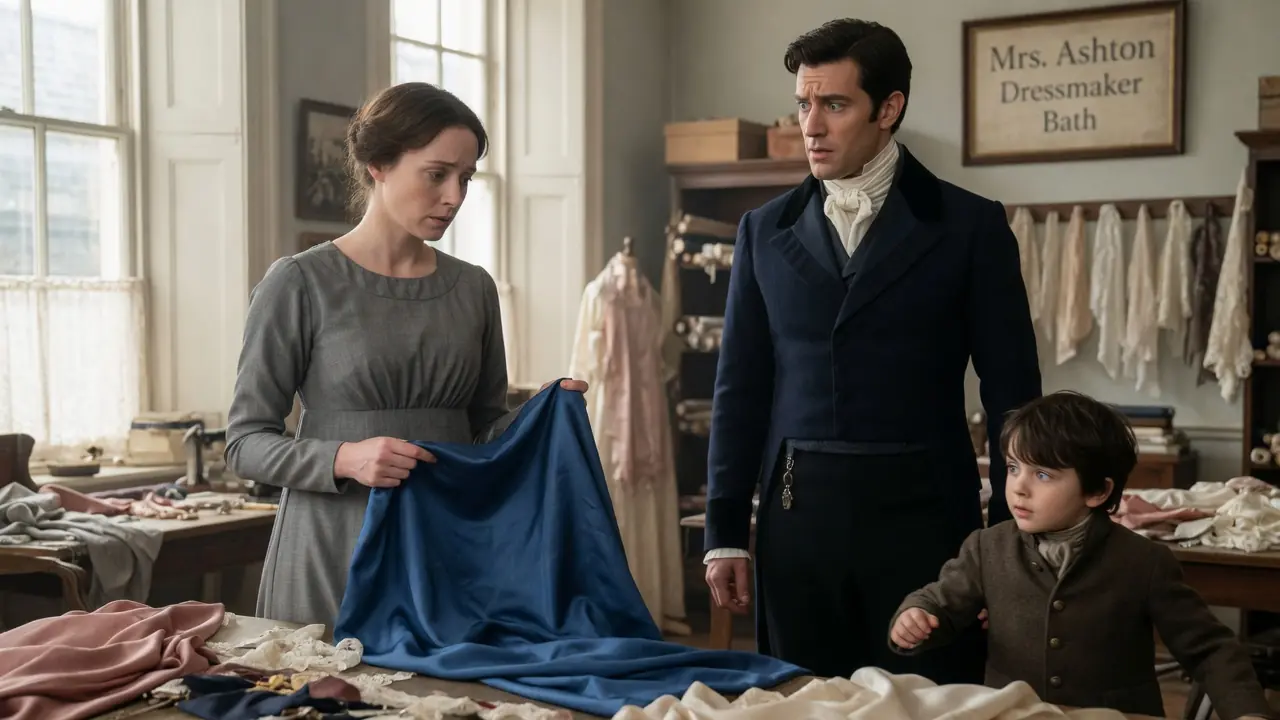
"Mrs. Davies," called Mrs. Ashton from the front of the shop, her voice carrying the particular note of urgency reserved for clients of consequence. "Your assistance is required." Genevieve set down her work, smoothing the front of her simple gray dress as she rose. The gown was well-made, but unremarkable.
The sort worn by respectable working women throughout Bath. She had chosen gray deliberately, a color that helped her fade into the background of daily commerce, neither memorable nor offensive to the eye. When she entered the main shop, she found Mrs. Ashton arranging samples of lace with unusual nervousness. The older woman glanced toward the street entrance, where a carriage of obvious quality waited, its gleaming black lacquer and ducal crest announcing the status of its owner before he ever stepped through the door.
"A gentleman requires a gown commissioned for his cousin," Mrs. Ashton explained, her words tumbling out faster than usual. "He specified our establishment particularly. I thought your eye for detail would serve best for such an important client." Before Genevieve could respond, the shop door opened with a crystalline chime of bells.
Adrian Holsworth, Duke of Westmere, entered the establishment with the unconscious authority of a man accustomed to doors opening before him. He stood well over six feet, his broad shoulders filling his perfectly tailored coat of midnight blue superfine. His hair, black as a raven's wing, was swept back from features that might have been carved by a sculptor's careful hand, all sharp angles and aristocratic planes. But it was his eyes that struck her motionless.
Those penetrating blue-gray depths she had once memorized in candlelight, believing she would spend her life learning their every shade and mood. For one terrible moment, Genevieve forgot to breathe. "Your Grace," Mrs. Ashton curtsied deeply, nearly upsetting a display of ribbon in her haste.
"What an honor you bestow upon our humble shop." "Mrs. Ashton," he acknowledged, his voice that same low rumble that had once whispered endearments against her skin. "I require a gown for my cousin, Lady Pembroke. She writes that your establishment produces the finest eveningwear in Bath."
"Too kind, Your Grace. Too kind, indeed." Mrs. Ashton gestured toward Genevieve, who had somehow remembered to curtsy, keeping her eyes downcast in a manner she had perfected over five years of hiding in plain sight. "This is Mrs. Davies, our most accomplished seamstress.
She will attend to your requirements personally." Adrian's gaze moved to Genevieve, and she felt its weight as though he had laid a hand upon her shoulder. She forced herself to meet his eyes briefly, just long enough for politeness, not long enough for recognition. "Mrs. Davies," he said, and she heard nothing in his tone beyond casual acknowledgement.
He did not know her. Five years of hard living had altered her more thoroughly than she had realized. The soft roundness of youth had given way to sharper features, her cheekbones more prominent, her jaw more defined. She had lost weight in those desperate early months, and though she had regained some of it, her figure remained notably leaner than the well-fed curves of her former life.
Her hair, once elaborately dressed with jeweled pins and flowers, now hung in a simple knot at the base of her neck. But more than physical changes, it was her bearing that had transformed. The Duchess had moved through the world with unconscious privilege. Mrs. Davies carried herself with the careful posture of someone who had learned to take up as little space as possible.
"Your Grace," she managed, pitching her voice slightly lower than its natural register. "If you would describe your cousin's coloring and preferences, I can suggest appropriate fabrics and designs." They moved to the consultation table, where Mrs. Ashton spread samples with trembling hands before excusing herself to attend another customer who had just entered. Genevieve stood across from her husband, this man who had mourned her, this stranger who did not recognize the woman he had married.
"Lady Pembroke has fair coloring," Adrian began, then paused, studying Genevieve with sudden intensity. "Forgive me, but have we met previously?" Her heart lurched against her ribs. "I think not, Your Grace.
I would certainly remember such a distinguished introduction." "Of course." But his eyes narrowed slightly, as though trying to place a face that hovered just beyond memory's reach. "My cousin prefers blue, I believe.
Something suitable for evening entertainments in London." Genevieve's hands moved automatically toward samples of silk, though her thoughts raced. She should have known this moment would come eventually. Bath attracted the wealthy and titled seeking its healing waters and fashionable diversions.
She had been fortunate to avoid such encounters for five years, but fortune, she had learned, was an unreliable ally. "This shade of sapphire would complement fair skin admirably," she said, keeping her voice steady through sheer force of will. "And the weight of the silk drapes beautifully for eveningwear." She spread the fabric before him, and as she did, her sleeve rode up slightly, revealing the faint white line of a scar on her wrist.
It was a small mark, barely noticeable, the result of a childhood accident involving a broken china cup. Adrian had traced that scar once with his fingertip, had kissed it while telling her some foolish story about imperfections being what made beauty memorable. His gaze fell upon it now, and something flickered in his expression, too quick to identify. "Mrs. Davies, are you quite well?" he asked.
"You've gone rather pale." "The afternoon light," she lied smoothly. "It gives me occasional headaches. Nothing of consequence."
She pulled her sleeve down and continued discussing details of the commission, measurements that would need to be sent from London, the time frame for completion. Adrian listened, occasionally interjecting questions that demonstrated both genuine interest in his cousin's satisfaction and the kind of careful attention to detail that had made him an effective manager of his vast estates. They had been married for barely eight months when she fled. Not long enough for the kind of deep knowing that comes from years together, but long enough that she had memorized certain things.
The way his left eyebrow rose slightly when he was skeptical. The unconscious gesture of running his thumb along his jaw when contemplating difficult decisions. The particular timbre his voice took when he was being polite, but had no real interest in a conversation. He displayed all those small tells now, responding to her professional competence with courteous distance.
The shop door chimed again, and Genevieve glanced up reflexively. Oliver burst through the entrance, his small face flushed from running, his dark hair falling across his forehead in the same way his father's did when it needed trimming. At five years old, he retained the slight plumpness of early childhood, but his features were already defining themselves in a way that would have been unmistakable to anyone who had seen both father and son together. "Mama!" he called, the word carrying clearly across the shop.
"Mrs. Finch says I may have a currant bun if you permit it, and I finished all my letters this morning without a single blot, and" He stopped abruptly, his eyes widening as he took in the tall gentleman standing beside his mother. Children possessed an instinctive wariness of adult strangers, and Oliver had been taught to mind his manners around his mother's clients. Adrian had turned at the child's entrance, and Genevieve watched, helpless, as her husband looked upon their son for the first time. The resemblance was not merely strong, it was absolute.
Oliver had inherited her coloring, her brown hair and the shape of her face, but his eyes were his father's, that same distinctive blue-gray that seemed to shift with the light. They were unusual eyes, striking enough that people often remarked upon them. Adrian stared at the boy with an expression Genevieve could not interpret. His face had gone absolutely still, all polite social masks abandoned in a moment of pure unguarded shock.
"Oliver," Genevieve said quickly, moving between them. You must not interrupt when Mama is attending to a customer. Run back to Mrs. Finch, and yes, you may have the bun as a reward for your good work. "Yes, Mama."
Oliver bobbed an approximation of a bow toward Adrian, his curiosity about the imposing stranger evident despite his obedience. "Good afternoon, sir." "Good afternoon," Adrian replied, his voice sounding strange, almost hoarse. Oliver scampered back out to the street where Mrs. Finch from the bakery waited with the promised treat.
The door chimed shut behind him, and silence descended upon the shop. Your son? Adrian asked, and there was something in the question beyond mere polite inquiry. Yes, Your Grace.
He has remarkable eyes. He does. Genevieve forced herself to meet Adrian's gaze to show nothing but the mild pride of any mother whose child had been complimented. He takes after his late father in that respect.
The lie tasted bitter on her tongue, but it was necessary. Everything about her existence now was necessary rather than chosen. Adrian continued to stare at the door through which Oliver had disappeared, his expression troubled. How old is the boy?
Five years, Your Grace. He will be six come spring. She watched calculations moving behind his eyes, watched as he worked backward through years and months. Five years ago, his wife had died in childbirth, or so he believed.
The timing would be impossible to miss for any man of even moderate intelligence, and Adrian had never been anything less than exceptionally sharp. "I see," he said finally, though his tone suggested he saw far more than she would have wished. Mrs. Ashton bustled back to the table, breaking the tension with cheerful efficiency. Have we settled upon a fabric then, Your Grace?
The sapphire silk. Adrian confirmed, though his attention remained partly elsewhere, his thoughts clearly occupied by something beyond the transaction at hand. Send the particulars to my London address. I trust Mrs. Davies can manage the commission competently.
Oh, most competently indeed, Your Grace. Mrs. Davies is our finest worker. They concluded the business details, and Adrian prepared to depart. At the door, he paused, turning back to where Genevieve stood beside the consultation table.
Mrs. Davies, he said carefully, I find myself wondering if we might not have encountered one another before, perhaps in London during the season. I have not been to London in many years, Your Grace, she replied, which was truth masquerading as answer. I believe you must be thinking of someone else. He studied her for a long moment, and she felt the full weight of his scrutiny, felt him cataloging her features with the same careful attention he brought to all complex puzzles.
Perhaps, he said at last. Good day to you, Mrs. Davies, Mrs. Ashton. When the door closed behind him and his carriage pulled away from the curb, Genevieve discovered that her hands were shaking. She pressed them flat against the table's surface, willing steadiness back into her limbs.
Such a distinguished gentleman, Mrs. Ashton sighed. They say he has been in mourning these five years since his young Duchess died. Tragic. Truly tragic.
She perished birthing their child, or so the story goes, though the babe died as well. He has never recovered from the loss, they say. Never even considers remarrying, though every ambitious mama in London has thrown her daughters at him. Genevieve said nothing.
There was nothing to say that would not shatter the careful fiction she had constructed. That evening, after Oliver had been fed and tucked into their narrow bed in the rooms above the bakery, Genevieve stood at the window, looking out over Bath's lamplit streets. She had known this day might come. She had prepared herself for it, rehearsed scenarios in her mind during countless sleepless nights, but she had not anticipated Oliver, had not considered that her son would appear at precisely the wrong moment, his eyes marking him as unmistakably Adrian's child.
Adrian, who believed both his wife and heir had died five years ago. Adrian, who had no knowledge of the conspiracy that had driven her into hiding. Adrian, who had just seen those eyes in the face of a child who should not exist. She pressed her forehead against the cool glass, watching her breath fog the windowpane.
Tomorrow, she would need to be careful. Tomorrow, she would need to be ready for questions, for scrutiny, for the possibility that the safe, small life she had built might begin to unravel. But tonight, she allowed herself one moment of weakness, one moment to remember what it had felt like to stand close enough to Adrian to catch the familiar scent of sandalwood and leather that clung to his clothes, to hear his voice speaking her name, even if it was the wrong name entirely. Some women disappeared in death, she thought again, but the women who disappeared to survive carried different burdens, heavy with all they had left behind and could never reclaim.
Five years ago, his wife had died in childbirth, or so Dr. Leonard Whitmore had solemnly informed him, presenting certificates of death for both mother and infant. Adrian had buried an empty coffin in the family vault at Westmere, had worn black for a year, had carried his grief through countless sleepless nights, much like this one. Yet today, he had seen a child of approximately five years bearing his eyes, calling a seamstress Mama with easy familiarity. Coincidence, perhaps.
The world was large enough to contain such strange parallels, but coincidence did not explain the other thing. That nagging sensation when he had looked at Mrs. Davies, the feeling of something familiar hovering just beyond conscious recognition. When dawn finally crept through the windows, Adrian rose and dressed with deliberate care. He had built his life on logic and careful observation.
Whatever mystery surrounded Mrs. Davies and her remarkable son, he would unravel it systematically. He returned to Mrs. Ashton's establishment shortly after it opened for business. The older woman's surprise at seeing him again so soon was evident. Your Grace, has there been some difficulty with the commission?
None whatsoever, Adrian assured her. However, I find I require additional consultation with Mrs. Davies regarding specific measurements. My cousin is particular about sleeve length, and I neglected to mention her preferences yesterday. It was a transparent excuse, and Mrs. Ashton's expression suggested she knew it, but one did not question a duke's stated purposes.
She sent her assistant to fetch Mrs. Davies from the workroom. Genevieve appeared in the doorway, and this time, Adrian saw the slight widening of her eyes, the momentary tension in her shoulders before she composed herself into professional courtesy. She knew he had returned for reasons beyond sleeve measurements. Your Grace, she said, her voice steady.
How may I assist you? The fitting room, if you please, Adrian replied. This will require some discussion of details. Mrs. Ashton showed them to the private room used for fittings, a small chamber with good light from tall windows and a standing mirror in the corner.
She departed with promises to send tea. Once the door closed, Adrian wasted no time on pretense. Who are you? Mrs. Davies, Your Grace, as I stated yesterday.
That is what you call yourself. It is not who you are. He moved closer, studying her face with the same intensity he brought to examining disputed contracts or questionable ledgers. I do not forget faces, Mrs. Davies, and yours troubles me with its familiarity.
I have one of those faces, Your Grace. She kept her gaze level, her hands folded before her in a posture of perfect composure. People often believe they have met me previously. Do they?
Adrian circled slowly around her, noting details he had missed yesterday in his initial shock, the way she held herself, the slight calluses on her fingers, the quality of her gown, which was well-made but old, mended in places with stitches so fine they were nearly invisible. Tell me, Mrs. Davies, have you ever visited Westmere Court? Her control slipped for just a fraction of a second, a barely perceptible intake of breath. I am not acquainted with Westmere Court, Your Grace.
Strange, Adrian continued, because during our discussion yesterday, you mentioned that the East Gallery would provide excellent light for displaying evening gowns. I had mentioned my cousin might wear such a gown at Westmere, but I did not specify which room I referred to. Yet you knew immediately that the East Gallery was the logical choice. He paused, letting the implication settle between them.
The East Gallery is not a common room. It is a private space that only family and intimate guests would know. The color drained from her face, but she rallied. You must have mentioned it, Your Grace.
I merely repeated what you said. I mentioned no such thing. Adrian stopped directly before her. You made a mistake, Mrs. Davies.
A small one, easily overlooked by anyone who had not lived at Westmere for generations, but I know every stone of that house, every room and corridor. And I did not describe the East Gallery to you. So I ask again, who are you? "I am no one of consequence," she whispered, and for a moment genuine anguish showed through her careful mask.
I am merely a seamstress trying to earn an honest living with a child who has my eyes. Her throat worked as she swallowed. Children's eyes can resemble many people, Your Grace. It is not uncommon.
The color is distinctive. My family has carried these eyes for four generations. Adrian's voice dropped lower. That boy is my son.
I do not know how or why, but he is mine. Which means you are The door opened, interrupting them. Mrs. Ashton entered bearing a tea tray, chattering about the quality of the morning's delivery from the baker. By the time she departed again, Genevieve had retreated behind her walls of composure.
If Your Grace has concluded his business, she said formally, I have other commissions requiring attention. This is far from concluded, Adrian replied, but I will allow you temporary reprieve while I make certain inquiries. He departed, his mind already forming plans. Whatever truth lay behind Mrs. Davies and her son, he would discover it.
By afternoon, Adrian sat in the offices of Mr. Thomas Brennan, the most discreet solicitor in Bath. I require information about a woman calling herself Mrs. Davies. She works as a seamstress at Mrs. Ashton's establishment on Milsom Street. Brennan made careful notes.
What specifically does Your Grace wish to know? Everything. When she arrived in Bath, where she came from before that, what records exist of her husband, her background, her circumstances. I want details, Mr. Brennan, not suppositions.
It will require several days, Your Grace. You have two. When Adrian returned to his hotel that evening, he found himself staring out the window toward the general direction of Milsom Street. Five years he had mourned.
Five years of believing himself widowed, his heir lost, his line threatened with extinction. Five years of well-meaning relatives suggesting remarriage, of ambitious mothers parading their daughters before him, of nights spent remembering Genevieve's smile, her laugh, the way she had looked at him on their wedding day with trust and hope. If Mrs. Davies was somehow connected to that lost past, if that boy was truly his son, then someone had deceived him catastrophically. The question was who, and more importantly, why?
The following day dragged interminably. Adrian occupied himself with correspondence and business matters, but his attention wandered repeatedly. He caught himself standing at the window, watching the street below for no reason he could articulate. On the second evening after their confrontation, Mr. Brennan arrived at the hotel bearing a leather folder.
Your Grace, the solicitor began carefully. The information I have gathered is unusual. "Tell me." Brennan opened the folder, consulting his notes.
Mrs. Davies appeared in Bath four and a half years ago. She arrived alone, noticeably pregnant, and took rooms above a bakery on Trim Street. She had very little money and no references. Mrs. Ashton took her on as a seamstress only because Mrs. Davies demonstrated exceptional skill with a needle.
And before Bath, nothing. No records whatsoever. It is as though she materialized from thin air. Brennan hesitated.
The name she uses is clearly false. No Mr. Davies exists in any registry I could locate. No marriage records, no death certificate. The address she gave Mrs. Ashton when first employed was fabricated.
So she is hiding, Adrian said slowly. But from what? Or from whom? That I cannot say, Your Grace.
However, Brennan glanced at his notes again. The timing of her arrival in Bath is noteworthy. She appeared in late autumn of 1807, visibly pregnant with perhaps two or three months remaining before delivery. If one calculates backward, it aligns with when my wife disappeared, Adrian finished, his hands clenched on the arms of his chair.
Mr. Brennan, I need you to make further inquiries. Specifically, I want every detail about the circumstances surrounding the death of the Duchess of Westmere five years ago. Speak to the servants who were at Westmere Court that night. Find Dr. Whitmore and question him.
I want facts, not the comfortable story I was told. Your Grace, are you suggesting I am suggesting nothing yet, Adrian interrupted, but I will know the truth, whatever it may be. After Brennan departed, Adrian remained sitting in the gathering darkness. If Genevieve had survived, if she had fled instead of dying, then why?
What had driven a Duchess to abandon her title, her home, her husband, and live in poverty as a seamstress under a false name? Unless she had not fled from him, but from something else entirely. The thought sent cold clarity through his confusion. He rang for his valet.
We leave for London at dawn, Adrian instructed. Send word ahead that I require meetings with my estate steward and anyone who was in residence at Westmere Court five years ago. I want them available for questioning immediately upon my arrival. But before London, he would see Mrs. Davies one final time.
Adrian waited near the shop as evening approached, watching from across the street as Mrs. Ashton closed for the day. When Genevieve finally emerged, shawl wrapped against the autumn chill, he stepped from the shadows. Mrs. Davies. She stopped, her body going rigid.
Your Grace, you startled me. We need to speak. I have nothing further to say to you. She made to move past him, but he blocked her path gently.
Perhaps not, but you will listen. Adrian kept his voice low, aware of passersby who might overhear. I have made inquiries. I know you appeared in Bath four and a half years ago with no past, no history, no husband who ever existed.
I know you arrived pregnant and alone. The timing aligns precisely with when my wife vanished from Westmere Court. Your wife died, Genevieve said, but her voice trembled. So I was told.
Yet here stands a woman with her intimate knowledge of my home, bearing a son with my eyes, hiding under a false name. He leaned closer. I am not a fool, madam. I do not know what game is being played, but I will discover the truth.
There is no truth to discover, she insisted. You are mistaken in your suspicions. Mama! Oliver's voice rang out as he ran up the street from the direction of the bakery, waving a small wooden horse.
Look what Mr. Finch carved for me. He says it looks just like the horses the fine gentlemen ride, and he skidded to a halt, seeing Adrian standing close to his mother. The boy's eyes, those unmistakable Holsworth eyes, went wide. Good evening, young man, Adrian said, his throat tight.
Good evening, sir, Oliver replied with careful politeness. Then, to his mother, using the same endearment Adrian had heard before, Mama dear, may we go home now? I'm hungry. Mama dear.
It was an unusual term, old-fashioned. Adrian's mind snagged on it, pulling at some memory just beyond reach. Then it struck him with perfect clarity. Genevieve's mother, the late Viscountess Penworth, had used that exact endearment with her daughters.
Adrian had heard it during his brief courtship, had smiled at its quaint charm. His gaze snapped to Genevieve's face, and he saw her realize her mistake. Saw her understand that this small detail had betrayed her as surely as any confession. Genevieve, he breathed.
She grabbed Oliver's hand. "Come, darling. We must go." Stop, Adrian commanded, but they were already moving, Genevieve pulling Oliver along, hurrying down the street while the boy looked back over his shoulder in confusion.
Adrian did not pursue them through the public street, but he stood watching until they disappeared around a corner. His heart pounding with the certainty of revelation. His wife lived. His son existed.
And for five years, someone had lied to him about both. Tomorrow he would ride to London and begin tearing apart every comfortable assumption about his wife's death until he found who had orchestrated such a monstrous deception. But tonight, he would content himself with one absolute truth. Genevieve Holsworth was alive, and nothing would prevent him from discovering why she had hidden from him for five long years.
Genevieve did not wait for Adrian to return with accusations and demands for truth. She spent the night after their encounter on the street composing a letter by candlelight while Oliver slept in their narrow bed, his breathing soft and steady in the darkness. Her hand trembled as she wrote, but the words came with surprising clarity. She detailed everything she remembered about the conspiracy, every fragment of overheard conversation between Philip Carrington and Dr. Leonard Whitmore during those final terrible weeks at Westmere Court.
She described dates with precision, the evening of October 3rd when she had heard Philip discussing her impending tragedy with Whitmore in the library, believing her safely upstairs. The morning of October 10th, when she had discovered falsified medical records in Whitmore's bag, documents already prepared declaring her dangerously ill. The afternoon of October 14th, when she had fled, 3 months pregnant and terrified, with nothing but the clothes she wore and the small amount of coin she kept hidden in her chamber. She named the servants she suspected of involvement.
Henry Marston, the footman who had suddenly begun avoiding her eyes. Agnes Thorne, the housemaid who had wept when bringing her tea. Robert Kemp, the groom who had looked stricken when she asked about the condition of the carriage horses, as though he knew she would never ride in them again. What she did not write was why she had never returned after escaping.
That explanation felt too raw, too shameful to commit to paper. How could she make Adrian understand that returning would have meant placing herself back into a world where someone had wanted her dead, badly enough to orchestrate an elaborate murder. That even if Philip were exposed, she could never again trust the walls of Westmere Court, the servants who moved through its halls, the physicians who attended its residents. That fear had become her constant companion, shaping every decision, every careful step she took to remain invisible.
No, those words would not come. Better to let him think her a coward than to reveal how thoroughly terror had reshaped her. She sealed the letter with plain wax, dressed before dawn, and walked through Bath's quiet streets to the Crescent Hotel. The porter accepted the letter with professional discretion, promising it would reach His Grace immediately upon his waking.
Then Genevieve returned to her rooms and waited, knowing she had set events in motion that could not be stopped. Adrian read the letter three times before the meaning fully settled into his mind. He sat in his chamber, still wearing his dressing gown, the pages spread across the breakfast table before him, forgotten tea growing cold in its cup. Conspiracy, falsified death, attempted murder.
The words should have seemed fantastic, the stuff of sensation novels sold in railway stations, but they aligned too perfectly with the inconsistencies he had noted over the years. Small troubles that had never quite resolved in his memory. The haste with which Philip had insisted upon Genevieve's burial. Dr. Whitmore's strange reluctance to allow Adrian near his wife's supposed deathbed, claiming contagion risk.
The sealed coffin that Adrian had never been permitted to open, even in his grief's desperate moments. He had been a fool. Worse, he had been a trusting fool, accepting comfortable lies because the truth was too painful to examine closely. By noon, Adrian was riding hard toward London, his valet and a hired guard following with his luggage.
He covered the distance in record time, driving his horse with single-minded determination until Westmere Court rose before him in the fading afternoon light. The house looked exactly as it always had, graystone walls weathered by centuries, windows reflecting the sunset like watchful eyes. But Adrian saw it differently now, imagined Genevieve fleeing through these very gates, pregnant and alone, believing death waited for her behind those familiar walls. He did not pause to refresh himself or change his travel-stained clothes.
Instead, he sent immediate word to London for Dr. Leonard Whitmore to attend him on urgent business, making it clear through his secretary that refusal would result in legal consequences. Then he summoned his steward and demanded a list of every servant who had been employed at Westmere five years previous. "Those who remain in service, I want assembled in the morning room within the hour," Adrian commanded. "Those who have left, I want their current locations."
His steward, a steady man named Mr. Grayson, who had served the family for 30 years, hesitated. "May I ask the nature of this inquiry, Your Grace?" "You may not." Adrian's tone brooked no argument.
"Simply do as I have instructed." Dr. Whitmore arrived the following afternoon, his manner obsequious and uncertain. He was a man of middling years with thinning hair and soft hands that had never known manual labor, the sort of physician who catered to wealthy families and knew the value of discretion above medical ethics. Adrian received him in the library, the same room where Genevieve claimed to have overheard the conspiracy being planned.
"Dr. Whitmore," Adrian began without preamble, "I have reason to believe you provided false medical testimony regarding the death of the Duchess of Westmere 5 years ago." The color drained from Whitmore's face. "Your Grace, I assure you "Do not lie to me," Adrian interrupted, his voice deadly quiet. "I have witnesses placing you in conversation with Philip Carrington regarding arrangements for the Duchess's supposed illness weeks before her death.
I have evidence of falsified documents. What I require from you now is the truth, complete and unvarnished. Provide it, and I will consider leniency. Refuse, and I will see you prosecuted for conspiracy to commit murder."
Whitmore's hands shook as he gripped the arms of his chair. "Murder? Your Grace, I never That is to say, I believed "What did Philip Carrington pay you to do?" The question hung in the air between them.
Whitmore's face worked through a succession of expressions: denial, calculation, fear, and finally, defeat. "He asked me to prepare documents," the physician admitted, his voice barely above a whisper. "Medical certificates stating that the Duchess had contracted childbed fever. He said He said it would be necessary after she delivered, that there would be complications, and he wanted the paperwork ready to avoid delays."
"And you questioned none of this?" "I thought Whitmore swallowed hard. I thought perhaps His Grace wished to be prepared for the worst. Childbirth is dangerous, and the Duchess was young, inexperienced.
It seemed prudent." "You prepared death certificates before anyone had died," Adrian said flatly. "You found nothing suspicious in this?" "Mr. Carrington was most persuasive.
He spoke of family concerns, of protecting the ducal line, of preventing scandal should the worst occur." Whitmore's voice grew stronger, as though repeating Philip's justifications somehow absolved him. "He promised it was merely precautionary. And when the Duchess disappeared, he told me she had fled after a dispute with Your Grace, that she had abandoned her marriage and her child.
He said the documents would allow the family to move forward without the shame of a public desertion." Adrian's hands clenched into fists. "So you signed false certificates declaring her dead of fever, knowing no such thing had occurred?" "I believed I was helping the family," Whitmore insisted, but his eyes would not meet Adrian's.
"You were paid," Adrian countered. "How much?" The sum Whitmore named was substantial enough to purchase a comfortable house in a good neighborhood. Blood money, paid to help facilitate a Duchess's disappearance.
"I want everything," Adrian demanded. "Every document Philip asked you to prepare, every conversation you can recall, every detail of the arrangements. You will write it all down, sign it, and have it witnessed by my solicitor. Do this, and I will consider allowing you to leave England quietly rather than facing trial.
Refuse, and I will destroy you." Whitmore nodded miserably, already reaching for the paper and ink Adrian's secretary provided. While the physician wrote his confession, Adrian turned his attention to the servants. Of the three Genevieve had named, only Agnes Thorne remained in his employ.
She was brought before him in the estate office, her cap clutched in trembling hands. "Agnes," Adrian said, gentling his voice because she looked terrified enough to faint. "I am not angry with you, but I need the truth about what happened 5 years ago." Tears spilled down her weathered cheeks.
"Oh, Your Grace, I've carried the shame of it all these years. We thought That is Mr. Carrington said "What did he say?" "That the Duchess was unwell, that she needed rest and quiet, that we mustn't disturb her or speak of her condition to anyone." Agnes twisted her cap until Adrian feared she would tear it.
"He said it was to protect her reputation, that she had taken with fits and wasn't herself. He asked us to testify if anyone questioned that we'd seen her acting strangely, wandering the halls at night, saying odd things." "And had you seen such things?" "No, Your Grace."
Agnes looked up, meeting his eyes with desperate honesty. "The Duchess was always kind, always well, but Mr. Carrington, he gave us money, said it was for our discretion, and we thought we thought we were helping." Adrian questioned Henry Marston and Robert Kemp that evening, having sent riders to fetch them from their current positions. Both told similar stories.
Philip had paid them to observe the Duchess, to report her movements, and later to testify that she had seemed ill and disoriented in the weeks before her disappearance. Neither had actually witnessed anything unusual, but Philip's authority and money had convinced them to comply. "Did none of you question why the Duke himself was not informed of his wife's supposed illness?" Adrian demanded.
Robert Kemp, the former groom, hung his head. "Mr. Carrington said you knew, Your Grace. He said you'd asked him to handle the matter quietly because you didn't wish the Duchess to know how serious her condition was. We believed him because he was family, because he managed the estate, because Because you were paid not to ask questions.
Adrian finished coldly. He spent two days assembling the evidence, watching as Whitmore completed his detailed confession, recording the servants' statements, compiling everything into a damning portrait of Philip Carrington's conspiracy. The picture that emerged was clear. Philip, who had served as estate manager and stood to inherit if Adrian died without issue, had orchestrated an elaborate plan to remove Genevieve.
Whether he had intended actual murder or merely to drive her away, the result was the same. She had fled in terror and Philip had used prepared documents to declare her dead, securing his position and eliminating any threat her child might pose to his eventual inheritance. Adrian's rage burned cold and controlled. He would see Philip prosecuted with every legal weapon at his disposal.
But first, he needed Genevieve's complete testimony, the pieces only she could provide. He wrote back to Bath with Whitmore's confession and the servants' depositions secured in a leather case. This time when he appeared at Mrs. Ashton's establishment, he waited until evening when the shop closed, then approached Genevieve as she locked the door. "I need to speak with you," he said without preamble.
"Not as your husband, not as a duke demanding answers, but as someone who needs your help to see justice done." She looked at him warily, exhaustion evident in the shadows beneath her eyes. "I told you everything I know in the letter." "You told me what Philip did.
You did not tell me all the evidence that exists, the witnesses who might corroborate your account, the details that will make the difference between suspicion and conviction." He gestured to the case he carried. "I have Whitmore's confession. I have statements from the servants Philip bribed, but I need more, Genevieve.
I need your testimony to complete the case." She stared at him, and he watched her process his use of her true name, the first time he had spoken it aloud since the revelation on the street. "You believe me?" she said softly. "You truly believe what I wrote?"
"I have evidence that proves what you wrote. Whitmore confessed to preparing false death certificates before you disappeared. The servants admitted to being paid to testify about an illness that never existed. The conspiracy is real, Genevieve, and I will see Philip answer for it.
But I need everything you can remember." She glanced down the street toward her lodgings where Oliver waited. "Not here. Come to my rooms in 1 hour.
There are things I kept, letters I should have burned but couldn't. If they help convict Philip, you may have them." When Adrian arrived at the modest building on Trim Street, he climbed narrow stairs that creaked beneath his weight to a door that had been mended poorly and painted many times. Genevieve opened it at his knock, and he stepped into a world so different from Westmere Court that he might have been entering another country entirely.
The rooms were small but scrupulously clean. A single lamp burned on a scarred table where Oliver sat practicing his letters on a slate. The child looked up with those unmistakable Holsworth eyes and offered a shy nod of greeting before returning to his work. Genevieve had spread papers across the table, pushed Oliver's schoolwork carefully aside.
"These," she said, indicating several folded letters, "are correspondence Philip sent to a Mr. James Wickham in London. I found them in Philip's desk when I was looking for household accounts. They discuss investments and property, but also mention removing obstacles and ensuring the succession. At the time, I thought he meant ordinary estate business.
Now I understand differently." Adrian examined the letters, recognizing Philip's handwriting, seeing the veiled references that took on sinister meaning with context. "And this," Genevieve continued, producing a small leather journal, "belonged to a maid named Sarah Pemberton. She died of fever the winter before I fled, but before her death, she told me she had been asked to spy on me and report to Philip.
She kept notes of what she saw, perhaps thinking to use them for leverage someday. I found the journal among her effects when I helped pack them after her death. The journal detailed innocent activities rendered suspicious through Philip's interpretation. Genevieve walking in the gardens alone, Genevieve declining dinner and taking a tray in her room, Genevieve seeming preoccupied and distant, normal behaviors twisted into evidence of instability."
"This is extraordinary," Adrian breathed. "This proves Philip's surveillance of you began months before your disappearance. Damn." "There's more," Genevieve said quietly.
She moved to a small trunk in the corner, unlocked it with a key she wore on a ribbon around her neck, and withdrew a bundle of cloth. "These are letters Philip wrote to Dr. Whitmore. I took them when I fled. I thought they might serve as proof if I ever found the courage to reveal the truth."
Adrian read through them with growing fury. The correspondence detailed the entire conspiracy, Philip's concerns about Genevieve producing an heir, his suggestions that certain medical interventions might prove necessary, Whitmore's agreement to assist in exchange for payment. It was all there, written in Philip's own hand, damning evidence that could not be explained away. "Why did you never use these?"
Adrian asked, his voice rough with emotion. "You could have exposed Philip years ago." Genevieve wrapped her arms around herself. "Because exposing Philip meant exposing myself.
It meant returning to the world that had tried to kill me. It meant trusting that justice would prevail when I had every reason to believe it would not." She met his eyes. "And it meant giving up my son.
Giving up Oliver was born here in these rooms with only a midwife to attend me. He has no legal existence as your heir. If I had returned and presented him, what then? Philip would claim I had invented the child, found some boy with convenient eyes, and tried to pass him off as ducal blood.
I had no proof of the marriage consummation, no witnesses to the pregnancy, nothing but my word. Who would have believed me?" Adrian stared at her, seeing for the first time the full weight of impossible choices she had carried. She had not merely fled danger, she had calculated every angle, understood every vulnerability, and chosen the path that kept her child safe, even if it meant living as no one, belonging nowhere.
"I believe you," he said. "And these documents will ensure that Philip faces justice for what he attempted." "Justice?" Genevieve repeated the word as though testing its taste.
"And what happens after justice is served? Where does that leave Oliver? Where does it leave me?" Adrian had no answer for her.
He gathered the evidence carefully, securing it in his case alongside Whitmore's confession and the servants' depositions. When he looked up, Genevieve was watching him with an expression he could not read, something between hope and resignation. "I promise you," he said quietly, "Philip will not remain free much longer. Whatever happens next, you need not fear him again."
She nodded but said nothing, and Adrian left her there in her small, clean rooms with their son bent over his slate, both of them wrapped in a safety that depended on invisibility. But invisibility could not last much longer, not now that Adrian held evidence that would shake the foundations of everything Philip had built on lies and false death certificates. He rode toward London at dawn, his case full of damning truth. His mind already planning the prosecution that would see his cousin face consequences for attempting to destroy the woman Adrian had married, the child he had never known existed.
Behind him in Bath, Genevieve stood at her window watching the sun rise over a city where she had hidden for 5 years. She did not know what Adrian's justice would mean for her fragile existence. She knew only that the careful walls she had built were beginning to crack, and whatever came next would reshape everything she had fought so hard to preserve. Adrian returned to London with a fury that burned cold and methodical.
He assembled his legal advisers in the study at his Mayfair townhouse within hours of his arrival, spreading the evidence across the mahogany desk like a general planning a military campaign. "Gentlemen," he addressed the three barristers he had summoned, each renowned for their skill in criminal prosecution. "I require Philip Carrington arrested and charged with conspiracy to commit murder, fraud, and falsification of official documents. These are the proofs."
The eldest barrister, Sir Edmund Hartley, examined Whitmore's confession with meticulous attention. "This is damning, Your Grace. Combined with the servants' testimonies and the letters in Mr. Carrington's own hand, we have sufficient evidence to proceed immediately." "Then proceed," Adrian commanded.
"I want charges filed before week's end." But Philip had not survived years of scheming without developing instincts for danger. By the time Adrian's solicitors had prepared the formal charges, Philip had already learned through his own network of informants that the duke was gathering evidence against him. He appeared at Adrian's townhouse 2 days after Adrian's return, his manner that of a man preparing for confrontation.
Adrian received him in the same study where the evidence lay compiled, though he had ordered it locked away in his safe. No need to show his hand before delivering the final blow. "Cousin," Philip began, his smile not reaching his eyes. "I understand you have been making inquiries into matters that occurred some years past."
"Have I?" Adrian remained standing, denying Philip the courtesy of a seat. "Come now, Adrian. We both know you have been questioning servants, consulting with physicians, digging into affairs that are long settled."
Philip's voice carried an edge of warning beneath its affected casualness. "I wonder at your purpose." "My purpose is justice." "Justice?"
Philip laughed, but the sound held no mirth. "For what crime?" "The Duchess died in childbirth 5 years ago. A tragedy, certainly, but not a crime."
"She did not die," Adrian said flatly. "You orchestrated a conspiracy to drive her away and falsify her death. I have proof, Philip. Confessions, letters, testimonies, enough to see you hanged."
The color drained from Philip's face, but he recovered quickly, shifting to a different approach. "If you believe such things, then you have been deceived by false testimony. The servants lie, seeking money or advancement. Whitmore is a drunkard whose word means nothing.
Whatever story the Duchess herself has told you, assuming she truly lives, is the fabrication of a woman who abandoned her marriage and now seeks to return with invented grievances." "The letters are in your handwriting." "Forgeries." "Witnessed and verified by three different experts."
Philip's composure cracked further. He moved closer to the desk, his hands gripping its edge. "Adrian, listen to reason. I am your cousin, your family.
Whatever you believe happened, we can resolve it privately. The Duchess can return if she wishes, with full honors and no questions asked about where she has been. I will retire to the country, manage the northern estates, stay out of London society. We need not involve the courts in family matters."
"You attempted to murder my wife." "I attempted nothing." Philip's voice rose, desperation creeping in. "I merely prepared for possibilities.
The Duchess was young, childbirth is dangerous. I thought only to spare you the complications if the worst occurred." "I never touched her, never threatened her directly. If she fled, it was her own choice based on misunderstandings."
"Misunderstandings," Adrian repeated, his tone glacial. "You bribed a physician to prepare false death certificates. You paid servants to testify to an illness that never existed. You buried an empty coffin and allowed me to believe both my wife and child had died.
These are not misunderstandings, Philip. These are crimes." Philip straightened, his expression hardening into something uglier. "Very well.
If you will not be reasonable, consider this. I am not without resources or influence. I know things about the ducal finances, about certain investments that might not bear close scrutiny. Press charges against me, and I will ensure every scandal, every questionable dealing, every minor impropriety in the Holsworth family history becomes public knowledge.
Your name will be dragged through every London drawing room and newspaper." "Threaten me again," Adrian said softly, "and I will add blackmail to the charges." He pulled the bell cord. Within moments, three men entered the study, his head footman and two constables from Bow Street, whom Adrian had summoned in anticipation of precisely this confrontation.
"Philip Carrington," Adrian addressed him formally, "I am bringing charges against you for conspiracy to commit murder, fraud, and falsification of legal documents. These officers will escort you into custody pending your hearing before the magistrate." Philip's face contorted with rage. "You cannot do this.
I am family. I am "You are a criminal," Adrian interrupted, "and you will face justice." The constables moved to restrain Philip, who struggled briefly before realizing the futility of resistance. As they led him toward the door, he turned back with a final venomous glare.
"She will never be accepted," he spat. "A Duchess who disappeared for 5 years, living God knows where, doing God knows what. Society will destroy her, Adrian. Even if you clear my name through some miracle of legal manipulation, she will never recover her reputation.
You are ruining us both for nothing." "Remove him," Adrian ordered, and Philip was dragged from the study, his protests echoing down the hallway until the front door closed behind him. Adrian stood alone in the sudden silence, his heart pounding with an exhilaration he had not expected. Justice, it seemed, carried its own satisfaction.
But Philip's escape attempt came swiftly. That very night, he bribed one of the guards at the holding facility and fled toward Dover, intending to cross to France, where British law could not reach him. He had gold, connections, and desperation driving him. He did not account for Adrian's thoroughness.
The Duke had anticipated exactly such a move and had posted men at every port within a day's ride of London. Philip was apprehended on the Dover Road at dawn, his horse lathered and his pockets full of hastily gathered valuables. The attempted flight sealed his fate in the eyes of the law. Innocent men did not flee justice.
When he was returned to London in chains, even those who might have supported him out of family loyalty or social obligation, withdrew their assistance. The formal criminal proceedings began within the week. Meanwhile, in Bath, Genevieve faced consequences of an entirely different nature. The Duke of Westmere's repeated visits to Mrs. Ashton's establishment had not gone unnoticed.
Bath thrived on gossip, and the sight of such an elevated personage calling upon a modest seamstress provided ample fodder for speculation. It began with whispers over morning tea, progressed to pointed questions in the pump room, and culminated in the sort of scandal that ruined reputations. "I hear the Duke has developed quite an attachment to one of Mrs. Ashton's girls," Lady Thornbury remarked to her companion, loud enough for others to hear. "One cannot help but wonder at the nature of such frequent consultations."
"A widow, I understand," her friend replied. "Quite beneath his station, but then, gentlemen have their needs." Such conversations multiplied throughout Bath society. Within days, the rumors had calcified into accepted truth.
The Duke of Westmere was keeping a mistress among the seamstresses. The first tangible consequence arrived when Lady Pemberton sent her maid to cancel an order for three day dresses that Genevieve had been commissioned to make. No explanation was offered, but none was needed. The message was clear.
More cancellations followed. Mrs. Ashton's face grew increasingly troubled as she tallied the lost commissions, all requests that had specifically named Mrs. Davies as the seamstress. Finally, on a gray afternoon when rain drummed against the shop windows, Mrs. Ashton called Genevieve into her private office. "Mrs. Davies," the older woman began, wringing her hands.
"I must speak with you about a delicate matter." Genevieve had known this conversation was coming. The cancellations. "Yes."
Mrs. Ashton looked genuinely distressed. "I do not believe the rumors about you. I want you to know that. You have been nothing but professional and skilled in your work, but the other seamstresses are complaining, and the Association of Dressmakers has sent a formal letter expressing concerns about the shop's reputation.
You wish me to leave." "I do not wish it," Mrs. Ashton said emphatically. "But I fear I must ask it. The shop cannot survive if our clients believe we harbor women of of questionable character.
It is not fair. It is not right, but it is the reality of business." Genevieve nodded slowly. She felt no anger toward Mrs. Ashton, only a weary recognition of how quickly respectability could be lost and how impossible it was to defend against whispers.
"I understand." "When would you like me to depart?" "End of the week." Mrs. Ashton's relief at Genevieve's lack of protest was evident.
"And I will provide you with a letter of reference. A strong one, should you seek employment elsewhere. Perhaps in another city where the talk has not spread." "Perhaps."
Genevieve agreed, though she had no intention of fleeing again. She cleared her workspace that Friday, packed her needles and threads, and the half-finished projects she had been working on privately. The other seamstresses avoided her eyes, some from embarrassment, others from satisfaction at seeing a rival removed. Only young Annie, the apprentice, approached as Genevieve prepared to leave.
"I think it's all rot," the girl whispered fiercely. "You never did anything wrong, and everyone knows it." "Thank you, Annie," Genevieve said, touched by the loyalty. "Mind your stitches stay small, and you will do well here."
She returned to her rooms and transformed them into a makeshift workshop. She hung a small sign in the window, "Mrs. Davies, fine sewing and alterations." She had saved some money over the years, enough to purchase fabrics and notions to sustain them for perhaps 3 months if she was careful. But clients were scarce.
Those who might have hired her independently now avoided association with a woman touched by scandal. She took in mending work, hemmed plain skirts for servants, accepted any commission, no matter how small or poorly paid. The money dwindled faster than she had calculated. She began purchasing the cheapest cuts of meat, watering down Oliver's milk, mending her own clothes rather than replacing them.
The lamp oil was rationed, so she worked by daylight only, straining her eyes in the failing afternoon sun. Oliver noticed. He was a perceptive child, and though Genevieve tried to shield him from their difficulties, he saw the thinner soups, the longer hours his mother spent bent over her sewing, the worried expression she wore when she thought he was not looking. "Mama," he asked one evening as she served him bread and cheese for supper, "are we poor now?"
Genevieve's hand stilled. "We are managing, darling. Do not worry yourself." "But you worry," Oliver observed with the simple directness of childhood.
"You worry all the time now. Could the tall man help? The gentleman who came to the shop? He looked very grand.
Grand people have lots of money." "We do not accept charity," Genevieve said gently, though her heart ached at his innocence. "We make our own way in the world, Oliver. That is what gives us dignity."
"What's dignity?" "It is knowing that what you have, you earned through your own honest work. It is being able to hold your head high." Oliver considered this gravely.
"Is dignity more important than not being hungry?" The question pierced her. "Eat your supper, love. We are not hungry.
We have enough." But enough was becoming a flexible concept, and Genevieve lay awake at night calculating how long her savings would last. What she could sell, whether she might find legitimate employment that did not require references from shops she had been asked to leave. When Adrian's messenger arrived bearing a sealed letter and a bank draft for 500 pounds, Genevieve stared at the money as though it were a serpent.
The letter was brief. "Accept this assistance without pride. You and Oliver should not suffer because of my cousin's crimes. A.H." 500 pounds, a fortune, enough to secure better lodgings, proper food, security for a year or more.
Enough to erase every anxious calculation that kept her awake at night. She sat at her table with pen and paper composing her refusal. "Your Grace," she wrote, "I am grateful for your concern, but I cannot accept your assistance. I fled 5 years ago to escape dependence upon a world that sought to control and ultimately destroy me.
To accept your money now would be to place myself once again under obligation to that world. I must prove to myself that I can survive through my own efforts, that my life and my son's life belong to us alone. Please understand that this is not pride, but necessity. I must know that I am capable of standing without support, or I will never trust my own strength.
G.H." She sealed the letter and sent it back with the messenger, the bank draft enclosed and untouched. That night she ate nothing so that Oliver might have a full portion. "Dignity," she told herself, "had to be worth something, even if at the moment it tasted remarkably like hunger." Outside her window, Bath's elegant streets glowed with lamplight, and in distant London, courts were preparing to try a man for attempting to murder a duchess who had spent 5 years learning precisely how much survival could cost.
The trial of Philip Carrington became the sensation of the London season. For Adrian and Genevieve, there was no shock left, only a grim, steady recognition. Every letter, every bribed whisper, every forged certificate had already been laid bare between them in quieter rooms. Yet as the story unfolded under oath, stripped of family excuses and spoken into the public record, it felt less like reopening an old wound and more like watching it finally, irrevocably, be named.
The Old Bailey courtroom filled beyond capacity each day with spectators crowding the galleries and spilling into the corridors outside. Ladies of quality arrived hours early to secure seats, their morning gowns carefully chosen as though attending a theatrical performance rather than a criminal proceeding. The newspapers devoted entire columns to the proceedings, each revelation more shocking than the last. Sir Edmund Hartley, prosecuting on behalf of the Crown, laid out the evidence with methodical precision.
Dr. Leonard Whitmore took the stand on the trial's second day. His testimony, given in exchange for a reduced sentence, described in meticulous detail how Philip Carrington had approached him in the autumn of 1807 requesting assistance what Philip termed a delicate family matter. "Mr. Carrington explained that the duchess was unstable," Whitmore testified, his voice carrying clearly through the hushed courtroom. "He said she suffered from melancholy and fits of temper, that she posed a danger to herself and the unborn child.
He asked me to prepare documents that would allow the family to act quickly should intervention become necessary. And by intervention," Sir Edmund pressed, "what did you understand him to mean?" "Commitment to an asylum," Whitmore admitted. "Or in the event of her death during childbirth, immediate certification to prevent scandal and legal complications."
"Did it not strike you as unusual to prepare death certificates before anyone had died?" "Mr. Carrington was most persuasive. He spoke of protecting the ducal succession, of preventing the duchess from doing harm in her unstable state. He paid me handsomely for my discretion."
The gallery erupted in whispers. The judge's gavel cracked sharply demanding silence. The servants followed, each corroborating pieces of the conspiracy. Henry Marston described being paid to watch the duchess's movements.
Agnes Thorne wept as she admitted fabricating stories of the duchess's odd behavior. Robert Kemp detailed how Philip had arranged for the funeral before there was a body to bury, how the coffin lowered into the Westmere vault had contained nothing but weighted stones. But the most damning evidence came from Philip's own letters, read aloud in the courtroom. His handwriting, verified by multiple experts, outlined the entire scheme with callous calculation.
"The duchess represents an obstacle to proper management of the estate," one letter stated. "Her removal, whether through retreat to the country or more permanent measures, would simplify matters considerably. The child, should it survive, can be managed more easily without maternal interference." When Philip himself took the stand in his own defense, his testimony rang hollow against the weight of evidence.
He claimed misunderstanding, insisted his letters had been taken out of context, accused the servants of lying for money, and Whitmore of fabricating testimony to save himself. "I acted only to protect my cousin's interests," Philip declared. "The duchess was young and unsuitable for her position. I sought merely to guide her toward a more appropriate retirement from public life by preparing her death certificate before she died."
"Sir Edmund asked." "As a precaution only. By bribing servants to testify to an illness that never existed, they misunderstood my instructions. By burying an empty coffin and allowing the duke to mourn for 5 years."
Philip had no answer for that. The jury deliberated for less than 2 hours. When they returned, their verdict was unanimous. Guilty on all charges of conspiracy to commit murder, fraud, and falsification of official documents.
The judge's sentencing was severe. "Mr. Carrington, you have betrayed your family, corrupted servants, and attempted to destroy an innocent woman through schemes both elaborate and monstrous. The law provides for such villainy. You are hereby sentenced to life imprisonment at His Majesty's pleasure.
Your properties and titles forfeit to the Crown. Your name stricken from the family records." Philip was led from the courtroom in chains, his face ashen. The spectators erupted in applause until the judge's gavel restored order.
The newspapers seized upon the story with voracious enthusiasm. "Duchess lives," proclaimed The Times. "Conspiracy exposed in Holsworth family," screamed The Morning Post. Every drawing room in London buzzed with speculation and questions.
If the duchess had survived, where had she been these 5 years? Why had she not come forward? What had become of the child she carried when she disappeared? And most tantalizingly, when would she return to reclaim her rightful place?
Adrian deflected all inquiries with practiced stoniness. He issued a brief statement through his solicitors confirming that the former charges against Philip Carrington had been proven beyond doubt, but offering no information about his wife's whereabouts or condition. Society's frustration at being denied the full story only intensified the gossip. With Philip safely imprisoned and justice officially served, Adrian wrote to Bath with a sense of purpose he had not felt since this entire affair began.
Surely now, with the threat eliminated and the conspiracy exposed, Genevieve would agree to return. She had hidden out of necessity, but that necessity no longer existed. Philip could harm no one from prison. He arrived at her lodgings on Trim Street to find the building even more shabby than he remembered, the paint more peeled, the stairs more worn.
When he climbed to her door and knocked, it took several moments before she answered. The woman who opened the door looked exhausted. Dark circles shadowed her eyes, and her dress, though clean and mended, hung more loosely than it should, as though she had lost weight she could ill afford to lose. "Adrian."
She said, "Not Your Grace." And he noted the shift. "May I come in?" She stepped aside, and he entered the cramped rooms.
Oliver sat at the table copying letters onto his slate, his concentration absolute. The boy looked thinner, too. His clothes clearly let out at the seams to accommodate growth his mother could not afford to outfit properly. "Oliver."
Genevieve said gently. "Why don't you take your slate downstairs and practice in the bakery? Mrs. Finch said she would give you an arithmetic problem about counting loaves." The boy obeyed, casting Adrian a curious glance before departing.
His footsteps echoed down the stairwell. When they were alone, Adrian turned to Genevieve. "Philip has been convicted and imprisoned for life. The threat is eliminated.
You can come home now." "Home?" She repeated the word as though it were foreign. "Westmere Court was never my home, Adrian.
It was a cage dressed in silk and stone." "That is not fair. You lived there for 8 months before Philip's conspiracy drove you away. How can you judge what it might have been had you stayed?"
"I judge it by the fact that someone within those walls plotted my murder and nearly succeeded." Genevieve replied, her voice tight with barely controlled emotion. "I judge it by the servants who watched and said nothing. By the physician who prepared my death certificate while I still drew breath.
By the family who accepted my disappearance with unseemly haste." "I did not accept it." Adrian said. "I mourned you."
"You buried an empty coffin without opening it. You trusted Philip's word without question. You moved forward with your life while I was fleeing for mine." She wrapped her arms around herself.
"I am not condemning you, Adrian. You had no reason to doubt what you were told. But I cannot return to a place where such deception was possible, where I was so vulnerable the conspiracy could flourish unchecked around me. Things would be different now.
I would ensure your safety personally." "Would you?" Genevieve's laugh held no humor. "How?
By watching me every moment? By suspecting every servant, every guest, every person who enters the house? That is not safety, Adrian. That is another kind of prison."
"So you would rather live like this?" He gestured at the shabby room, the meager furnishings, the evidence of poverty barely kept at bay. "Working yourself to exhaustion, denying Oliver proper food and clothing, clinging to some notion of independence that serves no one?" "I would rather know that my life belongs to me."
Genevieve said fiercely. "That I am not dependent upon anyone's goodwill or protection. I have built this life through my own labor. It may be small and difficult, but it is mine."
"And what of Oliver?" Adrian pressed. "Does he not deserve better than this?" "He is my son, my heir.
He should be educated properly, given advantages, prepared for the responsibilities he will inherit." "He is being educated. He attends school. He studies his letters and numbers.
He learns." "He learns in a room above a bakery while wearing clothes you have mended 20 times over." Adrian's voice rose despite his efforts at control. "He is the heir to a dukedom, Genevieve.
He should be at Eton, not scratching lessons on a slate in poverty." "He is happy." She shouted back. "He is safe.
He is loved. That is worth more than any title or fortune." "Is it?" Adrian demanded.
"Is happiness worth hunger? Is safety worth denying him his birthright? You are being selfish, Genevieve, clinging to your pride at Oliver's expense." "My pride?"
Her voice shook with fury. "You dare speak to me of pride when you know nothing of what I have endured. I have survived 5 years of fear and hardship so that my son would not be used as a pawn in your family's schemes. I have "Mama?"
Oliver's frightened voice cut through their argument. They both turned to find him standing in the doorway, his slate forgotten, his eyes wide and filling with tears. Neither of them had heard him return up the stairs. "Oliver, darling."
Genevieve began, but the boy was already backing away. "You're fighting." He said, his voice small. "You're angry at each other like the mean people in the market."
"No, sweetheart. We're just But Oliver was already running, his feet clattering down the stairs. Genevieve and Adrian rushed after him, emerging onto Trim Street to find Oliver had fled toward the small garden behind the bakery, a neglected patch of weeds and overgrown shrubs where neighborhood children sometimes played. They found him curled beneath a scraggly oak tree, his face buried in his arms, his thin shoulders shaking with sobs.
Adrian reached him first. He knelt in the damp earth without regard for his expensive breeches, his hand hovering uncertainly before gently touching Oliver's back. "Oliver." He said quietly.
"I apologize for frightening you. Your mother and I were discussing difficult matters, but we should not have raised our voices." "Are you going to take Mama away?" Oliver asked without lifting his head.
"The other boys at school say that grand gentlemen can do whatever they want, and Mama is just a seamstress, so if you wanted to take her away, you could." The words struck Adrian like a physical blow. He glanced at Genevieve, who stood a few feet away with her hand pressed to her mouth. "I would never take your mother anywhere she did not wish to go."
Adrian said firmly. "Never. I promise you that, Oliver." "But you were shouting at her."
"Yes. And that was wrong of me. Sometimes adults disagree about important things, and sometimes we forget to disagree properly, with respect and quiet voices." Adrian paused, then added, "I was angry because I worry about you and your mother.
I want to help you both, but your mother values her independence, and I was not respecting that. Do you understand?" Oliver finally looked up, his blue-gray eyes searching Adrian's face. "My schoolmaster says that helping people means listening to what they need, not just giving them what you think they should have."
"Your schoolmaster is very wise." Adrian said. He held out his arms tentatively. "May I?"
Oliver hesitated, then allowed himself to be gathered up. Adrian lifted him easily, feeling the lightness of the boy's frame, the way he fit against Adrian's chest as though made to be held there. Oliver's arms crept around Adrian's neck, and something in Adrian's chest cracked open. This was his son, his child.
Five years of this boy's life had passed without Adrian knowing of his existence, without seeing his first steps or hearing his first words, without being there to comfort nightmares or celebrate achievements. "I'm sorry I ran away." Oliver whispered against Adrian's shoulder. "You did nothing wrong."
Adrian murmured. "You were startled, and running somewhere quiet is a sensible response to being startled." He carried Oliver back to where Genevieve stood, her face wet with tears she did not bother to hide. When Adrian met her eyes over their son's head, something shifted between them.
Not forgiveness, perhaps, and certainly not resolution, but something softer than the anger that had flared moments before. "We should discuss this inside." Adrian said quietly, calmly. Genevieve nodded and led the way back to her rooms.
Once there, Adrian set Oliver down and watched as Genevieve knelt to embrace their son, whispering reassurances and love. When Oliver had been convinced that no further arguing would occur and had returned to his slate work, Adrian and Genevieve sat at the small table, both of them exhausted. "I understand why you refused to return." Adrian said after a long silence.
"And I acknowledge that my anger was unfair. You have survived through incredible strength and determination, and I should not diminish that. But Oliver does deserve more." Genevieve admitted quietly.
"I see him watching other children with toys he cannot have, wearing clothes that mark him as poor. I know what I am denying him by insisting on independence." "Then perhaps." Adrian suggested carefully.
"We might find a middle ground. Not a return to Westmere, not immediately, but perhaps assistance that does not feel like surrender. A better lodging, proper tutors for Oliver, security that allows you to work if you choose, but does not force you to work yourself to exhaustion." Genevieve looked at him, and for the first time since he had found her in Bath, Adrian saw not fear or defiance in her expression, but something closer to consideration.
"I need time to think." She said finally. "This is not a decision to be made rashly." "Take what time you need."
Adrian replied. "I will not press you, but know that I am here, and that my offer stands." He departed as twilight fell over Bath, leaving Genevieve and Oliver in their small rooms with the first genuine peace they had felt since Adrian had walked back into their lives. The days following their argument and Oliver's frightened flight brought an unexpected shift in the delicate balance between Adrian and Genevieve.
Adrian did not press again for her return to Westmere. Instead, he appeared at unexpected moments throughout the following week, always with some practical purpose that required no grand declarations or difficult conversations. He brought books for Oliver, volumes on natural history and adventure stories appropriate for a boy of five. He arranged for a reputable tutor to call twice weekly, paying the man's fees through a third party so that Genevieve could maintain the fiction that she had secured the arrangement herself.
Most surprisingly, he began teaching Oliver to ride. There was a small stable on the outskirts of Bath where Adrian kept his horses when visiting the city. On a bright morning when autumn sunlight painted the landscape in shades of amber and gold, he arrived at Trim Street with a gentle gray pony in tow. "His name is Percival," Adrian told Oliver, who had rushed down the stairs at the sight of the animal.
"He belonged to my youngest cousin, but she has outgrown him. I thought perhaps you might give him a proper home." Oliver's eyes went wide with wonder. "For me?"
"Truly, if your mother permits," Adrian said, glancing at Genevieve, who stood in the doorway with her arms crossed, but her expression softening despite herself. She could not afford to refuse such a gift without appearing churlish. And more importantly, she could not bring herself to deny Oliver the joy that lit his face as he tentatively reached out to stroke Percival's velvet nose. "He may keep the pony," Genevieve said quietly, "but only if you teach him proper care and responsibility, not merely the riding."
"Naturally," Adrian agreed. "A gentleman must know how to tend his own mount." So began a routine that gradually wove itself into the fabric of their days. Three mornings each week, Adrian would collect Oliver and take him to the stables.
Genevieve watched from her window as they walked together down the street, Oliver's small hand occasionally reaching up to grasp Adrian's larger one, their dark heads bent in conversation. She did not accompany them on these excursions. Some boundary within her required that she maintain separation, that she not allow herself to be drawn too thoroughly into Adrian's orbit. But she could not deny the change in Oliver.
Her son bloomed under his father's attention, grew more confident, asked questions about history and science that Adrian patiently answered. In the afternoons, when Oliver was at school or occupied with his studies, Adrian sometimes called upon Genevieve under the pretense of discussing Oliver's progress. These visits were careful, formal affairs conducted in her small sitting room with the door left appropriately open. But gradually, the formality cracked.
"He asked me today why his last name is Davies when yours is Holsworth," Adrian mentioned one afternoon, his tea growing cold in its cup. "I told him that Davies was the name you had chosen for safety, but that his true name was Oliver Holsworth." Genevieve's hands stilled on her sewing. "And what did he say?"
"He asked if that made him important. I said yes, but that importance came with responsibility." Adrian paused, then added quietly, "He asked if it meant he had to leave you." "What did you tell him?"
"I told him that he would never be separated from his mother, that whatever the future held, that bond was sacred and inviolable." Adrian met her eyes. "I meant it, Genevieve. Whatever arrangements we ultimately make, I will not take him from you."
Something in her chest loosened at those words. She nodded, unable to speak past the tightness in her throat. Their conversations began to extend beyond Oliver. Adrian spoke of the years following her disappearance, the grief that had consumed him, the way he had thrown himself into managing the estates to avoid the empty rooms of Westmere Court.
"I blamed myself," he admitted one gray afternoon while rain drummed against the windows. "I thought I had failed you somehow, that you had found marriage to me so unbearable that death in childbirth seemed preferable to remaining. It was irrational, but grief seldom observes the rules of logic." "I never wanted to leave you," Genevieve said softly.
"The marriage was new, uncertain, but I had hoped we might grow into something genuine given time. Philip stole that possibility from both of us." "Oh." Adrian reached across the small table between them, his hand stopping just short of touching hers.
"We have time now, however you wish to use it." She did not pull away. And though their hands did not quite meet, the gesture carried weight nonetheless. The fragile peace was shattered when the Dowager Duchess arrived in Bath.
Adrian's mother, Lady Catherine Holsworth, descended upon the city with the force of a winter storm. She was a formidable woman of 60 years, her spine straight as steel, her gray hair dressed impeccably beneath a bonnet that had cost more than Genevieve's entire wardrobe. She had learned of her son's activities through her own network of informants, servants who wrote faithfully to keep her apprised of family matters. She did not send word ahead of her arrival.
She simply appeared at Genevieve's door on a Tuesday morning, her traveling coach blocking half of Trim Street, drawing curious onlookers from neighboring buildings. Genevieve opened the door to find the Dowager standing on the landing, her expression a mixture of fury and curiosity. "So," the older woman said without preamble, "you are the daughter-in-law who has been dead these five years." "Your Grace," Genevieve managed, dropping into a curtsy that years of poverty had not erased from her muscle memory.
"This is unexpected." "I imagine it is." The Dowager swept past her into the modest rooms, her sharp eyes taking in every detail, the mended furniture, the sparse belongings, the evidence of genteel poverty. "We must speak, you and I, privately."
Oliver had been sent to his lessons, leaving them alone. Genevieve closed the door and turned to face her mother-in-law, a woman she had known for less than two months before her flight five years prior. "You abandoned my son," the Dowager began, her voice cutting. "You disappeared without word, left him to mourn, allowed him to suffer for years while you hid in this this hovel, living under a false name like a common criminal."
"I fled for my life," Genevieve replied, her voice steady despite the trembling in her hands. "I overheard your nephew Philip plotting my murder. I was three months pregnant and terrified. I had no one to turn to, no proof of the conspiracy, no certainty that I would be believed over Philip's word.
So yes, I ran. I chose survival over propriety." "You could have gone to Adrian." "Could I?"
Genevieve's control snapped. "Philip controlled the household, paid the servants, managed the estates. He had positioned himself between Adrian and me from the moment we married. Who would Adrian have believed?
His trusted cousin, who had served the family for years, or a wife he barely knew who brought wild accusations without evidence?" The Dowager's eyes narrowed. "You think my son so easily deceived?" "I think your son was trusting and kind and had no reason to suspect the people around him of treachery," Genevieve said.
"I think Philip exploited that trust brilliantly. And I think had I stayed and tried to convince Adrian of the danger, I would be truly dead now, not merely believed to be." She detailed the conspiracy then, every piece she had overheard, every sign that had terrified her in those final weeks. She described the falsified medical documents, the servants who had been bribed to report her movements, the way Philip had prepared her death certificate before she had even shown signs of illness.
"I fled in the night with nothing," Genevieve continued, her voice breaking slightly. "I gave birth alone in these rooms with only a midwife I barely knew. I have worked myself to exhaustion for five years to keep my son fed and safe. I chose this life, not because I wanted it, but because the alternative was death.
So if you have come to condemn me for surviving, Your Grace, then I invite you to speak your judgment and depart." The Dowager had been silent throughout this recitation, her face an unreadable mask. When Genevieve finished, breathless and trembling with emotion, the older woman moved to the window and stood looking out over Trim Street's shabby facades. "I was 17 when I married the late Duke," she said finally, her voice different now, softer.
"I was terrified. He was twice my age and had the temperament of a winter squall. My own mother told me to endure, to produce heirs and otherwise stay out of his way. I thought that was what marriage meant, endurance."
She turned back to face Genevieve. "I bore three children. Two survived to adulthood. For 30 years I endured.
When my husband finally died, I felt relief more than grief, and I have carried shame over that relief ever since." Her eyes met Genevieve's. "What I am trying to say, poorly, is that I understand the prison that propriety creates for women. I understand how survival sometimes requires choices that society condemns."
Genevieve stared at her mother-in-law, unable to believe what she was hearing. "You did what you had to do," the Dowager continued. "You protected your child and yourself. Philip was the criminal, not you.
And if anyone in society questions your actions, they will answer to me personally." "I I do not know what to say." "Say nothing. Simply know that if you choose to return to the family, you will have my support.
If you choose to remain here, I will respect that decision as well. But do not believe yourself alone in this, child. You have allies now, whether you wish them or not." The dowager departed as suddenly as she had arrived, leaving Genevieve standing in her small rooms feeling as though the ground had shifted beneath her feet.
When Adrian called that evening, Genevieve told him of his mother's visit. He listened quietly, then smiled in a way she had never seen before, something warm and almost boyish. "She terrified me as a child," he admitted. "But she has always been fiercely protective of those she considers family."
"Apparently, she has decided you qualify. I do not know how to feel about that." Genevieve said honestly. "Neither do I, entirely."
Adrian stood, preparing to depart. But at the door, he paused. "Genevieve, I want you to know that I do not love the memory I carried of you these past five years. That woman was more fantasy than reality, an idealized ghost I mourned.
But the woman you have become, the one who survived and fought and raised our son with such fierce determination, I find I respect her enormously. And I think, given time, I might come to care for her very deeply." He left before she could respond. But his words lingered long after his footsteps faded down the stairs.
Genevieve stood at her window watching the street below, feeling something she had not felt in five long years, the possibility that the future might hold more than mere survival. That perhaps, impossibly, it might hold something approaching happiness. The fever came suddenly, as such things often do. Oliver had been perfectly well at breakfast, laughing at something Adrian had said about Percival's stubborn refusal to trot in circles.
By midday, when Genevieve collected him from his lessons, he was flushed and complaining of headache. By evening, he burned with fever that no cool cloth could diminish. Genevieve sent urgently for the local physician, Dr. Harris, who examined Oliver with grave concern. The boy's breathing had grown labored, a rattling cough shaking his small frame.
"Pneumonia," Dr. Harris pronounced. "Keep him warm, give him liquids, and pray. I will return tomorrow to bleed him if the fever persists." Genevieve's blood turned to ice at the word "pneumonia."
Her mother had died of pneumonia when Genevieve was 15, had gone from healthy to fevered to dead within a week, despite every medical intervention available. "No bleeding," Genevieve said firmly. "What else can be done?" Dr. Harris looked affronted.
"Madam, I am the physician. Bleeding releases the bad humors that cause fever. It is standard treatment." "Then find another treatment," she insisted, her voice rising.
"Steam, poultices, anything but bleeding. He is too small, too weak already." The physician departed with wounded dignity, leaving Genevieve alone with her terrified thoughts and her feverish son. She spent the night at Oliver's bedside, bathing his face with cool water, trying to get him to sip broth, listening to the terrible sound of his breathing.
He drifted in and out of consciousness, sometimes calling for her, sometimes murmuring nonsense in his fever dreams. By morning, he was worse. The fever had climbed higher, and his cough brought up spots of blood that stained the handkerchief she held to his lips. Genevieve had never felt more helpless.
She held her son's burning hand and remembered sitting beside her mother's deathbed, watching another person she loved struggle for breath, watching the physician's treatments fail one by one, until there was nothing left but grief. She did not send for Dr. Harris again. She did not know what else to do, but she knew bleeding would not help. Adrian arrived mid-morning, as had become his habit, expecting to find Oliver ready for their riding lesson.
Instead, he found Genevieve red-eyed and trembling, Oliver motionless in the bed, except for the terrible rise and fall of his labored breathing. "How long has he been like this?" Adrian demanded, his hand already on Oliver's forehead, feeling the scorching heat. "Since yesterday evening.
The fever keeps climbing. He coughs blood. I do not know what to do." Genevieve's voice broke.
"My mother died like this. I watched her slip away while the physicians bled her and purged her and did everything that made her weaker. I will not let them do the same to Oliver. But I do not know how to help him."
Adrian looked at her, saw the terror in her eyes, and made a decision. "Pack what you both need for several days. We are moving him immediately." "Where?"
"Somewhere with proper facilities for his care. I am sending for Dr. Samuel Henley from London. He specializes in respiratory illnesses and has successfully treated pneumonia in children before. But Oliver needs better conditions than this."
He gestured at the cold, drafty rooms. "The Royal York Hotel has suites with good fires and proper ventilation. I will install you there within the hour." "I cannot afford "Do not," Adrian said sharply.
"Do not speak to me of pride or independence while our son struggles to breathe. Pack. Now." Genevieve had no strength left to argue.
She threw clothing into a bag while Adrian carefully lifted Oliver, wrapping him in blankets. The boy barely stirred, his breathing shallow and rapid. Within two hours, they were established in a spacious suite at Bath's finest hotel. Adrian had already dispatched his fastest rider to London with instructions for Dr. Henley to come immediately, offering whatever sum was necessary to secure his attendance.
A fire roared in the grate, warming the room without making it stifling. The windows were positioned to allow fresh air circulation, something Dr. Harris had condemned, but that Adrian insisted upon based on recent medical theories from the continent. Dr. Henley arrived the following morning, a younger man than Genevieve had expected, perhaps 40 years, with an alert, intelligent face and none of the pompous certainty that had characterized every other physician she had encountered. He examined Oliver thoroughly, listening to his breathing, checking the color of his lips and fingernails, asking detailed questions about when the symptoms had begun and how they had progressed.
"You were right not to allow bleeding," he told Genevieve. "The boy needs his strength, not further weakening. We will treat with steam inhalations to ease the breathing, willow bark tea for the fever, and careful nursing. The next few days will be critical."
He showed Genevieve how to create steam tents using boiled water and herbs, how to position Oliver to help his lungs drain, when to encourage liquids and when to let him rest. Adrian watched and learned alongside her, his questions precise and practical. "You must both rest as well," Dr. Henley said. "Take turns at his bedside.
An exhausted nurse is less effective than a rested one." But neither of them could rest, not truly. They maintained their vigil through the long hours, alternating between sitting with Oliver and pacing the sitting room, meeting each other's eyes across the sickbed with shared terror neither would voice. On the third night, Oliver's fever spiked dangerously high.
He convulsed once, his small body arching, and Genevieve screamed for Adrian, who was in the next room. Together, they held Oliver through it, keeping him from injuring himself, calling his name, begging him to stay with them. Dr. Henley arrived within minutes, administering cool compresses and a tincture that gradually brought the fever down from its terrifying peak. When Oliver finally stilled and slept, his breathing still labored but less frighteningly so, Genevieve collapsed into a chair and wept.
She wept for her terror, for her helplessness, for the memory of her mother, for five years of carrying everything alone. Adrian knelt beside her chair and pulled her into his arms. She did not resist. She leaned into his strength and let herself break, let herself be held while great shuddering sobs tore through her.
"He will survive," Adrian murmured against her hair. "Dr. Henley says the convulsion, while terrifying, often marks the fever's peak. He will survive, Genevieve." "You cannot promise that," she whispered.
"No one can promise that." "Then I will promise this. Whatever happens, you will not face it alone. Not anymore."
She clung to him, this man who had been her husband and then her stranger and now was becoming something she could not yet name. They stayed like that until dawn crept through the windows, finding them still tangled together, drawing strength from shared fear and shared hope. Oliver's fever broke on the fifth day. The crisis passed gradually rather than dramatically, the fever subsiding degree by degree, his breathing growing easier, his color improving.
He woke properly for the first time in nearly a week and asked for water in a voice hoarse from coughing, but wonderfully clear. Genevieve and Adrian had been dozing in chairs by his bed. They both startled awake at his voice, and Genevieve was at his side instantly, helping him drink, tears streaming down her face. "Mama, why are you crying?"
Oliver asked, confused. "And where are we? This is not our room." "We are somewhere safe, darling.
You have been very ill, but you are getting better now." "Did I worry you?" he asked with the simple concern of a child who has caused his parent distress. "Terribly," she admitted, "but you are here and recovering, and that is all that matters." Oliver's gaze found Adrian, who stood at the foot of the bed with his own eyes suspiciously bright.
"Did I worry you, too, sir?" "Very much," Adrian said, his voice rough. "You gave us both quite a fright." "I'm sorry," Oliver said seriously.
Then, with the mercurial nature of childhood, he added, "May I have something to eat? I am very hungry." They laughed, relief making them giddy. Oliver was brought soup and bread, and though he could eat only a little before exhaustion claimed him again, it was the most beautiful sight Genevieve had seen in days.
Dr. Henley declared himself satisfied with Oliver's progress and departed with instructions for continued care. "He will need several weeks to regain his strength," the physician said. "Plenty of rest, good food, fresh air when he is strong enough. No lessons or exertion until I give permission."
Over the following days, Oliver's strength gradually returned. He progressed from sleeping most of the day to staying awake for hours, from sips of broth to proper meals, from lying in bed to sitting up, and finally to taking tentative steps around the suite. It was during his convalescence, when he was well enough to be bored but not well enough to leave the hotel, that Oliver asked the question that changed everything. He had been playing with his carved wooden horse, making it gallop across the carpet while Adrian read aloud from an adventure story.
Genevieve sat by the window mending one of Oliver's shirts. The scene was domestic, comfortable, almost painfully normal. "Papa," Oliver said, and it was the first time he had used that word. "Why do you not live with us?"
Both adults froze. Adrian's reading faltered mid-sentence. Genevieve's needle stilled. "What do you mean, Oliver?"
Adrian asked carefully. "Tommy at school says his papa lives in their house with his mama. They all eat supper together every night. But you visit us, and then you leave and go to your own house."
Oliver looked up from his toy with guileless curiosity. "Why?" Genevieve and Adrian exchanged glances over his head. The moment stretched, neither certain how to answer.
"That is a complicated question," Adrian said finally. "Your mother and I are married, but we have been living separately while we while we worked out some difficult matters." "Are the difficult matters finished now?" "Some of them," Genevieve said quietly, "not all."
Oliver considered this with the gravity children bring to matters they sense are important. "Tommy's papa and mama fight sometimes. They argue about money and about Tommy's schooling and about lots of things, but they still live together. Does living together mean you have to fight?"
"Sometimes families disagree," Adrian explained. "But disagreement does not mean they do not care for each other." "Do you care for mama?" Oliver asked with devastating directness.
"Yes," Adrian said without hesitation. "Very much." "And mama, do you care for papa?" Genevieve met Adrian's eyes, and in them she saw hope and fear and a question that mirrored her son's.
"Yes," she said softly. "I do." "Then why?" Oliver began, but Adrian gently interrupted.
"Oliver, would you mind playing in the bedroom for a short while? Your mother and I need to discuss some things privately." Oliver nodded, collected his toys, and retreated with the admirable discretion of a child who senses adults need space. When the door closed behind him, silence filled the sitting room.
"He deserves an answer," Adrian said finally. "A real one, not the careful evasions we have been offering." "I know." Genevieve set aside her mending.
"But what is the real answer, Adrian? Are we to continue this strange arrangement indefinitely? You visiting, me maintaining my independence, Oliver caught between two households." "What do you want?"
Adrian asked. "Not what you think you should want, not what fear or pride dictates, but truly, what do you want for yourself and for Oliver?" Genevieve was quiet for a long moment, examining the question honestly. "I want Oliver to have a father," she said finally.
"These weeks watching you with him, seeing how he blooms under your attention, hearing him call you papa, I cannot deny him that. He deserves to grow up knowing both his parents." "And for yourself?" "I want" She struggled to articulate the tangle of desires and fears.
"I want not to be alone. These past days when Oliver was ill, having you here to share the terror, to hold me when I broke, to be another pair of hands and eyes and strength, I had forgotten what it felt like not to carry everything myself." "Then let me share the burden," Adrian said. "Not as obligation or duty, but as partnership."
"But on what terms?" Genevieve stood, agitation driving her to pace. "I cannot return to Westmere and become the decorative duchess, attending balls and making polite conversation while having no real agency over my own life. That world nearly killed me once.
I cannot risk it again." "Then we invent new terms," Adrian said simply. "Who says you must be a decorative duchess? You could continue your work if you wished.
You could employ women who need employment, use your position to create opportunities rather than simply ornament society. You could have your own household within the larger estate, spaces that are yours alone, where I would not intrude without invitation." "Society would be scandalized." "Society can be damned," Adrian replied with surprising vehemence.
"Philip is imprisoned. His allies have scattered. My mother supports you. We could build something different, Genevieve, if we had the courage to try."
She stopped pacing, turning to face him. "And what of us? You speak of partnership, but what does that mean? Are we to be husband and wife in truth, or merely cordial strangers sharing a child and an estate?"
Adrian stood, crossing to where she stood by the window. He did not touch her, but he was close enough that she could feel the warmth of him. "I want us to be partners in truth," he said quietly. "I want the chance to know the woman you have become, to earn your trust, to build something real rather than the fantasy marriage we briefly had 5 years ago.
I do not expect instant intimacy or immediate love, but I think, given time and patience, we might find our way to something genuine." "I am afraid," Genevieve admitted. "Afraid of losing what independence I have fought so hard to claim, afraid of being vulnerable again, afraid of trusting and being betrayed." "I know," Adrian said.
"And I cannot promise that trust will be easy or that there will not be difficulties, but I can promise that I will never deliberately harm you, that your autonomy matters to me, that I want you strong and whole, not broken and dependent." Genevieve looked at him, this man who had been stranger and then adversary and now offered partnership. She thought of Oliver asking why his parents did not live together. She thought of the long nights alone, the weight of solitary decisions, the exhaustion of carrying everything herself.
She thought of Adrian's hands steadying her when Oliver convulsed, his voice murmuring comfort in the darkness, his presence making the terror bearable. "We try slowly," she said finally. "We do not rush back to Westmere tomorrow. We take time.
We establish trust. We build foundations properly this time." "As slowly as you need," Adrian agreed. "And I keep autonomy, real autonomy, not the illusion of it."
"I would not offer otherwise." "Then," Genevieve said, her voice barely above a whisper, "perhaps we can try." Adrian smiled, and it transformed his face into something warm and unguarded. He offered his hand, and after a moment's hesitation, she placed hers in it.
Not a romantic gesture, but something more significant. A handshake between equals, sealing an agreement, beginning a partnership. When they called Oliver back into the room and told him, in language he could understand, that they would be spending more time together as a family, his joy was incandescent. He threw his arms around both of them, and for the first time in 5 years, Genevieve allowed herself to hope that perhaps survival might evolve into something more.
Outside the hotel windows, Bath spread in elegant curves and terraces, a city of healing waters and second chances. And inside, three people who had been torn apart by conspiracy and fear took their first careful steps toward becoming a family. Three months after Oliver's recovery, the world had shifted in ways both subtle and profound. The morning sunlight filtered through the tall windows of the Chelsea townhouse Adrian had secured for them, painting geometric patterns across the breakfast table where Oliver practiced his arithmetic.
He worked with his tongue caught between his teeth in concentration, his dark hair falling across his forehead, in the same way Adrian's did when absorbed in ledgers or correspondence. Genevieve sat nearby reviewing accounts for the charitable fund she had established with the dowager duchess's backing. Numbers marched in neat columns across the page, each representing a woman employed, a family housed, a crisis averted. The work gave her purpose beyond mere survival, and she found herself rising each morning eager to see what might be accomplished.
Mama, Oliver said, setting down his pencil, Mr. Fletcher says I am ready for Latin. May I begin? If you promise to practice your French as well, Genevieve replied. A gentleman should be fluent in multiple languages.
Papa says the same, Oliver observed. He speaks French and Latin and some German. When I am older, will I travel to those places? Perhaps, Genevieve said.
Would you like to? Oliver considered this with the seriousness he brought to all important questions. I think so, but not without you and Papa. I should like us to go together.
His casual assumption of their continued unity as a family made something in Genevieve's chest tighten. They had come so far from those desperate early days in Bath when Oliver had been merely her son, her responsibility, her sole reason for surviving. Now he had both parents and the security of knowing they would remain constant in his life. The door opened and Adrian entered carrying correspondence and the morning papers.
He had taken to breakfasting with them most mornings, arriving early from his own rooms in Mayfair, a compromise that preserved Genevieve's independence while allowing them to build the routines of family life. "Good morning," he said, pressing a kiss to Oliver's head before meeting Genevieve's eyes with a smile that had become familiar over these months of careful reconstruction. I have news that requires discussion. Good news or complicated news?
Genevieve asked. Both, perhaps. Adrian settled into a chair, accepting the tea she poured for him. The Chelsea property has been made available for purchase.
I thought we might consider acquiring it permanently rather than continuing the lease. Genevieve's hand stilled on the teapot. Purchasing the house would signal permanence, a commitment to this arrangement they had built. That is a significant decision.
It is, Adrian agreed. Which is why I am asking rather than simply proceeding. This is your home, Genevieve. The decision should be yours as much as mine.
Oliver looked between them, sensing the weight of adult conversation. Does this mean we would stay here always? Not move to Westmere? You would have both, Adrian explained.
Westmere is your inheritance and you would spend time there learning to manage the estate, but this house would remain our family home in London, a place that belongs to all of us. I should like that, Oliver said decisively. I have friends here now and I like my tutors. And Percival is stabled nearby so I can visit him easily.
Genevieve studied Adrian across the table. They had navigated these months with careful respect for boundaries, but she recognized what he was offering now. Not a return to the suffocating world of Westmere Court, but a new foundation built on choices rather than obligations. We should purchase it, she said finally.
It feels right. Adrian's expression softened with something that looked remarkably like relief. Then I shall instruct my solicitors today. The morning proceeded with comfortable domesticity.
Oliver finished his mathematics and was released to practice his writing. Adrian remained, ostensibly to review correspondence, but lingering over his tea in a way that suggested other motivations. Your mother has invited us to dinner at Westmere next week, he mentioned. She wishes to introduce Oliver properly to the estate staff and tenants.
She says it is time they knew their future duke. Genevieve's first instinct was refusal, but she checked it. The dowager had been nothing but supportive and Oliver deserved to know his heritage without fear coloring every association. We will come, she said, but only for the day.
I am not ready to stay overnight at Westmere. Of course, Adrian said immediately. We will return to London the same evening. There is no pressure, Genevieve.
We move at your pace." "I know," Genevieve said, and realized it was true. He had proven his respect for her autonomy in a hundred small ways over these months. "I am grateful for your patience."
"It is not patience," Adrian replied. It is simply recognizing that trust must be earned, particularly when it has been so thoroughly broken before. That evening, after Oliver had been put to bed and the house had settled into quiet, Genevieve and Adrian sat in the small parlor. A fire burned low in the grate, warding off the spring chill.
They had fallen into the habit of these evening conversations, reviewing the day's events, discussing Oliver's progress, occasionally touching on deeper matters. "I received a letter from Mrs. Ashton," Genevieve mentioned. She asks if I might return to Bath next month to consult on a particularly challenging commission. Apparently, word has spread that the Duchess of Westmere possesses exceptional skill with a needle.
Adrian smiled at her dry tone. "Will you go?" "I am considering it." Not for the commission itself, but because it would demonstrate that I can move freely, that I am not hiding anymore.
She paused, then added, would you object?" "Why would I object?" You are free to travel as you wish, though I confess I would worry about you making the journey alone. I thought to take Oliver with me.
He could visit the places we knew during our years there, see how different his life is now. "That seems wise," Adrian said. Children benefit from understanding where they have come from. They fell into comfortable silence, both staring into the fire.
After a moment, Adrian spoke again, his voice careful. Genevieve, I wonder if I might ask you something personal. "You may ask," she said. I cannot promise to answer.
Fair enough. He turned to face her more fully. "Are you happy with this arrangement we have built, with how things stand between us?" The question surprised her with its directness.
She considered it honestly before answering. "I am content," she said finally, which is more than I expected to feel again. I have work that matters, a son who thrives, security without suffocation, and I have..." She hesitated over how to characterize their relationship. I have a partner who respects my choices.
Yes, Adrian, I am happy. "Only content?" he pressed gently. Or truly happy? Is there a difference you are seeking?
Perhaps. Adrian's gaze held hers. "We have built a partnership based on respect and shared responsibility, but I wonder if there might be room for something more given time." Genevieve's heart beat faster, but she kept her voice steady.
What sort of more? "Affection," Adrian said simply. Not the fantasy romance of novels, but genuine care built on knowing each other as we truly are. I find myself..." He paused, seeming to search for words.
I find myself thinking of you throughout the day, wanting to share small observations with you, seeking your opinion on matters that do not require consultation, missing you when we are apart. I believe I am developing feelings for you, Genevieve. Real ones. Not the infatuation of our first marriage, but something deeper and more durable.
She drew a careful breath, absorbing this declaration. Part of her wanted to deflect, to maintain the careful distance that felt safe, but honesty seemed more important than safety. "I feel it, too," she admitted quietly. This pull towards something beyond mere partnership.
It frightens me, Adrian. The last time I allowed myself to be vulnerable in marriage, I nearly died. "I know," he said. And I would never ask you to trust blindly or quickly, but perhaps we might acknowledge what is growing between us.
Not rush toward it, but allow its space to develop naturally. "What would that look like?" Adrian shifted closer, though he did not touch her. "More time together, not just for Oliver's sake, but because we enjoy each other's company.
Permission to court you properly as I should have done before. Small gestures of affection as they feel appropriate. And eventually, if we both wish it, a true marriage rather than merely a legal arrangement." "Eventually," Genevieve repeated.
But not immediately. "Not until you are certain," Adrian promised. I have waited five years believing you dead. I can wait longer to build something real with you living.
Genevieve studied his face in the firelight, seeing sincerity in every line. This man had proven himself through actions rather than words, had respected her boundaries while making clear his desire to move beyond them. "We may try," she said finally. Slowly, carefully, with the understanding that I may need to retreat sometimes.
"Always," Adrian agreed. He extended his hand palm up on the sofa between them, an invitation rather than a demand. After a moment, Genevieve placed her hand in his. His fingers closed around hers gently, and they sat that way until the fire burned down to embers, neither speaking, but both feeling the weight of possibility settling around them.
The visit to Westmere Court the following week proved less difficult than Genevieve had feared. She arrived with Oliver clutching her hand and Adrian at her other side, a physical reminder that she did not face this alone. The dowager received them in the East Gallery, that room Genevieve had inadvertently referenced months ago in Bath, betraying her intimate knowledge of the house. Afternoon light streamed through tall windows and the room had been arranged for an informal gathering rather than a formal reception.
"My dear," the dowager said, embracing Genevieve with genuine warmth. "Welcome home." "I am not certain this is home," Genevieve replied honestly. "But I am grateful for your welcome nonetheless."
"Home is where we make it," the older woman said. "And you have made yours in Chelsea admirably. But Oliver should know this place as well. Come, there are people who wish to meet their future duke."
The afternoon proceeded with introductions to estate stewards, tenant farmers, long-time servants. Oliver conducted himself beautifully, his natural curiosity and politeness winning immediate affection. Several of the older servants grew tearful seeing the young master who should have been known to them all along. One elderly woman, Mrs. Crawford, who had served as housekeeper for 40 years, approached Genevieve privately.
"Your Grace," she said, her voice trembling. "I want you to know that some of us suspected something was wrong all those years ago. But Mr. Carrington controlled everything, and we were afraid to speak. I have carried shame over my silence."
"You were in an impossible position," Genevieve said gently. "Philip wielded considerable power. I do not blame those who were unable to resist him." "Thank you, Your Grace," Mrs. Crawford whispered.
"That forgiveness means more than you know." As the afternoon waned and they prepared to depart, Genevieve found herself standing in the main hall looking up at portraits of Holsworth ancestors. Oliver stood beside her studying the faces of people who shared his blood. "Will my portrait hang here someday?" he asked.
"Undoubtedly," Adrian said, joining them. "And hopefully, you will have a long and happy life before that day comes." "Will Mama's portrait hang here, too?" Oliver pressed.
"She is a Holsworth as well." Adrian glanced at Genevieve, and she saw the question in his eyes. "If your mother wishes it," he said carefully. "This is her family as much as mine."
Genevieve looked around the grand space remembering the terror that had driven her from these halls. But she also saw the potential for different memories for Oliver running through these corridors, for holidays gathered around fires with the dowager telling stories, for a future not defined by past fears. "Perhaps," she said. "Someday."
They returned to Chelsea as twilight fell over London, Oliver chattering excitedly about everything he had seen and the people he had met. When he finally exhausted himself and was carried up to bed, Genevieve and Adrian found themselves once again in the parlor. "Thank you," Genevieve said, "for not pressuring me to stay, for respecting my need to return here."
"This is your sanctuary," Adrian replied. "I would not violate that." She moved closer to him, acting on impulse. When she reached up to touch his face, he went still, letting her set the pace.
She traced the line of his jaw, memorizing features she had once known and was learning anew. "I think," she said softly, "that I am beginning to trust you, Adrian. Truly trust you. Not just intellectually acknowledge your reliability, but feel it in my bones."
"That is no small thing," he murmured. "No," she agreed. "It is everything." She kissed him then, a deliberate choice rather than a spontaneous gesture.
His response was careful, reverent, the kiss of a man who understood the gift he had been given. When they parted, both were breathless. "Slowly," Genevieve reminded him, though her hand remained on his chest feeling his heartbeat. "Slowly," Adrian agreed, covering her hand with his.
"We have time now, all the time we need." And in that moment, standing in the parlor of their Chelsea home with their son sleeping safely upstairs and the future stretching before them, uncertain but no longer terrifying, Genevieve believed him. They had survived conspiracy, separation, fear, and loss. Whatever came next, they would face it together, building something real from the ashes of what had been destroyed.
It was not a fairy tale ending with all conflicts resolved and eternal happiness guaranteed, but it was honest, hard-won, and entirely their own. And that, Genevieve thought as Adrian's arms came around her, was perhaps the only kind of ending worth having.