The refusal happened on a Tuesday in March, which was, in retrospect, the worst possible day for it. Not because Tuesday was significant, but because March in Derbyshire was still cold enough that the walk home from the Alderton dinner was long and uncomfortable. And James Ashford, the Earl of Pembroke, had too much time on the way back to think about what had just happened, and not enough cold air in the world to make him stop thinking about it. He had asked her in the garden. It had seemed at the time like the right moment.
The evening was warm enough for the terrace, the dinner concluded, the company dispersed into small groups, and Margaret Vane standing near the rose arbor with her glass of wine, and the expression she always had, which was the expression of someone who was thinking about something more interesting than whatever was happening around her. He had always found that expression maddening. He had also, for approximately 6 months before that Tuesday, found it something else entirely. He had asked her clearly and without excessive preamble, because excessive preamble was not his way, and he did not believe it was hers. She had listened.
She had set down her wine, and then she had said with the direct, unhurried composure of someone delivering a verdict they have considered carefully, "No. I am sorry, Lord Pembroke, but no." He had waited for more. More did not come. "Is that all?"
he had said, and the sharpness in his voice had surprised even him. She had looked at him steadily. "You asked me a direct question. I gave you a direct answer. Would you prefer I elaborate?"
"I would prefer," he had said, and this was where the pride had entered it, where the thing had gone wrong. "Some explanation beyond a single syllable." "The explanation," she had said, with a patience that had somehow made it worse, "would not change the answer, and I do not think either of us would be improved by the telling of it." She had picked up her wine. She had gone back inside.
He had walked home in the cold March dark, and thought about the patience in her voice, and the steadiness of her eyes, and the terrible, complete composure of a woman who had just refused him, and felt, as far as he could tell, almost nothing about it. He had never forgiven her for the almost nothing. He had spent three years not forgiving her in the way that two people who share a boundary wall and a parish and a set of mutual acquaintances cannot avoid each other. Which meant he had spent three years being in the same rooms as a woman he could not forgive, and pretending that he was entirely indifferent to her presence. He was not entirely indifferent to her presence.
He had spent three years being furious about that, too. The Whitfield dinner was the last social occasion of November, which both of them knew, and both of them had attended anyway, because the Whitfields were old friends, and declining would have required an explanation. They had managed the evening in the way they had managed every evening for three years, with the precise, careful architecture of two people who have agreed, without ever discussing it, to occupy the same room without acknowledging each other more than strict social necessity required. He had spoken to her once about the boundary dispute with the lower field, which required speaking to, because Lord Whitfield had raised it at dinner, and looking pointedly at them both, and ignoring it would have been conspicuous. She had answered in the concise, practical way she had with everything, and he had responded, and the matter had been addressed in four sentences, and they had both returned to their separate corners of the evening.
He had not looked at her after that. He had been extremely aware of where she was. The snow had begun at nine o'clock. By ten o'clock, it was clear that it was not stopping, and by eleven o'clock, Lord Whitfield's coachman had come inside to say, with the apologetic certainty of a man delivering unavoidable news, that the road back toward Pembroke and Vane Hall was not possible, and would not be until morning. Margaret had received this information from across the room.
He had watched her take it in. The slight pause, the recalculation, the composed acceptance of someone who had learned to adjust to things she could not change. She had thanked Lord Whitfield for his offer of a room, and Lord Whitfield had said warmly that of course, of course, they had plenty of space. And then, Lady Whitfield had appeared with the expression of a woman who had just done a rapid inventory of her house and arrived at an unfortunate conclusion. "The East Wing," she had said quietly to her husband, and something in her tone had made James pay attention.
Lord Whitfield's face had done something complicated. "What about the East Wing?" James had asked. "The roof," Lady Whitfield had said, with the tone of someone managing bad news. "The repairs are not finished."
We have one guest room available. One." The sentence had landed in the room. Margaret had looked at the fire. James had looked at the ceiling.
Lord Whitfield had offered his own room with great enthusiasm, at which point Lady Whitfield had reminded him that his own room was also in the East Wing, and the conversation had run its course into the specific silence of people confronting the inevitable. "The coaching inn at Hartston," James had said finally. "It is a mile. I can walk it." "You cannot walk it," Lord Whitfield had said.
"I have no intention of sleeping in the stable." "Then what do you intend?" He had no immediate answer to this. Lord Whitfield, with the slightly desperate enthusiasm of a man trying to solve a problem, had said that the coaching inn at Hartston had two rooms, and that surely They had both looked at him. He had spread his hands helplessly.
thirty minutes later, they were in James's carriage, moving through the snow toward Hartston, sitting on opposite sides of the carriage with the careful distance of two people managing proximity, and neither of them speaking. The silence lasted approximately 4 minutes. "You did not have to come," Margaret said, without turning from the window. "You did not have to refuse the room." "You offered it with the air of someone doing a great favor."
"I was doing a great favor." She turned from the window then, and looked at him with the direct, unimpressed gaze that had been for three years one of the most irritating things about her. "You were performing gallantry. There is a difference." "I was being practical."
"You were being conspicuous about being practical, which is a different thing." He looked at the snow outside the window. The carriage moved slowly through it. The horse careful on the invisible road. "Two rooms," he said finally.
"Two rooms," she agreed. They said nothing else until Hartston. There was one room. The innkeeper delivered this information with the apologetic resignation of a man who had already delivered it three times that evening, and was tired of the response it produced. "The other room," he said, "was taken an hour ago by a family from Bakewell.
I have the one. It is a good room, two chairs, a proper fire, and the bed is" "Thank you," Margaret said before he could finish. "We will discuss it." She turned. James was looking at her with the expression she had categorized, over three years of enforced proximity, as his particular species of controlled irritation.
The jaw set, the eyes doing the thing they did when he was deciding something. The inn's common room was warm and loud with stranded travelers, and smelled of wood smoke and wet wool. And the snow was still coming down outside the single window visible from where they stood. And the options were as follows. The one room, the common room floor, or the stable.
"The common room floor," James said. She looked at the common room floor. A man in the corner was already asleep across two chairs with his coat over his face. The space available was limited. The stone flags were clearly cold, and there was something liquid near the far table that she did not want to examine closely.
"The room," she said, "I will take the floor." "You will not take the floor. You are forty years old. I am thirty-three, and the floor will ruin your back, and then you will be impossible about it for the rest of winter, which will make the boundary dispute significantly worse than it already is." He stared at her.
She looked back steadily. "There are two chairs," she said. "We are adults. It is one night." Something worked in his expression, the resistance of a man who has committed to a position finding the position increasingly difficult to defend.
"Fine," he said at last. "Fine," she agreed. They went upstairs. The room was, as the innkeeper had promised, a good one. Not large, but warm, with a fire already built up, and two chairs positioned near it, and the bed in the far corner with its curtains drawn.
Margaret set her things on the table and took off her damp outer coat and hung it near the fire without ceremony. And James stood in the middle of the room for a moment as though he was not entirely certain how to occupy it. She noticed this. She did not comment on it. "Sit," she said, gesturing at the chairs.
"You are making the room feel smaller." He sat. She sat. The fire crackled between them. Outside the snow continued with the patient persistence of weather that had decided on something and intended to follow through.
The silence lasted perhaps five minutes, which was, she would reflect later, considerably shorter than the silences they had maintained across dinner tables for three years. There was something about a small, warm room and a fire that made sustained silence feel different from sustained silence across a ballroom. More like something that required addressing. "Tell me something," he said. She looked at him.
"About what?" "Anything." He was looking at the fire. "We have been in the same county for three years, and I find that I do not know a single thing about you that I did not know before." "You know about the boundary dispute."
"I know about the boundary dispute. I know you have strong opinions about hedgerow management. I know you take your coffee without sugar." He paused. "That is the complete accounting."
She considered this. "You know about my father's estate," she said. "I know it exists." "I have been managing it since my father died. four years now."
She looked at the fire. "It was not in good condition when I took it over. He was he believed strongly in optimism as a financial strategy." Something shifted in James's expression, a fractional softening quickly controlled. "How bad?"
"The optimism or the finances?" "Both." "The optimism was considerable. The finances were worse." She reached forward and adjusted the log nearest the fire, because adjusting things was better than looking at him when she said difficult things.
"I spent the first year being told by every man on the estate that I could not manage what my father had not managed. I spent the second year proving that I could. I am now in the third year, which is considerably more pleasant." He was quiet for a moment. "I did not know it was that bad."
"No." She settled back into the chair. "People do not generally advertise the difficulty. They advertise the recovery." "Is it recovered?"
"It is recovering." She looked at him then, properly, for the first time that evening. "What do you know about the Vane Estate drainage system?" He blinked at the shift. "Enough," he said carefully.
"The lower field backing up against the boundary affects both our properties. I have been planning to address it in the spring, but the eastern channel needs clearing from your side as well as mine, and I have not She stopped. "We do not generally speak long enough for me to raise it." "No," he said. "We do not."
The fire settled. She was aware that they were speaking differently than they ever had. Not the clipped, careful sentences of the dinner table, or the precise exchanges of the boundary meeting, but something with more room in it. "The room," she thought. The room made it different.
"Why did you refuse me?" The question arrived without warning, quietly, in the voice of a man who had not planned to ask it, and had asked it anyway. She looked at the fire for a long moment. "I did not think you would bring that up tonight." "I have been not bringing it up for three years."
He was looking at the fire, too, now, which helped. "I find that one snowed-in coaching inn is sufficient to exhaust my restraint." She was quiet for so long that she felt him begin to regret asking. "I refused you," she said slowly, "because I had learned, very recently, that optimism was not a financial strategy." She paused.
"My father had just died. The estate was in the state I described. I had been asked by my father, in his last weeks, to maintain it, to not let it go. And I had promised." Another pause.
"And you had you have land that borders mine, and connections that would have simplified certain things, and a manner that suggested you were accustomed to things being simplified. And I thought She stopped. "You thought I was asking for the estate," he said. "I thought the timing was She pressed her fingers briefly together. I thought it was very convenient timing."
The fire popped. He said nothing for a very long time. She was beginning to think she had made a mistake in saying it when he spoke. "I did not know about your father," he said. "I knew he had died.
I did not know about the estate. I did not know about the promise." His voice had a quality she had not heard before, stripped of the careful management he usually wore it with. "I asked you because I had been trying not to ask you for 6 months, and I ran out of reasons not to." She looked at him.
He was still looking at the fire. "I asked you," he said, "because I thought about that expression you have when you are thinking about something more interesting than what is happening around you, and I thought I want to be the something more interesting. I want to know what is in your head when you look like that." She had no immediate response to this. He turned then and looked at her, and his face in the firelight was she had never seen it without the management, without the three years of carefully maintained distance.
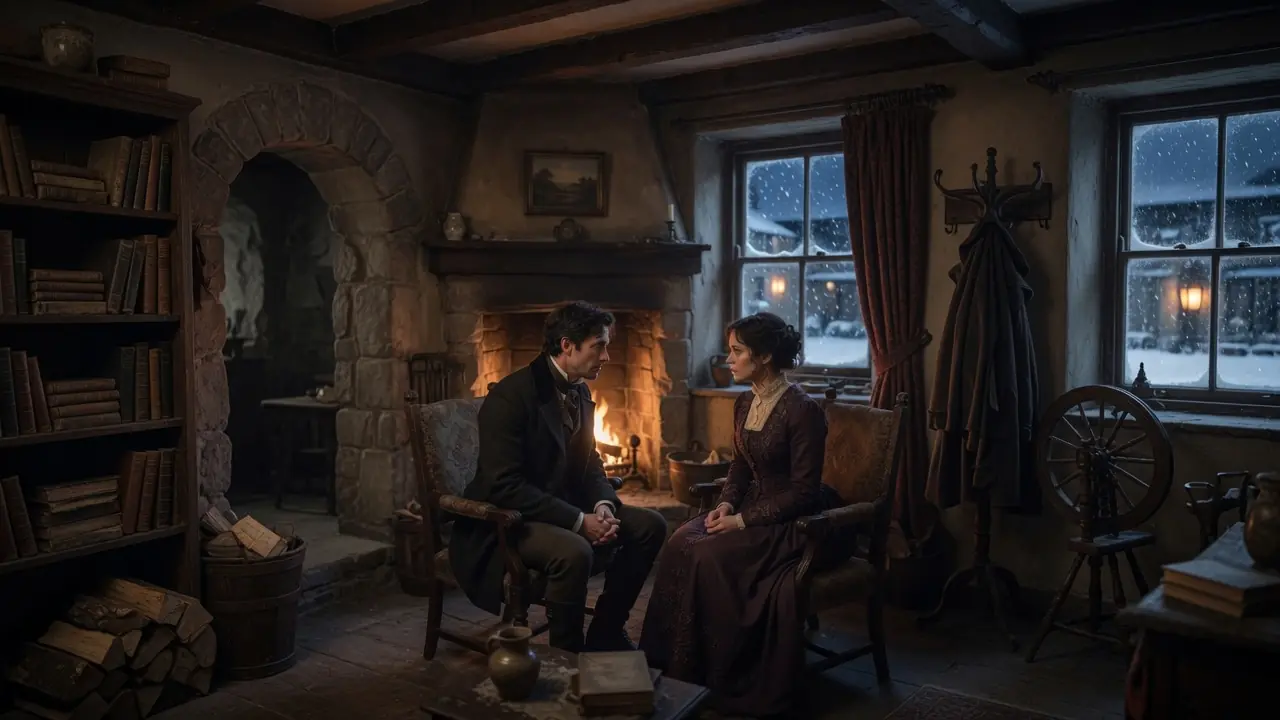
It was a different face than the one she had been looking past for three years. "I know," he said quietly, "that my timing was convenient, and I know that you had good reason to doubt the convenience. I am not telling you that you were wrong to refuse me." He held her gaze. "I am telling you that you were wrong about why I asked."
The snow came down outside the single window of the room. The fire burned between them. She thought about three years of shared rooms with carefully maintained distance, and the boundary dispute, and the hedgerow management, and the things she had not allowed herself to think about directly since that Tuesday in March. She thought I was not entirely right. She thought I was not entirely wrong.
She thought I do not know what to do with that in a coaching inn room in the snow at eleven o'clock at night. "It is late," she said. "Yes." "We should sleep." "Yes."
Neither of them moved. They talked until three o'clock in the morning, not about the refusal. They did not return to it. It had been said, and it sat between them with the specific gravity of a thing that has been named and is no longer pretending to be something else. And neither of them needed to press it further that night.
They talked about other things. She told him about the estate, the real version, the one she did not tell anyone. Not the recovery narrative she deployed in company, but the actual accounting of the four years. The mornings she had sat with the ledgers and felt the specific heavy anxiety of someone responsible for something they were not certain they could manage. The tenants who had doubted her, and the tenants who had not, and the difference between them.
And what the difference had told her about people. He listened in a way she had not expected. Not the listening of someone waiting to offer a solution. The listening of someone who was actually following, and found what they were following worth following. He told her about his own estate in return.
The things that were working and the things that were not. And the tenant family in the North Field whose situation had been worrying him since September. He talked about it with the unguarded specificity of a man who has stopped performing competence and is simply describing a problem. She had questions. He answered them.
She had a suggestion about the North Field tenant that came from something she had dealt with on the Vane estate two years ago. And he listened to it properly and said, "That is better than anything my steward has proposed." "Your steward," she said, "is not particularly inventive." "No." "He is thorough, which is most of what I need."
"You need both." "Most people do not have both." "No," she agreed. "But you could develop the inventive yourself with sufficient information." He looked at her in the firelight.
"Is that what you did?" "By necessity." She tucked her feet up under her in the chair, which was not entirely proper, and which she did anyway because it was three o'clock in the morning and propriety had its limits. "When there is no one else to think of the thing, you think of the thing. Eventually, it becomes a habit."
He was quiet for a moment. "You have been doing this alone," he said. Not quite a question. "Yes." "Four years."
"Yes." "Is there no one" He stopped himself, started differently. "Your cousin in Bath" "is in Bath." "Your mother's family" "have their own difficulties." She looked at the fire.
"I am not complaining. I am simply describing." "I know," he said. "I know you are not complaining." He said it with a certainty that surprised her.
The certainty of someone who had been paying closer attention than she had known. "You are not a person who complains," he said. "You are a person who assesses. The assessment is different from the complaint, even when the content is the same." She looked at him across the fire.
"That is a very accurate observation," she said. "I have had three years to observe." "You have spent three years not looking at me." "I have spent three years," he said carefully, "looking at everything else when you were in the room. That is not the same as not looking."
The fire burned lower. She reached over and added another log without getting up because the fire and the chairs were arranged in a way that made it possible, and she had spent four years developing the habit of doing the practical thing without ceremony. He watched her do this. "The boundary dispute," he said. "The boundary dispute."
"I have been making it worse than it needs to be." She considered how to respond to this. "Yes," she said finally. Because he had been honest and it deserved honesty back. "I know I have."
He settled back in the chair. "I told myself I was being precise about the property law. I was being precise about the property law, but that was not the only reason." "No." "The reason was that it was the only legitimate way I had to" He stopped.
"to continue being irritated with you in an official capacity." Something happened in her chest that was not quite a laugh, but was close to it. "That is remarkably honest." "It is a remarkably honest hour of the night." She looked at the window where the snow was still falling in the dark, quieter now, the heavy dump of it easing into something gentler.
"I should not have said what I said," she told him. "After" "when you asked for an explanation." He was still. "I should not have implied it would not change the answer," she said. "The answer might have been the same, but the reason I gave" "that it would not be improved by the telling" "that was cowardice dressed as composure."
He turned to look at her. "I was frightened," she said. "The estate was in pieces. My father had just died. And you" She kept her eyes on the window.
"You asked me something I wanted to say yes to. And I was frightened of why you were asking. And I could not manage both the fear and the wanting. And so I managed the fear and let the wanting go." The room was very quiet.
"You wanted to say yes," he said. "I wanted to say yes." He breathed in, out. "Margaret," he said. She looked at him.
It was the first time in three years that he had used her given name. "We have wasted three years," he said. "Yes." "Because of my pride and your fear and neither of us saying the true thing." "Yes."
He stood. Not quickly, with the deliberate quality of someone who has made a decision and is enacting it with full intention. He crossed to her chair and stood before her and looked down at her with the unmanaged, honest face she had been seeing all evening and had been slowly understanding as the real one. "I am going to ask you again," he said. "Not tonight, not here, in a coaching inn in the snow at three o'clock in the morning.
I am going to ask you properly when we are home with full information and nothing forced by circumstance." She looked up at him. "But I want you to know," he said, "that I am going to ask so that you are not surprised and so that you have time to" "so that the fear has time to be a smaller thing than the wanting." She held his gaze. "All right," she said.
"All right?" "All right," she said again. "Ask me properly when we are home." He nodded once. He went to his chair, she went to hers.
The fire burned low. Outside, the snow eased toward morning. Neither of them slept for some time, but it was a different kind of not sleeping than the three years had been. Not the wakeful, unresolved not sleeping of two people who had been managing something that refused to be managed, but the quiet, forward-looking not sleeping of two people who had said the true thing and were now waiting with some patience and some impatience in roughly equal measure for what came next. The road was passable by eight o'clock in the morning.
They came downstairs to find the inn's common room full of the cheerful disorganization of stranded travelers preparing to depart. And they ate breakfast at a small table by the window with the snow-bright morning coming through it. And they talked about the eastern drainage channel with the practical ease of two people who had established, somewhere between midnight and three o'clock, that practicality between them was not a retreat from something but a foundation for it. The carriage came at half past eight. On the road back, the countryside was transformed.
Every fence and hedgerow and bare branch carrying its weight of snow. The world reduced to white and gray and the particular still quality of a morning after a storm that has exhausted itself. She sat across from him as she had on the way there. The distance felt different. "The eastern channel," she said.
"I have a plan for it. I would like your steward to see it before I begin because the work on your side needs to happen first or mine will be redundant." "I can arrange that." He was looking at the countryside. "Next week?"
"Next week is fine." "Tuesday, before the Alderton dinner." She noted that he had used the Alderton dinner as a reference point, as something they were both attending, which they always were, which they had always navigated with such careful separation. The using of it as a shared marker felt like something. "Tuesday," she said.
They reached the fork in the road where their properties diverged, Pembroke to the right, Vane Hall to the left. The carriage slowed. He looked at her. She looked at him. "Three years," he said.
"Yes." "We were both very stubborn." "Extremely." "And very foolish." "Considerably."
Something moved across his face, the beginning of a smile still unfamiliar on him, still the thing she was learning to read. "I find that knowing the cause does not make it significantly less embarrassing." "No," she agreed. "It does not." The carriage had stopped at the fork waiting for direction.
He did not give the direction yet. "Tuesday," he said. "Tuesday," she said. He gave the direction. The carriage moved left toward Vane Hall.
He was traveling further out of his way to see her home first. She noticed this. She did not comment on it. But she looked out the window at the snow-covered countryside and thought about a coaching inn and a fire and 3 hours of saying the true thing, and she thought, "Tuesday is four days away." She thought, "four days is manageable."
She thought, "I have managed three years. four days is nothing." She arrived home. She went inside. She stood in the entrance hall of Vane Hall for a moment, still in her damp coat, and breathed.
four years of managing alone and three years of managed distance and one night in a coaching inn in the snow and something that had been wound tight in her chest for all of it had, somewhere between midnight and 3 in the morning, come loose. Not resolved, not finished, not the neat conclusion of something, but the beginning of something. She went to find Mrs. Harding, the housekeeper, who needed to know she had arrived safely and the estate accounts, which needed her attention, and the list of things requiring management that was always waiting. She managed them, but she managed them differently than she had the day before, with the specific, grounded quality of someone who knows that Tuesday is coming and that Tuesday is the beginning of something that has been waiting three years to begin.
four days. She could wait four days. He came on Tuesday at ten in the morning, which was earlier than the stated time for the drainage meeting, and she was in the kitchen garden when he arrived because she had been awake since 6 and the kitchen garden was where she went when the waiting had made her restless. Mrs. Harding showed him through.
He appeared at the kitchen garden gate in his outdoor coat, the morning bright and cold around him, and looked at her with the expression she was still learning, the unmanaged one, the one she had only seen clearly for the first time 4 nights ago. "You are early," she said. "I know." He came through the gate. "The drainage can wait 20 minutes."
She set down the trowel she'd been using on absolutely nothing in particular and looked at him. He crossed the garden. He stopped in front of her. "I said I would ask you properly," he said. "When we were home."
"Yes." "We are home." "Yes." He looked at her in the winter morning light with the direct, clear attention of a man who had spent three years not looking at her and had decided that the not looking was finished. "I'm not going to make it complicated," he said.
"three years ago I asked you and I asked you badly and the timing was wrong and the understanding between us was wrong and everything about it was wrong except the asking itself. And the asking was right. And I would like to try it again." She looked at him. "You are not going to ask me to marry you in the kitchen garden."
"I absolutely am." "It is twenty degrees and there is frost on the ground." "I am aware." He did not waver. "Miss Vane, Margaret, I have been in love with you for longer than I knew what to call it and I have wasted three years being too proud to admit it and I would very much like to stop wasting time if you are willing."
She was quiet for a moment. The frost glittered on the kitchen garden beds around them. A robin was doing something in the far hedge that involved a great deal of noise for a small bird. She said, "You told me 4 nights ago that you looked at everything else when I was in the room because looking at me directly was too because you could not manage it." "Yes."
"I have been doing the same thing," she said. "Looking at everything else for three years." "I know." "I did not know you knew." "I suspected."
A pause. "The hedgerow management." "You know more about my hedgerow management than anyone has a reason to know about a neighbor's hedgerows unless they are paying close attention." She looked away briefly. Back.
"Yes," she said. "Yes, you have been paying attention or yes yes to the question you are actually asking," she said. "The one you have been building toward for the last four days." He breathed. A long, slow breath that left a small cloud of vapor in the cold air.
He took her hands, which were cold from the garden and bare because she had taken her gloves off to use the trowel, and held them with the careful, deliberate warmth of someone making a decision about how to hold something. "Then we are agreed," he said. "We are agreed." "Finally." "Extremely finally."
He smiled, the full version, not the careful fraction she had been seeing for years. It transformed his face entirely and she thought, "I have been looking at the wrong thing for three years. I have been looking at the management and missing the face underneath it." She thought, "I am going to look at the right thing from now on." She let him hold her hands in the frost of the kitchen garden and thought about a coaching inn and the boundary dispute and three years of looking at everything else.
And she thought, "Here we are. Here, finally, we are." The eastern drainage channel was cleared in March. It took both sides of the boundary working in coordination, which was the first time in the history of the boundary dispute that both sides had worked in coordination. And the result was that the lower field stopped flooding and stayed stopped, and the tenant on the Pembroke side, who had been losing crops to the waterlogging for four years, came to James with the expression of a man who has received something he had stopped expecting and said, "It is fixed."
James said, "Yes." The man said, "How?" James said, "We talked to each other." The man looked at him with the slight bewilderment of someone who has found the solution disappointingly simple. Margaret, who was standing three feet away reviewing the finished work, said without looking up from her notes, "It turns out most boundary disputes resolve the same way."
The man looked at her. He looked at James. He said, "You married her." James said, "I did." The man nodded slowly as though assembling a picture.
Then he said, "Good. She knows what she is doing." He walked away. Margaret looked at James. James looked at Margaret.
"He is not wrong," he said. "He is often not wrong," she said. "He is one of the better farmers on either property." "I know. You told me in December."
"You should have known before December." "I know more than I did before December." He came to stand beside her and look at the cleared channel, which was running properly for the first time in four years, carrying the water away from the low fields toward the river in the natural, correct way that it had always been supposed to. "I have a very good source of information now." She looked up from her notes.
"Are you calling me a source of information?" "A primary source. That is not romantic. It is accurate." She gave him the look, the direct, unimpressed one, which he had learned in the months since the coaching inn was not actually unimpressed at all, but was something it had taken him three years and one snowed-in night to understand correctly.
It was the look she gave things she found worth looking at. He found this enormously reassuring every time. "The Northfield tenant," she said, "the Hargrove family. You said their situation had been worrying you since September. It has been addressed."
He had addressed it in January using the approach she had described in the coaching inn. It worked. "Good." She made a note. "I thought it would.
You were right." "I am frequently right." "I know," he said. "It is one of the things I find most valuable about you." She looked at him.
He looked back with the steady, honest attention that was, she had understood this finally, properly, simply how he looked at things he loved. He had been looking at her that way for three years, and she had been calling it something else. She had stopped calling it something else. She looked at the drainage channel running clear and clean in the March morning and thought about a coaching inn and a fire and a question asked three years too late and three years of wasted time that had become, in the accounting of it, not entirely wasted. Because they had arrived at the coaching inn as two people who had spent three years learning each other at a distance, which meant they had arrived already knowing the important things, and the night had only needed to do the work of admitting what was already known.
She thought the knowing was always there. She thought we were just looking at everything else. She tucked her notebook under her arm and looked up at the March sky, which was the particular pale blue of early spring, cold still, but not winter cold, the cold of a world deciding to become something else. He was still beside her. He was always beside her now.
She thought three years. She thought we were very foolish. She thought I am glad we ran out of options at a coaching inn and not somewhere with more choices, because with more choices, we might have chosen differently, and differently would have been wrong. The field ran clear. The season turned.
They walked back to the house, her house now, their house. The boundary between the properties redrawn to include both of them. And the morning went on around them, practical and ordinary and entirely sufficient. It was, she thought, exactly right. It was, she thought, worth the three years.
Not the wasting of them, the arriving here, together, finally.