Rain came down so hard that night it made the whole town sound hollow.
It hit the roof of Millie’s Star Diner in sheets, rattling the old metal awning above the front windows and turning the parking lot into a dark mirror of headlights, neon, and running water. Thunder rolled over the highway every few minutes, low and heavy, the kind that made coffee cups tremble in their saucers if you were paying attention.
Most people inside were not paying attention.
They had already made their peace with the storm. Truckers leaned over plates of meatloaf. A young couple shared fries in the corner booth. Two deputies sat near the register with wet shoulders and tired eyes. The radio behind the counter crackled between old country songs and static every time lightning flashed beyond the glass.
Millie Harper, who owned the diner and had worked behind that counter since before half the town learned to drive, wiped down the same clean spot for the third time and watched rain race sideways across the windows.
“Road’s going to flood near County Line Bridge,” she muttered.
Nobody answered.
They were used to Millie predicting trouble. The thing about Millie was, she was usually right.
Outside, a semi rolled past on the highway, throwing water high into the air. Its lights blurred red and white through the rain. For a second, the diner windows glowed like they were underwater.
Then the front door opened.
Not all at once.
Slowly.
The old bell above it gave one weak, trembling ring.
Every head near the counter turned.
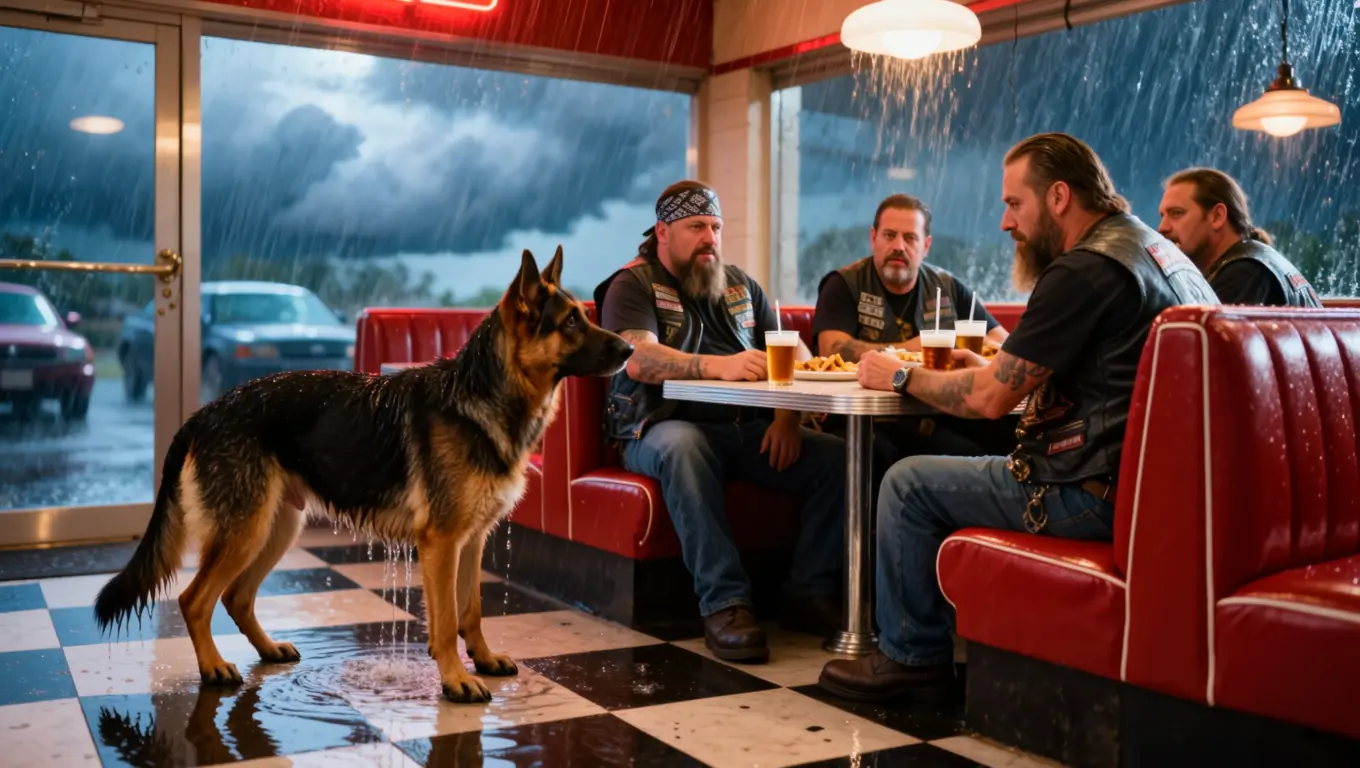
At first, all anyone saw was rain and darkness beyond the doorway. Then something large stepped inside, and water began dripping onto the shiny tiled floor.
It was a German Shepherd.
Soaked to the bone.
The dog stood just inside the entrance with its head lowered, sides heaving, ears pinned halfway back from exhaustion. Rainwater streamed from its coat. Its paws left dark prints on the pale floor, one after another, like it had walked through miles of mud before reaching that door.
For a moment, nobody moved.
Millie stopped wiping the counter.
The deputies looked up.
A waitress named Clara, holding a pot of coffee, froze mid-step between two booths.
The dog did not bark. It did not shake itself dry. It did not sniff around for dropped food or look for a friendly hand. It simply stood there, breathing hard, eyes moving across the room as if searching for something specific.
Then it walked forward.
Heavy paws echoed down the center aisle.
Conversation thinned, then faded entirely.
The German Shepherd moved past the front booths, past the pie case, past the register. A boy near the window pulled his feet up onto the seat. His mother reached for his arm, but she did not scream. Something about the animal did not feel wild.
It felt urgent.
Almost human in its focus.
At the back of the diner, four middle-aged bikers sat at a round table beneath a faded sign that read BEST PIE ON ROUTE 19.
They were not the kind of men people looked at twice unless they had a reason.
They had gray in their beards, scars on their hands, road dust dried into the seams of their leather cuts. Their motorcycles were parked outside under the flickering neon sign, four big machines shining with rain and chrome. The patches on their backs read IRON CREEK RIDERS, a name that meant different things to different people depending on which stories they had heard.
To some, they were trouble.
To others, they were the men who fixed a widow’s porch without charging her, escorted veterans to funerals, and once rode eighty miles to return a runaway teenager to his grandmother.
Their names were Wade Mercer, Calvin Briggs, Jesse Pike, and Amos Trent.
Wade was the quiet one. Big-shouldered, fifty-six, with a silver beard and eyes that had seen too many roadside crosses. Calvin was bald, broad, and always looked angry even when he was trying to be kind. Jesse had long hair tied at the back of his neck and a laugh that could fill a room. Amos was the oldest, nearly sixty-three, thin as a fence rail, with one bad knee and a habit of noticing everything.
They were halfway through dinner when the dog stopped in front of their table.
Forks froze.
Jesse looked from the dog to Wade.
“Well,” he said softly, “that ain’t something you see every Tuesday.”
The German Shepherd stared at them.
Not at the food.
At them.
Its body trembled with fatigue, but it did not sit. Its eyes locked onto Wade first, then moved to Calvin, then back again. The dog took one more step and lowered its head as if presenting something.
That was when Amos noticed the object hanging from its collar.
“Hold on,” he said.
The others leaned in.
A small waterproof pouch had been tied to the dog’s collar with red cord. It was soaked, dirty, and swinging against the dog’s chest. Beneath the clear plastic, something pale was folded inside.
A note.
The room had gone so quiet that the rain seemed louder than before.
Millie came around the counter slowly.
“Is that somebody’s dog?”
Nobody answered.
Wade pushed his chair back with care. He did not reach fast. Men who had lived around animals knew better than that. He lowered one hand near the dog’s nose and waited.
The German Shepherd sniffed him once.
Then, in a motion that made several people gasp, the dog pressed its wet forehead against Wade’s palm.
Wade’s expression changed.
It was small, but Amos saw it.
“Easy,” Wade murmured. “Easy, boy.”
The dog gave a low whine.
Wade looked at the collar. There was a name stamped into the leather, though the letters were half-covered in mud.
RANGER.
Calvin frowned. “That’s a working dog name.”
Wade untied the pouch with thick fingers. The red cord had swollen from the rain and did not want to loosen. He worked at it patiently while the dog stood still, shaking so hard water dripped from its belly in a steady rhythm.
When the pouch finally came free, Wade opened it.
Inside was a folded sheet of notebook paper.
The ink had bled a little, but the words were still readable.
Wade read the first line.
Then his face went still.
“What is it?” Jesse asked.
Wade did not answer.
He read the whole thing once, then again, like he was hoping the words might change if he gave them time.
Calvin reached for the paper. “Wade.”
Wade handed it over.
Calvin read it aloud, his voice rougher with every line.
“My name is Lily Mae Carter. I am nine years old. If Ranger found people, please help. My mom is hurt. The car went off the road near the old quarry bridge. My little brother won’t wake up. I can hear water. Please don’t leave us. Ranger knows the way.”
Nobody spoke.
The diner seemed to forget how to breathe.
Clara set the coffee pot down so hard it clinked against a plate.
Millie pressed one hand to her mouth.
One of the deputies, Officer Dale Reeves, stood so quickly his chair scraped backward across the tile. “Old quarry bridge?”
His partner, a younger deputy named Sam Norwood, was already reaching for his radio.
“That road’s been closed since last month,” Sam said.
“Not closed enough,” Millie whispered.
The dog whined again.
Then it turned toward the door.
Wade saw it immediately.
“He wants to go back.”
Ranger took two steps toward the entrance, then looked over his shoulder at the bikers. Rain blew in through the gap beneath the door, carrying cold air across the floor.
Officer Reeves spoke into his radio, giving location details, requesting rescue, ambulance, fire, anyone who could get through the storm. Static snapped back at him. The storm was eating half the signal.
“Dispatch says County Line is flooding,” he said. “They’re sending units, but the roads are a mess.”
“How long?” Wade asked.
Reeves looked at the note in Calvin’s hand.
“Too long if that car’s taking water.”
Ranger barked once.
Sharp.
Desperate.
The sound cracked through the diner like a command.
Wade looked at his brothers.
No speeches passed between them. They had ridden together too long for that. They knew the look. They knew the math. Rain, bad roads, a child’s handwriting, a dog too exhausted to stand and still willing to run.
Calvin was already pulling cash from his wallet and dropping it on the table.
Jesse grabbed his jacket.
Amos took one last swallow of coffee, grimaced, and stood carefully on his bad knee.
Millie stepped in front of them. “You are not taking motorcycles out in this.”
Wade picked up his helmet from the booth beside him.
“Then we better not waste time arguing.”
Officer Reeves turned toward him. “Mercer, don’t do something stupid.”
Wade looked down at Ranger, who had gone to the door and was pawing at it now.
“Stupid would be sitting here.”
The whole diner watched as the four bikers headed for the storm.
Then something unexpected happened.
Clara pulled off her apron.
“I know that road,” she said. “My uncle farms near the quarry. There’s a service lane before the bridge. Trucks can’t get through if it’s washed out, but bikes might.”
Millie turned on her. “Clara Lynn, you have lost your mind.”
“Maybe,” Clara said, grabbing her raincoat from a hook. “But I can point.”
Officer Reeves cursed under his breath.
He looked at Sam.
Sam looked at the radio, then at the dog, then toward the door.
“We’ll follow in the cruiser as far as we can,” Sam said.
Reeves nodded once. “Everybody else stays here. If rescue calls back, tell them we’re moving toward Quarry Road.”
Millie snatched a stack of towels from beneath the counter and shoved them into Jesse’s arms.
“For the kids,” she said.
Her voice broke on the last word.
Outside, the storm hit them like a wall.
Rain slapped Wade’s face the second he stepped under the awning. The parking lot was ankle-deep in water near the curb. The neon sign buzzed overhead, turning the rain red, then white, then red again.
Ranger bounded toward the motorcycles, slipped once, recovered, and looked back.
Wade pointed to his bike.
“Up.”
The German Shepherd hesitated only a second.
Then he jumped onto the sidecar attached to Amos’s old bike. It was not meant for a dog that size, but Amos had used it for supply runs and once for a rescued goat, so nobody questioned it. Jesse wrapped one of Millie’s towels around Ranger’s body, not to dry him, but to keep him from sliding.
“Good boy,” Jesse said.
Ranger’s eyes stayed on the road.
Clara climbed behind Calvin, her arms tight around his jacket. Deputy Reeves and Sam pulled out behind them in the cruiser, lights flashing blue and red through the rain.
They left the diner in a roar of engines and water.
Inside, everyone crowded near the windows.
Millie stood with one hand on the counter and the other over her heart.
She had seen plenty of strange things in that diner. Fights. Proposals. Runaways. Men crying over coffee at two in the morning. But she had never watched a dog deliver a note from a child and lead bikers into a storm.
Route 19 was nearly empty.
The rain turned the road slick and shining. Water ran across the lanes in fast, shallow streams. Wade rode in front, his headlight cutting through the storm. Amos followed with Ranger in the sidecar, the dog braced against the turn, nose lifted, ears pinned back.
Every few minutes, Ranger barked.
Not randomly.
At turns.
At roads.
At places where the riders had to choose.
Clara leaned close to Calvin’s ear and shouted directions over the engine. “Left ahead! Past the grain silo!”
They turned onto a narrower road where the pavement broke into patches. The cruiser followed, tires hissing. Tree branches whipped in the wind. Mud splashed up from the shoulder.
Wade kept his speed steady.
Fast enough to matter.
Slow enough to stay alive.
After six miles, they reached the first flooded dip in the road. Water rushed across from a swollen drainage ditch, brown and angry, carrying branches and gravel.
Wade stopped.
The others pulled in behind him.
Deputy Reeves stepped out of the cruiser with rain running off his hat. “That’s too deep for the car.”
Ranger stood in the sidecar and barked toward the far side.
Amos looked at the water.
Then at his old bike.
“Sidecar’s heavy enough,” he said. “Might hold.”
Wade shook his head. “No. We walk it.”
The four men climbed off their bikes. Together, they pushed Amos’s motorcycle through first, boots sliding against the pavement beneath the water. Ranger jumped out and swam halfway, then scrambled up the far bank, shaking violently before barking again.
Clara crossed with Calvin, gripping his arm.
The water hit her thighs and nearly took her down, but Calvin held her like a post planted in the ground.
The cruiser stayed behind.
Reeves shouted, “We’ll radio from here! Go!”
Wade raised a hand, then mounted again.
The storm swallowed the cruiser lights behind them.
Quarry Road was worse.
The pavement narrowed. Trees pressed close. The old quarry had been abandoned for fifteen years, but the road still curved through the hills where trucks once hauled stone. In daylight it was rough. At night, in rain, it was a black ribbon sliding along steep ground.
Ranger ran now.
Not in the sidecar.
On the road ahead of them.
Every so often, he vanished in rain and darkness, then reappeared in the headlights, looking back to make sure they were following. His body was exhausted, but some deeper engine kept him moving.
Wade watched him and felt an old ache open in his chest.
Years ago, before the club, before the gray in his beard, Wade had been a paramedic for eight months. Not long. Long enough. He quit after a wreck outside Tulsa where a mother survived and her two children did not. People told him he was too sensitive for the job, which made him laugh because nobody had called him sensitive before or since.
The truth was simpler.
He could not learn how to leave screams behind.
So he became a welder, then a rider, then a man who did good things quietly and bad things loudly enough that people remembered the wrong ones.
Now a wet dog was leading him toward a child’s note, and the past was riding with him whether he wanted it or not.
Ranger stopped suddenly.
He stood at the edge of a curve where the guardrail had been smashed open.
Wade braked hard.
The others stopped behind him.
At first, they saw nothing except rain, trees, and broken metal.
Then lightning flashed.
For one white second, the ravine below appeared.
A car lay at the bottom, half-hidden by brush and rising water.
Its rear end was tilted up against a tree. Its front was down near the swollen creek that ran beneath the old quarry bridge. One headlight still glowed weakly under the rain, pointed at nothing.
Ranger began barking so hard his whole body shook.
“There!” Clara screamed.
Wade was already off his bike.
The drop was steep, muddy, and dangerous. Water ran down the slope in little rivers. The broken guardrail hung twisted outward like a torn rib.
Calvin grabbed rope from his saddlebag. Jesse pulled a flashlight from his jacket. Amos took the towels and emergency blanket from the sidecar.
Wade looked down.
A small face appeared in the cracked rear window.
A girl.
Pale.
Terrified.
She slapped one hand against the glass.
Wade’s breath caught.
“Lily!” he shouted. “Lily Mae!”
The girl’s mouth opened, but the storm swallowed her voice.
Ranger tried to scramble down the slope.
Jesse caught his collar. “No, buddy. Let us.”
Wade tied the rope around his waist.
Calvin wrapped the other end around the remaining guardrail post and braced himself with both boots in the mud.
“I’ve got you,” Calvin said.
Wade looked at him.
“I know.”
Then he went over the edge.
Mud gave beneath his boots almost immediately. He slid the first ten feet, catching himself on roots and stones, rain blinding him, shoulder slamming into the slope. The rope tightened around his waist. Calvin held.
Jesse came after him with the flashlight.
By the time Wade reached the car, water was already licking at the lower edge of the front doors.
The vehicle was a dark green sedan, crushed hard at the front. A branch had gone through the windshield on the passenger side. The driver, a woman in her thirties, was slumped over the wheel, hair wet across her face.
In the back seat, Lily Mae Carter stared out at him through the cracked glass.
She had one hand pressed against the window.
The other was wrapped around a little boy who lay across her lap.
Wade moved close.
“Lily! My name is Wade. Ranger brought us.”
The girl’s eyes widened.
“Ranger?” she mouthed.
“He’s here,” Wade shouted. “He found us.”
Her face crumpled, but she did not cry. Maybe she had used up all her crying before sending the dog into the rain.
The back door was jammed.
Wade pulled once.
Nothing.
Again.
Nothing.
Jesse reached him, slipping in the mud, flashlight beam shaking across the car.
“Window,” Jesse said.
Wade nodded.
He took the center punch from his pocket. Men like Wade carried tools the way other people carried keys. He pressed it to the rear window corner and hit it with the heel of his hand.
The glass cracked.
He hit again.
The window shattered inward in small safety-glass cubes.
Lily flinched over her brother.
“Good girl,” Wade said. “Keep covering him.”
He cleared the edges with his sleeve, cutting his wrist without noticing. Then he leaned through the window.
The boy was small, maybe four. His lips looked pale in the flashlight. A seat belt was twisted around his jacket. Lily had one arm around him and one foot braced against the door to keep them from sliding as the car shifted.
“My mom won’t wake up,” Lily said.
Her voice was thin and hoarse.
“We’re going to get you out,” Wade said. “Both of you.”
“And Mama?”
“Her too.”
He did not know if that was true.
He said it anyway because sometimes hope had to arrive before certainty.
Jesse passed him a knife.
Wade cut the boy’s seat belt first, then reached in and lifted him carefully through the window. The child’s body was limp but warm.
“Amos!” Wade shouted.
Amos had made it halfway down the slope, one bad knee dragging but refusing to quit. He took the boy from Wade and wrapped him in a towel.
The boy coughed.
Once.
Then again.
It was a small sound.
A whole world fit inside it.
“He’s breathing!” Amos yelled.
Lily began sobbing then.
Not loud.
Just broken little sounds that shook her shoulders.
Wade reached for her. “Your turn.”
She shook her head and looked toward the front seat. “Mama first.”
Water rushed harder against the car.
The front end shifted with a deep metallic groan.
Wade felt the danger in his bones.
“Lily,” he said, making his voice firm. “You get out now, then I get your mama. That is how we help her.”
The girl stared at him.
For one second, he thought she would refuse.
Then she nodded.
He pulled her through the broken window. She was smaller than he expected, all elbows and wet hair and trembling legs. As soon as her shoes hit the mud, Ranger tore free from Jesse and scrambled down the rest of the slope.
The dog reached Lily and pushed his head into her chest.
She wrapped both arms around his soaked neck.
“You came back,” she cried. “You came back.”
Ranger whined and licked her cheek.
There was no time to watch.
Wade turned to the driver’s door.
The woman was pinned.
Her seat belt was locked tight. The steering column had crushed inward. Blood ran from a cut near her hairline, but her chest moved slightly.
Alive.
“Ma’am!” Wade shouted. “Can you hear me?”
No response.
Calvin slid down the slope next, bringing a pry bar from his bike. He landed hard beside Wade, cursed, and shoved the bar into the bent edge of the driver’s door.
“On three,” Wade said.
“One.”
They pulled.
“Two.”
The metal groaned.
“Three.”
The door screamed open six inches.
Not enough.
Again.
Calvin’s arms shook. Wade’s boots slid in the mud. Jesse wedged his shoulder under the frame from behind.
The door opened another foot.
Enough.
Wade cut the seat belt.
The woman slumped sideways.
“Careful,” Amos shouted from above. “Spine, neck!”
“I know,” Wade snapped, though he was not angry at Amos.
He was angry at time.
He was angry at water.
He was angry at every road that took people by surprise and every second that disappeared before help arrived.
They worked together, slow and awkward in the rain. Calvin held the door. Jesse supported the woman’s head and shoulders. Wade freed her legs inch by inch.
The car shifted again.
This time, everyone heard it.
The creek had risen to the front bumper.
“Move!” Calvin shouted.
They pulled her clear just as the front wheels dropped another foot into the rushing water.
The whole sedan slid forward.
Metal screamed against rock.
Wade fell backward with the woman in his arms. Jesse grabbed his jacket. Calvin grabbed Jesse. For one wild second, all three men were slipping toward the creek.
Then the rope tightened.
Above them, Amos had looped the line around his body and fallen backward into the mud, using every pound he had left to hold them.
The car broke free.
It slid nose-first into the swollen creek and rolled halfway onto its side, water swallowing the front seats where the woman had been seconds earlier.
Lily screamed.
Ranger barked.
Wade lay in the mud, breathing hard, the woman still against his chest.
“She’s out,” Calvin said.
His voice shook.
“She’s out.”
They carried her up the slope in pieces of effort: five feet, stop, breathe, adjust, pull. Clara stood at the top, soaked through, directing emergency crews by phone after finally finding a small pocket of signal. In the distance, sirens began to rise beneath the thunder.
By the time rescue trucks reached the road, Lily and her brother were wrapped in blankets beside Amos’s sidecar. Ranger sat pressed against Lily’s legs, refusing to move more than an inch away from her.
The little boy, whose name was Noah, had opened his eyes.
He cried weakly when a firefighter checked him, which made every adult nearby look relieved.
Their mother, Grace Carter, was unconscious but breathing. Paramedics loaded her carefully, speaking in quick, practiced voices. Wade stepped back, hands muddy, wrist bleeding, rain still running down his face.
Lily would not let go of Ranger.
A paramedic tried to guide her toward the ambulance.
She looked back at Wade.
“You read my note?” she asked.
Wade nodded.
“Ranger found you?”
“He walked right into a diner full of people and picked the ugliest table in the place,” Jesse said.
Lily looked confused.
Calvin grunted. “He means us.”
For the first time that night, Lily almost smiled.
Then her face changed.
“I didn’t know if he would understand.”
Wade crouched in front of her.
“He understood enough.”
Lily touched Ranger’s wet head.
“Mama said if anything bad ever happened, Ranger would find help. She trained him when Dad was still alive. He used to be a search dog.”
Wade looked at the German Shepherd.
That explained the focus.
The pathfinding.
The way he ignored food, noise, fear, and warmth because a job had been given to him.
“What happened?” Wade asked gently.
Lily swallowed.
“A deer ran out. Mama swerved. The road was gone. We fell.” Her lower lip trembled. “Noah wouldn’t wake up, and Mama wouldn’t wake up, and the water kept getting louder.”
“So you wrote the note.”
She nodded.
“With my school pencil. I had a plastic pouch from my field trip. I tied it to Ranger.”
Her face twisted.
“I told him to find people.”
Wade looked toward the road, toward the miles of storm between the ravine and the diner.
“He did.”
Lily leaned forward and wrapped her arms around his neck before he could prepare for it.
Wade froze.
Then, carefully, he hugged her back.
She was shaking.
So was he.
“Thank you,” she whispered.
Wade closed his eyes.
For a second, he was not in the rain on Quarry Road. He was back beside another wreck years ago, holding a different child he could not save, hearing sirens arrive too late in his memory even though nobody had blamed him but himself.
This time, a child was alive in his arms.
This time, the story had not ended at the roadside.
He opened his eyes and let her go.
“Thank Ranger,” he said, voice rough. “We just followed.”
The ambulances pulled away first.
Deputy Reeves arrived with another unit after the water dropped enough for them to pass the flooded dip. He looked at the smashed guardrail, the muddy bikers, the dog, the rope burns on Calvin’s hands, and Wade’s bleeding wrist.
For once, he did not start with a warning.
“You boys all right?”
Jesse looked down at himself, covered head to boot in mud.
“I was prettier at dinner.”
Reeves shook his head.
“You were never pretty.”
That broke something open.
Calvin laughed first. Then Amos. Then Clara, who was crying so hard her laugh came out crooked.
Wade did not laugh.
Not then.
He stood near Ranger, who watched the ambulance lights fade into the rain with a worried stillness.
“She’ll be okay?” Wade asked.
Reeves exhaled.
“They’re alive. Tonight, that’s the miracle we got.”
They rode back to the diner close to midnight.
The storm had weakened by then, though rain still fell in cold strings across the highway. Millie’s Star Diner glowed in the dark like a place that had been waiting with its breath held.
Every customer who had stayed rose when the door opened.
Wade entered first, muddy and bleeding.
Calvin came next, carrying Clara’s ruined raincoat.
Jesse limped in with a torn sleeve.
Amos followed slowly, one hand on the doorframe and the other on Ranger’s collar.
The German Shepherd stepped inside and stopped in the same place where he had first stood hours earlier.
This time, the diner erupted.
Not loud at first.
People were too emotional for that.
A woman began crying. Someone clapped once, then stopped, then clapped again. The deputies who had stayed behind stood straight. Millie came around the counter with towels, coffee, and a face that looked ten years older than it had before they left.
“Children?” she asked.
“Alive,” Wade said.
Millie pressed both hands to her mouth.
“Mother?”
“Alive.”
The whole diner seemed to exhale.
Ranger sat down.
Finally.
His body gave out as if permission had been granted. He lowered himself onto the tile, rested his head on his paws, and closed his eyes while water pooled beneath him.
Millie knelt beside him with a towel.
“You brave old thing,” she whispered.
Ranger opened one eye and sighed.
Someone brought hamburger patties from the kitchen. Someone else found a bowl for water. A trucker took off his dry flannel shirt and laid it over the dog like a blanket.
Ranger did not move except to breathe.
Wade sat in the back booth again.
His plate was still there, cold and untouched.
The pinkish gravy had hardened at the edges.
He stared at it for a while.
Then he took the folded note from his vest pocket.
The paper had dried some, wrinkled and soft now. Lily’s handwriting leaned downhill across the page. The words were simple. Terrified. Brave.
Please don’t leave us.
Wade read that line again and again.
Amos slid into the booth across from him.
“You did good.”
Wade did not answer.
Amos waited.
He had known Wade longer than anyone at that table. Long enough to know that silence was sometimes the only door Wade could open.
Finally Wade said, “Dog did good.”
“Dog did his part. You did yours.”
Wade folded the note carefully.
“I almost didn’t go fast enough.”
Amos’s face hardened.
“Don’t start that.”
Wade looked toward Ranger sleeping by the counter.
“There was another wreck years ago.”
“I know.”
“You don’t know all of it.”
“I know enough.”
Wade’s jaw worked.
Amos leaned forward.
“Listen to me. There are nights that take something out of a man and never give it back. I know that. But tonight gave something back. Don’t insult it by turning it into another punishment.”
Wade stared at him.
The words struck harder because Amos rarely wasted them.
Across the diner, Millie poured coffee into mugs nobody had ordered. Clara sat wrapped in a blanket near the pie case while Calvin told her she was insane and brave in the same sentence. Jesse was showing a little boy the tear in his jacket like it was a battle scar.
Ranger slept through all of it.
For the first time in a long time, Wade felt the old scream inside him quiet down.
Not disappear.
Just quiet.
Three days later, Millie taped a newspaper article beside the cash register.
LOCAL DOG LEADS RESCUERS TO FAMILY TRAPPED AFTER CRASH.
The picture showed Ranger sitting outside the animal clinic, one ear up, looking annoyed by attention. Beside him stood Lily Mae Carter with one arm around his neck. Noah sat on her other side holding a stuffed dinosaur. Grace Carter was still in the hospital when the photo was taken, but the article said she was awake and expected to recover.
The story spread faster than anybody expected.
People came into the diner just to see the table where Ranger had stopped. A woman from two towns over brought homemade dog biscuits. A man dropped off a new collar with brass letters spelling RANGER. Children drew pictures of the German Shepherd wearing a cape, which Ranger probably would have hated if he understood art.
The Iron Creek Riders hated the attention nearly as much as he did.
Wade refused three interviews.
Calvin told one reporter, “We followed the dog. Write that.”
Jesse said he would talk only if they mentioned Millie’s coconut cream pie.
Amos simply walked away.
A week after the storm, Grace Carter came to the diner.
She moved slowly, with a brace under her coat and Lily holding one hand as if she were afraid her mother might vanish if released. Noah followed behind them, carrying a toy truck. Ranger walked at Lily’s side, freshly brushed, proud, and still watching every exit.
The diner went quiet when they entered.
Not from fear this time.
From respect.
Wade stood from the back booth.
Grace crossed the room carefully.
She stopped in front of him and looked up.
“You’re Wade Mercer.”
“Yes, ma’am.”
Her eyes filled before she said another word.
“My daughter told me you came through the window.”
Wade glanced at Lily.
“Your daughter did the saving before we got there.”
Grace looked down at Lily, then at Ranger.
“She said that too.”
Noah stepped forward and held up his toy truck.
“You got muddy.”
Jesse, from behind Wade, said, “He always looks like that.”
Noah studied Wade seriously.
Then he nodded, accepting this as fact.
Grace reached into her purse and took out the original plastic pouch. It had been cleaned, but the edges were still scratched. Inside was Lily’s note, now sealed behind clear plastic.
“I wanted you to have a copy,” Grace said. “The original stays with us.”
She handed Wade a folded paper.
It was Lily’s message, rewritten neatly and laminated.
Wade looked at it, then at Lily.
“You sure?”
Lily nodded.
“So you remember Ranger is in charge.”
That made Millie laugh from behind the counter.
Wade looked at the note again.
Please don’t leave us.
His throat tightened.
“I won’t forget.”
Grace touched his arm.
“You gave my children a chance.”
Wade shook his head slightly.
“Ranger gave them a chance.”
Grace smiled through tears.
“Then you were smart enough to listen to him.”
That sentence stayed in the diner long after she said it.
Over the next month, things changed in small ways.
Millie put a brass hook beside the back booth where Ranger’s new leash could hang whenever Lily brought him in. Clara painted a little paw print near the bottom corner of the BEST PIE ON ROUTE 19 sign. Deputy Reeves arranged for a proper barrier near the washed-out quarry road, and this time the county did not take six months to approve it.
The Iron Creek Riders started carrying emergency blankets, rope, first-aid kits, and waterproof flashlights on every ride.
Calvin said it was because Wade had become “annoying about preparedness.”
Wade said nothing.
He just checked every saddlebag twice.
Ranger became a regular at Millie’s, though he never begged and never wandered. He always walked in with purpose, looked around the room, then settled near Lily’s booth where he could see the door.
People joked that he was waiting for another mission.
Maybe he was.
Dogs like Ranger do not stop being what they are just because the world gives them a warm floor.
One evening near the end of summer, after the worst heat had passed and the sky outside turned purple over Route 19, Wade came into the diner alone. He sat at the back table, ordered coffee, and unfolded Lily’s note from his vest pocket.
It was not the original.
Just the copy.
Still, he carried it carefully.
Millie saw him reading it and came over with the pot.
“You ever going to stop looking at that?”
Wade gave a small shrug.
“Maybe.”
“That means no.”
“Probably.”
Millie filled his cup.
“You know, some folks carry things because they hurt. Some carry things because they remind them they’re still useful.”
Wade looked up at her.
Millie smiled sadly.
“I’ve been running this place forty years, Wade. You think you’re the first man to hide a wound under leather?”
He looked back at the note.
Outside, a motorcycle rolled into the lot.
Then another.
Then another.
The Iron Creek Riders parked beneath the neon sign, their engines ticking in the warm evening. Jesse came in first, laughing about something. Calvin followed, scowling at the humidity. Amos walked behind them with his bad knee and his old calm eyes.
A few minutes later, Lily entered with Ranger.
The dog saw Wade and came straight to him.
He rested his head on Wade’s knee.
Wade placed one rough hand between the Shepherd’s ears.
“Evening, boss.”
Ranger sighed.
Lily slid into the booth across from him.
“You coming Saturday?”
“To what?”
“My mom’s doing a thank-you cookout. Ranger is guest of honor.”
Jesse leaned over from the next chair.
“What about us?”
Lily looked at him.
“You can come if you bring pie.”
Calvin pointed at her. “Smart kid.”
Wade looked at Lily, then at Ranger, then down at the folded note.
For years, he had believed the worst nights of a person’s life only left stains.
On memory.
On hands.
On sleep.
On the places nobody else could see.
But sometimes, if the right creature came through the right door at the right moment, soaked to the bone and carrying a child’s desperate handwriting, a night could leave something else behind too.
A road back.
A reason to move.
A reminder that not every scream ended too late.
Later, people would tell the story in different ways.
Some would say a heroic dog saved a family.
Some would say a group of bikers rode into a storm when nobody else could reach the road.
Some would say Lily Mae Carter was the bravest child in three counties for writing a note in the dark and trusting her dog to carry it.
All of those versions were true.
But Millie told it best.
Whenever someone new asked about the framed copy of the note hanging beside the register, Millie would point toward the back booth and say, “That was the night everybody in here learned something.”
Then she would wait for them to ask what.
And when they did, she would look toward the door, where Ranger had once stood dripping rain onto the tile, and say, “Help does not always come wearing a uniform. Sometimes it comes on four paws. Sometimes it comes on two wheels. And sometimes the only thing that saves a life is somebody being willing to follow.”
The note stayed framed by the register.
The booth stayed in use.
The road near the quarry got repaired.
Grace healed slowly.
Noah grew loud again.
Lily never stopped giving Ranger credit.
And Wade Mercer, who had spent years thinking he was a man built mostly from old mistakes, began carrying the laminated note in his vest pocket every time he rode.
Not because it hurt.
Because it reminded him.
When the rain comes hard enough, when the road disappears, when somebody out there is waiting in the dark, you do not have to be clean to answer.
You only have to go.