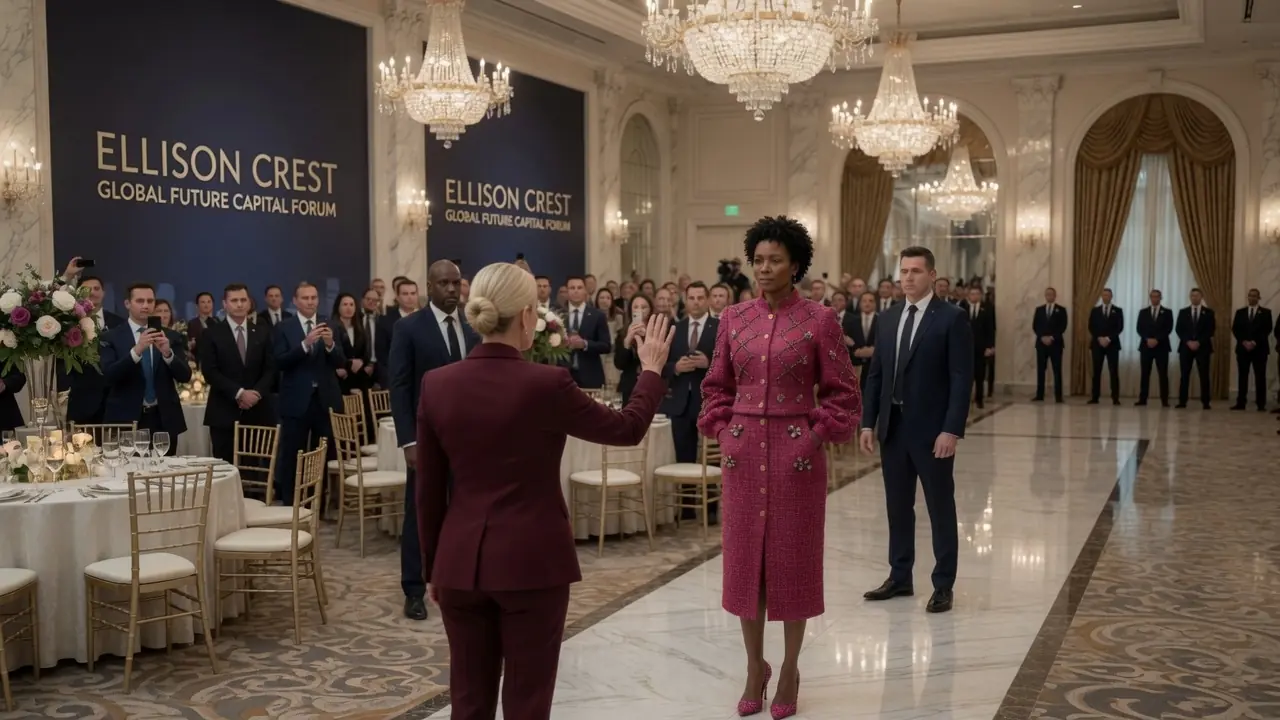
The ballroom had been designed to make wealthy people forget the world could still touch them.
Light spilled from crystal chandeliers across white marble floors. Champagne flutes caught the glow like small golden flames. At every table, executives laughed with the confidence of people who had never been asked to explain why they deserved a seat.
This was not simply an investor summit.
It was a coronation.
The banners across the stage read: Ellison Crest Global — Future Capital Forum.
The company had spent nearly two million dollars on the evening because appearances mattered in finance almost as much as money itself. Cameras waited near the back wall. Business journalists whispered into recorders. Board members sat beneath floral arrangements tall enough to hide private panic.
At the center of the stage stood Margaret Ellison.
She was fifty-one, white, elegant, and sharp enough to cut without raising her voice. Her pale blonde hair was styled into a smooth twist. Her white tailored suit fit like armor. When she smiled, people smiled back quickly, not because she was warm, but because they understood warmth was not required from someone that powerful.
Margaret was the CEO of Ellison Crest Global, a private equity firm that had grown too fast for anyone to question in public.
She was admired in magazine profiles.
Feared in boardrooms.
Quoted at women’s leadership panels.
That evening, she stood beneath the lights, holding a microphone like a scepter, thanking investors for believing in the next era of disciplined expansion.
Then she saw the woman near the back.
The woman was Black, calm, and dressed in a plain midnight-blue gown that did not sparkle under the chandeliers. She had no visible entourage. No photographers circling her. No eager banker leaning in to whisper opportunities into her ear.
She was standing beside the last row of tables, hands folded, watching.
Her name was Simone Avery.
But Margaret did not know that.
Or perhaps, in a worse way, she did not care to know.
To Margaret, the woman looked too quiet to matter.
Too unannounced to be important.
Too composed to be harmless.
Margaret’s smile cooled.
The room noticed before it understood.
She lowered the microphone slightly, then lifted one hand toward the side entrance.
“Security,” she said, her voice smooth enough to pass for courtesy. “Please assist this woman out of the ballroom.”
The music faded beneath the sudden silence.
A few people turned.
Then everyone did.
Margaret’s smile returned, but now it had teeth.
“This summit is restricted to registered investors, founding partners, and invited guests.”
Phones rose almost instantly.
Because modern humiliation rarely happens without witnesses hoping to become the first person to post it.
Two security guards moved toward Simone.
She did not move.
She did not look embarrassed.
She did not plead, did not search her purse, did not wave a badge or force a smile.
She simply remained where she stood, one hand resting lightly on the leather folio placed on the chair beside her.
No one noticed the folio.
No one saw that the future of Ellison Crest Global was sitting quietly inside it.
Margaret stepped down from the stage and crossed the ballroom herself.
Her heels clicked against the marble, each step precise and controlled. People moved aside. Bankers lowered their glasses. A television anchor tilted her phone for a better angle.
Margaret stopped in front of Simone.
“I’m sure this is awkward,” she said. “But this event is not open to observers.”
Simone looked at her with the stillness of a lake before thunder.
“I am not observing.”
A soft laugh drifted from a nearby table.
It was not brave laughter.
It was borrowed cruelty.
The kind people use when they believe the powerful person has already decided who may be mocked.
Margaret tilted her head.
“Then you must be accompanying someone.”
Simone did not answer.
“An assistant perhaps?” Margaret continued. “A guest of staff? Media support?”
The implication moved through the room without needing to be spoken plainly.
You are not here on your own authority.
Simone glanced once at the phones pointed toward her.
Then she looked back at Margaret.
“I came alone.”
Margaret’s eyes moved over the simple dress, the understated earrings, the calm posture.
“Of course.”
More laughter.
This time, shorter.
The guards reached them.
One stood to Simone’s left. The other moved near the chair where the leather folio rested.
“Ma’am,” the first guard said, clearly uncomfortable, “we need you to come with us.”
Simone looked at him.
“Did anyone check the capital registry?”
The guard hesitated.
Margaret answered before he could.
“She is not on the guest list.”
Simone’s expression did not change.
“You’re certain?”
Margaret smiled.
“I know every serious investor in this room.”
That sentence did something.
It did not crack the marble.
It did not dim the chandeliers.
But it shifted the air.
Simone felt it, and so did a few people watching carefully.
It was the soundless moment when arrogance finishes writing its own confession.
Simone reached toward the leather folio.
Margaret’s voice hardened.
“I would advise you not to make this more embarrassing.”
Simone paused, fingers touching the clasp.
“For whom?”
The nearby laughter stopped.
A few phones lowered by an inch.
The tone of Simone’s voice did not match the role Margaret had assigned her. It was not defensive. Not grateful. Not frightened.
It was clean.
Measured.
Dangerous.
Margaret leaned closer, lowering her voice but not enough to keep it private.
“I don’t know how you entered this room, but this summit is for serious capital. Not curiosity. Not networking. Not people hoping to be photographed near power.”
Simone nodded once.
“Then we agree on that.”
She opened the folio.
Inside were several documents, a black metal executive card, and a narrow folder bearing the Ellison Crest seal.
The security guard nearest the chair looked down.
His face changed first.
Margaret saw it.
Then she saw the seal.
Her smile faltered.
“What is that?”
Simone lifted the sealed folder.
“The final commitment package.”
Margaret’s eyes narrowed.
“For what?”
“For the $3.7 billion strategic allocation your board has been negotiating with Avery North Capital for the last eight months.”
The silence that followed seemed to pull sound from the walls.
Someone whispered, “Avery North?”
A banker at the nearest table answered under his breath, “That’s the anchor capital.”
Margaret stared at Simone.
Her face did not collapse.
People like Margaret trained themselves too well for that.
But color left her cheeks in a slow, visible withdrawal.
“That account is managed by our institutional desk,” Margaret said.
“Yes,” Simone replied.
Then she looked directly into Margaret’s eyes.
“And I own Avery North Capital.”
The ballroom stopped breathing.
Margaret’s mouth opened, but no sentence came.
Simone removed her phone from the folio pocket and tapped one number.
When the call connected, her voice remained quiet.
“Julian, it’s Simone. Freeze the $3.7 billion allocation to Ellison Crest Global immediately.”
A gasp moved across the room.
Not from one table.
From all of them.
Margaret took a step forward.
“Wait.”
Simone did not look away.
“And send a preliminary notice to their board,” she continued. “Their CEO just ordered security to remove the principal investor from her own summit.”
The room did not erupt after that.
It caved inward.
Every sound became painfully distinct. A glass touched a plate. Someone whispered a curse. A chair scraped backward too quickly. The violinist near the stage stopped playing halfway through a note.
Margaret stood three feet from Simone, looking like a woman who had just watched a locked vault open without her permission.
“Ms. Avery,” she said, softening her voice suddenly. “There has been a misunderstanding.”
Simone lowered the phone but kept the call open.
“No,” she said. “There has been a revelation.”
A man’s voice came through faintly on speaker.
“Allocation frozen. Board alert ready for release upon your confirmation.”
Margaret’s eyes snapped toward the phone.
“No. Do not release anything.”
Simone looked at the two guards.
Both stepped back.
That retreat mattered.
It told the room more than an apology could have.
A woman who had been moments away from public removal had become the center of gravity.
Margaret tried to smile.
The effort looked painful.
“This was a procedural mistake.”
Simone glanced toward the stage.
“You used a microphone.”
Margaret lowered the microphone still in her hand as if it had betrayed her.
“We should discuss this privately.”
Simone looked around the ballroom.
At the phones.
At the guests who had laughed.
At the board members suddenly whispering behind their water glasses.
“You chose public,” she said. “I am simply staying where you placed us.”
A man at the second table whispered, “If Avery North pulls out, the expansion fund is dead.”
Another replied, “Not dead. Worse. Exposed.”
The truth spread faster than official language could contain it.
Ellison Crest Global was not merely hosting a celebratory summit.
It was depending on Simone’s capital to hold together the appearance of inevitability. The $3.7 billion allocation was the anchor for a new expansion fund. Without it, three acquisitions would stall, bridge financing would tighten, and lenders would begin asking questions they had been politely avoiding.
Simone knew because she had read every page.
The room began to understand because fear is an efficient teacher.
Margaret reached toward Simone’s arm.
Simone moved back half a step.
Small.
Visible.
“Do not touch me,” Simone said.
Margaret’s polished expression cracked for the first time.
“You have no idea what is at stake.”
Simone looked at her.
“Then perhaps you should not have treated a stranger as disposable in front of the people funding it.”
Margaret flushed.
“This company employs thousands.”
“Then your arrogance endangered thousands.”
The words landed harder than the frozen money.
Margaret turned toward the board table.
Several directors were already gathered in a tight circle near the stage. Their faces had changed from admiration to calculation. The chairman, Leonard Price, rose slowly.
Leonard was seventy-three, white-haired, and cautious in the old corporate way. He had survived scandals by knowing exactly when loyalty became liability.
“Ms. Avery,” he called carefully. “The board would appreciate a few minutes of your time.”
Simone turned to him.
“You had eight months of my time.”
Leonard swallowed.
“Then allow us ten minutes to repair what our CEO just damaged.”
Margaret looked sharply at him.
“Leonard.”
He did not look back.
That was when Margaret understood the second collapse.
First the money.
Then obedience.
The people who had applauded her minutes earlier were already deciding where to stand when the story became official.
Simone lifted her phone again.
“Julian, hold the public withdrawal notice for ten minutes.”
Margaret’s breath caught.
Simone continued.
“Keep the capital frozen.”
The hope vanished from Margaret’s face.
Julian replied, “Understood.”
Simone ended the call.
Then she looked at the ballroom.
“No one touches my documents. No one removes my folio. And no one deletes recordings of what happened here.”
Margaret’s voice sharpened.
“You’re giving orders in my summit now?”
Simone looked at Leonard.
“No,” she said. “Your board is about to.”
The emergency meeting happened in a private salon behind the stage.
It was the kind of room built for quiet deals and expensive cowardice. Gold-framed mirrors lined the walls. A long black table sat beneath warm ceiling lights. A marble fireplace glowed below a painting of an old financier who looked as if he had never apologized in his life.
Simone sat at one end of the table.
Margaret sat across from her, rigid in white.
Leonard Price sat between them with five directors, two attorneys, and a communications officer whose phone would not stop buzzing.
Outside the salon doors, the ballroom murmured like a storm trapped behind glass.
“Ms. Avery,” Leonard began, “on behalf of the board, I want to apologize for what occurred.”
Simone looked at Margaret.
Margaret said nothing.
Leonard cleared his throat.
“Margaret.”
Margaret’s jaw tightened.
“I regret the confusion surrounding Ms. Avery’s attendance.”
Simone leaned back.
“My attendance was not the issue.”
Margaret’s eyes flashed.
Simone opened her folio and removed one page.
“The issue is leadership.”
She placed the page on the table.
“The capital agreement contains a conduct covenant.”
One attorney closed his eyes briefly.
Margaret noticed.
“What conduct covenant?”
The attorney answered quietly.
“The executive trust provision.”
Simone nodded.
“Avery North Capital required it after due diligence revealed concerns about Ellison Crest’s internal culture and vendor practices.”
Margaret gave a short laugh.
“You inserted a behavioral trap into a funding agreement?”
“No,” Simone said. “I inserted consequences.”
Leonard took the page and read aloud, his voice tightening with each word.
“The anchor investor may suspend or withdraw capital upon evidence of discriminatory exclusion, reputational harm, executive misconduct, or behavior materially inconsistent with fiduciary trust.”
No one spoke.
Margaret turned to her legal counsel.
“You allowed this?”
The attorney looked down.
“You signed the agreement.”
Simone watched the sentence enter Margaret’s body.
Powerful people rarely study the clauses written for the possibility of their own failure.
The communications officer whispered, “The video is already online.”
Margaret closed her eyes.
“How bad?”
“Seventy thousand views in nine minutes.”
Leonard muttered something under his breath.
Simone removed another envelope from her folio.
“There is more.”
Margaret opened her eyes.
“Of course there is.”
Simone placed the envelope in the center of the table.
“This is why I came personally.”
Leonard looked at it.
“What is it?”
“An anonymous complaint delivered to my office four weeks ago.”
The room changed.
Not loudly.
But several people stopped breathing normally.
“The complaint alleges Ellison Crest Global used minority-owned advisory firms as presentation partners to secure public retirement fund commitments, while diverting actual fee streams through preferred vendors tied to executive leadership.”
The attorneys began speaking at once.
Simone raised her hand.
They stopped.
“I had not yet concluded whether the complaint was credible,” she said.
Then she looked at Margaret.
“Tonight helped.”
Margaret leaned forward.
“You are threatening a major institution because you think I misread a guest list.”
“No,” Simone said. “I am protecting capital because you revealed how easily people disappear inside your institution when you assume they have no power.”
Leonard rubbed both hands across his face.
“What do you want?”
“Independent forensic audit. Immediate suspension of CEO authority over the expansion fund. Preservation of all communications involving public retirement commitments, minority subcontractor certifications, and vendor-routing approvals.”
Margaret stood.
“Absolutely not.”
Simone stood too.
She was not as tall as Margaret.
The room adjusted anyway.
“Then the money leaves tonight.”
Margaret’s voice became sharp enough to cut.
“You do not walk into my summit and take control of my company.”
Simone tapped the agreement.
“I did not walk into your summit,” she said. “I funded it.”
Leonard asked Margaret to wait outside.
For the first time that anyone in the room could remember, Margaret Ellison was told to leave a room where she expected to rule.
She stared at Leonard as if he had become someone beneath recognition.
“You cannot be serious.”
“I am,” Leonard replied. “This is a board matter now.”
Margaret looked around the table, waiting for one director to defend her.
No one did.
She turned toward Simone.
“You planned this.”
Simone shook her head.
“I prepared for it.”
“That is the same thing.”
“No,” Simone said. “Planning would mean I wanted this to happen. Preparation means I know women like me are rarely given the luxury of surprise.”
Margaret’s mouth tightened.
Then she left.
The door closed softly behind her.
Somehow, that quiet click sounded louder than the microphones in the ballroom.
Leonard exhaled like a man who had been holding his breath for years.
The board talked for twenty-five minutes.
They spoke of exposure, fiduciary duty, reputational damage, pension liabilities, investor confidence, and whether Margaret could be controlled without being removed.
Simone let them talk.
She had learned that frightened boards often reveal more in crisis than in formal disclosure.
Finally, one director stopped circling the obvious.
Her name was Anika Rao, the youngest board member and the only person in the room who had not tried to soften every sentence before speaking.
“Ms. Avery,” Anika said, “what are you holding back?”
Simone looked at her.
It was the first honest question of the night.
“I am holding back the name attached to the anonymous complaint.”
Leonard leaned forward.
“What name?”
Simone slid a second envelope across the table.
“Ruth Avery.”
Anika’s eyes widened.
“Your mother?”
Simone nodded.
The room fell quiet in a different way.
Not legal quiet.
Human quiet.
“My mother ran a small audit and compliance firm thirty-two years ago,” Simone said. “She was hired by Crestwell Advisory, the predecessor entity to Ellison Crest, to review public fund disclosures.”
Leonard frowned.
“Ellison Crest did not exist thirty-two years ago.”
“No,” Simone said. “Crestwell & Ellison did.”
At the far end of the table, an elderly director named Harold Whitman went pale.
Simone saw it.
“My mother found irregular fee routing tied to teacher and municipal retirement funds. She wrote a report. Her contract was terminated. Her firm was blacklisted.”
Her voice remained even.
“Six months later, we lost our home.”
Harold whispered, “I remember Ruth.”
Simone turned to him.
“Then you remember what happened after.”
His hands trembled.
“She died.”
Simone nodded.
“I was twelve.”
The room seemed smaller now.
“My grandmother told me my mother died from a stroke. She also told me exhaustion helped kill her. I believed that was the whole story until the anonymous complaint arrived.”
Anika asked gently, “What did the complaint include?”
Simone pointed to the envelope.
“Copies of my mother’s original report.”
Leonard opened it.
Inside were scanned pages, handwritten margin notes, and a photograph of Ruth Avery standing outside a courthouse with a cardboard box of files in her arms.
Simone continued.
“The vendor structures she flagged then are almost identical to the vendor structures in your expansion fund now.”
Harold lowered his head.
Margaret’s empire was not new.
It was an old machine wearing cleaner branding.
Then the salon door opened sharply.
Margaret stood in the doorway, pale with fury.
“Do not bring Ruth Avery into this.”
Everyone turned.
Simone’s breath caught.
Because Margaret had not asked who Ruth was.
She had said the name like someone reopening a wound.
“You knew my mother,” Simone said.
Margaret’s face went blank.
“No.”
“You just said her name.”
Margaret looked at Leonard.
“This meeting cannot proceed without the CEO present.”
Anika stood.
“You were asked to wait outside.”
Margaret ignored her.
Her eyes remained fixed on Simone.
“You should not have come here.”
Simone studied her.
Fear was speaking now.
Fear wearing arrogance.
“Why?”
Margaret said nothing.
Harold Whitman pushed his chair back with shaking hands.
“Margaret was there.”
Leonard turned to him.
“What?”
“The day Ruth delivered the report,” Harold said.
Margaret snapped, “Harold, stop.”
But old guilt, once released, does not always obey old power.
“She was young,” Harold continued. “Mid-twenties. Her father brought her into the meeting.”
Simone stared at Margaret.
“Your father?”
Margaret’s eyes hardened.
“Edward Ellison built the original firm.”
Harold whispered, “Edward Ellison buried Ruth Avery’s report.”
The room went still.
Simone felt her mother’s name rise inside the room like a witness finally called.
Margaret’s voice dropped.
“You have no idea what that report would have done.”
“To whom?” Simone asked. “Your father? The firm? You?”
“To everyone.”
“No,” Simone said. “To the people stealing.”
Margaret stepped further into the room.
“My father said Ruth was reckless.”
“My mother was right.”
“He said she would collapse public funds.”
“She was trying to stop them from being looted.”
Margaret’s composure cracked.
“She came to our house.”
Simone froze.
“What?”
Margaret looked away.
“After the firm cut her loose. She came to my father’s house with the files. She begged him to release the report properly.”
Simone’s chest tightened.
Her memories from childhood were broken things.
Rent notices.
A raincoat.
Her mother’s hand around hers.
“Was I there?” Simone asked.
Margaret nodded once.
“You were wearing a green coat. You stood outside the gate with your mother.”
Rain.
Iron bars.
Her mother kneeling to button her coat.
A blonde woman behind a window.
Simone took one slow breath.
“You saw us.”
“Yes.”
“And you did nothing.”
Margaret’s answer was almost too quiet to hear.
“Yes.”
The word was small.
The damage was not.
Simone’s phone buzzed.
Julian.
She answered without looking away from Margaret.
“Tell me.”
Julian’s voice was tight.
“We found something in the legacy archive.”
Margaret went rigid.
Simone saw it.
“What?”
“A trust participation agreement tied to Crestwell & Ellison’s original public fund recovery structure. It names Ruth Avery as a contingent beneficiary.”
Leonard stood halfway.
“What kind of beneficiary?”
Julian continued, “If her report established material fraud, she was entitled to eighteen percent of recovered management interest under a whistleblower equity clause.”
Simone looked at Margaret.
Margaret whispered, “That file was sealed.”
Julian heard it.
“Then she knows what it is.”
The attorneys began speaking at once again.
Simone raised one hand.
They stopped again.
Julian continued.
“If the clause is valid, Ellison Crest may have been built partly on assets owed to Ruth Avery’s estate.”
Simone felt history shift under her feet.
Her mother had not only been silenced.
She had been robbed.
The firm that helped destroy her had grown into a financial empire.
And that empire had just tried to remove her daughter from its ballroom.
Margaret reached for the back of a chair.
“My father said she signed a waiver.”
Julian replied, “No valid waiver in the archive.”
Simone looked at Margaret.
“Then let’s find it.”
Margaret’s silence told Simone the waiver existed.
And Margaret knew where.
They found it just after midnight.
Not in legal archives.
Not in the secure data room.
Not in any place an innocent company would keep a crucial historical document.
It was inside Margaret Ellison’s private office safe, behind a framed photograph of her father shaking hands with a senator.
The paper had yellowed at the corners.
Ruth Avery’s signature sat at the bottom.
But the forensic attorney noticed the problem almost immediately.
The date was impossible.
Ruth Avery had supposedly signed away her claim four days after her death.
No one spoke when the attorney read it aloud.
Even Margaret sat down slowly, as if her body had finally become too tired to carry the family lie.
The empire had not only buried Ruth Avery.
It had forged her silence.
By 1:09 a.m., the board voted to suspend Margaret Ellison pending a full investigation.
By 1:22 a.m., Simone authorized a public withdrawal notice unless Ellison Crest entered emergency restructuring.
By 1:38 a.m., the ballroom understood that the celebration had become an autopsy.
Margaret did not cry.
That might have made her easier to hate.
Instead, she sat perfectly still in her white suit, staring at Ruth Avery’s forged signature as if it were a ghost that had finally learned how to accuse.
Simone stood across from her, holding her mother’s old report.
“You knew,” Simone said.
Margaret’s voice was flat.
“I knew my father ruined her.”
Simone waited.
Margaret swallowed.
“I did not know the waiver was dated after her death until later.”
“And you stayed.”
Margaret looked up.
“So did everyone.”
It was not a defense.
It was an indictment.
Harold Whitman began to cry quietly.
Leonard looked ill.
Anika called for outside counsel, regulatory notification, pension fund protection, executive severance freezes, and full document preservation.
The board moved at last.
Not because bravery had arrived.
Because exposure had.
At 2:11 a.m., Simone stepped back into the ballroom.
Most guests were still there.
Some had remained for gossip.
Some because their money was tangled in the outcome.
Some because history had a way of making cowards stay near exits.
Simone walked to the stage Margaret had used earlier.
The microphone remained on its stand.
The chandeliers still glittered.
The flowers were still perfect.
But the room no longer felt untouchable.
It felt stripped.
Simone looked out over the investors, bankers, executives, journalists, and board members.
“My mother, Ruth Avery, was removed from rooms like this before I was old enough to understand why,” she said.
Her voice did not shake.
“She found fraud. She documented it. She told the truth. She was threatened, blacklisted, erased, and robbed.”
A murmur moved through the ballroom.
Simone held up the report.
“Tonight, I was nearly removed from a room built on the same arrogance that destroyed her.”
A few faces lowered.
Not enough.
But some.
“This is not only about $3.7 billion,” she said. “Money is only the language this room learned to respect.”
The silence deepened.
“This is about what happens when power mistakes silence for permission.”
The video of that speech reached millions before sunrise.
By morning, public retirement fund trustees demanded audits.
By noon, regulators opened inquiries.
By the end of the week, Ellison Crest Global lost two acquisition partners, three board members, five senior executives, and the illusion that Margaret Ellison was inevitable.
But the strangest truth arrived two weeks later.
Simone received a package with no return address.
Inside was a cassette tape, a small green raincoat button, and a letter written in Margaret’s hand.
The first line read:
I was the woman behind the glass.
Simone sat in her office for a long time before playing the tape.
When she finally pressed the button, rain filled the speakers first.
Then her mother’s voice.
“Edward, these funds belong to teachers, nurses, sanitation workers, firefighters. You cannot bury this report.”
A man answered.
Edward Ellison.
Cold.
Almost amused.
“You should have taken the settlement, Ruth.”
Then a younger woman’s voice whispered, “Father, let them in. There’s a child out there.”
Simone stopped breathing.
Margaret.
Not a CEO.
Not a villain in white.
A young woman watching the machinery begin.
Edward snapped, “Go upstairs, Margaret.”
The tape crackled.
Then Ruth Avery’s voice came closer, softer.
“Simone, baby, keep your coat buttoned.”
Memory returned like a door breaking open.
Rain on her face.
Her mother’s fingers fumbling with a button.
A blonde woman behind glass, crying silently with one hand pressed to the window.
Simone had spent her life imagining the Ellison family as a wall.
But someone inside that wall had seen her.
Margaret’s letter told the rest.
She found the tape after Edward died. She kept it hidden because telling the truth would destroy the company, the family name, and the only version of herself she knew how to be. When Simone walked into the summit, Margaret recognized her.
Not from photographs.
From the green coat.
From the face of the little girl outside the gate.
That was why she ordered Simone removed.
Not because she did not know who Simone was.
Because she did.
The truth did not absolve Margaret.
Simone knew that.
Fear could explain cowardice, but it could not turn cowardice into innocence.
Still, revenge became more complicated after the tape.
Margaret had spent her life becoming the kind of woman her father would allow inside the room.
And in doing so, she had become the woman who ordered Simone out.
Six months later, Ellison Crest entered court-supervised restructuring.
Avery North Capital returned only under brutal conditions.
Full restitution to affected retirement funds.
Public acknowledgment of Ruth Avery’s report.
Forfeiture of executive bonuses connected to the misconduct.
Removal of senior leadership tied to vendor routing.
Creation of an independent whistleblower protection trust.
The trust was named after Ruth.
Margaret resigned.
She testified against surviving executives from her father’s old circle.
She lost the company, the reputation, the social invitations, and most of the people who had once called her brilliant.
At the final hearing, she saw Simone across the aisle and stood.
“I am sorry,” Margaret said.
Simone studied her.
“For my mother?”
Margaret shook her head.
“For becoming my father.”
Simone did not forgive her that day.
Forgiveness is not a decoration placed at the end of a story to make the audience comfortable.
But she accepted the truth.
Sometimes truth is the first mercy given to the dead.
A year later, Simone returned to the same ballroom.
The chandeliers were still there.
The marble still shone.
But the stage carried a different banner now.
The Ruth Avery Fund for Ethical Capital.
Simone stood beneath the lights in a black gown, her slim folio beside her on the podium. This time, no guard approached her. No executive asked who invited her. No guest laughed as if belonging could be measured by noise.
When she stepped toward the microphone, the entire ballroom stood.
Not because she demanded it.
Because the room remembered.
Near the back, on an easel beneath soft light, stood a photograph of Ruth Avery. She was young in the picture, smiling with tired eyes, holding a cardboard box of files against one hip.
Beside the frame lay a small green raincoat button.
Simone touched the microphone.
“My mother once stood outside a locked gate with the truth in her hands,” she said.
The room remained silent.
“Tonight, the gate is open.”
She looked toward the photograph.
Not toward the cameras.
Not toward the bankers.
Not toward the board members who had finally learned fear in the language of ethics.
She smiled at her mother.
And for one bright second beneath the chandeliers, the empire that tried to erase Ruth Avery became the room that finally had to say her name.