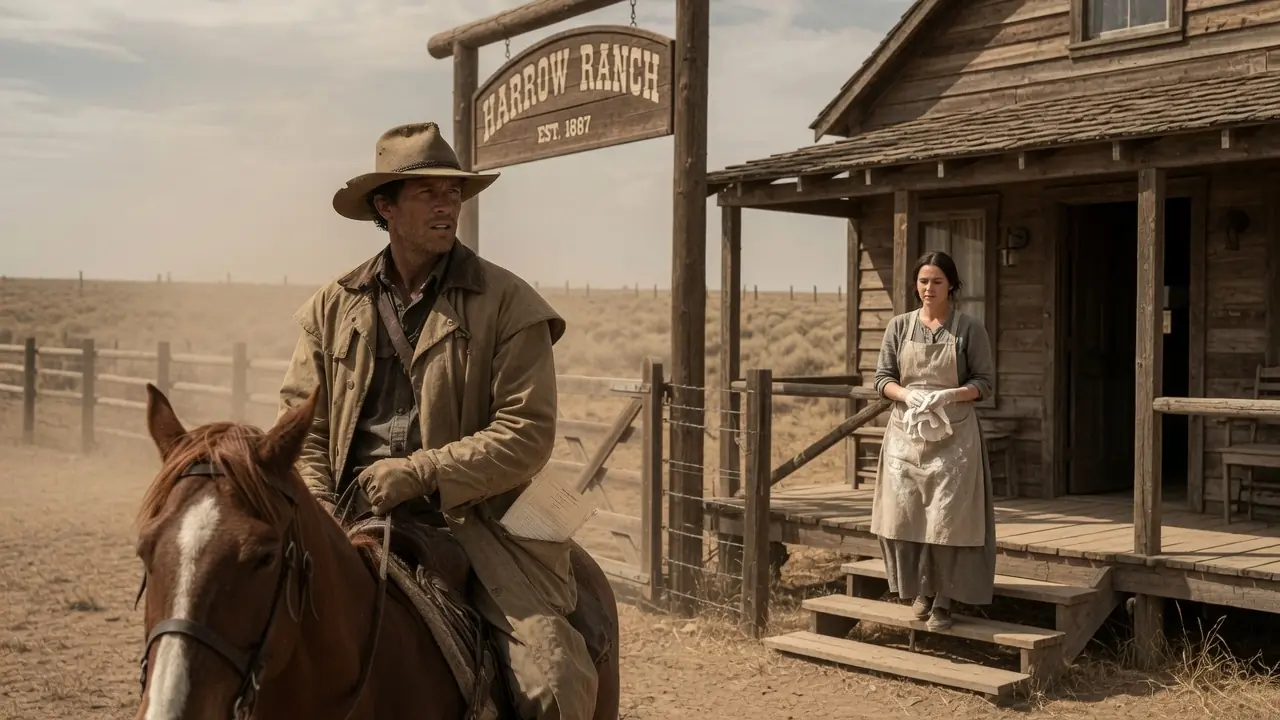
He came back to sell the only thing his father ever loved more than him and found a stranger living inside it like she'd always belonged there. 20 years of silence, 20 years of telling himself the old man deserved it, and now Wesley Harrow stood at the gate of the Harrow Ranch with a signed contract in his coat pocket and a chest full of something that felt a lot like cowardice dressed up as resolve. He hadn't expected the fences to be straight. He hadn't expected the fields to be green. He hadn't expected her.
The stage road from Millhaven took Wesley Harrow through 14 miles of high country scrubland before it broke over a ridge and gave him his first clear look at the valley below. He pulled the rented horse to a stop and sat there in the saddle longer than he intended to. The ranch looked different. That was the first thing that hit him. Not the grief, not the guilt he'd rehearsed the whole journey, but simple, stubborn surprise.
The Harrow Homestead had always been a hard-working place, never a pretty one. His father, Elias Harrow, had believed that beauty was something you earned through labor, not something you planted to impress your neighbors. Which meant the place Wesley had grown up on was clean and functional and relentlessly plain. But the valley he was looking at now had color in it. Someone had planted a row of cottonwoods along the south fence line that weren't there 20 years ago.
The barn roof had been patched with new timber, still pale against the weathered gray of the original boards. Three horses moved along the near pasture in the late afternoon light, fat and calm, not the nervous half-starved animals his father had always struggled to keep. Wesley clicked his tongue and started the horse down the ridge. He was 43 years old and had spent the last two decades making a decent living as a land surveyor out of Cheyenne. Decent was the right word, not prosperous, not desperate, just decent.
Enough to rent a good room, keep a horse, eat without counting the coins first. He'd built that life on distance, on the simple principle that putting miles between yourself and a wound allowed it to scar over if not fully heal. 20 years was a lot of miles. He'd gotten the letter from the county land clerk 3 weeks ago. Elias Harrow, aged 71, had died of a heart failure on the 14th of March.
As the only surviving heir, Wesley was entitled to the property. The clerk had enclosed a notice from a land acquisition company out of Denver, already inquiring about purchase. Wesley had sat with the letter for 2 days before he wrote back. Then he'd arranged to take the stage north. He told himself the trip was simple business.
A man had to sign papers, collect what was his, close accounts. He had not let himself think about the last time he'd seen his father, the argument in the yard, both of them shouting things they couldn't take back. Wesley finally turning his horse and riding away while Elias stood watching with that locked jaw and those terrible quiet eyes. Wesley had not looked back. He'd been 23 and certain he was right.
And certainty at 23 had a way of lasting long past the point where it still made sense. He reached the gate just as the sun was dropping behind the western hills. The gate was new, solid pine, well fitted with a simple latch that actually worked, which was more than the old one had ever done. He dismounted, opened it, led his horse through, and refastened it behind him. The yard was swept.
That was the next thing he noticed. Not just swept, maintained. Someone had replaced the broken boards on the front porch, rehung the door on its hinges, planted something low and flowering along the south wall of the house that had no business surviving a plains winter, but apparently had managed it anyway. Wesley was still standing in the middle of the yard, his horse's reins in one hand, his hat in the other, when the front door opened. The woman who stepped out was somewhere in her mid-30s.
Dark hair pulled back plain, a canvas work apron over a gray dress, flour on her hands, which she was already wiping on a cloth as she came down the porch steps. She wasn't startled by him, which surprised him. She looked at him the way you look at someone you've been half expecting to see eventually. "You're Wesley," she said. It wasn't a question.
He put his hat back on. "I am." "Who are you?" "Mara Bellamy." She stopped at the bottom of the porch steps, still wiping her hands. "I work worked, I suppose, for your father." "Worked?" "He passed 6 weeks ago. I wrote to the county clerk. I assume that's how you found out." "The clerk wrote to me," Wesley said.
He was trying to read her, trying to figure out the situation. A ranch hand who lived in the house, a woman alone on a property that belonged legally to a man she'd apparently never met. He looked around the yard again, the cottonwoods, the patched barn, the green of the pasture where there should have been dry grass. "How long have you been here?" "8 years," she said. He looked at her again.
"8 years. Your father hired me the spring of '81. I was passing through on the stage, needed work, he needed help." She said it plainly, without apology, without the slight defensive edge he might have expected from someone who knew they were standing on land that wasn't theirs anymore. "I can show you the records. He kept everything." "I'm sure he did," Wesley said, though he wasn't sure of anything at that moment.
She looked at his horse. "You've come a long way. There's room in the barn, hay and water both. Supper's on if you want it. We can talk about the rest after." Well, he ate at the same table where he'd eaten every meal of the first 23 years of his life, and the familiarity of the room hit him harder than he'd expected.
The smell of it, pine boards and lantern oil and something herbal that turned out to be dried sage hanging in the kitchen doorway, went straight past his reasoning mind and landed somewhere older and less defended. His mother had died when he was seven. After that, it had just been Wesley and Elias and the ranch and the particular silence of two people who loved each other and had no idea how to say so. Elias Harrow had not been a cruel man. He had not been a warm one.
He was a man built by hard country and harder times and he expressed himself through labor, through what he fixed, what he built, what he kept going. Feelings were not something he discussed. Weaknesses were not something he acknowledged. It had taken Wesley until his 20s to understand that this was its own kind of damage and by then the damage had passed from father to son. The argument, when it finally came, had been about the ranch itself.
Wesley had wanted to sell off the eastern pasture to a neighbor, use the money to buy better equipment. Elias had called it short thinking. Wesley had called his father stubborn. Elias had said something about Wesley not understanding what sacrifice meant and Wesley had said something that he still couldn't repeat to himself without feeling sick and that had been the end of it. He pushed his supper around the plate.
Across the table, Mara ate with the economy of someone used to eating after a long day's work. She didn't try to fill the silence with talk. He found that he appreciated it in a way he wouldn't have expected. The land acquisition company in Denver, he said finally. Have they contacted you?
She looked up. They sent a man out last fall. I told him the property wasn't for sale. You told him. I told him to come back when the owner had been contacted.
She picked up her coffee. That seemed right. Wesley set his fork down. And when were you planning to leave? She met his eyes, not hostile, not wounded, either.
When you tell me to, I suppose, or when the property changes hands. Whichever comes first. And your things? I don't have much. She said it without self-pity.
The horse is mine, a few clothes. Most of what's here was your father's. Wesley looked around the room again, at the clean walls, the straight curtains, the new hinges on the cabinet doors. You did all this, he said, the repairs, the cottonwoods? Most of it.
Your father did what he could for as long as he was able. The last 2 years he slowed down some. She paused. I did what needed doing. Why?
The question came out more direct than he intended, and she looked at him for a moment before she answered. Because it needed doing, she said, and because your father asked me to help keep it right. That was the arrangement. An arrangement where you lived in the house? Yes.
For 8 years? Yes. She set her coffee down. If you want to know whether he paid me properly, the records will show it. If you want to know whether I was here because I had nowhere else to be, the answer to that is also yes, at least at the start.
People take the work they can find, Mr. Harrow. I'm not ashamed of where I landed. He looked at her for a moment. She held his gaze without flinching, without the practiced blankness of someone hiding something, or the over-explanation of someone with guilt to manage. She just looked at him, steady and a little tired.
I'm not accusing you of anything, he said. Good, she said. Because there's nothing to accuse me of. He slept in his old room that night. In a bed with clean sheets that someone had aired out recently.
He lay on his back and stared at the ceiling and listened to the sounds of the ranch, wind off the high country, one of the horses shifting in the barn, the distant call of something he couldn't name. He had not intended to feel anything on this trip. He had planned it as a business matter, a transaction, a thing to get through. He would arrive, assess the property, arrange the paperwork, sign what needed signing, and go back to Cheyenne lighter by one inheritance and heavier by one bank deposit. Clean, simple, done.
But the clean curtains and the straight fences and Mara Bellamy's steady eyes were already complicating his plan in ways he hadn't prepared for. In the morning, she was up before him. He heard her in the kitchen while it was still gray outside. And by the time he came down, she had coffee on and was already dressed for work. "The east fence line needs looking at before the weather turns," she said without preamble.
"One of the horses tested it last week. I thought you might want to walk the property today." "I was going to go through the records," Wesley said. "You can do that this afternoon. The fence won't wait for the afternoon." He looked at her. She wasn't being impertinent.
She said it the way someone states a fact about weather, just information. Here it is. "All right," he said. They spent the morning walking the harrow land. Wesley knew every foot of it from childhood, or thought he did, but 8 years of Mara Bellamy's attention had changed things in ways both large and small.
"Your father," she said. "He couldn't always do it himself the last few years, but he knew how everything should be done. He liked to explain things." Wesley stood up and looked out over the south field. "He never explained things to me," he said before he thought better of it. Mara was quiet for a moment.
He talked about that, she said carefully. Wesley turned to look at her. What do you mean? She seemed to weigh something. Maybe we should finish the fence line first, she said.
What did he say? She looked at him, then she said, "He said he'd taught you all the wrong things, or not the wrong things. He said he'd done the teaching wrong. He said he showed you how to work and forgot to show you why." Wesley said nothing. The wind came down off the ridge, cold and smelling like snow that hadn't fallen yet.
"He said that a lot," Mara added quietly. "Near the end, especially." They ate lunch on the porch, sandwiches and cold water from the well, and Wesley asked her to start from the beginning, how she'd come to be here. All of it. Mara was quiet for a moment, as though deciding how much to say. Then she started.
She'd been 26 when she'd come through on the stage. Her husband, a miner named Cal Bellamy, had died of a fever 18 months before that, leaving her with $12 and a pair of boots that didn't fit, and no family within 500 miles. She'd been traveling from settlement to settlement looking for work, doing laundry, cooking, mending, whatever there was to do. "I got off the stage in Millhaven to buy food," she said. "Your father was in town for supplies.
He overheard me asking at the dry goods store whether they knew of anyone looking for help. He said he needed someone who could cook and wasn't afraid of hard work." She paused. "He also said he'd pay fair wages and that I could have my own room, and it wasn't a social arrangement, just a work one. He was very clear about that, very She thought for a second. Formal about it.
"That sounds like him," Wesley said. "I said yes because I needed the money. I didn't expect to stay longer than a season." She looked out at the yard. "But he was She stopped. "What?" "He was good company," she said, and it came out simply, without embellishment.
I don't mean easy company. He wasn't easy. He was stubborn, and he had opinions about everything, and he didn't like to be wrong, and he could go whole days without saying three words. She paused. But he was honest, and he was fair, and after a while I realized that working for a man like that was worth something.
So, I stayed. Wesley had his elbows on his knees, looking at the yard. Did he ever talk about me in those first years? She hesitated. Not much at first.
I knew he had a son who'd left. I didn't ask about it. But later? Later, she said carefully. Yes.
Tell me. She looked at him, and whatever she saw in his face must have settled something in her. "He kept your letters," she said, "all of them." Wesley went still. "I wrote him twice," he said, "in 20 years. The first time was about 2 years after I left.
The second time was when I heard he'd been ill. That was he calculated 7 years ago. "I know," she said. "Two letters. He kept them in the tin box on the shelf in the bedroom, along with the only photograph he had of you, from when you were about 12, with the river behind you." She looked at her hands.
"He read them more than twice." Wesley looked away. The south pasture was bright in the midday sun, the cottonwoods throwing thin shadows across the grass. "He wasn't a man who showed things," Mara continued. "You know that better than me. But I'd come into the kitchen sometimes, and he'd have that tin box out on the table, just sitting there, not even open, just sitting with his hand on top of it.
And he'd hear me come in, and he'd put it back on the shelf, and we'd both pretend I hadn't seen it." Wesley pressed his thumb and forefinger against the bridge of his nose. "He never wrote back," he said, "to either letter." "I know," she said, "he's started two more than once. There were drafts of letters in that tin box, too. He just" She shook her head. "He didn't know how to say what he wanted to say, and he wasn't willing to say it wrong.
So, in the end, he didn't send anything." "He was stubborn," Wesley said. The words came out flat, but there was something underneath them that wasn't flatness at all. "Yes," Mara said. "So were you, by his account." A short silence. "He said that?" "He said the two of you were exactly the same, and that it was the biggest mistake he ever made raising you to be like him." She looked at Wesley steadily.
"He meant it as a confession, not a complaint. That's the way it came out." In the afternoon, Wesley went through the records Mara had kept. They were thorough and carefully organized. Eight years of accounts, wages, supply purchases, livestock tallies, maintenance records. Mara's handwriting was clear and consistent.
The numbers were honest. He could see that without an accountant. The ranch had not made anyone rich, but it had not failed, either. It had held on, which in this country was its own kind of accomplishment. He found the tin box where she said it would be.
On the bedroom shelf, next to an oil lamp and a spare set of bootlaces. He sat on the edge of the bed and opened it. The two letters he'd written were there, folded carefully. The envelopes worn at the creases from handling. There was the photograph she'd described.
Himself at 12, squinting into the sun, the river behind him, a fish he'd caught that afternoon held up in both hands. He remembered the day clearly. The cold of the water, his father's voice saying, "Hold it up higher so we can see it." The click of the borrowed camera from the passing photographer who'd set up in Millhaven for 3 days. Beneath the photograph were the drafts of letters. Three of them.
All in his father's handwriting, which was large and slightly uneven. The handwriting of a man who hadn't gone to school long enough. He read them. The first was from shortly after Wesley had left, and it was mostly anger, sentences crossed out and rewritten, corrections layered over corrections. But near the end there was a paragraph that hadn't been crossed out.
I don't know how to tell you that I'm sorry when I don't know if I am sorry, but I know the place feels wrong without you here, and I keep thinking what I would have done different, and I can't figure it out. That doesn't mean I was right. It might just mean I don't know how to be any different. Wesley sat with that for a long time. The second draft was shorter, written in a different year.
Wesley could tell by the ink, a different bottle. Wesley, I heard you were working steady in Cheyenne. I'm glad for that. The East Field came in well this year, and then nothing. The sentence just ending there, as though his father had run out of words at exactly the moment he needed more of them.
The third was undated and had only one line, written and not crossed out. I should have said I was proud of you and I never did, and I don't know why, and I'm sorry. Wesley folded the paper carefully and put it back in the tin box. He closed the lid and sat there in his father's bedroom in the late afternoon light with the tin box in his lap, and he didn't move for a long time. At dinner that evening he was quieter than the night before, and Mara didn't push.
She put food on the table, sat down across from him, and let him be where he was. After a while he said, He mentioned me to people in town? She nodded. He talked about you to anyone who'd listen. Bragged about you, really.
About your work as a surveyor, about the precision of it. He said once that it suited you because you always needed to know exactly where things stood. She tilted her head slightly. I thought that was a kind way to put it. Or accurate, Wesley said.
Maybe both. He turned his coffee cup in his hands. I thought he hated me. Mara set down her fork. "He never hated you," she said.
"He told me so directly once. He said it was the only thing he was sure of, that whatever else had gone wrong between you, he had never hated his son." She paused. "He was angry at himself. That's different." Wesley looked at her across the table. She changed out of the canvas apron into a plain blue dress for dinner, and in the lamplight she looked less like a ranch hand and more like what she actually was, a woman who had navigated a great deal of difficult terrain and come through it with her edges intact.
"What about you?" he asked. "Do you have family somewhere?" "No." She said it without elaboration. "Cal's people were in Ohio, but we'd been gone long enough that we were strangers by the time he died. My own family" She stopped. "My mother's been gone a long time.
I was never close with my father." "So you came here with nothing?" "I came here with $12 and bad boots," she said. "And I'm still here. So I suppose I managed." "Suppose? You did more than manage," Wesley said. He gestured vaguely at the room around them, the house, the ranch outside.
"This place, what you've done with it." "Your father built this place," she said, firm but not unkind. "I just kept it going." "That's not nothing." "No," she agreed. "It isn't." That night, he walked the property again in the evening after supper, alone this time. The air had the smell of early spring cold, the kind that reminded you that winter hadn't fully decided to leave yet. The horses were quiet in the pasture.
The new cottonwoods stood in their row along the fence line, bare branch still but rooted. He walked to the east field, the one he and his father had argued about. It was still whole, still part of the ranch, not sold off to the neighbor, still producing. His father had been right about that. He hadn't been wrong about much that was practical.
He stood there in the darkening air and thought about a man who read two letters until the envelopes wore through at the folds. A man who kept draft apologies on a shelf with a photograph of his boy holding a fish. A man who hadn't known how to say I'm proud of you out loud, had written it down instead, and then hadn't sent that either. Wesley put his hand on the fence post, one of the ones Mara had repaired, and pressed his palm flat against the wood. It was solid.
Someone had sunk it deep, set it right. He stayed there until the light was fully gone. Then he walked back to the house. The lamp was on in the kitchen window, a yellow square against the dark, the same square of light he'd walked toward a thousand times as a boy. He came inside and Mara was at the kitchen table going through the account ledger.
She looked up when he came in. "I need to see the deed," he said. "And I need to know what else my father wanted." She looked at him for a moment, then she stood, went to the shelf beside the door, and came back with a folded paper. "He had it drawn up the winter before last," she said, "when he knew he wasn't going to get better." Wesley unfolded the paper and read it. It was a letter, not a legal document, a letter his father had written to him, addressed to him by name, meant to be delivered when he arrived.
It was the longest thing his father had ever written to him. It began, "Wesley, I don't know if you'll come, but I'm writing this because I'd rather say it wrong than never say it. A man can only hold silence so long before it costs him more than the words would have." Wesley read the whole letter standing at the kitchen table while Mara stood at a respectful distance by the window. When he finished, he folded it slowly and put it in his coat pocket, close to his chest. "He left the ranch to me," he said.
"Yes." "Free and clear?" "Yes." He stood there for a moment. "He asked you to stay," he said, "in the letter. He asked you to stay until I came." "He asked me to be here when you arrived, yes." She was watching him carefully. "I said I would. And now I'm here." "And now you're here," she agreed.
Wesley looked at the kitchen, at the clean walls, the swept floor, the dried sage hanging in the doorway, the account ledger open on the table showing eight years of careful, honest work. "I brought a contract with me," he said, "from a Denver acquisition company." Mara looked at him steadily and said nothing. He reached into his other coat pocket, not the one where he'd put his father's letter, and withdrew the folded contract. He set it on the kitchen table between them. He looked at it for a long moment.
Then he looked up at her. "I haven't signed it yet," he said. Mara let out a slow breath, just a small sound, almost nothing, but he heard it. Outside the wind moved through the new cottonwoods along the south fence, the ones that hadn't been there when he left, the ones that were already tall enough to matter. Wesley Harrow stood in his father's kitchen, in his father's house, on his father's land, with a contract he hadn't signed and a letter he couldn't stop feeling against his chest, and listened to the trees his father would never see grow move in the dark.
He left the contract on the kitchen table that night and didn't touch it. Not a decision exactly, more like a postponement, which Wesley knew was a different thing, though in the dark of his father's bedroom, they felt similar enough. He lay there listening to the wind work through the cottonwoods and told himself he was just tired from the road. That was all. A man didn't make property decisions at 9:00 at night after reading a letter that hit him like a fist under the ribs.
He'd sleep, and in the morning things would be clearer. In the morning, things were not clearer. They were more complicated. He came downstairs to find Mara already gone from the house. Her coffee cup rinsed and set to dry on the sideboard.
Through the kitchen window he could see her in the near pasture checking the horses, moving along the fence line with the focused attention of someone who had a long list of things to do and wasn't going to wait around to be told to start them. She moved with a kind of quiet competence that was hard to watch without feeling something, not admiration exactly, though that was part of it. More like recognition. The way you recognize a kind of work ethic that was built the same way yours was, out of necessity and repetition rather than choice. Wesley poured himself coffee and stood at the window and looked at the contract still lying on the table.
Then he folded it and put it in his coat pocket and went outside. She heard him coming across the yard and glanced up but didn't stop what she was doing, which was working a burr out of the gray mare's mane with more patience than the mare deserved. Sleep all right? She asked. Well enough.
He stopped at the fence. What's wrong with her? Nothing wrong with her. She just gets into everything. Mara worked her fingers through a knot.
She's the smartest one in the pasture. That's usually how it goes. Wesley leaned on the fence post and watched. The mare stood with the long-suffering air of an animal that knew perfectly well she was being helped and was annoyed about it anyway. I want to know more, he said, about the last few years, about what he was like.
Mara glanced at him. What specifically? All of it. What his days looked like, whether he was He stopped, not quite sure what word he wanted. Whether he was all right.
She freed the last of the burr and smoothed the mare's mane flat. Then she ducked out of the fence and came to lean against the rail beside him, close enough to talk but not crowding him. He slowed down gradually, she said. It wasn't one thing. His hip had been bad for a while, old injury from when he was young, before I came.
Some mornings he couldn't get around until it loosened up. He never said it hurt. He just moved slower and didn't offer any explanation, and I didn't ask for one because he didn't want to be asked. "That sounds right," Wesley said. "He adapted.
That was what he was good at." She looked out at the pasture. He started doing more of the planning and less of the lifting. Taught me things so I could do the physical work, and he'd walk the property with me and tell me what needed doing. We had a rhythm. She paused.
It was a good arrangement. "Was he lonely?" The question came out before Wesley had decided to ask it. Mara took her time answering. "Sometimes," she said. "Not always.
He liked the work even when he couldn't do much of it himself. He liked talking through problems. He'd sit on the porch in the evenings and watch the light change on the ridge, and I'd sit with him and we'd talk about what needed fixing, what the cattle were doing, what the weather looked like. Ordinary things." She was quiet for a moment. "I think ordinary things were what he needed most, not company exactly, just the presence of someone else living in the same space." Wesley looked down at his hands on the fence rail.
His father's hands had been enormous, the biggest hands he'd ever seen on a man, rough and scarred and oddly gentle when they needed to be. He remembered those hands teaching him to rope, to mend tack, to read the sky for weather. He remembered the same hands clenched at his sides during their argument, white knuckled, the only outward sign that something was tearing. "Did he ever say why he didn't write back?" Wesley asked. "To my letters?" "He talked around it," Mara said carefully.
"He said he started to write back more than once. He said every time he tried to put it in a letter it came out wrong, either too proud or too She searched for the word. too exposed. He said he could never find the middle." "There wasn't one," Wesley said. "With him, it was all or nothing. He knew that.
He said it was his worst quality. That he'd never learn to say a small true thing. It was either silence or the whole awful truth, and he didn't know how to do the whole awful truth in a letter to his son." Wesley made a sound that wasn't quite a laugh. He could have tried. "Yes," she said simply.
"He could have." They stood there for a moment in the pale morning, the horses moving slow and easy in the field, the ridge still in shadow. "He talked about the argument," Mara said. "Eventually, not all at once. It came out over the years, pieces of it. He felt he'd been wrong about the east field." Wesley turned to look at her.
"He said that?" "He said you were right that the money from selling that section could have been put to use. He'd been holding on to every acre out of" She paused. "He called it fear, which surprised me because I never saw him afraid of anything practical. But he said it wasn't the land itself he was afraid of losing. It was the idea that if he let any of it go, the whole thing would come apart.
That it had to stay whole or it meant nothing." She glanced at Wesley. "He said he understood later that he'd put that feeling onto you in a way that wasn't fair. That he'd made you carry the weight of his fear and called it arguing about land." Wesley said nothing. "He was very clear about it," Mara continued. "He said, 'The boy wasn't wrong about the east field.
He was wrong to leave, but I was wrong first.'" The words landed and sat there. "He never would have said that to my face," Wesley said finally. "No," Mara agreed. "I don't think he could have, but he said it to me. He said it more than once." Wesley pushed off the fence and walked a few steps away, not going anywhere, just needing to move.
He stood with his back to her for a moment, looking at the east field, green and whole, unbroken, still part of the ranch. "I said something to him," he said without turning around, "the day I left. Something I've never said out loud to anyone since." Mara waited. "I told him he was the loneliest man I'd ever known and that he'd made sure I'd end up the same way." He paused. "I said it to hurt him.
I knew exactly where to put it." He heard her take a breath. "Did it work?" she asked quietly. "Not as a wound, just a question." "Yes," he said. "I could see it on his face." He turned back around. "That's the part I've been carrying." Mara looked at him steadily.
"He never mentioned that," she said. "Specifically, but" she stopped. "What?" "There was a period, that first winter I was here, when he was drinking more than was good for him. Not badly. He wasn't a mean drunk or a helpless one.
He just had a glass in the evenings that became two and then sometimes three and he'd get very quiet in a different way than his usual quiet, like he was somewhere else entirely." She crossed her arms against the morning cold. "It stopped after that winter. He pulled himself back from it on his own. Never said why. But the following spring was when he first started talking about you in any real way.
Not just mentioning your name, but actually talking. Like he'd worked something out over that winter and decided it was done." Wesley tried to imagine his father in this house in the long dark of a plains winter, carrying those words. He found he could imagine it all too clearly. He had done his own version of the same thing in a rented room in Cheyenne in those first years. The difference was Wesley had eventually moved past it through the simple grinding mechanism of days.
Enough of them, one after another, and the acutest pain dulled to something you could live around. He hadn't known his father had done the same work in the same silence. "Come on," Mara said, pushing off the fence. "I want to show you something." Mara took him to the barn, not the main barn where the horses were kept, but the smaller outbuilding on the north side that Wesley had always known as the equipment shed. She pushed open the door and let him inside.
The smell hit him first, sawdust and linseed oil and old wood, familiar in a way that went deep. The shed had been reorganized since he'd last been in it. Tools hung in careful order on the wall. A workbench along the south side was clear and clean. And on that workbench, arranged in a row, were six carved wooden figures.
Wesley went closer and looked at them. They were animals mostly, a horse, a dog, a mule, something that might have been a rabbit, carved with the same large careful hands that had taught him to rope and read the weather. They were not skilled exactly. His father had never been an artist, but they were detailed in a way that showed time and attention. Someone had spent hours on each one.
"He started carving about 4 years ago," Mara said from behind him. "When his hip was bad in the winters and he couldn't get outside much. He said it was something to do with his hands." She was quiet. "He made about 30 of them total. He gave most away, to the children in Millhaven, to the preacher's wife who'd been kind to him.
These are the ones he kept." Wesley picked up the horse. It was smoother than he expected, worn down in the places that had been handled most. He turned it over. On the bottom, carved into the base in small uneven letters, were two words, for W. He set it down very carefully.
"He made things for you," he said. It was not quite a question. "Yes," Mara said, "he made things, and he talked, and he did what he could with what he had left." She came to stand beside him at the workbench, looking at the carved figures. "He wasn't he could not transform himself into a different kind of man. You have to understand that.
He was who he was and he knew it. But he spent the last years of his life trying to find the edges of who he was, trying to see if there was any more room in there than he thought. Wesley stared at the row of animals. "He made this one this winter before last." Mara said, reaching past him to pick up the horse. He was sick by then, not dying yet, but not well either.
His hand shook a little. You can see it in the neck where the line isn't quite even. She ran her thumb along the carved mane. He worked on it for 3 weeks. When it was done, he put it on the shelf in his bedroom, right next to the tin box.
She set it back down. He didn't say who it was for. He didn't have to. Wesley had to step back from the workbench. He walked to the open shed door and stood there in the frame, looking out at the north field, breathing the cold air, getting his face under control.
Behind him, Mara said nothing. She understood. He was beginning to realize the precise calibration of when silence helped and when it didn't. It was a skill that came from spending years with a man who needed it constantly. After a while, he said, "Did he know he was dying at the end?" "Yes." She came to stand near him, not beside him, giving him room.
"He'd known for about 6 months. Dr. Hennessy from Millhaven came out twice and was fairly plain with him about what was happening. Your father took it the way he took most things. He asked a few questions, said thank you, and went back to work." "Did he want" Wesley stopped. "Did he want me to come?
At the end? Did he try to reach me?" This was the question that had been sitting at the bottom of everything since he'd arrived. He'd been circling it and he finally just asked it directly. Mara was quiet for a moment. "He told me not to write to you until after." She said.
"He didn't want you to come out of obligation. He said if you came, he wanted it to be because you chose to, not because you felt you had to. She paused. He was afraid that if you came and it was if the reason you came was only obligation, it would be worse than you not coming at all. He couldn't have stood that.
Wesley felt something fracture in his chest that had been holding shape through sheer stubbornness for 20 years. "So he died alone." he said. "He died with me here." Mara said, gently but clearly. He turned to look at her. "I was with him." she said.
"The last 2 days I didn't leave the house. He wasn't in pain at the end. Dr. Hennessey had left something for that. He was mostly sleeping, but I was there." She met Wesley's eyes. "He didn't die alone." Wesley had not cried.
He had not let himself cry since he was about 9 years old, which was around the time he'd understood that tears made his father uncomfortable, and so he'd trained himself out of them. He wasn't about to start in a doorway in front of a woman he'd known for 2 days, but it was a near thing, closer than it had been in years, and he had to work at keeping his breathing even. "Thank you." he said. "I wasn't doing it for your gratitude." she said. "I was doing it because he mattered to me." "I know." Wesley said.
"But thank you anyway." They had lunch late that day after a morning of work. Wesley had insisted on helping with the fence Mara had mentioned, and they'd spent 3 hours running wire and resetting posts in a wind that had come up sharp and cold from the northwest. It was hard physical work, and it cleared his head in the way that hard physical work always had. The body's simplicity cutting through whatever the mind was making too complicated. He wasn't bad at it, which surprised him a little.
He'd spent 20 years doing survey work, which was precise and mostly sedentary, and he'd half expected his body to have forgotten the ranch rhythms. But it hadn't entirely. Some things stayed in the muscle. "You're not useless," Mara said, surveying their finished section of fence line. She said it in the tone of someone reporting a mildly unexpected fact.
"High praise," Wesley said. "I don't give it out easily," she said. And he believed her. They ate inside, out of the wind. Mara made soup, simple stuff, beans and salt pork and whatever was left from the week's supplies, and Wesley found himself eating two bowls of it without noticing until the second was half gone.
He couldn't remember the last time he'd eaten like that, just ate without thinking about it. "Tell me about the last message," he said, when the soup was gone and she'd put coffee on. "He left me a letter." "But you said he had a message." "Were they the same thing or different?" she said. She came back to the table with both cups and sat down. "The letter was written when he was well enough to write clearly.
The message" She wrapped her hands around her cup. "The message was what he said to me directly, near the end, when he was too weak to write anymore, but still had his mind." Wesley waited. "He made me promise to tell you," she said, "word for word, as close as I could get it. He was very specific about that. He said" She stopped, gathering it.
"He said, 'Tell Wesley that the only thing I got right was the land, and even that I nearly got wrong. Tell him the ranch isn't what I'm leaving him. I'm leaving him what the ranch taught me, which took me too long to learn, that things don't hold together on their own. They hold together because someone chooses, every single day, to hold them together. I chose wrong about a lot of things.
I'm asking him not to make the same choice." Wesley stared at his coffee. And then he said Mara's voice was careful, measured, the voice of someone reporting something they'd been carrying for weeks. "He said Tell him I was proud every day. Tell him I was just too damn stupid to say it while it would have done any good. The kitchen was very quiet.
Outside the wind had picked up again, moving through the cottonwoods along the south fence, the same sound he'd heard the night before. A rushing, living sound, the sound of something that had been planted and had taken hold and was now part of the place. Wesley picked up his coffee and put it back down without drinking it. "He planted those trees," he said finally, "the cottonwoods." "The winter after I arrived," Mara said. "He drove all the way to Durango to buy the saplings.
Wouldn't say why. He just said he wanted something along the south fence that would grow." Wesley looked out the window at the bare branches moving against the gray sky. His father had known they were cottonwoods, had known that cottonwoods, properly placed, grew fast and tall and lived long, had planted them in a row along the south fence 8 years ago on land he intended to leave to the son he hadn't spoken to in 12 years, had tended them through eight winters and never said why to anyone. Wesley understood then, in the way you understand something that was always true but that you hadn't been able to see straight on until the right moment. His father had spent 20 years doing what he could not do directly, fixing fences, teaching a widow to manage his land, keeping letters in a tin box, planting trees, carving a horse with unsteady hands and putting a letter on the bottom.
None of it was what Wesley had needed. None of it was what either of them had needed. But it was what Elias Harrow had known how to give, which was labor and care and stubborn continuity, and he had given it in the only direction left to him, the son who'd gone, the land that remained, the woman who'd stayed and learned to speak his language. Wesley sat at the kitchen table in his father's house for a long time after that, not saying much, and Mara let him sit there, and neither of them pretended that was easy or sufficient or anything other than exactly what it was, a man learning something too late in a warm kitchen with good coffee going cold in his cup. He slept badly that night and woke before dawn.
Not the restless kind of bad sleep where the mind runs in circles, more like his body had decided it was done with sleep before sleep was done with him, and he lay there in the dark listening to the ranch settle around him, the old timber of the walls contracting in the cold, the horses shifting in the barn, the wind that never fully stopped in this country. He'd forgotten that about this place. The wind was constant, part of the texture of life here, and he'd spent 20 years in Cheyenne where the wind also came through hard, but somehow it had never felt the same, never felt like it belonged to anything, just passed through and moved on. He got up before first light and dressed in the dark and went downstairs. The contract was still in his coat pocket.
He'd moved it there from the table 2 days ago, and it had been there since, folded and unsigned. A document that had seemed like a simple solution in Cheyenne and felt like something else entirely now. He set his coat on the kitchen chair and made coffee and sat down at the table without putting the coat on. Just looked at it hanging there with the contract in the pocket. The thing was this, he still didn't know what he was going to do.
He had thought, riding in on that rented horse 3 days ago, that this would be simple. Sign the papers, collect the deed, arrange the transfer. Go back to Cheyenne. The acquisition company in Denver had offered a fair price. He'd looked at the number and thought, "That's enough to buy a decent house and still have something left over." A clean break.
A finished chapter. But you couldn't unread a letter. You couldn't unknow that your father had kept your envelopes until they wore through at the folds. You couldn't look at a row of cottonwoods planted with clear intention and pretend they were just trees. He was on his second cup of coffee when he heard Mara's door, and a few minutes later, she came into the kitchen already dressed, which meant she'd been awake for a while, too.
She looked at him and at the coat on the chair and at his face, and she didn't ask how he'd slept. "There's something I didn't tell you yet," she said. She went to the stove and poured herself coffee and came to the table but didn't sit, leaned against the counter instead, which was her way when she had something that required some standing room. "I've been deciding whether to bring it up." "Bring it up?" Wesley said. "There's a man named Cutter Doyle." She said the name plainly, the way you say the name of a problem you've learned to say without flinching.
"He's been acquiring land in this valley for the past 3 years. Not buying it outright, mostly. He does it through pressure. Lets water rights disputes drag on until people are tired enough to sell. Files nuisance claims on property lines.
He has a man at the county recorder's office who delays paperwork when it suits him." She watched Wesley's face. "He made an offer on the Harrow land 18 months ago. Your father refused. What happened after that?" "The following spring, someone cut the fence on the north pasture and let three of our cattle out. We never proved it was Doyle's men." "Your father went to the county sheriff, and the sheriff" She paused.
"The sheriff is not Doyle's man, exactly, but he's not someone who goes looking for trouble with Doyle, either." Wesley was very still. "What else?" "Last fall, a man came out claiming there was a survey discrepancy on the east boundary. Said the Harrow land extended about 40 ft less than the recorded deed showed." "Your father knew the boundary. He'd lived on it for 40 years." "But the man had documents, official-looking ones." "Your father hired the only lawyer in Millhaven to look at them, and the lawyer said they appeared legitimate, which your father didn't believe for a single minute." She put down her coffee. "The lawyer cost him most of his cash reserve.
The survey dispute is still unresolved. That's why the Denver Acquisition Company moved so fast, Wesley said slowly. They already knew about the dispute. They wanted to buy before I had a chance to look into it. That's what I think, Mara said.
The man who came out last fall, the one who claimed to work for the county, I later heard from a woman in Mill Haven that he'd been seen at Doyle's ranch office the week before. Wesley pushed back from the table and stood up. Not agitated, just needing to be vertical. He went to the window and looked out at the gray pre-dawn yard. How much of the land is at risk?
The east boundary dispute, if it holds, would cut off your best hayfield. And once one boundary dispute is established, it's easier to file another. She said it levelly, not as a frightened report, but as a practical accounting. Doyle isn't in a hurry. He doesn't have to be.
He's patient, and he has money, and he has people in the right places. He just waits. And if the ranch sells to the Denver company, they'll fold. The Denver company won't fight a boundary dispute in a county where the recorder and the sheriff are both disinclined to help them. They'll take what they can get and move on.
Doyle gets the east field eventually, and the rest follows. Wesley was quiet for a moment. Outside the sky was beginning to separate from the land, just a faint lightning at the eastern ridge. The world deciding to be day again. "You've been holding this together alone," he said.
"I've been managing," she said. "But I'll be honest with you, it's gotten harder. Without your father here, Doyle's people know the property is in transition. There was a rider along the north fence line 2 weeks ago. I watched him from the ridge.
He wasn't a neighbor." Wesley turned from his window. He looked at her. This woman who had been managing a land dispute and a boundary claim and a dead man's legacy all at once, alone, while waiting for a stranger who might decide to sell everything out from under her. "Why didn't you tell me this the first night?" he asked. She held his gaze.
"Because the first night you had a contract in your pocket and you hadn't read your father's letter yet. I didn't want you making decisions about Doyle before you'd made a decision about yourself." He looked at her for a long moment. "That was calculated," he said. "Yes," she agreed without apology. "It was." He almost smiled.
Almost. "Fair enough," he said. Though, he rode into Millhaven that morning alone on the rented horse. He needed to see the county recorder's office and he needed to find out what the actual survey dispute looked like on paper. And he also needed to think without the ranch pressing in on him from all sides.
Millhaven was a working town, not large, not prosperous, but solid in the way that frontier settlements that had outlasted the boom years tended to be solid. A main street with the necessary businesses, a hotel that doubled as a saloon after 6:00, a church at one end and a livery at the other. He'd grown up making the 14-mi ride in with his father to collect supplies and the town had the same bones it always had, just weathered down further. The county recorder's office was a small room off the back of the courthouse building, staffed by a thin man named Perch, who had the careful, avoidant manner of someone who knew exactly what was expected of him and exactly how much he was getting paid for it. Wesley asked to see the survey dispute filing on the Harrow property.
Perch found it with a little too much ease for a man who hadn't been asked for it by name. The document was three pages. Wesley read it carefully, twice. It cited a survey from 1879, before Elias had bought the property, that showed the eastern boundary set 42 ft west of where the Harrow deed recorded it. The 1879 survey was signed by a man named T.
R. Calloway. "Do you have the original 1879 survey documents in the county archive?" Wesley asked. Perch said he'd have to look. "I'll wait." Wesley said.
He waited 40 minutes, which was longer than it should have taken to find anything in a records office this small. When Perch came back, he said the original Callaway survey documents appeared to be missing from the archive. Misfiled possibly or damaged, he couldn't say. "Of course." Wesley said. He spent another hour in the recorder's office going through what public records were available.
Land transfer dates, original deed filings, property tax assessments. What he found, working through the numbers the way he'd been trained to work through survey data, was a simple problem. The 1879 date on the dispute document was inconsistent with other records from that year. The road that was referenced as a boundary marker in the survey hadn't been built until 1881. Someone had made a mistake.
Or more precisely, someone had made a fake document and hadn't checked their dates carefully enough. He wrote down what he'd found in his survey notebook, closed it, and thanked Perch in a voice that made Perch look away. Then he rode to the far end of town and found the lawyer Mara had mentioned, a man named Aldous Frick. Small office above the dry goods store. The kind of tired legal practice that served a frontier community's minimum needs and not much more.
Frick was in and didn't seem busy. "I know the Harrow dispute." Frick said when Wesley introduced himself. "I told Elias the documents looked legitimate. I stand by that assessment. I'm not a surveyor." "The survey references a road that didn't exist in 1879." Wesley said.
He laid his notebook on Frick's desk and pointed to the dates. "Crow Creek Road wasn't cut until the spring of 1881. It's in the county road commission records, which are in the courthouse building 50 ft from the recorder's office." Frick looked at the notebook for a long time. "I should have caught that," he said finally. "Yes," Wesley said.
"You should have." Frick had the grace to look genuinely bothered. "The documents came to me through the recorder's office as verified originals. I assumed "I know what you assumed." Wesley closed the notebook. "I need to know who filed the dispute. The filer's name on the document is a company called Territorial Land Services.
What do you know about them?" Frick was quiet for a moment in the way of a man doing a small internal calculation about what he could afford to say. "They've filed similar disputes on three other properties in this valley in the past 2 years," he said. "I've heard Cutter Doyle's name mentioned in connection with the company. I don't have proof of that. I want to be clear that I don't have proof of that." "I understand," Wesley said.
"But if someone were to hire an independent surveyor to establish the actual eastern boundary of the Harrow property, and if that survey contradicted the dispute filing, and if the 1879 document could be shown to reference a road that didn't exist at the claimed date, how would you assess the legal position of whoever filed that dispute?" Frick thought about it carefully. "Precarious," he said. "Potentially criminal if intent to defraud could be established. And if the county recorder could be shown to have held records relevant to the dispute, that's a harder case," Frick said. "Unless you had a witness." Wesley thought of Perch's too easy familiarity with the filing and his 40-minute disappearance to find records that didn't exist.
"I might have a witness," he said, "or at least someone with a memory that could be refreshed." He stood up. "I'd like to hire you, Mr. Frick, to represent the Harrow property against the boundary dispute. I understand you charged my father for work that didn't catch a fairly obvious error. I'd like to start fresh on that account." Frick looked at him for a long moment. The retainer would be Whatever it is, I'll pay it, Wesley said.
What I need to know is whether you're actually going to work for me or whether there's a reason I should be looking for a lawyer in the next county. Frick straightened in his chair. It seemed like the direct question did something to him, reset something that had been sliding. I'll work for you, he said. Good, Wesley said.
He put on his hat. I'll be back tomorrow with the survey data, but He rode back to the ranch in the afternoon with the sun at his back throwing a long shadow ahead of him on the road. The land on either side of the trail was the same land it had always been. High country grass, thin soil, rock outcroppings on the ridgelines, the kind of country that asked more from you than it gave back and that some people loved for exactly that reason. He had been one of those people once.
Before the argument, before Cheyenne, before 20 years of other landscapes. He was thinking about that. About whether that particular feeling was still in him or whether it had gone the way of other things from his youth when he crested the last ridge and saw the ranch below him and saw in the yard a horse he didn't recognize. He slowed his own horse and looked. The unfamiliar horse was a dun, well-fed with good tack, not a working animal, a riding horse, the kind you kept when money wasn't a concern.
He watched for a moment, then started down the ridge. When he rode into the yard, Mara was standing on the porch and a man was standing at the bottom of the porch steps. The man was maybe 50, broad through the shoulders, wearing a coat that cost more than anything Wesley owned. He had a pleasant face, the kind of face that had learned to look pleasant because pleasantness was useful. "Mr. Harrow," the man said, turning when Wesley rode in.
He had a voice that carried without effort, a voice accustomed to being listened to. "I'm glad you're back. I was just introducing myself to your He glanced at Mara with a small pause that wasn't quite anything. Housekeeper. Is that right?
Wesley said. He dismounted and tied his horse at the rail. He did not offer his hand. Cutter Doyle, the man said. He extended his own hand and Wesley looked at it for a moment before he shook it, brief and firm.
I've been a neighbor in this valley for going on 15 years. I was sorry to hear about your father. Elias was a hard-headed old man, but he knew his cattle. I'll say that. What can I do for you, Mr. Doyle?
Wesley said. Doyle smiled. It was a practiced smile, applied with the precision of someone who used it as a tool. I wanted to come out personally, first thing. Pay my respects and also, I'll be honest with you because I find that's the best way, to talk about the property.
I expect you've had time to look at the situation. The boundary dispute, the deferred maintenance costs, the isolation of it. He spread his hand slightly, a gesture of reasonable sympathy. It's a lot to take on. For a man who's built his life elsewhere.
I've looked at the situation, Wesley said. Then you know what I'm saying isn't wrong. Doyle's tone was still pleasant, still measured. I'm prepared to offer you a fair price. Better than the Denver company.
I'll promise you that. And I can have the paperwork ready in a week. Quick and clean. Let you get back to your life. From the corner of his eye, Wesley could see Mara on the porch.
She was standing very still, her face neutral, watching. The boundary dispute, Wesley said conversationally. The survey document that references Crow Creek Road. Unfortunate business, Doyle said. These old records are full of inconsistencies.
It'll take time to untangle. The road was cut in 1881, Wesley said. The survey document is dated 1879. That's not an inconsistency, that's a document that couldn't exist. Something shifted in Doyle's pleasant face.
Not dramatically, just a small recalibration, like a machine making an adjustment. I'm not sure what you've heard. I'm a land surveyor, Mr. Doyle, Wesley said. By trade, 20 years of it. I know what a fraudulent survey document looks like.
A beat of silence. The pleasant face was still pleasant, but the engine behind it was running differently now. That's a serious accusation, Doyle said. It's a serious observation, Wesley said. The accusation will be filed through Aldous Frick, who I've retained as of this afternoon.
Once I've had an independent survey done to establish the actual eastern boundary of this property. I expect that survey will match the original Harrow deed exactly. He looked at Doyle steadily. And then we'll talk about what Territorial Land Services knew when they filed the dispute. And what their connection is to anyone in this valley who might have an interest in seeing the Harrow property change hands at a reduced price.
Doyle was quiet for a moment. The smile had not entirely left his face, but it had gone thin, more architectural than genuine. You just got here, Doyle said. His voice was still level, but there was an edge under it now. Just the edge.
You don't know this valley anymore. You don't know how things work here. I know how survey fraud works, Wesley said. That's enough to start with. Doyle looked at him for a moment longer, then looked up at Mara on the porch.
A brief look. The kind of look you give something you've been planning to remove. Then he looked back at Wesley. Think carefully, he said. Not a threat, exactly.
More like a man reminding you of the weather. I plan to, Wesley said. My answer to your offer is no. I'm not selling the Harrow property. He said the words and felt them land in him with a weight that surprised him.
Not the words to Doyle, but the decision itself, stated out loud for the first time in plain language. "I'm not selling." He had not fully known he'd made that decision until he heard himself say it, which was perhaps not the most organized way to handle a major life choice, but there it was. Doyle held his gaze for another second, then nodded once, almost imperceptibly, and walked to his horse. He mounted with the ease of a man who spent a lot of time on horseback, turned the dun, and rode out of the yard at a deliberate pace, not hurrying, making sure you understood he wasn't hurrying. Wesley watched him go.
When the rider had cleared the gate, he heard Mara come down the porch steps behind him. "You told him no," she said. "I told him no." She was quiet for a second. "He'll file another dispute or something worse." "Probably," Wesley said. He turned to look at her.
"I found the date error in the survey document this morning. I've got Frick working on it. I need to do a proper survey of the east boundary. I can do that myself. I have the equipment in Cheyenne.
I can have it sent." He looked at the gate where Doyle had ridden out. "He's been doing this for 3 years, and nobody's pushed back. That's why he's still doing it." "Your father tried," Mara said. "My father tried alone and sick and with a lawyer who wasn't paying close enough attention." Wesley turned back to face the house, his father's house, his house. The fact of it settling onto him one degree at a time, like the way cold settles into ground.
"I'm a land surveyor. This is the one situation in my life where what I actually know how to do is exactly what's needed." He said it without drama, just plainly, as a fact. And the fact of it, the alignment of it, the accidental precision with which 20 years of professional life had produced exactly the skill set this particular problem required, was not something he was willing to call anything as large as fate. But, it was something. It was the kind of coincidence that made you understand why people needed a word for things beyond coincidence, even if they didn't always agree on what that word should be.
He looked at the contract still folded in his coat hanging on the chair inside. Then, he went up the porch steps and into the house, and he took the contract out of his coat pocket and set it on the kitchen table. He found the box of matches on the shelf near to the stove. Same shelf, same spot they'd always been kept. Muscle memory brought his hand straight to it.
He struck a match and held it to the corner of the contract. The paper caught cleanly, and he held it over the kitchen sink while it burned, and dropped the last curling piece before it reached his fingers. The ash sat in the bottom of the dry sink, thin and black. He looked at it for a moment. Then, he washed it down with a cup of water from the pitcher, dried his hands on a cloth, and went back outside.
Mara was still in the yard. She was looking at him with an expression that was not quite readable. Some careful combination of relief and something less certain. Some awareness of what came next that wasn't simple. "I need my equipment from Cheyenne," he said.
"And I need to send a letter to the county seat about the road commission records." He looked at the east field in the pale afternoon light. "And I need to fix the north pasture fence properly. That section we did yesterday, the third post is still not deep enough. I could see it moving in the wind." Mara blinked. "You're staying," she said.
"I'm staying," he said. She looked at him steadily. "For how long?" It was the right question to ask, and she asked it directly without pretending it was smaller than it was. No assumption about what his answer meant. No preemptive shaping of it into something she could manage.
She just looked at him and asked the question straight. "I don't know," he said, equally straight. "But, I'm "I'm not leaving until this land dispute is resolved and the ranch is on solid ground. After that," he stopped, looked at the fields, the barn, the row of cottonwoods. "I don't know, but I'm not leaving tomorrow." She held his gaze a moment longer as though measuring something.
Then she nodded once. "The third post," she said. "I know which one. I'll get the tools." She walked toward the barn and Wesley stood in the yard of his father's ranch, his ranch now. The fact of it still unfamiliar in his chest like a stone he'd swallowed and hadn't yet figured out what to do with, and looked at the eastern ridge where Cutter Doyle had disappeared, and at the cottonwoods along the south fence throwing their late afternoon shadows across the grass, and at the smoke from the kitchen chimney going straight up in the still air.
Then he went to help with the fence. The survey equipment arrived from Cheyenne 10 days later, packed in two crates on the northbound stage. Wesley had sent the letter the morning after burning the contract, a short, precise note to his landlady in Cheyenne asking her to box what was in his room and ship it, and a separate letter to the survey office where he'd kept his professional instruments on loan requesting their return along with his personal transit and chain. He hadn't told anyone in Cheyenne he wasn't coming back. He hadn't been sure enough to say it that plainly, but he'd sent for the equipment, which amounted to the same thing.
Mara helped him carry the crates from the stage depot in Millhaven without asking what was in them. She'd understood what his sending for them meant and had not made a production of it, which he was beginning to recognize as one of her consistent qualities, a refusal to perform reactions she didn't actually feel. If something mattered to her, she said so. If it didn't require comment, she didn't comment. He found the consistency of it restful in a way he hadn't expected.
The boundary survey took him 3 days. He worked methodically, the way he'd worked for 20 years, setting the transit, running the chain, checking and rechecking his angles, recording everything in the survey notebook in the neat tight script that his first employer had drilled into him as a young man. Mara brought him lunch on the second day, set it on a flat rock without interrupting what he was doing, and sat nearby while he ate, and then walked the line back with him afterward asking questions about how the instruments worked. He answered them. She absorbed the answers quickly, asked follow-up questions that showed she'd understood the first explanations.
And by the end of the afternoon, she was reading the hand level herself with reasonable accuracy. "Your father teach you to learn like that?" he asked. "Fast." "Necessity," she said. "When you're the only one around who can figure something out, you figure it out." The survey established, with the kind of precision that 20 years of professional practice produced, that the eastern boundary of the Harrow property fell exactly where the original deed said it did. The Crow Creek Road reference in the dispute document placed the claimed boundary not 42 ft inside the Harrow property, but 42 ft inside what had been, in 1879, open range.
A stretch of land that hadn't belonged to anyone at the time the fake survey claimed to have measured it, which added a layer of sloppiness to the fraud that Wesley found almost insulting. He brought the completed survey to Frick's office on the fourth day with a written report that laid out every inconsistency in plain language. Frick read it carefully. Then he read it again. "This is good," he said.
"This is very good, actually." "I know," Wesley said. "Doyle's people are going to dispute the methodology." "They can dispute it all they want," Wesley said. "The road commission records establish the construction date of Crow Creek Road, and those records are public, and they haven't been tampered with. Everything else follows from that." He leaned forward. "I need you to file a counter complaint against Territorial Land Services for fraudulent survey submission, and I need you to request that the county recorder's records on this filing be preserved and examined because I believe you'll find that certain documents related to the original Harrow deed were delayed in processing.
Frick set down the report. If I file that complaint, Doyle will know immediately. He already knows I'm not going away, Wesley said. He had a rider on my north fence line last week. Did you report that to the sheriff?
Wesley looked at him. Did you? Frick had the grace to look uncomfortable. The sheriff is it's complicated. It usually is, Wesley said.
File the complaint and find out who the circuit judge is this quarter. I want to know if there's anyone in the judicial chain who hasn't had dealings with Doyle's money. He stood up. Frick looked at the survey report on his desk, then up at Wesley. You're going to make an enemy of the most powerful man in this valley, he said.
It wasn't a warning exactly, more like a man making sure all the facts were on the table. He was already an enemy, Wesley said. He just didn't know I noticed. The first real test came 6 weeks after Wesley had decided to stay. It was March, still cold enough at night to freeze the water in the outside barrel, and he was in the barn working on a piece of harness that had cracked when he heard a horse come fast into the yard.
He came out to find a boy from the Alderman family, their nearest neighbors, a homestead about 4 miles east, pulling up hard and breathing like he'd been riding at a run. "Mr. Harrow," the boy said. "My pa says to tell you Doyle's men put a fence across the old creek road, the one that crosses the south end of your property to get to ours. They put it up last night." Wesley looked at him. "How old are you?" "14," the boy said.
"Your father know you rode here alone?" "He sent me." Wesley went back into the barn and got his horse. "Go home and tell your father I'll meet him at the fence in an hour." he said. He went inside first and told Mara where he was going. She immediately started taking off her work apron. "I'm coming." "You don't have to." "The Creek Road crosses our property line." she said.
"I've been maintaining access to that road for 8 years. I have standing." She said it without heat, just stating the legal and practical reality. "I'm coming." They rode together to the south end of the property and found exactly what the boy had described. A new barbed wire fence strung across the Creek Road where it crossed the Harrow boundary, padlocked gate, two fresh-cut cedar posts still bright against the old ground. Frank Alderman was already there with his oldest son, both of them sitting on their horses looking at it with the contained fury of men who knew that acting on fury in this situation would make things worse.
"Wesley." Frank said. He was a compact, weathered man in his late 40s with the kind of face that showed everything the weather had done to it over 30 years of outdoor work. "I'd say good morning, but I'm not in the mood." "When did this go up?" Wesley said. "Sometime between dark and midnight." "My wife heard horses." "I came out this morning and there it was." He looked at the padlock. "That road is the only way my wagons can get to Millhaven with a full load.
The north road is too soft in the spring." Wesley looked at the fence and then at the land on either side of it. He pulled out his notebook. He'd started carrying it every day, a habit he'd gotten into during the survey work, and wrote down the location, the post spacing, the lock make. Then he took out his compass and shot a bearing. "The fence crosses the Harrow property line." he said, "by about 30 ft." "So it's trespassing." Frank's son said.
He was maybe 19, hot-eyed and ready. "It's trespassing." Wesley confirmed, "and obstructing an established road easement, which has a different set of legal consequences. He looked at Frank. Has that road been in use since before Doyle came to this valley? Since before I came to this valley, Frank said.
And I've been here 22 years. I need you to write that down and sign it, Wesley said. Date it. Your wife, too, if she's willing. What are you going to do?
Frank asked. I'm going to cut this fence, Wesley said, because it's on my property and I have the right to do that. Then I'm going to document exactly where it was, photograph the posts and the lock, and add it to the complaint I've already filed against Territorial Land Services. He looked at the fence. Doyle wants a reaction.
He wants one of us to do something that looks like aggression so he can file a counter complaint and muddy the water. So we're going to cut the fence, document everything, and file the paperwork. No yelling, no threats, no shots fired. Frank was quiet for a moment. You sound like a lawyer, he said.
I'm a surveyor, Wesley said. We get to the same place by different roads. He pulled the wire cutters from his saddlebag. He had thought to bring them and cut the fence. Three strands, clean cuts.
He rolled the wire to the side, removed both cedar posts by hand, and stacked them on the edge of the road. The whole operation took about 20 minutes. Nobody said much while he worked. When it was done, Frank Alderman looked at the clear road and then at Wesley. I've been out here 12 years watching Doyle do what he does, he said.
Nobody's pushed back in a way that's stuck. I have the paperwork for why the fraud won't hold, Wesley said. What I need is people who will sign statements about the road easement and about anything else Doyle's done in this valley that can be documented. He looked at Frank directly. Are there others?
Frank and his son exchanged a glance. Henderson, 3 miles north, Frank said. Doyle's been disputing his water rights for 2 years and the Prentice widow Doyle tried to buy her out last spring and when she wouldn't her well got fouled. Nobody proved anything. Would they talk to Frick?
If someone went to them directly, maybe. Frank paused. If they thought it would actually do something. I'm going to need you to help me with that, Wesley said. Go to them.
Tell them what's happening. Tell them I'm not going anywhere and I have documentation that can support a legitimate case against fraudulent survey filings. He looked at the stack of cedar posts by the road, Doyle's fence dismantled and sitting in the mud. This isn't one man's problem anymore. The month that followed was the hardest Wesley had spent in a long time and he'd had some hard months.
Frick filed a counter complaint on a Tuesday and by Thursday there were two riders doing slow circuits of the Harrow North fence every morning, not crossing it, just riding the line. Watching. Wesley logged them in the notebook with times and descriptions and added it to the file without giving them the satisfaction of a visible reaction. Doyle filed a response to the counter complaint that questioned the credentials of the surveyor, Wesley, and claimed the survey methodology was flawed. Wesley wrote a 12-page rebuttal that was, by any professional standard, airtight.
Frick submitted it to the circuit court and the circuit judge, a woman named Hargraves who sat out of a larger town 50 miles south and who had, as far as anyone could determine, no financial relationship with Cutter Doyle, requested a hearing. The hearing was set for April. In between all of it, there was the ranch. The ranch did not pause its demands because Wesley was managing a legal dispute. The cattle needed feeding, the fences needed constant attention, the early spring brought a week of hard rain that turned the north pasture into standing water and revealed a drainage problem on the east side of the barn that had probably been developing for years.
Wesley fixed the drainage ditch himself over 2 days, hip-deep in cold mud, with Mara working alongside him, and the two of them not talking much because there wasn't much to say. It was just work, ugly and necessary, the kind of thing his father had done alone for years, and that was twice as fast with two people who didn't need to explain everything to each other. That was the thing he was least prepared for. Not the legal work. He'd been solving complicated problems professionally for two decades.
Not even the physical labor, which was harder than his survey work, but not unfamiliar to his body. It was the daily-ness of working alongside Mara. The way it didn't require management. She told him when she thought he was wrong. Not frequently, not as a habit, but when she had something to say, she said it plainly.
The second week of March he'd wanted to move the cattle to the south pasture ahead of schedule to let the north pasture drain faster, and she said that was a mistake because the south fence wasn't ready for that pressure yet, and they'd be re-stringing wire within a week. He'd disagreed. She'd explained her reasoning. The south fence had two weak sections she'd been watching. She knew exactly which posts were soft.
She'd been watching them since October. He'd conceded, and they'd fix the fence first and then move the cattle, and she'd been right about the timing. He told her so. "I know," she said. "You're not going to say you told me so?" "I just did," she said.
"I said I know." He'd laughed. Actually laughed. A short, genuine sound that surprised him as much as it seemed to surprise her. She looked at him with a small expression that was not quite a smile, but was something adjacent to one. "You should do that more," she said.
"What? Agree with you?" "Laugh," she said, and went back to work. Thumped. He found his father in pieces throughout that spring. Not dramatically, not in any single revelation, but in accumulated small discoveries.
A repair on the chicken coop made in a particular way that Wesley recognized as his father's method. The same technique Elias had used on everything structural, the same logic of it. A notation in the margin of the farm account ledger from 3 years back. Hay yield down 12%. Consider rotating East Field earlier.
His handwriting, large and slightly uneven, and the voice he used when he was thinking practically. No sentiment, just the problem and the possible solution. A pair of work gloves hanging on the same nail inside the barn door where work gloves had always hung for as long as Wesley could remember. Worn down to nothing at the right thumb where his father had held things. The leather shaped exactly to the hand that had worn it for years.
Wesley left the gloves on the nail. One evening in late March after supper, he was in the equipment shed looking for a particular wrench and instead found on a shelf behind the tool chest four more carved wooden figures he hadn't seen before. Rougher than the ones on the workbench. Earlier work, he guessed, from when his father was first learning. A dog that looked more like a cow.
A bird that could have been anything. Two figures that might have been people, small and simple, side by side. He stood there with the four rough carvings in his hands for a long time. Mara appeared in the shed doorway. She saw what he was holding.
"I didn't know he'd kept those." She said. "I thought he'd given them all to the children in town." He kept these. Wesley turned the two human figures over in his hands. They were very simple. Just the basic shape of a person, no real features, but something in the proportion of them, something in the way they were placed relative to each other on the shelf, suggested intention.
"Did he ever say what he was carving, specifically?" "He said once that he was practicing." Mara said. She came into the shed and looked at the figures. He said he was trying to learn how to make something that looked the way he meant it to look, rather than the way his hands made it come out. Wesley looked at the two small figures side by side, same shelf, same wood. "He was making things for someone to find," he said.
"I think so," Mara said quietly. He set them back on the shelf carefully where they'd been. The week before the hearing, Doyle made one more move. Perch, the county recorder, submitted a document to the court claiming that the Harrow deed itself had a recording error, a different issue from the survey dispute, suggesting the original land grant boundaries had been misdescribed at the time of filing. It was a new problem, a separate thread, designed to complicate the hearing and cast doubt on the legitimacy of the original deed.
Frick brought the news out to the ranch personally, which told Wesley it was serious. "He's trying to widen the dispute," Frick said. They were at the kitchen table, the three of them, Wesley and Mara and Frick with his papers spread between the coffee cups. "If he can get the original deed questioned, it undermines everything else, even if we win on the survey fraud. The original deed is in the county archive," Mara said.
She'd been sitting quietly up to that point, listening. "I know because I went looking for it when the survey dispute was first filed. I read it in the archive room myself. It was there and it was clear." Frick looked at her. "You read the original deed?" "I read everything I could find when Doyle's man first showed up," she said.
"I didn't have a lawyer, I had myself and the county archive and a lot of evenings." She looked at Frick with the particular patience she used on people who underestimated what she'd done. "The original Harrow deed was recorded in February of 1868. The description uses the creek bed and the north ridge line as natural boundaries, not road references. Perch can't claim a recording error in the deed description without contradicting every property tax assessment that's been filed against this property for the last 25 years, and those assessments are in the same archive. Frick stared at her.
You're certain? I took notes, she said. She got up, went to the shelf near the door where she kept the account ledgers, and came back with a small notebook, her own, separate from Wesley's survey notebook, and set it open on the table. Her handwriting was neat and the notes were organized by date and document reference number. Frick looked at the notes, and then at Wesley with an expression that was struggling to stay professional.
She's been keeping records since the survey dispute was filed, Wesley said. Since before that, Mara corrected, since Doyle's man first came to the property, 18 months ago. Frick picked up her notebook carefully. He read for several minutes. This, he said finally, pointing to an entry, references an assessment from 1871 that I hadn't pulled.
If the boundaries described in that assessment match the original deed and contradict Perch's new claim, They match, Mara said. Exactly. Frick closed the notebook and looked at both of them. I would like, he said carefully, to call Ms. Bellamy as a witness at the hearing. Mara looked at Wesley.
Wesley looked at Mara. Whatever helps, she said. The night before the hearing, Wesley couldn't sleep again. It had become a pattern in his life here, insomnia as a reliable indicator of what actually mattered to him. And he went downstairs to find the kitchen dark and Mara already there.
She was sitting at the table with a cup of something that smelled like tea rather than coffee, which he'd learned meant she was in a quieter frame of mind than usual. She looked up when he came in, but didn't say anything, just moved her cup slightly as though making room. He sat down across from her. "You scared?" he asked. "Of testifying?" She thought about it.
"A little. I've never done it." "You'll be fine," he said. "You know the material better than Frick does." "That's not difficult." He almost smiled. "True." He folded his hands on the table. "Mara, whatever happens tomorrow, what you've put together, the notes, the records, you didn't have to do any of that." "I did it for your father," she said.
"He worked this land for 40 years. I wasn't going to let someone take it through paperwork." "He knew you wouldn't," Wesley said. "I think that's why he asked you to stay." She looked at her cup. "He asked me to stay until you came," she said. "That's different from what you're describing." "Is it?" She was quiet for a moment.
"Maybe not," she said finally. They sat in the kitchen in the dark, the lamp low, the wind outside doing its usual work through the cottonwoods. It was the kind of quiet that had weight to it, not uncomfortable, not empty, but full of things that were present without being said. "What happens if we win?" she asked eventually. "At the hearing?" "Frick files for damages.
Doyle's survey fraud goes into the county record. The other affected properties can use our case as precedent." He looked at the dark window. "It won't end Doyle. He has money and patience, and he'll find other angles. But it breaks this particular strategy, and it makes clear that the Harrow property isn't soft." "And for you?" she said.
"What happens for you?" He considered the question honestly. Three months ago he'd arrived on a rented horse with a contract and a plan to be gone within the week. He was still here. The rented horse had been returned, and his own horse was in the barn. His survey equipment was in the shed alongside his father's tools.
He'd had dinner at the Alderman place twice and been introduced to the Henderson family and the Prentice widow. And he knew his neighbors now in a way he hadn't since he was a boy. I stay. He said. I think I stay.
Mara looked at him across the table. For how long then? She asked again. The same question she'd asked the day he'd burned the contract. The one she asked simply and directly without putting anything around it to make it softer.
I don't know the end of it, he said. But I know I'm not... He stopped, finding the right words. Not the big ones, the actual ones. I'm not waiting to leave anymore.
That's different from what I was when I got here. She held his gaze for a moment, then nodded once. The same way she had the day she'd gone to get the tools for the fence post. Acknowledgement, not conclusion. A thing registered and filed without ceremony.
Get some sleep, she said. We have to be in Millhaven by 8:00. He stood up. At the doorway to the hall he stopped. Thank you.
He said. For the notes. For keeping records when you didn't have to. I always have to, she said. That's just who I am.
He went upstairs. Through his window the East Ridge was dark against the sky that was just beginning far out at the edge to think about being something other than night. He lay down on the bed that had been his for 43 years off and on in the truest sense. The bed he'd grown up in. The bed he'd come back to.
The bed he'd probably been in his father's mind when Elias had sat with his hand on a tin box and looked at a photograph of a boy holding a fish. He lay there and thought about what it meant to not be waiting to leave anymore. It was a quiet thought as thoughts went. Not triumphant, just true. Outside the cottonwoods moved in the dark.
The hearing was held on a Tuesday in April in the same courthouse building that housed the county recorder's office, which meant that Perch had to walk past the courtroom door on his way to work that morning. Wesley noticed him do it. The quick sideways glance, the slightly too deliberate pace of a man pretending not to look at something. Judge Hargraves was the small woman in her late 50s with gray hair pinned flat and the particular quality of attention that good judges develop over years of listening to people try to mislead them. She had come down from the larger circuit the night before and was staying at the hotel and she had, according to Frick, already read the submitted documentation before the hearing began.
The courtroom was not large. It held maybe 40 people in the gallery and it was nearly full, which surprised Wesley until he realized that a legal challenge to Cutter Doyle's methods was not a private matter in this valley. It was the kind of thing people came to watch because they needed to know how it came out. He saw Frank Alderman near the back, the Henderson family, three of them, in the second row, the Prentice widow, a woman named Clara, 60s, with the careful stillness of someone who'd learned to be watchful, sitting alone near the aisle. Doyle was there with his own lawyer, a man brought up from Denver who wore a coat that said money and carried a leather case that said more money.
He sat at his table with the composed ease of a man who believed the room would ultimately arrange itself in his favor as rooms generally had. Wesley sat at the other table with Frick and did not look at Doyle. The hearing went for 4 hours. Frick presented the survey evidence methodically. The date discrepancy with Crow Creek Road, Wesley's professional survey establishing the actual boundary, the chain of documentation connecting Territorial Land Services to the fraudulent filing.
The Denver lawyer objected to Wesley's survey on grounds of conflict of interest given that Wesley was the property owner. Judge Hargraves asked Wesley to walk her through his methodology. He did so for 20 minutes, precisely and without embellishment, the way he'd explain survey work for two decades to people who needed to understand it rather than be impressed by it. When he was done, Judge Hargrave said, "Your objection is noted and overruled." to the Denver lawyer without looking up from her notes. Mara testified for 40 minutes.
She was not a natural public speaker. She was too accustomed to saying things to one or two people rather than a room. And in the first 5 minutes, her voice was slightly too careful, the way a person sounds when they're monitoring themselves. But when Frick asked her about the property tax assessments in the original deed language, she stopped monitoring and just answered. And what came out was 8 years of accumulated precise knowledge about one piece of land delivered without dramatics because it didn't need any.
The Denver lawyer cross-examined her on her status as an employee rather than a property owner, implying her testimony was motivated by self-interest. Mara looked at him and said, "I kept records for 18 months before Wesley Harrow arrived. He couldn't have asked me to do that. The records exist because I thought they should exist." She paused. "I do it again." Judge Hargrave's wrote something down.
Perch was called as a witness by Frick. He had the look of a man who had spent several weeks understanding that the room he was about to walk into was going to be uncomfortable and had not found a way to make peace with that. He answered questions about the filing of the dispute document and the missing 1879 archive records in a voice that got progressively smaller as Frick worked through the timeline of what had been filed, what had gone missing, and when. He didn't confess to anything directly. But by the time Frick was done with him, the shape of what he'd done and not done was visible to anyone paying attention, including Judge Hargrave's.
At 2:00 in the afternoon, Judge Hargrave's called a recess and went into her chambers for 40 minutes. Wesley stood outside the courthouse in the April air with Frick and Mara. Nobody said much. Frick went over some papers. Mara stood with her arms crossed looking at the street, and Wesley stood beside her and looked at the same street and thought about the fact that whatever happened in the next hour, he wasn't leaving.
That was the thing he kept coming back to. Win or lose, he wasn't getting on a horse and riding away. He'd already made that decision, and it sat in him solid and settled in a way that not many decisions in his life had. "You did well," he said to Mara. "I told the truth," she said.
"That's not the same as doing well. Sometimes the truth doesn't help." "Today it helped," he said. She looked at him sideways. "We don't know that yet." "No," he said, "but I think so." She looked back at the street. "Your father would have liked today," she said.
"Watching you work. He always said you had his stubbornness, but your mother's precision. He said that was a better combination than just having one or the other." Wesley looked at her. "He talked about my mother?" "Sometimes. Near the end." She was quiet for a moment.
"He said she was the one who taught him that things could be done carefully. He said he forgot that lesson after she was gone and spent 30 years doing things roughly and calling it strength." She paused. "He said he saw her in you sometimes, and that it made him proud and sad at the same time." Wesley looked at the courthouse door. He had not thought about his mother in a long time. She'd been gone so many years that she'd become more concept than person in his memory, softened by distance into something almost abstract.
The idea that his father had carried her with him all those years, had seen her in the son he'd argued with and driven away. "He never said any of that to me," Wesley said. "I know," Mara said. "He said so much to me that he never said to you. I used to think it was because I was easier to talk to, no history, no weight.
But I think it was also because he knew I'd remember it." She turned to look at him directly. "I think he knew you'd come eventually, and he was saving it through me. It was the only way he knew how to send it. The courthouse door opened, and the bailiff called them back in. Judge Hargraves ruled that the survey document filed by Territorial Land Services contained a material factual error that was inconsistent with innocent mistake, specifically, the road reference issue, which she described in her ruling as either gross negligence or deliberate fraud, and noted that the distinction was a matter for further investigation.
She voided the boundary dispute filing in its entirety and restored the Harrow deed boundaries as the legal record. She ordered the county recorder's office to preserve all documents related to the filing pending a separate inquiry into the handling of the archive records. She did not name Doyle directly in the ruling. She didn't need to. Territorial Land Services was named, and the connection between that company and the man who'd been building a land empire in this valley through patience and paperwork was not a secret that would survive the week.
After the ruling, the Denver lawyer spoke quietly with Doyle for several minutes at the far end of the courtroom. Then Doyle left without looking at Wesley's table, which was a choice that required some effort, and the effort showed. Frank Alderman shook Wesley's hand outside the courthouse. Henderson wants to talk to Frick about his water rights, he said, and Clara Prentice has been keeping her own records since the well incident. Didn't know anyone would want them.
Tell them to come to the ranch Saturday, Wesley said. I'll be there. Frank looked at him for a moment. You know this isn't finished, he said. Doyle doesn't stop.
I know, Wesley said. But he's going to have to find a different approach, and that takes time, and in that time we build the case stronger. He paused. He's been doing this to one property at a time. We stop doing it one property at a time.
Frank looked at Mara. You put up with him all right? He said. It was a dry question, almost a joke, but not entirely. Mara glanced at Wesley.
He's improving, she said. Frank laughed, a real laugh, the kind that comes from somewhere genuine, and went to find his son, Bote. They rode back to the ranch in the late afternoon, side by side on the Millhaven Road, the same road Wesley had come in on 4 months ago on a rented horse with a contract in his pocket. The light was doing the thing it did in this country in April, going golden and horizontal, catching the new grass on the ridge in a way that made it look almost lit from underneath. He'd forgotten about that, too, in 20 years.
How the light here at the end of a clear day was its own particular thing, the kind that made you understand why people stayed in difficult country. What are you thinking? Mara asked. That the north pasture needs reseeding this spring, he said, and that the barn roof is going to need another look before summer. She was quiet for a moment.
Is that actually what you're thinking? He considered it. Mostly, he said, and other things. What other things? He looked at the ridge, the golden grass, the long shadows of the horses stretching out ahead of them on the road.
That I spent 20 years thinking I'd made the right choice by leaving, he said. And then I spent the first few weeks here thinking the right choice was obvious, that I should have come back sooner, that I wasted all that time, that I was a fool. And now? She said. Now I think it's more complicated than either of those things.
He kept his eyes on the road. I wasn't ready to come back sooner. I would have come back angry, and I would have fought with him again, and probably left again. The man who could hear what my father was actually trying to say, I don't think that man existed until recently. He paused.
I don't know if that makes the 20 years right. I don't think it does, but it makes them what they were, which is different from wrong. Mara rode for a moment without speaking. Then she said, "Your father said something like that once. Not about you specifically.
He said he'd spent years wishing he could go back and do things differently. And then one day he stopped because the person who would have done things differently wasn't him. It was some imaginary version of him that didn't have his specific faults. And his faults were also his character, which meant you couldn't remove one without losing the other." She glanced at him. "He said it was a depressing thought and also a relieving one." "That sounds like him." Wesley said.
"It did to me, too." She said. "By the time he said it, I knew him well enough." They rode in silence for a while. The ranch came into view below the last ridge. The house, the barn, the new cottonwoods along the south fence that were just beginning to show the first pale green of spring leaves. Smoke from the chimney, which meant the banked fire in the kitchen had held, which was one of those small reliable things that made a place feel inhabited rather than just occupied.
"Mara." He said. "Yes." He stopped his horse and she stopped hers and they sat there on the ridge above the ranch, the last of the evening light on their faces. "I want to ask you something." He said, "and I want to ask it straight without building up to it because I've spent enough time in my life not saying things directly." She turned to look at him. Her expression was what it usually was. Steady, present, waiting without impatience.
"I'd like you to stay." He said. "Not as an employee of the ranch, not because you feel obligated to what you promised my father. I want you to stay because I'd like you to be here with me. Because the past 4 months, the work we've done, and the things you've told me, and what it's been like to be here with someone who He stopped, collected himself. "You're the reason any of this is still standing.
And I think my father knew that and I think he was hoping I'd figure it out. Mara looked at him for a long moment. The wind moved her hair slightly. "You're not asking very smoothly," she said. "I told you I was going to ask straight," he said.
"I didn't say anything about smooth." She looked back at the ranch below them. He watched her face, that face he'd been watching for 4 months, learning its particular economy of expression, the way it showed what was actually happening rather than a managed version of it. "I've been on my own a long time," she said finally. "Since Cal died." "That's" She stopped. "It changes you.
Not badly, I don't think, but it changes you. I know how to be alone. I've gotten good at it. The idea of not being alone anymore is" She paused again. "It's not as simple as it sounds." "I know," he said.
"I've been alone a long time, too. You're going to be difficult," she said. "You already are. You're stubborn, and you keep your thoughts too close, and you don't ask for help until something is already gone wrong." "Yes," he said. "And you're staying," she said.
"You're actually staying." "I'm actually staying." She looked at him. Whatever she was measuring, she seemed to come to the end of it. "Then yes," she said. "I'll stay." He nodded. She nodded.
Neither of them made it into more than it was, which was the right way to handle it. Then they rode down the ridge to the ranch, and there was supper to make, and a fire to build up, and a north pasture that needed reseeding, and the evening came on the way evenings did in this country, gradually and then all at once. They married in June, in the yard of the Harrow Ranch, on a morning that started cold and warmed as the day went on. Frick came, and the Aldermans, and the Hendersons, and Clara Prentice, who brought a pie and cried twice and was unembarrassed about both. The circuit preacher from Millhaven performed the ceremony in about 15 minutes, which suited both Wesley and Mara, neither of whom needed a long ceremony to mean it.
Frank Alderman said afterward, standing with Wesley near the cottonwoods, that he'd never seen a man look more like he'd arrived somewhere after a long trip. "Is it that obvious?" Wesley said. "To someone watching, yes." Frank said. "To you, maybe not." He looked out at the pasture where his own wife was talking with Mara by the fence. "That's usually how it works." The inquiry into Perch's handling of the archive records concluded in August.
Perch resigned from the recorder's office before the inquiry completed, which was not quite an admission of guilt, but was close enough to matter. The new recorder, a young woman named Darcy, who'd come up from the county seat specifically because the old one had left under a cloud, brought a different approach to the office, which is to say she actually filed things when they were submitted and kept the archive in the order it was supposed to be in. The Henderson water rights dispute was resolved in September through a combination of Frick's legal work and a community meeting in Millhaven at which six valley property owners showed up with their own documentation of Doyle-adjacent pressures and were, for the first time, in the same room talking about it together. Doyle himself was not there, but his lawyer was briefly and left early. Cutter Doyle did not disappear from the valley.
Men with money and patience and a certain approach to acquiring things rarely did. But the specific mechanism he'd been using, fraudulent surveys, strategic archive interference, boundary disputes filed through shell companies, that mechanism was now on record as having failed in court, which made it considerably less useful. He turned his attention to other ventures in other valleys, and the properties he'd been pressing in this particular stretch of country were left, if not alone, then at least unharassed by the specific methods that had been working. It was not a complete victory. Wesley understood that.
You didn't beat men like Doyle completely. You made the cost of coming after you higher than he was willing to pay right now, and you stayed ready, and you kept your documents in order. He told that to Frank Alderman, and Frank said it was the most practical thing he'd heard all year, which from Frank was high praise. The first winter Wesley and Mara spent together as a married couple was harder than the previous one, which had been hard enough. A cold snap in December killed two of the cattle they hadn't managed to get to shelter in time, which cost them money they'd been planning to put toward equipment.
A section of the barn roof that Wesley had assessed as stable in the summer turned out to be less stable than he thought and came apart in a February storm, and they spent 3 days in brutal cold making temporary repairs until the weather broke enough to do it properly. Wesley's survey work, he'd taken on three jobs in the valley over the fall, establishing property lines for neighbors who now trusted him, had brought in reasonable income. But the winter ate through reserves faster than either of them had planned. There were nights that winter when the ranch felt like a thing they were holding together by will alone. When Mara was tired in the particular bone-deep way that came from months of physical work and cold weather, and Wesley was short-tempered from the stress of the legal and financial accounting, and they sat at the kitchen table not talking because neither of them had anything generous left to say, and the lamp flickered in the draft that came through the kitchen wall seam they hadn't gotten to yet, and the wind did its constant work outside, those nights existed.
Wesley didn't pretend otherwise. He'd had enough of pretending things were other than they were, but they also existed differently than the hard nights of his previous life, the hard nights in a rented room in Cheyenne, alone, with the particular cold of rooms that have only one person in them. The difficulty here had another person in it, someone who was also cold and tired and who got up the next morning anyway and put coffee on and stood at the window looking at the snow and said, "The east fence is going to need checking today." and meant it and went. That was the difference. It was not a small one.
In the spring of the second year, a man rode out from Mill Haven specifically to ask Wesley about surveying a disputed property line between two families who'd been arguing about it for 3 years and hadn't resolved it because they didn't trust anyone local. He'd heard the man said that Wesley Harrow was both professionally qualified and not interested in taking sides for money. Wesley said he'd look at it. It became a second job alongside the ranch, survey work and property line consultation for people in the valley who needed someone who knew the land and knew the law well enough to navigate both. It wasn't something he'd planned.
It came from the hearing, from his reputation after the Doyle dispute, from the specific combination of what he was and where he was and what had happened. By the end of the second year, he had more work than he could handle alone and he hired a young man from Mill Haven named Teague to help with both the ranch labor and the survey assistant work. Teague was 20, awkward, willing, and made the kind of mistakes that 20-year-olds make when they're working hard and paying attention but haven't yet accumulated enough experience to know what they don't know. Wesley was patient with him in a way that surprised himself. He noticed himself explaining things the way and then stopped that thought.
But it was already there. The way he'd always wished things had been explained to him. "You're good with the boy." Mara said one evening watching Wesley walk Teague through a surveying technique in the yard. "He wants to learn." Wesley said. "So did you." she said.
"At that age." He looked at her. "My father didn't know how to teach me what I wanted to learn." "No." she said. "He knew how to teach you everything else though." She looked at the east field, the cottonwoods, the barn with its repaired roof. You learned how to hold things together. You just didn't know that's what you'd learned until you had something worth holding.
He thought about that for a long time afterward. But the cottonwoods along the South fence were tall enough by the third year to provide real shade in the summer afternoons. Wesley had been watching them since he arrived, counting, without meaning to, the evidence of his father's long- term thinking. Elias had planted trees he wouldn't live to sit under, had done it anyway, which was either faith or stubbornness, and in Elias Harrow's case was probably both. One afternoon in late summer, Wesley was sitting under those trees on an upturned crate eating lunch and doing paperwork, a survey report that had to be ready by Friday, when Mara came across the yard from the barn and sat down in the shade next to him.
She had a bucket of mending that she'd been meaning to get to for a week, and she set it between them and started in on it. They sat there together under the trees his father had planted, not talking, each working on their own thing, the ranch quiet in the midday heat around them. After a while, Mara said, without looking up from the mending, "Are you happy?" He looked up from the survey report. It was the kind of question she asked directly, without building a framework for it first, which was her way, and which had stopped startling him somewhere in the first winter. He sat with it for a moment, giving it the honest attention it deserved rather than the reflexive answer.
"I think so," he said. "I don't know if happy is exactly the right word." "What's the right word?" He thought about it. "Here," he said finally. "I feel here. I haven't felt here in a long time, maybe since before I left." She considered that.
"That might be better than happy," she said. "I think it is," he said. She went back to the mending. He went back to the survey report. The shade moved slowly across the yard as the afternoon went on.
The way shade does when trees are tall enough to make it meaningful. There was a thing that Wesley had been carrying since he arrived. Not the grief exactly, not the guilt, but something underneath both of them. Some basic weight of a man who had spent 20 years in the wrong place and known it and not been able to name it clearly enough to fix it. He'd been carrying it so long he'd stopped noticing it was there.
The way you stop noticing a sound that's been constant for years until it stops. It had stopped sometime in the last 3 years. He couldn't say exactly when. He thought about his father. Not the arguments, not the tin box, not the carved horses, but just the man.
Elias Harrow, who had known how to work and had not known how to say what the working meant. Who had loved his son in the only language available to him and had watched that language fail and who had in the end left behind a woman and a row of cottonwood trees and a property kept in good order by the careful accumulation of daily choices. Wesley understood now what his father had been trying to teach him. Not through words, which Elias couldn't manage, but through everything else. That the land didn't care about your feelings.
That it rewarded consistency and punished neglect and had no interest in your intentions, only your actions. That showing up every day for something difficult was its own kind of statement even when, especially when, no one was watching. That was what Elias had been trying to give him. Not the ranch itself. The knowledge of what it took to keep it.
He'd gotten it eventually. Later than he should have, imperfectly, through someone else's accounts of a man he should have known directly. But he'd gotten it. That had to be enough. In the end, enough was what you worked toward.
Big. On the fourth anniversary of his return, Wesley walked the full boundary of the Harrow property alone at dawn. The same survey walk he'd done in those first weeks, but different now. The land known under his feet in a way it hadn't been then. The east boundary clear and documented and fought for.
The south fence with the cottonwoods. The north pasture reseeded and green. The creek that ran along the western edge, the one his father had shown him as a boy, the one he'd waded in one summer catching crawfish while Elias watched from the bank with an expression Wesley had read as indifference and now understood was something else entirely. At the eastern corner, he stopped and looked at the ridge. The sun was just coming over it, the first light of the day hitting the new grass, doing the thing it did in this country at this time of year.
That particular gold that made you understand why people stayed. He was the man who had come back to sell the last thing his father loved and had found something he hadn't known was missing. He was not by any reasonable measure the same man who'd ridden in on that rented horse with a contract in his pocket. The contract was ash at the bottom of a sink. The rented horse had long since been returned.
The man was still here. He thought about what it meant to come home, not the act of returning, but the thing underneath it, the reason returning was ever possible at all. Some places hold a door open for you even when you've been gone too long. Not because they forgive easily, but because they're made of things that outlast the mistakes. The land itself, the work embedded in it, the people who kept faith with it when you couldn't.
He had not earned what he'd come back to. He'd inherited it from the stubbornness of a man who couldn't say he was sorry and a woman who'd stayed when staying wasn't required. What he could do, what he was doing, was deserve it going forward. One fence post at a time, one filed document, one honest day's work. That was the only redemption available to him and he'd learned to find it sufficient.
He turned and walked back down toward the ranch, toward the smoke beginning to rise from the kitchen chimney, toward the sound of Mara moving around in there the way she did in the mornings. Not quiet, not loud, just present. And the particular comfort of walking toward a light that was on because someone had put it there for you. The cottonwood stood along the south fence in the morning light, tall and rooted, throwing shadows across the grass. His father's trees.
His land now. His life. He went home.