"Play something simple. You will only embarrass us."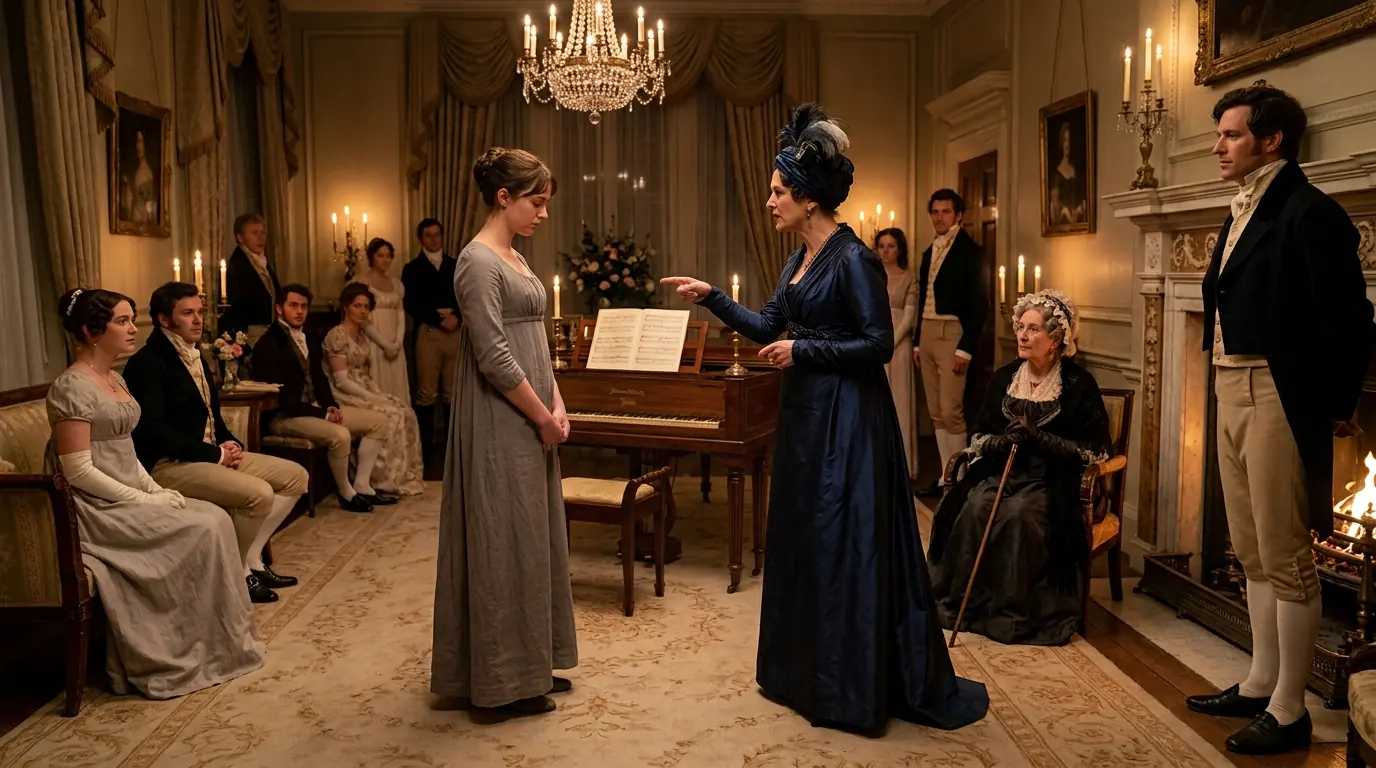
Cordelia Wexford was three steps from the instrument. Her hands were still at her sides; she had not touched a key.
The long drawing room at Amberley in Shropshire on the 11th of March. Lady Wexford did not lower her voice. There was no reason to. She was saying a thing the whole room already believed. Eleven guests heard it. A footman at the door heard it. The candles at that end had just been lit, so it was the bright part of the room.
Nobody looked at Cordelia. That is what a room like this one does: it does not stare. It finds somewhere else to put its eyes, and the finding is the part that hurts.
Cordelia did not answer. She never had. She went to the instrument, sat down, and put her hands on her knees.
Behind her, a woman said something low and pleasant to the woman beside her. The two of them laughed at it. Before she was through the first page, somebody in that room had worked out who wrote the music.
At the far end, an old woman had not spoken since the tea went out. That was the Dowager Duchess of Amberley, seventy-one, back to the fire, stick across her lap. Cordelia had never met her. In eighteen months, those two had exchanged fourteen letters and forty guineas. Not one of those things had reached the person it was addressed to. Cordelia did not know about the guineas at all.
She lifted her hands and played the plainest thing she knew.
Cleeve Manor stands above the Corve, four miles out of Ludlow: twenty rooms, a bad roof over the west end, and a very good stable.
Sir Roland Wexford died there in June of 1811. His physician called it a decline; his groom called it drink. He left one daughter by his first wife—that was Cordelia, twenty-two then. And what he left her came to £8 a year, which is what a village schoolmaster was paid, and about a third of a lady's maid. He left a widow of five years' standing, who had been Mrs. Callow of Chester and had a daughter of her own. And he left a will drawn by a Ludlow attorney who did not like him.
The will gave Lady Wexford the house and its income for her life. Cordelia had £200 in the funds and nothing else in the world. Then it added a clause in the ordinary form. The widow got her provision on one condition: she was to maintain the testator's daughter in the manner of a gentlewoman, so long as that daughter stayed unmarried and under the roof.
Nobody had looked at that clause since the reading. It sat in a deed box in Ludlow, being perfectly true. Cordelia was fed and clothed twice a year, and had a bedroom on the north side. In the county's opinion, Lady Wexford had done a handsome thing by a girl who was no relation of hers.
Nobody had ever asked what the girl did all day.
What she did all day was write music. Her mother taught her, and her mother died when Cordelia was nine. After that, nobody. "Self-taught" is the wrong word for it. Her mother left sixty pages of exercises in a small upright hand with the fingerings marked, and Cordelia had worked through them for eighteen years, the way other people say their prayers. She was better at it than anybody within thirty miles. Nobody at Cleeve Manor could have told you so, because nobody there could tell one piece of music from another.