Ten-year-old Caleb Turner had learned to make a sandwich last.
Not because he liked eating slowly.
Not because he was picky.
But because one sandwich had to carry him through an entire school day, a walk home, and sometimes the long evening before dinner finally appeared on the stove.
His mother, Lydia Turner, worked at a laundry shop on the edge of Millbrook, Ohio, where the machines rattled all day and steam fogged the windows until everyone inside looked like a ghost. She left before sunrise and came home with sore hands, aching feet, and the kind of tired smile mothers wear when they do not want their children to know how hard life has become.
Caleb noticed anyway.
He noticed the bills tucked under the sugar jar.
He noticed how his mother watered down soup when there was not enough.
He noticed how she always said she had eaten at work, even when her stomach growled while she folded laundry at the kitchen table.
So Caleb never complained.
Every morning, he packed his own lunch in a brown paper bag that had already been used three times. Usually, it held peanut butter spread thin across two pieces of bread, half an apple if they had one, and a small cookie if his mother had managed to buy a discount pack from the store.
On cold days, he carried the lunch bag inside his jacket to keep the bread from turning stiff.
On rainy days, he wrapped it in his homework folder so the paper would not tear.
It was not much.
But it was his.
And in Caleb’s world, having something of your own mattered.
Millbrook Elementary stood at the top of Pine Street, a red-brick building with tall windows, cracked steps, and a flagpole that squeaked whenever the wind blew. Most children arrived by car or bus. Caleb walked.
His sneakers had been white once, but now they were gray at the toes and split slightly along one side. When puddles covered the sidewalk, cold water slipped inside and soaked his socks before the first bell rang.
Still, Caleb walked with his head up.
His mother had taught him that being poor was nothing to be ashamed of.
“Shame belongs to people who are cruel,” she always said. “Not to people who are trying.”
Caleb believed her.
At least, he tried to.
There were days when believing was hard.
Like the morning Tyler Brooks pointed at Caleb’s lunch bag and laughed.
“Is that the same bag from yesterday?” Tyler asked loudly as the class lined up outside the cafeteria.
A few kids turned around.
Caleb held the bag closer to his chest. “It still works.”
Tyler smirked. “My mom throws bags away after one use.”
“My mom doesn’t,” Caleb said quietly.
“That’s because your mom probably can’t afford new ones.”
The words hit harder than Caleb expected.
He looked down at his shoes and said nothing.
Their teacher, Mrs. Bell, appeared at the end of the hallway before Tyler could say more. She was a gentle woman with silver-framed glasses and a voice that rarely rose above calm, but one look from her could quiet a room.
“Tyler,” she said, “walk with me.”
Tyler’s smile disappeared.
Caleb kept his eyes on the floor.
He did not want trouble.
He did not want pity either.
At lunch, he sat at the far end of the cafeteria, near the windows. Snow had begun to fall outside, soft and slow, covering the playground in white. Other children traded crackers, fruit snacks, and little bags of chips. Caleb opened his sandwich carefully, making sure no crumbs fell.
He took one bite.
Then another.
He was about to take a third when he noticed someone outside.
At first, he thought it was a bundled-up parent waiting near the gate.
But the person did not move.
Caleb leaned closer to the window.
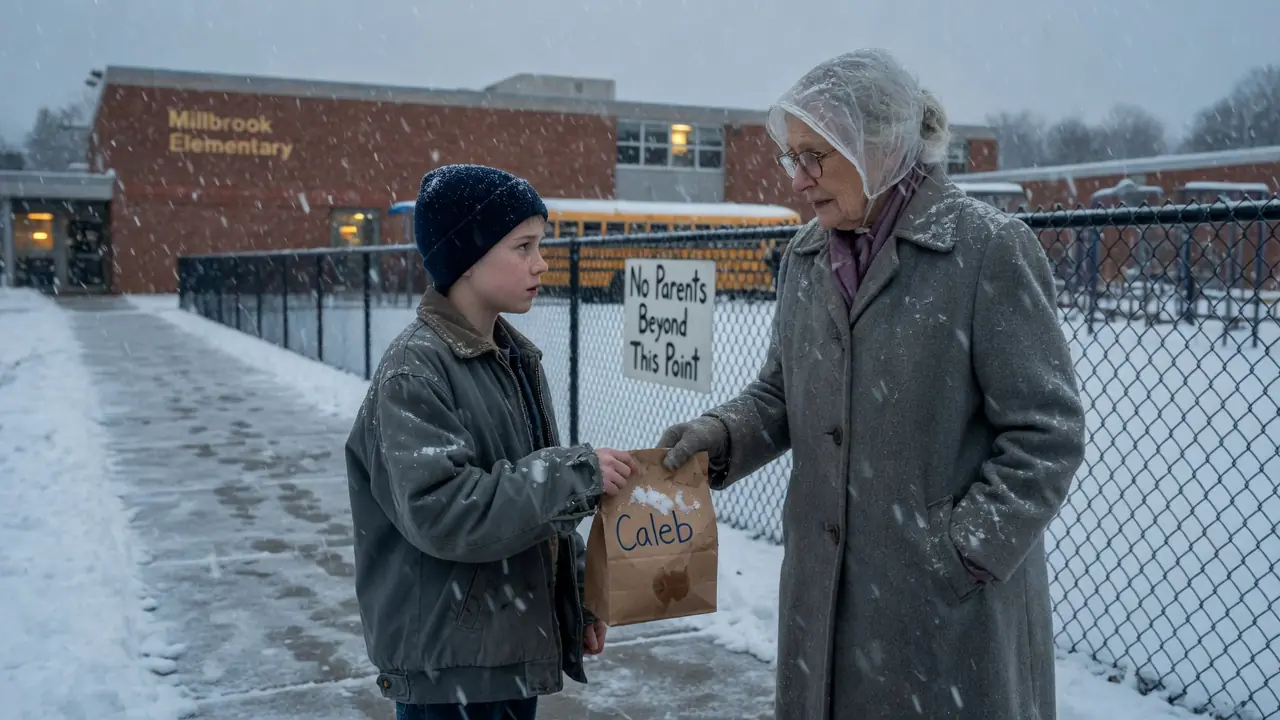
An elderly woman stood beside the school fence, one hand gripping the metal bars, the other pressed against her chest as if she were trying to hold herself together. She wore a long gray coat, too thin for the weather, and a knitted hat pulled low over white hair. Snow gathered on her shoulders.
Teachers moved through the cafeteria with trays and papers.
No one looked out.
But Caleb kept watching.
The woman seemed confused. She turned her head slowly, scanning the street, then the school, then the sidewalk. Her lips moved, but Caleb could not hear what she was saying.
Something about her reminded him of his grandmother, who had died when he was six. Not her face exactly, but the way she held herself, small against the weather, trying to be brave when she was clearly frightened.
Caleb looked down at his sandwich.
Half remained.
His stomach tightened.
He thought of the long walk home.
He thought of the empty feeling that would come later.
Then he looked back at the woman.
She was still standing there.
Caleb folded the sandwich back into the napkin, slipped it into his lunch bag, and raised his hand.
Mrs. Bell saw him from across the cafeteria and walked over.
“Yes, Caleb?”
“There’s an old lady outside,” he said. “By the fence. I think something’s wrong.”
Mrs. Bell looked toward the window. Her expression changed immediately.
“Stay here,” she said.
But Caleb was already standing.
“She looks cold,” he said.
Mrs. Bell paused. She glanced at his lunch bag, then at the woman outside. “All right. Come with me, but stay beside me.”
They hurried through the side door into the cold.
The wind struck Caleb’s face so sharply that his eyes watered. Snowflakes landed on his lashes. Mrs. Bell walked quickly toward the fence, calling out, “Ma’am? Are you all right?”
The elderly woman turned.
Up close, Caleb saw that her face was pale and deeply lined. Her eyes were blue, but clouded with confusion. She had the kind of hands that had worked for many years—thin, veined, and trembling.
“I was going to the library,” the woman whispered. “I think I missed the corner.”
“The library is three blocks away,” Mrs. Bell said gently. “Do you live nearby?”
The woman looked around. “I know this street.”
“What’s your name?”
The woman blinked.
For a moment, she seemed embarrassed.
“Eleanor,” she said finally. “Eleanor Whitcomb.”
Mrs. Bell nodded. “All right, Mrs. Whitcomb. Let’s get you inside where it’s warm.”
But Eleanor did not move.
Her eyes had lowered to Caleb’s lunch bag.
Caleb noticed.
Her lips trembled slightly, and for one painful second, she looked not confused but hungry.
Without thinking too long, Caleb stepped forward and held out the bag.
“You can have this,” he said.
Mrs. Bell looked at him quickly. “Caleb—”
“It’s okay,” Caleb said.
Eleanor stared at the bag as if he had offered her something precious.
“I couldn’t take your lunch,” she said.
“You’re colder than me,” Caleb replied. “And I already ate some.”
That was not entirely true.
Two bites were not lunch.
But it was enough of a truth for him to say.
Slowly, Eleanor accepted the bag. Her fingers brushed his, cold as ice. She opened it and saw the half sandwich wrapped in a napkin, the apple slice tucked beside it, and the small cookie his mother had placed inside that morning.
Her eyes filled with tears.
“No one has shared lunch with me in a very long time,” she whispered.
Caleb did not know what to say.
So he said the only thing that felt right.
“My mom says food tastes better when someone needs it.”
Eleanor looked at him for a long moment.
Then she smiled.
It was small, fragile, and beautiful.
Mrs. Bell guided Eleanor inside. The school nurse called the police, not in a frightening way, but to help find where the woman belonged. Caleb sat beside Eleanor in the nurse’s office while she ate slowly, holding the sandwich with both hands.
She did not eat like someone who was merely hungry.
She ate like someone who had forgotten the world could still be kind.
“What is your name?” she asked him.
“Caleb Turner.”
“Caleb Turner,” she repeated carefully, as though saving it somewhere important.
Then she looked down at the cookie in her palm.
“Do you want this back?”
Caleb shook his head. “You can keep it.”
Eleanor’s fingers closed around it.
“Then I will remember you by it,” she said.
The police found Eleanor’s address later that afternoon. She lived alone in a small white house near the old train station. Her husband had died years before. Her only son lived in another state. She had been walking to the library, become disoriented in the snow, and wandered several blocks in the wrong direction.
When the officers came to take her home, Eleanor stood slowly and reached for Caleb’s hand.
“You saw me,” she said.
Caleb did not understand why that mattered so much.
But he nodded.
“I hope someone sees you too,” Eleanor whispered.
Then she was gone.
That night, Caleb did not tell his mother about giving away his lunch.
He did not want her to worry.
But mothers notice the shape of hunger.
At dinner, Lydia watched him eat his bowl of potato soup too quickly.
“Did you have enough at lunch today?” she asked.
Caleb froze.
He was a terrible liar.
“I had some.”
His mother lowered her spoon. “Some?”
Caleb looked at the table.
“There was an old woman outside school. She was lost and cold. I gave her the rest of my sandwich.”
For a moment, Lydia said nothing.
Caleb braced himself for worry, maybe even scolding. Food was not something they could afford to give away easily.
But his mother reached across the table and placed her hand over his.
“You did right,” she said softly.
His throat tightened.
“But what if we don’t have enough?” he asked.
Lydia looked tired. Very tired. Yet her eyes were steady.
“Then we share what we can and keep going.”
The next morning, Caleb found two sandwiches in his lunch bag.
One was peanut butter.
The other was cheese.
He stared at them.
His mother stood by the sink, pretending not to watch.
“Mom,” he said, “this is too much.”
She shrugged. “Maybe you’ll be hungry.”
Then, after a pause, she added, “Or maybe someone else will be.”
Caleb carried the bag carefully all the way to school.
For the next few weeks, he looked for Eleanor whenever he passed the fence.
He did not see her.
Snow melted. February became March. The playground turned muddy. The days stretched a little longer, and the wind stopped biting so hard.
Life returned to normal.
Or as normal as Caleb’s life could be.
His mother kept working long shifts. The bills still came. Tyler Brooks still made comments sometimes, though less often after Mrs. Bell began watching him closely. Caleb’s shoes still leaked when it rained.
But something inside Caleb had changed.
Before Eleanor, he had thought kindness was something rich people could afford.
After Eleanor, he understood that kindness was not about having extra.
It was about seeing someone and deciding they mattered.
In April, a letter arrived at Millbrook Elementary.
It came in a cream-colored envelope with careful handwriting across the front.
To Caleb Turner, Room 4B.
Mrs. Bell brought it to him after math class.
The whole room watched as Caleb took it.
“Who’s it from?” Tyler asked.
Caleb turned the envelope over.
There was no return address.
His heart beat faster for reasons he did not understand.
Mrs. Bell smiled gently. “You may read it in the hallway if you’d like.”
Caleb nodded and stepped outside.
The hallway smelled like floor polish and pencil shavings. He opened the envelope carefully, afraid of tearing it.
Inside was a folded note.
Dear Caleb Turner,
You may not remember me for long, but I will remember you for the rest of my days.
My name is Eleanor Whitcomb. On a snowy afternoon, you gave me your lunch when I was lost, cold, and frightened. You did not ask what I could give you back. You did not look away. You saw an old woman at the fence and treated her like she mattered.
I am writing because I wanted you to know something.
That lunch was not just food.
It was proof that the world had not forgotten me completely.
My memory is not what it used to be. Some days are clear, and some days feel like walking through fog. But I remember your face. I remember your brown paper bag. I remember the way you said your mother taught you that food tastes better when someone needs it.
Your mother raised a good boy.
I have asked my neighbor to help me mail this letter because writing it myself took many tries. I do not have much family nearby, and I do not often have visitors. But if your mother allows it, I would like to invite you both to tea one Saturday.
No pressure. No obligation.
Just tea.
And perhaps, if you like, I can show you my husband’s old workshop. He used to build birdhouses, rocking chairs, and little wooden trains. I have not opened it in years.
With gratitude,
Eleanor Whitcomb
Caleb read the letter twice.
Then a third time.
When he returned to class, Mrs. Bell did not ask what it said. She only touched his shoulder and said, “Good news?”
Caleb nodded.
“I think so.”
That Saturday, Lydia walked with Caleb to Eleanor’s house near the train station.
It was a small white house with blue shutters and a narrow porch. The yard was overgrown, but daffodils had begun to bloom along the walkway. A wind chime hung beside the door, turning softly in the breeze.
Eleanor opened the door before they knocked.
She wore a lavender sweater, and her white hair was neatly pinned back. She looked less frightened than she had at the fence, but still fragile, as though a strong wind might carry her away.
“Caleb,” she said, smiling.
“This is my mom,” Caleb said. “Lydia Turner.”
Eleanor took Lydia’s hands in both of hers.
“You raised him,” she said.
Lydia looked surprised. “I try my best.”
“You did more than try.”
Inside, the house smelled faintly of lemon polish and old books. Framed photographs covered the walls: Eleanor as a young woman in a blue dress, Eleanor beside a tall man with kind eyes, a little boy on a bicycle, a family at Christmas, a workshop full of wood shavings and sunlight.
Tea waited on the kitchen table with biscuits, sliced apples, and a small plate of sandwiches.
Caleb stared at the food.
Eleanor noticed and laughed softly.
“Do not worry,” she said. “These are meant to be eaten.”
They sat for nearly an hour.
Eleanor told them about her husband, Samuel Whitcomb, who had built furniture by hand and believed every piece of wood had a second life hidden inside it. She told them about the train station when it still carried passengers every day. She told them about summers when children ran through her yard to buy lemonade from a stand she kept on the porch.
Sometimes, she repeated herself.
Sometimes, she lost a word and stared at the table until it returned.
No one rushed her.
Caleb listened carefully.
After tea, Eleanor led him to the back of the house.
“The workshop is there,” she said, pointing to a small building behind the garden. “Samuel loved that place.”
The door stuck at first. Lydia helped pull it open.
Dust floated in the air like tiny sparks.
Inside, Caleb saw tools hanging on the walls, jars of nails lined on shelves, blocks of wood stacked in corners, and half-finished projects resting on benches. A wooden rocking horse stood near the window, missing one painted eye. Birdhouses hung from rafters. A small train engine sat unfinished beside a can of faded red paint.
Caleb stepped inside slowly.
It felt like entering a memory.
“Did your husband make all this?” he asked.
Eleanor nodded. “With those hands of his. Strong hands. Patient hands.”
Caleb ran his fingers along the edge of the little train.
“I wish I knew how to build things.”
Eleanor looked at him.
For the first time that day, her expression became clear and sharp.
“Then you should learn.”
Caleb laughed shyly. “We don’t have tools.”
“You have hands,” Eleanor said. “That is where tools begin.”
From that day on, Caleb and Lydia visited Eleanor every Saturday.
At first, it was only tea.
Then Eleanor asked Caleb to help sweep the workshop.
Then to sort nails.
Then to sand rough pieces of wood.
She could not teach him everything herself, but she remembered enough. And when she forgot, she opened Samuel’s old notebooks, where he had drawn careful diagrams and written instructions in neat pencil.
Caleb learned the names of tools.
Plane.
Clamp.
Chisel.
Level.
He learned how to measure twice before cutting once.
He learned that wood could split if forced, but shaped beautifully if treated with patience.
He learned that mistakes were not always failures. Sometimes, a crooked cut became a smaller shelf. A scratched board became a painted sign. A broken piece became the base for something new.
Eleanor watched him with quiet joy.
Lydia watched too.
At home, Caleb began noticing things he had never noticed before. The wobbly kitchen chair. The loose drawer handle. The broken step near the back door.
One evening, he fixed the drawer with an old screw Eleanor had let him keep.
His mother stared at it, opening and closing it three times.
“Well,” she said, smiling, “look at that.”
Caleb stood taller than he had all week.
By summer, he had built his first birdhouse.
It was uneven.
The roof leaned slightly to one side.
A streak of blue paint ran down the back.
But when he showed it to Eleanor, she held it like treasure.
“Samuel’s first birdhouse looked worse,” she said.
“Really?”
“No,” Eleanor admitted with a mischievous smile. “But yours has more heart.”
They hung it on the fence outside her kitchen window.
Two weeks later, a pair of sparrows moved in.
Caleb considered that the first real miracle of his life.
The second came in September.
School had started again. Caleb was now in fifth grade, still wearing old sneakers, though Lydia had managed to patch them better. Tyler Brooks had moved on to bothering other children, mostly because Caleb no longer lowered his eyes when insulted.
Every Saturday, Caleb still visited Eleanor.
But Eleanor was changing.
Some days, she remembered everything.
Other days, she called Caleb by her son’s name, Daniel.
Sometimes she forgot tea was on the stove.
Sometimes she stared at Samuel’s workshop and asked when he would be coming home.
Caleb did not know what to do with that kind of sadness.
He asked his mother once, “Is Mrs. Whitcomb getting worse?”
Lydia took a long time to answer.
“Yes,” she said gently. “I think she is.”
“Can we fix it?”
His mother’s eyes softened.
“Not everything can be fixed the way a drawer can.”
Caleb hated that answer.
But he understood it.
So he did what he could.
He labeled jars in the workshop with large letters.
He wrote “TEA” on a card and placed it near the kettle.
He made a little wooden sign for her front door that said: You Are Home, Eleanor.
When she saw it, she cried.
“Why are you sad?” Caleb asked, alarmed.
“I am not sad,” she whispered. “I am remembered.”
In October, Eleanor’s son came to Millbrook.
Daniel Whitcomb was a tall man in his forties with tired eyes and a business coat that looked too formal for the small town. He arrived on a Saturday while Caleb and Eleanor were sanding a shelf in the workshop.
Eleanor froze when she saw him.
For one painful second, Caleb feared she did not know who he was.
Then she whispered, “Danny.”
The man’s face broke.
He crossed the workshop and hugged her carefully, as though she were made of glass.
“I’m sorry, Mom,” he said. “I should have come sooner.”
Eleanor patted his back. “You came now.”
Daniel stayed for tea. He thanked Lydia for helping his mother. He thanked Caleb too, but Caleb shrugged because being thanked made him uncomfortable.
“I didn’t do much,” Caleb said.
Daniel looked around the workshop. His eyes moved over the swept floor, the labeled jars, the birdhouses, the repaired shelves, and the sign Caleb had made.
“You did more than you think.”
A week later, Daniel arranged for Eleanor to have daily care at home. A woman named Mrs. Alvarez began visiting in the mornings, helping with meals and medicine. Daniel came on weekends whenever he could. The house became safer, brighter, less lonely.
But Eleanor insisted Caleb keep coming.
“The boy is part of the house now,” she said.
Caleb smiled at that.
Winter returned.
The first snow fell on a Thursday morning, nearly one year after Caleb had found Eleanor by the school fence.
He stood at the classroom window, watching flakes drift over the playground, remembering the way she had looked that day—cold, lost, holding his lunch bag like it was a lifeline.
Mrs. Bell came to stand beside him.
“Thinking about something?” she asked.
“Mrs. Whitcomb,” Caleb said.
Mrs. Bell smiled. “She’s lucky you saw her.”
Caleb shook his head.
“I think I’m lucky she was there.”
Mrs. Bell looked at him curiously.
Caleb did not explain.
How could he?
Before Eleanor, he had thought his life was only about what he lacked.
After Eleanor, his life had a workshop in it.
It had tea on Saturdays.
It had sparrows in a crooked birdhouse.
It had someone who forgot many things but remembered his kindness.
That was not a small thing.
In January, Eleanor became ill.
It began with a cough, then weakness, then days spent mostly in bed beneath a quilt Samuel’s mother had made decades earlier.
Caleb visited with Lydia after school. He brought small things from the workshop to show her: a sanded block, a painted wooden car, a little shelf he had finally finished without help.
Eleanor’s hands trembled when she touched the shelf.
“Beautiful,” she whispered.
“It’s crooked,” Caleb said.
“So are trees,” Eleanor replied. “People still sit under them.”
He laughed, though his chest hurt.
One afternoon, Eleanor asked Lydia to make tea, though she barely drank any. Then she asked Caleb to sit beside her.
On the nightstand was a small wooden box.
“Open it,” she said.
Caleb lifted the lid.
Inside lay Samuel’s old measuring tape, a pencil worn down to half its size, and a silver pocketknife with a smooth wooden handle.
Caleb looked up quickly. “I can’t take this.”
“Not today,” Eleanor said. “But someday.”
Her cloudy blue eyes held his.
“You must promise me something.”
Caleb swallowed. “What?”
“Build things,” she said. “Not just shelves or birdhouses. Build places where people feel less alone.”
Caleb did not fully understand.
But he nodded.
“I promise.”
Eleanor smiled.
“Good boy.”
Two weeks later, Eleanor Whitcomb passed away in her sleep.
The news came on a quiet Sunday morning.
Lydia answered the phone in the kitchen. Caleb knew before she said anything. He knew from the way her shoulders sank and one hand covered her mouth.
He stood in the doorway, unable to move.
His mother turned.
“Oh, Caleb,” she whispered.
He ran to her then, and she held him while he cried into her shirt.
The funeral was small.
Daniel stood beside the casket, older somehow than he had looked months before. Mrs. Bell came. Mrs. Alvarez came. Several neighbors came too, though many admitted they had not seen Eleanor much in recent years.
Caleb wore the best shirt he owned, the collar tight around his neck.
In his pocket, he carried a tiny wooden bird he had carved badly from scrap wood. One wing was too large. The beak was uneven. But he had sanded it until it was smooth.
When no one was looking, he placed it beside the flowers.
“Thank you,” he whispered.
After the funeral, Daniel asked Caleb and Lydia to come to Eleanor’s house.
Caleb did not want to go at first.
The idea of the house without Eleanor felt wrong.
But his mother squeezed his hand.
So they went.
The house was quiet. Too quiet.
Daniel led them into the kitchen, where three envelopes lay on the table.
“One of my mother’s last clear wishes,” Daniel said, “was that you both receive these.”
Lydia stiffened. “Daniel, we didn’t help your mother for money.”
“I know,” Daniel said gently. “She knew too.”
He handed Lydia the first envelope.
Inside was a letter.
Lydia read it silently, then covered her mouth.
Daniel handed Caleb the second envelope.
His name was written across it in Eleanor’s careful handwriting.
For Caleb Turner.
His hands shook as he opened it.
Dear Caleb,
If you are reading this, it means I have gone where memory cannot trouble me anymore.
Do not be too sad for me.
I had many lonely years after Samuel died. I thought the world had grown quiet because no one needed me and no one saw me.
Then a boy with a brown paper lunch bag saw me at a fence.
You gave me half a sandwich, an apple slice, and a cookie. It sounds like a small thing. It was not. It brought me back into the world.
Because of you, my last year was not empty.
It had tea.
It had laughter.
It had sawdust.
It had birds in the yard again.
It had your mother’s kindness and your good heart.
I spoke with Daniel, and he agrees with what I have chosen. Samuel’s workshop now belongs to you, when you are old enough to use it safely. Until then, Daniel and your mother will help care for it.
But there is more.
Samuel and I saved money for years. Some was meant for travel we never took. Some was meant for repairs we never made. I have asked Daniel to place a portion of it into an education fund for you.
You once told me you wished you knew how to build things.
Now you will learn.
Use it for school, training, tools, or whatever helps you become the kind of builder the world needs.
Remember your promise.
Build places where people feel less alone.
With all my gratitude,
Eleanor
Caleb could not see the last line clearly because tears had blurred the page.
He lowered the letter.
“I don’t understand,” he whispered.
Daniel opened the third envelope and slid a document across the table to Lydia.
“It’s real,” he said. “My mother arranged it with an attorney. The education fund is not enormous, but it will be enough to help Caleb later. And the workshop will remain here for him to use. I’ll keep the house for now. He can come whenever you allow.”
Lydia was crying silently.
“Daniel, this is too much.”
He shook his head.
“My mother said the same thing about Caleb’s lunch.”
No one spoke after that.
They simply sat in Eleanor’s kitchen, surrounded by old photographs, dust motes, and the echo of a woman who had turned a half sandwich into a legacy.
Years passed.
Caleb grew taller.
His patched sneakers became work boots.
His small hands became strong hands.
He studied hard in school, not because every subject came easily, but because Eleanor’s letter sat framed above his desk, reminding him that someone had believed he could become more than his circumstances.
He spent weekends in Samuel’s workshop, first under Daniel’s supervision, then on his own. He built birdhouses, shelves, benches, toy trains, and eventually furniture that people in Millbrook began to buy.
By sixteen, he was repairing neighbors’ porches for small payments.
By eighteen, he had earned a scholarship to a trade school for carpentry and design, helped by Eleanor’s education fund.
By twenty-two, Caleb Turner returned to Millbrook with a truck full of tools, a notebook full of plans, and a dream that had begun in an old woman’s forgotten workshop.
He did not open a fancy business.
He opened a community repair shop.
Turner & Whitcomb Workshop.
The sign above the door was made from reclaimed wood taken from Eleanor’s old fence.
Under the name, in smaller letters, Caleb carved:
Build Places Where People Feel Less Alone.
The shop repaired furniture for people who could pay.
For those who could not, Caleb found another way.
Children could sweep floors, sort screws, or learn to sand wood.
Elderly neighbors could bring broken chairs, picture frames, and memories.
Single mothers could get a crib fixed without shame.
Veterans could sit in the corner with coffee and talk while Caleb worked.
Every December, Caleb and his mother organized a lunch drive at the workshop. Brown paper bags filled with sandwiches, fruit, cookies, and handwritten notes lined the tables.
No one was turned away.
On the first snowy day after the shop opened, Caleb stood by the front window and watched children run past, laughing as flakes landed in their hair.
His mother came to stand beside him.
She was older now, lines at the corners of her eyes, but her hands no longer shook from endless laundry shifts. Caleb had made sure she could rest more.
“She would have loved this,” Lydia said.
Caleb looked toward the back wall, where Eleanor’s photograph hung beside Samuel’s tools.
In the picture, Eleanor was smiling on her porch, one hand lifted as if waving someone home.
“I hope so,” Caleb said.
A small knock sounded at the door.
Caleb turned.
An elderly man stood outside, bent against the cold, holding the broken leg of a wooden chair. His coat was thin. His expression was uncertain, almost ashamed.
Caleb crossed the room and opened the door.
“Come in,” he said warmly. “It’s freezing out there.”
The old man hesitated. “I don’t have much money.”
Caleb smiled.
For a moment, he was ten years old again, standing at a school fence with a brown paper bag in his hand.
“That’s all right,” he said. “Let’s see what we can fix.”
The old man stepped inside.
Behind Caleb, the workshop smelled of pine, tea, and fresh bread from the lunch table.
Outside, snow covered the sidewalk.
Inside, no one had to feel forgotten.
And somewhere in every birdhouse, every repaired chair, every shared sandwich, Eleanor Whitcomb’s kindness lived on—not because she had been rich, not because she had left money behind, but because one hungry boy had seen her when the rest of the world looked away.
That was the gift Caleb had received.
Not just the workshop.
Not just the fund.
Not even the chance to build a better life.
The true gift was this:
He had learned that a small kindness, offered at the right moment, could become a doorway.
And once opened, that doorway could lead more people home.