I have known Mrs. Cecily Hawthorne since she was a girl of twelve, when her father brought her to Sunday services in a cart pulled by a lame pony, and she still managed to arrange the altar flowers before anyone else arrived. She had that quality even then—a quiet usefulness the world perpetually overlooked.
When she married young Hawthorne, I thought the man had found more than he deserved. When he died of a fever three winters later and left her with almost nothing, I was not surprised that society promptly forgot she existed.
I mention this because it was I who drove her to the Pemberton wedding in April. She had been invited, I suspect, out of an obligation so old it had calcified into mere habit. The Pembertons are distant cousins of her late husband, and they seat the unimportant early so the important may arrive late and be seen arriving.
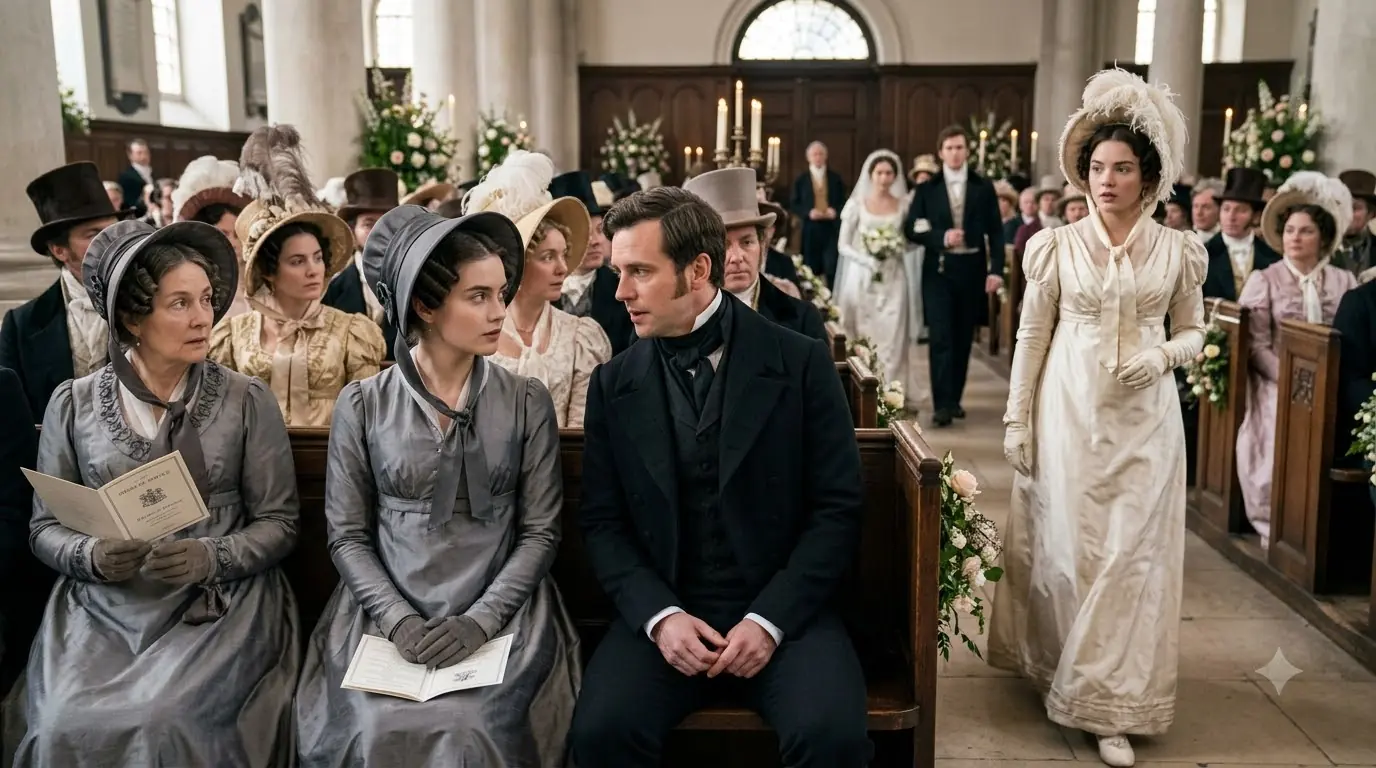
Cecily and I arrived at a quarter to eleven and were shown to a bench near the side aisle—not quite the back, but close enough that I could hear the draft through the vestibule door. She sat very straight. She wore a gray silk that had been turned and re-hemmed, which I noticed because I noticed everything that morning and wished I could do more than notice.
Around us the pews filled with lace and feathers and the low, self-satisfied murmur of people who know they belong where they are standing. Three women Cecily had once called friends swept past our bench without a word. A fourth glanced at her and then glanced away with the particular speed that is worse than any open cut.
It was somewhere during the processional that I became aware of a disturbance at the end of our row. Not a loud disturbance; the man was far too controlled for that. He simply appeared, as certain men do, filling the air around him before he quite filled the space. Tall, dark coat of a quality that needed no ornament, the kind of face that has decided, somewhere in its late thirties, not to offer anyone an easy expression.
Lord Edward Crane, the Duke of Ashworth.
He was known in three counties as the most feared landlord in the north, a man whose silences were said to be more punishing than other men's speeches. He was also, if the rumors were correct, the target of a scheme. The bride's elder sister, a Miss Portia Pemberton, had been engineering circumstances all season to have herself placed at his right hand at every conceivable social occasion. The rumor was that she intended to manufacture a compromise situation before the day was out. I had heard this from my housekeeper, who heard it from the Pembertons' cook, which is to say I heard it as gospel.
Ashworth had clearly heard it, too. He stood at the end of our row, surveying the pews with the expression of a man calculating an escape route, and found there was none. Miss Portia Pemberton was already making her way along the opposite aisle with the focused intention of a woman who has rehearsed this moment.
He sat down beside Cecily Hawthorne.
It was so unexpected that I, on her other side, nearly dropped my order of service. He leaned toward her, and I heard him say in a voice pitched to carry no further than her ear, "I find myself in need of a small kindness, Mrs. Hawthorne. If you would permit me to sit with you and your companion, and if you could bear to behave for the length of this service as though we are old acquaintances, I would be deeply in your debt."
I watched her face. She turned to look at him with those steady gray eyes of hers, and I saw her take the measure of him in a single unhurried glance: the discomfort he was hiding, the pride that made it cost him something to ask, and the genuine decency beneath both.
"You know my name," she said.
"Your late husband and I shared a tutor for two years at the age of nine," he said. "I attended his funeral. You may not have noticed."
"I noticed," she said quietly. "You stood at the very back and left before the bell finished."
A pause that I thought contained more than either of them expected. Then she folded her hands in her lap and said, quite simply, "Old acquaintances, then, Your Grace."
Miss Portia Pemberton, I am pleased to report, arrived at our row to find it entirely full.
Through the service, he sat like a man enduring a siege, and Miss Pemberton's gaze upon our bench could have lit kindling. When the first hymn was given out, Cecily tilted her open book toward him without being asked. He took the other edge of it, and I heard him murmur, "You are doing me a greater kindness than you know, madam."
"Then repay it by singing properly, Your Grace," she said. "The second line rises."
I will swear before any bishop in England that the most feared man in the north very nearly smiled.
What followed over the next six weeks, I can only describe as a comedy that did not know it was becoming something else.
Ashworth called on Cecily three days after the wedding, ostensibly to thank her. He stayed two hours debating the management of tenant housing in the northern counties—opinions she had formed from reading reports I had lent her.
"You disagree with my steward," he said at one point, in the tone of a man encountering a new species.
"Your steward has never wintered in one of those cottages," she said. "I have sat with the families who do."
He left looking, as my housekeeper put it, as if someone had surprised him.