The first thing Abigail Harper noticed about Calloway Ranch was that nobody had opened the windows in months.
The second was the smell.
Old coffee, horse leather, woodsmoke, damp wool, dust, onions, sweat, and something that might once have been stew had settled into the one-room cabin with such determination that Abigail stopped just inside the doorway and wondered whether the place technically qualified as inhabited. Sunlight pushed weakly through cream curtains that had once been white, revealing floating dust thick enough to make the air look solid.
Behind her, Jacob Calloway dropped her trunk onto the plank floor.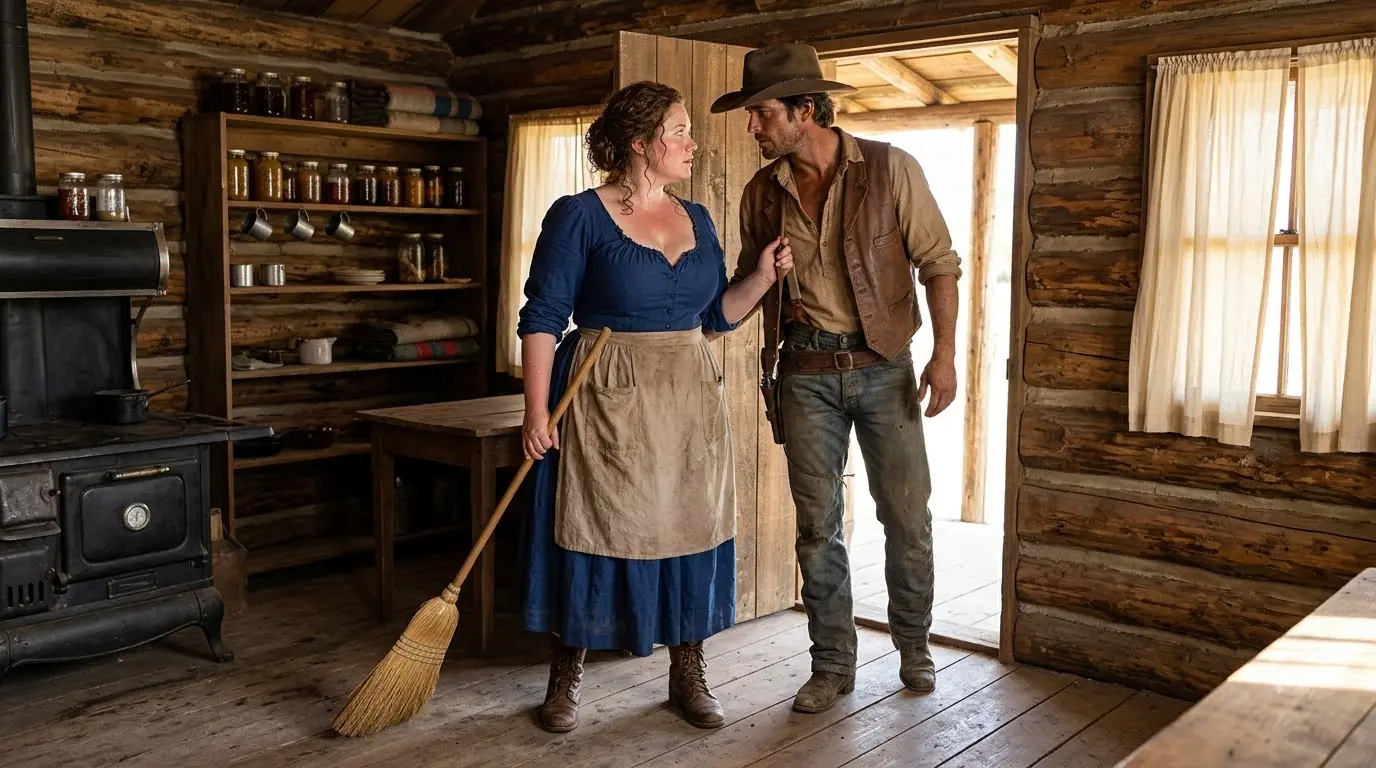
“There.”
Abigail turned.
“There what?”
“Your things.”
“I gathered that.”
Jacob looked toward the trunk, then toward her.
He was thirty-seven years old, though the lines around his gray-blue eyes made him look older when he was tired, which seemed to be most of the time. He wore a battered brown hat, tan work shirt, leather vest, dusty trousers, and the expression of a man who had spent several years forgetting that conversation sometimes required more than one word.
Abigail crossed her arms.
“You really live like this?”
Jacob looked around.
“Yes.”
“Voluntarily?”
He frowned.
“What’s wrong with it?”
Abigail almost laughed.
Instead she walked to the table and lifted a plate that appeared to have been abandoned after breakfast sometime during the previous territorial administration.
“This.”
Jacob stared.
“That’s yesterday.”
“There is something growing on it.”
“Cheese.”
“Cheese doesn’t crawl.”
Jacob looked closer.
He took the plate from her.
“Fine.”
He walked outside and threw the entire thing somewhere beyond the porch.
Abigail stared after him.
That was the moment she understood the advertisement had been painfully honest.
Ranch housekeeper wanted. Room, meals, eighteen dollars monthly. Remote location. Hard work. No nonsense.
Abigail had needed work badly enough that “no nonsense” sounded almost peaceful.
Now she suspected it meant Jacob Calloway simply did not know where his socks were.
He returned.
“You staying?”
She looked around again.
Then at the man who clearly expected her to turn around and walk six miles back toward the stage road.
“Yes.”
Jacob seemed almost disappointed.
“All right.”
Abigail removed her gloves.
“Where’s the broom?”
He pointed toward a corner.
She found it beneath a saddle blanket.
That was how their life together began.
Not with romance.
Not with destiny.
With Abigail Harper holding up a broom covered in cobwebs and telling Jacob Calloway that if he intended to pay her eighteen dollars a month, the first thing she was going to do was make his house fit for human lungs.
Abigail had arrived in Montana Territory carrying one trunk, thirty-one dollars, two dresses fit for public viewing, one work dress, a pair of good boots, her mother’s Bible, and a determination never again to depend entirely upon a man.
That last item weighed more than the trunk.
Her father had died when she was sixteen.
Her mother followed four years later.
At twenty-two, Abigail married Edward Harper, a bookkeeper in St. Louis who spent the first year calling her beautiful and the second year explaining which parts of her needed improvement.
Too outspoken.
Too heavy.
Too curious about money.
Too willing to ask where his salary went.
Too unwilling to accept vague answers.
The marriage lasted five years.
It ended when Edward disappeared with the savings account and a woman who wore feathers in her hat.
Abigail discovered both facts from the same hotel clerk.
By the time legal papers finally arrived, Edward had taken nearly everything that could be easily converted into cash.
What remained was Abigail.
She decided that was sufficient.
She worked briefly in a boarding house, then traveled west with a cousin whose family settled near Bozeman. When her cousin’s husband lost work and the household became crowded, Abigail answered Jacob Calloway’s advertisement.
She told herself she wanted wages.
Privacy.
Distance.
Nothing else.
Calloway Ranch seemed perfect.
At least until she saw the kitchen.
Jacob had different reasons for preferring strangers.
People in Clearwater Crossing knew too much.
They knew his father had owned almost twice the land Jacob held now.
They knew Jacob’s older brother had died in a wagon accident.
They knew his mother spent her final years blaming Jacob for not persuading the brother to stay home that morning.
They knew Jacob had been engaged once.
And they knew the engagement ended after Margaret Bell decided life with a struggling cattleman offered less security than marriage to a merchant in Helena.
Jacob did not hate Margaret.
That surprised everyone.
He simply stopped asking women to stay.
The ranch became easier.
Cattle did not require promises.
Fences did not interpret silence.
Land did not ask whether a man loved correctly.
Then his housekeeper, Mrs. Dorsey, moved to California to live with her daughter.
Three weeks later, Jacob nearly set fire to the kitchen trying to fry bacon while repairing a harness at the same time.
The advertisement appeared the following morning.
He expected an older widow.
Maybe a stern woman in her fifties.
Instead Abigail Harper stepped from the supply wagon wearing a dark traveling dress, carrying herself with the confidence of a woman who had already survived something worse than whatever he could offer.
Jacob knew she was trouble within five minutes.
Within five weeks, he knew that assessment had been too small.
Abigail cleaned for four days.
Not continuously.
No building could survive that much judgment.
She opened windows.
Washed curtains.
Scrubbed shelves.
Boiled linens.
Burned one mattress cover.
Threw away food that Jacob insisted remained “probably fine.”
Organized his jars.
Found six missing spoons.
Discovered a revolver beneath flour sacks.
Jacob blamed mice.
Abigail asked what kind of armed mice lived in Montana.
He avoided answering.
By the end of the first week, the cabin smelled of soap, cedar, coffee, and bread.
Jacob entered one evening and stopped.
Abigail looked up from the stove.
“What?”
He glanced around.
“Nothing.”
“You’re standing in the doorway.”
“I can see that.”
“You look confused.”
“It looks different.”
“It looks clean.”
Jacob removed his hat.
“That too.”
Abigail turned back toward the pan.
“You’re welcome.”
He stood there another moment.
Then:
“Smells good.”
She looked over her shoulder.
“Was that praise?”
“Observation.”
“Coward.”
Jacob almost smiled.
That became their first joke.
Work extended beyond the cabin almost immediately.
Abigail had been hired as housekeeper.
Then Jacob injured his left shoulder pulling a calf from a washout.
He claimed he could still repair the south fence.
Abigail watched him attempt to lift a post.
“No.”
Jacob stared.
“What?”
“You’re not doing that.”
“It needs doing.”
“I know.”
She took the post.
He looked horrified.
“You can’t carry that.”
Abigail lifted it.
The post was heavy.
She refused to show how heavy.
Jacob’s eyebrows rose.
Abigail walked toward the fence.
“You planning to stand there admiring me?”
“I’m trying to decide whether to stop you.”
“Decide faster.”
He followed.
They spent the afternoon repairing fence together.
Jacob learned Abigail could drive staples, stretch wire, carry feed, and swear fluently when a hammer struck her thumb.
Abigail learned Jacob laughed more easily when outdoors.
By sunset, they were exhausted.
Jacob offered his hand to help her across the creek.
Abigail looked at it.
“I can cross.”
“I know.”
“Then why?”
“Because the rock’s wet.”
She took his hand.
It should have meant nothing.
Instead both noticed.
Neither mentioned it.
The first real problem appeared in June.
Jacob’s irrigation ditch stopped carrying enough water to the lower pasture.
He blamed drought.
Abigail disagreed.
She had no formal knowledge of irrigation.
But she understood numbers.
For three weeks she had been recording water usage because Jacob’s account books offended her sense of order.
The decline was too fast.
She showed him.
Jacob looked at the page.
“You’ve been measuring the ditch?”
“Yes.”
“Why?”
“You were guessing.”
“It worked for fifteen years.”
“Apparently it stopped.”
Jacob sighed.
They followed the ditch upstream.
Half a mile beyond the north fence, they found mud piled deliberately against a narrow diversion gate.
Someone had partially blocked the channel.
Jacob crouched.
“Could be runoff.”
Abigail pointed.
“Runoff tie rope?”
A piece of cut rope protruded from the mud.
Jacob’s face changed.
They cleared the obstruction.
Water returned.
Abigail stood with mud covering her skirt to the knees.
“Who wants your pasture dry?”
Jacob looked toward the neighboring ridge.
“Could be kids.”
“Do children here sabotage irrigation for entertainment?”
“Some are very bored.”
She stared.
Jacob sighed.
“My neighbor’s been asking to buy the lower pasture.”
“Name?”
“Calvin Rusk.”
Abigail looked toward the distant hills.
“Rich?”
“Enough.”
“Honest?”
Jacob did not answer.
That answered it.
Calvin Rusk arrived three days later.
He was forty-eight, clean-shaven, well dressed, and rode a chestnut gelding that looked better fed than most people in Clearwater Crossing.
Abigail was hanging laundry.
Calvin removed his hat.
“Mrs. Harper?”
“Miss is sufficient.”
“My apologies.”
He smiled.
“You must be Jacob’s new help.”
Abigail looked at him.
“Must I?”
Calvin seemed entertained.