The debt was impossible. The stranger at her door was not. Lucy Roberts had one night to save her dying father from ruin and only one offer on the table: a rough-looking farmer, a bank draft bearing the exact figure she owed, and a proposal that made no sense. Marry him, leave by morning, and ask questions later.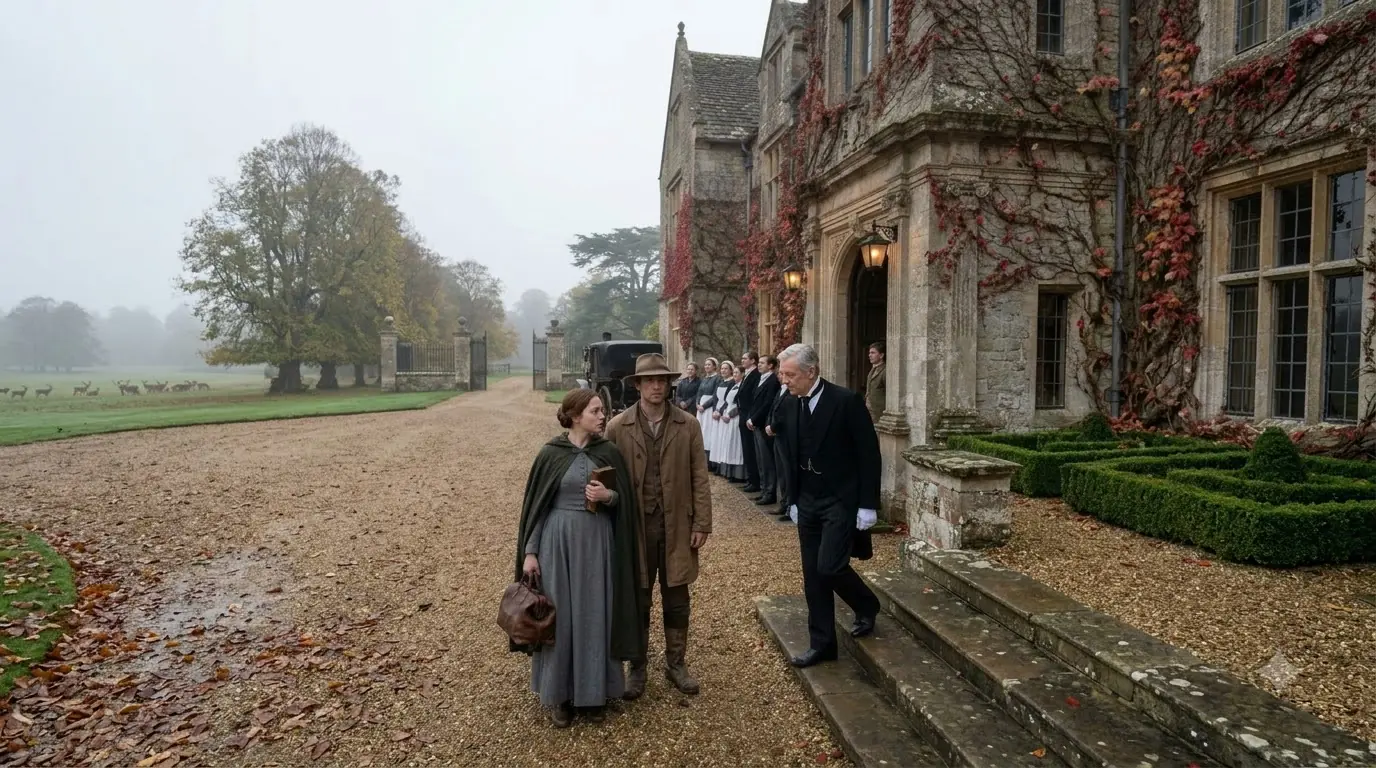
The village laughed when she accepted. They said desperation had made her foolish, and that a poor farmer was the best a ruined girl could hope to find. Yet when the carriage stopped that evening, the iron gates swung open, and servants lined the steps of a great stone manor glowing gold through the mist, the butler bowed and spoke two words that changed everything.
“Welcome home, Your Grace.”
Lucy turned slowly toward the man in the worn coat and muddied boots—the man who had called himself a farmer, the man she had married at dawn. He was already watching her, and he did not look surprised at all.
The rain had come without apology the night before. It pressed against the windows of the Roberts cottage in long silver sheets, drummed against the cracked sill, slipped through the gap above the front door, and tapped steadily into the tin basin beneath the leak in the ceiling. Lucy Eloise Roberts had heard that sound so often during the past few months that she barely noticed it anymore.
What she noticed was the fire: how low it burned, how little wood remained beside the grate, and how the cold moved across the floor like something alive, searching for ankles. Lucy was twenty-two years old. She had been poor for three years, but only that winter had poverty begun to settle into her bones.
She stood at the window with her arms folded across her chest, her breath clouding the glass. At the far end of the lane sat the black shape of a carriage. It had not moved for ten minutes; it simply waited in the rain, patient and dark, like an omen wearing wheels.
Lucy already knew who was inside it.
Behind her, in the narrow back room, her father slept in a bed that had grown too wide for his shrinking frame. Thomas Elias Roberts had once been a careful man and a respected steward’s clerk, a person of small but genuine dignity. Illness had taken his strength first, then his position, then his reputation, and the debts had followed as scavengers follow a storm.
One misfortune had come after another until the Roberts name meant little in Hawthorne Village except failure. Lucy heard the carriage door open but did not move from the window. She watched Mr. Archibald Reginald Shaw step onto the muddy lane, his boots protected by leather gaiters and his coat perfectly pressed despite the weather.
Shaw was built for the appearance of authority: broad shoulders, a silver-handled cane, and a black leather case tucked under one arm as though it contained documents rather than daggers. He looked toward the cottage with the expression of a man who had already decided what he would find inside it.
Lucy exhaled slowly, straightened her spine, and smoothed the gray wool dress that was the only presentable one she still owned. She reached the door before he could knock twice.
“Miss Roberts,” Shaw said pleasantly when she opened it. “What a grim evening.”
“Come in, Mr. Shaw.”
He entered without wiping his boots. He placed the leather case on the small table near the hearth as though it already belonged to him and opened it with the deliberate movements of a man who understood that slowness could be its own kind of cruelty. Inside were rows of folded papers, notices, letters, and ledger copies, all arranged with the precision of someone who took pleasure in order.
“I’ll save us both the performance,” Lucy said. “Tell me how much.”
Shaw’s smile shifted slightly. He appreciated her directness, she suspected, because it spared him the trouble of pretending to be sorry. He named the figure.
The number struck Lucy like a stone dropped into still water, sending cold ripples all the way to her fingertips. For a moment the room tilted, as rooms do when the world reminds a person how little standing she has in it. Lucy kept her face still; she had learned that much.
“That cannot be the full amount,” she said. “My father’s records—”
“Your father’s records are not the records I hold,” Shaw interrupted gently. “The interest has accumulated, Miss Roberts. The leases on the land rights have lapsed, and administrative fees are attached to every notice of delay.”
He paused to let her absorb it.
“You have seven days to produce the full sum. Otherwise, the cottage, the furniture, the land-use rights, and every remaining item of value will be seized in settlement.”
Lucy thought of the empty medicine bottle on the shelf behind her. She thought of the three books she had not sold because they had belonged to her mother, and of the basin in the back room where she had sat through the previous night wringing cool cloths for her father’s fever.
“And the books?” she asked, because it was the only question smaller than the one she could not bear to ask.
“Everything, Miss Roberts.”
Shaw closed the case with a quiet click. “There are other arrangements available to women in difficult positions, of course. Private arrangements.”
He did not look at her when he said it. He merely straightened his gloves.
“I mention it as a practical consideration.”
The fire popped behind Lucy.
“Get out.”
Her voice did not shake, and that surprised even her. Shaw gathered his case without hurry and moved toward the door. On the threshold, he raised his collar against the rain.
“Seven days, Miss Roberts. I will return at noon.”
He went back to his carriage. The door closed, and the black shape rolled away through the rain. Lucy remained in the doorway a moment too long, letting the cold cut across her face until it steadied her, then returned to her father’s room.
Thomas Roberts was awake, lying on his side with his eyes fixed on the door. He had heard everything. Lucy saw it in the careful way he held his face—the way people compose themselves when they are trying not to add pain to a situation already full of it.
“Lucy,” he said quietly.
“Rest.” She drew the blanket higher over his chest. “Don’t speak.”
“I have failed you.”
He had clearly been carrying the words all evening and could no longer hold them. Lucy sat on the edge of the bed, took his thin hand between both of hers, and felt the sharpness of his knuckles beneath his skin.
“You raised me,” she said. “You educated me when many men would not have bothered with a daughter. You read to me, taught me figures, and told me the world was wider than this village. That is not failure. That is the only inheritance that matters.”
Thomas closed his eyes. A tear traced the side of his face and vanished into the pillow.
Lucy stayed until his breathing settled into sleep, then returned to the main room and stood beside the table where Shaw had placed his case. Seven days. She looked at the empty medicine bottle, the cracked ceiling, and the nearly full basin beneath the leak.
She did not allow herself to weep. Weeping solved nothing. What she required was a number far larger than anything she could produce in seven days—and a miracle, though she had stopped believing in miracles sometime during the second winter of her father’s illness.
Then came another knock.
It was different from Shaw’s. His had been three sharp, confident blows—the knock of a man certain he would be admitted. This one consisted of two measured strikes, almost considerate.
Lucy opened the door to a tall, broad-shouldered man in a coat that had seen better years. The collar was turned up and the fabric dark with rain. His boots were worn at the heels, and his hands, visible at his sides, were roughened by outdoor work.
He wore a plain hat pulled low. The lamplight behind Lucy caught enough of his face to show that he was somewhere in his early thirties, with a firm jaw and eyes that seemed gray, though perhaps they would look green in better light. Those eyes were neither friendly nor cold. They were simply attentive, as though he had already moved several thoughts beyond the conversation they had not yet begun.
“Miss Roberts,” he said.
She had never seen him before, yet he knew her name.
“Who are you?”
“My name is William. I have a proposition.”
She nearly closed the door. A stranger arriving in the rain within an hour of a debt collector, carrying a proposition, invited no sensible confidence. Yet something in his stillness stopped her. He did not lean forward, shift his weight, or attempt a reassuring smile. He merely waited as though he had all the patience in the world and no intention of wasting it on performance.
“You had better come in.”
He stepped inside and removed his hat. Unlike Shaw, he did not inspect the poverty around him or catalogue what the cottage lacked. He looked only at Lucy.
“How much does your father owe?”
The hairs rose along her arms beneath her sleeves. “How do you know my father owes anything?”
Lucy named the figure and watched his face. His expression did not change. He reached into his coat, withdrew a bank draft, and placed it on the table.
The amount written upon it was exact to the last penny.
Her heart accelerated as her mind began testing every detail. A poor farmer did not carry such a draft. A poor farmer did not possess that sum, already written and prepared, and a poor farmer did not arrive within an hour of Archibald Shaw’s departure unless the visit had been planned.
“What do you want?”
It was the question beneath all the others.
“I want a wife.”
The fire crackled. Lucy studied him for a long moment.
“You want to marry a woman you have never met, on the evening a debt collector threatened to seize everything she owns?”
“Yes.”
“That is not a proposition. It is an ambush.”
The faintest line appeared at one corner of his mouth—not quite a smile, but its suggestion.
“I prefer to call it an opportunity. For both of us.”
“What do you receive from it?”
Her father had taught her that every transaction possessed two sides.
“A wife,” William repeated. “One who is not afraid of difficulty, who keeps her head under pressure, and who does not break when a man like Shaw tries to make her feel small.”
Something more complicated than calculation moved behind his eyes.
“I watched you this evening, Miss Roberts. When Shaw left, you did not cry or beg. You closed the door and went to your father.”
A chill moved through her that had nothing to do with the cold.
“You followed me.”
“I observed. There is a difference.”
She wanted to dispute that point, but the bank draft lay on the table, the medicine bottle was empty, and her father slept in the next room while the most important decision of her life waited beside the fire.
“If I agree, my father receives proper care—a physician, medicine, and someone to remain with him while I am gone.”
“Agreed.”
“I have conditions of my own.”
“I expected you would.”
“And if I refuse?”
William picked up the draft, folded it, and returned it to his coat.
“Then I will trouble you no further, and I will find someone else.”
He moved toward the door.
Lucy thought of her father’s hand in hers, worn almost to nothing by illness. She thought of Shaw’s polished voice speaking of private arrangements, of seven days, and of the empty place on the shelf where the medicine had stood.
“The old chapel,” she said to William’s back. “At dawn.”
He paused with one hand on the door and looked over his shoulder. His expression remained difficult to read, but something beneath its careful stillness seemed to ease.
“Dawn,” he agreed.
He stepped into the rain, and the lamp guttered in the draft as the door closed behind him.
Lucy returned to her father’s room and sat beside him in the dark. She listened to his uneven breathing and remembered something he had told her when she was a child afraid of the night.
“Courage is not the absence of fear. It is the decision that something else matters more.”
By dawn, she would be either a daughter watching her world collapse or a wife to a stranger she did not understand. She had never been more afraid. She had never been more certain.
Lucy did not sleep. She remained beside her father through the long dark hours. Once, he stirred and opened his eyes, and she told him softly that everything was all right with the steady conviction of someone who had decided that the truth was less useful than comfort. Sometimes that decision is its own kind of love.
Thomas was not easily deceived by his daughter. He pulled her hand against his chest, and she felt the uneven rhythm beneath her palm.
“I heard what you said to him at the door,” he whispered. “The chapel at dawn. Lucy, you cannot sell yourself for me.”
“Rest, Papa.”
“No father should purchase his life at the cost of his daughter’s freedom.”
“Then do not think of it as a cost. Think of it as a choice—my choice, made with full knowledge. Poverty has taken my choices one by one for three years. This is the first it has given me that matters.”
He was quiet for a long time before releasing a slow, resigned breath.
“Then listen to me.”
Even weakened by illness, Thomas Roberts retained the mind of a man who had spent his life among accounts, documents, and the subtle legalities of estate management. He chose each word with care.
“Keep something hidden, even if it is only a small sum set aside before anyone knows to ask for it. Learn the house—every door, every ledger, every servant’s name and loyalty. Watch carefully. Trust slowly. Never forget that a bargain does not erase the person making it. And take the packet in the desk drawer. It may mean nothing, but keep it safe.”
In the gray hour before dawn, Lucy opened the drawer. Among folded receipts and notes in her father’s precise hand lay a thick packet tied with brown string. She recognized estate figures, names, dates, and property notations, but did not stop to read them.
She wrapped the packet inside her mother’s old Bible and tucked both into the small bag she intended to carry. Into it also went two dresses, a sewing kit, and the pale blue ribbon her mother had once worn in her hair, now slightly frayed at the edges.
Lucy looked around the cottage one last time in the thin light of almost morning. The walls were cracked, the roof leaked, and the fire had never quite been warm enough that winter, but the rooms held every memory she possessed: her mother at the kitchen table, her father reading near the window, the smell of cold smoke and old books.
She closed the door quietly behind her.
The village was already awake. Curtains shifted as she passed, the blacksmith’s apprentice paused with a bucket in each hand, and a low voice sounded near the post house. Lucy could not hear the words, only the tone—the tone used when a person was being discussed and found wanting.
She kept walking with her chin level, her shoulders straight, and her pace unhurried. If the villagers wished to watch, they would watch her leave with her dignity intact.
William waited outside the old chapel. He had changed from the rain-soaked coat of the previous night into a plain dark waistcoat and a simple gray cravat—the clothes of a respectable working man rather than a gentleman, though cleaner and better fitted than she had expected. He stood with his hands behind his back, watching the lane, and did not smile when she approached.
The curate was already inside, along with a single elderly witness Lucy did not know. There were no flowers, no music, and no assembled guests. The ceremony was brief and entirely without ceremony.
When the curate asked whether Lucy Eloise Roberts took the man beside her as her lawful husband, her voice answered clearly. She felt as though she were observing herself from a small distance, as though the girl who had grown up in Hawthorne, been educated by a careful father, and mourned a gentle mother was being quietly folded away. What remained was someone she had not yet named.
William signed the register. Lucy leaned close enough to read his signature.
William Ashton Goodwin.
She had not thought to ask his surname before marrying him. Standing in a cold chapel at dawn, she realized she had taken the name of a man whose full name she had learned only after the vows.
Outside, she asked, “Where exactly is your farm, Mr. Goodwin?”
“Beyond the western road.”
He took her bag from her before she could object. It was a small, practical gesture, and its ease startled her.
“Is it far?”
“Far enough that no one reaches it by accident.”
The carriage waiting beside the lane was not a farm cart. It was enclosed, properly sprung, and made of dark polished wood. The exterior was deliberately plain, but the quality of the cushions beneath Lucy revealed the expense of it.
She sat opposite William as they left Hawthorne Village. Through the window, she watched the only home she had known disappear around a bend. She allowed herself one private moment of grief, then looked at her husband.
He sat with his hands resting perfectly still on his knees. His posture was too controlled for a man raised entirely in fieldwork. His coat was plain but well made—not the cloth of poverty, but the cloth of someone who had deliberately chosen not to appear wealthy.
“You know Shaw,” she said.
William turned from the window. “Yes.”
“How?”
“He works for certain landowners in this county. I am familiar with his methods.”
“And my father’s debt? You knew the exact figure, and the draft was already written. That means you had prepared before coming to my door. You had decided to offer for me before you knocked, which means you know more about me than you have said.”
The carriage passed between tall hedges. Beyond them lay fields kept too carefully for the poorer part of the county. Lucy stored that detail with the others.
“I will answer your questions in full when we arrive,” William said.
“I would prefer some answers now.”
His eyes met hers in the pale morning light. They were unmistakably gray, deep and clear, with something darker beneath them like still water above stone.
“I know you are brave, practical, and capable of managing desperation without losing yourself. Those qualities are rarer than you understand, Miss Roberts.”
“Goodwin,” she corrected, because the distinction seemed important.
Something moved at the corner of his mouth. “Mrs. Goodwin.”
The carriage struck a rut left by the rain and threw Lucy sideways. William’s hand closed around her wrist immediately, warm, firm, and certain. He released her as soon as she had regained her balance, but the memory of his touch remained against her skin.
“Forgive me,” he said.
“For catching me?”
“For hiding something.”
He did not elaborate.
The road narrowed and then grew smoother. Trees thickened on either side, and through them Lucy glimpsed managed parkland. They passed a small gatehouse whose gate already stood open, as though someone had been informed of their arrival.
Ancient yews formed a dark tunnel over the final stretch of road. At its end stood wrought-iron gates between stone pillars crowned by a carved crest. A uniformed gatekeeper stepped from the lodge, saw William through the carriage window, and bowed before opening the gates.
Beyond them, a long drive curved across open parkland toward a great stone manor with towers at its corners, carved lintels above its windows, and lanterns still glowing along the approach. Ivy burned deep October red across the north wing. A row of figures waited at the top of the steps.
“William.”
It was the first time Lucy had spoken his given name. If he noticed, he gave no sign.
“We are nearly there.”
The carriage stopped. A footman opened the door, and William descended before offering Lucy his hand. She stepped onto the gravel in her gray wool dress with her small bag containing two dresses, a Bible, and a secret packet of papers.
She looked up at the household: a tall, silver-haired butler; a housekeeper with keys at her waist; and rows of maids and footmen in dark livery. The butler descended two steps and bowed deeply.
“Welcome home, Your Grace.”
He was speaking to William.
Lucy turned slowly toward the man beside her. He had removed his plain hat and stood on the gravel of his own manor in the worn coat and rough boots he had chosen for his disguise. His expression was steady, watchful, and braced for what she would say.
“Your Grace,” Lucy said. The words emerged as a question, an accusation, and the beginning of a sentence she had not yet found the rest of.
“I will explain everything.”
She looked at the manor, the servants, and the man she had married in a cold chapel, who had signed the register as Goodwin while neglecting to mention the rank that came before his name.
“Yes,” Lucy said with a steadiness that cost her considerably. “You will.”
Ravensmere Manor was everything Hawthorne Village was not: tall, pale, ancient, and certain of itself in the manner of old wealth. It was not boastful, merely absolute, like a mountain that saw no need to apologize for its height.
The entrance hall had marble floors, gilded portraits, and a chandelier that caught the morning light and scattered it in brilliant fragments. The ceilings were painted with pastoral scenes faded into soft blues and creams, and the staircase rose in a wide curve toward the upper galleries.
The butler introduced himself as Harlon Warren. His careful, expressionless professionalism suggested a man who had performed difficult duties quietly for many years. Behind him, the housekeeper, Mrs. Matilda Warren, greeted Lucy with a practical warmth that was cautious but nearly kind.
Lucy was shown to a bedroom larger than the whole Roberts cottage. The four-poster bed was draped in deep blue silk, and a carved marble fireplace stood opposite two tall windows overlooking a formal garden dormant beneath the autumn sky.
She sat on the edge of the bed, placed her bag on the floor, and folded her hands in her lap.
She was the Duchess of Ravensmere.
Lucy allowed the sentence to exist in her mind without attempting to understand it.
The title did not feel like elevation. It felt like another locked door. Nothing in the cottage had prepared her for servants waiting upon a gesture, rooms arranged for lives she had never imagined, or the knowledge that the man she had married possessed enough power to have solved her father’s debt without asking anything in return. The fact that he had chosen a bargain instead demanded explanation.
Lucy also understood that wealth did not erase danger. It merely gave danger more rooms in which to hide. Her father’s packet lay beneath two dresses in the small bag beside the bed, and she found comfort in the fact that the most important thing she owned remained something no servant had unpacked and no duke yet knew she carried. From every angle, it remained equally incomprehensible, so she set it aside and considered what she knew.
She knew that the man she had married was a duke, that he had disguised himself deliberately, and that he had watched her before approaching her. He had wanted a wife urgently for reasons more complicated than loneliness. Most troubling of all, she had entered their bargain believing him poor, and the terms had shifted without her consent.
William came to her room later, changed into clothes that were still restrained but unmistakably tailored for a man born to rooms such as these. He sat in a chair near the fire, looking resolved rather than comfortable.
“You lied to me,” Lucy said.
“I concealed my rank. I did not lie about saving your father, the marriage, or giving you a secure home.”
“You allowed me to believe I was marrying a poor farmer. You permitted me to decide based upon false information.”
“If I had told you I was the Duke of Ravensmere, what would you have assumed?” William asked. “What would any woman in a desperate position assume if a wealthy duke appeared and offered to save her? She might think he wanted something shameful, or she might want his title so greatly that she agreed to anything. Either way, the truth of the person would be lost.”
He held her gaze. “I needed to know who you were before you knew who I was.”
The logic was cold and strategic, but not irrational. That did not make Lucy less angry.
“Why me?”
“I watched you for three days before coming to your door. I saw you manage your father’s care without complaint. I saw you sell your books for medicine and hide the cost from him. I watched you stand before Shaw without trembling.”
His eyes remained fixed upon hers.
“I did not choose you from pity. I chose you because I needed someone who would not break under pressure, and you had spent three years proving you were precisely that person.”
The words affected her in ways she resented. Part of Lucy acknowledged their truth; another part disliked being assessed like a candidate for a position she had never sought.
“And the enemies you mentioned?” she asked. “Tell me about them.”
William did.
He was William Ashton Goodwin, sixth Duke of Ravensmere. His father had died fourteen months earlier. Since then, William’s uncle, Sebastian Gideon Goodwin, had pressed a claim that his nephew was unfit to manage the estate, citing William’s withdrawal from society, his preference for fields over ballrooms, his unmarried state, and financial irregularities Sebastian publicly attributed to neglect.
Sebastian was supported by a cousin, Edmund Jasper Sinclair, who possessed a legal mind and a talent for paperwork. For nearly a year, Edmund had prepared documents that could persuade a formal estate hearing to remove William from active control and place Ravensmere under a council of management.
There was also Lady Vivien Caroline Prescott, a wealthy and ambitious widow once considered a likely duchess. She had not responded kindly to being passed over and had spent months circulating elegant rumors that William was unstable, reclusive, and incompetent.
A married duke, by contrast, appeared settled and capable. Sebastian’s case would weaken if William presented himself beside a wife who could demonstrate that his household and judgment were sound.
“So you married me to defend the estate,” Lucy said.
“Partly.”
“And the other part?”
William looked toward the window. “The other part is harder to explain simply. For fourteen months I have been surrounded by people who want something from me—relatives who want control, society women who want a title, and magistrates who want influence. You wanted none of those things because you did not know they existed. I found I could not stop thinking about that.”
Lucy remembered the warmth of his hand around her wrist and the bank draft already written with the exact sum.
“I have conditions.”
“Name them.”
She presented them as her father had taught her to present any important arrangement: directly, in order, and without apology. Thomas Roberts was to receive immediate medical care. Lucy would be free to write to him and receive his replies without interference. She would have an independent household allowance, genuinely private rooms and hours, and the right to ask direct questions and receive direct answers. Their marriage was to be a partnership, not ownership.
“Agreed,” William said before she had quite finished breathing.
She had expected negotiation, especially regarding money or privacy. His immediate acceptance told her something, though she did not yet know what.
Mrs. Warren later guided her through drawing rooms, galleries, corridors, and wings closed for the season. Ravensmere was not merely large; it was layered, full of doors Lucy was told not to open yet, rooms whose purposes she would learn, and histories resting beneath silence.
Before dinner, Mrs. Warren showed Lucy the lesser-used morning room, the family chapel, the schoolroom that had been closed since William was a boy, and the narrow passage connecting the household offices to the service stairs. She explained that Ravensmere employed people whose families had served the estate for generations, but also newer men brought in under Sebastian’s recommendations. Those newer appointments, she said, had appeared gradually during the old Duke’s final illness.
Lucy asked for names. Mrs. Warren supplied them without embellishment and explained what each person controlled: keys, correspondence, supplies, or access to the account office. Lucy remembered her father’s advice to learn every door, every ledger, and every servant’s loyalty. Before the tour ended, she could already see how a house this large might be governed by someone who understood its passages better than its owner did.
Her own rooms were private, as William had promised. A small sitting room joined the bedchamber, and a writing desk stood near the windows with fresh paper, sealing wax, and a locked drawer whose key had been left for her alone. On the desk rested the first installment of her personal allowance, entered plainly in a household book that did not require William’s signature. The speed with which he had honored her conditions unsettled her almost as much as the deception that had made them necessary.
She wrote to her father before dressing for dinner. She told him only what would comfort him: that she had arrived safely, that her husband had kept his promise regarding the physician, and that she was living in a house large enough to lose herself in if she ever stopped paying attention. She did not mention the title, the hostile relatives, or the locked rooms. Thomas had taught her to distinguish honesty from burdening a sick man with facts he could not yet help her carry.
That evening she dined with William in a room far too large for two people. They spoke carefully of tenants, the household, and the estate. Lucy watched him across the table and began learning his patterns: the way he touched the stem of his glass when choosing words, how his attention sharpened when she surprised him, and the tension that entered his jaw whenever a question approached something he was not ready to discuss.
He did not perform comfort or fill silence with trivial conversation. He simply occupied the room with a contained authority that was easier to sit beside than she had expected.
At one point, Lucy asked how many families depended directly upon Ravensmere. William gave the number without hesitation, then named the villages, mills, farms, and workshops connected to the estate. He knew which fields flooded first in spring, which tenant had lost two sons to fever, and which mill wheel required replacement before winter. The knowledge did not fit the picture of an indifferent nobleman Sebastian was said to be circulating.
William asked in return how Lucy had kept the Roberts household functioning after her father became ill. She explained the small economies—mending candles from their ends, selling books one at a time so Thomas would not notice, stretching broth without weakening it beyond nourishment. William listened without pity. That absence of pity felt like respect, and Lucy valued it more than sympathy.
Unable to sleep after dinner, Lucy walked the upper corridor with a candle and learned the shape of the manor in darkness. At the end of the east wing, she found an unlocked door that nevertheless carried the gravity of something significant. Movement sounded beyond it.
Lucy pushed the door open a few inches. It was a long, narrow study lined with shelves. William stood at a central table covered with ledgers, maps, and letters, his coat removed and his sleeves rolled to the forearms.
He had stopped writing. One hand held a pen; the other held an opened letter. When he saw Lucy, his expression changed—not to anger or guilt, but to the look of a man caught in a moment of unguarded concentration.
“There are things in this house,” he said slowly, “that are safer left untouched.”
Lucy looked at the ledgers, the maps, and the broken seal upon the letter.
“Yes,” she said. “I am sure there are.”
She closed the door and stood in the passage with her candle burning steadily in the still air.
Lucy had not survived three years of poverty by leaving dangerous things untouched. She had survived by understanding what was dangerous, why it was dangerous, and what could be done about it. She would have to understand Ravensmere in precisely the same way.
As she returned to her room, her thoughts were already reaching toward the packet hidden inside her father’s Bible.
Ravensmere did not wake gently. It woke with purpose and precision: bells at appointed intervals, servants moving through corridors in practiced rhythms, and fires laid before dawn in rooms that would not be used until midmorning. Lucy stood at her window as the first light reached the stable yard and watched men begin their work with the purposeful quiet of people who understood exactly what was expected of them.
She had already been awake for an hour.
Part of that hour had been spent reading her father’s papers. Lucy did not understand every line. The packet was dense with estate notations, lease numbers, property designations, and dates reaching back nearly a decade. Certain things, however, were unmistakable.
Thomas Roberts had worked as a clerk connected with the Ravensmere estate before his dismissal. During the years immediately preceding that dismissal, he had begun recording anomalies: figures that failed to reconcile, payments listed as received that tenants later denied making, and land rights transferred upon paper without the knowledge of the families who held them.
Beside several entries he had written three names: Shaw. S. Goodwin. E. Sinclair.
Lucy retied the packet, placed it inside the Bible, and sat with her hands folded in her lap. The shape of the problem was not yet complete, but its edges had begun to show.
Mrs. Warren came for her after breakfast. The housekeeper was compact and efficient, with sharp eyes and a warmth expressed entirely through practicality. She explained the household hierarchy, identified which servants had been at Ravensmere for years, and told Lucy which newer employees should be watched.
She was not a gossip. Her precision was the precision of a woman who had managed a complicated house for two decades.
“The Duke has managed Ravensmere alone since his father’s death,” Mrs. Warren said as they approached the estate office in the west end of the main floor. “He has kept the household functioning, but there are pressures he has not been able to resolve.”
“What sort of pressures?”
“Tenant complaints, primarily. Three families in the eastern holdings received debt notices they insist are false. Another family was ordered to leave a cottage they have leased for thirty years.”
Mrs. Warren paused beside the office door, considering how much trust to extend.
“The notices bear Mr. Shaw’s seal.”
“Shaw administers Ravensmere’s accounts?”
“Certain accounts. The arrangement was made several years ago, before the old Duke died. Mr. Sebastian Goodwin arranged it.”
She opened the door. “His Grace has been trying to discover the extent of the problem.”
The estate office was practical rather than grand. Shelves held current ledgers, historical records, tenant files, and maps going back decades. A heavy oak desk stood before the window, with an inkstand and three correspondence boxes arranged upon it.
Lucy chose a current account book and opened it. She was not a trained accountant, but she had grown up in a home where every coin was tracked. During the past three years she had managed scarcity with exactness, and she knew the basic grammar of a ledger—what healthy accounts looked like, and what they did not.
This ledger contained gaps. They were not crude omissions, missing pages, or blank lines. They were subtle gaps made by someone who understood how accounts appeared and knew how to make irregularities resemble ordinary variation.
One entry recorded an unusually large tenant payment for the Alderton holding, a sum three times what any reasonable tenancy in the county should have produced. The date was two weeks after the corresponding lease had been marked transferred. A family had lost its rights, the land had moved elsewhere, and the ledger recorded a large payment as though the matter had resolved smoothly.
It had not resolved smoothly. Someone had profited.
Lucy thought of her father sitting at the cottage desk and writing careful observations in his clerk’s hand. He had not been ruined by bad fortune alone. He had been removed by deliberate design.
Before noon, she found William in the library with three ledgers open upon the long table. He looked up as she entered, and his expression changed when he saw the packet in her hands.
“Sit down,” Lucy said.
He sat.
She unfolded her father’s papers beside his account books and pointed out the names, figures, and dates. William read in silence. His jaw tightened gradually as a controlled, quiet anger moved through him—the kind that resembled stone cracking along a fault line under sustained pressure.
“Your father found this,” he said at last. “They ruined him to bury it.”
“Yes. Shaw inflated the debt and came to collect it personally. That suggests the debt was never only about money. It was meant to remove a witness.”
William crossed to the shelves, returned with several more ledgers, and placed them beside the packet.
“Then we should work together.”
It was the first time he had used the word we since their marriage. It settled something in Lucy’s chest, a tight suspended feeling that had remained braced since the old chapel.
She opened the first ledger.
They worked until the candles burned low. Outside the library windows, the afternoon faded from pale gold to gray and then to darkness without either of them noticing. Lucy asked direct questions, and William answered fully, no longer managing information as carefully as he had before.
He explained the structure of Ravensmere: ten tenant farms, timber rights, mill leases, a horse-breeding program, and agricultural reforms begun by his father that William had tried to continue alone. The estate was not ruined. Beneath the surface it was wealthy and productive, but it was bleeding steadily in amounts small enough to escape immediate alarm and large enough, over three years, to matter.
Once seen, the pattern was clear. Someone had been draining Ravensmere with patience and purpose.
The fraud moved through several different accounts so that no single clerk would see the whole of it. Tenant payments were first received correctly, then copied into secondary books with altered dates or missing amounts. A family would be sent a notice claiming arrears. When the frightened tenant produced a receipt, Shaw’s office added an administrative charge for the dispute itself, and the new charge became the foundation for the next notice.
If the family resisted long enough, its lease was transferred to a private holding company whose ownership disappeared behind layers of legal names Edmund had prepared. The land remained part of Ravensmere in practice, but the income flowed through contracts Sebastian controlled. In the Duke’s principal ledger, the transfer appeared as an emergency measure required by unpaid rent. The documents were designed not merely to steal, but to manufacture evidence that William had failed.
The household accounts carried the same signature in smaller form. Coal purchased for a full winter arrived short by several carts. Linen recorded as replaced never appeared in the cupboards. Repairs were paid twice—once to the actual tradesman and again to a company linked to one of Sebastian’s agents. The losses were dispersed so carefully that each could be blamed upon ordinary waste.
William showed Lucy letters he had written demanding explanations. Several had never received answers; others had returned with smooth assurances that the differences would be corrected in the next quarter. Edmund had used delay as a weapon, knowing that a duke who appeared impatient could be called unstable while a duke who waited could be called negligent.
Lucy understood then why William had spent so many nights alone over the accounts. He had known something was wrong but had been forced to investigate through records already shaped to deceive him. Her father’s packet was valuable because it came from before the system had closed around itself. Thomas had recorded the original figures while the first alterations were still fresh.
They created a separate index. William read out holding names and dates while Lucy placed each false notice beside the corresponding lease, receipt, and transfer. They worked without servants present and locked the library whenever they left. By midnight, the first section of the table held a complete chain of evidence from an honest payment to a manufactured debt and finally to a stolen lease.
Late in the evening, Lucy became aware of the ache in her shoulders and the candles burned almost to stubs on her side of the table. She sat back and rubbed her neck. When she looked up, William was watching her rather than the ledgers.
He turned his attention away at once, reaching for the nearest candleholder as though that had been his intention all along.
“It is late,” he said.
“It is.”
They began arranging the documents. Both reached for the same stack, and their fingers brushed across the top sheet. The contact was brief and accidental, paper between them, yet the warmth remained in Lucy’s hand after William withdrew his.
Neither mentioned it.
The next morning, a letter arrived from Hawthorne. The physician William had sent was established at the Roberts cottage. Thomas was receiving medicine and regular care. He remained weak but stable and sent his love in the restrained manner of a man who believed deep feeling should be expressed quietly.
Lucy held the letter in the entrance hall while morning light passed through the tall windows. For one private moment, she allowed herself to feel relief. Then she folded the page and placed it safely in her pocket.
That afternoon, William’s enemies arrived.
Sebastian Gideon Goodwin entered first. He possessed the sort of polished charm that functioned as armor—handsome in an over-refined way, with clothing too carefully assembled and manners smooth as a blade sharpened beyond usefulness into performance. He greeted Lucy with elaborate courtesy while his eyes measured her from head to hem and found her wanting.
Behind him came Edmund Jasper Sinclair, narrower, cooler, and legal in every gesture. Edmund smiled rarely, and when he did, the effect was calculated rather than warm.
Lady Vivien Caroline Prescott joined them at dinner. She was beautiful in the manner of a woman who had trained beauty into a professional skill. Her burgundy gown managed to appear modest while being precisely designed, and she entered the dining room with the confidence of someone who had visited Ravensmere many times and expected to do so again.
Vivien looked at Lucy only once, but the glance was thorough. It conveyed the precise distance she believed existed between herself and the provincial woman occupying the place she had intended to claim.
The dinner remained polished on the surface and venomous underneath. Sebastian spoke of Ravensmere with the proprietorial concern of a man who considered it his by natural right. He questioned William about tenant complaints in tones of helpful worry that meant the opposite of what they appeared to mean.
Edmund made observations about legal matters that implied, without directly stating, that Ravensmere was in disorder. Then Vivien set down her glass and looked across the table at Lucy.
“How extraordinary,” she said with a smile like pressed flowers—beautiful and entirely without life. “I understand you kept house in Hawthorne Village. How charming.”
Lucy waited.
“Tell me, Mrs. Goodwin, are you familiar with the management of an estate of this scale—the accounts, the tenant obligations, the lease structures? It is a great deal to learn all at once.”
“The Ravensmere accounts are quite interesting,” Lucy replied pleasantly. “The October ledger in particular contains an entry concerning the Alderton holding that I would very much like to understand. The sum recorded under rent received is considerably higher than the lease would warrant, and I am told the Alderton family has not been in residence for several months.”
She looked at Sebastian.
“But you are correct. There is a great deal to learn. I find that the more one looks, the more there is to see.”
The table became precisely silent.
William watched Lucy from across the candles. She did not turn toward him, but she could feel the quality of his attention—still, focused, and warming her skin from a distance.
Vivien’s smile remained in place. Her eyes did not.
Later, in the corridor outside the dining room, Sebastian stopped beside Lucy while the other guests prepared to leave.
“You are very quick,” he said softly. “For a girl from a cottage.”
“My father was a careful man. He taught me to look at things precisely.”
Sebastian’s smile endured exactly as long as manners required. Then he followed Edmund toward the entrance.
William appeared beside Lucy after they had gone. He stood close enough that she could feel his warmth in the cool corridor.
“You quoted from the Alderton file.”
“I read it this afternoon. I thought it might be useful.”
“It was.”
He looked at her with an expression she had not seen before—not the assessing regard of their first night, nor the controlled reserve of dinner, but something plainer and more vulnerable.
“Thank you,” he said.
Lucy held his gaze for a moment before looking away. There was a kind of warmth in his expression that she was not ready to examine closely.
“Good night, Mr. Goodwin.”
She climbed the staircase, with his silence following her all the way to the landing.
That night, Lucy stood at her window and looked over the moonlit garden. Somewhere beyond the gates, the road ran through darkness toward the cottage where her father slept. He was safe, and she was safe, but something was gathering within Ravensmere.
She could feel it in the closed rooms, the guarded study, the ledgers with their careful erasures, Sebastian’s polished eyes, and Vivien’s measured smile. The danger had been building long before Lucy arrived. Now its shape was becoming visible.
Rain returned the following week, and Lucy welcomed it. Rain kept people indoors, and people who remained indoors spoke—to housekeepers, to servants, and to one another over evening candles. Conversation produced information.
Lucy and William settled into a daily rhythm. Each morning after breakfast, they met in the library. She asked questions; he answered them. With each passing day, his answers became less guarded, more precise, and more willing to include the darker details he had previously carried alone.
She came to understand Ravensmere’s genuine wealth and potential: the new crop rotations on the eastern farms, drainage work planned for the western lowlands, and improvements to the mill leases that would benefit both the estate and the families dependent upon it.
She also came to understand the theft, because theft was what it was.
For three years, Sebastian, Edmund, and Shaw had redirected estate income through false debt notices, inflated administrative fees, quiet seizures of tenant holdings, and fabricated accounts that absorbed the proceeds. No individual sum was large enough to cause immediate alarm. Together, they formed a significant drain.
More important than the money was the method. Every irregularity had been recorded so that it appeared to result from William’s mismanagement. Tenant complaints, missed payments, and unexplained transfers all pointed toward the Duke while concealing the machinery operating beneath him.
“If this proceeds to a formal hearing,” Lucy said one morning, spreading connected documents across the table, “and Sebastian presents these accounts without the corrections, the original figures, your father’s correspondence, the Alderton file, and the others like it—what happens?”
“The hearing declares me unfit. A council of management is appointed, Sebastian and Edmund are named to it, and Shaw becomes its legal administrator. The title remains mine in name. Everything that matters passes to them.”
“And the hearing?”
“Sebastian has requested a date six weeks from now.”
“Then we have six weeks.”
“We have six weeks,” William agreed.
Lucy had already made copies of the most important records. She had worked alone in the library during the hour before William usually arrived, copying each page in a careful hand and hiding the duplicates inside the Bible in her room.
She did not do this because she distrusted him. Poverty had taught her that important evidence should never exist in only one place. Later, that instinct would prove correct.
The danger became immediate on a gray Thursday morning when Lucy found a tenant family waiting in the estate courtyard. The mother was a widow named Agnes Cartwright. Two small children stood behind her skirts, and her face held the stunned, ash-gray expression of someone who had just been told her world was ending.
Agnes had received a debt notice and an order to leave her cottage within thirty days. The document bore Shaw’s seal.
Lucy read it twice. Its language and structure matched the notices in her father’s papers: a missed payment, retroactive fees, accumulating penalties, and an ordinary obligation transformed into an impossible debt.
William came out of the house behind her.
“This woman is being removed from a cottage her family has held for thirty years,” Lucy said, “on the basis of a debt I believe was fabricated. I should like to visit the holding.”
“Lucy—”
“I will not be a duchess only in rooms with chandeliers. If Ravensmere’s tenants are suffering, I need to see it.”
William’s restraint was visible. He had spent fourteen months managing alone, protecting what he cared about by keeping it at a distance. At last, he nodded.
“I will have the carriage brought around.”
The Cartwright holding was a small stone cottage with a kitchen garden and a chicken yard, carrying the careful dignity of working poverty. Everything was worn but clean, scarce but tended with pride.
Agnes laid her records upon the kitchen table with the defensive precision of a woman accustomed to justifying her existence before people with greater authority. Her books were immaculate. Every payment had been made.
There was no debt.
Lucy sat beside her and examined the papers while William stood near the window. A payment had been marked missed despite the receipt proving it had been paid. A fee had then been added retroactively, followed by another and another, until the total became impossible.
On the return journey, rain began in earnest. By the time they passed the gatehouse, it hammered against the carriage roof so heavily that the driver stopped near a disused chapel among the trees. It was the nearest shelter.
Inside, the chapel was cold and smelled of old stone and candle wax, with the accumulated quiet of an abandoned sacred place. Lucy stood near a pew and loosened her wet cloak. William remained near the door, water running from the brim of his hat.
“This estate has been used against you,” Lucy said.
“Yes.”
“By people you trusted.”
“Sebastian was my father’s brother. Edmund grew up here and knows this house better than many of the servants.” William removed his hat and turned it slowly between his hands. “I thought I was managing alone because I was capable of it. I understand now that I was managing alone because they ensured that everyone who might have helped me was removed.”
“Including my father.”
“Including your father.” He paused. “I owe him more than I can easily express.”
Rain beat steadily upon the roof. Lucy looked at William in the gray light, stripped of Ravensmere’s formal scale and the authority of its rooms. He looked tired—not defeated, for she doubted William Goodwin knew how to be defeated, but worn by sustained isolation.
“When did your father die?”
“Fourteen months ago. He was the only person I trusted entirely.”
“And after him?”
“No one.”
Lucy met his eyes. “I know what that is.”
“Your mother?”
“Three years ago, which is also when my father’s difficulties began. We each lost the person who made the rest of the world make sense.”
William was quiet, then said, “That is exactly what it is.”
The rain began to ease.
“I did not marry you for love, Lucy.”
It was the first time he had deliberately spoken her given name. The difference mattered.
“I know.”
“But I find that every day I spend in this house with you, I have another reason to wish I had.”
The words remained in the cold chapel between them, neither claimed nor released. William did not move closer. He simply stood six feet away, holding his hat, every line of his body revealing what his discipline refused to demand.
Lucy felt warmth move slowly through her, like heat entering cold stone from within. His restraint affected her more deeply than an easy declaration could have done. She did not answer, but neither did she step away.
When the rain weakened enough for the horses to proceed, they returned to Ravensmere in a silence unlike those that had come before it—warmer, unresolved, and filled with the ache of something named but not yet claimed.
That evening, Lady Vivien hosted a dinner at a neighboring estate. The guest list included local magistrates, investors connected to Ravensmere, and county families whose opinions carried weight. The stated purpose was an autumn social gathering. Its actual purpose was visible to anyone paying attention.
Lucy wore a borrowed gown of deep green silk altered by Mrs. Warren. She felt every eye in the room. After the soup was cleared, Vivien directed the conversation toward estate management with the skill of someone who had rehearsed the performance.
She praised William in a manner that implied he required praise, then looked toward Lucy.
“It must be overwhelming, managing a household of this scale when one’s experience has been so—how shall I say it?—modest.”
Lucy set down her glass with a small, precise sound.
“The accounts are not overwhelming. They are, in fact, quite revealing.”
She turned toward the nearest magistrate, Sir Aldus Fenwick.
“Sir Aldus, your family holds leases adjacent to the Mortlake tenant holdings on Ravensmere’s eastern boundary, does it not?”
“It does.”
“Were you aware that the Mortlake holding changed hands in the register eighteen months ago? It is now recorded as transferred to a private entity rather than renewed with the family that worked it for twenty years.”
Fenwick looked surprised. Lucy opened the ledger she had brought to the table, a book Vivien had noticed and dismissed as provincial eccentricity.
“The transfer fee is attributed to unpaid tenant debt. Yet the original Ravensmere lease record shows the family’s payments current through the date of transfer. A payment was marked missed when it had not been missed, and the lease was then transferred.”
The room fell silent. Vivien’s smile remained fixed, but her eyes flattened.
“The Mortlake family approached me for help after losing their holding,” Fenwick said slowly.
“I believe they would have.”
The dinner ended not long afterward.
In the carriage home, William watched Lucy in the darkness with an attention she could almost feel against her skin.
“You are extraordinary.”
She looked through the window at a sky bright with stars. “I am practical.”
“Those things are not mutually exclusive.”
Lucy turned toward him. His expression was open in the same costly way it had been in the chapel. The careful distance he usually maintained had narrowed, and she became aware of him with a feeling that had nothing to do with strategy and everything to do with the slow truth gathering between them.
For once, she was content simply to ride through the dark countryside beside a man who looked at her as though she were worth seeing.
Neither of them spoke for several miles. The carriage lamps moved over hedges and stone walls while the rhythm of the wheels filled the space between them. Lucy had spent years being noticed only when someone wished to measure what she lacked. William’s attention was different. It did not reduce her to poverty, beauty, usefulness, or gratitude. It rested upon her mind and remained there.
When the carriage turned through the Ravensmere gates, William offered his hand to help her down. Lucy could have managed without it. She accepted anyway, and for the first time the gesture did not feel like part of their contract.
Sebastian filed for a hearing three days later. It was scheduled for the last Thursday of October. The speed suggested that he had prepared long before the dinner and had only been waiting for an excuse to act.
Lucy felt the acceleration throughout Ravensmere: servants watching more closely, letters arriving that William discussed with her in lowered tones, and the unmistakable sense of pieces moving into position.
She worked methodically. Every ledger in the estate office was examined. Every redirected payment, false fee, forged notice, and groundless lease transfer was placed in chronological order. Lucy made three complete copies of the most important evidence in her father’s packet.
Mrs. Warren joined the effort without being asked. One afternoon she entered the library and laid a bundle of household accounts beside Lucy’s papers. They showed payments recorded as having been made from the household budget that the staff confirmed they had never received. The sums were small, consistent, and built into a pattern identical to the tenant fraud.
“I have kept these separately,” Mrs. Warren said. “I did not know whom to trust with them until now.”
Lucy gave her two sets of copies to hide in the linen press at the top of the east wing. She kept the third set with her at all times.
She did not tell William until the night before the hearing.
“You expected them to take the originals?” he asked.
“Yes.”
“When did you make the first copies?”
“During my second week here.”
He stared across the library table, arrested once again by something in Lucy that kept exceeding whatever limits he had placed upon it.
“You have prepared for this since the second week.”
“I have prepared for this since the night Shaw came to my father’s door. I merely changed the subject of the preparation.”
That night, Lucy could not sleep. She listened to the old manor settle—the creak of timber, wind in the chimneys, and a horse moving in the distant stable yard. She reviewed every document in her mind and thought of what had changed between herself and William.
She had entered Ravensmere carrying a bargain. What she carried now had grown from late evenings in the library, rain-dark carriage rides, and the daily accumulation of being known by someone who had taken the trouble to look.
When she went downstairs, the library candles were already burning. William stood at the window with a glass in his hand and the stillness of a man who had stopped pretending to work.
He turned when she entered and did not seem surprised.
“Are you afraid?” she asked.
“No. I am angry.” He paused. “I have been angry for fourteen months. Tonight it is simply clearer.”
“Good.”
A faint suggestion of amusement crossed his face. “Good?”
“Anger is more useful than fear. I have learned that.”
William looked at her for a long moment.
“Lucy.”
She lifted her eyes.
“Whatever happens tomorrow, I want you to know that having you in this house—having you beside me—” He stopped and placed the glass upon the table. William chose words precisely, but precision had become insufficient. “It has changed things. It has changed me.”
Lucy held his gaze and felt the warmth of being known by someone who had looked and had not turned away.
“Then let us make sure there is a Ravensmere left to change in.”
The morning of the hearing was cold and clear. Ravensmere’s great hall had been prepared for the proceeding, its high ceiling and long portrait gallery designed for occasions when authority wished to look permanent. Two rows of chairs faced an oak table beneath the ducal crest, where three county magistrates sat with documents arranged before them.
Sebastian entered with Edmund and Shaw behind him, composed and impeccably dressed. He greeted the magistrates with the warm ease of a man accustomed to official rooms and confident that such rooms belonged to people like him. Lady Vivien Prescott attended as a witness.
The hall filled with tenants, county figures, estate investors, and household staff. Lucy recognized Agnes Cartwright in the second row. Harlon and Mrs. Warren stood along the side wall with several senior servants.
Lucy sat beside William at the respondents’ table in a dark blue gown. Her posture was straight and her hands quiet in her lap. Around her, whispers passed from chair to chair.
Cottage girl. Farmer’s duchess. Poor little thing.
Lucy kept her chin level.
Sebastian spoke first. For thirty minutes, he delivered an elegant and measured destruction of William’s character. He began with sympathy, calling William’s grief after his father’s death understandable and praising his devotion to agricultural work. Only after establishing that appearance of concern did he turn each virtue against him. A duke who preferred fields to society became isolated. A man who studied his own land became obsessed with details. A son who mourned privately became emotionally unfit.
He produced correspondence William had never seen and reports written by clerks Sebastian himself had appointed. One described a delay in mill repairs without mentioning that Shaw’s office had withheld the payment. Another recorded tenant unrest while omitting the fraudulent notices that caused it. Each document was technically connected to a real event and therefore more dangerous than a complete invention.
Sebastian spoke first. For thirty minutes, he delivered an elegant and measured destruction of William’s character. He cited the Duke’s withdrawal from society after his father’s death, unresolved tenant complaints, and discrepancies in the accounts, presenting each irregularity as evidence of neglect rather than fraud.
He also cited William’s sudden marriage to a woman of no known standing.
“The hearing must consider the circumstances of that marriage with care,” Sebastian said. “His Grace was isolated and vulnerable. Mrs. Goodwin possessed no family influence, no fortune, and considerable financial desperation.”
Lucy understood exactly what he had done. He had transformed her from William’s defender into the aggressor: a desperate young woman who had maneuvered a lonely duke into an impulsive marriage.
Edmund presented legal documents with neat, devastating precision. Together they told a story of a mismanaged estate, a disconnected owner, and the urgent need for a management council to protect Ravensmere’s tenants and investors.
Then Shaw was called.
He entered the witness place carrying the same black leather case he had brought to the Roberts cottage. Lucy recognized the silver clasps and remembered the rain running from his coat while he suggested private arrangements. He did not look toward her when he swore to speak truthfully.
He spoke with the smooth assurance of a man who had lied within legal frameworks for so long that he knew exactly how far sworn honesty could be stretched. He described Thomas Roberts as a dishonest clerk dismissed for irregular accounting. He suggested that Lucy’s accusations originated in a daughter’s resentment rather than evidence.
Lucy stood.
She did not raise her voice. “Your Honors, I wish to present documents material to this hearing.”
The presiding magistrate, Justice Clark, permitted her to continue.
Lucy began with the Alderton lease transfer and the false debt notice that preceded it. She showed the original rent schedule, then the later copy in which one digit had been changed. The alteration was small enough to look accidental until it was placed beside the transfer document prepared only four days afterward.
She moved next to the Cartwright holding, where the widow’s receipts bore dates matching the estate’s own bank deposits. The money had entered Ravensmere’s account and had then been recorded as missing in Shaw’s secondary ledger. Lucy asked the magistrates to notice that the false debt notice used the same phrasing as the demand served upon her father.
Lucy began with the Alderton lease transfer and the false debt notice that preceded it. She presented the Cartwright notice beside receipts proving every payment had been made. She showed the Mortlake account entry recording a missed payment the family’s records proved had been delivered on time.
Next came the domestic accounts: money marked as paid to servants that the servants had never received. Then she laid out her father’s papers, showing the names Shaw, Sebastian Goodwin, and Edmund Sinclair beside anomalies stretching back seven years.
She did not decorate the evidence with outrage. She arranged it in order and allowed the documents to speak.
“Mr. Shaw stated that my father was dismissed for dishonest accounting,” Lucy said. “My father’s notes record, with dates and figures, the irregularities he discovered and reported. He was dismissed shortly afterward. The question before this hearing is who benefited from removing the man who found the evidence.”
The hall became very quiet.
Sebastian rose. His polished charm had not fully broken, but fracture lines showed beneath it.
“These are copies,” he said sharply. “Copies produced by a woman who entered this house only three weeks ago.”
“The originals are available. I made copies and stored them separately as a precaution.”
Sebastian’s eyes narrowed.
Lucy turned toward Mrs. Warren. “The originals are here.”
The housekeeper carried a sealed box to the table. Lucy opened it, and the preserved documents were placed before the magistrates. Justice Clark began to read.
Agnes Cartwright stood from the second row. Her voice trembled, but it was clear.
“The debt notice I received was false. My family has paid the rent on our cottage every month for thirty years. I brought the receipts.”
She carried them forward. One magistrate examined the first pages, then looked toward Shaw.
Shaw said nothing.
Harlon Warren stepped away from the wall. In the measured voice of a man who had waited a long time to speak in a room that would listen, he confirmed that household orders had been forged. He produced copies of three letters sent in the Duke’s name but signed by Edmund Sinclair.
Other servants came forward. One confirmed that Shaw’s men had removed account books from the estate office after midnight. Another testified that payment receipts had been replaced before William could inspect them. A former assistant steward described being dismissed after questioning transfers involving the eastern farms.
The room changed. It was visible in the way people sat when they realized the story they had been told was not the true one.
Sebastian stood rigid. Edmund studied the papers with the expression of a man calculating what could still be saved. Vivien looked at no one.
Shaw rose abruptly and moved toward the doors. Two men Harlon had stationed there an hour earlier stepped into his path.
William stood beside Lucy.
“When I brought Lucy to Ravensmere, I believed I needed a wife to hold a position,” he said. “What I found was a partner. She saw this estate’s wounds before I had finished explaining them. She protected my tenants, uncovered my enemies, and stood in the hall of my ancestors to tell the truth without flinching.”
His gaze moved through the room and returned to Lucy.
“She is the Duchess of Ravensmere—not merely as a title given to her, but as a truth she has earned.”
Lucy remained still, though the words moved through her with quiet force.
Before the magistrates withdrew, Edmund requested time to challenge the handwriting, seals, and chain of custody. Justice Clark asked whether he denied preparing the transfer documents bearing his signature. Edmund answered that he would need to review them, and the refusal to give a direct answer did more damage than a denial might have done.
Sebastian attempted one final appeal. He argued that even if clerks had committed misconduct, William’s failure to detect it still proved unfitness. Lucy replied that the conspiracy had included the men appointed to report those very problems and that the purpose of the scheme had been to isolate the Duke from reliable information. William did not interrupt her or reclaim the argument. He let his wife finish.
The magistrates withdrew to confer. When they returned, the application for a management council was rejected. Sebastian’s authority over every Ravensmere account was suspended pending investigation. Edmund was ordered to surrender the complete record of documents he had prepared, and Shaw was remanded to the county magistracy for examination regarding fraud, coercive debt collection, and forged estate instruments.
Ravensmere remained under William’s control.
After the hall emptied, Lucy walked alone into the adjoining corridor. The sounds of departure echoed from the entrance: voices, carriage wheels, and the systematic unraveling of a threat that had been building for three years.
Only then did she allow herself to shake.
She had been afraid throughout the hearing. It had been the controlled and purposeful kind of fear that functions because too much depends upon what a person does with it. Now, in the empty corridor, it moved through her hands and shoulders.
William found her there.
“You saved me.”
The words made Lucy feel proud, aching, and uneasy with the weight of being someone’s rescue.
“I stood beside you. That is different.”
William was silent for a moment. “That is the part I never knew how to ask for.”
In the dim corridor, the public surface of him had worn thin. Lucy could see the exhaustion in his shoulders and the fine lines beside his eyes—things no witness in the hall would ever have noticed. She reached out and took his hand.
She intended it as a simple gesture between two people who had survived a sustained ordeal. William’s fingers closed around hers with careful, absolute certainty, and warmth traveled up her arm to the center of her chest.
They stood that way until a servant appeared at the far end of the passage with a message.
Thomas Roberts had collapsed in Hawthorne.
William ordered the carriage without discussion. He moved with the decisive efficiency that defined him whenever something mattered. During the journey, he did not offer Lucy comforting phrases he did not believe. He simply remained present across from her while the dark countryside passed beyond the windows.
That was enough.
The Roberts cottage was warm when they arrived. The physician had remained there throughout the day. A high fire burned in the grate, and the smell of medicine and fresh linen lay over the familiar scents of old wood and smoke.
Lucy went directly to her father’s room.
Thomas was pale and slight against the pillows, but his eyes were clear. Relief moved across his face when she entered—the kind of expression that makes a difficult journey worth having made.
Lucy sat beside him and took his hand.
“I heard,” Thomas whispered. “The physician told me what happened.”
“It is done. Shaw is in custody. Sebastian has been stripped of authority, Edmund must surrender his records, and the magistrates rejected the council. The hearing went in William’s favor.”
Thomas closed his eyes. His chest rose with what seemed the first full breath he had drawn in three years.
“Your papers made the difference,” Lucy said.
“I always meant them to.” His fingers tightened around hers. “I was afraid of what would happen if I acted alone. I knew what Shaw and his men could do. I thought I had failed. I believed I had left you nothing but debt and trouble.”
“You left me everything I needed to fight. Exactly everything.”
William stood in the doorway. He did not enter further, possessing an instinct for the proper distance in moments that belonged first to others. Thomas saw him, and the two men regarded each other across the low-ceilinged room.
“Take care of her,” Thomas said.
William’s expression softened almost imperceptibly. “She is taking rather good care of herself.”
Thomas’s mouth moved into something close to a smile.
They remained in Hawthorne for two days.
During the first night, Lucy slept in the narrow room where she had grown up. The repaired fire burned more steadily than she remembered, and William took the chair in the main room rather than displace anyone from a bed. At dawn, she found him speaking quietly with the physician over a list of medicines and costs. He had already paid them, but he still asked which treatments were necessary and which merely expensive, because he refused to mistake price for care.
Thomas was stronger the next morning. He asked William about Ravensmere’s tenants, not the title or the manor, and listened closely to the answers. Before the conversation ended, he warned the Duke that Lucy would never remain where she was treated as an ornament. William replied that he had already learned she was more likely to rearrange the house than decorate it. Thomas laughed once, weakly but genuinely, and Lucy heard in it a piece of the father she had feared was gone. William arranged a permanent nurse, improved medical care, and repairs to the cottage. The leaking roof was set right, new windows ordered, and the fire grate replaced. He did everything quietly, practically, and without performance.
When Lucy thanked him, he said there was nothing to thank him for.
She looked at him one afternoon in the lane outside the cottage, which no longer seemed a monument to failure but simply a house being restored. He was not merely the man who had arrived in a worn coat pretending to be poor. He was more complicated and more genuine than that.
Lucy had been falling toward that understanding for weeks. Only then did she admit it to herself.
When they returned to Ravensmere, the manor had changed, although its stone, portraits, and formal gardens remained exactly as before. The tension that had hung within the house like weather was gone. Servants moved with a different ease, and the household seemed able to breathe.
News of the hearing spread quickly. The county magistracy opened a formal investigation. Shaw and Edmund became occupied with serious legal difficulties. Sebastian withdrew to his own estate under the management of solicitors. Vivien Prescott departed for London with an elegance that concealed the haste of her retreat.
The tenants began to come forward.
The first were those whose names Lucy already knew from the papers. The Aldertons came with a box of receipts kept beneath a loose floorboard. The Mortlake family brought a copy of the original lease, its edges worn from being unfolded every time someone told them the land was no longer theirs. A mill worker produced letters he had been ordered to deliver but had secretly copied because the signatures looked wrong.
Each new account added another human consequence to figures Lucy had first encountered as ink. A transfer meant a family leaving a cottage where children had been born. An inflated fee meant medicine not purchased, a roof not repaired, or a daughter withdrawn from school to work. The fraud had not merely reduced Ravensmere’s income. It had converted the estate’s authority into fear.
They arrived not all at once, but steadily over the following weeks, carrying receipts, account books, notices, and the quiet dignity of people who had been wronged and were unaccustomed to being heard. They came because word had spread that the great house might finally be listening.
Lucy listened.
She sat in the estate office beside the new register William had established and reviewed every case carefully. False fees were reversed. Unlawful transfers were examined and, where evidence supported the claim, restored. Families received repayment or renewed leases. Records were corrected in ink that would remain long after the people responsible for the fraud were gone.
The work was painstaking. On some afternoons, the accumulated harm of three deliberate years sat heavily in Lucy’s chest. Still, she continued. She kept the accounts, preserved the records, and watched Ravensmere begin to heal.
William worked beside her whenever estate duties allowed. He rode to disputed farms, met tenants without Sebastian’s agents present, and ordered that no family be removed while a claim remained under review. Some people approached him cautiously, accustomed to authority appearing only when it wanted payment. They began to trust him after seeing him return a second and third time, not merely once for appearance.
Lucy established a rule that every notice affecting a home or lease required two independent signatures and a copy delivered directly to the tenant. Receipts were entered in duplicate, one held by the estate and one by the family. It was not dramatic reform, but it made the old fraud much harder to repeat. William approved every measure and insisted that Lucy’s name appear beside his upon the new instructions.
One evening in late November, Mrs. Warren found her outside the closed West Wing. That part of the manor had remained sealed since the death of William’s father. Lucy passed the door daily and had understood, without asking, that it held something she should not approach until William chose the moment.
Mrs. Warren carried a ring of keys.
“His Grace asked me to open the West Wing this afternoon,” she said. “He said you would know where to go.”
Lucy did.
At the end of the passage, she opened a door and entered a sitting room. It was neither enormous nor grand, but warmly proportioned, with bookshelves, a fireplace, and two chairs facing a window over the south garden. The room carried the preserved stillness of a place someone had occupied often and had been deeply mourned within.
Candles were already lit. William stood at the window.
He turned as Lucy entered. The light touched his face warmly and directly, without the formality of Ravensmere’s public rooms. He looked like the man she had seen in the chapel on their wedding morning—not costumed, not armored, simply himself.
“My father used this room,” he said. “He read here in the evenings. After he died, I could not come back.”
Lucy crossed the room and stood beside him. Beyond the glass lay the dormant garden, the distant lights of the tenant farms, and parkland stretching toward the iron gates.
“You are not poor,” she said.
“No. Not in the way you believed.”
“But you were, in another way.”
“Yes.”
Outside, Ravensmere rested in the dark. It was not merely a possession but a living responsibility, a legacy upon which hundreds of people depended. Lucy realized that she was genuinely glad to share in it.
“When I came to your door,” William said, “I believed I was making a strategic decision.”
“You were.”
“I had convinced myself that I needed only a brave woman—someone who would hold a position beside me and give the appearance of a settled household. I told myself it was practical and had nothing to do with the fact that I had watched you for three days and could not stop.”
Lucy looked at him. “And now?”
“Now I understand the difference between what I told myself and what was true.”
He turned from the window. His gray eyes were open in a way that cost him something.
“You walked into my house and understood it faster than I had in fourteen months. You stood in my great hall and told the truth when you had every reason to remain silent. You went to my tenants in the rain and saw what I had missed. You gave this house back its heart, Lucy. In doing so, you gave me back mine.”
She stood very still.
“I would like to ask you something.”
“Ask.”
“Does our marriage remain a contract to you?”
Lucy looked at him for a long moment. Then she reached into the pocket of her dress and withdrew the folded paper bearing the conditions they had agreed upon during her first days at Ravensmere.
William watched with absolute attention, fully present and prepared for whatever came next.
Lucy crossed to the fireplace and placed the paper in the flames. She watched the edges blacken, curl, and become ash. Then she turned toward him.
“A contract saved my father,” she said. “It is not what keeps me here.”
William crossed the room slowly, deliberately, allowing her every opportunity to reconsider. He stopped close enough for Lucy to feel his warmth, raised one hand, and offered it palm upward.
She placed her hand in his.
His fingers closed around hers with a certainty that was neither urgent nor tentative, but simply sure. He drew her nearer with the patient care of a man who had waited a long time and had no intention of rushing now that nothing remained between them.
Lucy moved toward him. She rested her face against his chest and closed her eyes. William placed his chin gently against the top of her head with the ease of a man arriving somewhere he had been trying to reach for years.
They remained together in the candlelit room, the fire steady behind them and November darkness against the windows. It was not a ballroom declaration, a public triumph, or a performance for society. It was only two people in a warm room choosing one another after every reason to pretend had been burned away.
It was more than enough.
Three months later, Ravensmere’s south lawns opened to the estate families for the first harvest celebration held at the manor within living memory. The December afternoon was gray, with pale winter sunlight casting long blue shadows across the formal gardens.
Tables stood along the lawns, covered with enough food for a village—which was precisely what they were intended to feed. The kitchen had worked for two days, but Lucy had insisted that no family be placed at a lesser table and no servant be made invisible during the celebration. Estate workers ate beside tenant farmers, and the senior household staff were invited to sit rather than remain behind the doors.
A clerk from the estate office displayed the corrected register in the south gallery. Families were free to examine their entries and receive copies without charge. William had resisted the idea at first only because he feared turning private hardship into spectacle. Lucy persuaded him that transparency was not spectacle when the people concerned were the ones who had been denied the truth.
Children ran between hedgerows and down the gravel paths. Older tenants sat together upon the stone benches with the ease of people who had worried for a long time and were finally permitted to rest.
Agnes Cartwright attended with her children, who chased one another around the fountain. When she caught Lucy’s eye, she pressed a hand briefly against her heart.
Thomas Roberts sat near the kitchen-garden door with blankets over his knees and a warm mug between his hands. His color was better than it had been in years. He watched his daughter with the expression of a man allowed to see more happiness than he had believed life would grant him.
Lucy stood upon the manor steps. William stood beside her—not in front of her, but beside her.
She looked over the gathering: families who had been drained and were now being restored, servants who had worked in silence and were finally being seen, children running freely across lawns their parents had once feared losing, and her father resting safely near the garden door.
The full, strange, hard-won reality of her life settled around her.
Lucy remembered the rain, the cottage, the dying fire, and the debt collector’s carriage at the end of the lane. She remembered the stranger in a worn coat arriving with a bank draft already written and an offer she should not have accepted, yet somehow could not refuse.
She remembered the iron gates opening, the servants upon the steps, and the butler’s bow. She remembered late nights in the library, the abandoned chapel in the rain, and the warmth of William’s hand reaching across papers and ledgers.
She had come to Ravensmere with a small bag, no certainty, and little faith that the gamble would hold. She had not been rescued, and she had not been handed a fairy story. She had entered a house filled with secrets, enemies, and a man who had hidden himself behind the appearance of poverty because he needed someone brave enough to see through everything.
Lucy had done the work. She had earned the truth.
William turned toward her and lifted one eyebrow in the dry, restrained manner that now carried more warmth than he would readily admit. Lucy returned his look with the composure of a woman who had survived difficulty without allowing it to harden her.
He offered his arm.
She took it.
Below them, Mrs. Warren was directing a footman who had attempted to separate the household staff from the tenant tables. Harlon carried a tray himself after a young servant nearly dropped it from nerves. Thomas watched the scene with quiet amusement, and when Lucy looked toward him, he lifted his mug in a small salute.
William followed her gaze. “He is proud of you,” he said.
“He taught me what to do.”
“No,” William replied. “He taught you how to see. What you did after seeing was yours.”
Lucy considered that distinction, then tightened her hand lightly upon his arm.
Together they descended the steps into the garden, the gathering, and the estate that was no longer only his or only hers, but genuinely and irreversibly theirs. The winter sun emerged from behind a cloud. Children’s voices rose through the pale air, and Ravensmere glowed warmly behind them.
Lucy Roberts had not been rescued by a duke’s manor. She had walked into it, faced every shadow within its walls, and given a lonely man something no rank or fortune had ever provided: someone who chose him rather than his title or his estate.
In return, William had given her something she had not known she was missing—not wealth, safety, or even love alone, though it was all of those things. He had given her a place to stand, and she had earned that place room by room, ledger by ledger, and truth by truth, until it was hers as surely as the name she had taken, the contract she had burned, and the hand she had placed in his within the candlelit room where everything had finally, quietly become real.