By the time Jonah Rusk saw her, the sun had already turned cruel.
It hung above the prairie like a white coin hammered flat against the sky, giving light without mercy. The grass was dry, the wind was low, and the land stretched in every direction with nothing to soften it except the shimmer of heat rising from the earth.
The girl was tied to a fence post beside an abandoned cattle pen.
Not loosely.
Not as warning.
As punishment.
Her wrists were bound behind the rough timber, the rope twisted tight enough to burn skin. Her ankles were tied near the base of the post. Her dress, once pale blue perhaps, had been torn by thorns and dust until it hung unevenly around her knees. One sleeve had slipped from her shoulder. Her hair clung to her wet face in tangled strands.
Jonah stopped his horse thirty yards away.
For a moment, he did not speak.
Men like him learned not to rush toward scenes that looked simple from a distance. The frontier had a way of arranging traps with a human shape. A crying woman. A lame horse. A wagon wheel broken on a road too quiet. You rode too fast toward pity, and sometimes pity had rifles waiting behind it.
So he watched.
The girl lifted her head when she heard the horse.
Her face was bruised along one cheek. Her lip had split and dried dark at the corner. Dust stuck to the tear tracks beneath her eyes.
“Please,” she rasped.
The word came out broken from thirst.
Jonah dismounted slowly.
He was not a young man, though he had not surrendered to age either. Thirty-nine, maybe forty. Tall, narrow through the hips, hard through the shoulders, with black hair threaded by early gray and a face that seemed carved more by weather than birth.
He wore a dark trail coat faded at the elbows. His hat was pulled low. A revolver sat on his right hip, carried without decoration.
People in three counties called him the Ash Rider.
Nobody seemed to know who had started it.
Jonah never corrected them.
Names were useful only when you meant to keep the life attached to them.
He took two steps closer, then stopped again.
The girl’s eyes followed his hands.
Not his face.
His hands.
That told him enough.
“You hurt bad?” he asked.
She swallowed.
“Not dead.”
It was the kind of answer a person gives when pain has become too large to sort.
Jonah looked at the ropes.
“Who did this?”
The girl closed her eyes.
For a second, he thought she might faint.
Then she forced them open again.
“My stepfather,” she said. “Silas Vane.”
The name carried weight even out here in the empty grass.
Silas Vane owned cattle, grain debts, two board seats at the bank, and more influence in Mercy Crossing than any man should have been allowed. He wore clean shirts and shook hands after Sunday service. He donated lumber when the schoolhouse needed repairs. He smiled at widows with exactly the right amount of sadness.
Jonah had known men like him.
Men whose goodness always had witnesses.
The girl breathed shallowly.
“And his son. Abel.”
Jonah’s jaw moved once.
“Why?”
She gave a dry laugh that hurt her throat.
“Because I ran.”
“From what?”
She looked past him toward the low ridge behind the cattle pen.
As if she expected riders to appear there at any second.
“A marriage.”
Jonah’s eyes sharpened.
“A marriage you wanted?”
Her answer was small.
“No.”
The wind pushed dust across Jonah’s boots.
Somewhere far off, a meadowlark sang with insulting cheer.
The girl’s voice broke when she spoke again.
“They owe money to Theodore Pike in town. Silas says Theodore will forgive the debt if I marry him.”
Jonah looked back at the ropes.
“Forgive the debt.”
“That’s what they call it.”
“What do you call it?”
The girl’s face tightened.
“Selling me.”
That settled the matter.
Jonah moved closer.
The girl flinched when he reached into his coat.
He stopped immediately and showed her both hands.
“Knife,” he said. “Just the ropes.”
She nodded, but her breathing turned fast.
Jonah drew a small blade and crouched beside her. He did not look at the places where her dress had torn. He did not let his eyes linger on her bruises. He looked only at knots, fibers, tension, and how to cut without nicking skin.
That was the first thing she noticed about him.
He saw the ropes before he saw her shame.
One by one, the bindings gave way.
Her right wrist dropped first. Then her left. She made a small sound, not quite a cry, when blood moved back into her fingers. Jonah cut her ankles free last.
When the final rope snapped, her knees buckled.
He caught her by the elbow.
Not around the waist.
Not possessively.
Just enough to keep her upright.
“You got a name?” he asked.
“Lydia.”
“Last name?”
She hesitated.
“Vane.”
Jonah heard the shame in it.
He shook his head once.
“That’s his name.”
She looked at him.
The smallest flicker of surprise crossed her face.
“My mother’s name was Bell,” she whispered. “Before him.”
“Then hold to that for now.”
She swallowed.
“Lydia Bell.”
“Good.”
It was not a baptism.
But it felt near enough.
Jonah led her toward the shade of his horse. He gave her his canteen and waited while she drank. She took three desperate swallows, coughed, then forced herself to slow down.
Her hands shook around the metal.
“Easy,” he said. “Too much too fast will make you sick.”
She nodded.
The ridge gave them warning in the next breath.
Hooves.
Two horses, maybe three.
Lydia went still.
“They came back.”
Jonah did not turn quickly.
He put the cork back in the canteen and tied it to the saddle.
“How many?”
“Usually two. Silas and Abel. Sometimes one of Pike’s men.”
Jonah looked toward the ridge.
Dust rose behind it.
“Can you ride?”
“I can stay on.”
“That wasn’t the question.”
She almost smiled, though it vanished quickly.
“Yes.”
Jonah lifted his hat, wiped his brow with the back of his wrist, and looked toward a collapsed shed near the cattle pen.
“Get behind that wall.”
“No.”
He looked at her.
Fear had returned to her face, but something else stood beside it now.
“I won’t hide while they tell the story,” she said.
Jonah held her gaze.
That answer mattered.
“Then stand where you can move if you have to.”
She moved beside the shed, not behind it.
The riders crested the ridge.
Three of them.
The first was Silas Vane, broad-bellied and straight-backed, dressed in a dark coat too fine for open pasture. His beard was trimmed. His hat was clean. Even from a distance, he carried himself like a man accustomed to rooms making space for him.
Beside him rode Abel Vane, younger, red-faced, thick through the shoulders, anger already sitting in his jaw.
The third man was not Theodore Pike, but one of his men. A thin rider in a gray vest with a rifle across his saddle and eyes that measured exits before faces.
Silas slowed when he saw Lydia free.
His expression did not change at first.
That was the ugly thing.
A cruel man surprised in public often looks calmer than an innocent one.
“Afternoon,” Silas called.
Jonah stood beside his horse, one hand resting near the saddle horn.
“Hot one.”
Silas looked at Lydia.
“My daughter’s unwell,” he said smoothly. “She gets frightened. Runs off. You’ve made a mistake interfering.”
Lydia’s hands curled into fists.
Jonah glanced at her.
Not to silence her.
To tell her she did not have to answer alone.
“She was tied to a post,” he said.
Silas sighed, as if explaining manners to a child.
“For her own safety.”
“Rope cuts don’t look much like safety.”
Abel swung down from his horse.
“She belongs with us.”
Jonah’s eyes moved to him.
“She belongs to herself.”
Abel laughed.
It was a short, ugly sound.
The thin man in the gray vest shifted his rifle a little.
Jonah noticed.
So did Silas.
“Let’s not make this unpleasant,” Silas said.
“It is already unpleasant.”
Silas’s smile thinned.
“You know who I am?”
“Yes.”
“Then you know this is family business.”
Jonah looked at Lydia’s wrists, raw and red.
“Family business has a funny way of becoming everybody’s business once it leaves marks.”
Abel stepped closer.
“You got a mouth on you.”
Jonah did not move.
“Most men do.”
Abel reached for Lydia.
He did it fast, with the confidence of someone who had grabbed her before and never paid for it.
Jonah moved faster.
He caught Abel’s wrist, turned it, and used Abel’s own charge to send him face-first into the dust.
No show.
No flourish.
Just physics.
Abel hit hard enough to empty his lungs.
Silas’s hand went toward his gun.
Jonah lifted both hands.
Palms open.
“Don’t.”
The thin rider lowered his rifle slightly from the saddle.
Jonah looked at him next.
“You don’t want to die over another man’s debt.”
The rider’s eyes narrowed.
That sentence had found him.
Silas helped Abel up by the collar.
“This will cost you.”
“Maybe.”
“You think one dirty girl’s word beats mine in Mercy Crossing?”
Lydia flinched.
Jonah’s face hardened.
“No,” he said. “That’s why we’re riding there now.”
For the first time, Silas’s calm cracked.
Only slightly.
But enough.
Lydia saw it.
So did Jonah.
“You take her to town,” Silas said, voice lower now, “and she’ll be called what runaway girls are always called.”
Lydia went pale.
Jonah stepped closer to Silas.
Not threatening.
Worse.
Certain.
“Then we’d best arrive before you finish writing the lie.”
Silas stared at him for a long moment.
Then he spat into the grass.
“This is not done.”
Jonah nodded.
“I figured.”
Silas mounted again.
Abel glared at Lydia with hatred hot enough to travel.
The thin rider looked at Jonah once more, then turned his horse after the others.
They rode out under the hard blue sky.
Lydia exhaled, but her knees shook.
Jonah took the spare shirt from his saddlebag and handed it to her.
“Put this over your dress.”
She looked at it.
“I don’t want them thinking I’m ashamed.”
“They’ll think what serves them.”
She met his eyes.
“What do you think?”
Jonah looked toward the ridge where the riders had vanished.
“I think you should choose how much of yourself they get to look at.”
Lydia took the shirt.
Mercy Crossing sat seven miles east, a town built from sunburned wood, bank notes, church bells, and the kind of silence people call order when they profit from it.
Jonah and Lydia rode in just before dusk.
Not through the back road.
Not through the alley behind the livery.
Straight down Main Street.
People noticed immediately.
They noticed Lydia’s bruised face.
They noticed the rope burns at her wrists.
They noticed Jonah beside her, dark coat shifting in the wind, expression unreadable.
At the general store, Clara Moss stepped out with a basket of flour in one arm.
Clara was fifty-eight, widowed, sharp-eyed, and feared by gossip because she remembered exact words.
She saw Lydia and did not waste breath on shock.
“Inside,” she said.
Lydia’s shoulders sagged with something like relief.
Jonah tied the horses.
The store smelled of coffee beans, soap, leather polish, and dried apples. It was crowded enough to matter. Three ranchers near the stove. Two women selecting ribbon by the counter. A bank clerk buying tobacco.
Witnesses.
Clara closed the door behind them.
“What happened?”
Lydia opened her mouth.
No sound came.
Jonah answered only the part that needed saying.
“She was tied outside Vane’s south pen. Forced marriage arrangement. Debt settlement with Theodore Pike.”
A low murmur moved through the room.
The bank clerk looked suddenly very interested in his tobacco.
Clara’s eyes went to Lydia’s wrists.
Then to Jonah.
“You have proof?”
“Not yet.”
Lydia spoke then.
“There’s paper.”
Everyone turned toward her.
She swallowed hard.
“Silas made Theodore sign it. He said if I ran, nobody would believe me without it, but he kept waving it in my face. I saw the seal. Pike’s seal. Red wax.”
Clara’s mouth tightened.
“That man does love his red wax.”
A rancher near the stove muttered, “Pike owns half the town’s debts.”
“And wants the other half,” Clara said.
The bell above the door rang.
Everyone turned.
Theodore Pike entered as if summoned by his own name.
He was tall and thin, with a silver waistcoat and gloves too clean for Mercy Crossing. His hair was oiled back from his forehead. He carried a cane he did not need and a smile he used like a receipt.
Behind him came Silas Vane and Abel.
The thin rider was gone.
Pike took in the room quickly.
Lydia.
Jonah.
Clara.
Witnesses.
His smile did not move, but his eyes sharpened.
“Miss Bell,” he said.
Not Vane.
Bell.
Lydia noticed.
So did Jonah.
Pike knew more than he should have.
“Theodore,” Clara said. “Strange hour for gloves.”
He ignored her.
“Lydia has been under considerable strain,” Silas said. “Her mother’s death unsettled her. She creates stories.”
Lydia’s face tightened.
“My mother died because you delayed calling a doctor.”
Abel stepped forward.
“You shut your mouth.”
Jonah moved one step.
Abel stopped.
That one step was enough.
Pike looked amused now.
“I have no wish for unpleasantness.”
“Then produce the agreement,” Clara said.
Pike’s eyes flicked to her.
“What agreement?”
“The one where a woman becomes payment.”
A silence followed.
Nobody breathed comfortably inside it.
Pike removed his gloves slowly.
“Careful, Mrs. Moss.”
“I am careful. That is why I keep copies.”
Silas’s face changed.
Pike’s smile vanished.
Clara walked behind the counter and opened a locked drawer.
The entire room watched her.
From inside, she removed a folded document tied with blue thread.
“Pike had this copied here last week,” Clara said. “Said it was a property settlement. Paid extra for discretion.”
She placed it on the counter.
Pike’s voice turned cold.
“That is private business.”
Clara looked at Lydia.
“No. It isn’t.”
Jonah unfolded the paper.
He read silently.
The language tried to make itself respectable.
Marriage contract.
Transfer of household responsibility.
Debt forgiveness.
Protection of minor dependent female.
But beneath the polished words, the meaning stood naked.
Lydia Bell’s personhood had been weighed against Silas Vane’s debt.
Jonah slid the paper toward the bank clerk.
“You read law?”
The clerk looked like he wanted the floor to swallow him.
“A little.”
“Read it.”
The clerk hesitated.
Clara said, “Mr. Ellis, if you can read tobacco labels, you can read a contract.”
The room waited.
The clerk picked up the page and began.
His voice shook at first.
Then steadied as the words became too ugly to protect.
When he finished, no one spoke.
Lydia stood still in the middle of the store.
For the first time, the town had heard the lie in its own formal clothes.
Pike cleared his throat.
“The girl agreed in principle.”
“I did not,” Lydia said.
Silas snapped, “You had no right to refuse.”
The sentence did more damage than the document.
People heard it.
Not as rumor.
As confession by temperament.
The door opened again.
Marshal Edwin Sloane stepped inside.
He was a tired man in his fifties with dust on his coat and a badge dulled by years of trying to keep peace in a town where money often spoke louder than justice.
He looked at the faces.
Then at Lydia.
Then at the contract on the counter.
“What now?” he asked.
Pike recovered first.
“This man kidnapped a girl from her rightful household.”
Jonah said nothing.
Lydia stepped forward.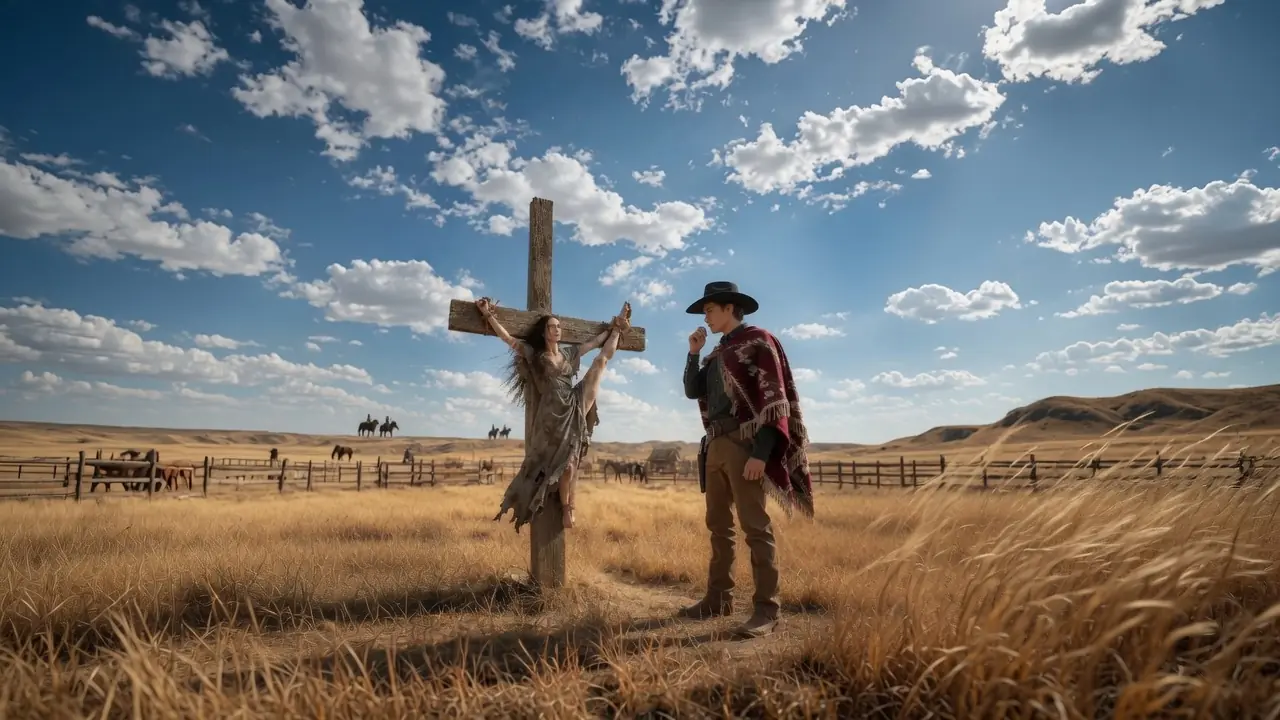
“No.”
Everyone turned to her.
Her hands shook.
She lifted them anyway.
“They tied me to a post because I ran. They were selling me to Mr. Pike to clear debt. I did not agree. I will say it in front of the marshal, the store, the church, and God if I need to.”
Her voice cracked.
But did not collapse.
Marshal Sloane looked at her wrists.
“Who tied you?”
Lydia looked at Silas.
“My stepfather.”
Then at Abel.
“And him.”
Abel lunged.
It was not thought.
It was fury losing its leash.
Jonah caught him before he crossed half the room and drove him back against a stack of flour sacks. White dust burst into the air. Someone cried out. Abel swung once and missed. Jonah hooked his arm, turned him, and pinned him chest-first against the counter.
Marshal Sloane drew his revolver.
“Enough.”
Jonah released Abel and stepped back with both hands visible.
Abel spat flour and curses.
Silas shouted, “Assault!”
Clara coughed in the flour cloud.
“Attempted assault, I’d say. With witnesses.”
The rancher by the stove raised his hand slightly.
“I saw the boy move first.”
“So did I,” said one of the women near the ribbon counter.
Pike stepped back toward the door.
Quietly.
Jonah saw him.
“Leaving?”
Pike froze.
“I have no part in violence.”
“You have your part in writing.”
The marshal picked up the contract.
His face had gone dark.
“Theodore.”
Pike lifted his chin.
“It is not illegal to propose marriage.”
“No,” Sloane said. “But buying a girl under threat might interest a judge.”
Silas laughed once.
“You think a judge will care?”
The marshal looked at him.
“No. But I think he’ll care when half the town hears you say it like that.”
Silas realized then that he had miscounted the room.
He had counted influence.
Not witnesses.
His eyes moved toward the door.
Jonah saw that too.
“Don’t.”
Silas bolted anyway.
He slammed into the door, knocked it open, and ran into the street. Abel followed, shoving past Clara hard enough to make her stumble.
Jonah caught her before she fell.
Marshal Sloane cursed and ran after them.
The street exploded into movement.
Horses screamed.
Boots hit planks.
Silas reached his horse first, with Abel right behind him. They mounted hard, kicking dust into the faces of everyone pouring from the store.
Jonah did not wait for permission.
He swung into his saddle.
Lydia grabbed his arm.
“Don’t let them make me disappear again.”
He looked down at her.
“I won’t.”
Then he rode.
The chase cut north through town, past the livery, past the chapel, out toward the dry wash where cottonwoods bent over a shallow creek.
Silas rode like a man who still believed escape could restore authority.
Abel rode like a man who wanted to turn and fight.
The marshal followed, slower but steady.
Jonah angled wide.
He did not chase the dust.
He watched the land.
The north road narrowed near Miller’s Crossing, where rain had carved ruts into the bank. Silas would know it. Abel would know it. They would think to use the creek bed to split their tracks.
Jonah cut across open ground and reached the crossing before them.
He drew no gun.
He simply stopped his horse in the road.
Silas reined in hard.
Abel nearly crashed into him.
Dust rolled past all three men.
“You are persistent,” Silas said.
Jonah looked at him.
“You are predictable.”
Abel drew his pistol.
Too fast.
Too angry.
Jonah’s gun cleared leather before Abel’s barrel leveled. The sound of the cocking hammer was small, but it froze the creek bed.
“Drop it,” Jonah said.
Abel’s face twisted.
Silas raised one hand.
“Do as he says.”
Abel looked ready to refuse.
Then the marshal arrived behind them.
“Drop it, Abel.”
Two guns now.
One in front.
One behind.
Abel dropped the pistol into the dust.
Marshal Sloane dismounted, breathing hard.
“You two are under arrest.”
Silas actually smiled.
“For what? Running from gossip?”
“For false imprisonment. Assault. Coercion. And whatever the judge decides to call that contract.”
Pike’s thin rider appeared then on the ridge, rifle in hand.
Jonah saw the glint first.
He moved before thought.
He kicked his horse sideways and fired once.
Not at the man.
At the rifle barrel.
The shot sparked against metal. The rider’s rifle flew from his hand. His horse reared, and he tumbled hard into the grass.
Abel lunged for his fallen pistol.
The marshal tackled him.
Silas grabbed a hidden derringer from his coat.
Jonah turned his gun toward him.
The world narrowed.
Silas held the little pistol low, half-hidden in his palm.
His eyes were no longer smooth.
No longer polite.
Just afraid.
“You won’t shoot me in front of the law,” Silas said.
Jonah looked at him.
“No.”
Silas smiled.
Then Jonah added, “But he might.”
Marshal Sloane had his revolver leveled from the ground, one knee pinning Abel.
“Drop it, Silas.”
For a long second, nobody moved.
The creek whispered over stones.
A crow called from a fence post.
Then Silas opened his hand.
The derringer fell.
Mercy Crossing saw them return before sunset.
Silas with hands tied.
Abel with flour still in his hair and blood at his lip.
Pike’s rider limping behind the marshal’s horse.
People stepped out of stores.
Curtains shifted.
Children stopped playing near the trough.
Lydia stood on the steps of Clara Moss’s general store, wrapped in a shawl, wrists bandaged, back straight.
When she saw Silas bound, something left her face.
Not fear.
Not all of it.
But the oldest part of it.
He looked at her as the marshal led him past.
“You did this,” he hissed.
Lydia stepped down one step.
“No,” she said. “You did.”
That was the first full sentence she had spoken to him without apology.
It rang through the street.
Silas looked away first.
Theodore Pike did not flee.
He had not expected Silas to be caught so quickly. By the time the marshal returned, Pike was still in his office, burning papers in a stove.
Clara arrived with two ranchers and no patience.
They found enough unburned to matter.
Three more contracts.
Two involving young women whose families owed debt.
One involving a widow’s land in exchange for “protective marriage.”
By midnight, Mercy Crossing had learned that its respectable banker had been turning desperation into ownership for years.
The town did what towns do first.
It denied.
Then whispered.
Then chose sides.
By morning, the sides were clearer than Pike wanted.
Women came to Clara’s store carrying stories they had swallowed for too long. Men who owed money to Pike brought ledgers. A former clerk admitted he had copied contracts without reading them because reading them would have required courage.
Marshal Sloane sent riders to the county judge.
Jonah slept in a chair by the store door with his hat over his face and his revolver across his lap.
Lydia slept upstairs in Clara’s spare room for three hours, then woke from a dream and could not stop shaking.
Clara sat beside her until dawn.
“You don’t have to be brave every minute,” Clara said.
Lydia stared at her bandaged wrists.
“I don’t know what else to be.”
“Alive first.”
Lydia breathed in.
Then out.
Alive.
It sounded too simple for something so difficult.
The trial came two weeks later in the county courthouse, which smelled of pine boards, ink, sweat, and coal smoke.
People packed the room.
Some came for justice.
Some for spectacle.
Some to see whether powerful men could truly fall or merely kneel and rise again.
Silas wore a clean suit.
Pike wore a better one.
Abel glared at everyone.
Lydia sat beside Clara, hands folded in her lap. Jonah stood near the back wall, not because he did not care, but because he did not want the room to mistake her truth for his protection.
The judge was a woman named Miriam Ashcroft, sixty years old, with iron-gray hair and eyes that did not enjoy nonsense.
She listened for two days.
To the contract.
To the rope marks.
To Clara.
To the bank clerk.
To the ranchers.
To three women who came forward after Pike’s ledgers were found.
Silas tried to call Lydia unstable.
Judge Ashcroft stopped him.
“Mr. Vane, every time a man in this courtroom has lacked evidence, he has called a woman unstable. You will bring facts or sit down.”
The room nearly gasped.
Lydia almost smiled.
Almost.
Pike argued that debts were legal obligations and marriage was a civil arrangement.
The judge asked him whether civil arrangements required ropes.
He did not answer well.
Abel claimed Jonah attacked him first.
Four witnesses disagreed.
When Lydia took the stand, the room changed.
She did not speak loudly.
She did not need to.
She told them about her mother. About Silas taking control of the farm after her mother’s death. About debts she had never seen and promises made over her head. About Theodore Pike looking at her across a desk and saying marriage would give her “security.”
She told them about running.
About being caught.
About the post.
About the sun.
About Jonah arriving.
Silas stared at her the whole time, willing fear into her bones.
But fear no longer had the room to itself.
When she finished, Judge Ashcroft removed her spectacles.
“Miss Bell,” she said, using the name Lydia had chosen, “do you understand that your testimony may cost these men their standing?”
Lydia looked at Silas.
Then at Pike.
Then at the judge.
“Yes.”
“And you still stand by it?”
Lydia’s voice was steady.
“For once, I am standing for myself.”
That sentence traveled through Mercy Crossing faster than any verdict.
The judge ruled hard.
Silas and Abel were convicted of unlawful restraint and assault, with further charges pending for coercion. Pike’s contracts were seized. His accounts frozen. His office closed pending investigation. The women named in the ledgers were released from any obligations tied to fraudulent agreements.
The town did not become clean overnight.
No town does.
But something had cracked open.
The kind of crack light uses.
Lydia did not leave Mercy Crossing immediately.
People expected her to.
Some advised it kindly.
Others wished it because her presence reminded them of what they had ignored.
She stayed.
At first, in Clara’s spare room.
Then in a small cabin behind the store.
She worked for Clara, not because she had nowhere else to go, though that was also true, but because the work paid wages and the wages were written in a ledger Lydia could see.
Jonah came and went.
Sometimes he disappeared for weeks.
Then returned with dust on his coat and no explanation.
He never asked Lydia to follow him.
He never asked her to wait.
That, more than gallantry, made her trust him.
One evening in early winter, she found him fixing a loose hinge on Clara’s back door.
“You could stay,” she said.
He looked over his shoulder.
“In Mercy Crossing?”
“You helped break it open. Seems only fair you help make sure it doesn’t close again.”
He turned the screwdriver once more.
“I am not much for towns.”
“You are not much for hiding either, though you pretend otherwise.”
That made him pause.
Lydia folded her arms.
“Clara says every man who calls himself nameless has a name he’s afraid someone will say kindly.”
Jonah gave a low laugh.
“Clara says too much.”
“She usually says enough.”
He looked at her for a long moment.
“My name was Jonah Rusk before people made stories of me.”
“I know.”
His expression sharpened.
“How?”
“You told me.”
“No, I didn’t.”
Lydia smiled faintly.
“You did when you stopped me from using Vane. You knew what a name could do to a person.”
The wind moved through the yard.
For once, Jonah had no answer ready.
In spring, Lydia bought the abandoned cattle pen where she had been tied.
People thought she was mad.
Clara called it “dramatic, but useful.”
Lydia turned the land into a refuge for women traveling through the county, especially those leaving houses where law and family had become traps. A small bunkhouse went up first. Then a well. Then a kitchen. Then a sign at the gate.
BELL HOUSE.
No woman sold for debt.
No child traded for silence.
No one tied to stay.
The first resident was a widow from Pike’s ledger.
The second was a girl of sixteen whose uncle had promised her to a miner twice her age.
The third arrived at midnight in rain, carrying a baby and a sack of flour.
Lydia opened the door herself.
Every time.
Jonah built the fence.
Clara kept the books.
Marshal Sloane sent women there quietly when the law moved too slowly and danger moved fast.
Judge Ashcroft visited once and said the place was “legally inconvenient and morally necessary.”
Lydia kept that as a compliment.
Years later, people told the story of the day the Ash Rider found Lydia Bell tied beneath the Kansas sun.
They liked the version where a mysterious gunslinger cut the ropes and defeated the villains.
It was simple.
People enjoy simple.
Lydia knew better.
The rescue had not ended when the ropes fell.
It had continued in the store, when Clara chose to open a drawer.
In the courtroom, when witnesses chose to speak.
In the marshal’s decision to stop protecting peace at the cost of truth.
In every woman who walked through Bell House gates and learned that safety did not have to come with ownership.
And in Lydia herself, each morning she woke in a bed no one could drag her from.
One evening, long after Silas Vane died in prison and Theodore Pike became a name spoken only as a warning, Lydia stood beside the old post that she had refused to remove.
It remained near the edge of the property.
Weathered.
Cracked.
Powerless now.
Jonah stood beside her, older, quieter, still wearing a dark coat though the land had become gentle with late summer.
“You ever want to burn it?” he asked.
“Every year.”
“Why don’t you?”
Lydia touched the scar on her wrist.
“Because some women arrive here thinking the rope marks make them weak. I bring them here and show them the post.”
Jonah looked at her.
“And what do you tell them?”
“That wood can hold you for a night. A man can hold you for a season. A lie can hold a town for years.”
She looked across Bell House, where lamps glowed in the windows and voices rose from the kitchen.
“But none of it is the same as owning you.”
Jonah smiled faintly.
“You always had a better mouth than me.”
“You were never as mysterious as you hoped.”
He laughed then.
A real laugh.
The prairie wind moved through the grass.
Once, it had carried dust, hooves, and terror.
Now it carried supper smoke, women’s voices, hammer strikes from a new porch being built, and the ordinary sounds of lives no longer waiting for permission to continue.
Lydia looked at the old post one last time.
Then back at the house.
The world had not become perfect.
Nothing ever does.
But somewhere in western Kansas, on land that had once been used to break a girl, a door now opened for every woman who needed to remember she was not property, not payment, not shame, and not alone.
And sometimes that is how justice begins.
Not with thunder.
Not with bullets.
Not even with a stranger riding out of the heat.
But with one person cutting the rope.
And another refusing to let the truth be tied up again.