Sometimes the greatest Christmas miracle does not begin beneath a decorated tree.
Sometimes it begins on the side of a frozen road with a dead battery, a frightened stranger, and one person who decides that getting home five minutes later is less important than making sure somebody else gets home at all.
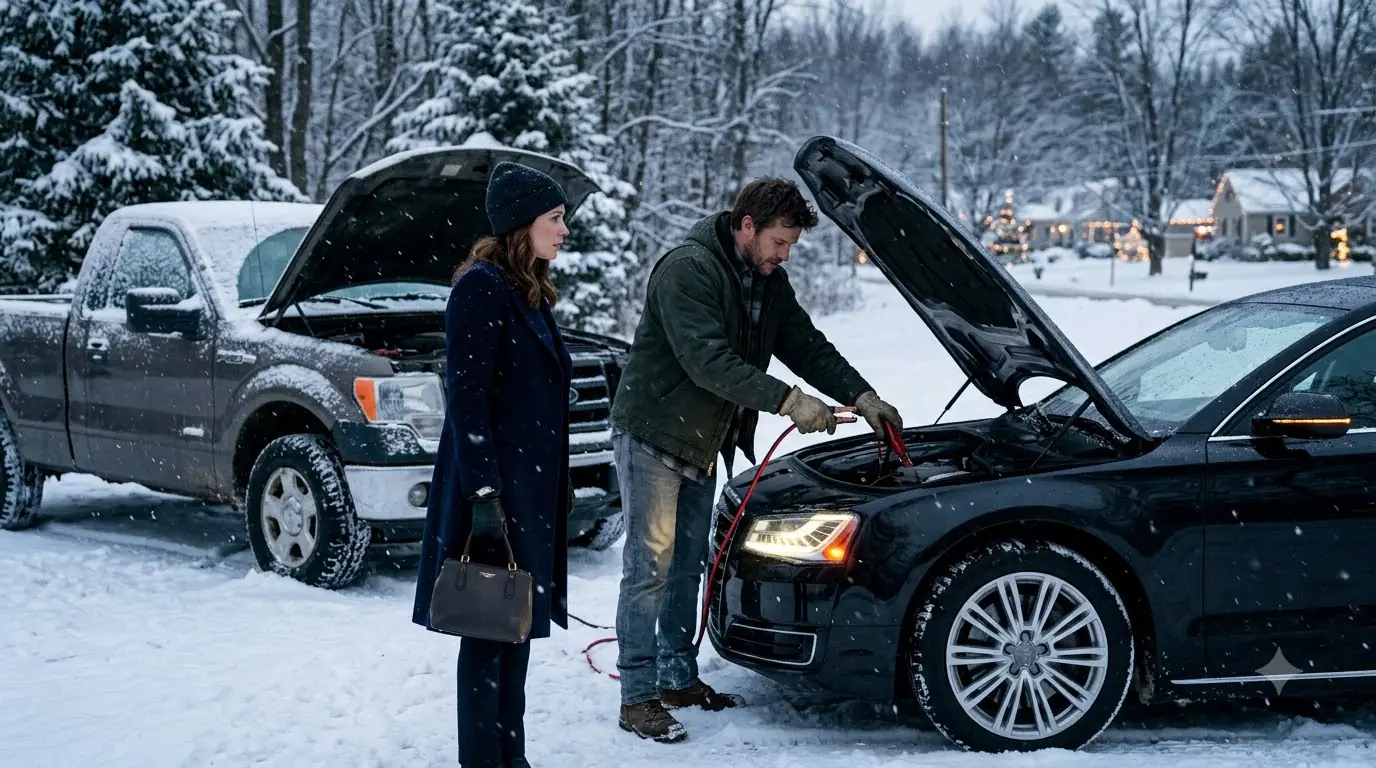
Snow drifted gently across Maple Grove, Ohio, as Christmas Eve settled over the small town.
By five in the afternoon, nearly every storefront along Main Street had closed. White lights wrapped around lampposts. Wreaths hung from brick buildings. Families hurried across sidewalks carrying grocery bags, wrapped presents, and children too excited to remember their gloves.
The weather service had been warning about a winter storm since morning.
At first, the snow had been light.
Beautiful, even.
By late afternoon, the wind had strengthened, and the road crews were beginning to lose the fight against accumulating snow on the county roads outside town.
Daniel Carter knew they should already be home.
His eight-year-old daughter, Emily, knew it too.
Neither complained.
They still had one delivery left.
Daniel stood behind his aging dark-blue Ford pickup, tightening a canvas strap around a handcrafted wooden rocking horse in the truck bed.
The horse had taken him almost eighteen hours to finish.
White oak body.
Walnut handles.
Hand-painted blue flowers carved into the side because the little girl receiving it had told her grandmother that blue flowers were prettier than real ones.
Daniel had spent the final two evenings working past midnight to complete it before Christmas.
Emily stood beside him wearing a red knitted hat with a white pom-pom and a scarf wrapped so many times around her neck that only half her face remained visible.
Snowflakes collected on the top of her hat.
“Dad?”
Daniel pulled the strap once more.
“Yeah?”
“Do you think Santa likes handmade toys?”
Daniel stopped.
He looked at his daughter.
Emily’s brown eyes were serious.
Very serious.
The kind of seriousness children reserve for questions adults do not realize are important.
“I think Santa appreciates anything made with love.”
Emily considered that answer.
“What if the paint is a little crooked?”
Daniel smiled.
“Then Santa knows somebody painted it by hand.”
“What if one wheel squeaks?”
“Then Santa knows the person who made it is human.”
Emily grinned.
“You made the wagon wheel squeak.”
“I fixed the wagon wheel.”
“After it squeaked.”
“Technical detail.”
Emily laughed.
She carried a small box beneath one arm.
Daniel knew what was inside because he had made it.
A tiny wooden angel.
Walnut body.
Maple wings.
Her name carved across the bottom.
He had hidden it beneath a stack of lumber for two weeks before wrapping it the previous night.
Emily thought the box contained extra cookies for their last customer.
Daniel preferred it that way.
He opened the passenger door.
“Inside.”
“Yes, sir.”
“Seat belt.”
“I know.”
“You said that yesterday.”
“And I wore it yesterday.”
Daniel shook his head.
“You're becoming argumentative.”
“Grandma says it's genetic.”
“That woman says many irresponsible things.”
Emily climbed inside laughing.
Daniel closed the door.
At thirty-seven years old, Daniel Carter had learned to measure wealth differently from most people.
He had not always done that.
There had been a time when he wanted many of the ordinary things ambitious young men wanted.
A larger house.
Newer truck.
A respected title.
A workshop with employees instead of one where every piece left through his own hands.
At twenty-three, Daniel had been hired by Morris & Crane Furniture in Columbus.
He started on the shop floor.
Within five years, he was designing custom furniture for hotels, corporate offices, and luxury homes.
He understood wood instinctively.
Grain direction.
Moisture.
Joint strength.
How a piece of walnut could look almost plain until oil brought the figure alive.
He became one of the company’s best furniture designers.
At thirty, management began talking about making him regional production supervisor.
The salary would have nearly doubled.
Sarah had been proud of him.
Sarah Carter had been Daniel’s wife.
She was three years younger than him, a kindergarten teacher with curly brown hair, terrible handwriting, and the ability to remember the birthdays of people she had not spoken to in ten years.
Daniel had met her at a county fair when they were both twenty-one.
He had spilled lemonade on her shoes.
She had told him they were ugly shoes anyway.
He married her two years later.
Emily arrived eight years after that.
For a while, life felt almost unfairly good.
Then Sarah became tired.
At first, they blamed work.
Then she began losing weight.
Tests followed.
Then more tests.
The diagnosis came in a room Daniel could still picture perfectly years later.
Cancer.
Aggressive.
Treatable, the doctor said.
Daniel held onto that word.
Treatable.
For thirteen months, their lives became appointments, medications, hospital parking garages, good scans, bad scans, cautious hope, and exhaustion.
Morris & Crane offered Daniel the regional supervisor role during that period.
More money.
More travel.
More responsibility.
Daniel declined.
His manager called him into the office.
“You understand what this could do for your career?”
“Yes.”
“This opportunity might not come again.”
“I know.”
“Then why are you saying no?”
Daniel looked at him.
“Because Sarah needs me.”
“You have family.”
“She needs me.”
That was all.
The manager tried again six months later.
Daniel declined again.
Eventually he reduced his hours.
Then took leave.
When Sarah’s condition worsened, Daniel resigned entirely.
People told him not to.
Some meant well.
“Think about the insurance.”
“Think about your future.”
“Think about Emily.”
Daniel was thinking about Emily.
That was precisely why he left.
During Sarah’s last winter, she spent most days in their living room near the window because she liked watching snow fall.
One evening, Daniel was adjusting the blanket over her legs when she said:
“Promise me something.”
“No.”
Sarah looked amused.
“You don't even know what.”
“Any sentence beginning with promise me something is dangerous.”
“Daniel.”
He sat beside her.
“What?”
Sarah looked toward Emily, who was sitting on the floor coloring.
“When I'm gone, don't disappear into work.”
His chest tightened.
“Sarah.”
“I mean it.”
“You're not going anywhere.”
She gave him the look she always used when he was lying badly.
“Daniel.”
He looked away.
Sarah reached for his hand.
“You're a wonderful provider.”
“That sounds suspicious.”
“You think fixing things is how you love people.”
“It is.”
“I know.”
She smiled.
“I love that about you.”
Then her expression became serious.
“But Emily isn't a broken chair.”
Daniel said nothing.
“She won't need you to solve every problem.”
Sarah squeezed his fingers.
“She'll need you there.”
Daniel looked toward their daughter.
Sarah continued.
“Promise she will never grow up wondering whether her father loved his work more than he loved her.”
He felt his throat close.
“Never.”
“Promise.”
“I promise.”
Sarah died three months later.
Daniel returned to work eventually.
Not to Morris & Crane.
He could have.
They offered.
Instead, he opened a small woodworking shop behind the modest white house he and Sarah had purchased years earlier in Maple Grove.
At first, the decision made no financial sense.
He earned less.
Much less.
But he controlled his hours.
He could walk Emily to school.
Attend teacher meetings.
Make dinner.
Be home when she was sick.
If she needed him, he did not have to ask a manager whether family counted as an acceptable reason to leave.
He built tables.
Cabinets.
Bookcases.
Children’s furniture.
Then toys.
The toys began almost accidentally.
A neighbor could not afford a Christmas gift one year.
Daniel used leftover maple and built a small train.
Someone saw it.
Then someone else asked.
By the following Christmas, he had orders for rocking horses, wagons, puzzles, toy airplanes, doll beds, and wooden animals.
The work paid the bills.
Barely, some months.
But Maple Grove had become their home.
Not because their house was special.
Because people knew one another.
If Daniel's truck would not start, three people offered help.
If somebody's porch railing broke and money was tight, Daniel often repaired it for materials only.
When Sarah died, church members brought dinner every night for three weeks.
Daniel never forgot that.
He believed debts of kindness were not repaid to the same person.
They were passed forward.
That was why, when he saw the black sedan on Christmas Eve, stopping never felt like a decision.
The pickup was three miles outside town when Daniel noticed flashing hazard lights ahead.
The snow was heavier now.
Headlights reflected against a white curtain.
Vehicles passed slowly.
Each one hesitated near the stranded sedan.
Then continued.
Daniel eased off the accelerator.
Emily looked forward.
She saw the lights.
Then looked at her father.
Neither spoke for several seconds.
Daniel activated his turn signal.
Emily smiled.
“I knew it.”
“Knew what?”
“You were stopping.”
“You say that like it's a personality defect.”
“It makes us late.”
“That is true.”
Daniel pulled safely onto the shoulder.
The sedan was expensive.
Very expensive.
Black.
Clean except for snow.
Its driver stood beside it holding a phone above shoulder level as if another two feet of height might produce a signal.
She wore an elegant navy coat.
Dark trousers.
Leather boots that were absolutely not designed for standing in snow.
Daniel shut off the pickup.
“We cannot leave someone alone tonight.”
Emily nodded.
“I know.”
“Stay inside.”
“I know.”
“Doors locked.”
“I know.”