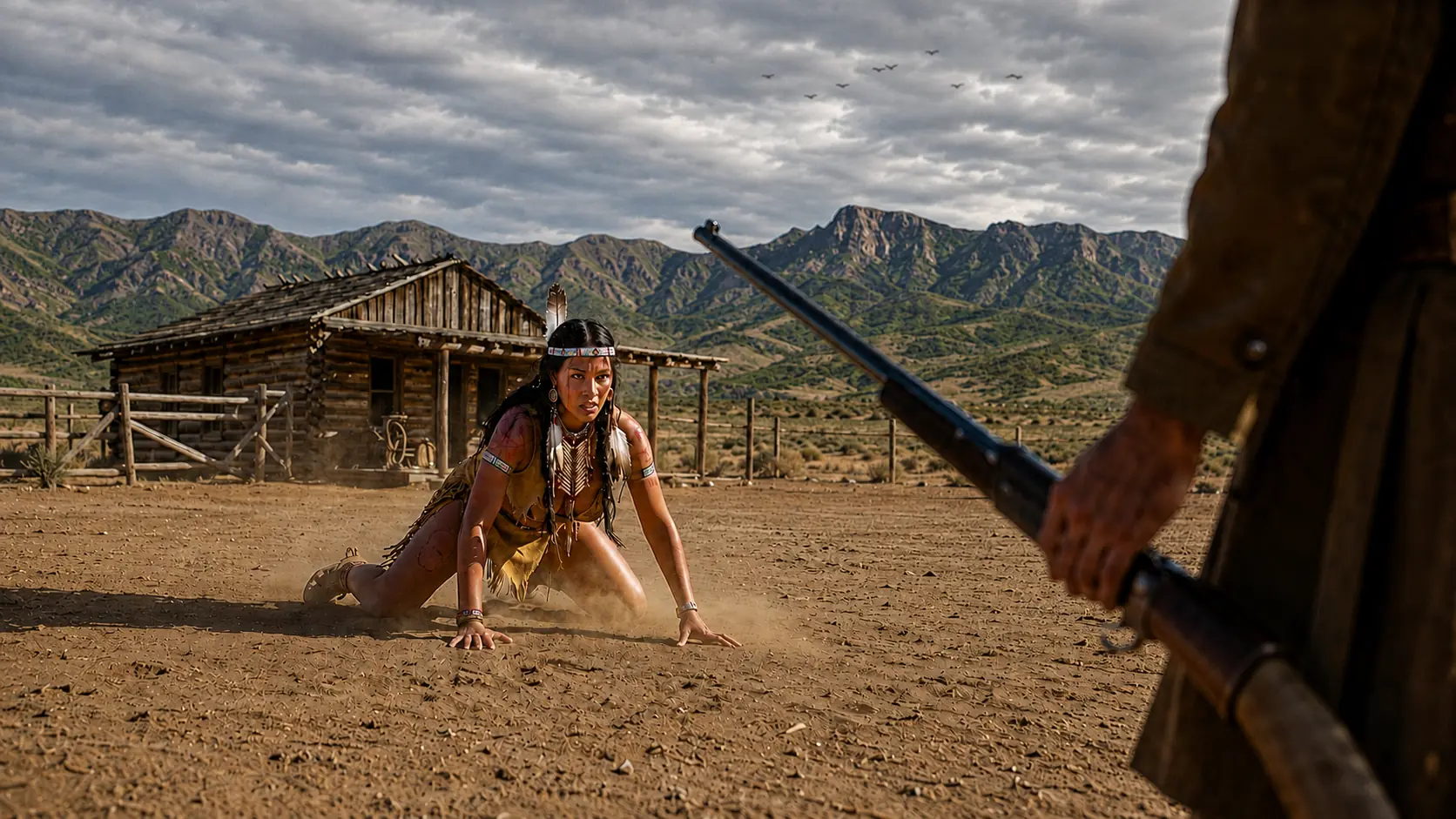
The night Maren Crowe found the woman in the yard, he nearly killed her before he knew her name.
It was 1879, near the ragged edge of New Mexico Territory, where the land was dry enough to crack a man’s lips by noon and cold enough to stiffen his bones after dark. Maren lived alone in a one-room cabin tucked beneath a ridge of stone and twisted juniper, three miles from the nearest trail and farther than that from anyone who might ask how he was doing. He preferred it that way.
He had once ridden as a scout for cavalry columns, reading tracks in sand, finding water in country that looked dead, and warning officers about ambushes they were too proud to see. That life had left him with a limp in his left leg, a scar across one cheek, and a way of waking at the smallest sound. His wife, Ruth, had died of fever six winters earlier, and after burying her behind the cabin under a flat stone, Maren decided the world had taken enough from him.
That night, a sound pulled him from sleep.
Not a coyote.
Not wind.
A dragging step outside the cabin wall, soft but wrong, followed by the scrape of something stumbling through gravel. Maren rolled from his cot with the rifle already in his hands before he was fully awake. Years of soldiering did that to a man. It turned fear into movement before thought could catch up.
He eased the door open.
Moonlight spilled across the yard, pale and cold, showing the water barrel, the broken fence rail, the woodpile, and the narrow path leading toward the dry creek bed. At first he saw nothing. Then a shape moved near the cottonwoods, thin and staggering, one hand braced against a trunk as if the earth itself kept shifting beneath her feet.
It was a woman.
Her dress was torn down one side, clinging to her body in ragged strips. Her black hair hung loose and tangled around her face. Her feet were bare and bleeding, and every step she took left a dark mark in the dust.
Maren lifted the rifle.
“Stop right there.”
The woman froze.
Her head snapped up, and the moon caught her face. She was young, maybe twenty-five, maybe younger, with bronze skin, hollow eyes, and terror so complete it seemed to hold her upright when her body could not. For one second, Maren saw only danger. A lone woman could be bait. Raiders had used worse tricks. Men could be waiting beyond the trees, counting on pity to open his door.
His finger tightened near the trigger.
The woman saw it.
She dropped to her knees so fast her body nearly folded into the dirt. Both hands clutched the torn front of her dress, trying to cover herself, trying to make herself smaller than the rifle pointed at her chest. Her lips trembled, and when she spoke, the words came broken and desperate.
“Stop,” she sobbed. “I’ll be your obedient wife. Please. Just don’t kill me.”
The sentence hit him harder than a bullet.
Maren kept the rifle raised, but something inside him twisted. Obedient wife. Not “help me.” Not “I am hurt.” Not even “I am innocent.” She had offered the only thing the world had taught her might buy mercy from a man with a gun.
He had heard women speak that way before.
Years ago.
In burned camps.
At the edge of battlefields.
In places where men with uniforms and men without them had treated the weak like property and called it the cost of the frontier. Maren had carried the shame of those memories longer than he had carried any medal.
The woman bowed her head.
“I work,” she whispered. “I serve. No trouble. Please.”
Maren looked past her into the dark.
No movement.
No horse breath.
No click of a rifle hammer from the trees.
Only the woman shaking in the dirt, her knees bruised, her shoulders bare to the cold, blood on her feet and rope burns around one ankle. If she was bait, she had paid too much for the trick.
He lowered the barrel an inch.
“Stand up.”
She tried.
Her legs failed.
Maren cursed under his breath and stepped forward before he could think better of it. She flinched so violently he stopped three feet away. That reaction told him more than words could. This was not a woman pretending fear. This was a woman expecting pain from every hand that came near.
“I’m not touching you,” he said. “Get up if you can.”
She pushed herself upright, swaying.
Maren nodded toward the cabin.
“Inside.”
She stared at him.
“Inside,” he repeated. “Before you freeze.”
She moved past him like a beaten animal, slow and careful, never turning her back fully until she crossed the threshold. Maren followed with the rifle still in hand. Trust did not come easy to him, and mercy did not erase sense.
The cabin was dark except for the last dull coals in the stove.
The woman backed into the corner near the wall and stood there trembling, arms folded across her torn dress. Maren shut the door, barred it, then knelt by the stove and fed in kindling. Sparks caught. The fire breathed upward, throwing a low orange light across the room.
Only then did he see the full damage.
Her lips were cracked. Her wrists were raw. A bruise darkened one cheekbone. Dirt streaked her arms and neck, and the fabric at her shoulder had been ripped so badly it barely held. She looked half-starved and more frightened of shelter than she had been of the night.
Maren took a tin cup from the shelf, filled it with water, and set it on the table.
“Drink.”
She looked at the cup.
Then at him.
Then back at the cup.
“Drink,” he said again, softer this time.
She moved toward it slowly, as if any sudden hunger might be punished. When she lifted the cup, both hands shook. She drank too quickly, choking once, spilling water down her chin before forcing herself to stop.
Maren looked away.
He took an old blanket from the foot of his cot and tossed it near the stove.
“You can sleep there.”
The woman clutched the cup.
“You not take me?”
Maren’s jaw tightened.
“No.”
Her eyes searched his face.
“Not tonight?”
“Not ever.”
She did not seem to understand that.
Or maybe she understood and did not believe it.
Maren sat on the edge of the cot with the rifle across his knees. He did not ask her name. He did not ask where she came from. Questions had a way of becoming traps when someone had been hunted too long.
The woman lowered herself near the stove and wrapped the blanket around her shoulders. Even covered, she kept one hand at her throat, holding the torn dress closed. Her eyes stayed open a long time.
Maren leaned back against the wall.
He told himself he would stay awake until morning.
Instead, sometime before dawn, exhaustion took them both.
When Maren opened his eyes, sunlight had slipped through the cracks in the boards and laid thin gold lines across the floor. The woman was still near the stove, curled beneath the blanket, her hair spread like dark water over one arm. For one strange second, the cabin felt almost alive.
Then she stirred.
Her eyes opened sharply.
She pushed herself upright and pulled the blanket tight, fear rushing back into her face as if sleep had only borrowed it for a few hours.
Maren swung his legs over the cot and reached for his boots.
“You hungry?”
She blinked.
The question seemed to confuse her more than the rifle had.
After a moment, she nodded.
He set beans on the stove and cut the last piece of salt pork into the pan. The smell filled the cabin slowly, rich and smoky, and he saw the woman swallow hard while trying not to stare. When he handed her a plate, she took it with both hands and waited.
“For what?” he asked.
She lowered her eyes.
“You eat first.”
Maren sat opposite her and took a bite.
“There. Eat.”
She did.
At first fast, desperate, almost panicked. Then slower, once she realized he was not going to snatch the plate back. Maren ate his share and watched the fire instead of watching her.
When she finished, she wiped her mouth with the back of her hand.
“I can work,” she said.
Her voice was stronger in daylight, though still rough from thirst and fear.
“I clean. Carry wood. Cook if you want.”
Maren looked at her.
“You don’t have to earn breakfast after nearly dying in my yard.”
Her face tightened at the kindness, as if kindness itself had edges.
“I work,” she repeated.
He understood then.
Work meant safety.
Work meant usefulness.
Work meant she was not simply waiting for his patience to run out.
He nodded toward the woodpile outside.
“Bring in kindling. Small pieces. Don’t carry more than you can.”
She stood at once.
The blanket slipped, and she clutched it back around her. Her eyes went to the door, then to him, asking permission without words. Maren hated that most of all.
He looked away.
“Door’s open.”
She stepped outside.
Maren sat alone for a moment, staring at the plate in his hands. The cabin had held grief for so long that another person inside it felt almost like trespass. He had built his days around silence, around predictable work, around not needing anything and not being needed in return.
Now a barefoot Apache widow had stumbled into his life and asked to be owned so she would not be killed.
That kind of thing did not pass through a cabin without changing the air.
When she returned with a small stack of kindling, he saw blood fresh on one palm where a splinter had cut her. She set the wood beside the stove and hid her hand behind her dress.
Maren went to the shelf, took down a rag, and held it out.
She did not move.
“For your hand.”
She looked at the rag like it might bite.
Then she took it.
“What’s your name?” he asked.
Her fingers froze.
Silence filled the cabin.
He waited.
Finally, she said, “Atsila.”
The name came soft, almost guarded.
Maren nodded.
“Atsila.”
She looked surprised that he repeated it correctly.
He gestured toward himself.
“Maren Crowe.”
She said nothing, but her eyes held his name the way someone holds a tool they might need later.
For the rest of the day, they moved around each other carefully. Maren repaired a warped shutter and replaced the loose latch on the door. Atsila swept the floor with a bundle of brush, then mended a tear in his old coat using a bone needle from her own small pouch. Her hands were quick and skilled, even with the cuts and swelling.
He noticed things without meaning to.
The way she flinched when the hammer struck too sharply.
The way she kept her back near a wall.
The way she never reached for anything without glancing at him first.
He also noticed the way she straightened when given a task, how her breathing steadied when her hands were busy, how the faintest trace of self returned whenever she completed something useful and no punishment followed.
By evening, Maren cooked more beans and set both plates on the table.
Atsila remained standing.
He looked up.
“Sit.”
She sat.
Not beside him.
Across from him.
Far enough to run if running became possible.
After a while, she asked, “You live alone?”
“Yes.”
“Wife?”
“Dead.”
The word came out harder than he meant it to.
Atsila lowered her eyes.
“I am sorry.”
Maren stirred his beans but did not eat.
“Fever took her. Fast.”
Atsila nodded.
“My husband dead too.”
Maren looked at her then.
She was staring into the fire.
“His brothers said I carried bad spirit. Said I brought death. They sent me away with no food.”
Her fingers tightened around the cup.
“Men found me. Not my people. Bad men. They tied rope. Took me for trade. I ran when they drank.”
Maren’s hand closed slowly around his spoon.
Now he understood the rope burns.
The torn dress.
The words in the yard.
Atsila spoke again, quieter.
“If they find me, they take me back.”
“No,” Maren said.
She looked at him.
He held her gaze.
“Not from here.”
She watched him for a long moment, searching for the lie.
He gave her none.
The next morning, frost silvered the yard.
Maren had planned to check the west fence alone, but Atsila stood when he reached for his tools. She wore the blanket over her shoulders and had wrapped rags around her feet, though blood had already seeped through.
“I come,” she said.
“No.”
“I work.”
“You can barely walk.”
Her face hardened slightly.
“I have walked worse.”
Maren almost argued.
Then he stopped.
Pride, he knew, was not always vanity. Sometimes it was the last bone holding a person upright.
He stepped to the corner near the door and pulled down an old pair of boots.
Ruth’s boots.
They had hung there for six years because he could not throw them away and could not bear to see anyone wear them. The leather was cracked, the soles worn, but they were whole.
He held them out.
Atsila stared.
“Take them.”
She looked from the boots to his face.
“They were hers?”
“Yes.”
“I cannot.”
“She has no use for them now.”
Atsila’s eyes softened, but she took the boots.
They were too big for her, but she stuffed rags into the toes and tied them tight. When she stood, the relief passed over her face before she could hide it. Maren turned away so she would not have to know he had seen.
They walked to the fence together under a pale morning sky.
Maren carried hammer, nails, and rope. Atsila followed close, quiet in the oversized boots. At the fence line, she held boards steady while he drove nails. She learned quickly, handing him the right tools before he asked, bracing posts with more strength than her thin frame promised.
At one point, the hammer slipped and struck the wood with a loud crack.
She flinched hard.
Then she steadied herself and kept holding the rail.
Maren saw the shame in her face.
He said, “Noise ain’t always danger.”
She looked at him.
Then nodded once.
By midday, they sat beneath a stunted juniper and ate cold beans from a tin.
Atsila looked across the valley.
“You were soldier?”
“Scout.”
“You fought Apache?”
Maren stared at the ground.
“Sometimes.”
Her face became unreadable.
He did not defend himself.
He had worn many excuses once. Orders. Survival. The way things were. None of them fit cleanly anymore.
“I did things I carry,” he said.
Atsila looked at him then.
“So do I.”
That was all.
Some understandings do not need forgiveness to become honest.
On the walk back, Maren noticed tracks near the dry wash.
Three horses.
Maybe four.
Fresh.
He stopped so suddenly Atsila nearly stepped into him.
“What?” she whispered.
He crouched, studied the dirt, then looked toward the ridge.
“Riders.”
Her face went pale.
“They came?”
“Close enough.”
She gripped the blanket tighter.
“They look for me.”
Maren stood slowly, his bad leg stiff beneath him.
“Then we make sure they don’t like what they find.”
That evening, he barred the door before sunset and loaded both rifles. One was his. The other had belonged to Ruth, light enough for Atsila to hold. He showed her how to check the chamber, how to brace the stock, how to aim without closing her eyes.
Her hands shook.
He did not mock them.
“Shaking don’t mean you can’t shoot,” he said. “Just means you’re alive.”
Atsila looked at the rifle.
“I killed once.”
Maren waited.
“The man holding rope,” she said. “When I ran.”
Her voice trembled, but her eyes remained dry.
“I took stone. Hit his head. I hear it still.”
Maren nodded.
“Good.”
She stared at him.
“Good?”
“You lived.”
The answer seemed to trouble her and comfort her at the same time.
Outside, night settled heavy over the cabin.
The riders did not come that night.
But they came the next.
Maren heard the horses before Atsila did.
He stood from the cot, rifle in hand, and motioned her toward the back wall. She took Ruth’s rifle and crouched beside the stove, her face tight but determined.
Three riders stopped at the edge of the yard.
One called out, “Old man!”
Maren stepped onto the porch.
Moonlight showed the men clearly. Rough clothes. Dusty hats. Rifles across their saddles. One had a raw scrape along his jaw and the mean slouch of a man who enjoyed making fear last longer than necessary.
“We’re looking for an Apache woman,” he called. “Barefoot. Black hair. Might have passed this way.”
Maren kept his rifle low but ready.
“Ain’t seen one.”
The rider laughed.
“Now that’s strange. Tracks say otherwise.”
“Tracks lie.”
“Men do too.”
Maren said nothing.
The rider leaned forward.
“She belongs to us.”
Maren’s eyes sharpened.
“No woman belongs to you.”
The rider’s smile vanished.
“You got a limp and one cabin between you and trouble, old man.”
Maren raised the rifle.
“And I got the first shot.”
The yard went silent.
The other riders shifted, measuring distance, cover, risk. Men like that preferred easy prey. They liked women alone, families afraid, old men unarmed. A rifle steady in the hands of someone willing to use it changed the arithmetic.
The leader spat into the dirt.
“We’ll come back.”
Maren’s voice stayed flat.
“Then bring men you don’t mind burying.”
The riders cursed and turned away.
Only when the hoofbeats faded did Maren lower the rifle.
Inside, Atsila was trembling so hard the barrel of her rifle tapped softly against the wall.
“You should have given me,” she whispered.
Maren shut the door.
“No.”
“Easier.”
“Not for me.”
She looked at him, tears filling her eyes.
“You fight for me?”
“I said you were safe here.”
“Words are easy.”
“So are lies.”
He set the rifle down, crossed the room, and stopped a few feet from her.
“I won’t give you to men who think you’re a thing.”
A tear slid down her cheek.
For the first time since she arrived, she stepped toward him instead of away.
Her fingers touched his sleeve.
Lightly.
As if asking whether closeness could exist without a price.
Maren did not move.
After a moment, she let her hand rest there.
The next days sharpened them both.
Maren hunted while Atsila helped carry what they could. They dressed a small deer by the creek, salted the meat, and hung strips near the stove. She worked beside him without complaint, blood on her hands, wind in her hair, the oversized boots dragging through dust. When he looked at her, he no longer saw only a woman who had collapsed in his yard.
He saw someone fighting her way back into herself.
Inside the cabin, she claimed corners slowly.
A bundle of herbs near the window.
Stacked wood by the stove.
His torn shirts folded instead of left in a trunk.
Ruth’s boots near the door, not hidden.
Maren should have resented the changes. He had built his life around grief and called it peace. But each small sign of Atsila’s presence made the cabin feel less like a grave with a roof.
One evening, she found him sharpening his knife by the fire.
“You loved your wife,” she said.
Maren’s hand stilled.
“Yes.”
“You keep her things.”
“Yes.”
“Does it hurt that I wear boots?”
He looked at her.
The question had clearly been sitting in her for days.
He stared at the old boots beside the door, then back at Atsila.
“It hurt worse when they hung empty.”
Her eyes lowered.
“I do not want to take her place.”
“You couldn’t.”
She nodded.
He continued, “That don’t mean there’s no place for you.”
The words surprised them both.
Atsila looked up slowly.
Maren returned to the knife, though his hands were less steady now.
The fire cracked.
Outside, wind dragged sand against the door.
After a long silence, she said, “My husband was kind.”
Maren looked at her.
“He laughed when I burned bread,” she said. “He told me smoke was flavor. He died from sickness after winter. His family said I carried death because two babies died before they breathed.”
Her voice thinned.
“I believed them for a while.”
Maren felt something hard settle in his chest.
“You didn’t kill anyone by surviving.”
She looked at him through the firelight.
“Neither did you.”
That answer struck too close.
He looked away.
But later, when she lay down near the stove, she placed her blanket closer to the cot than before. Not touching. Not asking. Just closer.
Maren noticed.
He said nothing.
The riders returned five days later.
Not to speak.
To test.
Maren found a cut rope near the corral and fresh hoof marks behind the cabin. One shutter had been pried at with a knife. A small bundle of feathers and bone had been left on the porch, a crude warning meant to frighten Atsila into running.
She found it before he could hide it.
Her face went still.
Then she picked it up and threw it into the fire.
Maren watched her.
“They want me scared,” she said.
“Yes.”
“I am scared.”
“I know.”
She looked at him.
“But I am here.”
That night, Maren gave her the pistol he had kept wrapped in oilcloth beneath the floorboards. It was old but reliable.
Atsila took it carefully.
“You trust me?”
“I trust you don’t want to be taken.”
Her mouth curved faintly.
That was nearly a smile.
By then, something had grown between them that neither could name without frightening it. It was not simple gratitude. Not possession. Not the bargain she had tried to offer in the yard. It was built from coffee shared at dawn, meat salted side by side, silence that no longer punished, and the strange tenderness of two wounded people learning where not to press.
One cold evening, after they had barred the door early, Atsila sat beside him instead of across from him.
Maren felt the warmth of her shoulder through his shirt.
He did not move.
She reached for his scarred hand.
He let her take it.
“My first words to you were shameful,” she whispered.
Maren stared into the fire.
“No.”
“I said I would be obedient wife.”
“You said what fear taught you to say.”
Her thumb brushed over his knuckles.
“I do not want to be obedient.”
“Good.”
She looked at him.
“I want to choose.”
Maren’s throat tightened.
No one had said a more dangerous thing in that cabin.
Not because it threatened him.
Because it asked him to be worthy of it.
He turned toward her.
“Then choose slow.”
Atsila’s eyes softened.
“I already choose to stay.”
Outside, the wind hit the cabin hard enough to rattle the shutters.
Inside, she leaned closer and rested her forehead against his shoulder. Maren closed his eyes. For years, he had believed wanting anything again would betray Ruth. But grief, he was beginning to understand, was not love’s grave. It was proof love had lived and left room for mercy if a man stopped guarding the emptiness like treasure.
He lifted one hand and touched Atsila’s hair.
She did not flinch.
That mattered more than the kiss that came later.
When morning arrived, she was still beside him, wrapped in the same blanket, her breathing quiet against his chest. Maren lay awake a long time, staring at the ceiling, one arm around her. He knew the riders would come back with more men. He knew the winter would be hard. He knew Mercy Springs, the nearest town, might not look kindly on a white ex-scout and an Apache widow building a life beyond the law’s neat boxes.
But he also knew the cabin was no longer only his.
And he did not want it to be.
The final test came two days after the first snow dusted the ridge.
Six riders appeared at noon.
They did not hide this time.
They came down the trail in a loose line, rifles visible, faces hard, horses snorting clouds into the cold. Atsila saw them from the window and went pale, but she did not step back. She tied her hair behind her neck, took Ruth’s rifle, and stood beside the door.
Maren loaded his rifle on the porch.
The leader rode forward.
He was the same man from before, scrape healed into a red line across his jaw.
“Last chance,” he called. “Send the woman out.”
Maren rested the rifle across the porch rail.
“No.”
The man laughed.
“You willing to die for an Apache widow?”
Maren did not answer.
Atsila stepped out behind him.
The leader’s eyes lit with satisfaction.
“There she is.”
Maren’s voice lowered.
“Get back inside.”
Atsila did not move.
The rider smiled wider.
“Come on now, girl. We’ll make this easier if you walk.”
Atsila lifted the rifle.
Her hands shook.
But the barrel stayed pointed at his chest.
“I do not walk with you.”
The rider’s smile vanished.
“You hear that?” he called to his men. “She thinks she belongs here.”
Maren’s eyes narrowed.
“She does.”
The words reached Atsila like warmth.
The rider spat.
“You can’t keep her.”
Maren cocked the rifle.
“I already have.”
The first rider on the left moved too fast, pulling his gun.
Maren fired.
The shot cracked across the yard, and the man fell from the saddle before his horse bolted sideways. Chaos broke loose. Another rider raised his rifle, and Atsila fired from the doorway. Her shot struck the man’s shoulder and spun him back with a cry.
The others scattered behind their horses.
Maren moved with the cold precision of a man who had survived too many fights to waste fear. His limp slowed his step but not his aim. He fired again, splintering the saddle horn of a man trying to flank the porch. Atsila reloaded with trembling fingers but did not drop the rifle.
The leader shouted curses.
“Kill the old man!”
A bullet tore through the porch post beside Maren’s head.
Wood exploded against his cheek.
He dropped behind the rail, rolled to one knee, and fired from lower ground. The rider who had taken the flank screamed and fell backward into the dust.
Two men down.
One wounded.
The rest lost appetite for the fight.
That was how such men often were. Brave when surrounding the desperate. Less brave when desperation answered back.
The leader pulled his horse around, fury twisting his face.
“This ain’t finished!”
Maren stood, rifle smoking.
“It is if you keep riding.”
The man looked at Atsila.
For one second, old fear moved through her.
Then she stepped beside Maren fully, rifle raised, face uncovered to the cold wind.
“I am not yours,” she said.
The leader stared.
Maybe it was her voice.
Maybe it was the dead man in the dirt.
Maybe it was the realization that whatever terrified woman he had hunted had become someone else at this cabin door.
He cursed, gathered the remaining riders, and fled toward the ridge.
Maren kept his rifle raised until they were gone.
Only then did the pain hit him.
He staggered.
Atsila caught his arm.
Blood ran from a shallow cut near his ribs where a bullet had grazed him.
“You are hurt.”
“Not enough.”
She looked up at him, eyes full of tears and anger.
“Do not say foolish things.”
That almost made him laugh.
Inside the cabin, she cleaned the wound with boiled water and wrapped it in torn cloth. Her hands were steady now. Maren watched her face while she worked. She was frightened, yes, but no longer broken by fright.
When she finished, she sat back on her heels.
“You could have died.”
“So could you.”
“I chose to stand there.”
“So did I.”
She looked at him.
That was the truth of them, plain at last.
Not debt.
Not obedience.
Choice.
That evening, they buried the dead rider beyond the wash because even bad men had to be put somewhere. Maren marked the grave with no name. The wounded man, left behind by his companions, was given water, bandaged roughly, and sent toward the main trail on foot with a warning that mercy would not repeat itself if he returned armed.
Atsila watched him go.
Maren stood beside her.
“You think they come back?”
“No,” he said. “Men like that remember losing better than they remember shame.”
Winter settled over the land after that.
Hard.
Snow came thin but bitter, and the wind found every crack in the cabin wall. Maren trapped rabbits, hunted when his leg allowed, and taught Atsila how to read tracks in frost. Atsila dried herbs, cooked better meals than the cabin had known in years, mended Ruth’s old quilts, and turned the small room into something that could hold more than survival.
In spring, they planted corn near the creek.
Not much.
Enough to hope over.
One morning, Maren found Atsila outside Ruth’s grave. She had placed wildflowers beside the flat stone.
He stood back, unsure whether to interrupt.
Atsila turned.
“She was here before me,” she said.
“Yes.”
“I thank her for boots.”
Maren looked down, throat tight.
“She’d have liked that.”
Atsila returned to his side.
“I do not take from her.”
“No,” he said. “You don’t.”
She slipped her hand into his.
“You make room.”
He looked toward the grave, then toward the cabin, smoke rising from the chimney into clear morning air.
“I’m learning.”
Months later, a preacher passing through Mercy Springs married them under a cottonwood near the dry creek.
There were no guests except Hank Bell, an old trapper who had traded with Maren for years, and a Mexican widow named Teresa from the road station who had brought bread, coffee, and a blue ribbon for Atsila’s hair. Atsila wore a simple brown dress she had sewn herself. Maren wore the only clean shirt he owned.
When the preacher asked whether she would obey, Atsila’s face hardened.
Maren spoke before she could.
“Leave that word out.”
The preacher blinked.
“It’s customary.”
“Not here.”
Atsila looked at Maren.
The preacher cleared his throat and changed the line.
“Will you walk beside this man?”
Atsila smiled.
“Yes.”
Then he turned to Maren.
“Will you walk beside this woman?”
Maren glanced at his bad leg.
“I’ll do my best.”
Atsila laughed.
That laugh carried across the creek bed, bright and impossible, and for a moment the hard country seemed almost gentle.
Years later, people in Mercy Springs told the story with more drama than truth.
They said an Apache widow crawled to a cowboy’s cabin and begged to be his wife.
They said raiders came and the old scout killed half of them before breakfast.
They said the woman could shoot better than any man in the territory.
They said all kinds of things.
Maren never corrected much.
Atsila corrected only one part.
“I did not become his wife because I begged,” she would say.
People usually went quiet then.
She would look toward the cabin, toward the woodpile, the garden, the patched fence, the porch where Maren sat carving handles for tools he did not need.
“I became his wife because I chose.”
That was the part people needed to hear.
The night she arrived, fear had taught her to offer herself like property. The world had taught her that men with guns owned choices and women without shelter traded whatever dignity they had left for another sunrise. But that cabin, rough and cold and lonely as it was, became the first place where nobody demanded her surrender as payment for safety.
Maren had raised a rifle at her.
Then he lowered it.
That mattered.
But what mattered more was everything after: the water without a bargain, the blanket without a hand reaching under it, the boots offered with grief still inside them, the rifle placed in her hands when danger came, the word obey removed from the wedding because she had spent too much of life surviving men who loved that word.
Maren changed too.
He had thought loneliness was loyalty to the dead.
He had thought grief meant keeping the cabin exactly as Ruth left it, dust and silence preserved like scripture. Atsila taught him that memory did not require emptiness. Love could remain and still make room for warmth.
The cabin that had once held one man’s sorrow became a home.
Not quickly.
Not cleanly.
Homes built by wounded people are made slowly, one repaired board, one shared meal, one night without fear at a time.
In the end, the story was not about a woman begging to be taken.
It was about a woman learning she never had to beg again.
And in the hard country of New Mexico, where men often mistook force for law and loneliness for strength, Maren Crowe and Atsila built a life no rider could steal.
Not as captor and captive.
Not as protector and burden.
But as two people who had both been left for dead by the world, and chose, against every cruel lesson the frontier had taught them, to stay.