"Get off my bench, old man." "I'm just sitting here, son." "Don't call me son," Brad snapped. He grabbed Byron by the collar and yanked him forward. "Who are you to call me son, you one-eyed old man?" "Let go of my shirt, please."
Brad slapped the glasses off Byron's face and seized his collar again. "You're driving me crazy. Maybe I should make the other eye match." "Don't say that." Brad released Byron and turned to his friends. "Teach him a lesson. This stubborn old man thinks he can talk back to me."
They cornered Byron. He stood slowly, every joint protesting, and looked directly at Brad. "You sure about that, son?" Brad had no idea who the man he had just attacked really was. This is the story of Byron Ingram and the day they picked the wrong old man.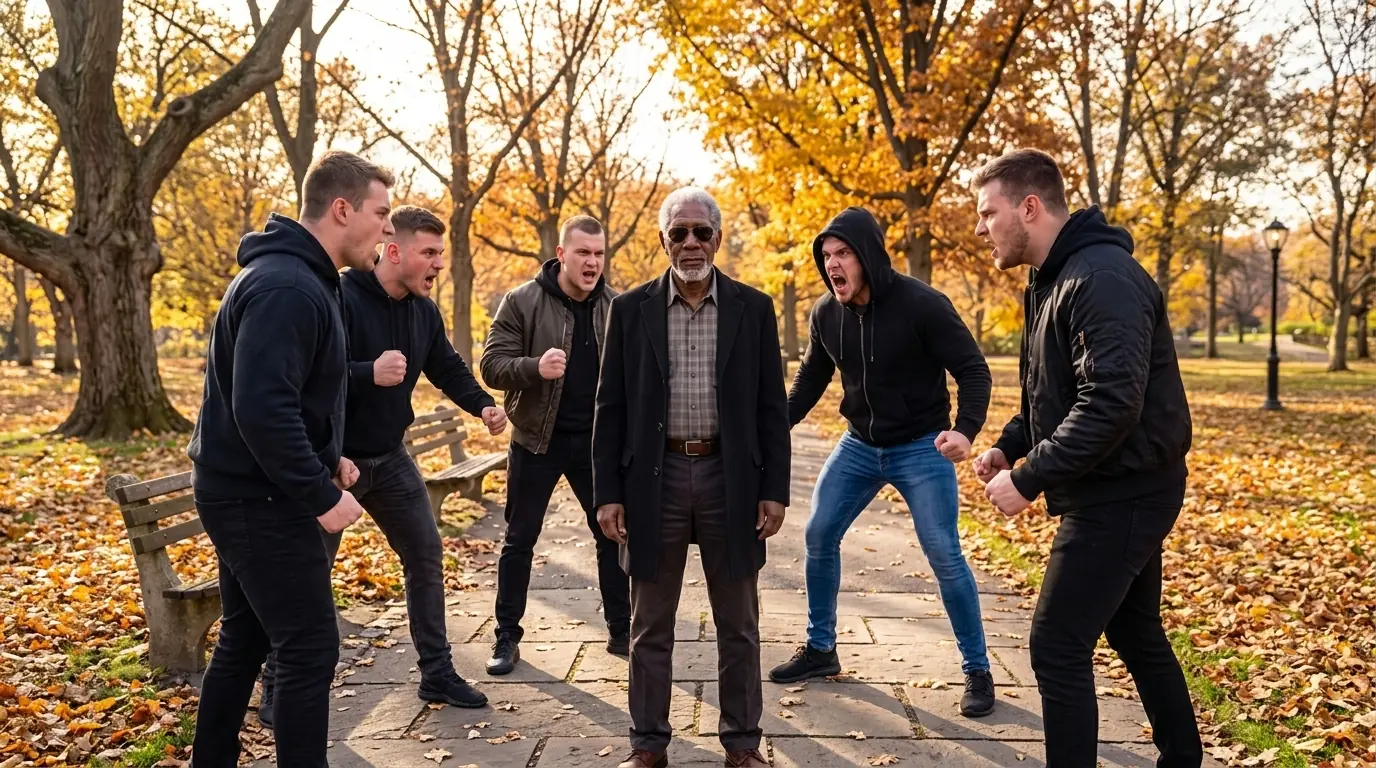
Byron Ingram had lived on Oakfield Road for 41 years. Same house, same porch, same cracked steps he never got around to fixing. The neighborhood had changed around him. New fences, new faces, new money creeping in from the east side. But Byron stayed.
He stayed because this was where Helen had planted her roses. And even though Helen had been gone 9 years, the roses still bloomed every April. He was 74 and moved slowly in the mornings. His left eye saw the world just fine. His right eye saw nothing at all.
That eye had seen nothing since 1984. A detached retina from a punch that should never have been thrown in a fight that should never have happened. But that was a long time ago. Most people on Oakfield Road knew Byron as the quiet old man who swept the sidewalk at 6:00 a.m. and carried grocery bags for Mrs. Patterson on Tuesdays. They didn't know about the 23 professional fights.
They didn't know about the middleweight belt in a shoebox under his bed wrapped in Helen's old scarf. They didn't know that the name Byron "The Ghost" Ingram had once made grown men cross to the other side of the gym. Byron didn't talk about it. When people asked about his eye, he told them glaucoma. Easier that way.
Every morning at 7:00, he walked four blocks to Brandon Park. He carried a canvas bag with two pairs of boxing gloves, a jump rope, and hand wraps so old the elastic had given up. He set up near the basketball courts under the oak tree where the roots had cracked the concrete into something that almost looked like a ring. The kids started showing up three years ago. First came Deshawn, 12 years old and angry at everything.
Then came Kesha, 10 years old and faster than any of them. Then Caleb. Caleb was the one who kept Byron coming back. He was 10 years old and small for his age. He had a stutter that turned simple words into obstacles. His father had been in prison since Caleb was four.
His grandmother brought him to the park every morning before her shift at the hospital. She couldn't afford a babysitter. She couldn't afford much of anything. On the first day, Caleb watched from behind the water fountain. On the second day, he stood closer.
On the third day, Byron held out a pair of gloves. "You want to try?" Caleb shook his head. "That's okay," Byron said. "They'll be here tomorrow."
It took two weeks. One morning, Caleb walked up, put his hands out, and let Byron wrap them. His fingers were shaking. Byron pretended not to notice. "First thing," Byron said, "plant your feet like this."
He showed Caleb the stance. Left foot forward, right foot back, weight balanced. It was the same stance his trainer, Curtis Holloway, had drilled into him 50 years ago in a basement gym in Philadelphia. "Now, hands up. Protect what matters."
Caleb raised his fists. They barely reached his own chin. "Good," Byron said. "Really good." Caleb smiled.
It was the first time his grandmother had seen that smile in months. Every morning after that, Caleb was there 6 days a week. He learned the jab first, then the cross, then how to slip a punch by moving his head two inches to the left. No more, no less. Byron taught the way Curtis had taught him.
Patient, quiet, one thing at a time. He never raised his voice, never pushed too hard. When Caleb got frustrated and threw the gloves down, Byron picked them up, set them on the bench, and said, "They'll be here tomorrow." Caleb always came back. What Byron was really teaching wasn't boxing.
It was a Tuesday in late September when Brad Sawyer showed up at Brandon Park for the first time. He rolled in with four friends, all of them in their early 20s. Two had gym bags slung over their shoulders like props. One carried a speaker blasting music loud enough to rattle the chain-link fence around the basketball courts. Brad was 22, the son of Councilman Garrett Sawyer, a name that opened doors, closed complaints, and made police reports disappear.
Brad had never worked a job, never needed to. He spent most of his time making content for his TikTok. Mostly pranks, the kind that targeted people who couldn't fight back, homeless men, old women at bus stops. He called it comedy. His 200,000 followers agreed.
That morning, Byron was teaching Caleb how to keep his guard up after throwing a jab. "Bring it back fast," he said. "The punch that hurts you is the one you don't see." Caleb nodded, threw the jab, and pulled it back. He was getting better every week.
Brad spotted them from across the park. To Brad, it was an old Black man in dark glasses teaching a skinny kid to box with taped-up gloves on cracked concrete. "Yo, get this," Brad said to his friend with the phone. "This is gold." They walked over.
Brad kicked the canvas bag. Gloves and hand wraps spilled across the ground. "What is this, a homeless gym?" Brad said. His friends laughed.
The phone was already recording. Byron didn't look up. He put his hand on Caleb's shoulder. "Pick up your gloves, son," Byron said. "Hey, I'm talking to you," Brad snapped.
Brad stepped between them. You got a permit for this? You can't just set up camp in a public park. Byron looked at Brad with his one good eye, calm, measured. The way a man looks at something he's seen a hundred times before. "We're just training," Byron said quietly. "Training?"
Brad grinned at the camera. "Training for what, the retirement home Olympics?" More laughter. Caleb's hands were shaking. Not from the cold.
Byron picked up the canvas bag, packed the gloves, took Caleb's hand. "Come on," he said. "We'll come back tomorrow." They walked away. Brad's laughter followed them all the way to the sidewalk.
Byron came back the next morning. So did Brad. This time, Brad brought a water bottle, not to drink. He waited until Byron was showing Caleb how to pivot on the back foot, then walked up behind him and poured the entire bottle over Byron's head. Water ran down Byron's face, dripped off his chin, soaked through his collar.
His dark glasses fogged up. He stood still. Brad's friend screamed with laughter. Two phones out. One of them yelled, "Baptized him." "You're still here?"
Brad said. "I thought I told you to crawl home." Byron wiped his face with his sleeve, took off his glasses, cleaned them on his shirt, put them back on. "Caleb," he said quietly. "Show me that pivot again."
Caleb was frozen, eyes wide, his lips pressed together so the stutter would not escape. "It's okay," Byron said. "Show me." Caleb pivoted. His feet were perfect.
His hands were trembling. Brad watched them for another 10 minutes, then got bored and left. But he posted the video that night. The caption read, "Old Blind Man Gets Baptized in the Park." 14,000 likes by morning.
300 comments, most of them laughing. He came back Thursday. This time he went straight for the canvas bag, pulled out Byron's gloves. The old ones, cracked leather, laces frayed thin. The ones Byron had owned since 1979.
The ones Helen had kept polished on the mantle like a trophy even after he stopped fighting. Brad held them up to the camera. "Look at these museum pieces." He tossed one to his friend. They played catch with them across the court while Byron watched. "Give those back," Byron said.
His voice was even, but his jaw was tight. "Or what?" Brad dangled the glove over a trash can. "You want it? Come get it, old man."
Byron didn't move. Brad dropped the glove in the trash, then the other one. "There," Brad said. "Now you match the rest of the garbage out here." Byron said nothing.
He turned to Caleb. "Let's call it a day." That night, Byron fished the gloves out of the trash at 10 p.m. under a street light. He sat on his porch and cleaned them with a damp cloth for an hour. Rubbed the leather the way Helen used to.
His hands were steady. His breathing was not. The following Monday, Brad brought spray paint. Byron arrived at 7 as usual. Caleb was already waiting by the bench, their bench under the oak tree.
But something was different. Caleb was standing next to it, not sitting. Byron walked closer, saw it. Someone had sprayed the word BLIND across the seat in white paint. Beneath it, in smaller letters, were the words GO HOME.
Caleb looked up at Byron. "Mr. Byron, who did this?" The stutter was back. Three months of progress gone in two words. Byron didn't answer.
He set down his bag, sat on the bench anyway, right on top of the paint. "Come on," he said. "Let's work on your cross today." But Brad wasn't done. From Brad's perspective, this was the best content he'd ever made.
The baptism video had outperformed everything on his page. His followers wanted more. Comments said things like, "Do it again." and "Make the old man cry." Brad's friend suggested they find someone else, but Brad refused.
He liked Byron specifically because Byron never reacted. The non-reaction was the content. The silence was the joke. Brad also knew something the rest of the park didn't. His father was Councilman Garrett Sawyer.
Three terms on the city council, chair of the public safety committee. Every cop in the precinct knew the name. Two complaints had already been filed about Brad's behavior in the park. Both had been quietly moved to the bottom of the pile. One had disappeared entirely.
Brad could do whatever he wanted, and he knew it. The neighbors knew it, too. Mrs. Patterson watched from her window every morning. She saw the water. She saw the gloves in the trash.
She saw the spray paint. She picked up the phone twice to call the precinct. Both times she put it down. "What's the point?" she told her daughter. "His daddy runs the whole thing."
Deshawn's mother pulled him from the group after the baptism video went viral. "I can't have my son around that," she said. She did not mean Byron. She meant the danger that Byron attracted by refusing to leave. Kesha's father did the same. "Find somewhere else to play," he told her.
Kesha cried for two days. Within a week, only Caleb was left. His grandmother didn't have the option of finding somewhere else. She worked from 6:00 to 4:00. The park was it.
Every morning, Byron showed up. Every morning, Caleb showed up. Every morning, Brad showed up. And every night, Byron sat in his garage in the dark. The heavy bag hung from the ceiling beam, the same one he'd installed in 1986 when he still thought he might come back to the ring.
He hadn't touched it in 30 years, but now his hands found it in the dark. Left jab, right cross, left hook. The bag swung, and he caught it. The rhythm came back like breathing. His right eye saw nothing.
His hands remembered everything. He hit the bag for an hour, then two, then three. He never told anyone. Not Caleb, not Mrs. Patterson, not the ghost of Helen, whose roses he watered every morning before walking to the park. Something in Byron Ingram was waking up, and it scared him more than Brad ever could.
Hold on. The whole block saw it. Nobody moved. Not because they didn't care. They just did the math.
And that math left a 74-year-old man and a 10-year-old kid standing alone every morning. I don't know if I would have been any different. It was a Wednesday night when Byron stopped pretending. He stood in the garage wrapping his hands the old way. Two loops around the wrist, three across the knuckles.
Pull tight between each finger. Curtis Holloway's method. 50 years and his hands still knew the pattern in the dark. He hit the bag different that night. Not the slow, careful rhythm of a man remembering.
This was sharp, precise combinations he hadn't thrown since the middleweight final in Atlantic City. Jab, jab, cross, hooked to the body, uppercut. The bag jumped on its chain. The ceiling beam groaned. His right eye could not see, but his left tracked the bag like a scope.
His feet moved the way feet move when they've done 10,000 rounds of shadow boxing. Muscle doesn't forget. Bone doesn't forget. The Ghost did not forget. He stopped after midnight, sat on the concrete floor, hands throbbing, breathing hard.
He looked at the shoebox in the corner, Helen's scarf still wrapped around the belt inside. "I promised you," he whispered. "I know I promised you." The next morning in the park, Caleb asked the question, "Mr. Byron, why don't you ever fight back?" Byron looked at the boy, 10 years old, split lip from last week when Brad shoved him into the drinking fountain.
Yet he was still showing up every morning. "Because I haven't decided yet," Byron said. But he had. It happened on a Friday, October 9th. The kind of morning where the air smells like wet leaves and the sky can't decide between gray and blue.
Byron and Caleb were working on combinations. Caleb was getting good. Really good. His jab had snapped now. His cross came straight, not looping.
When he moved, his feet stayed under him the way Byron had taught. Left foot forward, right foot back. Protect what matters. "That's it," Byron said. "Now again, faster."
Caleb threw the combo. Jab, cross, pull back. Clean again. Jab, cross, pull back. Even cleaner.
Byron almost smiled. Three months of mornings and the kid was starting to look like a fighter. Not because he was big or strong. Because he was precise. Because he listened.
Because every morning he showed up and put his hands out and said nothing and let Byron wrap them. That was the morning Brad Sawyer decided to make his masterpiece. He showed up at 8:15 with five friends instead of four. A new guy had a ring light clipped to his phone. Professional setup.
Brad had announced on his TikTok the night before. "Tomorrow we finish this live at Brandon Park. Don't miss it." 11,000 people were watching the stream when they walked through the gate. Brad crossed the basketball court and headed straight for the oak tree.
Byron saw him coming. He put his hand on Caleb's shoulder. "Stay behind me," he said. "Well, well," Brad said loud enough for the stream. "The blind museum is still open."
He looked directly into the camera. "You guys watching? Watch this." Brad reached down and snatched the gloves off Caleb's hands. Caleb stumbled backward. "Give those back," Byron said. "Shut up."
Brad tossed the gloves to his friend, then turned to Caleb. "You know what your problem is, kid? You got nobody. Your daddy's in jail. Your mama's gone, and your boxing coach can't even see straight."
He bent down to Caleb's level. "You're nothing, just like him." Caleb's lip was trembling. He didn't say a word. The stutter had swallowed everything. "Leave the boy alone," Byron said.
His voice was low. The kind of low that sounds like a warning if you know what to listen for. Brad didn't. "Or what?" Brad straightened up, looked at the camera, grinned.
Then he shoved Caleb. Not a small shove. He drove both hands into the 10-year-old's chest with full force. Caleb flew backward, hit the edge of the concrete where the tree roots had cracked it and went down hard. His head bounced off the ground.
A cut opened on his forehead. A thin line formed and ran past his eyebrow toward his eye. Caleb didn't cry. He just lay there looking up at Byron with one eye open and one eye blurred by the cut, like a mirror. The stream had 16,000 viewers now.
Byron looked down at Caleb, looked at the blood, looked at the boy's hands, still curled into fists, even on the ground, still in guard position, still protecting what matters. Something shifted behind Byron's eyes. Not anger, something older than anger, something that had been sleeping in a garage for 30 years and was now fully, completely awake. Byron took off his dark glasses, folded them, set them on the bench. He turned to Brad. "You sure about that, son?"
The same words from the park bench. But the voice was different now. There was no trembling, no patience, no old man. Brad laughed. "What are you going to do, Grandpa? Bleed on me?"
He threw a punch. A lazy wide right hand. The kind of punch someone throws when they've never been hit back. All arm, no foundation, no guard. Byron slipped it two inches to the left.
No more, no less. The movement was so fast that Brad's fist hit nothing but air. His momentum carried him forward, off-balance. His eyes went wide. That was the first time fear touched his face.
Byron's left jab landed before Brad could reset, straight down the center, clean. The sound was sharp. Not a thud, a crack. Brad's head snapped back and to the side. Brad staggered, put his hands up.
Too late, too high. Byron's right cross came underneath into the solar plexus. Every molecule of air left Brad's lungs in one sound. His mouth opened. Nothing came out.
Then the uppercut. Byron planted his back foot, rotated his hips the way Curtis Holloway had taught him in the basement in Philadelphia, and drove his right fist upward from his waist. It connected under Brad's chin with the precision of a man who had thrown that exact punch 10,000 times in the ring, in the garage, in his sleep. Brad Sawyer left the ground for a split second, then hit the concrete and lay still. Three punches, five seconds.
46 years of silence, broken in five seconds. The park was quiet. 16,000 people on the stream were quiet. Brad's friends were quiet. The one with the ring light hadn't moved.
The phone was still recording. Byron stood over Brad. His hands were shaking now, not from exhaustion, from the flood of something he had spent 30 years trying to bury. He looked at his fists, opened them, closed them, then opened them again. Then he turned around, walked to Caleb, and knelt down.
He pressed his palm against the cut on the boy's forehead. Gentle. The same hands that had just put a 22-year-old on the ground were now holding a 10-year-old's face like it was made of glass. "You okay?" he asked.
Caleb nodded. His eyes were wide, but not afraid. Something else. "Mr. Byron," he whispered. "You can fight."
Byron picked the boy up, set him on the bench, wrapped his forehead with the old hand wraps from the canvas bag. Then he sat beside him and put his arm around his shoulders. He didn't say anything. There was nothing to say. Across the park, Brad Sawyer was being helped to his feet by his friends.
His nose was injured. His jaw hung slightly open on the left side. The ring light was still on. The stream had been recording the entire time, 22 minutes of footage. The clip of the three punches was extracted within the hour.
By noon, it had 4 million views. By the next morning, 40 million. The comments came in waves: "Who is this old man?" "That footwork is not street fighting." "Somebody identify this guy."
The hashtag started small. #ParkKnockout. But by evening, it had been replaced by something else. Something that would change everything. #BlindChampion.
And somewhere in a living room across town, a 68-year-old retired sports journalist named Gene Whitfield watched the clip for the 11th time. He paused it at the uppercut, zoomed in on the footwork, the pivot, the hip rotation. He knew that technique. He had seen it before. 30 years ago, in a ring from a fighter they called The Ghost.
Gene Whitfield picked up his phone. Councilman Garrett Sawyer saw the video at 9:00 a.m. on Saturday morning. His chief of staff sent it with one line. The message contained only four words: "This is your son." Garrett watched it twice.
Then he closed his office door and made four phone calls. The first was to the police chief, a man who owed his appointment to Garrett's endorsement. The second was to the district attorney's office. The third was to a media consultant who had managed three of his campaigns. The fourth was to his personal attorney.
By Sunday evening, Byron Ingram had been charged with aggravated assault. The arrest happened at 6:00 a.m. on Monday. Two officers knocked on Byron's door. He opened it in the same clothes he wore to the park. Canvas jacket, dark glasses, the bag of gloves sitting by the door, ready for the morning session. "Mr. Ingram, you're under arrest for the assault of Brad Sawyer."
Byron didn't resist. He set the bag down on the porch, took off his glasses, and held out his wrists. Mrs. Patterson was watching from her window. She saw them put the handcuffs on a 74-year-old man at sunrise. She called her daughter and cried for 20 minutes.
Garrett Sawyer held a press conference that afternoon. Suit pressed, American flag pin on his lapel. He stood behind the podium at city hall with Brad beside him, jaw supported by medical braces, neck brace, arm in a sling. The camera loved it. A father protecting his injured son.
The image was perfect. "My son was violently attacked by an unhinged individual in a public park," Garrett said. "Brad is 22 years old. He suffered a broken nose, a dislocated jaw, and a concussion. This was not self-defense. This was a brutal, unprovoked assault by someone who clearly has a history of violence."
He paused, looked down at his notes, then looked back up with practiced grief. "I'm asking the district attorney to pursue the maximum sentence. No one, regardless of age, has the right to put their hands on another person. We are a city of laws." No reporter asked about Caleb.
No reporter asked about the 20 minutes of harassment that preceded the three punches. Garrett's media consultant had sent the press a carefully edited clip, 90 seconds long, starting the moment Byron took off his glasses. Everything before that had been cut. The narrative was set. Cable news outlets ran the clip with a new headline: "Elderly Man Viciously Attacks Youth in Park."
They slowed down the uppercut. They zoomed in on Brad hitting the concrete. They showed Brad's hospital photo. Swollen face, neck brace, tubes. One anchor called Byron a ticking time bomb hiding in a public space.
They did not show Caleb. They did not mention the injury on a 10-year-old's forehead. They did not play the first 20 minutes of the stream where Brad harassed, humiliated, and shoved a child. That part of the footage had been quietly filed as unverified by the Sawyer legal team. The comment sections turned.
Not all of them, but enough. That old man could have killed him. There's no excuse for that level of violence. He needs to be in a facility. Why was he even around children?
The people who had cheered #BlindChampion on Friday were now sharing concern pieces by Monday. A petition appeared online. Remove dangerous individuals from Brandon Park. It had 800 signatures by Tuesday. Byron was released on bail Tuesday morning.
His public defender, a young woman named Sarah Collins, who had 43 active cases in a desk covered in folders, told him the situation was serious. "The district attorney is pushing for felony assault. Councilman Sawyer is pressuring the judge. They want to make an example." "An example of what?"
Byron asked. "Of you," she said. "They're saying you're dangerous, that you used trained fighting skills against an unarmed person. That makes it aggravated." Byron sat in her office and said nothing for a long time.
Then he asked, "What about the boy? What about what Brad did to Caleb?" Sarah looked at her desk. "The Sawyer family hasn't been charged with anything. Brad's statement says he was trying to mediate a dispute when you attacked him without warning." "That's a lie." "I know, but they have a councilman, a media team, and a district attorney who plays golf with Garrett Sawyer every Thursday. We have a viral video that half the country now thinks shows an old man beating up a kid. He's 22, but on camera with a neck brace, he looks 18. That's all that matters."
A restraining order was filed Wednesday. Byron was prohibited from going within 500 feet of Brandon Park. The order was signed by Judge Mitchell Crane, the same judge who had attended Garrett Sawyer's fundraiser dinner three months earlier. That evening, someone threw a rock through Byron's front window. No note, no face, just a fist-sized hole in the glass and shards on Helen's rug.
Byron swept them up in silence. He taped a piece of cardboard over the hole and sat on the couch in the dark. He couldn't go to the park. He couldn't see Caleb. He couldn't do the only thing that had given his mornings meaning since Helen died.
The canvas bag sat by the door like a promise he could no longer keep. Caleb's grandmother called that night. Her voice was thin. "Mr. Ingram, I don't know what to do. Caleb won't eat. He won't talk. He just sits by the window and looks at the park. He wrapped his own hands this morning and sat there with his fists up, hitting the air." "Tell him I'll be back," Byron said. "When?"
Byron didn't answer. He didn't know. The next morning, Byron woke at 7:00 out of habit. Got dressed, picked up the bag, walked to the front door, stopped, set the bag down, sat on the porch. He did the same thing the next morning, and the next, and the next.
On the fourth morning, he found Caleb sitting on his front steps. The boy had walked 11 blocks alone before sunrise to find him. His hands were already wrapped badly, lopsided, the tape bunching between his fingers. The way a 10-year-old wraps his own hands when his coach isn't there. "Mr. Byron," Caleb said, "I don't want to stop."
Byron looked at the boy, split lips still healing, dark circles under his eyes, but his fists were up. Guard position, protecting what matters. Byron knelt down, unwrapped the boy's hands, rewrapped them properly, two loops around the wrist, three across the knuckles, pulled tight between each finger. Curtis Holloway's method, the same way he'd been doing it for 50 years. "We're not stopping," he said.
They trained on Byron's porch that morning. No oak tree, no cracked concrete ring, no canvas bag of gear, just an old man and a boy and a pair of gloves that had survived everything the world had thrown at them. They took his park, threw a rock through his window, and a 10-year-old boy walked 11 blocks in the dark just to say, "Don't quit." Gene Whitfield had covered boxing for 41 years. Ringside at the Garden, press row at Atlantic City.
He had watched 400 professional fights in person and written about 300 of them. He knew fighters the way a piano tuner knows pianos, not by looking at them, but by listening to the way they moved. He watched the Brandon Park clip for the 14th time on a Wednesday evening. His wife asked him to come to dinner. He didn't hear her.
It was the uppercut that haunted him. Not the power, though. The power was real. It was the setup. The way the old man planted his back foot at exactly 45°.
The way his hips rotated before his arm moved. The way the fist traveled from the waist, not the shoulder. That wasn't a street fighter's uppercut. That was a trained technique. A specific technique.
One he had seen exactly once before in his career. Atlantic City, 1984, middleweight title fight. A fighter they called The Ghost. Gene pulled up his archive. 41 years of notes, photos, fight cards, press clippings, all stored in filing cabinets in his basement.
He found the folder in 20 minutes. Byron "The Ghost" Ingram. 23 fights, 23 wins, 15 knockouts. Middleweight champion at 28. Then nothing.
The record just stopped. No retirement announcement. No farewell fight. One day he was the most dangerous middleweight in the division. The next day he was gone.
Gene remembered the rumors. An underground fight, an unlicensed bout, serious injury, but no one ever confirmed it. The boxing commission had no record. The promoter was never identified. Byron Ingram simply vanished and the sport moved on.
Gene looked at the viral clip again, paused it at the moment Byron took off his dark glasses, zoomed in. The right eye was clouded and unfocused from a detached retina. The kind of injury that comes from a specific type of impact, the kind that ends careers. He picked up the phone and called a source at the state boxing commission. "I need everything you have on unlicensed bouts in 1984. Middleweight division. Anything involving an eye injury."
The source called back Thursday morning. "There's nothing in the official record, but I found something in the complaint files: a sealed report. An anonymous complaint was filed in March 1984 about an underground fight organized at a warehouse on Fulton Street. The complaint names a promoter named Garrett Sawyer." Gene Whitfield sat down slowly.
He read the name again. Then he looked at the press conference footage from Monday. Councilman Garrett Sawyer, wearing an American flag pin and declaring, "We are a city of laws." The same man. Gene drove to Oakfield Road on Thursday afternoon.
He knocked on Byron's door. Byron opened it, dark glasses on, cardboard still taped over the broken window behind him. "Mr. Ingram, my name is Gene Whitfield. I'm a sports journalist. I covered your title fight in Atlantic City in 1984."
Byron didn't move, didn't speak. Just stood in the doorway like a man deciding whether to close the door or step through it. "I know who you are," Gene said. "I know what happened to your eye, and I think I know who did it." Byron looked at him for a long time.
Then he stepped aside and let him in. They sat in the living room for two hours. Byron told him everything. The warehouse on Fulton Street. The heavyweight who outweighed him by 40 pounds.
The illegal elbow. Waking up in the hospital with one eye gone. The promoter who vanished overnight. The career that ended with no press conference, no farewell, no explanation, just silence. "I didn't know his name back then," Byron said. "He was just a voice behind a curtain. I never saw his face." "His name was Garrett Sawyer," Gene said.
Byron was quiet. He looked at the shoebox on the shelf, Helen's scarf still wrapped around the belt. His hands were flat on his knees still. "And his son," Byron said slowly. "His son is the one in the park." "Yes."
Byron closed his eyes. "One good, one blind, both closed now." Gene spent the next 48 hours building the story. He pulled county records, business filings, property deeds. In 1984, Garrett Sawyer was 29 years old and running an unlicensed boxing promotion out of a warehouse he leased under a shell company.
He organized underground bouts. No referees, no doctors, no commission oversight. Fighters were paid in cash. No medical coverage, no liability. On March 14th, 1984, Byron "The Ghost" Ingram fought in one of those bouts.
His opponent landed an illegal elbow that detached Byron's retina. There was no ringside doctor. By the time Byron reached the hospital, the damage was permanent. Garrett Sawyer shut down the operation the next week, changed his name on the business filings, moved into real estate, then local politics, then city council. Three terms, chair of the public safety committee.
The man who kept the city safe had once run the operation that destroyed a champion's career and left him half blind. And now his son had cornered that same man in a park, had poured water on his head, had thrown his gloves in the trash, had shoved a 10-year-old boy onto concrete. And when the champion finally fought back with three punches in five seconds, the councilman had used every ounce of his power to bury him again. Gene Whitfield published the story on Friday morning. Front page of the Tribune's website.
The headline read: "The Ghost of Brandon Park: How a City Councilman Destroyed a Boxing Champion Twice." The article included everything. The sealed complaint, the warehouse address, the shell company, the medical records from 1984. Side-by-side photos. Byron at 28 holding the middleweight belt and Byron at 74 sitting on a park bench with spray paint behind him.
The uppercut from the viral clip frame by frame matched against footage from the 1984 title fight. Identical technique, same fighter, 30 years apart. Garrett Sawyer read the article at 6:00 a.m. in his kitchen. His wife said his face went white. He called his attorney.
The attorney didn't pick up. He called his chief of staff. The chief of staff had already resigned by email at 5:45 a.m., 12 minutes after the article went live. The article hit 40 million views by Saturday night, twice the reach of the original viral clip. #BlindChampion came back, but this time it carried a different weight.
This time, people understood. The old man in the park wasn't just a fighter. He was a man who had been robbed of everything by the same family that was now trying to rob him again. The district attorney's office issued a statement Saturday afternoon. "In light of new evidence, the charges against Byron Ingram are under review."
By Sunday morning, the restraining order had been suspended. By Sunday afternoon, the state attorney general's office had opened an investigation into Councilman Garrett Sawyer. Sarah Collins, Byron's public defender with the 43 cases, called him at home. "Mr. Ingram, have you seen the news?" "No," Byron said. "My TV's been off since Monday." "The charges are being dropped. The DA just announced it, and the attorney general is looking into the councilman. All of it: the underground fights, the sealed complaint, the obstruction, everything."
Byron was quiet for a long time. "Mr. Ingram, are you there?" "I'm here," he said. "Is it safe to go back to the park?" Sarah laughed.
It was the first time she'd laughed in weeks. "Yes," she said. "It's safe." Byron hung up the phone. He walked to the front door, picked up the canvas bag.
The gloves were inside. Cracked leather, frayed laces, 30 years of silence stitched into every seam. He walked to the porch, looked at the cardboard still taped over the broken window, looked at Helen's roses, blooming late this year, but blooming all the same. Then he called Caleb's grandmother. "Tell him to meet me at the park tomorrow at 7:00, under the oak tree."
The investigation moved fast, faster than anyone expected. The state attorney general's office subpoenaed Garrett Sawyer's financial records on Monday. By Wednesday, they had the shell company filings, the warehouse lease, and the bank statement showing cash payments to unlicensed fighters between 1982 and 1984. Fourteen fighters had no medical coverage, no insurance, and no records filed with the state boxing commission. Three of those fighters had suffered career-ending injuries.
Byron was one of them. The other two had never come forward. On Thursday, Garrett Sawyer was formally charged with racketeering, operating an unlicensed sporting event, and obstruction of justice. The last charge concerned the two police complaints about Brad that had been buried. The sealed complaint from 1984 was unsealed.
His name was on every page. Garrett held no press conference this time. No American flag pin, no podium. His attorney released a two-sentence statement. "Councilman Sawyer denies all charges and looks forward to his day in court."
By Friday, he had resigned from the city council. Not voluntarily, the council voted unanimously to remove him. The man who had sat in the chair of public safety for three terms was escorted out of city hall by the same officers who had once buried complaints on his behalf. Brad Sawyer was charged separately. Assault on a minor for shoving Caleb, harassment, criminal mischief for the spray paint and property damage.
His TikTok account was suspended. His 200,000 followers watched his last video, the live stream from the park, get taken down by the platform. The comments section before it disappeared was nothing but #BlindChampion and #JusticeForByron. Brad's friends were charged as accessories. The one with the ring light deleted his account.
It didn't matter. The footage was already everywhere. The boxing community found Byron before the courts did. It started with a phone call from the World Boxing Association. Then the International Boxing Hall of Fame.
Then fighters active and retired who had grown up hearing whispers about The Ghost. The middleweight who vanished. The champion with no farewell fight. They had all watched the Brandon Park clip. They had all read Gene Whitfield's article and they all wanted the same thing to acknowledge what had been stolen.
The WBA issued a formal statement recognizing Byron "The Ghost" Ingram's career record. 23 fights, 23 wins, 15 knockouts, and condemning the circumstances that had ended it. The statement called the underground bout a criminal act that robbed the sport of one of its finest competitors. Three former middleweight champions recorded video messages. One of them, a man named Carlos Rivera, who had held the belt two years after Byron lost his eye, said something that went viral on its own. "I always wondered who The Ghost was. Now I know, and I wish I could have fought him. I think he would have beaten me."
Gene Whitfield published a follow-up piece the next week. This one was different. No investigation, no records, just a profile. He spent a morning on Byron's porch, watching him teach Caleb. Back on the porch, the canvas bag between them, the old gloves on the railing. "Do you feel vindicated?"
Gene asked. Byron thought about it. "I feel tired," he said. "But the good kind." The neighbors came back first.
Mrs. Patterson brought a casserole and an apology. She stood on Byron's porch with tears running down her face and said, "I should have called. I should have done something." Byron took the casserole. "You're here now," he said. "That counts."
Deshawn's mother brought him back to the group. So did Kesha's father. Within a week, Byron had nine kids showing up every morning. Then 12, then 15. Parents started staying to watch.
Some of them brought chairs. One brought a folding table with water bottles and orange slices like it was a real gym. The city council, now missing one member, passed a resolution the following month. Brandon Park would receive funding for a permanent community boxing program. New equipment, a covered training area near the oak tree, licensed coaches, free for all kids under 16.
They asked Byron what to name it. He didn't hesitate. "The Helen Ingram Boxing Program," he said. "After my wife. She's the reason I kept my hands down for 30 years. And she's the reason I finally put them back up."
Byron Ingram walked back into Brandon Park on a Tuesday morning in November. 7:00 sharp, canvas bag over his shoulder, dark glasses on, new ones paid for by a boxing fan in Detroit who had mailed them with a handwritten note for The Ghost: "Welcome back." Caleb was already there, sitting on the bench under the oak tree, hands wrapped, fists up, waiting. Byron set the bag down, looked at the bench. The spray paint was gone.
Someone had sanded it clean and repainted it. A small brass plaque had been screwed into the backrest. It read, "This bench belongs to Byron Ingram and everyone he teaches." He didn't know who put it there. He never found out. "Mr. Byron," Caleb said.
He was smiling. The stutter was still there, but the smile was bigger than the stutter now. "You ready?" Byron asked. "Yes, sir." "Show me your jab."
Caleb threw it. Snap. Straight. Pull back. Clean again.
Snap. Cleaner again. The morning light came through the oak leaves and landed on the cracked concrete like a spotlight. The other kids arrived one by one. Deshawn first, then Kesha, then new faces.
Kids Byron had never seen before. Some came with their parents, some came alone. One boy walked three miles from the east side because he saw the video and wanted to learn how to stand like that. Byron taught them all the same way, one thing at a time. "Plant your feet. Hands up. Protect what matters."
The Helen Ingram boxing program launched officially in December. The city provided heavy bags, speed bags, jump ropes, and a covered pavilion next to the oak tree. Two licensed coaches volunteered, both former Golden Gloves competitors who had followed the story. Byron wasn't technically a coach on paper. He didn't have the certification, but every morning he was there, and every morning the real coaches stepped back and let him work.
Nobody questioned it. Nobody needed to. Gene Whitfield visited one more time. He brought a photographer. The photo that ran with the final article became the most shared image in the Tribune's history.
Byron Ingram, 74 years old, kneeling on cracked concrete, wrapping a 10-year-old boy's hands. One good eye looking down at the tape, his damaged eye facing the camera. Behind them, 15 kids in a line, fists up, guard position, learning to protect what matters. The headline was simple. "The Ghost Found His Way Home."
Garrett Sawyer's trial was scheduled for March. Brad Sawyer pleaded no contest to the assault and harassment charges. He was sentenced to 200 hours of community service and a three-year restraining order from Brandon Park. His TikTok never came back. His followers moved on.
The internet forgot him the way the internet forgets everyone who isn't worth remembering. But nobody forgot Byron. Six months after the program launched, Caleb entered his first amateur boxing match, a youth exhibition at the Oakfield Community Center. He was 10 years old, 42 pounds lighter than his opponent, and so nervous his hands were shaking in the locker room. Byron wrapped them, two loops around the wrist, three across the knuckles. "Pull tight between each finger." "You scared?"
Byron asked. Caleb nodded. "Good," Byron said. "Scared means you care. Now plant your feet."
Caleb walked into the ring. Left foot forward, right foot back, hands up. He won in the second round. A clean cross to the body that dropped his opponent to one knee. The crowd stood.
Caleb's grandmother screamed so loud the referee turned around. Caleb looked across the ring at Byron. Byron nodded once. That was enough. Outside the community center, Helen's roses were blooming early this year.
Byron noticed them on the walk home. He stopped, touched one of the petals, smiled, then he kept walking.