The boy held the little wooden motorcycle like it might disappear if his fingers loosened.
It was no bigger than his palm.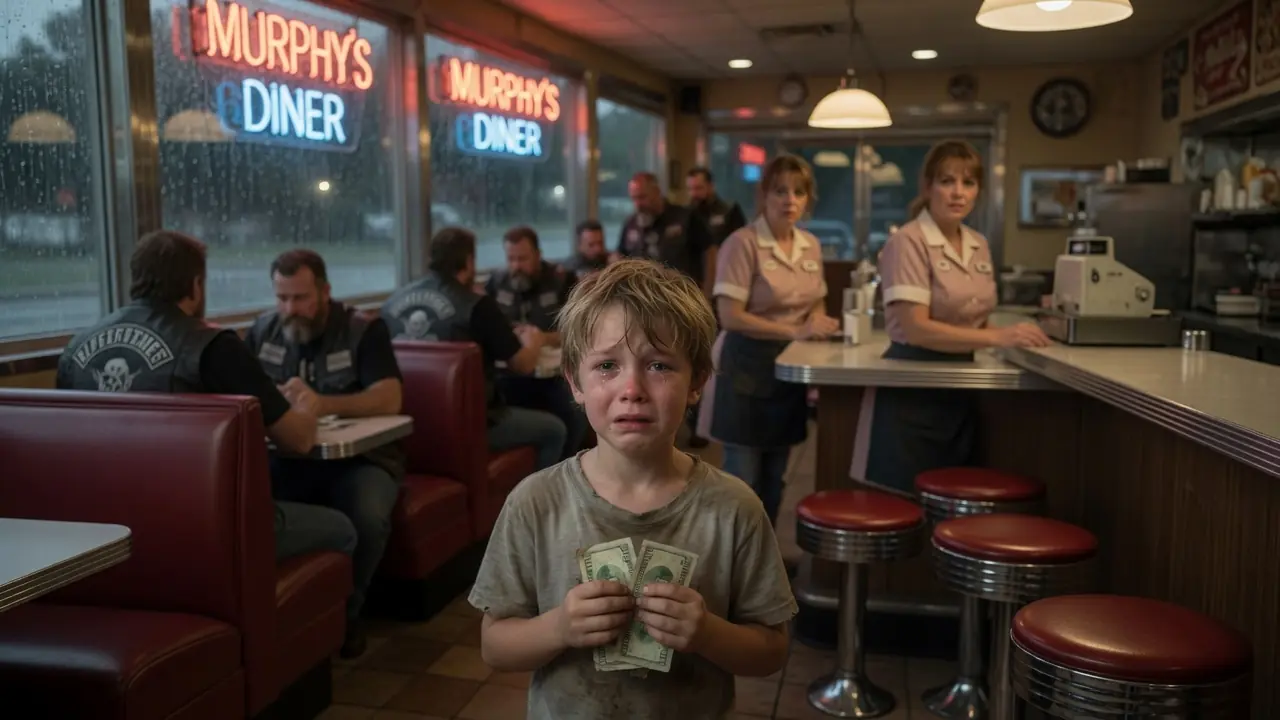
Rough around the wheels, crooked at the handlebars, carved from a scrap of pine that still smelled faintly of sawdust and diner coffee. One side had been painted red with a cheap marker, and the other still showed the pale grain of the wood.
But to the boy, it looked like treasure.
His name was Noah Wren.
He was seven years old, small for his age, with brown hair that always fell into his eyes and a backpack almost as big as his back. His sneakers were worn thin at the toes. His blue hoodie had a tear near one cuff. He sat in the last booth of Murphy’s Diner with both knees drawn up to his chest, looking at the motorcycle as if it had come from another world.
Across from him sat his mother, Cassie.
She was twenty-nine, though exhaustion had put older shadows under her eyes. Her waitress uniform was faded at the collar, and her hands shook whenever she reached for her coffee. Not because she was cold.
Because fear had a way of staying in the body even after the door was locked.
Murphy’s Diner sat off Route 70 in a small town in southern Illinois, the kind of place truckers remembered for strong coffee, cracked vinyl seats, and a neon sign that blinked even during the day. Rain had been falling since morning, tapping against the windows and turning the parking lot into a dark mirror of red brake lights and silver puddles.
Most nights, the diner smelled like bacon grease, wet coats, and old stories.
That night, it smelled like trouble.
Cassie had come in through the back door with Noah just before six, even though her shift did not start until seven. Her manager, a heavyset woman named Rhonda Pike, had taken one look at Cassie’s face and said nothing.
She only pointed toward the last booth.
“Sit there,” Rhonda said. “Kitchen door stays open. I’ll keep an eye out.”
Cassie whispered thank you.
Noah had not spoken.
He had kept both hands wrapped around the straps of his backpack as if someone might try to take it.
The first biker arrived at 6:18.
Then another.
Then six more.
Their motorcycles rolled into the parking lot with a low rumble that made the window glass hum. Noah flinched at the sound and ducked closer to his mother. Cassie’s arm came around him automatically.
“It's okay,” she whispered.
But she did not sound sure.
The bikers came in laughing, shaking rain from their jackets, boots heavy against the tile floor. They wore leather vests with patches that read Iron Shepherds. They were big men mostly, older, gray-bearded, weathered by road and sun and things they did not talk about in family restaurants.
At the front was a man people called Abel “Grizzly” Knox.
He was fifty-two, tall and broad, with a white beard, a shaved head, and tattoos running down both arms. His left hand had two missing fingers from a factory accident years before. His face looked hard at first glance, like it had been carved by someone in a bad mood.
But when he smiled at Rhonda, the hardness changed.
“Evening, boss.”
Rhonda snorted.
“You boys better not track mud all over my clean floor.”
Grizzly looked down at the floor, which had not been clean since lunch.
“Yes, ma’am. We’ll respect the palace.”
The bikers filled three tables near the middle of the diner.
They ordered burgers, fries, pie, coffee, and one chocolate milk because a rider named Moose claimed he was “cutting back.” Their voices filled the room, not aggressive, just large. The kind of noise that comes from people comfortable taking up space.
Noah watched them from the last booth.
Carefully.
Like he was studying dangerous animals behind glass.
Grizzly noticed.
He noticed many things.
He noticed Cassie’s bruised wrist half-hidden beneath her sleeve. He noticed how she kept looking toward the front door whenever headlights crossed the windows. He noticed the boy’s backpack, clutched tight even while he ate half a grilled cheese Rhonda sent over without charging.
And he noticed the way Noah stared at the small wooden motorcycles hanging from the diner’s Christmas donation tree.
The tree stood near the register even though Christmas was still three weeks away. Every year, Murphy’s Diner put up a charity tree for kids at the county shelter. People could take an ornament, buy a gift, and bring it back wrapped.
This year, Rhonda’s husband had made little wooden motorcycles for the bottom branches.
He had died before Thanksgiving.
Rhonda had hung them anyway.
Noah’s eyes kept drifting to one red motorcycle on the lowest branch.
He did not ask for it.
Children who have learned not to ask often stare instead.
Grizzly saw that too.
He waited until Cassie went to the counter to speak quietly with Rhonda. Then he stood, walked to the tree, and took the little red motorcycle off the branch.
Noah stiffened.
Grizzly stopped a few feet away from the booth, not too close.
“Hey, little man,” he said.
Noah did not answer.
His fingers tightened around the backpack straps.
Grizzly held up the wooden motorcycle.
“Been watching you eye this thing like it owes you money.”
Noah’s face went red.
“I wasn’t gonna take it.”
“Didn’t say you were.”
The boy looked at the table.
Grizzly crouched, which was not an easy task for a man built like an old bear.
“My name’s Abel, but most folks call me Grizzly. What’s yours?”
Noah glanced at his mother, still at the counter.
Then whispered, “Noah.”
“That’s a good name.”
Noah shrugged.
Grizzly held out the motorcycle.
“Want to keep this safe for me?”
The boy stared at it.
“I can?”
“If you want.”
“Why?”
Grizzly looked at the toy, then back at Noah.
“Because motorcycles don’t like hanging on trees. Makes them feel silly.”
That almost got a smile.
Almost.
Noah reached out slowly, as if expecting the offer to be snatched away.
When his fingers closed around the wooden motorcycle, something shifted in his face. A tiny thaw. The kind of change most adults would miss because they expect children to heal loudly.
Noah held the toy to his chest.
“Thank you.”
“You’re welcome.”
Grizzly stood and went back to his table.
The other bikers had gone quiet enough to watch without seeming to watch.
Moose leaned toward him.
“You gave away Rhonda’s ornament.”
“I’ll pay for it.”
“Wasn’t arguing.”
“Good.”
Moose looked toward Noah.
“Kid looks scared.”
Grizzly poured cream into his coffee.
“Kid is scared.”
Nobody asked how he knew.
Men like Grizzly did not guess about fear.
They recognized it.
For a while, nothing happened.
The rain kept falling. Truckers came and went. Rhonda refilled mugs. Cassie stayed near the counter, speaking in low tones. Noah sat in the booth and rolled the little wooden motorcycle across the table.
Forward.
Back.
Forward.
Back.
Each time the front wheel bumped a salt shaker, he carefully steered around it.
The bikers smiled from across the diner.
Not too much.
Not in a way that would embarrass him.
Just enough to let him know he was allowed to play.
For the first time since he entered Murphy’s, Noah looked less like a child waiting to be punished.
Then he opened his backpack.
It was an old green backpack with one broken zipper tied shut with string. Noah set the motorcycle beside his plate and reached inside with both hands. He dug past a school folder, a plastic dinosaur, and a folded sweatshirt.
Then he pulled out a drawing.
The paper had been folded and unfolded many times. The edges were soft. A corner had torn and been fixed with clear tape. Crayon marks covered nearly every inch of the page.
Noah looked at the drawing for a long moment.
Then he slid out of the booth.
Cassie turned immediately.
“Noah?”
He froze.
“I just want to show him.”
Cassie’s face tightened with worry, but she nodded.
“Okay. Stay where I can see you.”
Noah walked slowly toward the bikers’ table, the wooden motorcycle in one hand and the folded drawing in the other.
Every biker at that table stopped moving.
Even Moose, who was halfway through a bite of pie, lowered his fork.
Noah stopped beside Grizzly.
“Can I show you something?”
Grizzly turned fully toward him.
“Sure.”
Noah handed him the drawing.
Grizzly took it with a gentleness that looked strange against his big scarred hands.
He unfolded the paper carefully.
At first, his face stayed soft.
Then his smile faded.
The drawing showed a small house.
A crooked house with yellow windows, a brown door, and gray clouds above it. Beside the house was a little boy drawn in blue crayon. The boy’s mouth was a trembling line. His eyes were huge black circles.
In front of him stood a giant man wearing a red cape.
The man had wide shoulders, boots, and a helmet that looked almost like a motorcycle helmet. His arms were stretched out, blocking a dark shape coming from the edge of the paper.
At the top, written in uneven child letters, were five words.
My Hero Never Came Back.
Grizzly stared at the words.
Nobody at the table spoke.
The diner seemed to shrink around that piece of paper.
“What happened here?” Grizzly asked quietly.
Noah looked down at the wooden motorcycle.
“The hero left.”
Cassie had gone pale near the counter.
Rhonda put one hand over her mouth.
Grizzly swallowed.
“Who was the hero?”
Noah shrugged too fast.
“My mom said I don’t have to talk about it.”
“Then you don’t.”
The boy’s lip trembled.
“But I want to.”
Grizzly set the drawing on the table between them.
“Okay.”
Noah looked at the other bikers, then at Grizzly.
“My dad used to say he was gonna protect us.”
The words came out flat at first.
Like something memorized from inside a dark room.
“He said nobody would ever hurt us while he was there. He had a leather jacket, but not like yours. He said he was tough.”
Grizzly did not move.
Noah’s fingers tightened around the wooden motorcycle.
“Then he started yelling.”
A woman at a nearby table turned her face away.
“He yelled at Mom. Then at me. Sometimes he cried after and said heroes get tired too.”
Noah looked confused by that memory.
Like he had spent a long time trying to understand it and never could.
“Then last week, he got real mad because Mom hid the car keys.”
Cassie’s shoulders shook.
Rhonda moved beside her, close enough to steady her if she needed it.
Noah kept talking.
“He said if we left, nobody would come for us. He said nobody cares about scared little boys.”
The diner was silent now.
Not quiet.
Silent.
Even the grill seemed to hiss more softly.
Grizzly’s eyes lowered again to the drawing.
The little boy.
The house.
The cape.
The words.
My Hero Never Came Back.
“Did he hurt you?” Grizzly asked.
Noah did not answer at first.
Then he pointed to the dark shape at the edge of the paper.
“That’s his shadow.”
The sentence made something cold move through the diner.
Grizzly looked toward Cassie.
Her face told the rest.
The bruised wrist.
The early arrival through the back door.
The fear of headlights.
The way Noah kept his backpack ready.
They were running.
Not from poverty.
Not from bad luck.
From a man who had promised protection and become the thing they needed protection from.
Noah looked at the wooden motorcycle in his hand.
“When you gave me this,” he said, “I thought maybe…”
He stopped.
Grizzly leaned a little closer, but still did not touch him.
“Maybe what?”
Noah’s voice fell to a whisper.
“Maybe my hero didn’t come because he sent you instead.”
Grizzly closed his eyes.
The words hit him in a place older than the diner, older than the ride that brought him there, older than the beard and tattoos and road name.
His real name, Abel Knox, had once belonged to a boy who waited too.
He had waited on porch steps with a suitcase packed.
Waited for a father who promised to come back sober.
Waited through sirens.
Waited through apologies.
Waited until waiting hardened into something that looked like strength.
Grizzly opened his eyes.
They were wet.
He did not try to hide it.
“You listen to me, Noah,” he said, his voice rough but steady. “A hero ain’t someone who promises big and disappears when things get hard.”
Noah watched him.
“A hero is someone who shows up,” Grizzly said. “Maybe late. Maybe scared. Maybe not wearing a cape. But he shows up and stays long enough to matter.”
Noah looked down.
“Do bikers stay?”
Moose made a sound like a laugh breaking into a cough.
Grizzly smiled.
“Some do.”
Noah held the motorcycle tighter.
“Are you some?”
Grizzly looked at Cassie.
She was crying silently now.
Not loudly.
Not in a way that asked for attention.
Just tears sliding down the face of a woman who had held herself together too long.
Then he looked back at Noah.
“Yeah,” he said. “I’m some.”
The front door opened.
The little bell above it rang.
Every adult in the diner turned.
A man stood in the doorway, rain shining on his dark jacket, anger already twisting his face.
Cassie made a sound so small it barely reached the air.
Noah’s body locked.
The man was tall and lean, with wet blond hair, a trimmed beard, and the kind of clean clothes that made him look respectable from a distance. But his eyes were all wrong.
Sharp.
Searching.
Full of ownership.
His name was Darren Vale.
Cassie’s husband.
Noah’s father.
And the man from the shadow at the edge of the drawing.
Darren took one step inside.
“There you are.”
Nobody moved.
Darren’s gaze swept over the diner, found Cassie, then Noah, then the bikers.
His mouth curled.
“You got my boy sitting with these animals now?”
Grizzly stood.
Slowly.
The chair scraped back.
So did six others.
Darren stopped walking.
The Iron Shepherds rose from their tables like a weather front.
They did not rush him.
Did not shout.
Did not threaten.
They simply stood.
Big men in leather, boots planted, faces calm in a way that made the calm feel dangerous.
Darren’s eyes narrowed.
“This is family business.”
Grizzly stepped in front of Noah without touching him.
“No child shaking like that makes it private.”
Darren laughed.
A cruel little sound.
“You don’t know anything about my kid.”
Noah whispered from behind Grizzly, “I don’t want to go.”
Darren’s face changed.
Not hurt.
Anger wearing hurt as a costume.
“Don’t start, Noah. Your mother’s putting ideas in your head.”
Cassie wiped her face and stepped away from the counter.
Her voice shook, but she used it.
“We’re not going back.”
Darren stared at her.
Then smiled.
The smile was worse than yelling.
“You think these circus clowns can stop me?”
Rhonda reached under the counter.
“Darren,” she said, “police are already on the way.”
His eyes snapped to her.
“You called them?”
Rhonda did not blink.
“The second you pulled in.”
Darren’s jaw tightened.
He looked at Cassie again.
“You think cops fix this? You think they’ll believe you? You always exaggerate. You always make me the bad guy.”
Noah’s small voice came from behind Grizzly.
“You are the bad guy.”
The words hung there.
Darren went still.
Cassie covered her mouth.
Noah stepped slightly to the side so he could see his father, though Grizzly remained close enough to block any sudden movement.
“You said heroes protect,” Noah said. “But you made Mom cry. You broke the kitchen chair. You said sorry, but then you did it again.”
His voice trembled, but he did not stop.
“You’re not the hero.”
Darren’s face flushed red.
“You ungrateful little—”
Grizzly moved one step.
Only one.
That was enough.
Darren swallowed the rest of the sentence.
Outside, police lights flashed blue and red across the wet windows.
Two deputies entered with cautious hands near their belts. One was a woman named Deputy Maren Cole, who seemed to know exactly who Darren was. Her face hardened when she saw Cassie’s bruised wrist and Noah hiding behind the bikers.
“Darren Vale,” she said. “Step outside.”
Darren pointed at Cassie.
“She took my son.”
Deputy Cole did not look impressed.
“And we have a temporary protective order filed this afternoon. You were served by phone and email. You’re in violation just standing here.”
His confidence cracked.
“No. That’s not—”
“Outside.”
The second deputy moved behind him.
Darren looked once more at Noah.
For a moment, all the loudness left him, and something desperate came through.
“Noah.”
The boy held up the wooden motorcycle like a shield.
“I’m staying with Mom.”
Darren’s face twisted.
Then the deputies took him out into the rain.
The diner watched through the windows as he argued, pointed, turned red, then was placed in the back of a cruiser.
Only when the police car pulled away did Noah begin to shake.
The wooden motorcycle slipped from his fingers.
Grizzly caught it before it hit the floor.
Then Noah broke.
He did not cry like a child throwing a tantrum.
He folded inward, shoulders shaking, hands covering his ears like the yelling was still happening.
Cassie rushed to him, but stopped just short.
Afraid to crowd him.
Afraid to do the wrong thing.
Grizzly lowered himself to the floor, knees cracking.
He set the wooden motorcycle between them.
“Noah,” he said gently. “You’re safe in the diner. Your mom’s right there. The loud part is over.”
Noah sobbed harder.
“I told him he was bad.”
“Yeah.”
“Am I bad?”
“No.”
“He’s my dad.”
“I know.”
“I’m supposed to love him.”
Grizzly’s face tightened with pain.
“You can love somebody and still not let them hurt you.”
Noah looked at him through tears.
“That’s allowed?”
“Absolutely.”
Cassie knelt then and opened her arms.
Noah climbed into them.
Mother and son held each other on the diner floor while rain streaked the windows and half the room cried without pretending they were not.
Grizzly stayed beside them.
Not touching.
Just there.
A wall if needed.
A witness if needed.
A man who had decided, quietly and completely, that this child’s drawing was not going to end the same way twice.
Deputy Cole came back inside twenty minutes later.
She spoke softly with Cassie, confirmed that Darren would be held at least overnight, and told her the shelter in Carbondale still had a family room open. Cassie nodded, but her face showed the fear of a woman who had spent too long hearing promises that help was coming.
Grizzly overheard.
“Shelter’s good,” he said.
Cassie looked up.
“But?”
“But it’s thirty miles in the rain, and he knows shelters.”
Deputy Cole studied him.
“You have another suggestion?”
“The Iron Shepherds run a safe ride program.”
Moose raised a hand.
“We do?”
Grizzly did not look away from the deputy.
“We do now.”
The bikers adjusted instantly.
Not with confusion.
With the strange efficiency of men who may not know the plan, but know the man making it.
Moose pulled out his phone.
A rider named Bishop called his sister, who worked with a church housing network.
Another rider, Clay, called his wife, who managed a small motel on the edge of town.
Grizzly spoke to Deputy Cole about escort options, contact logs, legal next steps, and making sure no one from Darren’s family could track them.
Cassie watched all this with stunned eyes.
“You don’t have to do this,” she said.
Grizzly looked at Noah, who was sitting in the booth again, clutching the wooden motorcycle with both hands.
“Yeah,” he said. “We do.”
Rhonda brought pie.
No one asked for it.
She just placed slices of apple pie in front of Cassie and Noah, then set an entire pie on the bikers’ table with a knife stuck in it.
“Eat,” she ordered.
Moose saluted with his fork.
“Yes, ma’am.”
The heaviness in the diner shifted, not gone, but shared.
Noah ate three bites of pie.
Then four.
Then asked if he could put whipped cream on it.
Rhonda gave him a mountain.
For the first time that night, he smiled without checking whether it was safe.
Grizzly picked up the drawing again.
He studied the cape.
The little boy.
The dark shadow.
“You mind if I ask something?” he said.
Noah shook his head.
“Can I keep this?”
Noah’s eyes widened.
“Why?”
“Because I know some men who need to see it.”
“The bikers?”
“Yeah.”
Noah hesitated.
“It’s sad.”
“Sometimes sad things teach loud people how to be quiet.”
Noah thought about that.
Then nodded.
“But you have to keep it safe.”
Grizzly folded it with great care.
“Promise.”
The motel plan came together by nine.
Clay’s wife had a ground-floor room with two beds at a place called Pine Lantern Motor Inn. It was owned by her cousin, who did not ask questions when told not to. The Iron Shepherds would escort Cassie and Noah there. Deputy Cole would follow and make sure the paperwork was filed correctly.
Cassie stood near the booth, looking at the small pile of their belongings.
One backpack.
One purse.
A plastic grocery bag Rhonda had filled with food.
That was what leaving a life could look like.
Small enough to carry.
Heavy enough to crush you.
Noah looked at Grizzly.
“Are you coming too?”
“Yeah.”
“All the way?”
“All the way.”
“Tomorrow too?”
Grizzly glanced at Cassie.
“That’s up to your mom.”
Cassie’s mouth trembled.
“We could use friends tomorrow.”
Grizzly nodded.
“Then tomorrow too.”
The Iron Shepherds rode out in formation around Rhonda’s old minivan, which she insisted Cassie borrow because Cassie’s car was still at the house. Rain fell light now, silver in the headlights.
Noah sat in the back seat with his backpack on his lap and the wooden motorcycle pressed against the window.
Outside, the bikers surrounded them.
Not showing off.
Not roaring.
Just present.
At the motel, Grizzly checked the room before Cassie and Noah entered. He looked behind the curtains, under the beds, in the bathroom, in the closet. Cassie watched him with tears in her eyes.
“You’ve done this before?” she asked.
He nodded once.
“Different ways.”
Noah set his backpack on one bed and placed the wooden motorcycle carefully on the nightstand.
Then he looked at Grizzly.
“Can heroes be old?”
Moose, standing in the doorway, made an offended noise.
“Careful, kid.”
Grizzly smiled.
“Heroes come in all mileage.”
Noah looked at his face.
“Can they be scared?”
Grizzly crouched.
“The good ones usually are.”
“Are you scared?”
“Tonight?”
Noah nodded.
“Yeah.”
“Of what?”
Grizzly looked toward the parking lot where the motorcycles stood wet and shining under the motel lights.
“Of failing somebody who finally asked for help.”
Noah absorbed that.
Then he stepped forward and hugged him.
It was quick.
Awkward.
A child’s sudden decision.
Grizzly froze for half a second, then gently placed one hand against Noah’s back.
Cassie turned away and cried.
That night, the Iron Shepherds took shifts in the parking lot.
No one asked them to.
They just did.
Moose sat in a lawn chair under the motel awning with a thermos of coffee and a baseball bat he claimed was “for mosquitoes.” Bishop slept in his truck with one eye open. Grizzly stayed until dawn, watching the road, the folded drawing tucked safely inside his vest pocket.
At sunrise, Noah opened the motel room curtain.
Grizzly lifted one hand.
Noah lifted the wooden motorcycle back.
A signal.
I’m still here.
You’re still safe.
The next days did not become easy.
Real life rarely respects dramatic moments enough to become simple afterward.
Cassie had to meet with legal aid.
She had to file statements.
She had to retrieve documents from the house with police present.
Noah had to talk to a counselor at school. He had to learn that nightmares could come even when nobody was yelling anymore. He had to learn that safety felt strange before it felt good.
But the Iron Shepherds stayed close.
Not every minute.
Not in a way that took over.
Just close enough.
Grizzly drove Cassie to court when she needed to file for a longer protective order. Moose fixed Rhonda’s minivan for free after it started making a grinding noise. Bishop found a church group that helped Cassie apply for emergency housing.
Clay’s wife brought clothes for Noah.
A proper winter coat.
Pajamas with dinosaurs.
New sneakers that made him stand very still when he saw them.
“For me?” he asked.
Cassie knelt in front of him.
“For you.”
“Do I have to give them back?”
“No, baby.”
He touched the laces.
“Even if they get dirty?”
Cassie’s face broke.
“Even then.”
Grizzly saw that from the motel doorway and looked away.
Some things were too private to witness directly.
A week later, Cassie returned to Murphy’s Diner for her shift.
Not because she was fine.
Because rent did not wait for healing.
Rhonda shortened her hours, paid her under the table for the first few days, and told anyone who had an opinion to take it outside and argue with the dumpster.
Noah came after school and sat in the last booth.
The wooden motorcycle came too.
Every night, one Iron Shepherd showed up for coffee.
Sometimes two.
Never all at once, not after the first night.
They did not want Cassie to feel watched.
They wanted her to feel backed.
There was a difference.
One Tuesday evening, Noah brought a new drawing.
He walked straight to Grizzly’s table, where the biker sat eating meatloaf and pretending the vegetables were not happening.
“Can I show you?”
“Always.”
Noah unfolded the paper.
This drawing still had the little house.
Still had the boy.
Still had a dark shape near the edge.
But now, in front of the boy, there was not one hero.
There were many.
A huge man with a gray beard.
A woman holding pie.
A police car.
A motorcycle.
A mom with yellow hair drawn like sunlight.
At the top, Noah had written:
My Heroes Came Late.
At the bottom, smaller:
But They Stayed.
Grizzly stared at the paper.
His throat worked.
Moose, seated beside him, leaned over and immediately turned his face toward the window.
“Dust,” Moose muttered.
“There’s no dust,” Noah said.
“Emotional dust.”
Noah giggled.
Grizzly looked at the drawing for a long time.
“You mind if I keep this one too?”
Noah shook his head.
“I made it for you.”
That night, Grizzly took both drawings to the Iron Shepherds clubhouse.
It was an old converted garage behind a closed gas station, with mismatched chairs, a pool table missing one ball, and a fridge full of soda because half the men were pretending to quit drinking.
He taped the first drawing to the wall.
My Hero Never Came Back.
Then the second beside it.
My Heroes Came Late. But They Stayed.
The room went quiet.
Men who had argued over everything from engine oil to barbecue sauce stood with their hands in their pockets and did not speak.
Finally, Bishop said, “We should do something.”
Moose nodded.
“Safe ride program.”
Clay crossed his arms.
“For women and kids.”
“For anybody scared,” Grizzly said.
The plan grew from there.
At first, it was simple.
A phone number printed on cards.
A line at the bottom:
If you need to leave, call. No questions first.
They gave cards to diners, shelters, hospitals, gas stations, churches, laundromats, women’s clinics, and school counselors. Deputy Cole helped them connect with advocates who trained them on what to do and what not to do.
They learned fast.
Do not confront abusers unless safety requires it.
Do not make promises police or courts must handle.
Do not take control from people who have already had too much control taken.
Ask what they need.
Believe them.
Show up.
Stay until help is real.
Grizzly insisted every rider who volunteered take the training seriously.
“This isn’t playing hero,” he told them. “This is carrying scared people from one place to another without making them owe us for it.”
The program became official two months later.
They called it The Late Heroes Ride.
Noah picked the name.
Cassie cried when she saw the logo, a small wooden motorcycle beneath a red cape.
Spring came slowly.
Cassie and Noah moved into a small apartment above a bakery owned by a woman who believed in second chances and charged rent accordingly. The place smelled like bread in the mornings. Noah got his own room with a window facing the alley and a shelf where he kept the wooden motorcycle.
He started sleeping better.
Not always.
But better.
He began seeing a counselor named Miss Talia, who let him draw before talking.
Sometimes he drew motorcycles.
Sometimes houses.
Sometimes shadows.
One day, he drew a cape hanging on a hook.
Miss Talia asked what that meant.
Noah said, “Heroes need breaks too.”
Grizzly kept visiting Murphy’s.
Every Friday at six.
Same booth if it was open.
Noah would sit across from him and show him schoolwork, drawings, or new wooden things he had tried to carve with a child-safe kit Moose bought him.
Some were motorcycles.
Some were animals.
One was supposed to be a bear but looked like a potato with ears.
Grizzly kept it anyway.
Cassie changed too.
Slowly.
She laughed more.
The kind of laugh that startled her at first, as if she had forgotten she could make that sound. She still looked toward the door sometimes. Still tensed at certain engine sounds. Still had days when fear sat close.
But she kept going.
She got promoted to assistant manager after Rhonda admitted she was “too old to fight with suppliers every week.”
She opened a savings account.
She bought Noah a new backpack.
He kept the old green one in his closet.
Not because he needed it.
Because it had carried the drawings.
The first time The Late Heroes Ride got a call, it came at 2:13 a.m.
A woman at a gas station outside Marion.
Two kids.
One suitcase.
A husband circling the block in a pickup.
Grizzly, Moose, Bishop, and Clay rode out in the cold dark with Deputy Cole coordinating behind them. They did not shout. They did not threaten. They formed a wall between the gas station door and the parking lot until police arrived.
The woman and her kids were taken to a safe location before sunrise.
The next morning, Noah heard about it from Cassie.
“Did they save them?” he asked.
Cassie sat beside him on the bed.
“They helped them get somewhere safe.”
“That’s saving.”
“Sometimes, yes.”
Noah looked at the wooden motorcycle on his shelf.
“Can I make more?”
“More what?”
“Motorcycles. For kids who leave.”
Cassie’s eyes filled.
“If you want to.”
So he did.
Not alone.
Rhonda’s nephew cut the wood.
Moose sanded the edges.
Noah painted them.
Red.
Blue.
Green.
Yellow.
Purple.
Every wooden motorcycle had a tiny cape painted on the seat.
The first one went to a little girl named Ava, who held it the same way Noah had held his.
Afraid to let go.
Afraid it might not be real.
Noah watched her from across Murphy’s Diner as she sat with her grandmother and drank chocolate milk.
He understood her face.
The looking.
The checking.
The waiting for safety to vanish.
He walked over carefully.
“I made that,” he said.
Ava looked at him.
“For me?”
“Yeah.”
“Why?”
Noah thought about Grizzly.
Then said, “Because motorcycles don’t like sitting in boxes. Makes them feel silly.”
Ava stared.
Then smiled.
When Noah returned to the bikers’ table, Grizzly was looking at him with pride so raw it almost embarrassed them both.
“What?” Noah asked.
“Nothing.”
“You look weird.”
“Emotional dust.”
Noah rolled his eyes.
By summer, Murphy’s Diner had changed.
Not the walls.
Not the cracked booths or the neon sign.
But the feeling.
People knew about the cards near the register. They knew the Iron Shepherds were not just loud men with bikes. They knew Cassie and Noah’s story, though Rhonda made sure nobody bothered them about it.
Sometimes strangers left donations in a jar marked Late Heroes Fund.
Sometimes they left notes.
Thank you for helping my sister.
My niece got out because of you.
You gave my son a safe ride.
Grizzly read each one quietly.
Then taped copies inside the clubhouse, beneath Noah’s drawings.
The wall filled slowly.
Proof that one folded crayon picture in a scared boy’s backpack had done what speeches and sermons often failed to do.
It made grown men move.
The court hearing came in August.
Darren Vale stood before a judge and tried to sound misunderstood. He spoke about stress, work, anger, mistakes, how Cassie had turned his son against him. He wore a clean shirt and used a soft voice.
Noah sat beside Cassie, holding her hand.
Grizzly sat two rows back with Deputy Cole, Rhonda, and three Iron Shepherds in plain clothes because the judge had warned against “intimidating attire.”
Moose looked deeply uncomfortable without his vest.
The judge listened.
Then she looked at the evidence.
Photos.
Medical records.
Police reports.
Cassie’s statement.
Noah’s counselor’s notes.
And, because Noah asked for it, the first drawing.
My Hero Never Came Back.
The judge studied it for a long time.
Darren’s lawyer objected.
The judge overruled him.
When she granted the longer protective order, Cassie let out a sound like air returning to a room.
Noah did not cry until they reached the parking lot.
Then he turned and ran straight into Grizzly’s arms.
“Is it over?”
Grizzly held him.
“Part of it.”
Noah pulled back.
“What part?”
“The part where he gets to come close.”
Noah nodded.
“What about the scared part?”
Grizzly looked at Cassie.
Then at the boy.
“That part takes longer. But you won’t do it alone.”
Noah believed him.
Not fully.
Not the way children believe before the world hurts them.
But enough.
Enough is how healing often begins.
One year after the night in the diner, Murphy’s held a small event for The Late Heroes Ride.
Rhonda called it a fundraiser.
Moose called it an excuse for pie.
Noah called it “the anniversary of the motorcycle.”
They hung both original drawings in frames near the donation tree.
The first still hurt to look at.
My Hero Never Came Back.
The second helped people breathe.
My Heroes Came Late. But They Stayed.
Noah stood in front of them wearing a button-down shirt Cassie had bought new. His hair was combed badly. His face was brighter than it had been a year earlier.
Not unscarred.
Brighter.
Grizzly stood beside him, uncomfortable with attention.
Rhonda clinked a spoon against a coffee mug.
“All right, listen up before the pie gets cold.”
The diner quieted.
“We all know why we’re here,” she said. “A year ago, a kid walked into this place scared out of his mind. He showed one of our loudest regulars a drawing, and somehow that drawing gave a bunch of grown men a purpose besides arguing about motorcycles and barbecue.”
People laughed.
Grizzly muttered, “Unfair.”
Rhonda ignored him.
“Since then, The Late Heroes Ride has helped twenty-seven people get to safety. Twenty-seven. That started because Noah Wren had the courage to show somebody what hurt.”
All eyes turned to Noah.
He stepped closer to Cassie, but did not hide.
Rhonda continued, softer now.
“And because Abel Knox had the sense to understand that when a child hands you his pain, you don’t hand it back. You carry it better.”
Grizzly looked down.
Noah slipped his hand into the biker’s large one.
Rhonda raised her mug.
“To late heroes.”
The diner answered.
“To late heroes.”
Noah tugged Grizzly’s hand.
“Can I say something?”
Grizzly blinked.
“You want to?”
Noah nodded.
Rhonda handed him the spoon like it was a microphone.
Noah stood near the drawings.
His voice was small at first, but it grew.
“I used to think heroes had to come before bad things happen,” he said. “Like in cartoons. They show up before the monster wins.”
People listened.
“But sometimes they don’t. Sometimes bad things already happened, and you think that means nobody’s coming.”
He looked at Grizzly.
“But somebody can still come after. And they can help clean up the broken parts. And they can stay while you fix them.”
Cassie pressed a hand to her mouth.
Noah looked at the room.
“So if your hero didn’t come yet, maybe he’s late. Or she’s late. Or maybe there are a bunch of them, and they ride motorcycles and eat too much pie.”
Moose raised both hands.
“Accurate.”
Noah smiled.
“That’s all.”
The diner clapped.
Grizzly did not clap because he was too busy wiping his eyes and pretending not to.
After the fundraiser, when the crowd had thinned and the rain had started again outside, Noah sat in the same last booth where the story had begun.
The little wooden motorcycle sat on the table.
Its paint was chipped now.
One wheel leaned.
The handlebars were still crooked.
Grizzly slid into the booth across from him.
“You okay?”
Noah nodded.
“Do you ever get tired of being a hero?”
Grizzly laughed softly.
“Kid, I’m not a hero.”
Noah looked offended.
“Yes, you are.”
“I’m a man who showed up.”
“That’s what I said.”
Grizzly had no answer for that.
Noah pushed the wooden motorcycle across the table.
“I want you to keep it.”
Grizzly stared at it.
“No.”
“Yes.”
“That’s yours.”
“I know. But I don’t need to hold it so tight anymore.”
The sentence landed gently and broke something open anyway.
Grizzly looked at the little motorcycle.
Then at Noah.
“You sure?”
Noah nodded.
“When I got it, I thought it proved heroes were real. But now I know that without holding it.”
Grizzly picked up the motorcycle with great care.
His scarred fingers made it look even smaller than before.
“I’ll keep it safe.”
“I know.”
Outside, motorcycles waited in the rain.
Inside, the diner lights glowed warm against the windows.
Cassie stood at the counter laughing with Rhonda.
Moose argued with Bishop about pie.
Deputy Cole stopped in for coffee and pretended it was not because she liked checking on everyone.
Noah leaned back in the booth.
For the first time in a long time, his backpack sat on the floor beside him, unguarded.
He was not afraid someone would take it.
He was not afraid he would have to run.
He was still healing.
He still had nightmares sometimes.
He still startled at loud voices.
He still asked Cassie twice every night if the door was locked.
But the fear no longer owned the whole room inside him.
There was space now.
For pie.
For school.
For wooden motorcycles.
For drawings where the hero did come.
Years later, people in that town would tell the story in different ways.
Some would say it began when Darren Vale walked into Murphy’s Diner and found a room full of bikers standing between him and the family he had hurt.
Others would say it began when the Iron Shepherds started giving safe rides to people who needed to leave in the middle of the night.
Rhonda said it began with pie, because Rhonda believed all important things needed pie.
But Noah always knew the truth.
It began with a toy.
A little wooden motorcycle held tight in a scared boy’s hands.
It began with a folded drawing from a backpack.
It began with a biker big enough to frighten strangers, but gentle enough to unfold a child’s pain without tearing it.
And it began with four words that were not the end of the story after all.
My Hero Never Came Back.
For a while, Noah believed those words.
Then the door opened.
The bikers came in from the rain.
And one of them showed him that heroes sometimes arrive late.
But the good ones stay.