Wade Callahan pulled hard on the reins when his horse stopped dead in the sand.
The mare, Juniper, planted her hooves and refused to move another step.
Her nostrils flared. Her ears stood sharp toward the wind. A tremor passed through her neck beneath Wade’s palm, not fear exactly, but warning.
Five years riding the Arizona borderlands had taught him one simple rule.
When a good horse refuses the desert, the desert is hiding something.
Could be rattlesnakes.
Could be raiders.
Could be a dying man with enough breath left to pull you into trouble.
Wade swung down slowly, keeping his movements calm. He laid one hand along Juniper’s neck and felt the heat rising through her dusty coat.
“Easy, girl,” he murmured. “I hear you.”
Around them, the desert stretched wide and merciless. Red stone. White sun. Sand shimmering so hard it seemed the earth itself was burning. No birds circled overhead. No insects buzzed in the scrub. Even the wind sounded careful.
Wade knew that kind of silence.
It was the silence that settled before death.
Then he heard it.
A sound so faint he almost mistook it for the wind.
A groan.
Then another.
Then something like a child trying to cry but having no water left to make the sound.
Wade climbed a nearby ridge of rust-colored rock, one hand shielding his eyes from the brutal noon sun.
What he saw below froze him colder than winter.
A people were moving across the flats.
Forty, maybe more.
They did not walk so much as drift, like ghosts that had not realized they were already dead. Some staggered. Some crawled. Some leaned against one another so heavily that if one fell, three more nearly went down with them.
Women carried children too weak to lift their heads. Old men stumbled with empty eyes. Young warriors, thin and sunken, still tried to keep their bodies between the weak and whatever danger might come.
Wade recognized them.
The Painted Mesa people.
He had seen their riders from a distance. He had traded once with one of their scouts near a dry wash north of Tucson. Proud people. Careful people. Not the kind to stumble into open desert unless something had gone terribly wrong.
And something had.
Badly.
Wade had a choice.
He could ride on to Barrow Station, collect the money he was owed for moving two stray horses across county lines, and tell himself he had seen nothing.
Or he could step into a trouble big enough to swallow him whole.
He went down the ridge.
Up close, it was worse.
Children with cracked lips split open from thirst. Mothers pressing limp babies against their chests. Elders whose eyes had gone dull, as if half of them had already crossed some invisible line and only their bodies remained behind.
They had not had water in days.
That much was clear.
A man stepped forward from the group.
Tall.
Broad-shouldered.
Worn down but not broken.
Two eagle feathers hung from his dark hair, and a scar ran from his right temple down to his jaw. His lips were cracked. His face was hollowed by thirst. But his eyes were steady.
A leader.
He did not speak.
He only studied Wade.
Not begging.
Judging.
Friend or enemy?
Hope or danger?
Wade slowly took the canteen from his saddle and held it out.
No words needed.
The man took it, but he did not drink.
Instead, he turned and walked to an old woman barely standing beneath the weight of the sun. He held the canteen to her mouth first. Then to a child. Then another. Then a young mother with a baby wrapped against her chest.
Only after several others had taken a sip did he raise the canteen to his own lips.
Even then, he drank almost nothing.
That told Wade everything.
This man was the real thing.
The leader touched his chest.
“Nakai,” he said, voice rough but firm.
Wade nodded.
“Wade.”
Between gestures, broken English, and a few words Wade knew from trading camps, the story came together.
Soldiers.
Forced relocation.
A dead guide.
Three weeks lost in land they did not know.
Water gone two days ago.
Every hour under that sun pushing them closer to the end.
Wade ran the numbers in his head.
His canteen might keep a few alive for half a day.
Not enough.
Not even close.
By sundown, the weakest would start dying.
By tomorrow, half the group might be gone.
Unless.
A memory struck him hard.
His grandmother’s brother, Silas Bell.
Folks had called him Red Silas because of his beard and temper. He had trapped, hunted, traded, lied, gambled, and somehow survived forty years in desert country that killed better men. He had spent seasons with different tribes and knew paths most mapmakers never found.
Wade could still hear him by the fire when he was a boy.
There’s a stone hawk out past the dead flats. When the sun sits straight overhead and the hawk’s beak points east, count sixty steps along the shadow. Dig where the sand sounds hollow. Water’s there, if the old ones haven’t sealed it too deep.
Wade had thought it was just another old man’s tale.
Until now.
He turned slowly, scanning the horizon.
Rock formations rose in every direction, carved by wind and time into strange shapes. Some looked like towers. Some like crouching animals. Some like broken churches.
Then he saw it.
A hawk.
Frozen in flight.
Wade’s pulse quickened.
That had to be it.
He pointed toward the formation.
“Water,” he said clearly.
Then he mimed drinking.
Nakai’s eyes flickered.
For one fragile second, hope crossed his face.
“Water,” Wade repeated.
Before Nakai could answer, a sharp voice cut across the sand.
A young warrior stepped forward.
He could not have been more than twenty-five. Lean, strong, and tense as a drawn bow. His dark eyes burned with suspicion, and every movement in his body carried danger.
His name, Wade soon learned, was Tavo.
He spoke fast in his own language, his voice rising as he jabbed one finger toward Wade.
Wade did not need a translation.
Trap.
White men lie.
He will lead us to death.
Three other warriors moved beside Tavo, forming a wall between Wade and the rest of the people. Their hands hovered near knives and old rifles.
The air changed.
Danger thickened like storm pressure.
Nakai raised one hand.
When he spoke, his voice carried weight. It was not loud, but the others quieted. The kind of voice men followed into hunger, war, and exile.
Tavo answered fiercely.
He was not backing down, not even before his chief.
Wade stayed still.
His hands remained open, away from his gun.
One twitch in the wrong direction and the sand would drink blood before it drank water.
The argument dragged on.
Nakai pointed toward the children.
Then the elders.
Tavo pointed at Wade, then at the empty desert beyond the stone hawk.
Hope against fear.
Trust against survival.
Both men were right.
Both knew it.
Then Nakai spoke again.
This time, his voice cut through everything.
Even the wind seemed to quiet.
Tavo froze.
For a moment, it looked as if he might challenge him again.
Then slowly, reluctantly, he stepped aside.
But his eyes never left Wade.
The promise in them needed no translation.
One wrong step, and you die first.
Nakai turned back.
“Tavo,” he said, gesturing toward the young warrior. “My sister’s son. He does not trust.”
Then he touched his own chest.
“But I choose to.”
Wade gave a slow nod.
He understood that kind of trust.
It was not earned.
It was borrowed.
And it could be taken back faster than a drawn knife.
He swung into the saddle and turned Juniper toward the stone hawk.
Behind him, forty souls followed.
And somewhere among them, he could feel Tavo’s stare digging into his back like a blade.
Either Wade found water, or they all died out here.
Including him.
The sun hung overhead like molten iron as Wade led them across the desert.
Every step kicked up dust that clung to sweat and turned skin to cracked clay. The silence pressed down harder with each mile. Only the drag of feet and the occasional low groan broke it.
Wade felt the weight of every life behind him.
What if Silas had lied?
What if the story was half true?
What if the spring had dried up years ago?
Old Silas Bell had told plenty of tales by firelight. Some true. Some stretched. Some pure whiskey and imagination.
Wade had never needed to sort them.
Until now.
Behind him, someone collapsed.
He turned.
A young woman had dropped to her knees in the sand, one arm still wrapped around a child. Before Wade could move, Tavo was already there. He lifted her carefully, almost gently, and settled the child into another woman’s arms before carrying the young woman across his shoulders.
But Wade saw the tremor in Tavo’s legs.
Even the strongest were running on fumes.
“We must hurry,” Nakai said, coming beside Wade.
His English was rough but clear.
“One hour. Maybe two.”
He did not finish.
He did not need to.
Wade nudged Juniper forward, quickening the pace just enough. Too fast and the weakest would fall behind. Too slow and the sun would finish what thirst had started.
The stone hawk rose closer.
From this angle, the formation looked almost alive. Wings spread. Beak bowed. A guardian made of red rock, watching the desert with a patience older than men.
When they reached its base, Wade swung down and studied the ground.
The sun was almost overhead.
Almost.
According to Silas’s story, the shadow would reveal the path only when the sun stood high.
Not yet.
“We wait,” Wade said, pointing toward the sky.
Nakai’s face tightened.
Across the clearing, Tavo had just laid the young woman in a narrow strip of cactus shade. Now he strode toward Wade with anger burning in every step.
He spoke fast, sharp, accusing.
Nakai exhaled.
“He says you brought us here to watch death come slower.”
Wade kept his voice steady, even though his pulse hammered.
“Tell him if we move now without knowing where to dig, we die for sure. This is a gamble. I know that. But it’s the only one I have.”
Nakai translated.
Tavo spat into the sand at Wade’s feet.
Clear enough.
But he did not walk away.
He stood there, arms crossed, eyes locked on Wade.
Waiting.
Judging.
Time dragged.
Minutes stretched until they felt like hours.
Wade kept his eyes on the ground as the hawk’s shadow crept slowly across the sand.
Too slow.
The children had stopped crying.
That silence was worse than weeping.
Some of the women began to sing softly, low trembling notes drifting through the heat. Wade did not know the words, but he knew prayer when he heard it.
Then a sharp cry split the air.
A baby convulsed in his mother’s arms.
The sound that tore from her throat froze everyone.
Nakai rushed to her side and took the child carefully. The baby’s lips had turned blue.
Tavo spun toward Wade.
“Now!” he shouted in English, fury blazing. “No more waiting!”
Wade looked up.
The shadow.
Almost there.
Almost.
He made his choice.
He pulled his canteen from his saddle.
The last of his water.
He handed it to Nakai.
“For the baby,” Wade said. “Only a few drops.”
Nakai stared at him.
Then something deeper flickered in his eyes.
Respect.
He tilted the canteen, wetting the child’s lips.
For a moment, nothing happened.
Then a cough.
A weak cry.
Thin.
Broken.
Alive.
The mother took the child back, tears running silently down her dusty face.
Tavo watched.
Something shifted in his expression.
Only for a moment.
Then it hardened again.
“The shadow,” Nakai said suddenly.
Wade turned.
The stone hawk’s shadow stretched east across the sand, sharp and straight as an arrow.
This was it.
Wade stepped forward, counting under his breath as he followed the shadow.
Ten.
Twenty.
Thirty.
His heart climbed with every step.
Forty.
Fifty.
Sixty.
He stopped.
Nothing.
Only sand.
Scattered stones.
Empty desert.
A murmur rippled through the people.
Tavo gave a bitter laugh and started toward him with murder in his stride.
But Wade did not move away.
He dropped to his knees and dug.
“It’s here,” he muttered. “It has to be here.”
His fingers clawed through hot sand.
Nothing.
He dug deeper.
A stone cut his palm.
He kept digging.
Then his fingers struck something hard.
Not natural rock.
Shaped.
Worked.
Placed there by human hands.
“Help me!” Wade shouted.
Nakai came first.
Then two elders.
Then several warriors.
They dug with hands, knives, broken bowls, anything they had. Sand flew. Sweat poured. Slowly, a ring of stone emerged beneath the desert floor.
A covered well.
Tavo stepped in too.
Curiosity had beaten anger for the moment.
Together, they heaved at the stones.
The first shifted.
Then the second.
Then the last.
A sound rose from below.
A faint bubbling.
Then stronger.
Water seeped up through darkness.
Clear.
Cold.
Living.
It did not burst like a fountain. It rose steady and deep, filling the stone hollow until the sunlight shimmered across its surface.
For one breath, no one moved.
Then everything broke.
People rushed forward, falling to their knees. Hands plunged into the water. Mothers carried children. Elders were steadied by young men. Some laughed. Some cried. Some drank and then lifted their faces to the sky as if greeting the dead and the living at once.
Life returned to the desert in the sound of water being swallowed.
Wade stepped back and let them drink first.
He lowered himself onto a rock, legs shaking not from fear now, but from the weight leaving him all at once.
He had done it.
Silas Bell had not been lying after all.
Nakai approached after a while, water dripping from his beard.
He did not speak.
He placed one firm hand on Wade’s shoulder and squeezed.
That was enough.
Even Tavo, watching from a distance, looked at Wade differently now.
Not trust.
Not yet.
But the raw hatred had gone quiet.
Three days passed after the spring was found.
The Painted Mesa people came back to life around it.
Children ran between rocks, their laughter echoing against canyon walls. Women built shade frames and arranged bundles into a wide circle around the water. Elders sat beneath canvas and brush, telling stories in low voices as strength slowly returned to their bones.
The dead place became a camp.
Then a village.
Then something almost sacred.
Wade had planned to leave on the second day.
His work was done.
But something held him there.
Maybe it was the gratitude in the eyes of people who had nearly crossed the final line and been pulled back. Maybe it was the children following him at a distance, giggling whenever he turned around. Maybe it was the strange feeling, unfamiliar and uncomfortable, that for the first time in years he had done something that mattered beyond money.
On the third afternoon, as Wade tightened Juniper’s cinch and prepared to ride out, a boy came running.
His name was Lito, and he spoke better English than most.
“Chief Nakai calls for you,” he said, breathless. “Important.”
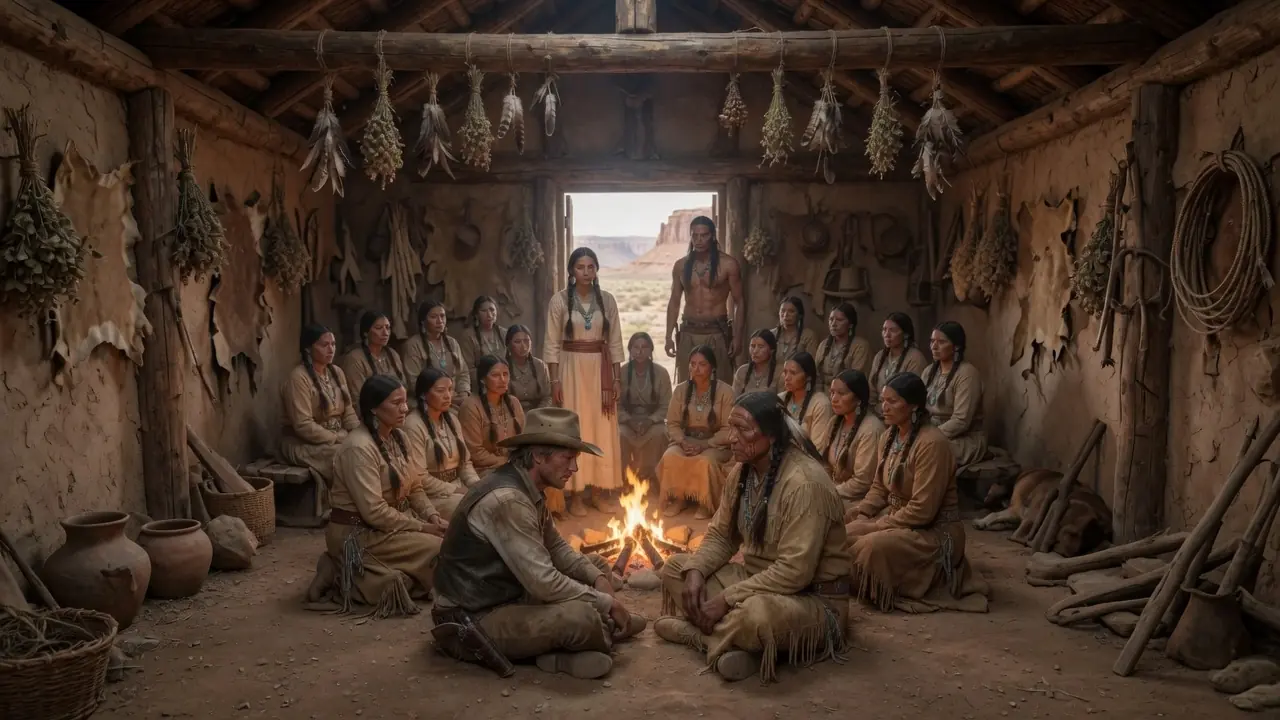
Wade followed him to the largest lodge in the camp.
It stood higher than the others, marked with painted symbols Wade did not understand but could feel the weight of. Two warriors stood at the entrance. Their faces were serious, but not hostile.
Inside, the air was thick with burning herbs.
Nakai sat on finely worked hides, surrounded by elders. Tavo stood off to one side, arms crossed, face unreadable.
“Sit, my friend,” Nakai said.
Wade sat.
The room grew still.
Something was coming.
Nakai studied him for a long moment.
“You saved my people,” he said at last. “Children who will now grow. Elders who will see another moon. Women who will sing again. Warriors who will still guard us. This is not small.”
Wade shifted, uncomfortable.
“Anyone would have done the same.”
One elder, old and sharp-eyed, leaned forward.
“No. Many would have ridden away. Some would have waited for payment. Some would have watched us die and called it fate.”
Nakai nodded.
“You gave your last water to a child. You drank after everyone else. In our way, a life debt is sacred. It cannot remain unpaid.”
The room tightened.
“The honor of my people demands that we offer you something equal to what you gave.”
Nakai lifted one hand.
The lodge curtain parted.
Women entered one by one.
Young.
Dressed in their finest.
Hair braided.
Jewelry bright against sun-warmed skin.
They formed a line before Wade.
He counted without meaning to.
Twenty.
His heartbeat picked up.
“These are the unmarried women of our people,” Nakai said solemnly. “Daughters. Nieces. Blood of the Painted Mesa. Each has agreed to this honor.”
Wade felt the air go out of him.
Nakai looked directly into his eyes.
“I offer them to you as wives. They will build your home. They will bear strong children. They will join their lives to yours. They are yours, if you accept.”
Silence slammed into the lodge.
Wade looked at the women.
Some looked at him with curiosity.
Others lowered their eyes.
A few smiled faintly, uncertainly, as if trying to be brave because they had been told bravery was required of them.
But one woman held his gaze.
She stood taller than most, with calm shoulders and eyes sharp enough to cut through any lie. A turquoise pendant rested at her throat. Her face held no smile, no fear, only a steady intelligence that made Wade feel she was weighing him as much as he was weighing the room.
Nakai noticed.
“This is my daughter,” he said. “Alaia. Most precious to my heart.”
His voice grew heavier.
“She is yours also, if you choose.”
The lodge seemed to close around Wade.
How did a man refuse such a gift without dishonoring everyone in the room?
But how did he accept it?
Twenty wives.
Not just impossible.
Wrong.
Then Wade saw Tavo.
The young warrior stood rigid, fists clenched so tightly his knuckles had gone pale.
But he was not looking at Wade.
He was looking at Alaia.
And in his eyes there was no mistaking it.
Love.
Pain.
Fear.
It struck Wade all at once.
Tavo loved her.
Not suddenly.
Not lightly.
This was the kind of love that had grown over years, through childhood, training, ceremony, glances, and promises no outsider had heard.
And now honor demanded she be handed to a stranger.
The tension in the lodge thickened.
Some elders watched Wade with approval, expecting gratitude.
Others studied him closely, waiting to see what kind of man he really was.
The women remained silent.
But their eyes spoke.
Hope.
Fear.
Resignation.
Alaia’s eyes said something else.
Please see me.
Not as a gift.
As a person.
Wade took a slow breath.
“This honor,” he said carefully, “means more than I can say.”
Nakai nodded once, expecting acceptance.
“But I have to speak honestly.”
The elders shifted.
Wade continued.
“Where I come from, a man takes one wife. And even then, only when both hearts choose it. A marriage built from debt is not marriage. It is another kind of chain.”
A ripple moved through the lodge.
One elder frowned.
“You refuse our daughters?”
“No,” Wade said quickly. “I refuse to dishonor them by taking what their hearts have not freely given.”
The room went still.
Alaia’s face changed.
Just slightly.
Tavo looked at Wade as if he had heard thunder from clear sky.
Nakai’s expression became unreadable.
“You reject our greatest gift,” he said.
“I ask for time,” Wade replied. “Until sunrise.”
Low voices filled the lodge.
Nakai listened.
Then he nodded.
“Until sunrise. But hear me, Wade Callahan. A life debt must be paid. If you do not accept our women, you must offer another way. Honor demands it.”
The women were dismissed.
They filed out quietly.
Alaia was the last to leave.
At the entrance, she turned and looked directly at Wade.
Her lips moved.
No sound reached him, but he understood.
Please.
Then she was gone.
Wade stepped into the night with his mind spinning.
Before he could take three steps, Tavo was there.
He grabbed Wade’s arm hard enough to hurt.
“If you take her,” Tavo said in sharp English, “if you touch even one hair on her head, I will kill you.”
Wade did not pull away.
“I’m not taking her.”
Tavo froze.
“But we need to talk,” Wade said. “You and me. Now.”
They walked to the edge of the camp, where firelight barely reached and the desert opened under a black sky full of stars.
For a long while, neither spoke.
Then Wade said, “Your English is better than you let on.”
Tavo let out a dry breath.
“Mission school,” he said bitterly. “Before they pushed us from our land, they taught me your language. Your books. Your prayers.”
He looked toward the camp.
“They thought words could make me forget who I am.”
He sat on a flat rock.
“They failed.”
Wade sat across from him, leaving space between them.
Close enough to speak.
Far enough to respect danger.
Tavo’s gaze stayed on the glow of Nakai’s lodge.
“Alaia and I were promised as children,” he said quietly. “She was nine. I was eleven. Our families made the bond.”
His jaw tightened.
“We waited. We trained. We dreamed. All these years, I thought my path was clear.”
Wade studied him.
“She loves you?”
Tavo did not hesitate.
“With every breath.”
His voice softened.
“And I love her the same.”
Silence settled between them.
“But Nakai,” Tavo continued, “his honor stands above his heart. If he gives his word before the elders, I cannot challenge him without shaming my blood.”
Wade looked at the stars.
“No man should have to choose between love and honor.”
Tavo’s eyes cut toward him.
“And yet we do.”
“I won’t take her,” Wade said firmly. “Not her. Not any of them.”
Tavo searched his face.
“You swear?”
“I swear.”
Hope flashed across Tavo’s expression, so quick it almost vanished before it arrived.
“But there’s a problem,” Wade said. “Your uncle says the life debt has to be paid. If I refuse the women, I need another way.”
Tavo nodded slowly.
“There is another way.”
“What way?”
“Trials,” Tavo said. “In our old law, if a man refuses a gift of honor, he may prove himself through trials. If he passes, he earns the right to offer his own payment.”
“What kind of trials?”
“Skill. Patience. Strength.”
“And if I fail?”
Tavo did not answer.
He did not have to.
Wade gave a small nod.
“And you would help me?”
Tavo looked away.
“Three days ago, I wanted you dead.”
“I noticed.”
“But I saw what you did,” Tavo said. “You gave your last water to a child. When the spring opened, you drank last. You could have claimed glory. Instead, you sat on a rock and let my people live before you spoke.”
He paused.
“Those are not the acts of a bad man.”
Another silence.
“And if you help me keep Alaia, I will owe you my life.”
Wade held out his hand.
“Then let’s keep her free.”
Tavo looked at the hand for a long second.
Then took it.
At sunrise, Wade stood before the council.
Nakai and the elders sat in a wide circle. The women were present too, seated together behind the elders. Alaia sat among them with her head lowered, but Wade saw her hands clasped tightly in her lap.
Tavo stood near his uncle, face still as stone.
Wade stepped forward.
“I have made my decision,” he said. “With respect, I cannot accept your women as wives.”
A murmur ran through the gathering.
“Not because they are unworthy,” Wade continued. “Any one of them would honor any man. But a woman is not a coin to settle debt, and a heart cannot be given by another person’s hand.”
The murmurs grew louder.
One elder rose, anger in his eyes.
“You insult our daughters.”
“No,” Wade said. “I ask not to insult them.”
He lifted his chin.
“I ask for the old right. Let me face the trials. If I pass, I will offer another way to repay the debt.”
Nakai leaned forward.
“You know this law?”
“Tavo told me.”
Several faces turned toward Tavo.
He gave one nod.
Something passed between him and Nakai. Silent. Heavy. Not approval exactly, but acknowledgment.
Nakai looked back at Wade.
“Very well. You will face three trials.”
He raised his hand.
“First, the ride. You will race to the twin red pillars and return. Second, the spirit deer. You will find the white stag of the hidden valley and mark it without harm. Third, endurance. You will stand against our strongest warrior.”
Wade took a breath.
“Who is your strongest warrior?”
Tavo stepped forward.
“I am.”
There was challenge in his eyes.
Also a trace of amusement.
Wade nodded.
“I accept.”
The first trial began at noon.
The entire camp gathered in a wide line. Far beyond the spring stood two red stone pillars rising from the earth like sentinels. Between the camp and those rocks lay loose sand, sharp stone, cactus fields, and stretches of ground that could break a horse’s leg if ridden carelessly.
Tavo would ride against him.
His horse, Smoke, was a powerful pinto, younger and faster than Juniper.
Wade knew it at a glance.
Nakai stepped forward.
“Ride around both pillars and return. First across this line wins. No other rules.”
Wade mounted Juniper.
Tavo mounted Smoke.
“May your horse be wiser than you,” Tavo said.
Wade almost smiled.
“She usually is.”
Nakai raised his arm.
Silence fell.
Then his arm dropped.
Both horses exploded forward.
Smoke surged ahead immediately, sand flying behind him. Juniper stretched into her run, strong but not as quick.
Wade did not chase too hard.
He knew his mare.
She was older, but steady. She could read bad ground better than most men. This was not just speed. This was survival.
They crossed the open stretch with Tavo three lengths ahead.
Then came the rocks.
Everything changed.
Speed mattered less here. Balance mattered. Trust mattered. Experience mattered.
Wade leaned low and let Juniper find her path. She moved between stones with smooth, careful power. Smoke had to slow more than once, hooves slipping near loose shale.
By the time they reached the twin pillars, they were nearly even.
They circled the stones side by side and turned back toward camp.
Both horses were breathing hard now.
This was where Tavo pushed.
Smoke surged forward again.
Then Wade saw it.
A small hitch in Smoke’s stride.
One step wrong among the rocks.
Not broken.
But strained.
Wade could win.
All he had to do was urge Juniper forward and leave Tavo behind.
But then he remembered why he was here.
This was not about defeating Tavo.
It was about proving what kind of man he was.
Wade eased back.
He kept Juniper beside Smoke instead of pulling ahead.
Tavo glanced over, confused.
“What are you doing?”
“Your horse is hurt.”
“Not badly.”
“Bad enough.”
“Then win,” Tavo shouted.
Wade shook his head.
“I don’t need to beat a hurt horse to prove I can ride.”
They crossed the finish line together.
A perfect tie.
The camp erupted in confused voices.
Nakai rose, watching both riders dismount.
Tavo crouched beside Smoke, confirming the injury.
One elder frowned.
“A tie complicates the trial.”
“No,” Tavo said.
Every eye turned to him.
“Wade won.”
Silence fell.
Tavo stood.
“He saw my horse was hurt and chose not to take advantage. That is greater than speed. That is honor.”
Nakai studied Wade for a long moment.
Then nodded.
“The first trial is complete.”
That night, Wade lay beneath the open sky, staring at stars so sharp they seemed close enough to cut his fingers.
He was nearly asleep when soft footsteps approached.
Alaia stood nearby, wrapped in a woven blanket. In her hands was a steaming bowl.
“I brought food,” she said.
Her English was careful but clear.
“You will need strength tomorrow.”
Wade sat up and accepted it.
The stew was simple: dried meat, desert herbs, and something sweet from cactus fruit. It tasted better than anything he had eaten in weeks.
“Thank you,” he said.
Alaia sat a short distance away.
“Tavo taught you English?” Wade asked.
She smiled faintly.
“He taught me many things. Words. Tracking. How to throw a knife when my father was not watching.”
Wade laughed softly.
“He seems like a careful teacher.”
“He is not careful,” she said. “He is patient.”
They sat in silence for a moment.
Then Alaia looked at him.
“Why are you doing this?”
“Doing what?”
“Risking your life for people who were strangers days ago.”
Wade stared into the fire.
“Because I’ve seen too many men do wrong and call it tradition, law, business, or survival.”
He looked at her.
“I don’t want to be one of them.”
Alaia’s eyes shimmered.
“My father is good,” she said. “But honor blinds him. He thinks giving me is gratitude. He does not see that love cannot be handed from one man to another.”
“He’ll see.”
“You believe that?”
“I have to.”
She studied him.
“And your payment? What will you ask for if you survive?”
Wade gave a small smile.
“You’ll know when your father does.”
Dawn came gold and violet across the desert.
The second trial waited.
The white stag of the hidden valley.
Tavo had given Wade quiet guidance before sunrise.
“The stag is not hunted,” he said. “It is found. If you chase it, it vanishes. If you fear it, it knows. If you mean harm, it will never come near.”
Wade rode out alone with a canteen, a strip of red cloth, and one rule.
He could not harm the animal.
Hours passed.
He searched the valley, reading tracks, bent grass, droppings, rubbed bark, and hoof marks near stone. There were signs everywhere, but each trail seemed to vanish into nothing.
The sun climbed.
Heat settled.
Wade stopped thinking like a hunter and started thinking like the land.
Animals lived by rhythm.
Water at dawn.
Shade at noon.
Feeding at dusk.
At midday, the stag would not be wandering in the open.
It would be hidden.
He searched for the coolest shade in the valley and found a narrow canyon where high walls blocked the sun and a thin stream cut through stone.
He dismounted and waited.
Time crawled.
Then it appeared.
Silent as breath.
White as moonlight.
The stag stepped from shadow into the canyon, its coat pale as bone, its antlers rising like polished branches. Its eyes were dark, aware, and ancient-looking in the way wild things sometimes seem older than the world around them.
Wade did not move.
The stag lowered its head to drink.
Then lifted it suddenly.
It knew he was there.
Wade did not reach.
Did not rush.
He began to speak in a low, steady voice. The words did not matter. The tone did.
Calm.
No threat.
No hunger.
He drew out the red cloth and let it flutter lightly in the breeze.
The stag watched.
Wade moved closer one slow step at a time.
The animal could have fled at any breath.
It did not.
Closer.
Closer.
When he was near enough, Wade held out the cloth.
The stag leaned forward, nostrils flaring.
Then, impossibly, it lowered its head.
Wade’s hands trembled as he tied the cloth gently around one antler.
For one heartbeat, his fingers touched living warmth.
Then the stag leaped backward and vanished into white sunlight and stone shadow like a spirit returning to the unseen world.
When Wade returned that afternoon, doubt waited in every face.
Until the dust scouts came running.
They had seen the stag.
White as moonlight.
Red cloth tied to its antler.
The camp erupted.
Some called it a blessing.
Some called it a sign.
Nakai said nothing for a long while.
Then he stood.
“Two trials are complete. Tomorrow, the last.”
The final day rose heavy and windless.
The camp formed a wide circle in the sand. The rules were simple and brutal.
No weapons.
No stopping.
No help.
Wade and Tavo would fight until one man could no longer stand or chose to yield.
This was not meant to be a brawl, though blows were allowed. It was strength. Endurance. Control.
Wade and Tavo stepped into the circle, both stripped to the waist, bodies marked by scars and hard lives.
Tavo leaned close.
“Do not hold back,” he murmured. “If this is to work, it must be real.”
Wade nodded.
“It will be.”
Nakai raised his hand.
Dropped it.
Tavo moved first.
Fast.
Precise.
A predator closing distance.
Wade blocked the first strike, missed the second, and took a hard blow to the ribs that drove the air from his lungs.
They locked together, boots digging into the sand. Tavo was stronger than he looked, and Wade was heavier than Tavo expected. They twisted, broke apart, came together again.
The fight dragged under the burning sun.
Minutes became an hour.
Sweat poured.
Breathing turned harsh.
Every muscle screamed.
Neither man yielded.
The crowd watched in silence.
Trials did not usually last this long.
These two were evenly matched not just in strength, but in will.
Finally, after nearly two hours, both men dropped to their knees at the same time.
Spent.
Bleeding from small cuts.
Covered in sand.
Tavo looked up.
Then extended his hand.
Wade took it.
They pulled each other to their feet.
Nakai stood.
“Draw,” he declared.
For the first time in days, the chief smiled.
“You have proven your worth beyond doubt, Wade Callahan. You have earned the right to speak.”
Wade, still catching his breath, turned toward him.
“My answer is this,” he said. “I do not want wives.”
A ripple moved through the camp.
“I want something better.”
He paused, letting the words settle.
“I want to build a trading post here by the spring. A place where your people can trade what they choose with the outside world, not as beggars, not as prisoners, but as partners.”
The elders listened closely now.
Wade continued.
“I can bring tools. Seed. Salt. Cloth. Ammunition. Medicine when I can get it. I know men in Tucson who will deal fair if I stand between them and you until trust is built.”
Nakai’s expression shifted.
Wade took one more breath.
“And I ask that Alaia be free to choose who she marries.”
The camp erupted into voices.
Nakai turned slowly toward his daughter.
Alaia stood with her head lowered, but her hand was clasped tightly in Tavo’s.
The whole camp saw it.
The chief closed his eyes.
For a moment, he looked older than he had when Wade first found him dying in the desert.
Then he opened them.
“My honor wished to pay a debt,” Nakai said. “But my daughter’s heart is not mine to spend.”
Alaia’s breath caught.
Tavo’s face changed.
Nakai looked at Wade.
“Your offer is accepted.”
The sound that followed was not quite cheering at first.
It was surprise.
Relief.
Then joy.
Women embraced. Children jumped. Elders nodded. Warriors struck their hands against their chests.
Alaia ran to her father and knelt before him. He placed both hands on her head, then lifted her and pressed his forehead to hers.
Tavo stood still, as if afraid to believe it.
Then Nakai turned to him.
“You have guarded her heart longer than I knew,” he said.
Tavo bowed his head.
“I tried to honor you.”
Nakai placed one hand on his shoulder.
“Now honor her.”
That evening, the camp gathered around the spring.
No one spoke of brides given as payment again.
Instead, they spoke of the trading post.
Where it would stand.
What it would need.
How it could protect the spring without revealing too much to men who would come only to take.
Wade listened, offering what he knew and staying silent when he did not.
That, more than anything, seemed to please the elders.
Alaia and Tavo sat together near the fire, not touching much, but close enough that everyone understood the space between them had changed.
Nakai came to sit beside Wade.
“You refused power,” the chief said.
Wade looked at him.
“Power over people isn’t much worth having.”
Nakai studied the fire.
“I thought honor demanded I give what was precious.”
“It did,” Wade said. “But maybe what was precious was not yours to give.”
The chief smiled faintly.
“You speak boldly for a man who nearly lost all three trials.”
Wade laughed.
“I passed, didn’t I?”
“You survived,” Nakai said. “Sometimes that is the truer word.”
Weeks passed.
Then months.
The trading post rose slowly near the spring, built from timber hauled by wagon, stone cut from the canyon, and labor shared by everyone who would depend on it.
Wade named it Hawk Spring Station.
Nakai insisted the name be spoken also in the language of the Painted Mesa people, and the two names were carved side by side above the door.
A place between worlds.
That was what it became.
Not perfect.
Nothing built by people ever is.
Arguments came. Traders tried to cheat. Soldiers asked too many questions. Miners heard rumors of water and rode too close. Wade stood in doorways often, one hand near his revolver, reminding men that fair trade was the only kind allowed at Hawk Spring.
Tavo became the station’s strongest guard and best negotiator, mostly because men underestimated him until he spoke English better than they did.
Alaia managed the records.
She learned numbers faster than Wade had ever seen anyone learn anything. Within a year, she could spot a crooked weight, a false tally, or a nervous liar before Wade had finished pouring coffee.
She and Tavo married at the first spring moon.
Wade stood with Nakai during the ceremony.
At one point, the chief leaned close and said, “If you had accepted my first offer, this would have been a sad day.”
Wade glanced at the firelight on Alaia’s face.
“Yes,” he said. “It would have.”
Nakai nodded.
“Then your refusal was also a gift.”
Years later, travelers would speak of Hawk Spring Station as a strange place in the desert where an old cowboy, a fierce warrior, a wise woman, and a chief rebuilt a future around hidden water.
Some stories claimed Wade Callahan had found the spring by magic.
Others said the Painted Mesa spirits led him.
A few drunken men in distant saloons insisted he had been offered twenty beautiful wives and was fool enough to refuse them.
Wade never corrected every version.
Stories had their own thirst, and men filled them with whatever they needed.
But when children at the station asked what really happened, Wade told it plain.
A horse stopped.
A people were dying.
A man remembered an old story.
Water was found.
A debt was owed.
Love nearly became the price.
And then everyone learned that honor without choice is only pride wearing sacred clothes.
One evening, many years after that first desperate march, Wade sat outside Hawk Spring Station beneath a sky full of stars.
Juniper was long gone by then, buried beneath a mesquite tree west of the spring. Dust had settled into the lines of Wade’s face. His gun hand had slowed. His beard had gone white.
Nearby, Tavo and Alaia watched their children chase fireflies near the water.
Nakai, older now but still sharp-eyed, sat beside Wade and listened to the night.
“You could have ridden away,” the chief said.
Wade smiled faintly.
“So could you.”
Nakai gave a low laugh.
“Perhaps we are both fools.”
“Maybe,” Wade said.
The spring whispered in the dark.
Alive.
Steady.
Giving.
Nakai looked at the trading post, at the children, at the fires, at the people sleeping safely where they had once nearly died.
“No,” he said after a while. “Not fools.”
Wade followed his gaze.
The desert had not become kind.
The West had not become fair.
Men still lied. Soldiers still marched. Traders still cheated when they thought no one watched.
But here, in this one place, something different had been carved out of sand, thirst, stubbornness, and choice.
Wade leaned back and looked at the stars.
He thought of Silas Bell telling wild stories by firelight.
He thought of a stone hawk pointing east.
He thought of a baby crying again after death had almost taken him.
He thought of twenty women standing silently in a lodge, waiting to learn whether gratitude would become a cage.
And he thought of Alaia’s silent plea.
Please.
That had been the real trial.
Not the race.
Not the stag.
Not the fight.
The real trial had been whether a man could be offered power and choose freedom instead.
Wade closed his eyes and listened to the spring.
For the first time in a long time, the desert did not sound empty.
It sounded like life.